Gilbert Clark
CEO at MERIDIAN MINING PLC
Replay available
Investor Presentation hosted by Meridian Mining (TSX:MNO) on Investor Meet Company, held 2026-06-02.
On 6ix: 6ix.com/event/meridian-mining-plc-mno-investor-presentation
Automated transcript · Written by software from the replay's audio. It can mishear names and figures; the replay is the record.
0:00 Good afternoon, and welcome to the Meridian Mining PLC Investor Presentation. Throughout this recorded presentation, investors will be in listen only mode. Questions are encouraged and could be submitted at any time by the Q and A tab situated on the right hand corner of your screen. Simply type in your questions and press send. The company may not be in a position to answer every question it receives during the meeting itself. However, the company can review all questions submitted today and publish responses where it's appropriate to do so. Before we begin, I'd like to submit the following poll. I'd now like to hand you over to Gilbert Clark, CEO. Good afternoon, sir. Thank you. Hello. My name is Gilbert Clark. I'm the CEO of Meridian Mining PLC. We are a British company developing Capasao cop copper gold VMS belt in but across the South South America and Brazil. With me today is James Mick Lucas, SVP of corporate development.
0:52 We've recently dual listed our com the company on TSX and now the London Stock Exchange. What we've hoped to bring to the London market is exposure to what we consider to be the preeminent copper gold VMS development story for South America. I'll go through the presentations. Please, if have any questions, just type them in. We just go through the standard forward looking statements. This presentation can be downloaded from our website. We are Marine has a long experience in operating in Brazil. Formally, we operated a small manganese mines in Rondonia, which is the neighboring state. In 2020, we restructured the company, went out for a new project, and we identified the Captisol belt as being a preeminent opportunity for the company.
1:43 From this, we looked at what we could do about Captisol. How could we grow Captisol? In the time since then, we've published a PEA within the PFS, and now we're well advanced on the DFS. We established Cabocell, the mine, to have some of the preeminent mining economics that's seen in the generation. We've been advancing our project towards FID. We've actually started ordering the long line long lead items. In q four of last year, we had a major event for us where we got the preliminary license granted by, the state of Mato Grosso. And premium license is very important. It's your most important and intensive license to, apply for. It essentially establishes your environmental credentials, your social credentials, the justification of economics and technical merits of the project, and we were very lucky to be able to do this.
2:39 With just under a 100,000,000 USD on the balance sheet, we're very well financed. We found Brazil. My background's in private equity. I've traveled the world. It's one of the best jurisdictions where we are in Mato Grosso, in Brazil for mining. But Meridian is just not one deposit. We have the preeminent exploration portfolio for South America for copper gold VMS host deposits. We're very fortunate in this, and this is really a company making opportunity that we focus on to bring this as the next near term producer and mining big tea company on the London Stock Exchange. We've seen in recent time tremendous growth in the middle prices. I think we're $44,600 $4,600 for gold today, it's over $6 a pound for copper.
3:31 All mining projects, real mining projects are based on very conservative metrics because it's a risk business. You have to manage risks. So for our PFS that we published in March of last year, we used twenty one nineteen for gold and four sixteen for copper that generated post tax NPV five of $9.84 US dollars. The internal rate of return is very high, 61.2%. The all in sustaining costs are remarkably in line with what you expect for the low low OpEx environment in Brazil of 742 US dollars per ounce of gold equivalent. The CapEx, again, we're not the cheapest. We're not the most expensive. We're right in the middle of the fairway for CapEx, and this is very replicates the opportunity that Brazil is for mining.
4:17 On that base case scenario, we pay back the CapEx in under seventeen months. Now if we look at today's spot price or long term consensus, we're gonna see even a quicker repayment in what we're looking at today. We have a mid tier production profile of over a 141,000 ounces of gold equivalent. And the base case is approximately for 51% gold, 1% silver, and 48% copper. A couple of key metrics here. The NPV to CapEx ratio, nearly four to one. Life of mine free cash flow using those base case economics is 1,400,000,000 US dollars, and we have a initial mine life of ten point six years. This is very fortunate for us because this actually gives that stand alone economic prosperity to then go ahead and and explore and develop the Greater Belt.
5:12 We have exceptional cash flow metrics. Now you can notice in year four that it jumps up. We actually permitted to build a four and a half million ton mill. What we're gonna do is build a two and a half million ton mill, make our operational activity, fluid, safe, and optimal, and then we're gonna expand up to four and a half million tons. This is a a low risk strategy, but it ensures for what what we consider to be long term success. It is a large deposit. As for United States geological services, it's actually considered a giant sized VMS deposit. Pit itself is over two kilometers long. It's half a kilometer wide.
5:57 It almost goes down to 200 meters. It's mineralized at surface. It has two types of mineralization in one. One is the VMS system, which is across the belt. And then subsequent a period after the VMS was in place, there's been a later event, which is in place high grade gold veins, vertically transecting the VMS layers. Now these high grade gold layers can manifest themselves as in c d 49. We hit 26 meters at $21.9 21.5 grams gold and point 2% copper. As we go towards the southeast of the deposit, the copper actually increases and hit one of the feeder zones with hold c d two forty where we hit 12 meters at four grams gold and over 9% copper.
6:45 As I said, we have with the CapEx that we're envisaging, we're building platform of volume to go to four and a half million tons. So in year four, with an additional 59,000,000 in CapEx, we then take the expansion up to four and a half million tons. We have already started to look at this as how do we derisk, how do we debottleneck the rollout within the DFS, and that's very key for us. On the reserve statement, in the last couple of years leading up to our IPO, we actually did a lot of counter cycle investment. A lot of people are going out there trying to explore, speculate. We focused on building hard assets. And so today, we have actually a reserve statement for Cabocell. 89% of that is in the proven category, 41,700,000 tonnes of point six three grams per tonne gold, 1.64 grams per tonne silver, point 44% copper. Now one thing about Cabosal that was previously in production back in the nineteen eighties is we knew what the flow sheet was, and it was exceptional. Meridian with Cabosal has the peer of, metallurgical recoveries for VMS deposits. It's a very simple flow sheet.
8:02 For the PFS, we use a 200 micron grind, incredibly high grade re result from that was we produce a copper construct between 20 to 30% copper. The overall recovery is very high. We produce two type of products with three through the flow sheet, we take out approximately 30% of the gold through gravity. We produce gold dory that'll be playing off-site, And then we have the copper, gold, and silver concentrates. We've specifically designed the plant to have a non acid generating environmental impact. We have dry stack tailings. In the world today, a lot of people are talking about copper and the growth of copper and the and the deficit of supply. We will never produce the world's largest volume of copper concentrates.
8:49 What we do produce is one of the best blending copper concentrates coming onto the market that will go for over the next decade, and that's why we've attracted such interest by all the smelting groups, the trading houses. What can tell you about Mato Grosso where we're located? It is a very wealthy state. It's in dominated by agricultural. It has many, many mines operating. It has a lot of power generation. Within a 100 kilometers. We've got over 10 hydroelectric dams of of the the mine, should say, which is giving us very low cost, a very stable grid at a cost of about 5.4¢ per kilowatt. I guess that'd be somewhere comparable to say British Columbia or Quebec for low cost electrical power.
9:39 And this is one of the reasons why our OpEx is so low. From that historical mining operation, we have power easements to site. We have concrete bridges to site. We have all all with the roads to site. So we benefit from legacy infrastructure. To export our products, we'll be tracking them down to the port in Sao Paulo. As this entire state of Mato Grosso is set up for logistics to very low value agricultural commodities to the coast, we benefit from that. So from mine gate to port, including, port charges, it's approximately a 159 US dollars per ton delivered. Again, this reflects the overall low cost operating environment of Brazil. We've always been focused on production, and we're we're very much on that next phase of preproduction, preconstruction, then leading production. And to do that, we have to complete the DFS, which we'll be filing in q four of this year.
10:40 But as we've built up the the historical and then to the first compliant resource and the pre feasibility resource, in January of this year, we actually permitted sorry, permitted, reported the definitive feasibility stage resource upgrade. Now that was over, 20,000,000 tons more ore in the ground. That gave us a 39% increase in gold content. There's a 19.3% increase in silver and a 14.2% increase in copper. That benefited from a more aggressive flow sheet. We're using more aggressive reagents to collect the metals. Importantly, on valuation side of things, is this contained this increased resource is within the same permitted pit outline that we used in the PFS, which then, the PFS resources on 50,000,000 tons have generated a 41,000,000 ton reserve.
11:36 So we're very confident that this new resource within the same pit would generate an increased reserve statement. So last year, we got the Pilbara license granted. We've actually submitted the installation license. We're giving guidance of sort of nine to twelve months for that. We could be granted that a lot sooner because there's a change in legislation. But we've always been conservative in our forecast so we can actually achieve those and sometimes in advance. Once we've got the DFS completed, once we've got the installation license granted, you then build the mine in Brazil. You prestrip, you construct, and then you go to your authorities and you say, we'd like to apply for our operational license. Essentially, then they come and look at the look at the mine and look at what you've built.
12:23 They said, yes. You've built what you said you're gonna build. Here's your operational license. You can now turn it on. And that's just something very mechanics getting into production in Brazil. But very much this last period, we've been focusing on optimizing the DFS. So we've increased the recoveries. So not only in that resource statement that we use slightly higher commodity prices, but we've also used higher and more efficient metallurgical recoveries. So that's one of the reasons why we saw that significant jump in the resource statement. The site optimization has been is mainly just trucking distances and the impact to ensure that we have an operation that is efficient from day one. And that historical infrastructure we're going through now, we're surveying that again. We're check whether we have to upgrade that or build build better bridges or better roads. But, greatly, we don't have to get that permitted that is there.
13:20 So for this year, there's gonna be a number of quite positive press releases coming out. Of course, the feasibility study is one of the key ones. We have actually with the feasibility studies reporting, we'll go straight into detail engineering. For the engineers out there, we included into the DFS scope of works that the basic engineering had to be completed within the feasibility study. That's one of the reasons why things like the SAG mill, the transformers have been able to be ordered and specified way in advance. Project finance, we've been very focused on how we've been doing this. We David, our CFO, joined us in March of last year. So we have always anticipated and prepared our finance so that is it's completed but completed in the best interest of our shareholders.
14:09 Installation license, as I said, give twelve months guidance, but we're quite confident that they'll be granted in time. The ordering of long lead items has commenced. We'll be con this dry season will be commencing the infrastructure works so so that we can go into q one next year and and start the construction, or should say q two. But what we've done clearly, and we've communicated this to the pro to potential project finance groups, is we have one of the, I guess, the best exploration portfolio in South America for VMS hosted copper and gold and silver. We will not be stopping our exploration during the construction phase. That is a key criteria accepting it. So that is ongoing as we at this very moment, and we'll continue all the way through to for, I guess, many, many years to come.
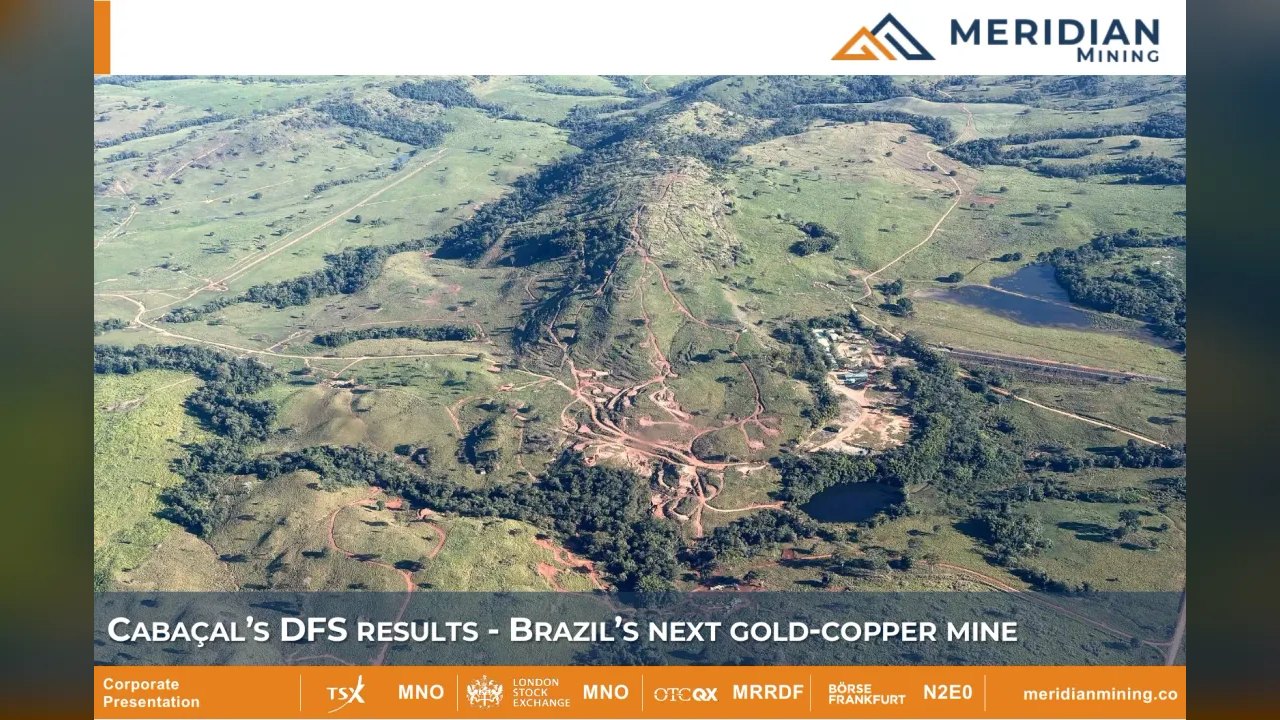
14:58 This is this photo here gives you a bit of an idea. We're not dealing with the Amazon jungle here. This is pastoral land. We call this the mine corridor. It's between the two mines, the Cabasal Mine and Saint Helena. Again, this is a small underground operation. Within that, you've got to keep Chiquito, Sukuri, Sagara. So what we have here is a lot of companies said we're in Canada or Australia. There'd probably be 10 or 15 companies with a piece of this belt. We effectively, very specifically, went about quietly accruing all of the what we could find to be the spare ground, and that's very important that this upside that we've identified and got permitted. We've done that through equity for through equity raises. So that means there's no financial instrument. There's no royalty, no third party royalty, no third party stream between the project and the shareholders. So all benefit, all financial benefit from the future mine will go to our shareholders.
16:01 Santolina, very, very exciting. We've it's a Santolina Central is a part of a longer system. Recently, it's a higher grade system. It's an, again, open pit. We're currently infilling and expanding that. Recently, we announced that we've identified that the gold overprint is present down in the Santa Elena areas, which is very important, specifically for one of our new projects that's popped up called the Aqua P Group, which is the overlying younger geology above the VMS Belt. Now to the west of us, there's a mining complex called EPP where they've extracted over 400,000 ounces of gold from this aqua p group. And what we've done there is we've identified that it is. This is very important. It's not only do we have the exposure, the exploration potential from the VMS bill, we now have the exploration for gold potential on the underlying sediments.
16:55 And combined of this, that's when we went down the process and the review to permit Saint Helena is we permitted as a second processing hub. So at the moment, we have permitted for four and a half million tons. We have the eventual positive decision to granting Santa Valena. It actually takes us up to over 5,700,000 tonnes of potential mine throughput, and that's a significant amount of mining processing capacity. As a one bit of history here, back in the nineteen eighties, this was entire area was under one ten men through a company called BP Minerals. Of course, that was the mineral division of BP. They sold it to a company called RTZ who actually then became Rio Tinto.
17:46 Their focus at the time was gold. This is back in the nineteen eighties. It's fine gold. So they found the Cabosal deposit, which was a gold rich deposit. There were other gold and copper anomalies, specifically some were quite significant like at Jowru. We've got over seven kilometers of copper anomaly to go and test and explore upon. But at the end of this first phase of exploration that ended in 1989, they essentially shut everything down for corporate reason, and it's just sat there ever since we actually acquired the project in November 2020. So this presents this tremendous opportunity. We have gone through and secured by tenement the the portfolio of South America, and this is the growth that we wanna bring to our equities. This is the growth we want to bring to the London Stock Exchange.
18:34 Not only do we have one Greenstone Belt, we've got Greenstone three three greenstone belts with a significant tenement tenement package covering the prospective ground. Just one thing to note, on the middle tenement out of Patonga, you'll see there's a lot less data there. We are actively still picking up ground there. We have the historical exploration. We just don't communicate that to potential other interested parties, but we are actively trying to increase our position along these two other belts. The Arapatunga and the Jaru Belt. Last twelve, eighteen months, we've seen sustained growth in our equities. One of the reasons when we came to London is we looked at last year's growth.
19:23 It was it was very robust, I think, from January through to December. We went from circa 35¢ up to over a dollar. But from my perspective, it was underperforming. We couldn't actually identify what was causing this underperformance. And now 300,400% growth is great, but I think it was a better valuation there. We looked at the Australian Stock Exchange, and they said we need to move your shares across to Australian custodians to get indexation, and that's when I realized what we're missing in our equities. So our reason we've never always been able to raise capital for our shareholders. And over at pre IPO in London, over 50% of our shareholders are actually London based. Today, we've now got probably close to probably 65% of our equities now London based.
20:13 And we're now, since our IPO, we will find out, I guess, tomorrow. But for the FTSE AllShare inclusion, we we are I I'm quite confident we've achieved the liquidity. You can see some of the names there. That's a suite of our, institutional investors. Our institutional register is one of the best in the junior market. Some of these group came in very, very early into our journey. And one of the reasons they came in early is that we projected a risk profile that was incredibly low for the value of equities. And we see tremendous growth through rewriting, through preconstruction, through construction sign off, and then into net free cash flow. That's the future we want to bring to to London. On the board of directors, we have a very broad experience.
20:59 Bruce McLeod, he recently was involved with the Skene, a subpoena construction in Canada. Adrian McCarthy is our present director. He works two month on, one month off on-site. He's PhD is in volcanic systems. He was actually ex WMC. John Skinner is a retired broker from Vancouver. Susie is a semi retired banker from Austria. Doug Ford is a head of the audit committee and senior independent director. Doug and I have sat on boards for over fifteen years. I brought him on for their independence and his knowledge of audit. Neil Gregson, Neil and I have known each other for ten years. He was as you know, he was on the JPMorgan natural resource desk. David is our CFO.
21:44 Again, known David for over a decade. Joel is our director of Brazil. He's been in the company since 2014. He's very experienced in operating in Brazil. James is on the call today. Catherine, our company secretary. She's just joined us last year as we saw the expansion in The United Kingdom. Martin McFarlane's ex MMG from Australia. He's a very experienced senior executive. He's head of strategy and projects. Victor Bellow is our mine builder. He's built and operated some of the largest gold mines in Brazil. He was the general manager of Kinrossos Paracatu. He's been involved in over nine mine builds and operate and expansions in Brazil. And he's built a team of over eight engineers today who are now sitting in the office of the Senco in Belo Horizonte overseeing each day that DFS program.
22:39 So production production, focus on production, getting the cash flow, expand the exploration through cash flow. We have very, very attractive economics. Post tax billion dollar valuation using $21.19 for gold and $4.16 for copper. If you just use the n the what we can actually report, it actually takes it over to 2,000,000,000 valuation. We have started the process of ordering long lead items. They some of these will take twelve, fourteen months, but they're being ordered now. The deposits have been paid. The premier license application, that appeal that came through, that was a key moment for us with derisking the project. Within that, just to take in context, we do not have any sensitive, first nations, rainforests, environmental concerns within the project's belt, and that's one of the reasons I've selected this project, could present it to me in low risk investment strategy.
23:38 Our balance sheet is very strong with nearly a 100,000,000 US dollars. That gets us past FID and 18 of the CapEx figure needed to bring it into production. We're focused on Brazil, but we've got over 50 kilometers of belt scale exploration with that first phase of high risk venture capital exploration has already been invested by BP back in the nineteen eighties, and we're now going through and targeting their projects. Yet even though we're using some of the historical data, even today, we are finding new deposits, new prospects on this bill. So I'd like to thank you for that. That was the presentation, the summary of the presentation. If you like, I can now take questions. That's great. Thank you very much for your presentation. Ladies and gentlemen, please do continue to submit your questions just by using the q and a tab situated on the top right hand corner of your screen. Just while the company take a few moments to review those questions submitted today, I'd like to remind you that recording of this presentation along with a copy of the slides and the published q and a can be accessed via investor dashboard.
24:40 As you can see, we have received number of questions throughout today's presentation. And if I may just start off with the first question here, which reads as follows. The recent Alamo discovery looks very encouraging alongside the ongoing high grade results from San Jose Helena. How material could this discovery become for the overall scale of the Cabocell Belt, And what are the main milestones we should be watching over for the next six to twelve months as you advance the project? Okay. The Alamo discovery was was very interesting for two reasons. One was the fact that we identified that there was structural gold, that later stage gold overprint, was present in the the Southeast of the belt. From Cabo Sal, we know that this can be incredibly high grade, but what we also know from Cabo Sal is it can be manifest itself into bulk tonnages.
25:27 We've seen zones of 20 meters going two grams gold in the Cabozol deposit, which is not related to the VNS. So it generated the opportunity to have bulk gold either associated or external to the Saint Helena central deposits. That was very interesting for us. Secondly, the equity unit, is mined as two types of deposits that we've identified in the EPP complex. One is an historical, what we call a paleo channel. The other is a structural element that's come up from the underlying units and perforated the aqua p. So that's giving us an exploration potential, a target to go after. It's not just for the the patio channel, but structural gold hosted within the aquapery, and we are following up on that now.
26:18 That's great. Just turning to the next question here. MERIDIAN can now be seen as having genuine district scale potential rather than just a single development asset. How are you thinking about balancing the advancement of Cabocell toward production while still investing in exploration opportunities that could further grow the overall resource base? That really comes down to preparing your your your management teams. So the Cabocell deposit has been drilled out. That's finished. That's moved across to the project team. Yeah. But the exploration team is still active. They've got their own budget. So this year, in 2025, we, I think, circled that 1,500,000 in exploration expenditure. This year, we're gonna do over 10,000,000 Canadian dollars in expenditure and still have a a very large balance at the end of the year. So what's important about that is that we don't we're not slowing down.
27:12 Now what we've also invested to in exploration is in geophysical tools. The reason being is the there are geophysical companies in Brazil, and they're quite good companies, but there's an import tax on new equipment of up to 60%. So we actually invested in some of the most modern geophysical equipment that any company has outside of the majors in Brazil, and that gives us the flexibility if we identify an anomaly to throw a full suite of exploration geophysical tools onto that project and advance it in a more quicker way, waiting rather than waiting in line with the the service companies to be available. We've got approximately today, I think we've got three three three drills on-site.
27:59 We just demobilized one team and expanding another team. That's great. Just moving on here. Following the recent financing, can you give shareholders a clearer sense of the key catalyst and value inflection points we should expect between now and potential construction decision? A key inflection point between now and construction decision would be first and foremost, would be the installation license. That's very key to us. Then I think you'd have to look at the results of the definitive feasibility study. Now taking the context that in the PFS, we use a resource base of 50,000,000 tons, which produced a reserve of 41,000,000 tons within the pit. Within that same pit, we've now expanded the resource to 70,000,000 tons. So I think that we have reflective increase in the reserve.
28:51 Now we are now gonna use, 3,106, I think it is, dollars for gold and $4.39 for copper, and we're gonna have higher recoveries. So my estimation is is that we'll also generate a high, NPV and IRR for the project, which is going to be quite key. So you're gonna see better economics, and that's what we hope to achieve. Then along the parallel of all this development at Cabo Sal was FID, exploration success, and we saw that recently with the, the discovery of gold. Perfect. Thank you. Given the growing market interest in gold copper projects globally, where do you believe MERIDIAN sits relative to other emerging development stories in terms of project quality, jurisdiction, and long term strategic appeal?
29:45 I think Cabas with Cabasar, Meridian is at the absolute top of the pops. It's we're at the top of the the the companies. A lot of so we had a porphyry. They cost billions to make, and effectively, the equity can never finance it. With a CapEx of 258,000,000, 20 sorry, 249,000,000, we're actually gonna be spending up nearly 20,000,000 CapEx this year. This is a company that we can very easily finance and build. Now then let's look at our product. We produce the best blending copper concentrate in the market today. It's it's without doubt, very high grade between 11 to 50 grams gold, four, five, six ounces of silver, copper up to 30%, sulfur 34 or above.
30:38 So this is what the smelters and the traders need to blend with poor quality, poor performing concentrates. There's been a lot of mention in the media recently and it didn't check the balance sheets of the smelters on the on the need for acid. Now we use acid for many, many things. Oxide copper, it's real growth has been related to the increased demand for lithium. To produce acid, you need to have twin concentrates. You need to you're gonna remove the fluorine, and that's what we have. We've got no fluorine in our concentrates, so you can use that with the dirty concentrates to produce not only the copper matte, but the acid. That's a key advantage that we have.
31:28 That's great. And the final question we've got here reads, what range of CapEx is the DFS indicating versus the $248 PFS estimate? And what would need to happen to pursue the expansion to 4.5 MPTA sooner rather sooner than planned? We don't we're not seeing any material changes in the CapEx. One thing that we're monitoring is the exchange rates. Okay? We use five we our guidance in the PFS and in the DFS came from the Central Bank of Brazil. They give us the the input number for the exchange rate. Currently, I think long term Brazil USD is about 5.4 to one. We use 5.9, so there's gonna be a trade off there. Sorry. What was the last question?
32:18 The question was what would need to happen to pursue the expansion to 4.5 MPTA sooner than that? The the we have to we look at the expansion. It's very key. If we were in production today, we were bringing Cabozol into production. We build a four and a half million ton mill straight away. Why? This has got nothing to do about the resource. It's all about safety and what I call logistics risk. So we don't anyone who thinks that they knew a first time company like ours building a mill can build a big four and a half ton four and a half million ton mill. In my experience, that generates tremendous risk. So what we're doing, this the the volume, the concrete, the steel, the cable, the instrumentation, the crushing, that's all preset at four and a half million tons throughput. We then add on the additional capacity for some 59,000,000.
33:17 That is very critical for us because you wanna know it's not just your logistics of mining diggers' trucks. It's also logistics of teaching people safety. It's also the logistics of taking people from the mine site to the community. So you wanna make sure that's fluid and established and safe, and then you take out your expansion. Because what you've got to ensure in that first twelve, fourteen months is that you meet your cash flow forecast to repay your debt. So you don't take risk with that construction front for project finance. You don't take assumptions on the community safety, you ensure that all that occurs because that's a low risk strategy and it's more important for the equities of our shareholders.
34:04 Perfect. We have just had another question come through. How far off is potential FTSE two fifty and FTSE All Share inclusion? I would say for the FTSE All Share inclusion, we've actually achieved that. That would we'll find out shortly. I on the two fifty, it's a bit we're just underneath the acceptance. So if we don't get it this time, we hope to get growth in the, September rebalance. But there is, I think, some tolerance, or acceptance that we may go into it. If not, we'll work get our valuation up, and then we'll be rebalanced in September. Yeah. Perhaps I can just add to that very quickly. Excuse me. It's a 350 on the list because automatic qualification, we are currently 333, so we are just under it. Somewhere in the one pound four would put us in right now. We're just under that number.
35:01 That's great. Thank you for answering all those questions you can from from investors. And, of course, the company can review all questions submitted today, and we'll publish those responses on the Investor Meet company platform. Just before redirecting investors to provide you with their feedback, which I know is particularly important to the company, Gilbert, could I please just ask you for a few closing comments? Okay. Meridian is bringing to the capital markets, both in Canada and London, a portfolio of assets and and growth assets that is being managed by a very experienced team, executed by Brazilians in Brazil. But that combination of land package, upside, and longevity, which is multi decade longevity, how I see it, that is something that has not been seen in the capital markets for a long, long time. And when you look at our economics, you can see that this is something special with tremendous growth opportunity for your investment. We're very very clear how we are stewards of your investment.
36:02 We're a thrifty company, but we're very much focused on returning in the near term, equity growth to our shareholders. That's great. Thank you for updating investors today. Can I please ask investors not to close the session as you'll now be automatically redirected to provide your feedback in order that the management team can better understand your views and expectations? This will only take a few moments to complete, and I'm sure will be greatly valued by the company. On behalf of the management team, we'd like to thank you for attending today's presentation, and good afternoon to you all.
Follow Meridian Mining PLC into a list and get an email when it puts out news.
CEO at MERIDIAN MINING PLC