Mark Payton
CEO at MERCIA ASSET MANAGEMENT PLC
Replay available
Preliminary Results hosted by Mercia Asset Management (LSE:MERC) on Investor Meet Company, held 2025-07-01.
On 6ix: 6ix.com/event/mercia-asset-management-plc-merc-preliminary-results
Automated transcript · Written by software from the replay's audio. It can mishear names and figures; the replay is the record.
0:00 Good afternoon, and welcome to the MERCIA ASSET MANAGEMENT PLC investor presentation. Throughout this recorded presentation, investors will be in listen only mode. Questions are encouraged and could be submitted at any time by the q and a tab situated on the right hand corner of your screen. Simply type in your questions and press send. The company may not be in a position to answer every question it receives during the meeting itself. However, the company can review all questions submitted today and publish responses where it's appropriate to do so. Before we begin, I'd like to submit the following poll. And then I'd like to hand you over to Mark Payton, CEO. Good afternoon,
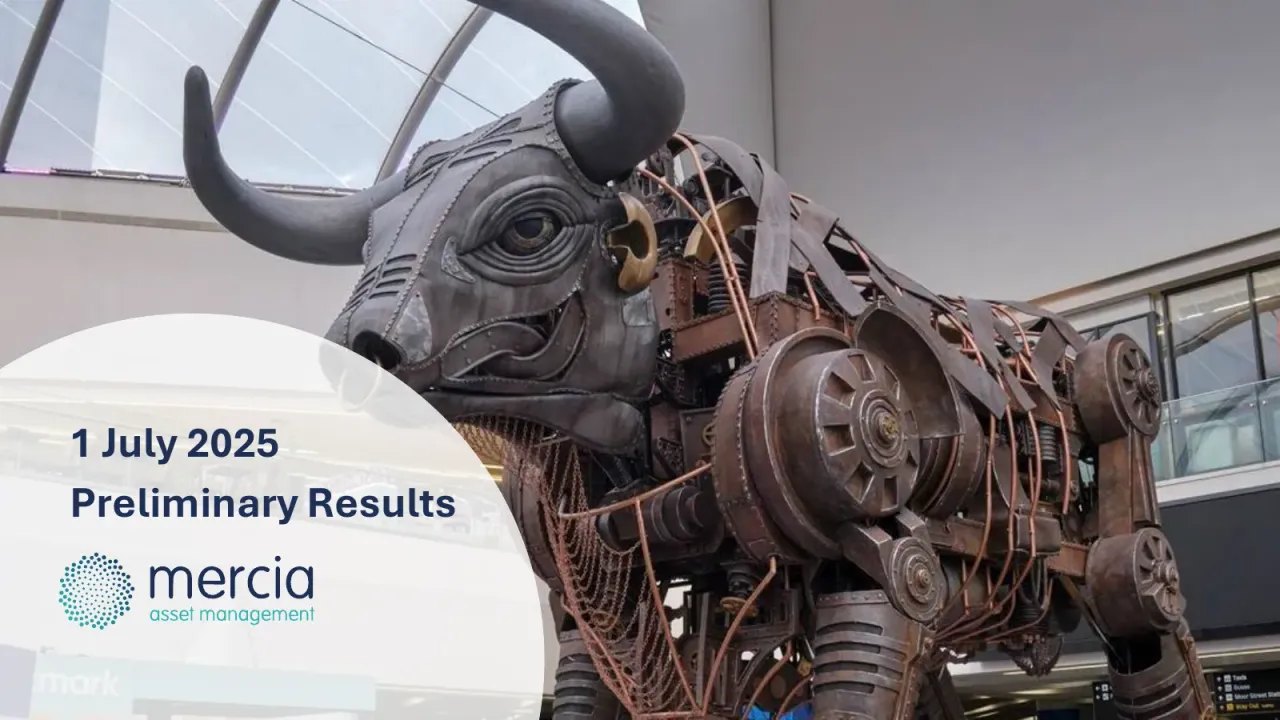
0:31 sir. Thank you. Good afternoon, and welcome, everybody. And thank you for joining both Martin and I, to present our f y twenty five preliminary results. And for those that have traveled to Birmingham, Birmingham New Street, you'll recognize Aussie that sits in Birmingham New Street. Martin and I are coming from our Birmingham office today. Just as introductions, I'm the chief executive cofounder of MERCIA. Approximately fifteen years now of commercializing technologies, but more importantly, investing into businesses, growing businesses, and either exiting them through IPO, but more often through trades trade sales. Yes. Good afternoon, everyone. I joined MERCIA over ten years ago now to float the business with MERCIA when there was just a small handful of us. MERCIA is my fourth listed company as CFO,
1:24 and most of my career has been spent in in and around technology related businesses. Thanks, MERCIA. So today, we'll talk a little bit about MERCIA, our model, the market opportunity that we're facing. Martin will give a more detailed review of the finances of the group. We'll talk about the progress over this period and our outlook and in summary for the group going forwards.
1:47 So for those that have not heard of MERCIA, what is MERCIA? Well, we are a fast growing, scalable alternative asset manager. We're one of the leading leading providers now across The UK aiming to see and source deals that others don't necessarily see. We focus exclusively on The UK where there are multi billions per annum invested, And we look to private capital deployment through debt and private equity, what we term together as development capital, property finance, and venture, and moving the group now towards real assets in parallel rather than instead of. We have been building over the last ten years a highly differentiated deal origination platform to see the best deals and win the best deals, and that's through our footprint across The UK and our regional offices.
2:36 Now with the growing and increasing opportunities that we're investing against, we are now building a sales and distribution platform across retail and predominantly now across institutional investment.
2:50 Martin mentioned joining us ten years ago, and this is very much a sort of ten year celebration actually on AIM. And at the point when we started MERCIA, that was fifteen years ago now, it was really to address this observation. And these are the most recent results from 2021, where 12,600 high growth businesses in The UK, 21% of those are based in London. However, somewhat alarmingly, 66 of all capital deployed are into those 21% of the businesses, those high growth businesses. And high growth is defined as growing at 20% growth in employees per annum averaged over three years. And so why is that? And our strong belief then, as it is today, is you've got to be physically based where those opportunities are. And we've got offices across The UK. You can see where they're there. And we are sourcing about 90% now of our investment transactions are outside of London. We do have a London office. We do transact out of our London office, but we are truly pannational.
3:52 And this shows the pace of growth of the group. So financial year twenty five, this reporting period, has been the strongest in terms of capital deployment that we've made. £284,000,000. You can see the red dots on the left figure there where those transactions have occurred across the country. 131,000,000 into venture businesses, and of that, circa 10,000,000 into our direct assets, and I'll talk to those later. 72,000,000 into development capital and 81,000,000 into property financing. And we've backed brands that some of you will be familiar with, but when we backed them, they were unknowns. Kirsty's, and you'll see those. They're gluten free, dairy free products. You'll see them in ASSET, Tesco, Sainsbury's, and most major super markets. Oddbox, Pure Pet Food based up in Newcastle.
4:37 Harrogate Springwater, we've lent money to repeatedly over the past. And the other names that you may not have heard of today, will do over time as they continue to grow. So a really strong stable of businesses, a majority of those out in The UK regions. Last year, we started our three year plan, which we termed MERCIA '20 seven, where we said we would grow assets under management over three years from 1,800,000,000 to 3,000,000,000. We've grown EBITDA from 5,500,000 to 10,000,000 and grow the EBITDA margin from 18.2% to 26%. And as you may have seen with the results today, we're very pleased with the progress, and we are more than capable of achieving this three year objective across these three areas.
5:23 We're at 2,000,000,000 now in AUM, 7,600,000 EBITDA and a 22.1% EBITDA margin. We also made a commitment last year to look to divest up to 70% by value of our direct investments as we look to simplify the business as a focused third party fund management business. Now we said in the this financial year gone by that we would not expect any exits, and that exit will start to appear at the back end of f y twenty six and into f y twenty seven. We don't change that position in terms of our belief in the exit timing. But during f y twenty twenty five, we did experience a small investment, one of our smaller businesses in the portfolio, which generated a return of £600,000.
6:09 Other key milestones within this financial year include the appointment of Dean Heaney as head of institutional distribution as we look to grow our institutional base. And on that basis, we've closed our first and we've had the first close of our new £82,000,000 institutional fund, MERCIA Evolution Fund. We've seen third
6:29 path third party capital raises across the three discrete pools of capital we manage, retail, institutional, and public sector, which is predominantly British business bank for us. And that collectively has resulted in net fund inflows of circa 15% when looking across the financial year and into the tax year end to the April 5. As I've mentioned, we've had a record deployment of £284,000,000 into a 165 businesses and importantly, 87 of those new to house. And the opportunity we face is driven by a number of features here. 9,100,000,000,000 in investable capital is is is held within The UK, predominantly invested overseas, circa 2,000,000,000,000 of that being retail capital.
7:18 A number of you may be familiar with the Mansion House Compact and the Mansion House Accord. The compact was a statement of intent to turn DC pensions towards putting 5% of their growing allocations to domestic basis into the private capital markets. The Mansion House Accord builds on the compact with 17 signing up across the pension and insurance industries. And this combines really with Solvency II act changes, Solvency UK reforms, and also a growing emphasis on place based impact investment. And we're seeing that particularly with the local government pension schemes. And also new structures brought in like LTAPs and certain platforms allowing funds to access a diverse portfolio of assets, but always pointed domestically, always on a regional deployment basis as well.
8:09 And we're extremely well placed. And put this into context, the 5% growth in terms of redirecting capital into The UK is estimated to be at least 16,000,000,000 in value by 2030. And the the remarkable thing here with The UK is it's the second largest behind The US holder of investable capital and actually accounts for about eight to 10% of the global capital comes from The UK. So you can see why reforms and interests are there to redirect capital into The UK, into the private markets. And as a regional based investor, we think we are extremely well placed for those tailwinds coming.
8:48 Thank you, Mark. This first slide in the finance section summarizes our financial performance for the year ending 03/31/2025. As you can see, we've increased our revenues by 13% during the year and our EBITDA by 37%, showing the economies of scale that MERCIA is now achieving. Our progressive dividend policy started in 2020, and I'm pleased to say that our Board is recommending a proposed final dividend per share of 0.58p, just over a 5% increase on the prior year. We managed our business carefully and at the year end, we retained $40,000,000 of cash and no debt. Our net assets per share have nudged up during the year to 43.6p.
9:36 And at the end of the year, we are now managing £2,000,000,000 of assets under management, which I'll speak to in more detail shortly. During the course of the financial year and the five days up to the tax year end, we achieved inflows of GBP $316,000,000. And at the end of the period, we have GBP $640,000,000 of dry powder.
10:02 This slide shows our sustained organic growth during the year in revenues, EBITDA and operating cash generation. Starting with the first chart on the left, you can see the growth there in revenues and we are managing to maintain our 2% blended fee margin across our asset categories. All of this revenue growth was organic. 81% of our revenue comes from our fund management operations, our contracted revenues being fund management fees and also direct monitoring fees and the remaining 19% comes from transaction related revenues. Of our total revenues, 98% is now coming from our fund management business and only 2% is coming from our direct investing balance sheet activities. Looking at the EBITDA performance and the growth in EBITDA, which is up 37%, I I think what's interesting is that over the last two years, we've grown our assets under management by GBP 600,000,000.
11:00 And that is what is helping to drive now the economies of scale in our business. And of that GBP 600,000,000 growth in the last two years, what's I think is quite interesting, showing the evolution of the balance of our asset classes is that 47% of that GBP 600,000,000 was new equity inflows, but 53% was new SME lending inflows as well, showing again, as I've said, the maturing and the diversification of our asset classes.
11:26 And over on the right hand side, you can see that not only are we generating growth in EBITDA, but we are turning that EBITDA into cash. And for the second year running, our cash generated from operating activities was higher than the actual reported EBITDA.
11:43 Against a continuing challenging market backdrop for many asset managers, this slide shows our growing assets under management with $237,000,000 fund inflows during the financial year and a further $79,000,000 just after the year end. There were no redemptions in any of our mandates at MERCIA and the only reductions in AUM of any magnitude was distributions to our many MERCIA stakeholders, which includes the shareholders of our three Northern VCTs, our LP fund investors where we are making investment returns to the LPs and, of course, through dividends to our existing shareholders. This slide provides more granularity on the makeup of our assets under management by asset class, investor type and funds type as at the March 31.
12:38 And combined, these typically long dated or evergreen funds are generating, as I've said, that fee margin of circa 2%. And that is across 67 fund mandates that we are now managing. And the breadth of those mandates means that we are increasingly able to either equity invest or lend throughout The United Kingdom.
13:02 This slide shows our consolidated profit and loss account, and I think there's two or three important things to draw out here. Firstly, I think what's interesting is that whilst the revenues of the business grew by 4,000,000 the cost base only grew by $2,000,000 And there is the example of economies of scale where we're able to now drive the top line, but the growth in our cost base is much lower than it has historically been when we were managing lower quantities of assets under management. I think the next thing to note is that the finance income remains strong. Most of that finance income line is deposit interest on our 40,000,000 or so of cash on deposit, and we've been earning during the past twelve months circa 44.5% with our money on deposit. I think the next thing that's quite interesting is that for the first time, not the only time, but for the first time in a few years, we've earned performance fees from managing the three Northern VCTs. We did earn significant performance fees in the early years after we acquired the VCT contracts.
14:02 And it's pleasing to see that the performance of the VCT NAVs has now resulted in MERCIA once again being entitled to a performance fee. Of that performance fee, we've agreed with the VCT Boards that we will distribute 80% including employers NI to the VCT investment team who are managing the three Northern VCTs. Thank you. This next slide is our consolidated balance sheet. And as you can see there, the strength of the balance sheet through principally the direct investment portfolio at $126,000,000 which Mark will talk to shortly, the $40,000,000 of cash and overall, a very strong balance sheet at $188,000,000 And what that is enabling us to do now is not only to increase the dividend, but also to announce a new policy, which is an annual GBP 3,000,000 share buyback, where shares bought back will be canceled from this new policy.
15:11 The next slide is our consolidated statement of cash flows, which is a very simple cash flow statement. I'm pleased to say, you can see there the top line $8,700,000 generated from operating cash flow. The GBP 9,700,000 invested during the year in that direct investment portfolio, a considerable reduction on prior year as the portfolio continues to mature and therefore require lower levels of investment. We said at the start of MERCIA twenty seven that we anticipated the balance sheet portfolio needing no more than $25,000,000 over the next three years. As you can see here, so far, we've invested 10,000,000 of that £25,000,000 and we still anticipate the portfolio over the remaining two years requiring no more than a further £15,000,000 Also on this slide, you can see the interest received from our cash deposits, the full payment of the final deferred consideration on the acquisition of Frontier Development Capital, which is continuing to perform extremely well, dividends paid in the prior year and the final purchase of the original GBP 5,000,000 share buyback.
16:23 One of the things we're focused on as a Board with our capital allocation policy is carefully monitoring how we are enabling increasing shareholder returns. And one way of looking at that is to calculate a theoretical return percentage known as the weighted average cost of capital. Not easy to do when you have no debt on your balance sheet. But nevertheless, we've applied the calculation and we've come up with an approximate weighted average cost of capital of 9%. We did ask ChatGPT what it thought our WACC should be and ChatGPT's response was 10%. So I think we're in the right ballpark. The important point about this is it sets a benchmark or a hurdle above which what we do with our shareholders' money, we should be exceeding that hurdle.
17:08 And down below in this slide is the example of our three acquisitions to date since our IPO. And you can see there that the return on invested capital thus far from each of the three acquisition exceeds our weighted average cost of capital. And that's really important because that's what that is telling us is that the investments we've been making of shareholders' money into these acquisitions is paying dividends. Thank you. Thank you, Martin. So next handful of slides will just reflect on the progress of the group and the outlook going forwards. As I said at the very beginning, this is ten years now on AIM. And every three years, the group has grown by circa a 100%. So fulfilling the growth aspirations of MERCIA going forward for the MERCIA '27, I think fits very neatly within that paradigm.
17:58 On pretty much every metric that you want to look at, whether it's third party funds growth from 23,000,000 to 1,800,000,000, revenue growth, profitability growth, you can see strong growth throughout the group. I think quite importantly, as we start to benefit from sort of scale economies, another piece that we're doing is we are writing larger checks. So investing larger amounts of capital, which requires the same amount of resource utilization, is a great way of driving efficiency and productivity through the group. The other piece to
18:27 pull out from this is the fact that when when Martin and I were on the market, when we were basically raising our IPO capital, the 70,000,000 when we came to market, there was a degree of cynicism seen that there are no the reason why there's no money chasing deals in the regions, there are no deals worth doing. But I'm really pleased to say ten years later, and this is just from equity realizations, we have returned over £800,000,000 back to our balance sheet and our managed funds, clearly demonstrating as fact that 85% of what we do is outside of London, outside of the Southeast, that there are returns to be made outside of that area. And then just on to the balance sheet direct investments. Here they are listed by value by by by our holding value. You can see on the left. You see the date when we first made the investment and then the starting position. So 117,000,000 at the start of this fire financial year.
19:22 9,700,000 invested across the portfolio. The realization of the smaller investment there, Artesian, bringing back £601,000. Realized gains and losses, we have a realized loss, which was at Sherlock Biosciences. So that's that's moved the $3.40 out. And then the fair value movements across the direct investments, the ups and downs pretty much cancel each other out to sort of close out on the 274,000 position.
19:50 Then what that means is the closing position for the group of the direct investments is 100 circa 126,000,000 at year end. I think finally on this table is the important observation about the the size of the equity stakes that we hold in these businesses, typically ranging from 20 to 40%. But all of these businesses also have MERCIA fund positions in them. So often, our holding in these businesses across the group is over over 50%,
20:18 But our influence, albeit very strong, our control is nonexistence. We do not control these businesses. We have board seats on most of them, and our influence is very strong. And that's important when we think about the balance sheet unwinding over time during this MERCIA twenty seven and adds cred credibility and credence to that moving forwards. These are our top 10 assets by value. So Netasea is a Manchester based business in revenue growth. It's bot detection. So bot detection and mitigation sits on customer side, server side with some very well known blue chip clients. VoxPopme is a video analytics for the market research arena. That's in revenue growth just moving to breakeven. That's a business based in Birmingham with a US operation.
21:06 We've got Warwick Acoustics, which is working with within the automotive sector under OEMs, looking at integrating its speaker technology, which is lightweight, flexible, low energy electrostatic speakers. And that is about to be rolled out into the first automotive partner, and we expect that in September. It's also got a headphone, a high end headphone set, which is in strong revenue growth. And that's in and and that business is in revenue growth as well. The cards, the universe, and everything, that's based just outside of London. That's platform. It's got two games now. It's in revenue growth just under breakeven now. MedHerron has got a significant partnership with Bayer.
21:51 It's in revenue generation with that partnership. It's also got its own program of development, which is a testosterone patch addressing the HRT arena. That's a business based in Coventry now. Iota based in Birmingham. That's got a remote split lamp, a family application. That business is progressing well now, actually, in making early such sales. And that's when just reflecting back a few years, we took a heavy provision and restructured that business, and that business has come out repointed now in a in a in a much better direction. Invincible Studios, soccer manager. This is a football management platform on a multiplatform focused predominantly in the mobile space. That's in strong revenue growth and is profitable. Locate Bio. This is the one asset actually here that fits outside of the MERCIA twenty seven. This is a much earlier business.
22:44 It's developing a bone regeneration product. It's yet to go into the clinic with that, and we think that that's a longer longer journey. So it falls outside of the MERCIA twenty seven scope. That's a Nottingham based business. Intelligent positioning, which is a SEO platform that's in revenue growth, is now cash breakeven and into profitability. That business is based in Brighton.
23:07 And then the final one is a business called Aonic, which acquired Endreams a little while ago, and this is the residual stake that we have in this business. Now this business is growing strongly. It's a PE backed buy and build gaming business. It's a highly profitable gaming business, and we'll be looking at a IPO when the market's open. And it is the one business in this particular piece that is dependent on the public markets opening. That happens when we will look to take out our position.
23:34 All of these businesses are under advisement. Locate Bio is the one business, PLC, as I said, falls outside of the MERCIA ASSET Arena. The other businesses that we have advisers supporting us to look to move these businesses out and divest those businesses within the next eighteen, twenty four months.
23:58 We really do seriously consider ourselves as a responsible investment with sustainability at the heart of what we do. And for us, sustainability is progress and scale and, frankly, doing the right thing. And for this, this is quite a key differentiator and an important part for our institutional funds that are with us and the ones that are looking to back us in terms of new funds under production. They are seeing this as a very key metric to manage, to measure the managers that they want to support. We have Bansy who's joined us as a dedicated sustainable manager, and she is integrating all elements of ESG from our deal origination through transactions, through business development, and exit. We have a number of bodies that we're a member. I'm a great believer if you measure it, it happens.
24:44 Just to pull one of those out, which I think has been great progress, is one of the early ones that we committed to, which was investing in women code. And that's where we've been developing talent within the business ground up, but also on a senior level, making sure we have the talent coming down. So if you look at
25:01 our board, half of our NEDs are women. If you look at the execs, a third are the executive committee that runs and delivers the strategic plan that we've been talking about, 50% women. In total, 40% women. So for the for a financial services business, that's great progress we're making, and we're making great progress in those other areas as well, which is critical in terms of winning new fund mandates and winning new funds.
25:24 And this really reflects us in this axis here where we're seeing strong growth in terms of our assets under management, which are predominantly funds under management. And so when we use the interplay between AUM and FUM so FUM is third party capital we're managing. AUM is then the addition of our cash, our balance sheet direct investments, our intangibles. So that's the delta between AUM and FUM. So of the 2,000,000,000 that we have in AUM, 1,800,000,000 is in third party funds. And we see that growth metric continuing.
25:56 So as we go towards the three year plan and the end of the three year plan, 03/31/2027, you can see growth across those assets, but predominantly driven by real assets, which would comprise of institutional and retail investors.
26:14 So just in summary, and I hope you agree with us, is that the we are very much right place, right time. There are strong domestic growth prospects across The UK as well as on a regional basis within the private markets, and we just see capital coming towards this space. We're highly diversified in terms of deal origination, in terms of asset class, and important in terms of investor type. The revenue is predictable and recurring, 30 circa 80% recurring, and we benefit currently from a blended fee
26:45 margin of circa 2%. But importantly, as we look to our shareholders, and we are very grateful for the support we've received over the ten years, we are looking now to increasingly return back to shareholders through our progressive dividend policy and through the commencement of our annual buyback. Thank you very much for your attention.
27:06 Mark Martin, thank you very much for your presentation. Ladies and gentlemen, please do continue to submit your questions just following the q and a tab situated on the top right hand corner of your screen. Just while the company take a few moments to review those questions submitted today, I'd like to remind you the recording of this presentation along with a copy of the slides and the published q and a, can be accessed via investor dashboard. As you can see, we have received a number of questions throughout today's presentation. Can I please ask you to read out the questions and give responses where appropriate to do so? And I'll pick up from you at the end. Sorry. I there is I don't know why, but I have no questions on my screen, and I know there will be questions. I'm just looking across at Martin's. Yes. I can only see actually one question, which is in relation to the VCTs, which says you generated performance fees from the VCTs for the first time. Actually, this year isn't the first time, as I mentioned earlier.
27:58 We did receive actually, in total, 6,000,000 of performance fees in the early years after we acquired the VCT contracts at the end of two thousand and nineteen. And just just while and and, hopefully, this can be sorted out so we can see the other questions. We we just can't see them, sadly. But we had two questions submitted to us, which was how is MERCIA using AI, and what is MERCIA's approach to sustainability, and is it helping with fundraising? So in terms of using AI, I think the first is a one word answer, which is carefully, is we we are using that. So we're using it in two broad approaches. So we have a quite a sophisticated outreach mechanism where we're reaching out to potential investees and prospective investees, and that is working extremely well, actually. And the other piece is within our own data.
28:50 So it's a sort of tenant basis where we're basically reinventing our own data and using that to interrogate via a large language model and copilot. So that is the way we're using it internally, and that is really to use the vast amount of data that we've accumulated over a decade with various systems, but to ensure that it remains proprietary because I'm sure many of you know that the moment you take it out to a chat GPT or something, it goes into the public domain, and that is not good for one's proprietary data. So, yes, we are using AI. We are using it very carefully, and we see its opportunity and strengths with us and with our portfolio. We do a number of seminars with our portfolio, and, internally, we do that as well so that we can get up to speed with the right application of it. And then in terms of the second question, which was what's MERCIA's approach to sustainability, and is it helping us with fundraising?
29:40 I'm hoping that slide on sustainability that was on there, it is critical. So Dean, who heads up our institutional investment, has said very clearly that this is an important tenant of what we're doing in terms of going out and fundraising. We are monitored and measured, and we have detailed questionnaires from pension funds, etcetera, about that, also from British business bank and also from intermediaries with retail. It's important, but it's something we do and we passionately believe in as well. And it fits very much with this sort of impactful investment, this place based impactful investment that we are
30:13 well known for in respect of commercial returns as well. There is no way we'd be able to manage capital without commercial returns. Right. So I can now see the question. So perhaps, Mark, if I may, I'll Yes. Please do. Come out to you in descending order. So the next question is, given your strong trajectory, how are you positioning MERCIA against larger asset management firms? And what do you view as your key competitive advantage? Yeah. So, I mean, it's it's really I mean, it's a bit I'm just gonna step back from that question because we so we for the first time ever, we are having institutional funds reach out to us. So this is this is a new development for it. And this is, I'm sure, because of the Munchen House Accord and the Munchen House Compact, where there is an increasing pressure to deploy capital domestically. And if you're a local government pension scheme, that's not just domestically, that's locally.
31:07 So there's increasing increasing pressure in that respect. So, yeah, I we we are often asked, are there other MERCIAs out there? And if you look at how many domestic focused regional managers are, there's only a handful. So the next point then is, so how much can you manage? And that's that's, I think, a really critical point because as as you get consolidation within this institutional sector, you'll get a requirement for new and larger funds. Now LTAPs, which is a new product coming through, is enabling, if you like, a multi asset approach of assigning pieces to different managers, and I think that is one solution. But the other solution is real assets. You know, a a venture fund will only ever be, if it's domestically pointed, $1.02,300,000,000.
31:54 Whereas, actually, you can go into real assets, and you can go $305,101,000,000,000. And that's why we anticipate that growth coming from real assets is because some of this a lot of this institutional capital will be looking for that more risk profiled approach that we do on a smaller scale but on a larger scale. So the next question is in four or five parts, actually. So if I may, I will read them one at a time. So first question is in relation to the investments post year end into the AXIS Spine and MERCIA ASSET MANAGEMENT Were those recent funding rounds post year end at or above holding value? And did third party investors come into that those rounds? Ah, okay. Well, the answer to that is yes. So we did have third party investors into those rounds, and, yes, they were at the holding value. Yeah.
32:42 Good. The next multipart question is what's the pipeline in terms of new regional fund launches or new tranches? So and that that's a that's a really excellent question, actually, because it's really important now. For those that, like me, are obsessed with what's going on, I have to I have to face in many directions. And what British business bank are being told by the government to do. It's really important to us that we manage a big portion of British business bank capital, and we believe we could manage more. So there was a a a larger allocation through the spending route to British business banks. So it's not just about existing mandates. It's not just about the original allocations into existing mandates. It's about larger allocations into existing mandates as well as new ones. And we'll see more and more BBB, like, for instance, the Evolution Fund. So the Evolution Fund has a an institutional pension fund in it, but it also has a subsidiary of British Business Bank, which is BBI that invested in. So we're seeing more and more of these discrete pools of capital moving together, and we would expect BBB to be more involved with retail, with family offices, with wealth managers, as well as institutions.
33:49 So we are looking at increased allocations not this year, but would be probably next year into the recent fund mandate wins. And we are acutely aware there's at least two more geographies that are coming out on a regional basis for new funds going through, and we will consider those. And we will, of course, be looking we are easily meeting our deployment targets for our regional funds, so we will be considering reupping, if you like, getting new allocations within the existing funds. There are other conversations ongoing with BBB. We believe we can help them fulfill their mandate as they look to operate against these eight pillars of the industrial strategy, pointing capital domestically and regionally. We think we're very well placed to help. Thank you, Mark. The next one is, does the potential consolidation of, I think, here, it means the local government pooled pension schemes, does that potential consolidation matter to us?
34:45 So so it it it doesn't matter to us because we have relationships with them individually, and those relationships will will continue throughout that consolidation. It does speak to what I was saying before, which is bigger is better, and that's really at the heart of our sort of go further, go faster theme because that's what we need to do. We need to grow as an asset manager, and we need to grow the size of funds under management because there's one thing that's for sure over the next five years is the capital allocations to individual funds will grow too. Next question is how many of the direct investment portfolio are profitable and or flow positive? So I will give the wrong answer if I say that. But of the the 10 that why don't I do it like that? Of the 10 yeah. Forgive me. I'm just scrolling through the slides.
35:37 So there were 10 that I highlighted which were on slide 22. So Netasir is loss making, but it's it's closing the gap. Vox Pop Me is breakeven. Warwick Acoustics is is small, but loss loss making. The cards, the universe, and everything is basically breakeven now. MERCIA ASSET is loss making. IOTA is loss making. Invincible Studios is profitable. LOCATE is very young in its journey and is loss making. Intelligent positioning is profitable and cash generative as is AONIC. Great. Thank you, Mark. So moving on to the next group of questions, if may. With a significant number of portfolio exits, I think this is the balance sheet planned, what factors will most influence your decision making on timing and pricing for these divestments?
36:27 So all 20 have been reviewed. So what we did before so just just stepping back. So MERCIA twenty seven was a year in the making, if that makes sense. So there was a strategic review for the twelve months before, and part of that strategic review was to look with advisers at all of our portfolio companies and ask when can we exit them. What are the metrics that will drive towards making these saleable assets? And that's why we arrived at 70%, not a 100% because clearly the timings and locate is a good example. Clearly, the timings of those would fall outside of that scope. From those advisers who are sector specialists who we have engaged on the portfolio, and it's back to our position as we as we have quite the influence on these portfolios, we have full alignment in terms of shareholders in these businesses, and we're working with management teams in terms of exit trajectories as well.
37:17 We have a a number of metrics. Some of them are ARR multiples. Some of them are breakeven multiples. Some of them are if you look at Warwick acoustics, it's a case of one o one OEM delivering in terms of in market supply, one OEM integrating. So there's a whole bunch of different metrics on that that we're driving through. We are optimistic that we can move those through. The one that, I guess, is the the the one challenge is the is Aonic because it's dependent on the IPO window opening, and that's something outside of our influence. As far as the others go, there's to do with commercial technical traction. Great. Thank you. Now I can ask the next one, Mark, which is a clarification request question, which is in relation to our assets under management and funds under management. So the question is, think it was mentioned that assets under management have grown by GBP 600,000,000 and now sits at around GBP 2,000,000,000. However, according to your balance sheet presented, total assets are just over GBP 200,000,000.
38:13 Please, would you clarify these different numbers? Yes, of course. So when we talk about assets under management, that is the combination of our funds under management, which is GBP 1,800,000,000 and the circa GBP 200,000,000, which is our consolidated balance sheet. The $600,000,000 growth in assets under management I referred to on one of the slides is the growth in our assets under management over the past two years. So I hope that answers that question. The next interesting question is that growth is not translating into shareholder value accretion on a similar basis. When can we expect this to improve? Yeah. And I think I mean, we we I'm sure we've both got answers to this. I mean, I'm a founding shareholder. Martin and I have invested repeatedly in this business out of our own money in that respect because we passionately believe in this business.
39:05 The point now is now that this business is is cash generative, profitable scaling, and I think attracting attention is it is up to us now to do what we can with the resources we have available to look to to correct that share price. Part of that is profile raising. Part of that is getting out into the market. Part of that is our progressive dividend policy, and part of that is our buyback. So we are we have a concerted effort this year to make sure this business' share price is what it deserves. Yes. And if I may also just add that since we started our progressive dividend policy and including the buyback, the 5,000,000 buyback that we did last year, we have already returned 20,000,000 to shareholders. So the next question is, what scope is there for further VCT management mandates?
39:52 I think this is what we acquire seek to acquire any further VCT mandates. And and and this is and and I get why this question comes forward, and this is a question I've heard before. The the challenge is for those that aren't completely familiar with VCTs is there are a number of restrictions and rules that wrap around them. So having multiple contracts doesn't help in respect to that. So in others, one of the rules is you've got you can only invest 20,000,000 into the recipient. So the investee can only receive 20,000,000 from the VCT. And the more VCTs you have, and if you're doing a sort of often managers do, if you're doing a sort of deal sharing basis, then the smaller the tickets are that are going into that. So some of the rules restrict the realistic scaling of those to the advantage of the existing incumbent investors in the BCT. So we're not doing it. Fundamentally, every at the heart of everything we're doing is we must make money for our investors.
40:43 And if for whatever reason it's not working out, we will do corrective action to make sure it does work out. And so we're not chasing revenue and profit per se, which you could do if you went to try and consolidate the sector because I think it would be at the disadvantage of the incumbent VCTs. So it's not it's not to say never because you, you know, you can never say never, but it is not on our radar to do. Yes. And I think it's also fair to say that we would we would not do so if if there was a a sense from our VCTs that they didn't feel that adding a further VCT mandate was in the best interest of the existing VCT shareholders. Absolutely. So the next question is a question around our share price performance since our IPO. And the question says, since you floated fifteen years ago, was actually original MERCIA was founded fifteen years ago, but our IPO was actually ten years ago.
41:34 And I note that the share price is roughly halved, slightly under that over the period. And what do we think are the main drivers of that? Yes. And so why is there a disconnect between MERCIA's increasing financial performance and the share price reductions since our IPO? Can start off with that, Mark, if you'd like to. If we go back to 2014, I think there were a number of balance sheet investment models on the market at that time. And there was an overarching belief, I think, in the intrinsic value that existed in those balance sheet portfolios, university spinouts, etcetera, the likes of IP Group, Touchstone Innovations, Allied Minds and a number of others, some of you may remember. And therefore, the share prices of many of those companies, including ourselves after we floated at 50p, went to were sitting at a premium to our net asset value.
42:26 And then as we went through beyond 2014 into 2016 and then into 2017, what we saw was a number of those models imploding, unfortunately, Allied Minds being first the larger players to do so. And then a merger between Touchstone and IP Group and the reduction in value creation, significant reduction in value creation that unfortunately created. And understandably, the market then began begun to become skeptical that rather than there being an intrinsic underlying value in these balance sheet portfolios, actually, there was an underlying risk in these venture loss making portfolios. And therefore, the market moved from holding those shares at a premium to NAV to moved into a discount to NAV territory.
43:12 And then in the subsequent years, again, quite understandably, that skepticism has only increased as a number of those balance sheet models have suffered significant reductions in their reported NAV per shares. So I think we have been caught in that sentiment, notwithstanding the fact that actually our balance sheet portfolio has performed extremely well during this ten year period. So I think that is part of the backdrop. I think it may also be possible that how do you value MERCIA when it's really two businesses in one. And I think we've had that feedback as well, understandably from our shareholder base, which is, are you a balance sheet investor? Do we value you on a discount to NAV per share? Or are you a profitable fund management business where we should value with a multiple tip of your EBITDA and of course and your cash on your balance sheet? And of course, the answer is we are both. But what we are now trying to do, as you can see, is clearly be an asset manager based on our funds under management, which is why part of the reason why we are divesting our balance sheet portfolio and turning it into cash. So it is it will become easier and easier to value MERCIA in the future based upon its EBITDA performance. That's spot on.
44:29 I hope that didn't take too long answering that question. The next question is, is our 2% fee margin sustainable? So I think the answer is over time, less likely because inevitably, when you're moving into real asset space, fee margins are way below two percent and sometimes they can be below 1%. However, I wouldn't be too worried about that because what comes with large fund mandates is increasing economies of scale. So to the extent that our overall blended fee margin starts to dip below 2% over time, I do think, as this year's results have demonstrated, I think that we will continue to see benefits of economies of scale, which will still continue to drive the bottom line. The next question is a follow on related question apparently to an earlier question, which is would we consider publishing net asset value data per share to allow investors and the market to assess whether the shares are undervalued, overvalued or fairly valued as is done by investment trusts?
45:34 Well, we do obviously publish our NAV per share every six months, and we do have our interim results reviewed by our auditors even though we don't have to. I think we aren't an investment trust. And I think to do so on we only actually value our balance sheet assets once every six months anyway. And I don't think to do so monthly or quarterly would be appropriate. I think we're nearly at the end. Thank you, everybody, for bearing with us. The buyback is welcomed. Thank you. Its quantum seems a little unambitious. The direct portfolio requires $10,000,000 capital this year, and you're looking to exit 70% in short order. Could you not have upscaled the buyback facility?
46:21 It is only an upper bound after all. So I'll start with that again. So the $3,000,000 is a start point. It's not the end point. And I think we've said that in the chair statement that we would keep it under review. Is what we feel we can afford today. It is in response to conversations that we've had with our many shareholders. And so the ambition would be to increase that over time. However, what I don't think we would either rule out would be as the balance sheet does unwind, we'll go through this onetime period where we will have a significant cash on our balance sheet. I cannot preempt, what our Board might decide as to whether or not there would be a one off additional buyback or there would be a special dividend or something like that. Time will tell. But we see the $3,000,000 as a start point, not an endpoint.
47:15 And I think that there's one further question, which was a repeat of essentially a repeat of an earlier question. And another very good question, which is, have you considered splitting the business into a fund manager and an investment trust to maximize shareholder value rather than pushing for an exit of 70% of the portfolio in short order? Yeah. I hear what you're saying. And in effect, we're doing we're we're trying to achieve the same. It's it's a maturing portfolio, I think, is the first point. And the second point, it has very modest capital needs. So if you're gonna go down that route, you're raising money. You're building you're renewing a a portfolio. We haven't added any new businesses now for two years, actually, to that to that portfolio.
48:00 So we have really made the commitment to turn it into cash. And the reason being is actually we we do have homes for that cash. We have bought businesses approximately every three years, and I would like to think within the next eighteen months, there'll be at least one acquisition to come. We don't want to raise money on the city. We want to do that from our own resources, and the balance sheet will be a source of that. The other thing is that we are often an LP, a limited partner within our own managed funds. And as we look to scale the fund management operation, we will need cash resource to see those funds as well. Typically, it's a 2% of the funds. It's not a huge drain of cash individually, but it will be an important element of our growth prospect going forwards. Thank you, Mark. Further question is, again, back to moving into the real asset space, another good question, which is how do you get into social housing or other real asset categories?
48:51 Is that not big boys territory? That's another very good question. The answer is, as we have done in the past, we will acquire our way in because we started as a retail an investor of retail money through our EIS funds. We then acquired Enterprise Ventures. That took us into institutional venture and into SME lending. We then moved into into Venture Capital Trust, where the check sizes were larger but still venture. And then with the acquisition of Frontier Development Capital, we moved into larger check sizes for SME lending, but then also into property lending. So the way that we have done that is to acquire the credentials and the people and the skills and the track records rather than trying to start from zero. And so therefore, our move we anticipate that our move into the real asset space will come via a careful acquisition.
49:49 And I think there's a number of questions that have come in at the end, which are similar to the question earlier on around the share price performance over over a period and also a question around are any of them are any of the direct investments, MERCIA, showing real traction? A somewhat skeptical question. Well, I mean, context is we are in a downswing in the venture cycle, unquestionably. We have been there for a number of years. Our venture businesses, so our balance sheet businesses are demonstrating real traction. Absolutely. But it's slower than we would like it to be. So we are doing everything we can to move that forwards. We have a model for a number you'll know. We have an internal model of operating partners, venture partners, where we put resource from our own capabilities into those businesses, and we're doing those to help them in what is unquestionably a challenging environment.
50:44 But that is why we are optimistic as we look forwards because we can see to put that into concept, we've got 20 ish businesses on our direct investment portfolio, but we've got about 260 across the group. And when we look across the group, we are definitely starting to see green shoots within this area. So we are optimistic in the medium term. But I think at the moment, it's about supporting these businesses to fulfill their ambition. And, yes, a number of them are making material transact transaction progress. You know, we've got businesses in here growing 30% plus revenue year on year. So they are growing, many of them. A question which is, what are your plans for the period after MERCIA twenty seven? Oh, ask me again in twelve months' time when we start to review for the next three year plan. More more of the same, I would say. I I would you know, we we On the main market, perhaps. Well, we we do we do you know, we I conclude the statement in the about going further and going faster, and that really means going bigger.
51:37 And I think that if we can become larger, then we can move to main market if that is an option. But it is about growth. I do think, and somebody referenced the big boys place. This is about scale. We are into a scale industry now. So whereas 2,000,000,000 to 3,000,000,000, yeah, that's great. But how do you get from three to five? How do get from five to 10? So it it will be about growth and scale and the continued thread on EBITDA growth and margin improvement as we look to benefit from scale advantages. So growth is gonna be at the heart of the next three year plan, but I'm absolutely focused on delivering this one. And I think perhaps a final question, which is around the the the performance of the various parts of MERCIA and actually another sample of a question around whether or not the only decent part of MERCIA is the VCTs.
52:28 What I can I'm happy to confirm is that every part of MERCIA is profitable. All of our asset classes are generating profits and cash. So no, it isn't just the venture capital trust that we manage. But thank you for that question. And that, I believe, is all of the questions that we received. And thank you very much indeed. I hope you feel that we've answered them all clearly for you. Mark, Martin, thank you for answering all those questions you can from investors. And of course, the company can review all questions submitted today. We'll publish those responses on the investor meet company platform. Just before redirecting investors to provide you with their feedback, which I know is particularly important to the company, Mark, could I please just ask you for a few closing comments? No. Of course. Absolutely. There there are there are really four areas that we spend our time focused on and maximizing the performance of. So our employees, our team, these are we are really proud of these results. When you look at the environment that all businesses are operating at the moment, the volatility, uncertainty, our team has performed miracles in this. So our our employees, our team are really important.
53:29 That's one. The investees, so the deal origination platform that we have developed is scaling well, and we are confident we will get better and more opportunities to invest. So investees, our fund investors, this is about now scaling our sales and distribution. So fund investors, really important and a big drive actually over the next eighteen months for us. But importantly, and a number of your questions have come to hit, are our shareholders. And we're incredibly grateful for those that have supported us over this journey, and we are driven now to get that correction sorted out because every presentation we do, which is frustrating and flattering at the same time as people say, you are worth more than your share price. So it is up to us now to make sure that that is corrected through to. Mark Martin, thank you for updating investors today.
54:18 Now please ask investors not to close the session and should now be automatically redirected to provide your feedback in order that the management team can better understand your views and expectations. This will only take a few moments to complete, and I'm sure will be greatly valued by the company. On behalf of the management team of MERCIA ASSET MANAGEMENT PLC, we'd like to thank you for attending today's presentation, and good afternoon to you all.
Follow Mercia Asset Management PLC into a list and get an email when it puts out news.
CEO at MERCIA ASSET MANAGEMENT PLC
CFO at MERCIA ASSET MANAGEMENT PLC