Tina Vermani
at Motilal Oshal Financial Services
Replay available
Lumino Industries (NSE:LUMINO) Q2 2027 earnings call, held 2026-11-05. Watch the replay and read the transcript on 6ix.
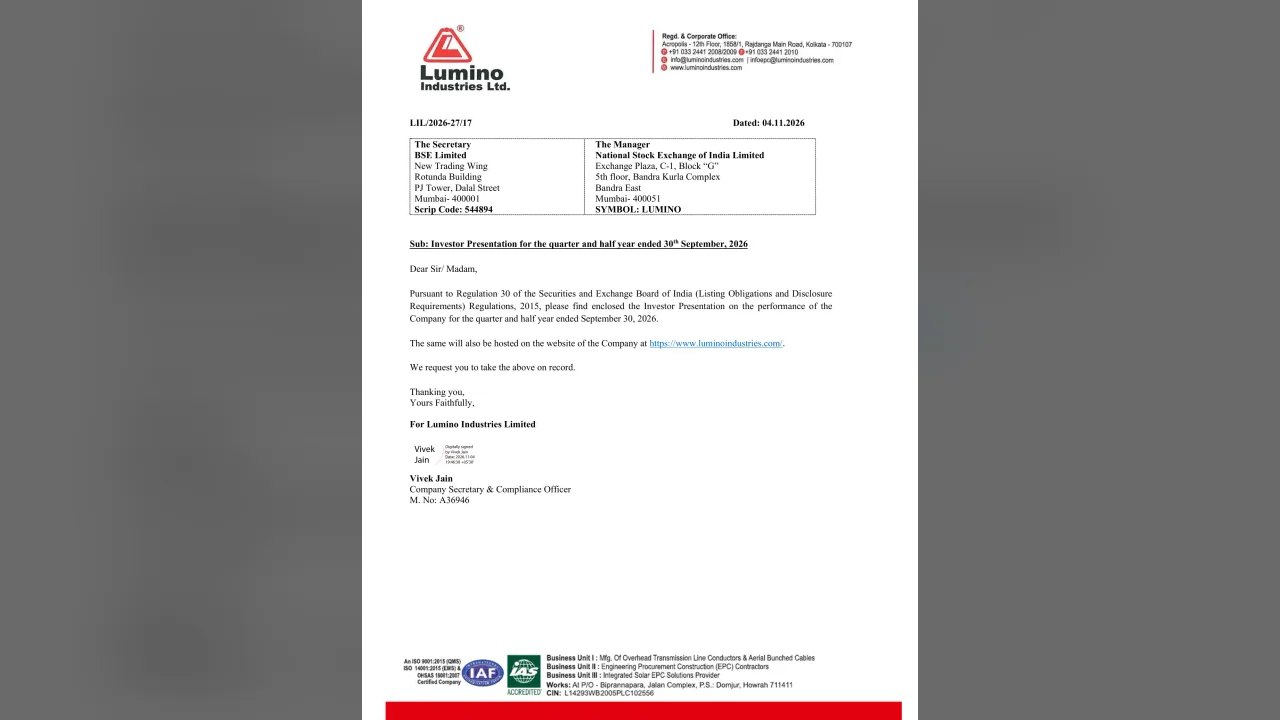
On 6ix: 6ix.com/event/lumino-industries-limited-lumino-q2-2027-earnings-call
Automated transcript · Written by software from the replay's audio. It can mishear names and figures; the replay is the record.
0:00 Ladies and gentlemen, good day, and welcome to the Lumino Industries Q2 FY 'twenty seven Earnings Conference Call hosted by Motilal Oswal. As a reminder, all participant lines will be in a listen only mode, and there'll be an opportunity for you to ask questions after the presentation concludes. Please note that this conference is being recorded. I now hand the conference over to Ms. Tina Vermani. Thank you, and over to you. Thank you. Good afternoon, everyone. On behalf of Motilal Oshal Financial Services, we welcome all of you for Lumino's... Lumino Industries conference call for second quarter. We would like to thank the management for giving us an opportunity to host the call.
0:47 From company side, we have with us mister, managing director, mister, full time director, mister, CFO. So I'll hand over the call to the management team for their opening opening remarks. And then after that, we will open the floor for Q and A. Over to you, sir. Thank you. So good afternoon, gentlemen. I'm Devinder Goel. I'm the Managing Director of Lumino Industries. Thank you for joining us today for Lumino Industries Limited Q2 and H1 FY 'twenty seven earnings conference call. This is an important occasion for us as it is our first quarterly earnings call since the company's listing in September 2026. On behalf of the entire Lumino Industries team, I welcome all our stakeholders, investors and analysts.
1:36 I would like to thank our shareholders for the confidence they have placed in the company. We understand that being listed company brings a greater responsibility towards our investors, and we remain committed to transparent communication and creating long term value for our shareholders. As we begin this new phase, I would like to use this opportunity to give you a detailed understanding of Lumino Industries, the markets we serve, the strength of our business model and the opportunities we see ahead. I will also discuss our operational developments, order book, capacity expansion and key priorities. Following my remarks, our CFO will take through the financial performance for the quarter and the first half of FY 'twenty seven in greater detail.
2:27 So let me begin by explaining the business we have built over the past three decades. Lumino Industries operates in India power transmission and distribution sector. Our business has developed around a clear need, electricity must be transmitted and distributed safely and efficiently from the point of generation to the point of consumption. This requires a larger network of conductor, cable, electrical wires, substation, transmission line and supporting infrastructure. We participate we as Lumino participate in this entire value chain or the ecosystem through our two business segments. One is manufacturing and the other is the EPC, which is engineering, procurement and construction. Our manufacturing business produces aluminium conductor, power cable, electrical wire and including special products such as high temperature, low side conductors, which is commonly known as STLS conductor.
3:27 We also manufacture high performance conductor, which is like AL-fifty nine. These products serve a wide range of application across power transmission and distribution and renewable energy, industrial facilities, railway networks, communication systems, electrical panels. These are the various industries where we cater to the demand for wired and cables. High temperature low SAC, which is STLS conductor are advanced overhead transmission line conductor designed to carry significantly higher electricity current than the conventional ACSR conductor without requiring substantial changes to the existing transmission line infrastructure. In India, STLS conductor are increasingly important for power transmission capacity enhancement, grid modernization and evacuation of renewable energy, particularly with constructing new transmission line corridors or acquiring additional right of way is difficult.
4:31 Our EPC business undertakes projects across extra high voltage substation, power transmission and distribution, HTLS reconditioning, solar and water management. These projects involve planning and execution of infrastructure, including the supply of materials, installation and associated commissioning activities. The combination of these business is an important part of our operation. We are not limited to supplying product nor are we dependent only by executing infrastructure project. We can participate at different stages of the value chain supported by our manufacturing capabilities and project execution experience. This integration is one of our key strengths in Lumino Industries.
5:18 For an EPC project, the availability of the right product at the right time is important for meeting the project schedules. Our in house manufacturing capability allow us to supply certain products directly to our own project, giving us greater control over product specification, quality and availability. It also reduces our dependence on external supply for these requirements. At the same time, our manufacturing business supplies product to external customers, including power utilities and EPC companies. This gives us access to demand beyond our own project portfolio. The two businesses, therefore, serve different customer requirement while also supporting each other. During FY 'twenty six, approximately 23% of the specialized products used in our EPC projects were manufactured in house. The model also supports our bidding process.
6:13 Our understanding of the product, their application and their cost helps us assess project requirement and plan procurement and execution more effectively. Over time, we believe that the combination of manufacturing knowledge and EPC experience can support stronger customer relation and a wider range of business opportunities. Now I would like to talk about our manufacturing capabilities because whatever revenue that we generate, 70% of the contribution is from product and and 30% is from the EPC. So for us, Lumino is more of a product company than an EPC company, and this is how we would like to grow going forward. We would like to be seen as a product company and not as an EPC company, and management is continuously working towards reducing the exposure on EPC.
7:04 So I would like to talk about our manufacturing capabilities. We currently operate two manufacturing facilities at Haura in Bazengal with a combined annual capacity of 40,000 metric tonnes for aluminium. Our facilities are supported by warehousing infrastructure and in house testing lab accredited by NABN. Our product portfolio covers both the convention requirements and specialized application. Aluminum conductors are used in the overall transmission line and distribution line. Power cables have applications ranging from substation to industrial installation to railway signaling and electrical systems under our brand LUMINO. We also manufacture electrical wires, including housewires, earth wires and thermostat insulated wires.
7:55 We have added products such as AL-fifty nine and STLS conductor to our portfolio. Our electrical wire business and cable portfolio also provides opportunity to serve broader range of customers and applications. We have recently obtained U. S. Certification to support exports to the markets, including U. S. And Europe. Our manufacturing footprint is located in West Bengal with access to rail, road, port infrastructure. From this base, we supply customers across India and overseas. Our operations have covered most of the state unit territories most of the states and the unit territories in India. With exposed to 17 countries as of September 26.
8:42 This reach reflects the range of applications served by our products. Our customers include power utilities, infrastructure developers, EPC companies and international customers. We aim to build on these relationships through product quality, dependable supply and a better understanding of customers' requirement. Alongside our manufacturing business, our EPC operations provide another avenue for growth. We have experienced across several areas of power infrastructure, including power substation, transmission and distribution networks, reconducting of HTLS conductor. We also have executed projects outside India, including our first international EPC power distribution project in Rwanda.
9:34 The EPC business requires across engineering procurement and material supply, site execution and project milestone. The scale and duration of each project depends on its scope, location and technical requirements. As project progress, the timing of the billing and the collection is linked to the contractual milestone, customers approval and the completion of the specified work. This makes project planning and working capital management important part of our EPC operation. We focus on aligning procurement with project requirement, maintaining execution schedules and ensuring that the work completed is appropriately done and built. Our in house manufacturing capabilities provide additional support in the process, where product specification and project economics permit supplying product manufactured by us can improve coordination between procurement and site execution.
10:34 This is particularly relevant when managing projects that require specialized conductors and cables. We see the manufacturing and the EPC business as complementary part of the same operating platform. Our objective is to grow both the businesses while maintaining discipline on order selection, project execution, use of capital and the ratio of revenue generated between two verticals, which is manufacturing and EPC. And as I said, that manufacturing would always contribute minimum 70% of the total revenue. Let me now discuss the industry environment and why we see a favorable long term opportunity for our business and our growth.
11:19 We see opportunities for conductors and cable supported by renewable capacity addition, the expansion of data center and the continued investment in power infrastructure. Initiatives such as Green Corridor Phase III and infrastructure development under Prahana Mantri Gatti Shakti are expected to support demand for our products. We also see opportunities for specialized products, particularly STLS conductor, as utilities seek to increase power transfer capacity across existing networks. India's electricity requirement are rising as economic activity expands. Industry capacity grows and more household and business gains access to reliable power. At the same time, the energy mix is changing with renewable energy becoming an increasingly important part of the country's power generation capacity.
12:13 These developments create requirements across the electricity network. New generation capacity needs suitable transmission infrastructure to carry power to the demand centers. Existing network need to be upgraded to handle changing power flows, while the distribution system requires investment to improve capacity, reliability and efficiency. The industry's investment opportunity, therefore, extends beyond the construction of new transmission lines. It also includes the expansion of substation, the replacement and upgradation of existing conductor, underground cabling, renewable energy evacuation and energy associated with railway electrification and industrial development.
13:08 So now I will take you through to the financial performance. For quarter two FY 'twenty seven, the revenue from operation was INR $6.61 crores compared to INR $50.09 crores in quarter two FY 'twenty six, representing year on year growth of 30%. EBITDA was at INR 84 crores with an EBITDA margin of 12.8, while profit after tax was INR 53 crores with a margin of 7.9%. In the first half of financial year 'twenty seven, the revenue from operation reached at INR $11.83 crores, representing year on year growth of 25%. EBITDA reached at INR 155 crore with a margin of 13.1% and profit after tax of 93% with a margin of 7.8%.
14:02 The cash flow from operations for H1 financial year 'twenty seven was positive by INR 56 crores. The repayment of borrowings from the IPO proceeds has further strengthened our balance sheet. The reduction in debt service cost is expected to generate greater utilization of internal approvals towards growth of business expansion. An important indicator for our business visibility is our order book. As of 09/30/2026, our closing order book stood at INR 2,885 crores. This comprises of INR $9.22 crores of orders for our manufacturing segment and INR $19.63 crore order for EPC segment.
14:48 Additionally, we secured orders worth INR $3.86 crores in October, comprising of INR $2.29 crores for Manufacturing segment and INR 157 crores for EPC segment, taking the order book total to INR 3,093 crores as of October. Additionally, as of date, we are L1 in tenders worth INR $5.55 crores. The manufacturing order book includes conventional and high performance conductors, also includes HD, LP railway signaling cables. This reflects demand across different product categories, while the underground cabling orders add to the EPC project portfolio.
15:35 Capacity expansion is another important part of our plan. We are deploying our new manufacturing facility for we are developing our new manufacturing facility at Ranihati Havana on a land acquired for this purpose. The facility is planned to add 35,000 metric ton of capacity in phases, taking our total installed capacity from 40,000 metric ton to 75,000 metric ton per annum. The new facility is intended to expand our cable manufacturing capabilities, particularly in ST cables and broaden the range of products we can offer. The additional capacity is planned to come up in stream of phases, in line with the facilities development and operational readiness.
16:23 Our expansion is important. It adds capacity input in the product categories that complement our existing manufacturing operations. It also provides opportunity to support future demand without relying solely on the current facility. Our focus will therefore be on commissioning the facility in a planned manner, establishing production process and building utilization as the business develops. So now I would like to talk about how the next phase for Lumino looks like, where would we see the growth coming from, where would we see the revenue and these kind of EBITDA margins that we're talking about, we would be able to generate these kind of numbers. So our focus will be centered on five areas.
17:13 The first will be we will focus on execution of our manufacturing and EPC order book, timely delivery, product quality, site safety and adherence to project requirement remains central to maintaining customers' confidence in securing repeat business. Second, we will work to expand the contribution of specialized products, including HDLL and a broader range of power cables. We believe that developing our capabilities in these areas can improve our product offering and create opportunities across transmission, distribution, railway and industrial application. Third, we will focus on efficient use of our manufacturing asset. As we bring additional capacity into the operation, we will pay close attention to utilization, operational efficiency and the development of demand for the products manufactured at the new facility.
18:04 Fourth, we will maintain close attention to the working capital and cash flow. Manufacturing and EPC have different procurement execution, billing and collection cycles, managing inventories, receivables, supplier payments and project milestones will remain important to ensuring that the business growth is supported by sound financial management. Fifth and the last point, we will pursue growth with discipline. Our integrated business model, established customers relationship and experience across power infrastructure provide a base for future opportunities. We intend to build on these trends while assessing new projects and investments on their commercial merits.
18:54 To conclude, Lumino enters this phase with more than three decades of experience in power transmission and distribution sector as product manufacturer and as an EPC, an established manufacturing platform, EPC execution capabilities and product portfolio serving a range of infrastructure application. The investment requirement associated with the rising electricity demand, renewable energy integration and network modernization provide a long term opportunity for our business. Our aim is to translate these opportunities into sustainable growth through the right product mix, timely execution and efficient use of capacity. We thank our employees, customers, suppliers, banking partners and shareholders for their support as Lumino Industries begins its new chapter as a listed company.
19:48 We look forward to engaging with our investors and keeping you informed about the process. Thank you. So now I'll leave the floor open for question and answer session. Sure. Thank you. We will now begin the question and answer session. We We have the first question from the line of Vedit Trivedi from Asian Market Securities. Mister, can you hear us?
20:42 As there is no response, we'll move on to the next question. We have the next question from the line of from Eco Quantum Solutions. Please go ahead. Sir, my name is. Sir, so my first question is, could you please share the revenue breakup of our manufacturing segment between cables and conductor? And within cables, how much revenue is coming from low voltage and about 33 kV cables? And similarly, within conductor, what is the revenue contribution from HDLS and conventional conductors? Fine. Thank you for your question. So the total revenue from manufacturing segment for H1 was INR $8.31 crores. Out of this, if you see on the conductor side, 65% of the revenue is from conductor, 35% of the revenue are from cable.
21:36 And for the HTLS segment, we did HTLS revenue of INR 50 crore in H1. And one more question was there regarding 33 kV. So we have set up a new facility where in the commercial production will probably start by December or January first week, wherein right now we are manufacturing low voltage cables only from December or January next calendar year, we will start manufacturing cable of medium voltage, which is right from 3.3 KV to 33 KV. That is where we've started expecting revenues from this range of product. But I would also like to inform that by the time we will start a commercial production, we also have a decent order book in hand for eleven thirty three kV cable to the TINO for more like $50.55 crores.
22:28 Okay. Great. Okay. So with the new facility coming online, so it will improve our product mix towards high voltage, medium voltage and high kV cable. So how should we see the EBITDA margin of the manufacturing segment going forward? This manufacturing facility, the new manufacturing facility would be coming up only in quarter four. In quarter four yes, so there would not be a substantial increase in terms of EBITDA margin for the current financial year. However, going forward, as the production for the new plant comes up and picks up, so there will be generally the EBITDA for the high-tech HD cables are 1% to 2% higher than the normal cable. So you can expect that our EBITDA would also go up by 1% to 2% on HD cable. However, on the blended basis, the EBITDA for the manufacturing segment should be in the range of 12% to 13%, 13.5%.
23:30 Ajith, for us as a new entrant to eleven and thirty three KV cable, our margins would not be there will not be a substantial increase in the EBITDA margin, reason being we would be entering this market though we carry a lot of experience of thirty, thirty five years of power sector. But to penetrate, obviously, it will take time. There'll be some price competition. So to bring those advantages to the balance sheet, I see after twelve months, the the numbers should improve in a better way. Could you please share the total volumes achieved in H1 FY 'twenty seven and how they are compared with H1 FY 'twenty six? And going forward, how should we see the volume growth for next two to three years in manufacturing such? Okay. Yes. So for H1 FY 'twenty seven, we did a total tonnage of about 13,781 metric tons.
24:23 And compared to H1 of FY 'twenty six, we did about 15,800 tonnes in H1 FY 'twenty six. So you see there is a slight decrease in the volume. That's because we have focused more this year on value added products. So because of our increase in this year as compared to last H1 in HTLS and PL-fifty nine conductors, that has led to the decrease in the tonnage. So typically, would like to say that with an installed capacity, right now, we have 40,000 metric tons of installed capacity in FY twenty five, twenty twenty six, our capacity utilization is approximately 82% to 83%. So and this year, H1, our capacity utilization is actually around 60%, 62%.
25:11 But effectively, it is 80% on a basis where we have manufactured high value items, better margin items, which effectively gives me an 80% utilization. Yes, because AL-fifty nine typically takes up more production capacity as compared to conventional conductors. You can have a higher HLS conductor, so they think about 1.5% almost capacity. So effectively, we've produced the same quantity as last year, H1. Thank you, Ajeev. And going forward, how should we see the volume growth for next two to three years? So Ajith, we are almost at 82% utilization. So from the existing plant, hardly there would be any major growth coming up in terms of quantity. But since once the Ranihati plant comes up, the major growth drivers would be coming from the Ranihati plant.
26:05 So wherein we'll be adding around 30 metric 35,000 metric tons. And in Phase one, we'll be adding 10,000 metric tons. So we believe that in next financial year, we should be able to use at least 70%, 75% of the 10,000 metric tons of new capacity that we'll add into our system. And going forward, every year, we are adding 10,000. So we believe that gradually that growth will be there. And by FY 'twenty eight, 'twenty nine, we should be having a capacity of 75,000 metric tons, out of which, yes, I believe we will always, as a management, we'll work very hard to ensure that we are using capacity at least to the tune of 80%. Yes. Could hear you clearly, sir.
27:06 My voice is not clear. Yeah. Now it is better. You said you are a retail shareholder of Lumino Industries? Yes. Yes, sir. You'll see those... You'll see somebody get through substantial credit receivables. I trade acceptance. How much of these receivables are over these? When do you expect to collect them? And what state is company taking to improve operating cash flow? Thank you. Thank you, sir. Sir... Yeah. Taking So as we currently... The cash flow from operation, if you see our cash flow is positive by INR 56 crores in September 26 as compared to INR 63 crores in September 25.
27:54 However, this INR 56 crores which you are seeing, this includes our reduction in trade acceptance to the tune of INR 68 crores, which we have paid from the proceeds of IPO. So had this INR 68 crores not been paid, you would have seen my cash flow from operation would have been positive by INR 125 crores, which is substantial as compared to September 25. Further, your question was on working capital. So if you see in March, my working capital was almost seventy three days, which has further come down to sixty six days as of September 26. Your third question was on realization.
28:39 So if you see my balance sheet as of March, we had our total debtors beyond six months, which was around INR $2.30 crores. My total debtors was almost INR 900 crores out of which more debtors more than six months was INR230 crores. So out of that INR230 crores, as of date, we have realized INR215 crores from that. So there is hardly any debtors which are beyond six months. However, in the nature of industry in which we operate, you will always see that the quantum of data is to the tune of INR700 crores, INR800 crores. But the payment cycle for the EPC are that we get 60% of the payment once we supply the material, we get 30% payment once the material are erected and 10% payment comes once the contract is completed and is kept with the project authority as retention amount.
29:34 So considering all that, our EPC working capital cycle as of September is one hundred and eleven days, which earlier was one hundred and twenty days. So there has further been improvement of nine days in working capital cycle for EPC segment. In terms of manufacturing, in March, it was almost fifty days, which has further come down to forty six days. We expect the working capital should further improve going forward. I hope we have been able to answer your question, sir. Yeah. Thank you. Thank you, sir. Thank you. Thank you. Participants who wish to ask a question may press star and one on your touch tone telephone. We have the next question from the line of Abhishek Kamdar from Value plus Advisors. Please go ahead.
30:29 Yes. Hi. Am I audible? Yes. We can hear you. Yeah. Thanks for the opportunity. I just wanted to know the order book that you saw has gone... The September 5 was 2,885. And post that, I think you would have put about almost 400 crores of orders plus an additional 555 crores of l one tenders. What do we expect the order book to be by... Be at by the end of this financial year? Abhishek, yes. So we expect the order book to be in the same similar range because as you understand in manufacturing, the order book is normally about five to six month order book. So as we are executing orders from now on to March, we'll be expecting the same kind of profitability in the manufacturing sector.
31:31 And similarly, EPCL sales, as we're executing orders, we'll be expecting in the same range. And Abhishek, there's another thing. The total order book is approximately with the L1 thing that you're talking about, the order book would be approximately INR 3,400 crore. Out of which EPC would be? Would be around INR 2,200 for the EPC. So Abhishek, the order booking is not a challenge in today. However, our focus remains on cash flow from operations that the project which we are executing, the cash flow should come on time and also the project should be completed on time. So the focus remains on that. As a result, which you see that the number which we have reported cash flow from operations, you have seen a positive cash flow. Further, in case you would have not paid the trade acceptance, this would have further gone to 125 crore. So we focus is there to have positive cash flow, complete the project on time and have a healthy EBITDA.
32:32 And secondly, Abhishek, our revenue contribution is 70% from product and 30% from EPC. So you might have a question that you have such a substantial order book on EPC. So how does it contribute to 30% only? So for manufacturing, our tax for the order book is around three to four months, whereas for EPC, we tax around three years. So this order book that you're talking about is spread over three years for EPC. Correct. Correct. Understood. Yeah. So fair enough. And I just wanted to check. You mentioned operating cash flow has has positive at about 56 crores net of the repayment of trade acceptances. Yes. What is the expectation for H two on this, on the operating cash flow? Do we expect a further improvement?
33:24 100. So Abhishek, absolutely, you will see further improvement in operating cash flows because our focus is always on realization and reduce the working capital cycle. So going forward, we expect that it should improve further. And this will be contributed both by the EPC and the manufacturing side, the improvement? Yeah, both the segments. Mostly mostly EPC because there has been long dues. We have completed those projects that are retention money line. So we expect that in H2, a lot of retention money is what we'll be able to bring back into the system. So that will help in making our cash flow healthier and positive, more positive. All right. Thank you and all the best. Thank you, Vishay. Thank you. We have the next question from the line of Rahul Shah, an individual investor. Please go ahead.
34:18 Good afternoon, sir. Congratulations on a great set of numbers. I have a couple of questions, but I'll start with the number one. How many substations of two twenty k v and 400 k v have been completed and handed over to the client? And when are we going to be eligible to bid for $7.65 k v station... Substations? Okay. Any other question, Rajesh? Another one is during the IPO, it was mentioned that substantial amounts of nearly 100 crores was stuck with West Bengal Electricity Board. How much of those monies have been received till date? Yes. Okay. So Rajesh, answering your second question, which is West Bengal Electricity Board, we have received INR98 crores, like total outstanding was approximately INR140 crores out of which we have received INR138 crores.
35:06 So right now, the outstanding is approximately INR2 crores only from West Bank Electricity Board. Now coming to your first question, which is how many EHP substation up to INR220 and 400 KV have we handed over? So we are in the process of completing these substations to the orders received last year. By March this year, we'll be completing about six substations, which will be five two twenty KV and one four hundred KV. And until now, we've already completed one from our earlier orders. So once we hand over the substations within March 27, we would become eligible to bid in tenders up to $7.65 KV. So we believe that next financial year, the company should be qualified to bid in tenders up to $7.65 KV.
35:54 Understood, sir. All the best for the future. Thank you. Thank you, Thank you. We have the next question from the line of, an individual investor. Please go ahead. Yeah. Thanks for the opportunity. And, sir, first of all, congrats on a great set of numbers. So, sir, my question was, you know, what is the outlook on underground EHV cabling orders? I mean, have you started getting any meaningful orders? And from which clients would that be? Okay. So, Rajvi, until now, we have been manufacturing low voltage power cables, which is though that is also used in underground cabling system.
36:44 But we are setting up a new manufacturing facility, which should be up and running by December, end of January first week, wherein the voltage rating would be medium voltage and high voltage cables right from 1.1 to 66 kV. So in that, we've already received orders worth INR 50 odd crores of INR 11 and 33 KV. And these are different clients like HD, Infra, Harteck Power, Vail and BPCL. So these are various clients that we have received the orders from. And also we've received an order a few days back from Gujarat Electric ity Board, DGBCL, which is an underground cabling order within the EPC and supply of underground cables. So that is about INR 75 crore order and out of which about 60% is the HDK.
37:37 That is HDK only. Yeah. HDK. Right now, in cable in cables, we already have an order book of almost, like, 400 crores for for up to 1.1 k. Understood. Sir, also sir, what's the outlook on the HDLS fund? We understand that there could be a potential of around annual order inflows of around INR 5,000 crores. I mean, does that outlook still stand? Could you please throw some light on that? Yes. STLS TAM for next financial year, we are looking at INR 5,000 crores. The numbers are pretty strong. We believe that this is how it this is these are the numbers which should be there in next financial year as far as the TAM is concerned. And we expect that 10% to 15% of the TAM is what we would be able to convert as our orders. Understood, sir. You, sir. I'll get back in the line. Thank you, Bharat.
38:27 Thank you. We have the next question from the line of Abhishek Tandar from Value plus Advisors. Please go ahead. Yeah. Hi. Thank you for the follow-up. I just had one question around the year '59. You mentioned that the... It takes up higher higher portion of the free cash. I'm sorry to interrupt you, Abhishek, but your voice is breaking up a bit. If you could come closer to the microphone. Is this is this better? Yes. This is better. Yes. Yeah. Thanks for the follow-up. I just had a question around EL 59. You mentioned that it consumes about one and a half times the capacity of conventional conductors.
39:13 In that sense, I have two questions. One is around the premium that we command for the AL-fifty nine. Is it on a capacity adjusted basis better off than our conventional conductors? Yeah. I... You had two questions. So this is one second. Yeah. And how should we think... So once we get to our 75,000 metric tons capacity with the expansion, how should we... You know, what should we expect in terms of product mix? Okay. With the Between the 15 and Yeah. So out of... Once we achieve that 75,000 metric tons, we assume and we believe that we should be able to use the capacity to the extent of 8085%.
40:01 So that would be approximately 56,000 to 60,000 metric tons annual. Out of that 56,000 to 60,000 capacity annually, are looking at say 20,000, 25,000 metric tonnes in cables and around 35 to 40,000 metric tonnes in conductors. Out of that 40,000 metric tonnes in conductor, we are looking at say, approximately 25,000 metric tons in AL-fifty nine and fifteen thousand tons would be contributed to HTLS and other conventional conductors. Now comes to your first question, which is about the premium between since we are making AL 59. So that's almost like 1.5 x of the conventional conductor. So what is the premium we are looking at? Yeah. So, yes, obviously, since it takes up more of the capacity, it does have a higher premium. But as the market in itself is moving from conventional to AL-fifty nine, that will be the standard form of conductors in a few years.
40:58 So that is why we see that there is a premium, but it's not substantial enough to cover that. Because right now, the demand from the TBCD is mostly for AL-fifteen and the commercial conductor demand is So gradually reducing, just phasing the EBITDA margin is mostly the same when it comes to... A little bit better in the 59 compared to conventional conductor. Got it. So in terms of our share of the 59 going up, expect our EBITDA margin should remain in this 12 to 13 and a half percent band even after we'll get to the 75,000 tonnes? Yeah. It should be within that range. Though as a management, we're definitely working towards reducing the cost, bringing more efficiency.
41:49 But there's something which I would like to comment that, you know, it should be within that range, but this will always pursue and work hard towards a better efficiency and a better margin. Sure. Alright. Thank you. Thank you. We have our next question from the line of from Seven Islands PMS. Please go ahead. Hello, sir. Am I audible? Yes. You are. Hello? Okay. Thank you. Also, my question is on the finance cost, sir. Since our gross debt is already down to $1.28 crores after the IPO, But we still have a lot of credit acceptances of around 520 crores, bank guarantee cost also, which adds up a lot to the finance cost.
42:39 So what is the finance cost that we expect for f y twenty seven and f y twenty eight? And it's only how much the reduction possible, if that way you can answer. So, Kartika, we have raised funds of 500 crores out of which INR $3.37 crores, the object was towards the repayment of the debt. Out of that INR $3.37 crores, we have already repaid debt of INR $2.64 crores as of September. However, this debt was paid towards the end of September, so that is why you do not see improvement in finance cost this year. However, in H2 of the current financial year, since most of the debt has been paid, you will see an improvement of INR 15 crores to INR 16 crores in H2 in terms of finance cost.
43:33 The balance out of INR $2.64 crores, the balance INR 75 crores debt, which is pending, that should be paid within November 15 because the due date for those dates were at November 15. Moving on, going forward, you will see the debt should be at the similar range. And on an annual basis, you see that, yes, there should be a reduction in finance cost to the extent of between 20 to 25 crores. Okay. Okay. So I have more on the Yeah. Yeah. That's that's okay. So we are expecting this claim to approximately 15 crores saving on FY '27 and 25 crores by FY '28. So I'm just asking. Right. One more question on the working capital, sir.
44:19 Since you are saying that we are already almost 80% capacity utilized on the manufacturing side, so given the growth which we are expecting in h two, is this right to assume that that will be most probably be driven by the EPC segment of the business? And if EPC is driving the growth, there might be some stretch on the working capital. So how much stretch is possible from the current sixty six days on the working capital? And if debt is to be maintained at the current level, do we have enough visibility on the cash generation from the current business? Yeah. We have enough of visibility on the cash generation, and the growth would be contributed by both the product and the EPC.
45:04 We feel that, you know, like our product would from H1 to H2, our product will increase by 30%, 35%. And our ratio between the revenue generation would be 70% product and 30% would be the EPC. So we don't foresee our working capital or the capital requirement getting stressed because of EPC because we are maintaining that ratio, and we would not be growing in a big way in EPC. That is what the management has decided. So we'll keep EPC within that range. And for that, we have the capital visibility. Okay. And for twelve twelve to 13% EBITDA margin, which we are guiding for, that is the consolidated margin. Right? If you could give me the margins which which are there for the EPC business, how much margin are we expecting from the EPC business business?
45:55 Yes. So for manufacturing segment, we reported an EBITDA of 13% for h one, and for EPC, we reported an EBITDA of 13.5%. Blended basis, it was 13.1. Going forward, the manufacturing EBITDA should be in the range of 12 to 13, 13.5, and EPC should be in the range of 13 to 14%. We have the next question from the line of Viraj Jain, an individual investor. Please go ahead. Hi. Thanks again for the opportunity. Sir, in general, we are listing that, you know, all the EPC players are facing labor shortages.
46:42 Whether we are also facing any similar issues and how do we intend to tackle this? Yeah. Yeah. Hi. So, yes, there are some labor shortages in general in transmission line specifically. Since we do not operate much in that segment, so we are not facing the same kind of challenges. And secondly, Biraj, since we are doing most of the jobs are EHE substation, so we have a set of gang for labor gang. So for us, is not an issue when it comes to E and T substation. Mostly, it is in the transmission line where the labor shortage is happening, and we are not doing transmission line projects. Understood, sir. Thank you so much. Thank you, Viraj. Thank you. As there are no further questions, I would now like to hand it over to the management for closing comments.
47:31 Yeah. Thank you, everyone, for taking the time to join us today and for your continued interest in Lumino Industries. We sincerely appreciate all your questions, observations and valuable feedback. We remain committed to maintaining transparent and consistent communication with all our stakeholders. As we move forward, our focus will continue to be on strengthening our manufacturing capabilities, improving operational efficiencies and expanding our presence in high growth segments and delivering sustainable and profitable growth. We are confident about the opportunities ahead and look forward to our continued support and association with Lumino Industries. Thank you once again and have a great day. Thank you. Thank you. Thank you. On behalf of Motilal Oswald, that concludes this conference. Thank you for joining us, and you may now disconnect your lines.
Follow Lumino Industries Limited into a list and get an email when it puts out news.
at Motilal Oshal Financial Services
Managing Director at Lumino Industries
at Asian Market Securities
at Value plus Advisors
individual investor
at Value plus Advisors
individual investor