Transcript
Automated transcript · Written by software from the replay's audio. It can mishear names and figures; the replay is the record.
0:11 Hi, everyone. Thank you for joining Core Mining's Live Investment Summit today hosted by 6. Today we're going to be reviewing the company's 2020 accomplishments and what investors can come to expect in 2021. Core Mining's President and CEO, Scott Tribblecock, is going to walk you through a company presentation. And then after that, we're going to be accepting questions. As a reminder, you can submit your questions at any point during the presentation in the Q&A panel in the right-hand side of your screen. We also have a copy of today's presentation
0:42 available in the handouts tab for you to download. And just so everyone's aware, this webinar is being recorded and it's going to be available for playback on the company's website. Without further ado, I'm going to hand it over to Scott.
0:57 All right, thank you very much, Jane. Good morning, good afternoon, good evening for everyone out there. Thank you very much for taking some of your valuable time to spend it with Core Mining. In respect of your time, I'd like to keep this relatively short. I'll try and keep my talking to 15 minutes or less. That's what I've committed to the IR team. I understand everyone's getting a little bit of a Zoom burnout. I'm getting a little tired myself of sitting here in my basement. But despite that, it's been an incredible year for Core Mining. I'm very proud of the team we've put together at Core and what we've accomplished in 2020. We've started adding significant value to the company's assets and to our shareholders.
1:46 And I'd expect equal or better value creation in 2021 with what we have planned for the company. So I think it's both an exciting look back at what we've accomplished in 2020 and super exciting about what we can expect in 2021. I think for those of you in the sector, myself, I'm a large investor in core mining. I'm a strong believer that we're in the early stages of a long term gold cycle. There's going to be ups and downs in that cycle, but I think gold is going to be an attractive asset class and commodity for several years to come here. And as a result, I think we're in for some incredible potential value creation for those companies that have the kind of assets where you can make moves from a deal perspective, add value into the ground by exploring and developing and unlocking latent value in those assets.
2:41 And Core has a portfolio of great gold assets to push through this cycle and generate value for our shareholders. I will be making some forward-looking statements, so please, I always encourage everybody, please just review all of our materials, AIF, MD&A and various other documents both on our website and CDAR before making an investment decision to thoroughly understand the risks. Now I imagine many of you out there watching this already know a lot about core mining and want me to get to sort of the guts of some of our recent news releases. But let me step back for those of you that might be new to the story and give a very, very quick overview. Some of the key attributes of Core that differentiate itself from some of its peers. Core is a portfolio company.
3:32 You're gonna hear that a lot, both in the strategy we're pursuing from here forward and talking about what we did in 2020, but Core has built a portfolio of 3 very high quality assets in safe and stable North American jurisdictions. We're unlocking value in those assets by having both a development capability. So we're moving the Imperial project through permitting to become a mine while having a great exploration team that's adding value with the drill bit and other forms of exploration across the portfolio. We're also aggressive entrepreneurs. We've been doing land deals, staking and other activities to add value to our assets on the ground. We'll talk about some of that.
4:21 All of that, particularly having a portfolio, means we've been able to set up a large number of value catalysts in 2020, and we don't see 2021 being any different. We are very aligned with you, the potential or current shareholder in that management owns 38% of the equity. We've attracted 3 strategic investments from Eric Sprott, who now owns 26% of the equity. And in 2020, the strategy was raise capital to daylight value from this portfolio. And that involved 100% of our fundraising coming from Eric. We've not done any public financings and that leaves a large potential untapped investor market out there for core in 2021 to keep adding value.
5:09 The company based on the on those assets and what we've put together in 2020 looks very cheap compared to our peers. So we believe there is a lot of value to create in 2021 in our portfolio despite having a good 2020. I hope Courage shareholders are pleased with performance.
5:30 The company has 4.9 million ounces of resources to backstop the valuation. I was just running some numbers as I was sitting here thinking about what to talk about and to make sure we can really get people to understand the heart of what Core is. So to give you, put some numbers, Core is currently trading at about $30 CAD per ounce in the ground. And those ounces are in these safe and stable jurisdictions in California and British Columbia. If you look at a peer group of North American gold developers, they're trading at an average of $100 per ounce, over 3 times Coors Current valuation. If you take a group of peer explorers, BC Exploration companies, they are trading at an average of $60 per ounce in the ground for those that have resources and an average of about $120 million market cap.
6:27 All of those show great value potential for individual core assets and for the company as a whole. How does Cores Board unlock that value? Well, we'll talk about that as we go through this presentation today. That's a brief introduction of the company. It is backstopped by ounces in the ground. The company has PEAs on both the Long Valley and Imperial that also give PNAV valuation we'll talk about. But let's step back a bit and talk about recent news flow and what's got us most exciting here at Core as I walk through 2020 and 2021. So just this morning, so at 8.30am Eastern Standard Time, we put out a news release with a great staking program that we'd implemented over the last month to increase the exploration potential at our Long Valley asset.
7:21 So Long Valley is a 1.7 million ounce epithermal gold deposit in Mono County, California. The project is located near infrastructure and this claim staking that we've done has captured all of the regional deep rooted structures that we've mapped at surface. These are fault structures and the main gold mineralization that you can see in the sort of yellow and gold colors on this map, right in those original green claim blocks is the 1.7 million ounces. Look at the scale potential we've created with those blue claims that we put out in a news release this morning. We've increased the claim size by 750%.
8:09 Across those new claims, which are the blue blocks, there's widespread alteration, indications of epithermal type gold mineralization. There's lots of potential to grow both make new discoveries and step out and grow the current mineralization we've had. So I think we've added a great district scale exploration story around this original 1.7 million ounces project that we started the beginning of the year. On some of that field work we did earlier this year shows that a lot of the fault structures that control the current mineralization, You can see these red lines going north, south, up and down through the resource are now captured on this new claim block.
8:56 You can see alteration mapping extending well off of the original claims onto this new claim area. And we're currently permitting a drill program to step out and grow that 1.7 million ounce resource. And you can see the various target areas that we've identified. We have a drill program currently in permitting with the US Forest Service. That's a federal regulator who owns the land, and we'd expect to get permits and start drilling in 0.5 1 of 2021. That drilling will be to step out and drill oxides to expand the known resources, as well as to test for underlying sulfides that are known to exist under this deposit. And we'd be looking specifically for high-grade sulfides at depth to look at expanding and creating a new path to value in this deposit.
9:49 The deposit is a fully intact epithermal and should have a boiling zone that has potential for ultra high grades and we'd like to test some of that as well. So exciting drill plan coming in 2020 after putting together this great exploration story in 2020. The 1.7 million ounces, however, there's more to it than just ounces in the ground. We completed a PEA on this project in 2020 that shows a potential value by moving through the development process for this deposit of $273 million NPV5 at $1,600 gold. That is a very low pre-production capex number to produce 700,000 ounces of gold at a rate of almost 100,000 ounces per year. We believe with those oxide drill expansion targets, we can expand and extend the life of mine at that mining rate.
10:45 And we've also got the potential to add silver to the economics of the project because silver was never assayed in historic drilling. It was only assayed for gold back in the 1990s. So there's an extra kicker coming from a silver in the deposit as well. So here we have a district scale exploration play with a defined resource with a great PEA that CORE is going to advance with drilling in 2021. So similar story at our Imperial Gold project At Imperial we also completed a PEA earlier in 2020. This showed a great NPV, $450 million NPV, a 52% IRR for again a low pre-production CAPEX.
11:30 This is a simple run of mine heap leach operation producing almost 150,000 ounces of gold per year. This project had the benefit of a lot of historic work. There was a historic feasibility study and a historic environmental impact and archaeology study of the sites. We also have a water well drilled on site. All of this gave the board confidence to immediately move this project into mine permitting. So as opposed to drilling more resource like we are at Long Valley. This project is moving immediately into permitting. So you would expect in 2021, we should see several milestones as we move through the permitting process, the acceptance of our plan of operations at the BLM, the start and development of the environmental impact assessment, the generation of social license to operate. These are all activities that our development team on the ground at the Imperial Project are pursuing in 2021.
12:29 We have a very simple strategy for permitting this project, obey the law and keep it local. California law is applied to federal land locally by the county. So we are out right now engaging with local stakeholders to develop a coalition of support for the project within Imperial County. Obeying the law is the other key. That sounds trite. You obviously have to obey the law, but that's very important in California because there are very stringent both reclamation, So how you leave the site when you finished mining and environmental laws in California that are a great standard to operate a mine to and fully complying with those laws, which include reclaiming the site to a greenfield state. So, literally, we will be leaving this location when we're finished mining and reclaiming, very much like it was when we originally came to the site. And there won't be an eyesore left over for communities after mining is complete in multiple decades from now. So I think having that, those dynamics is a great way to generate and get through what we believe will be a well supported project in Imperial County.
13:39 But continuing on core's theme of district scale exploration potential core when and grew the claim blocks around that great PEA project by 360%, capturing a 28km gold trend that extends from the operating Mesquite mine in the east to the Picacho mine in the west, we think there's an excellent potential to go and explore and find new deposits on that those claims. So I'm going to accelerate again, third project in core. Earlier this quarter, we announced we'd increased the claims at this project by 330%. Core now controls 1000 square kilometers of claims in the Cariboo Gold District of British Columbia.
14:30 To British Columbia. This is a long, long history of gold mining district that is adjacent to a Cisco Development Corporation, which has hit the market with an $800 million valuation, $200 million in liquidity, led by Sean Roussin, who's planning to deploy 6 to 10 rigs to this site to aggressively drill. And CORE has the largest land package next to that project, as well as a flagship FG Gold, where we've been drilling in 2020. At that FG Gold project, we've been stepping out and drilling large step outs from the known 1 million ounce deposit, and we've been successful at showing that there's potential for large resource growth and underground potential at the project.
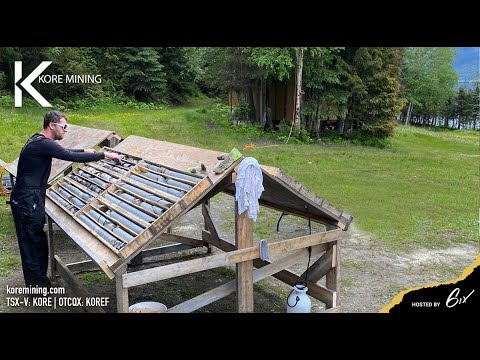
15:16 We've gone down 300m. We've drilled across 1.8km of a 3.6km mineralized strike and we've got a huge opportunity in 2021 to continue drilling this deposit. However, the early Part of 2021 is going to be putting out the assays from our 2020 drilling. We've got 14 holes at FG Gold at the lab. You should see more drill results coming out in January and February from this drilling. Then following that, we'll be drilling at another deposit on that huge claim block, Gold Creek, and you'll see 10 more holes from that drill program coming out also in 2021. So good news flow from the drill bit
15:54 in 2021. Core has only raised capital from Eric Sprott in 2020 and that has brought Eric to a 26% holding in the company. That leaves wide open the institutional investor market which has never been tapped by Core. So I think that will be a place where we will go in 2021. Core remains as I said earlier cheap on an ounces in the ground perspective. We also look reasonably cheap compared to the Priced and NAV of those great PAs I showed you. So all around, Core's got a lot of value to create to catch up and to our peers from a valuation perspective. Now put yourself in the in-cores board perspective. We've got this portfolio of district scale exploration plays with these huge claim blocks, lots of exploration to do, 2 PEAs back in Long Valley and Imperial. Imperial moving into the mine permitting process. So you've got this great development story at Imperial and Long Valley. You've got this incredible greenfield exploration story up in British Columbia.
17:00 All of these assets may not attract the same shareholders and definitely have different value drivers.
17:09 Derisking and getting a value for your net asset value in the ground of the PEAs is what you do in development, whereas creating exploration buzz and big torque to drill result news releases is what you like to see from Explorer. So as a result, Core has announced 2 weeks ago that we are in the process of considering breakup of core. We're looking to split the company between the US development assets and the BC exploration assets by spinning the BC exploration assets to our shareholders. So that would be you would have equal ownership as a current core shareholder in the BC spin co. And you know, we were joking around yesterday that it's kind of the US Thanksgiving sale, you get 2 for 1, owning a core share today.
17:58 What you're left with is core, They will have the US development assets that include those 2 PEAs, which have about 1 billion dollars Canadian in potential value at $1,600 gold and include those 2 great district scale exploration stories where we'll be permitting and drilling aggressively in 2021. You'll also end up an owner of the core exploration spin cloak. We haven't come up with a name yet because we haven't made the final decision. That company will control a strategic position in an emerging gold district right next to a Cisco gold development which we pounding the table in the caribou. We think it's a great time to put that company into a separate and a separate listed entity where you can
18:45 get the torque you expect from putting out the incredible drill results we put out from FT Gold this year. So I will stop there and I think you can get some flavor of what's coming in 2021. Obviously dominating news flow If the board chooses to go ahead will be the spinco transaction early in Q1. That'll include a peppering of drill results from these BC assets. Follow that with permitting and start of drilling in California for the original development company. And I think you're set up for excitement on both sides of the core story in 2021. All right. I almost kept it to 15 minutes. I couldn't help myself. Let's move into a Q&A session here.
19:31 All right. Thank you very much, Scott, for taking us through the presentation. We did have a number of questions come in through the live room as well as through our email channel. So let's get right to it. As a reminder to everybody that's in the room live right now, you can submit questions using the Q&A panel on the right-hand side of your screen. All right, without further ado, let's get to the first question. First question is asking about Eric Sprott's participation. You mentioned, Scott, that he now has 26% ownership. So what kind of influence does Eric really have on the company?
20:06 You know, that's a good question. We do regularly brief Eric and his team in Toronto on the company clearly. As a 26 percent owner, he has a control position in the company. So we obviously want to keep them updated. However, to date, he hasn't, he doesn't participate in management decisions. He hasn't demanded we do things. I mean, he followed his original investment in August of last year with his 2 follow on investments. I think as a signal, he liked what we were doing at management. We were being aggressive in grabbing ground, doing land deals to build up these great district scale projects. So I hate to describe him as a passive investor because he has a lot of sway with his shares. He can vote and really influence, you know, AGMs and special meetings of the company. But I think he's expressed through his investments that he's very supportive of management's entrepreneurial style, our focus on exploration and value creation at the project level.
21:07 Thanks, Scott. So I've got a couple of questions here asking about the core breakout plan that you talked us through a little bit. I'm just going to try to summarize them as best as I can. Basically, the sentiment is that people are saying we can clearly value the US development assets because they have PAs on them, plus the tremendous blue sky exploration opportunities to expand the resources like we talked about. But in terms of the Canadian assets, the BC assets, how should we value them? And specifically, how does this benefit core shareholders? Yeah, that's a great question. I mean, I think it's a huge benefit to core shareholders. You know, I am a shareholder, the rest of board and management are shareholders. And fundamentally, we believe that as a shareholder, if you own 1% of core today, you will end up a 1% owner of the BC Exploration Company. And when that BC Exploration Company puts out its next, you know, 32 meters of 3 grams or 14 meters of 6 gram hit, you're going to see
22:14 the share price react as you would expect an exploration company to do. I was watching another California explorer, K2 Gold, put out a news release today and their shares went up 25%. That's the kind of torque that a exploration risk investor expects from an exploration investment. So I really think the splitting of the companies matches the risk return profile better by being in a outside of the core portfolio that inside it because I think as As the questioner noted, Core with the US development assets is very much a PNAV story. How do you de-risk and get that billion dollars in PNAV into the market cap of the company while growing it with the drill bit? So I think they're very different stories over time. They will attract different shareholder bases. And I think we want to make sure our shareholders get best exposure to those 2 value creation paths.
23:16 Excellent. So because today we are looking ahead to 2021, Scott, can you talk a little bit about in a perfect world in 2021, how much drilling would you like to get done on each of your 3 distinct scale projects?
23:31 Yeah, Yeah, that's a great question. It's interesting. We actually have a board session next week to discuss this. So I don't want to and in 1 hour, the exploration team is presenting their 2021 plan. So I don't want to jump the gun here too much, But as far as what we're permitting, we are pursuing an area permit for our FG Gold project. That would give us almost unlimited meterage capabilities because within a certain area we'd be able to pick our drill pads where we want to go step out and drill those great down dip targets on FG Gold. Similarly, we believe Gold Creek is going to shape up similarly and we would like an area permit for Gold Creek. We should have as many drill as many meters that we can productively put in the ground that we can get drills and that we can raise capital at reasonable prices in 2021.
24:25 On the U.S. Side, we've got a large drilling plan of operations in at Imperial with I think over 140 drill pads that will give us multi years of permitted drilling opportunities. And then at Long Valley, we're permitting a smaller program, but should still give us the ability to do 10,000 meters of drilling in 2021, if we so choose. Now, exploration is discretionary and it'll be subject to core share price, access to capital and where capital markets are at in 2020, how aggressive we are with using those drill opportunities.
25:00 So I've got a couple of questions here specifically about Imperial from Chris. He's asking, when will the drill testing of targets commence at Imperial and why has there been a delay in drill permits? Yeah, good question. So we were originally planning to drill Imperial upside targets in Q4 of this year. So, you know, starting right about now as BC drill season ramped down to start around Christmas in California, because The heat's starting to come off. However, we did take a delay in permitting at Imperial. We switched from a notice of intent process to a full plan of operations because of the large number of drill pads that we wanted to put into the permitting process. And then also, COVID has had a significant impact.
25:49 You know, normally you'd go into the offices of the BLM and, you know, answer a whole bunch of questions in 1 meeting and talk of issues. Now we're doing everything with back and forth letters and it's led to, you know, several delays of, oh, they're not in the office for a week and they send you a letter back and it's an inefficient form of communication. So it's a combination of changing from an NOI to a plan of operations as far as the style of permitting and then there certainly has been delayed
26:16 impacts from COVID. We are however expecting to get that permitted in at the latest Q2 of next year to be out drilling late in Q2 or in Q3 at Imperial and at Long Valley we're expecting earlier than that in Q1 and that should allow us to start drilling in Q2 at Long Valley.
26:40 Excellent, thank you Scott. I hope that answers your next question as well Chris about the milestones for Imperial next year. Sounds like there's going to be some permitting and drilling that's going to go on. Yeah, filling out that question. There's also the development side. So the other major milestones at Imperial next year will be acceptance by the BLM, which is actually a significant event for the plan of operations for the mine. So that is the main document that will be the mine plan effectively submitted to the Bureau of Land Management. That will then, you know, kick off the, you know, the clock on the process of the BLM for development of the EIS and public consultation. We'd also expect to be working with the BLM to ensure it's got the resources and we've got something like an MOU in place to execute that EIS and get it done as efficiently as possible.
27:34 Definitely some steps coming on the ground on the development side in addition to that exploration.
27:40 That's awesome, Scott. Thank you for providing that extra context. Our next question is from Lawrence. They're asking, when do you plan to start production? That's a great question. So, you know, Imperial right now, if we get that the milestones we're expecting in 2021 with the mining plan of operations, We're currently forecasting 3 years to get permits for the project. That would put us in production in late 2023 kind of time frame. But however, you know, The value creation of core is not about waiting to get a permit or go into production. There's lots of pathways along here where we're going to step up in value. And I think our biggest concern at core is that we actually get taken over before we get the opportunity to go test some of these upside targets, because we want to get out there with the drill bit, as Chris asked, and test some of these targets.
28:38 If we can find evidence of other multimillion ounce oxide deposits here, I think it's going to attract a lot of attention from mid-tier miners in the US looking for growth. And there's a reasonable chance Core never makes it to actually putting the mine into production. Thanks, Scott. The next question is from Richard. Could you go a little bit into why you think the company is currently undervalued against your peers? And are you looking to focus on Canadian or US institutional investors now or both at the same time? Yeah, great, great, great question. You know, so to judge management performance, you know, we keep and track peer group lists inside the company for our own day-to-day trading.
29:25 We look at peer groups.
29:27 And part of this reason to consider the, you know, the breakup of the company is, is what peer group do you look at? You can follow the US gold developers, Corvus, Midas, Integra, Gold Standard, West Vault. There's an array of them in Idaho, Nevada, Arizona that you can look at their values. And almost across the board, Core looks cheaper on a price to NAV basis than any of those other companies. So I think that's the number 1 indication of undervaluation. I think that is a matter of maturity, convincing people and showing people, you know, and demonstrating we can overcome the perception of risk in California, etc, etc. And then on the on the exploration side, you can also look at ounces in the ground. You can look at the market cap of similar companies.
30:16 And if you look at some of the large BC explorers from Tudor to West Haven to these companies are, you know, 100 to 200,300 million dollar market cap with nothing but exploration stories in BC. I look at our BC assets and why can't they be worth similar values if they're put on their own and allowed to stand tall with the kind of investment you can attract to the exploration side. So all of this is kind of that mix of how do you value core is part of the reason we're considering this spinco. Thanks, Scott. I've got a couple of questions here across email and chat about timing. Why are we splitting up the company now?
31:02 Why not wait until all the drill results from FG Gold and Gold Creek have been announced? Could it potentially be associated with the US election results because you are foreseeing that permits and approvals could be more challenging under the new administration? Yeah, I guess the short answer is no. That interestingly didn't factor into it all. We've been tracking the election obviously quite carefully and, you know, we do have a team of professionals on the ground in Imperial County, California, who are managing the permitting of that project. As you know, California is largely Democrat. This particular area of California is 80% Latino. It's heavily Democratic. They know Kamala Harris.
31:49 Several of them sit on various super PACs with her to elect Latino politicians. And to them, they're very comfortable having a Democratic versus a non-Democratic regime because you face that in California all the time. Your senators, your congresspeople are all Democrats. So it doesn't really affect the political attention the project would attract. As far as what the Biden administration might do at the Department of Interior, or ultimately our regulator at the BLM, This project isn't big enough to hit any, if you're building a pipeline across the US, yes, maybe you should be concerned about the environmental bent of the various administrations. But if you actually look at on the ground, how the bureaucracies permit projects of small scale across the U.S. Even the Trump administration didn't change anything. The permitting timelines did not go down in the BLM during the Trump administration.
32:43 And what you faced as a mining company to permit a small mine was the same under Obama. It was the same under Trump and it'll be the same under Biden.
32:55 Thanks a lot, Scott. Our next question is from Wayne. They're asking, Have you been watching what Omenica and Osisko are doing on the adjacent lands in the Caribou? Yeah, absolutely. I think that was one major external factor that we considered at the board and in management and considering this spin out. Because you've got Osisko, led by Sean Rosen, who we all know is a very aggressive marketer. You know, look what he's done up at Windfall. You know, I understand from their management, they're planning to put 10 rigs on their Barkerville area project. They've already got 6 turning, they're rolling all winter. And you know, they're just by the law of averages, they're gonna be pulling, you know, great drill results from those projects. They're gonna be promoting hard. And they've got that company trading in an $800 million valuation.
33:46 And the next best thing in the district is core. We got the biggest land package, we got the next great project at FG Gold and we've got great drill targets ourselves. So it's kind of like saying, hey I got the next best thing next to Kirkland Lake, I got the next best thing next to Red Lake. We're in that kind of camp play and yeah it was definitely a factor and certainly we're going to be watching very carefully what they're doing and hopefully riding their coattails.
34:16 So why do you think CORE's caribou projects are similar to OSISCO's caribou gold projects? Not similar yet. Similar potential. So you're in the same gold district. They've got 1000 square kilometers of the caribou. We've got 1000 squares of the caribou. They are out drilling their Barkerville camp, which is more advanced. It's had multiple years of exploration. They've got a development pipeline to 200,000 ounces already. They've drilled out 5 million ounces of over 4 grams per ton across their resource base. FG, we started from this low grade at surface resource. We've now stepped under it and shown that we can generate underground kind of grades. We have hit that 16 meters of over 6 grams per ton.
35:06 If we can put some of those together with the drill bit, we've got that kind of potential and that's the kind of potential that Caribou has. This is the gold district that built British Columbia. So yes, our assets are not the same as theirs yet, but it's an area play. We're next to them. We've got similar geologic potential and we've got some great exploration targets. So I think we can ride, you know, I don't think Core is going to be, core spin out would be an $800 million valuation next year. But why can't it be 100? Why can't it be 200? And that would add a couple bucks a share to a core shareholder. Yeah, definitely very exciting and something to keep our eyes on. So Scott, can you remind us again, what are the near-term catalysts that all of us should be watching out for in Q1 of 2021?
35:54 Yeah, obviously the concept of this spin-out, if approved by the board, will dominate the very, very near-term news flow. The company will be announcing a special meeting followed by creation, closing of the deal. And that will expect to happen in January and February. We'd like to get that done quickly because we want these companies exposed quickly to their standalone valuations. If gold comes back and is a good Q1, we want to be right there with these 2 different stories attracting the shareholders that we think these stories can attract. During Q1, you'll see a string of news releases coming out of the drilling. That's still ongoing at both FG and Gold Creek. Obviously, the FG results will come first, followed by the Gold Creek drilling ongoing right now.
36:41 Follow that up with drill permits and the start of drilling in California. Throw in a few milestones from the mine permitting in the background at Imperial, and you can see this de-risking and momentum creating on both sides of this company, the BC assets and the US development story. So I think we've got great news flow on both sides of the coin going forward.
37:05 Great. Well, I do think that's all the questions that we have today. Thank you very much, Scott, for taking us through the presentation and answering all the questions so thoroughly. I also want to thank our audience. Those who submitted questions on email as well as live in a chat room. If you didn't get a chance to get your question answered or if you thought of 1 after the closing of this webinar, please stick around. We have a short survey where you can leave your contact details and the core mining team can reach out and follow up with you directly to answer any questions that you may have. Scott has also left his details here directly on the slide on screen here. You can reach him at 1-888-407-5450 or via the email at info at core mining dot com. He has promised to answer every single question that you have. So please reach out. Now, Scott, I'm gonna hand it back over to you for the final word.
37:58 Okay, great. Hey, great. Thank you very much for managing that Q&A, Jane. Great job. And thank you to 6 for hosting us today. It's been a great 2020 for CORE. There's no reason it can't be a great 2021. We've got lots of value to add to these assets, and we're super excited, looking forward to it. Thank you to shareholders and hope to see all of you