Replay available
Interview with Justin Brown, Managing Director of Element 25
Join us for a great event!
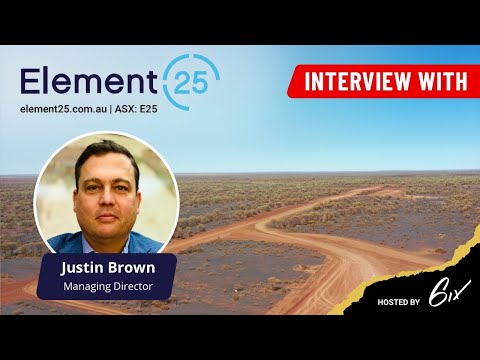
- Company
- Element 25 Limited (ASX:E25)
- Date
- Thu, Mar 18, 2021, 8:30 PM ET
- Replay
- Watch the replay on this page · 10 min
On 6ix: 6ix.com/event/interview-with-justin-brown-managing-director-of-element-25
Replay
Transcript
Automated transcript · Written by software from the replay's audio. It can mishear names and figures; the replay is the record.
0:08 All right. Well, Justin, can you tell me a bit about your story prior to Element25? Yeah, sure. Well, I'm a geologist by training. So I started my career in the early 90s in the goldfields of Western Australia. Worked for many years in exploration and mining and then started Element 25, which was then called Mondesiva Mining Company in 2006. And that's been my career ever since. So, and it's been an adventurous and fruitful 1 so far. So I'm enjoying it. Wonderful. You talk about Manganese Concentrate and EMM serving the old Manganese market and HPM serving the new. For investors new to manganese, can you please explain the difference between the 3? Absolutely, so manganese has been around for a long time ever since people started making steel because you need manganese to make steel. So it's an old world metal in many ways.
1:03 It's the fourth largest traded commodity in terms of metals globally. And, you know, it goes into a paramedical process typically to make an alloy, which then goes to the steel industry. EMM is an electrolytic metal product, which is used to sort of fine tune the metallurgy of the steel. So those 2 products go into the, I guess, the old world we call it steel industry. And then the new is really interesting because, of course, the world's transitioning to electric vehicles and electric vehicles need batteries and batteries require a cathode and manganese is a really important input into the cathode. So high purity manganese sulphate is the input that the battery makers need to make the batteries that drive the EVs. And that's what we call the new world application for manganese.
1:51 All right, got it, thank you. So why have stages 1 and 2 to serve the old manganese market? Why not raise the required capital and go straight for HPM? Yeah, it's a great question. I mean, when we started this journey about 10 months ago, the share price was obviously a lot lower. The market cap was under $20 million Aussie, and it was really difficult to raise the capital required to get the high purity manganese processing plant built. So that's why we started on this low capital cost, easy entry into the market. We generate cash flow from the concentrate business and then interestingly that concentrate is exactly the feedstock we need to put into the high purity manganese processing plant. So it kind of dovetails. 1 dovetails into the other, but one's a much lower capital hurdle than the other and is much easier to achieve for a small company.
2:42 Great. You mentioned in your corporate presentation that manganese is safer, more cost effective solution to both cobalt and nickel and batteries. Could you elaborate on that? Yes, manganese contributes to the thermal stability of the batteries and that's really important. You know, obviously for safety, the higher you go in terms of nickel content, the more difficult it is to manage the thermal stability of the battery. And so the costs go up. The other point is that nickel and cobalt are much more highly priced metals than manganese. So manganese is the most abundant and the lowest cost metal of the 3. So it's kind of a logical go-to to try and achieve an optimal battery outcome. Got it. So while EVs will certainly be the dominant choice long-term, Many sources say hybrids will see more adoption in the short term to medium term.
3:35 Do you feel this is the case? And if so, what implication does this have for Manganese and Element 25? You know, I don't I don't really buy into that. I think I think that was an argument that's a little bit outdated now. I think you're seeing even countries like Japan were moving heavily into hybrids as sort of admitting now that it's actually time to go fully V. So Europe's going fully V, China's going fully V. I expect North America will as well under the new government there. So I think that's probably an old argument, and I think that we can look forward to a fully electric vehicle world in the next decade or so. All right. Have you begun any discussions with OEMs on future deals for HPM from Buncher Bird? Yeah, look, we talk to a lot of people all the time. There's a limit to what I can say in terms of specifics because of that continuous disclosure obligations under the ASX listing rules. But we're definitely in contact with OEMs and it's, it's, there's no doubt the interest is strong and the demand, everyone expects the demand for these materials to really, really take off for the next 5 years or so. So yeah, no issue there. There is strong interest and we're engaging wherever we can.
4:47 Wonderful. You've trademarked 0 carbon manganese. Can you tell us more about what this means and the implication for investors, both from an ESG perspective and a financial perspective? Yeah, that's another great question. I mean, I think the other thematic, apart from the world moving to electric vehicles, is that the world wants to move to clean electric vehicles. So I guess part of that is the whole carbon intensity of the supply chain, right? So there's no point in kind of, you know, sinking all this carbon into your car, sort of supply chain and then calling it a green car, right? So one of the, obviously right from the start, the metals that are sourced to provide the inputs for these batteries that go into the cars needs to be ethically sustainably sourced and going 0 carbon is a really big part of that. It's not something that is gonna achieve a premium price right now, but I think the world is turning that way and it's not too far into the future, at least in my crystal ball, where the market will pay you a premium for a 0 carbon product. And I think even beyond that, you know, the consumers of these materials are going to kind of insist that you've got at least a pathway towards 0 carbon. So that's why we're starting early on it and we're going to work hard on it.
6:01 Absolutely. What have you heard from investors, either retail or institutional, about green investing? Look, I can give you an anecdote. There was a fund recently that was trying to raise 1 billion dollars and they had to hand back effectively 300 million because the investors behind that 300 million weren't prepared to invest in a fund that was gonna invest in coal. And so, and they were prepared at that point to say they're not gonna invest in coal, so the money kind of disappeared. I think that's an anecdote, but it's a sign of where the world's turning, right? The world wants to see money going into projects that can generate sustainable outcomes and I think it's finally arrived at mining's doorstep and miners need to be thinking about that. Right. You mentioned PFS for stage 3 is anticipated for 2021.
6:50 When can investors expect stage 3 to begin in terms of HPM production? Look, we've done a really, really great job of expediting delivery of stage 1. We did it from PFS to construction, completion of construction in 10 months, which is amazing. The HBM processing part's gonna be a slightly longer journey. We expect to deliver the feasibility study this year. But then of course, there's an exercise in project financing and construction. So it's probably gonna be 2024, I think, at best guess, before actually producing the stuff. But the good thing is that times beautifully with the real uptick in demand. So I think the timing is great for us. So President Biden refers to China as the model that the US wants to compete against in terms of infrastructure spending.
7:37 What impact is this competition on infrastructure, along with potential increased spending globally on infrastructure, going to have on manganese? Yeah, so I guess infrastructure is the go-to for governments, right, when they want to stimulate the economy because it's an easy way to generate economic activity. The way they do it is by building stuff. So the really important thing from a manganese perspective is that when you build stuff, you use a lot of steel. And as we've talked about, manganese is a key input of the steel. So I think one of the things underpinning the bullish outlook on manganese pricing is that, you know, these these stimulus programs from these various governments are going to mean consumption of a lot of steel. And that means consumption of a lot of manganese and that obviously goes on top of the EV demand that we've talked about already. Element 25 is in a far better position geographically to supply Asia-Pacific markets than North American markets.
8:29 Should investors be paying more attention to Asia-Pacific infrastructure plans in the short medium term to assess Element 25's future as it pertains to phase 1 and 2? There's a yes and no answer to that. I think Asia-Pacific is going to always be a really important market for us. It's obviously on our doorstep being located in Western Australia here. That said, manganese is kind of interesting. There's not really any source of manganese that's close to North America. So because North America doesn't have any of its own manganese production. I guess South America has some, so it's potentially that's a competitor, but I don't see any reason why Australian manganese can't be part of the solution for infrastructure spending in the US. Got it. So What separates Element 25 from other current future manganese producers in the market?
9:22 Look, I think if you look at the manganese setting in Australia, the existing mines are in downturn. I mean, they're running out of reserves. We're the first new manganese mine here in many, many years slash decades. Other sources of manganese supply come from jurisdictions like Asia, sorry, Africa and South America. So they're not tier 1 stable, ethical, sustainable jurisdictions. And I think Western Australia can claim all of those things and that is quite attractive to end users of the product because we can provide long-term stable supply. We have a huge resource and I think we're going to be in the space for a long time and that's attractive to people that need steady supply of manganese. So I think we're well placed in that regard. Great. Well, thank you
Follow Element 25 Limited into a list and get an email when it puts out news.
Latest news releases
- ASX:E25 — Site Works Commence at Butcherbird Expansion Project · Mon, Sep 14, 2026
- ASX:E25 — E25 Achieves Contractual Close on AU$50M NAIF Funding · Mon, Sep 7, 2026