Transcript
Automated transcript · Written by software from the replay's audio. It can mishear names and figures; the replay is the record.
0:03 So good morning, good afternoon, good evening, depending on where in the world you're signing in from. We have an international audience today, so thanks everybody for taking the time to join us. I'm lucky enough today to be joined by Hycroft's Vice President of Exploration, Alex Davidson. Alex, how are you today? Great. How are you? Good to see you. Good to see you. Happy New Year. I think this is the last day you can say it before it's like illegal to say happy new year. I'll say happy new year. So here's how today's going to work. I've got a number of questions that I'll post to you, and then we'll jump to any live questions in the chat. So that chat button in the bottom right hand of your screen you can use to answer questions live. I will say today's going to be a quick Q&A, really laser focused on the most recent press release. So really geology focused. You'll notice that in the questions that I ask and the ones that I take from the chat. That being said, please do feel free to ask whatever you'd like in the chat.
0:48 I'll make sure that Diane and the Highcroft team get them. So if it's not something that Alex and I are equipped to cover today, I'll make sure the team gets it, and they'll get back to you as soon as possible. So still feel free to ask them, but the only things we'll be actually covering in today's event are those geological questions. I should also say, as my last piece of housekeeping, this event is being recorded and will be available on replay this afternoon. It'll be both on YouTube but also on 6.com, as always. So let's go ahead and get started. Alex, if you don't mind, I'm going to grill you a little bit. ALEXANDER BIRKHOFERGADIS Go for it. Perfect. So the presence of coarse-grain Argento tetrahedrites and chalcopyrite crystals suggests a magmatic source rather than a low sulfidation system. So I'm curious if you could elaborate on how this reinterpretation might impact your exploration strategy and what it could mean for the potential scale and grade distribution of the whole deposit.
1:37 Yeah, thanks for that. And by the way, congratulations on saying Argento tetrahedra, that's quite a mouthful. Yeah, I guess first let's kind of go through what all of this really means. And I want to distinguish the difference between low sulfidation and what we mean by a magmatic sort of a source. And first, in the context of Highcroft, it has been considered to be a magmatic. That is to say, it doesn't have a magma-related heat source necessarily. It could be geothermal or it could be just a long ways away from a magmatic source. And if you think of it in terms of chemistry and heat, as fluid moves away from that heat source, changes chemistry and we get different sorts of minerals show up. So I guess to be clear, the type of low sulfidation deposits when we talk about that, and AMAG-MAG type of thing, we typically see along with gold and silver, but mercury,
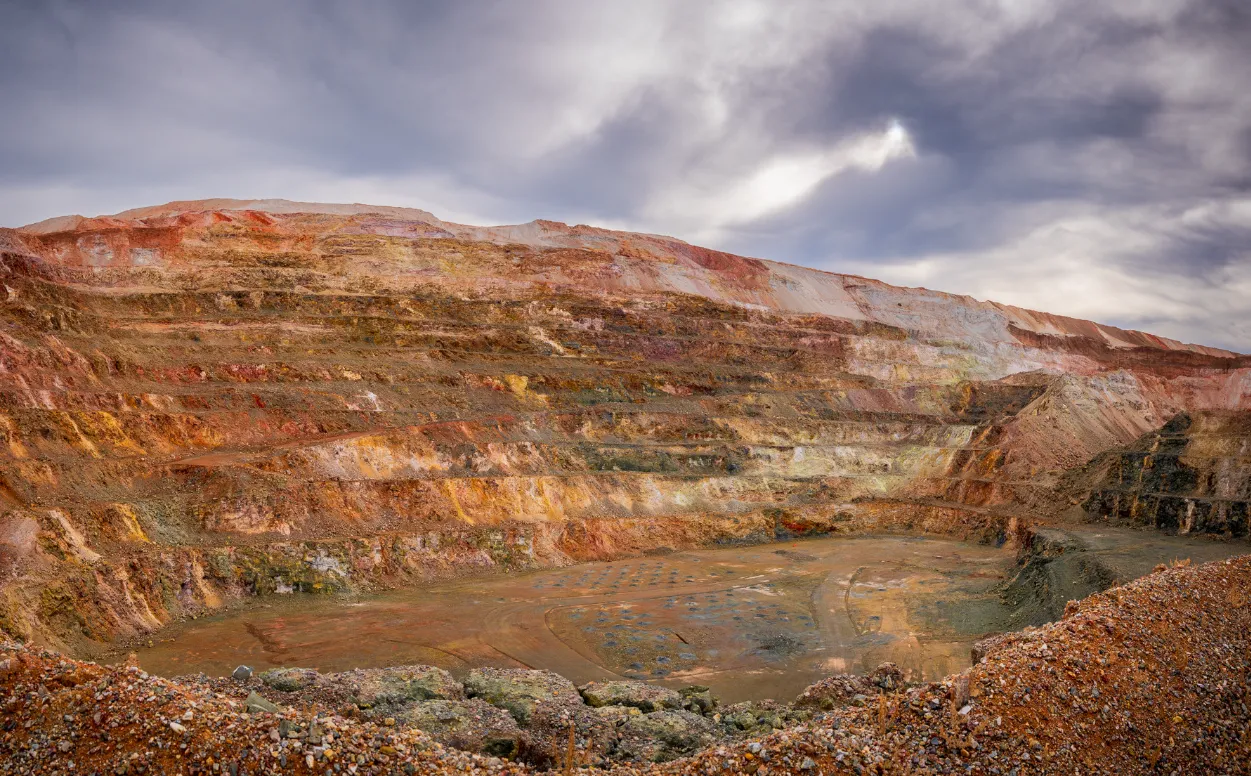
2:57 arsenic, and anemone are kind of the real big ones. And that is a great description for what we see for high croft as a whole, specifically on the north and west and south end of the high croft. So basically, that westerly sort of margin, when We talk about Bay, Central, and the Camel areas. Those really have that strong low-sulfidation elemental signature, if you will. When we go to brimstone, we see something that is really quite a bit different. Now we're beginning to see elevated copper, zinc, lead, and important to us is manganese as well.
3:48 And that's really important to us as we've done exploration east of our current resource, manganese tends to be towards the top of this magmatic type of a system.
4:03 And so we're seeing really elevated manganese on the surface. So that's one of the key elements that's helping us with this understanding. So that's really kind of the big part of it. And what it does for us is it drives the,
4:29 our planning for how we're going to drill this is changing. Instead of just coming at this and targeting the basin range type structures, we're looking more in detail and trying to understand a more discrete vein style mineralization. So every hole that we put in there, we have to reinterpret everything we see. We all step back, we go through each bit of information, what we've logged, and we try to put that in the context of the 3 dimensions.
5:09 So what it really does is it helps us unlock what Brimstone can be locally, but it's also unlocking what we think is gonna happen to the East. In other words, we think that Brimstone is gonna grow to the East as well. So there's a lot of work that goes into it and that's one of the really exciting parts about brimstone. Oh, cool. As a follow up, I know that sort of touching this already, but when you're looking at the discovery of those 2 trends, brimstone and vortex, that's got way higher grades than the historical interpretation, curious 1, how it affects your approach to the processing strategy, but particularly considering the need to potentially blend the very high-grade zones with lower-grade material? To the processing part of the question, from what we understand right now, shouldn't have any effect on the processing.
6:04 We're actually doing a bit of work right now to get a better handle on how that's going to go in the future, but right now we don't see that there'll be any effect on the processing part. So as we
6:21 continue to grow and get a better understanding of the orientation of these high grades, it will have an impact on how we mine this. It will change. You know, every drill hole we do, we have to go through and reinterpret the geometry of the mineralization, and that'll impact how the mine plans are drawn. And this is true for any sort of mining scenario you're in. As drilling goes on, ore bodies will change, will move, and the mine planning adapts to that.
7:04 So this is an ongoing, it's an iterative process on how we'll mine. Well, that's great. One question I got, and I think this is useful to give context to folks in the audience, The latest intercept of 80k grams per tonne silver over 0.2 metres within the broader high-grade zone suggests extremely high-grade chutes, like very unusually high-grade chutes. So I'm curious what geological controls are you seeing that help figure out, predict the location and orientation of these really, really high-grade zones? Yeah, so there's a number of factors that play into that geometry. And I've already talked a little bit about this already, but again, it's an iterative process, even to the detail of logging that we're doing.
8:01 Every drill hole that we put into the ground, we take all of that data, we look physically at the observations in the physical core, we look at the geochemistry, we look at the assays, We relate that to other drill holes around it. And the whole point of it is, our understanding of that geometry changes every time. So before we drill the next hole, before we get into the next targeted
8:36 part of drilling, we sat down, we go through all of what we see, we have spirited conversations, we're drawing pictures on the whiteboard, and then we translate that back to an actual three-dimensional model and try to get a solid 3D picture of how to target the next round, if that makes sense. That's great, we'll probably get a picture of the whiteboard. I'm not a great artist, so it just looks like a five-year-old's gotten up there and scratched on the board. There's hidden genius on the board, I'm sure. Yeah, exactly. So as we develop this, you know, we're really understanding that
9:27 vein density is a key element to the brimstone. So it's really critical for us to get the structural setting put together and get an understanding of the orientations and get that data back, those discrete structures back in into a 3 dimensional model. It's this constant feedback loop. It's a constant conversation. I probably drive Justin, my exploration manager, nuts on constantly, What do you think about this?
10:01 What do you think about that? We have spirited conversations about this. And then Justin will lecture me on, no, no, no. You've got to think about it this way. No, no, we'll think about it this way. So it's a very fun process to get to for me. Even though I've done this for a long time, you're always learning something new. And it's really important to have that team setting in order to get you to the next level. That makes sense. I think if a VPX isn't driving an exploration manager nuts, something's wrong. Something's gone off somewhere in the universe. I do want to ask you, your multidisciplined approach that combines geochemical, structural, assay, geophysical, seemingly has been successful, at least to my eyes.
10:48 I'm curious if you could share which specific geophysical methods have been most effective, just in simple terms, and how that guides what's up next. Yeah, so the geophysics method that we used is called induced polarity, and we simply call it IP. It's very, very effective in these kinds of deposits. And really what it does is it gives you a nice snapshot of the subsurface geology.
11:24 It is not necessarily a clear picture when you first get it. You have to put geologic context to everything that you do. That is true for everything that we do. It isn't just for geophysics. We've talked before about hyperspectral. Once you start laying out hyperspectral and put geologic context to it, the story starts to become much more clear and geophysics isn't any different. So the beauty of the IP is once you get that picture and once you start laying in the structural fabric as you know it, it really starts painting a brilliant picture and that's what's generating the next stages of exploration.
12:16 And you know there's other things that we'll layer in as we go on. One is called magnetics. Magnetics is another one, and they complement each other very well. They overlap, and then you have that structural context behind it, and your geochemistry and all those things. And then your picture starts becoming very, very clear. It's a disciplined approach. It's a lot of back and forth. It's getting information, trying to understand it, going into the field, mapping, coming back. It's a lot of back and forth and understanding what you're actually trying, what you're actually looking at, but very, very effective tool.
13:03 Well, that's helpful. I will say this is a couple of companies this is true for. With the shift from what was historically viewed as a large, low-grade system to 1 with really significant high-grade silver components, I'm curious how you see the balance between bulk tonnage and high-grade portion of the deposit evolving? And if you'd mind with me looking into a crystal ball for a second, what implications do you think this will have for future resource updates?
13:30 Well, first, the high-grade and the low-grade will complement each other. A couple of things that will come out of it is, once we get that high grade geometry well understood, it will drive mine plans to get there first. You know, that's the ultimate goal is to get to your highest grade first. That's what drives, you know, value for the shareholders. That's what drives good stewardship of your ore body, if you will. And every drill hole that we put into the ground, that influences those mine plans. So again, like I said before, it's an iterative process. You drill holes, you interpret, you build new models, you re-plan your mine.
14:23 It's a continuous iterative process to get you down there. And- I appreciate that. Yeah, yeah. No, that's super helpful context. I think useful for folks in the room. One thing, the technical studies for processing sulfide are ongoing, as I understand it, right? Yeah. Yeah, so how does the presence of these high grade silver zones, particularly with the argento tetrahedrates, tough one, Little tongue twister, I'm still getting there. Influence your metallurgical approach and recovery expectations. So yeah, we're still doing a lot of the testing at FLS and also at Hazen Research. And a bulk of that work is trying to address this very question right now.
15:13 What we really know is silver isn't gonna have an appreciable, the high-grade silver that is, isn't gonna have an appreciable effect on the overall process. It's not gonna affect grinding or crushing, flotation will go through. What we're trying to understand, both at FLS and Hazen is how we're gonna process this on the back end, you know, is this going to be a pox, a pressure oxidation, or is it gonna be a roasting type scenario? So, yeah, that's kind of the questions that we're trying to answer right now. The good news is it doesn't really look like it's going to have a major effect on the overall process.
16:04 Nope, appreciate it. There's one question that came in over email that I thought was interesting I wanted to throw your way. So this is one of the investors that signed up. Asked if there are plans to continue to core down dip of your latest record hole and see if that lens of silver has a greater thickness? Yes, obviously we gotta continue to develop the geometry of the high grade. So whether it's, you know, again, we're still going through the whole process of how to place that hole. You know, this is that whiteboard sketching trying to sort it out. Do we put it up here?
16:46 Do we put it down here? Put it over here? So we're in the middle of having all those conversations as we move into the next phase of drilling. But absolutely, we will be following up on the high grade. Awesome, I appreciate that. One question from the chat, Icarino asks, based on the current and future drilling, how soon will we enter the next phase and what is the next phase? Basically, what's up next for the geo team at Hikeroft? Yeah, That's a great question. We've been building our strategies. That's what we've been doing over the last couple of days is trying to figure out what field work needs to be done, what logging or re-logging, What assays do we currently have outstanding and how those are going to affect us?
17:35 So, you know, pulling all those things together, we've got a little bit of a pause in drilling right now. We're going to fire the drills back up, sorry, the drill back up in April. And we're gonna focus heavily on brimstone. We will do more drilling on the vortex side, But the key for us right now is to get Brimstone is a big unknown. We know there's this is just the tip of the iceberg in my mind. So there's a lot of work that has to be done there. That's why we're going to have that initial focus. I appreciate that.
18:21 M. Hodges from the chat asked kind of follow up, what's the timeline for resource estimation of Brimstone? Well, resource estimation is going to be an ongoing process with our current set of models. We'll have new estimations completed by March, and the technical report will come out in the second half of the year on that resources when that will become publicly available for everybody. And to that note, with all this new work, we are going to be building and the process is going on right now, new models, and then there'll be new estimations. And that's natural progression of how these things work. You know, you start off and you continually progress and rebuild And that's how you get to the final stages of beginning to mine.
19:26 No, and I'll jump off from that into a question that I see every time anything is posted on Highcroft's X page and people write in and it's just a summary question, but I'd love to hear your perspective. I know I ask it to Diane every single time we have a chat, but really the question is that gets posted in all caps that I get in emails is when do you start mining? So I'd love to get the perspective from the kind of head geo at the joint. What is the reason why you can start digging right today and start selling silver? That's a good question. And if you kind of follow along the logic of what we just talked about. There's still unknowns. I can't stress enough, in order for us to be the best stewards possible to the deposit, to bring profitability to not just the company, but the shareholders.
20:24 It's critical that we do the science. You have to do the science. You have to understand that geology. That's what drives your mine plans for maximum profitability. You have to do the metallurgy, the work that is going on at FLS and Hazen right now. All of that work has to be done to a high degree of understanding. If we don't, we've seen this over and over again, the companies that come in and just drive straight to production and start digging holes, they generally end up failing. It's it's almost a given.
21:11 The more you know, and more you understand about these things, the better off you're going to be. You simply said you have to do the science. No, that's great. I appreciate that. That's hopefully a clip. I know it's a lot of folks with Highcraft. It's their first mining company, which is really exciting, but it's helpful to understand just what the process is for kind of a typical setup. I was a good question from Macarino in the chat. He's curious if you can explain where Highcroft sits on the Lassonde curve. If I remember right, the Lassonde curve is that transition from exploration into production.
21:57 And we're kind of right in the middle of both. So I would say that we're on the left side of the curve, if you will, we're still doing our exploration. And once we move into, you know, actually building the mine, building the mills and all of that sort of stuff, then we'll be on the backside, on the right side of the curve. Awesome. No, no, I appreciate that. It's helpful. Just let me know from the chat asks, and this is just a question for you personally, in all your time in the industry, have you ever seen anything like high growth before in terms of discoveries? That's an interesting question. Worked in the area before in the 90s.
22:47 And it was Rosebud was what I'm referring to, kind of to the southeast of Highcroft. And it was one of a kind epithermal deposit. I've had a lot of conversations with my former boss and mentor. He and I still talk quite a bit. It was unique and kind of a once in a lifetime sort of a thing. Highcroft is a different beast. It is not anything like what I saw at Rosebud, and it's a different sort of a deposit. Interestingly, that being said, brimstone is something that is very unique and could be relatable to a rosebud to a degree.
23:45 They are still different, but definitely relatable. I will say that in my career, I've never seen centimeter wide Argento tetrahedra crystals. Tetrahedra is a crystal that is relatively common. The Argento part of that is the silver-rich tetrahedrates. I've never seen anything like what we're seeing. They're giant. I worked in a silver mine in Greens Creek and we didn't see silver grains that are approaching 2000 ounces per ton. You know, 80,000 grams is pretty phenomenal.
24:33 This is really unique. And I know that we are stumbling into something, not stumbling, academically working our way into something really, really fantastic. That's great. Austin from the chat asks, any deeper gold targets with this next drill program? Yeah, there are. We've been, Along with our focus on Brimstone and Vortex in 2024, we've reached out to, we've been doing some work outboard to the north in an area called Bay. And there's some really interesting things going on up there as well. Bay has a much higher gold to silver ratio.
25:26 We've done some work on that and we're narrowing down that epithermal deposit. I think that's actually a really good point to make, too, is that one of the interesting things about Highcroft is it's not 1 system, it's several systems. Brimstone is unique from everything else, but there are several other things at play. One of the things, one of our consultants kind of coined the phrase, and I just love it, is high crop sets in the middle of really big geology. We're proximal to crustal-scale deformation that drives mineralization.
26:15 Similarly, at other places in Nevada, some of the big mining districts that we know in Nevada, like Turquoise Ridge, the Carlin Trin, also sit on these similar type crustal scale, I'll throw the word out, so the creationary things where the plates have come together. We're quite proximal to that one of those structures and it has opened up this area for significant mineralization. That's why we see all these different things and all these different systems that make the high crop system is really encouraging to us. So yes, there's definitely things at depth that require more attention.
27:05 Awesome, I appreciate that very much. I'll close off, since we're getting close to the half hour mark, with a question just for you personally. Going into 2025, what are you, sorry, going into, we're already 2 weeks in, so fast years ago, But what are you most excited about for this year? Yeah, I think Brimstone has brought a new sense of vigor to the team. This high grade thing that we've been working on, you know, starting in late 2023. The results, the things that we're seeing, the geophysics that's been done, all the mapping that we've been doing outboard to the east is opening up this district. There's a lot more to discover.
27:51 There's a lot more work that's going in. I'm really excited to be kind of part of this and see this shift from, we've heard it a lot, that Highcroft has historically been known as this old dog and we're breathing new life into it. It's actually, it actually is really, really exciting to be a part of. So that's what I'm thrilled about. It's a dog with some new tricks for sure. Fun to see. So Alex, I know we're getting close to the end of that. I just wanted to thank you so much for accepting the grilling we put you through, both in the chat and through my questions. Thank you so much for your time. For those in the chat, especially those who came late, Alex, I believe I answered pretty much all the questions that are in there, except a couple that I'll shoot to Diane that I noted. The replay will be available later this afternoon, I believe, Eastern time. It's probably just before folks head out for work for the day. But appreciate everybody's time so much. And Alex, I'll throw it to you for the last word before we jet.
28:51 Yeah, thanks for having me and giving me an opportunity to talk about this place. It's an enormous property. It's an enormous undertaking and it is just heaps of fun. All these geologists and all the conversations we have, everybody comes out of there with a big smile on their face. It really is something that's got everybody engaged. So thanks for letting me share. No, no, thanks for coming on. And everybody, thanks for joining us today. I hope you