Replay available
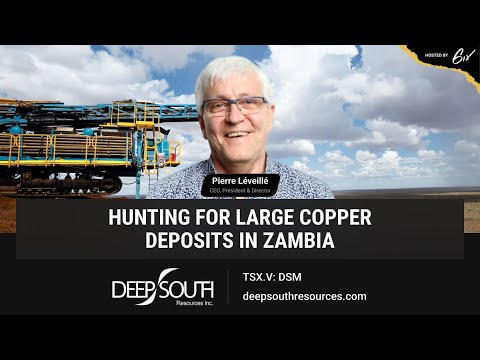
Hunting for Large Copper Deposits in Zambia
Join us for a great event!
- Company
- Koryx Copper S.A. (TSXV:KRY)
- Date
- Thu, Jul 21, 2022, 11:00 AM ET
- Replay
- Watch the replay on this page · 37 min
On 6ix: 6ix.com/event/hunting-for-large-copper-deposits-in-zambia
Replay
Transcript
Automated transcript · Written by software from the replay's audio. It can mishear names and figures; the replay is the record.
0:08 All right. Well, hello, everyone, and welcome to Deep South Resources Live Summit today hosted by 6. I'm very pleased to introduce Pierre Leveille, the President, CEO, and Director. Following his presentation, there will be a live Q&A session. So you can submit questions at any time using the Q&A panel on the right-hand side of the screen. We'll try to get to as many of them after the presentation is done. As always, the summit is being recorded and available to watch afterwards on six.com. But without any further ado, I'm gonna hand it over to you Pierre to kick it off. Thanks Dasha. I'm pleased to have all the attendees today. Before we start, I just want to inform you that I cut COVID 2 days ago. I'm still sneezing and coughing so if it happens I have to apologize in advance.
1:00 But I've checked it out and the virus is not moving through Wi-Fi so you should all be fine. So this being said, Deep South Resources is an exploration company that develop large exploration, large copper projects in mostly in Namibia and in Zambia. In Zambia, we just recently announced that we have taken an option on 952 square kilometers of very large exploration licenses in the heart of Zambia, the Zambia Copper Belt, which is one of the most, if not the most prolific copper belt in the world. In Namibia, deep south, we hold an injunction over the Ibe Copper project. And when I say an injunction, it's because we have a legal fight against the Ministry of Mines, which 1 year ago has refused to renew the license on our exploration license on the project.
2:03 But we're very confident. And now at the moment, we have requested the court in Namibia to review the decisions of the minister. And we're very confident we can turn that situation around. IBE Copper is a 43-101 resource of 850 million ton at 0.31% copper and we had started a feasibility study based on our recent PEA that shows an NPV of 1.6 billion dollars at a copper price of 4 dollars of course at the moment the copper price has dropped down it's temporary but we'll see you know it's like during the presentation, I'll show you the other MPV that we have. We have 147, 5 million shares issued. We have about $1 million in cash at the moment.
3:00 We don't have any debt. So we're quite well financed to do what we have to do, at least for the next year. It's tightly held capital structure also. Tech resources holds 16% and insiders holding holds 14%. Copper is most certainly the number 1 commodity for the next 30 years and because without copper you don't have any communication, without copper you won't have any transportation and it's involved in quite a lot of activities, economic activities, in a very large variety of activities like green energy transformation, electrification of transport infrastructure programs, 5G implementation, communication, data storage, internet, artificial intelligence.
3:53 So you have that in all of these activities. The thing is that the copper supply is in a strong decline on long-term production. Growth is impaired due to very few deposit discoveries because the exploration and development investment were very low in the past 10 years. Here what you see is that copper is really the largest beneficiary of the new energy technologies development. You can see that it's really, you know, there will be, There's an extreme fundamental turn for copper. As for the first time in a decade, stocks on exchange declined to March instead of rising.
4:43 So Goldman Sachs expect a deficit of 740,000, 48,000 tons of refined copper for 2022. And they forecast a price increase to US $13,000 per ton, which is equal to $6 per pound. It's very important to mention that yes, at the moment the price has gone down because most of the, let's say, market actors are speculating that there will be a recession. And if there's a recession, then there will be less metal that will be used because there will be a slowdown in the economy and of course in the industrial programs.
5:35 But we all think that it's gonna last for a very short period of time, because no matter what, there's a very huge need for the transformation and the new green energy, and for the transformation and transportation also. And that includes also not only the cars, but it includes also all other forms of transport, from trains to buses to trucks for delivery and also transportation of people by plane. So that's coming. I heard yesterday 1 vice president at CAE Industries saying that they will need 60,000 new pilots trained to drive electric air taxi. Drive electric air taxi.
6:40 So it's coming, it's moving very, very, very fast and because of that there will be a serious need for a lot of metals and of course copper is number 1. The Zambia license, as I said, there are 752 square kilometers. The license is neighbored by 9 large copper mines and we're talking of very very large mine and it includes Barrick, 1st Quantum, Rio Tinto, Glencore, Vedanta, also CINO Metals. And the president of Zambia recently said that the goal of Zambia is to increase the production of Zambia from 800,000 tons per year to 3 million tons per year by 2025.
7:28 It's pretty ambitious, Of course, but it shows one thing, is that the government and the country will support the industry heavily. And we see that now because Recently, 1st Quantum has announced investment of 1.5 billion dollars into increasing their production on one of their projects and Barrick has also said that they will invest over 1 billion dollars into improving their, increasing their production. So, there's a very, very positive mood in Zambia at the moment. If you look at where our license are situated, you will see that some of them are neighbored by, like the most northern 1, 23247, is neighbored by Lubembe mine and Kankola resource.
8:22 Kankola resource is 7 kilometers from our license on the same geology, on the same geological trend, and it's looking very good. And Kankola is a very, very large resource. We're talking 500 million tons at 2.30% copper. They're producing at the moment 91,000 ton of copper per year So that's the type of project neighboring the project that we have in Zambia. The first license, the most advanced I must say is the 23246 that you can see in the middle of that map. What is very important about the choice of these licenses is that we find on them a lower Rhone group of rock, where we have a very long contact with the granite basement and that's where all the copper mines in Zambia are found.
9:27 So that's what we have in these 2 licenses, in the 23246 and the 23248. And even in the 23246, there was quite a lot of JavaScript survey done, and there was also 850 samples done. We're compiling the data at the moment. We will be able to give more about the grades of these samples, but suffice to say at the moment that 95% of these samples contain copper. So, and we have been able to identify 4 major anomalies. So we already have targets for drilling. But the work has been done by a company that is not existing since something like 15 years.
10:12 We don't have any sample left to re-assay some of these samples. So what we will do, we will redo the full sample. We will redo the full sampling, 850 samples, to make sure that our targets are pretty well defined. The large 23248 license you see at the left bottom, there was no work done on that specific license, but it's a huge license. We're talking of over 675 square kilometers, but in that license, there's the lower own group outcropping on 17.5 kilometers and it's crossed by 4 major faults so there's quite a lot of potential there.
11:05 It's a huge potential and the sampling area that the area we will have to sample is covering 445 square kilometers. It's big and there's a huge potential for discoveries in a license like this. The more northern 1 license is 23247 near Chilida, Bambue. It's 12 kilometers from the Cancola mine and 30 kilometers from the Lubembe mine. It sits on the same geology as these mines and it is situated over the contact between the Granite Basement and the lower Rhone group as we've seen with the other licenses.
11:51 So it's another very prospective license. Of course, the most advanced one is 23246 and that's the one that we will certainly start sampling in that one. Where we stand at the moment is that we add to file environmental project brief, which is an obligation in Zambia, and we need that to get authorization to start the exploration work. We hope to have the authorization at the end of August, early September and then after we will start sampling. But pretty soon We will have press releases on the environmental project brief and also on the program that we plan for these projects and also the past work that has been done in 2.3.2.4.6 and the results.
12:46 So, it's coming Because we just closed the acquisition recently, so our geologists are still working on the data. Hyde Copper in Namibia. We're just scratching the surface of a massive copper porphyry deposit in that one. It's a little bit over 5 billion pounds of copper in the ground. We have found when we were drilling before being refused the renewal of the license, sorry for that, we were finding a lot of intercepts of up to 150 meter in between 0.50 and 1% copper.
13:36 And so that's an high grade area that has 140 million ton. So it's way over the 0.31% of the overall project. So it's probably the right place to start mining eventually. So as I said, the expiration licenses has not been renewed and we have requested a review of the decision of the minister at the High Court. That's the first step. That's what you have to do when a situation like this happens in Namibia. And as some of you may know, the final hearing for that court case will be on the 3rd and 4th of October and that's where our arguments and the arguments of the Ministry will be tabled.
14:22 But we're very confident we can get the license back. In general, It's a deposit that has seen 70,000 meters of drilling, metallurgical tests, geophysical surveys, geochemical sampling, quite a lot of exploration work. It's massive. And we have all the data on that. The deposit is defined by the main diamond drilling that has been done over an area of 2.6 square kilometers. So it's pretty huge and there's a strong potential to increase the size of the deposit at surface and at depth, and also strong potential to increase the grade, as we have shown when we were drilling just before being pulled out of the license.
15:16 There's many opportunities to optimize and improve the deposit and the way to work at it. It's a low-grade deposit, so it's sure that we need to find technologies that will permit to extract the metal at low CAPEX and low OPEX and that's exactly what we've done before doing our last PEA. The most important was that the bioleaching, bio-leaching was showing some very, very good, very good extraction rates. We're talking of 80 to 87%. And what you can see at the bottom on Project Economics is that at $3 per pound of copper, I'm using 3 now because the market is at 320.
16:10 The after-tax NPV is $957 million US. And the after-tax IRR was near 30% so when the price of copper will go back up again you will see a serious increase there. The PEA was based on a mine life of 24 years, treating 400 million tons per year with an average grade of 0.31% copper with a strip ratio of 1.41 to 1, which is a very good strip ratio. That's one of the key ingredients, let's say, in that specific deposit. And we also add a copper recovery of 80%.
16:57 We use the lowest number that we got at between 80% and 87%. So that's a very outstanding project. And we worked very hard to get it back, because it's a little bit of nonsense to be removed from a project where We have started a feasibility study. The last 2 years we proposed the government to invest $23.5 million in Namibia and we ended up investing $31.5 million in Namibia. So we did even more than what we had proposed. Drilling was completed and so we're pretty confident we will get it back. So in 2022, sorry, the exploration and development initiative will be in Zambia. We will complete the project environment brief which is done now, it's filed today or tomorrow with the Ministry and in order to receive the approval to start the exploration work on the licenses and then we will proceed with over 800 soil sampling over the 3 license area. In fact, I can tell you today that when I did that presentation, the number of samples, it was not totally clear at that time, but today I can say it will be over 2,500 on the 3 licenses.
18:17 With that, we intend to define drilling targets for early in 2023. And in Namibia, our priority is to recuperate our exploration license over the Ibekapper project and resume the feasibility study started in 2021. So we have a very strong management team and directors. All our team are highly experienced on the African continent. I have near 30 years of experience in Africa, Jean-Luc Walsh, so 30 years of experience in Africa. Viv Stewart-William and Dean Richards are South African. Nathan Sabao is Zambian, so and when you look at the other member of the board, Ali Angula is Namibian.
19:07 Pierre Matt has been involved in Africa for over 20 years. Thomas Tomaschait has a long career in commodities. So, we have, and Tim Fernback is, you know, is with the company since a while and has a long experience over 20 years in venture capital for the exploration and mining industry. So that's it, that's where we are, that's where we stand. We're pretty happy now that we can move forward in Zambia to resume the development of the company. So handed to you, Dasha, if you have any questions. Yeah, great. There's actually lots of questions here, but if anyone has any other ones, please submit them now.
19:53 So, Pierre, is the Zambia development dependent on the court case in Namibia? No. It's a completely independent project. We have the funds to go forward with it, and we will go forward with it. It's very important. When Namibia is resolved, Namibia will be resolved on its own, and it does not have any influence on Zambia. Okay. And will the judge render a verdict on the final hearing that will take place in October? Maybe yes, but in general, they take that and deliberate for, in general, it could take about a month before we get the final verdict after the hearing. In the meantime, we will continue to make efforts to find solution out of court and see how we can resolve that issue without going to the end of that court case.
20:42 Okay, thank you. There's a question here. Is the nickel and gold a byproduct and if copper is recycled on a routine basis considering that EVs use larger quantities can this potentially suppress demand for freshly mined metal? I think there's 2 questions in 1AM I right? It's a long question. I guess the first one is, is nickel and gold a byproduct? And if... Okay, let me answer that one, then we'll go to the other one. In the Zambia project, yes, there could be nickel, there could be, and there is normally gold and silver as byproduct and cobalt. But in general, nickel, you will find it in separate deposits where nickel is the main commodity.
21:34 So you would tend to find copper, cobalt, gold and silver. In Namibia, there's only one byproduct that is important and it's the molybdenum. Sorry, my COVID slows me down a bit. Okay, so what's the other part of the question? Yes, so If copper is recycled on a routine basis, considering that EVs use larger quantities, can this potentially suppress demand for freshly mined metal? We don't think so. I don't have any numbers on that. It's a pretty interesting question and with word searching numbers, but what I can say is that the recycling of copper product is pretty minimal at the moment.
22:26 And it will increase, of course, but you need to keep in mind that when you recycle let's say an iPhone, the amount of copper you will get there is pretty minimal. So you need to recycle quite a lot of iPhones in a year to really suppress the demand and it's the same for the other stuff that you will have to recycle. It's based on the number of device that we will use and not on the number of the, and the quantity is very limited. Okay. Yeah. All right. Thank you. Did surface weathering processes play a role in concentrating copper into the soil samples? Yeah, that's a good question too.
23:18 I'm not sure of that. If that the person that has asked that question would like to send me that email at info at deepsoutresources.com, I will find the answer and reply to that. Great. I will send all the questions to you with the email so you can follow up directly afterwards. Okay, that's fine. Another question from the same person. These are really good questions. Are there sufficient groundwater resources that can be utilized, assuming that local residential and agricultural activities won't be compromised? In Zambia, yes, there's enough water in most of the Copper Belt area.
24:03 It's not an issue in Zambia. In Namibia, the ground table, the water table is very weak and not very thick, so what we need to do is to pump the water from the river, the Orange River. Now, what is very important is that that project was approved in 2000, in year 2000, by a consortium of 4 countries that where the river, The river crosses 4 countries and the 4 countries have approved a certain number of projects for future development and I wasn't there so we can access the water for that project. Okay, thank you. Another question here from David. What's the value of the Zambian licenses and do you expect to receive royalties from the adjacent mines?
24:56 The value of our properties is based on the price we've paid recently. It's not a very high value at the moment for one reason because it's it's mostly green field and it's our job now to start you know doing the exploration work to add value on to that and and generate a very good added value I would say at the moment the value is probably turning around for the 3 together 200 to Let's say 250 to 500 thousand dollars us, okay What was the other part of the question? Do you expect to receive any royalties from the adjacent mines? No, because we have nothing to do with their license. Our license, our neighboring, we have legally speaking, we're not involved with them.
25:42 Okay, thank you. So, what should the fragmentation size of the crushed material be for the ore sorting to be optimal? Okay, that's in Namibia. That's a tricky question because we were not intending to go forward with the sorting because the Technologies for sorting today, how they work, they're pretty limited in size and volume you can treat. And just to have a 20, just as an example, if we want to have a 20 million ton per annum treatment plant on that project, we would need of having 20 sorting units working in parallel before the entry of the plant, which is pretty, it's nearly not feasible.
26:46 First, it costs too much. Second, it's very difficult to operate. So sorting is good for very small production. So, you know, in our case, we've tested it. It was giving some very interesting results, but It's because we're looking for larger, very large production, not going to be very convenient. Okay. Do you anticipate that copper will return to growth this year? Yes. Yeah? Yes. And the reason is pretty simple. It's, yes, we have a slowdown in the economy at the moment, but depending on how deep it will be and how long it will take, immediately after we will have a resumption, let's say, of...
27:36 Or because the economy is slowing down at the moment, but we have not stopped the big, large infrastructure programs in the United States, in Europe, in Canada, in Asia also. We have not stopped transforming the energy like we see at the moment. Keep in mind that solar energy takes 12 times more copper than any traditional coal energy plant. So because of that, and because there are some countries that are desperately in need of transforming their energy, like Germany. Germany is extremely dependent on the Russian gas. So at the moment it makes their life pretty difficult. So you can imagine that they want to transform their, no matter what, even if the economy is slowing down, they really want to transform their energy into green energy as soon as they can.
28:46 So that means investment, that means money that will put pressure on the price of copper because there will be a demand. So the demand will not slow down so much because of the economy slowdown. Thank you. Earl is asking how did management acquire their ownership interest? For example, cash to the company and the open market, on the open market or other? Management in our case, the people that own shares in our case, let's say directors, I can say 1 director has acquired the shares on the market, in a private placement, And as far as myself and our late chairman, who were pretty large, he was a large shareholder and I am a large shareholder.
29:42 It was private investment we did in the project in Namibia before the company's being listed. And we invested quite a lot of our own money into it. Great, thank you. Another question here, what is the current drill grid spacing if there is no measured resource? The drill spacing was 100 by 100 for most of it, but the drill spacing we were having was 50 by 100. That's in Namibia. In Zambia, of course, we don't talk about drill spacing because there's no drilling results yet.
30:33 Okay. This is a follow-up question. What is the main driver regarding resource classification? I'm not sure I get this one correctly. Resource classification is you go from inferred to indicated, to measured, and then to reserve. So it's just a question of tightening the grid of, the drilling grid, and more it's tight, more you can improve or classify your resource in a hopper category. So in general you have 100 by 100 or 100 by 150 you will have inferred. When you go to inferred and or indicated because it depends on the constants of the grades from 1 drill hole to another.
31:31 Then you go 50 by 150 by 50 and you will have measured. And if you want to go to reserve, then you will tighten the grid. But it's also dependent, as I said, on the constants of the grade between the drill hole. If it goes up and down vastly, then you need to tighten the grid. But if you find the same average results, let's say all over in a very stable form all over the drilling grid, then you don't need to be so tight. So that's more important than the grid. Okay, great. Thank you so much. David's asking, can you please provide more details about the bioleaching process at Habib? Hi.
32:19 Okay, it's a e-bleaching. So what it means is that you have a stack of gravel or rock that you have. First of all, the first step is to crush the rock to, you know, render it down to about 12 millimeters and then you will go to high pressure grinding rollers that will lower down the, around, let's say a bit below 5 millimeters, and then you stack the rock for some time, it can go as high as 20 meters, and you go with some solution of sulfuric acid over the stack and you spray your sulfuric acid that will that will go down the gravel and within that sulfuric acid you will add a strain of bacteria that has been developed specifically to that type of bioleaching or that type of rock, because we analyze the rock, we analyze the metallurgy, and then we analyze the bacteria that will have the right reaction with it. And what the bacteria are doing, because when we do that heat leaching, as it's mostly sulfide, it's very hard rock, you need to transform the sulfide into oxide
33:51 and that's what the bacterias will do. They will fix oxygen molecules over the sulfide, speed up the oxidation process, and then you will have oxide that will drip to the bottom of the vat, and then at the bottom of the vat, you will just collect the liquor and extract the copper out of it. Thank you so much. A follow-up question from David was, what is the initial mine capex? 340 million for a 20 million ton per annum production. Oh, right, thank you. Sorry, I know there's so many questions here.
34:37 One more though. What are tech's plans for their shareholding? We should ask them. At the moment, tech is a shareholder and a passive shareholder and they stay there. That's fine. They don't intend in the short term to increase their position. But I must tell you that what we did in Zambia could potentially eventually bring them back to some action around what we're doing because they were very curious to see what we want to do with these licenses. But of course it's pretty understandable because in Zambia we're talking of mega huge deposits. And that's the turf for major companies.
35:28 And that's the reason why you see so many of them in Zambia. We're talking of projects that have 10 billion, 15 and 20 billion pounds of copper in the ground. And the other thing which is very important, it's the grades. It's very high grade compared to what we have in the Andes, in Chile and Peru, in Namibia. We're in high-grade territory. So for us, I like to say that we're left-hand hunters. And that's what we're looking for. Thank you. Are you cashed up through to the end of the year? Yes, up to at least April 2023. Excellent.
36:14 All right, well thank you so much Pierre for taking us through the presentation and the live Q&A. And of course, thank you to everyone who joined and submitted all these great questions. If you do think of any other questions following the presentation, feel free to email directly to Pierre's email here. I believe it's on the slide. Or go to their website at deepsouthresources.com to find more information. And again, as I said, this has been recorded, so you can re-watch it on SIX.com following the summit. But I'll pass it back to you, Pierre, if you have any closing remarks before we close out. Thanks for hosting this webinar and thanks to the attendees to attend to it. If you have any questions, as I said, you can email me at info at deepsaltresources.com.
37:01 But keep in mind one thing is that even if we had a problem in Namibia, we keep moving forward and develop that company and we're very happy with what we've done recently in Zambia. That adds very, very good assets to the portfolio of the company and it's not over. We're looking for more.
Follow Koryx Copper S.A. into a list and get an email when it puts out news.
Latest news releases
- TSXV:KRY — Precious Metals & Critical Minerals Virtual Investor Conference Presentations Now Available for On-Demand Viewing · Fri, Oct 16, 2026
- TSXV:KRY — Koryx Copper Provides Interim Update on Pre-Feasibility Study Progress for the Haib Copper Project in Southern Namibia · Thu, Oct 8, 2026