Transcript
Automated transcript · Written by software from the replay's audio. It can mishear names and figures; the replay is the record.
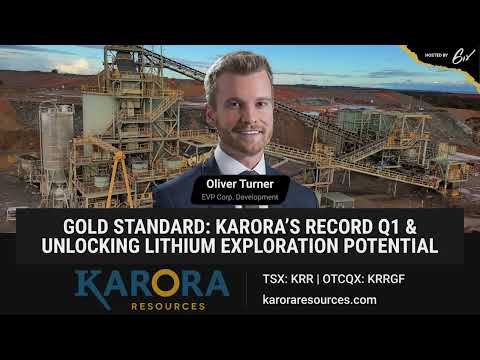
0:07 Hello everyone and welcome to Corora Resources Summit Gold Standard, Corora's record Q1 and unlock in Lithium exploration potential, hosted by 6. Today we're going to be chatting with Oliver Turner about Karora Resources 2023 Q1 results. So if you have any questions, please feel free to ask them in the Q&A tab on the right hand side of your screen. But I have prepared some questions for Oliver already and I'll try my best to incorporate your questions to create the best conversation possible. With that being said, Oliver, thanks for coming on. Why don't you start off by giving us a quick pitch of Karora Resources for
0:38 any individuals that are not familiar with the story. Where are you operating and why should people have Karora on their radar? Yeah, thanks a lot, Kyle, And great to be back on the 6th platform. Yeah. So Corora Resources is a Western Australian domiciled Gold producer. We have 3 producing assets located in the Kalgoorlie trend in Western Australia. We're also the largest landowners in Western Australia on the Calgary trend, 1900 square kilometers. Our flagship asset is the Beta Hunt mine. It's a very large and growing gold and nickel producer. We're actually halfway through a very large expansion plan right there, taking the company from about 100,000 ounces to about 200,000 ounces. By the end of next year, we also have the Higginsville properties, which feed our centralized Higginsville mill. And last year we acquired a second mill called the Lakewood mill, which brings us up to 2.6Mt per annum of processing capacity.
1:33 So a growing Gold producer, growing Nickel producer located in a Tier 1 jurisdiction. It's been a great story for the last several years. Perfect. And you just actually had an addition to your team. Before we get into the Q1 results, why don't you talk about Lee Junk, who was recently added to your senior
1:47 leadership team. Can you tell us more about Lee and what he brings to the table? Absolutely. We're thrilled to have Lee Junk join us. He's very well known in Australia. He comes into the managing director role in Australia, so We'll be leaving the team down there. Lee brings with him a long career in the Gold and Nickel spaces, which is key for what we want to do next year at Karora. His past Gold successes include Silver Lake and Dory Minerals, which he grew and expanded that business tremendously and graduated it onto several different indexes there. He made a fantastic return for shareholders in the Nickel space. Him and his brother have a long history in the Nickel space in Australia, stemming from their late 20s into early 30s, where they bought up several nickel assets and eventually sold them to large nickel producers. So brings with them gold and nickel experience, which is critical for us as we're expanding both the gold and the nickel side of the business. And then, of course, given his pedigree, brings with them a whole sort of new slate of potential Australian investors. So we're thrilled to have him here and he's already settling
2:51 in very well. Perfect. And like I said, we are here to talk about Q1 results and recent developments. So why don't you provide us the highlight reel and we can take it from there. Yeah, sure. So first quarter was it was another very strong quarter for us off the back of a strong fourth quarter in great 2022. So we produced just under 40,000oz in the first quarter. That's up significantly from where we were before and will continue to grow as we deliver into that guided range for next year of 170,000 to 195,000oz. So 40,000oz in the first quarter as we're stepping up the expansion of Bainah Hunt. We also came in right in the middle of our guided cost range at 1213 AISC per ounce, which is a huge success for us as well, particularly given the new cost environment that every Gold producer in the world, in particular in Western Australia, is now facing with increased labour costs and increased prices of consumables. That's just the reality of where we're operating right now.
3:47 So delivered into costs, delivered ounces very strongly. We're also well into the second quarter here and things are tracking very well for us to deliver into that guided range for this year of 145,000 to 160,000 ounces. So positioned us very well, maintained our cash balance, which is absolutely what our objective was, while we're continuing to deploy capital into that expansion at BetaHunt. So everything checked out very well.
4:11 Can you elaborate further on the capital expansion? And more specifically, because I was reading the press release and it said with the advancements of capital programs they were on schedule and on budget, with the second decline and the first of the 3 ventilation regions at Beta Hunt completed during the quarter. What is the plan for 2023 in terms of capital programs? Yeah, for sure. So just to confirm that and reiterate for some of the viewers, we are expanding Beta Hunt from 1Mt per annum to 2Mt per annum. That is expected to ramp up to that rate by the end of next year. The key catalysts have been the addition of the second decline. We have now finished that. It's about a kilometre of development, which was delivered ahead of schedule and on budget earlier in the first quarter. So that is now complete. We actually oversized that second decline, So we're able to haul up a little bit more ore and more heavily loaded trucks going up there, which is phenomenal. Basically, they come down empty in the first decline, they go up loaded in the second decline.
5:11 So that's working very, very well, which is part of the reason why we're able to push about 110,000t a month out of those declines now, which is great. The upper portion of that second decline is commissioned with the addition and commissioning of that first of 3 vent raises. That's now in. That goes all the way up to surface. The second 2 event raises will be completed over the course of this year in the 3rd and the 4th quarter. Those are internal event raises. They'll connect internal parts of the mine. And once those are commissioned, we'll have full ventilation capacity right throughout the mine, which allows us to ramp up production in Gold, production in Nickel and then of course, increase our exploration activity. So by the fourth quarter, we'll have that ventilation in to do all of that. Outside of the capital program at Beta Hunt, we're also spending some capital, and this is just sustaining capital, part for the course and part of regular business at tailings lifts at Higginsville and Lakewood, where we need to increase the capacity of the tailings in order to basically be able
6:09 to take that increased milling capacity that we have. We're also doing some upgrades to the Lakewood mill. This is what we identified with our engineering work last year. We're going to be upgrading Lakewood to that 1.1 to 1.2 million tonnes per annum capacity by the end of this year, which will actually increase our total milling capacity across both of our assets. So those would be the main programs. We'll also have some deliveries of equipment coming in over the course of this year associated with Beta Hunt. And then of course, we're continuing to deploy that 20 to $23 million a year into exploration across both properties. So a lot going on. We're maintaining that cash balance, deploying capital into it. And that's all fed from cash flow operations. So we're extremely excited to be there. Thank you. You just went in depth about deploying capital for the coming months. And I was reading about the outlook. Karora provides an outlook for 2023 and 2024.
7:02 Can you just further summarize that outlook? And then I have a follow-up question.
7:07 Yes, sure. These are the 2 big step-up years. The last several years we've stepped up production significantly by about 20% per year. That is continuing this year. It's a big step up from last year. We did just under 135,000oz last year. This year we're targeting 140,000oz to 160,000oz. Obviously, with just under 40,000oz in the fourth quarter, we're off to a great start there. That's a big step up for us in terms of production. That growth is coming from Beta Hunt. We also have an AISC range that's more accurately calibrated to that current cost environment, US$1,100 to US$1,250 this year. Then that steps down next year by about US$50 an ounce on the top end, which is great. So that's the ounces and the cost side of things. Capital will be expended this year on that growth plan and then trails off a little bit next year as well. And then 2025, we're off that capital spend and into strong free cash flow.
8:04 So do you think it would be a catalytic event update in your outlook for Karurara? Because 18 months is really not that far away. Yeah. So we put out that growth plan in the middle of 2021, I believe it was June of 2021. And that was to sort of summarize what we wanted to do with the operations over the course of the next 3 years. Obviously, we updated that for the current cost environment earlier this year, and we decided to prioritize some of the Nickel expansion work. That is, we're sitting on over 1 billion dollars worth of Nickel. So we really want to accelerate that. So that ended up shifting a few of the Spargos ounces into 2024 from 2023, which is why the top-end of guidance came down. So we put out that 3-year guidance and we've now got the 2-year guidance. We'll deliver into that and then we'll re-evaluate what the future years look like. But it's definitely a big step for us to put out 3 years there for sure. It's not par for the course for every junior gold producer to do that. But we definitely wanted to provide that clarity and now we'll fine tune on an annual basis going forward.
9:02 And you're not only an execution story based on your operations, Carrere also provides exploration upside potential. So in the recent press release, your team highlighted drill results from 1 hole at the Fletcher Shear Zone, 6.5 grams per ton over 26 meters and 46.5 grams per ton over 7 meters. Can you elaborate further on this Fletcher shear zone? Was it just 1 lucky hit? Or what do you know, or maybe more importantly, what do you not know about the Fletcher shear zone? Yes, It's a very, very exciting zone. At Beta Hunt, we've discovered 7 new shear zones since we wound back those Royalties in 2020, which was a key turning point for the asset in terms of unlocking it. We've taken the resource base from 400,000oz all the way up to 2.4Moz.
9:49 That's including mining 400,000oz to call it 2.8Moz. It is a very, very large system and it's grown very quickly now that we've taken that Royalty off. And then everybody remembers we have all the infrastructure in place to drill it off very quickly. So that's just reflective of how quickly this system can grow. Fletcher is the next step in that. And as is Mason, we can talk about that a little bit later as well. These 7 new shear zones that we've discovered, one of them is in resource now. It's the Larkin zone, which we took from initial discovery into initial resource in 18 months. That's really, really fast for any operation. But at Fletcher, it was originally discovered in 2016. There's a couple of holes that were put into it. But what we did last year was you put a couple of further holes into it and then the most exciting holes we announced probably about 4-weeks ago now, provided 900m step out from those original holes. Not only that, but those grades that you mentioned, phenomenal grades over 40g a ton and massive intercepts as well, are a big step up in terms of the potential grade of Fletcher, it looks in
10:53 core like it could be quite similar to Western Flanks. As a reminder, Western Flanks has been the backbone of the operation for years, about 60% to 70% of our ounces have come from there. There's over 1 million ounces in Fletcher alone and it remains open at depth. So if Fletcher can, sorry, Western Flanks alone, if Fletcher can repeat what we have at Western Flanks, that's huge. But if it can do it at slightly higher grades, there's huge leverage to higher grades in this mine. We continuously mine that 2.5g to 2.7g material. Any small increment or incremental improvement in grade is all straight to the bottom line in terms of free cash flow. At Fletcher, what we're going to be doing over the course of this year, we're following up on that hole. We're going to be infilling that 900m gap and it won't make it into resource this year, potentially 2024.
11:41 It's a bit further away than some of our other shear zones from the drill bays, so it takes a little bit longer to drill out, but that could be another potential large addition to resource ounces. And then we'll see what happens with grade. The early signs are very, very good, but of course we need to do more drilling in that gap in order to determine that. The total extent of Fletcher now is 1.4km. The potential extent of Fletcher is 2 kilometers. So, and again, all open at depth as well. So very, very excited about that. And I'm actually going to take the opportunity to elaborate on the Mason zone as well. A little bit here, which is south of the Afa Island fault. That's an area where we've hit some phenomenal grades. We had 12g over 17m there, which is a great result. Mason is the next one up. It's next to Larkin.
12:27 That's going to be included for the first time in the resource estimate this year. We'll have some ounces coming from Mason and we'll continue to expand that in future years. The general theme here at Beta Hunt has been discovering these parallel shear zones, extend the existing ones along strike until you hit a fault and then extend them at depth as well. A lot more ounces to come at Beta Hunt and we just got to methodically move through it with that US$20M exploration budget, all while expanding the operation. Once we're done that capital spend that I talked
12:58 about earlier, we'll be able to pump more money into exploration and add ounces faster. But really, we're doing 3 or 4 things at the same time right now, all while maintaining that cash balance. So excited about it. Fletcher is certainly one of the most exciting discoveries we've ever had at Beta Hunt. And those drill holes are some of the best ever return there, period. So we'll see how it maps out over the course of this year, but certainly a great target for us. Okay, thanks. And just to take a little pivot here, I know your team likes this saying that you have a mine within a mine. Can you talk about this Nickel opportunity And if there are any steps being made to add value on this Nickel resource? Yeah, so we we made a big decision earlier this year to prioritize acceleration of the Nickel opportunity. There's a number of reasons for that. Not the smallest one is that we've got 35,000 Nickel tons in resource there. That's excuse me, my voice is a little bit hoarse today, a little bit sick, but we have 35,000 Nickel tons there. That's over 1 billion dollars worth of Nickel. It's actually $1.3 billion worth of Nickel. And just for context there, for those of you new to the story. Those of you familiar will have heard this before, but Beta Hunt was a Nickel operation for 40 years before it became
14:07 a Gold operation. So it's a very, very unique mine where you have Gold and Nickel immediately adjacent to each other. And that's within 10m. Discrete zones, You're mining them separately, which is important for processing, but they are right next to each other. So we have 35,000 Nickel tons in that 40-year history of Beta Hunt, 66,000 Nickel tons were mined at Beta Hunt at rates up to 3,500 to 4,000 Nickel tons a year. So It is basically more than half of what was historically mined. Now we're sitting on that right now. We're mining some remnant areas, but we've got the infrastructure in place to go into it. Why aren't we aggressively mining that now? It all comes back to that ventilation that I mentioned at the beginning of the conference here. Once that ventilation is in place by the end of the year, we'll be able to ramp up our primary metal, which is of course Gold, and then of course ramp up Nickel activity as well. In the meantime, what we're doing is we're doing some additional exploration work and we're doing some engineering work in order to accelerate that whole Nickel opportunity.
15:07 In August of last year, we put out a PEA, which is really just a first attempt at seeing what the potential of that zone was. And it mapped out about 1,500 Nickel tons a year. Add on the 500 Nickel tons that we're doing this year in remnant mining. That's part of the guidance that we put out that steps up to 700NT next year. And you're looking at about 2,000NT a year, 25, 26 and beyond. That's very significant from a by-product basis. But also, can we do better than that?
15:34 That's what we're evaluating right now. This mine historically did, as I mentioned, 3,500 to 4,000 Nickel tons a year. We want to evaluate, can we get up to that level? So we're doing some engineering work on that now as well. And if we get to that level, it's going to be huge from a by-product credit basis. You'd have Beta Hunt, which would just be an absolute beast of an asset at very low cost. So certainly something that we want to accelerate. And that was part of the decision that we made this year to spend more capital in the Nickel and shift some of those Spargo's answers into 2024. My apologies. I might have missed it. Was this class 1 or class 2 Nickel?
16:12 We basically just mine the ore and we bring it up to surface. That's stockpiled on surface. And then BHP, who's compelled a concentrator, is 4km away from us for context. We will never build our own concentrator. We've got one that's right next door. BHP wants to buy all of the whole ore off of us that they possibly can to keep feeding that concentrator. It's only fed at 50% capacity right now. They need every ton that we can bring out of that mine. They buy the whole ore off of us. We don't actually produce a concentrate ourselves. However, the concentrate that's produced from our ore is very, very clean. There's essentially low to no Arsenic in it. So it produces a very clean concentrate, which BHP of course loves. They produce a class 1 product from our ore in that concentrator.
16:57 And then that of course goes into batteries for electric vehicles. So that whole value chain starting at Beta Hunt is part of the reason why we're driving the whole carbon neutrality side of things. Produces a green nickel that is very low in deleterious elements that produces a class 1 product. So pretty much everything that you want in
17:15 a nickel operation. OK. We have a pre-submitted question here. It was outside of Beta Hunt, Kroor was very successful in mining approximately 40,000oz of Gold from the high-grade Spargos open pit mine. Is the Spargos open pit mine completed? Is your team entertaining the idea to continue at depth as an underground operation? Yes, absolutely. As mentioned, we mined about 40,000oz of that open pit. Some of the grades there were fantastic, well over 3.5g. That's part of what delivered a great fourth quarter for us last year. So the open pit is depleted. What we are evaluating now is going underground. We haven't made an official decision yet, but let's just say it's looking very, very good to go underground with Scargos. It's been extended to about 500m depth now via drilling. We've actually been doing some deep drilling below that to see if we can extend it further. All indications are that it does continue further. And if you look at some of the deposits that are in the exact same structure, in the exact same post rocks in the region, for example, Mount Marion, which had over 1 million ounces and went to 1200m,
18:20 All indications are that Sparkless will continue deeper. Even if we were not to extend it deeper, we will be going underground there. That was deferred by a year earlier this year when we put out a guidance from 2023 into 2024. So we'll kick off underground mining if we get that go decision and approval from the board of directors in mid 2024. But looking very, very good there. It'll be a great underground operation as well and not a bad pickup in the end for $4.5M. And you also have Lithium, which has been a hot commodity. Can you talk about your Lithium assets, location, type of Lithium and what type of work has been done on the project? Yes. So we recently announced the spin out of our Lithium assets and vending them into a new vehicle called Cali Metals. So Cali Metals is an independent company that's been formed combining our assets as well as the assets of Kalamazoo Resources.
19:14 They had some properties in Northwestern WA as well as Southeastern Australia, some great assets. And then we combined the Higginsville Lithium Tenements to create a company that has 3,800 square kilometres of Lithium prospective ground. And some of the results that we already have on our property are fantastic. We actually began this about a year and A02 years ago. We ran some surveying work on our property and we discovered the fact that we indeed did have some great Lithium potential there. As a reminder, we're surrounded by Lithium giants at Higginsville. There's some multi-billion dollar Lithium companies, some of which are not even production that are in the area. So we are very excited to accelerate that. However, when we evaluated the various options that we had, we were focused on the Gold, squarely focused on the Gold. Now we've got this billion dollar plus of Nickel that we can't ignore. To use the word we said before, it's a mine within a mine. So we're always going to mine that ourselves.
20:08 With respect to the Lithium, we have this third opportunity. And what we decided was we can't distract from our operational and our management time and energy focusing on what we wanted to execute on. One thing we've always delivered on at Corora is we've got to execute 0.25 after 0.25. So we needed to basically bend that into a separate vehicle. So what we decided to do was basically talk to a bunch of different parties. Kalamazoo quickly boiled to the top with their fantastic properties and the combined entity Cora shareholders will own 45% of the combined entity. Kalamazoo will own 55% of the entity. It'll be run by a managing director very familiar to Cora shareholders, Graham Sloan, who was our managing director for years, stepped into retirement. The plan was always for him to run something smaller like this. So he's going to be running that. Kora will have a board seat. And in September when that thing is, when the Cali metals vehicle, pure play Lithium vehicle is going to IPO.
21:03 They're aiming to raise about $10M to $12M. That will be raised separately outside of a Qorors capital structure. So it won't dilute Qorors shareholders. It'll be funded separately with new shareholders, which is necessary obviously to create a tradable float as well at the same time. And then that vehicle can be a pure play lithium, lithium opportunity. So basically taking it outside of the core capital structure, but maintaining that exposure for our shareholders. And quite frankly, nothing that's been talked about and nothing that anybody had any value for, and most importantly, not going to distract us from a core focus. In your opinion, Oliver, what makes a successful spin out? Because it could go either way, but what do you think is the key to a successful spin out? That's a good question. I think the keys are, you know, basically right out of the gate, you've got to have a pretty tight share structure. I mentioned the fact that you do need a tradable float. But if all the shares are in 1 million different hands upon IPO, You know, that thing having momentum and trading the right way is really hard to do.
22:03 So what we're excited about in terms of owning, we want to own 45% on IPO. Obviously that $10 million raise is not being funded by us, so we'll be diluted down. But we're going to own a very large and pseudo control position in this company, which is a great place to be. We're long shareholders. We're here for this value to be crystallized. So we'll have that locked up, as will Kalamazoo for a lot of their shares as well. So you have those 2 strong core shareholder bases and then we'll be attracting a lot of the Lithium interest that is red hot right now in Australia. So I think from a capital structure perspective, we're positioning it to be very well positioned out of the gate. Then from a funding perspective, $10M to $12M, there's a lot you can do that in this space. So it'll be well funded at the same time. And then their choice to listen on the ASX makes all the sense in the world, even where the properties are. But also given the fact that the ASX in Australia in general has been a bed of activity for for lithium stocks and really strongly appreciate there, I think we're putting it on the right exchange. And of course, all that should flow through the other market mechanisms to give a core portion of that valuation. So I think that's positioning for success. We've already talked about the assets and why we like them.
23:15 But I think that's really important in the way that you structure it when you float it. We have a question from the audience. Warren wants to know what is the status of the Dumont sale? Yes, so Dumont is a project in Quebec that we had in RNC Minerals and previously Royal Nickel Corporation for years. As a reminder, we've divested the remaining portion of Cora's interest in that several years ago. We are owed about US$30M upon sale of that by Waterton. Waterton, the private equity firm now owns 100% of it. So that is progressing. They're obviously running a sales process for 100% of that asset. It's easier than 72% of the asset, which is what they owned before. That process is active right now. We've got strong indications that things are moving forward, potentially could have a sale this year, but we're not on the inside of that in terms of what we can disclose.
24:06 Things are moving forward and given where the Nickel market is and where Nickel interest is, you're seeing companies like Ford earlier this week talk about offtakes and directly into miners and taking a direct interest in the actual mineral source of these things, we're very confident that there's significant interest in Dumont in this environment. And it's a matter of time. So that's not in any of our corporate plans. We don't model the sale of that happening at any point in time. So that $30 million injection US, by the way, when it comes will be very well received. And there's lots of interesting things that we can do with that. Thank you. And Oliver, I know you're feeling a little under the weather so I said we'll wrap it up earlier today. And I just want your closing remarks. If anyone, thank you for attending. We appreciate your attendance. If you came in late, you can always watch the recording at 6 afterwards or on our YouTube channel.
25:00 But when you close it off with some closing remarks, Oliver? Yeah, for sure. I know it's just great to be back on the platform and appreciate everyone attending. Sorry for the hoarse voice here, but it's an exciting time to be a shareholder of this, particularly given that the whole Gould complex has pulled back pretty significantly here in the last couple of weeks. We have not been alone in that. The entire complex is down quite a lot in the last couple of weeks here. So back to a valuation and a relative valuation that's extremely attractive. So for those of you out shopping for Gold stocks, I think this is a great one. What do you get bolted onto that? You get a Nickel expansion story, which I think as we get towards producing more and more Nickel tons towards the end of this year and early into next year, I think you'll see more of that crystallize into the share price. Certainly not in the share price today, but you kind of got to prove it before you get that valuation. So you have Nickel coming into the story. And then of course, this Lithium spin out. We're extremely excited about that and bringing that to market later this year. So great time to be a core shareholder. I'm very constructive on gold over the next period of time, though it's been slapped in the last several days here. So I would love to have you as shareholders. Thanks for listening and we'll see you next time.