Replay available
GE Vernova T&D India (NSE:GVT&D) Q2 2027 Earnings Call
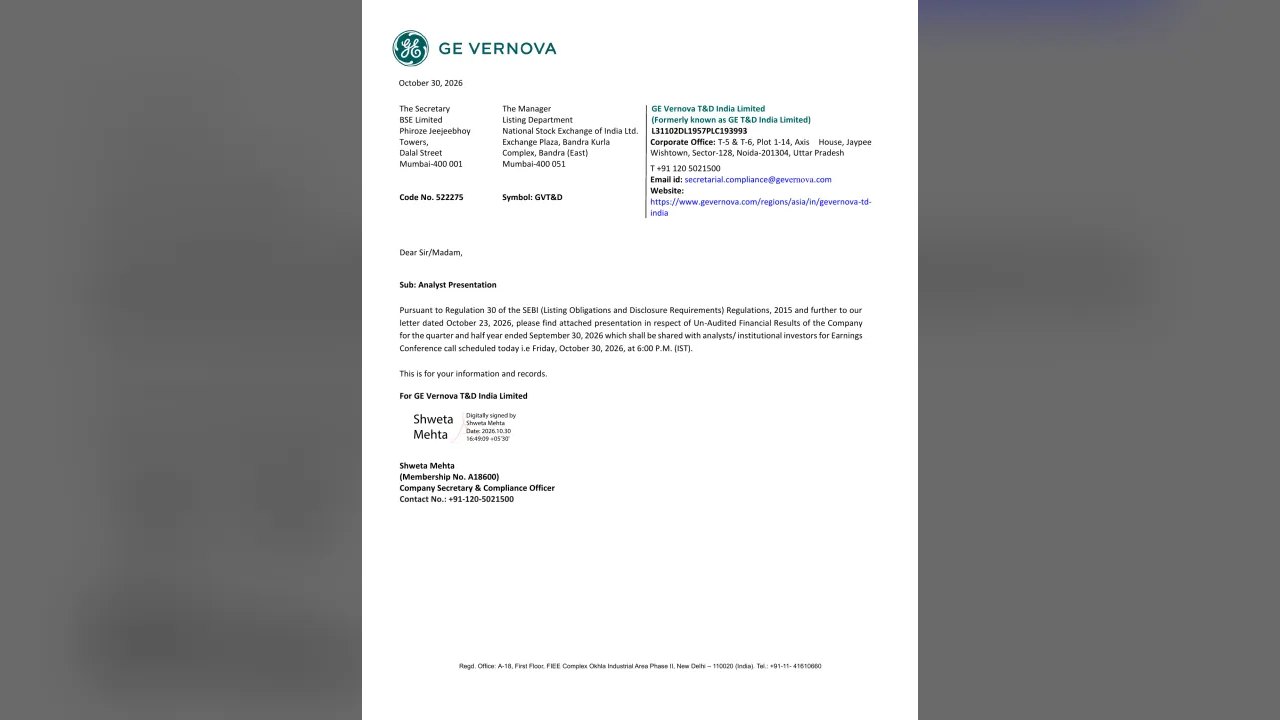
GE Vernova T&D India (NSE:GVT&D) Q2 2027 earnings call, held 2026-10-31. Watch the replay and read the transcript on 6ix.
- Company
- GE Vernova T&D India Limited (NSE:GVT&D)
- Period
- Q2 2027 earnings call
- Date
- Sat, Oct 31, 2026, 3:31 AM ET
- Replay
- Watch the replay on this page · 1 h 13 min
On 6ix: 6ix.com/event/ge-vernova-tandd-india-limited-gvtandd-q2-2027-earnings-call
Replay
Transcript
Automated transcript · Written by software from the replay's audio. It can mishear names and figures; the replay is the record.
0:00 Ladies and gentlemen, good day, and welcome to conference call hosted by GE Vernova TNT India Limited for quarter two of financial year twenty twenty six, twenty seven. As a reminder, all participant lines will be in listen only mode, and there will be an opportunity for you to ask questions after the presentation concludes. I now hand the conference over to miss Megha Gupta from GE Vernova TNT India Limited. Thank you, and over to you. Good evening, everyone. Welcome to the earnings call of GE Vernova TNT India Limited.
0:45 I'm Mega Gupta from Investor Relations team, and I'm joined by Mr. Sandeep Zandaria, CEO and MD of the company Mr. Ashish Kumar, who is the Director and CFO of the company Mr. Abhishek Shivastar, Head Business Operations and other members of the leadership team. Before we begin, I would like to highlight that today's discussion may contain few forward looking statements, which are subject to risks and uncertainties. These statements are based on our current expectations, and actual results may differ materially from those expressed or implied. Now I hand over the conference to mister Sandeep Zamzaria to open up the discussion. Thank you, Mega. Good evening, everyone, and thank you for joining the second quarter earnings call. The Indian power transmission sector is at its historic inflection point, moving from a centralized grid towards a more dynamic, digitalized, and decarbonized architecture.
1:36 Three key pillars are defining the industry. First is unprecedented grid expansion and modernization. India's energy demand is scaling at a pace that requires aggressive expansion of transmission infrastructure. The integration of large scale renewable energy often far from consumption centers requires robust long distance world... High voltage direct current and alternating current corridors. Second is the digital transformation of the grid. The grid has grown more complex, making advanced automation real time smart substation and predictive maintenance essential to reduce AT and T losses and improve the reliability. GE Vernova is focused on providing the software and digital infrastructure required to manage this complexity.
2:24 Third, the TNT sector is the backbone of India's energy transition and net zero ambition. The greener grid requires not only solar and wind capacity, but also the hardware and intelligence to balance the intermittent power sources. Systems such as flexible AC transmission solutions and energy storage integration are therefore becoming essential for grid resilience. Coming to the financial performance. During the second quarter, we saw an order book of 24,400,000,000, up 52% year on year compared to 16,100,000,000 in quarter ended September 25. Our q two revenue stood at 20,300,000,000 versus 15,400,000,000 INR in q two FY twenty five twenty six, up by 32% year on year.
3:16 Order backlog stands at 214,400,000,000 as of September 26 versus 214,600,000,000 as of March 26. The the order backlog stands at more than three years of revenue for FY 2526. Our profit before tax and exceptional items for the quarter ended September 26 was at INR 5,800,000,000 compared to around INR 4,000,000,000 in the corresponding quarter of the last financial year, growing by 1.4 x. Cash generation of 10,100,000,000 during h one. With this cash, our balance stands at the end of September at 32,500,000,000. Looking ahead, our priorities are consistent. First, execution excellence on mega projects, especially our HVDC.
4:07 Second, deeper localization, expanding our manufacturing footprint in India, reducing exposure to global supply chain risk, and supporting the vision of self reliant energy sector. Third, growing our services and software business, particularly grid automation and asset performance management, where predictive maintenance and software optimization help utilities get more from the assets they already have. A heartfelt thanks to our colleagues at the project sites and in our factories. As the volumes grow, they continue to deliver with regard and never compromise on safety. Now I turn to Abhishek to walk through the specific operational highlights for the quarter. Thanks. Thanks, Sandeep. Good evening good evening to all of you. So I will take you through the key network augmentations that we achieved in the last quarter. So first of the notable mentions is the 400 kV substation is for NEA in Nepal.
5:06 So this is for the backbone of 400 kV grid network that Nepal is trying to develop. So earlier, had commissioned Hindi, and this is the second in the lead. After that, 400 kV GR station was commissioned for GEBCO at Babazaar. In addition to that, we had been strengthening the transformation capacities at various existing and new substations. And in that, we commissioned seven sixty five kV reactor for our customers, PGCL at Vernova, at Bihar, and then seven sixty five kV generator transformer for a new PPL at Vatampur. In addition to that, we had GIF commissioning done at Narela in Delhi and some export jobs, one in in Spain and another one in Senegal.
5:56 All these commissionings are are testament of our focus in terms of network augmentation and our commitment towards operational excellence and continuously delivering on our promises to our customers. So I hand over to Sushil now to take us forward. Thank you, Abhishek. Good afternoon and good evening, everyone. First, I will talk about the order booking highlights for the quarter. During quarter two, we secured an order intake of INR24.4 billion, bringing our cumulative H1 order intake to approximately INR35.8 billion. This represents an 11% growth year on year. Key wins during the quarter reflect our strong technical capabilities and diverse market reach, including a major package for 400 kV generator transformer and four twenty kV GIS for a 1,500 megawatt pump storage hydro project in Maharashtra, 800 kV and 420 kV GIS packages for transmission projects in Andhra Pradesh, supply of 400 kV reactors and four twenty by two twenty kV GIS package for a TBCV transmission project in the state of Himachal Pradesh.
7:11 Supply of seven sixty five kV shunt reactor for a TBCV transmission project in the state of Andhra Pradesh. Transmission packages featuring 400 kV and seven sixty five kV reactors in of Pradesh and continued export momentum with multiple equipment orders for GICS across North America, Europe, Middle East, Africa alongside strategic automation packages. Our order backlog closed strong at billion, reflecting a healthy baseline as we efficiently convert our backlog into revenue. Turning now to the financial performance for the quarter and some highlights of the first half. Revenue for the quarter, Roombas stood at 20,300,000,000, up 32% year on year with H1 revenue reaching about INR 38,600,000,000, up 35%.
8:03 Gross margin for the quarter stood at 44.5%. Disciplined cost management across operations enabled us to deliver an EBITDA of INR5.5 billion, approximately 27.1% of revenue. This EBITDA is at the higher end of our mid-twenty guidance band that we had been communicating to the stakeholders in the past. Profit before tax for the quarter rose to 5,800,000,000 and profit after tax is at INR 4,300,000,000, representing 21.3% of revenue. Finance costs remain negligible with our continued net zero debt position. On the balance sheet side, we generated INR 10,100,000,000 of cash during first half, taking our total available cash and cash equivalents, including funds lent to the cash pool to approximately 32,500,000,000.
8:55 Regarding our capital expenditure as previously announced, the company is progressing with the capacity expansion program of approximately 10,000,000,000, out of which roughly 20% has been already incurred. Management continues to evaluate various options for the utilization of balanced cash to optimize returns to the shareholder. I would also like to highlight the continued quality and segmentation of our orders and revenue. For the quarter, our order and revenue mix reflects a strong balance sheet with export orders sitting at 21% and export revenues at 32%. Looking at our order and revenue split for the half year, orders stood at 29 export and revenue stood at 31% of export. Further, our ongoing counterparty derisking strategy ensures that private customers and central utilities PSUs continue to form an overwhelming majority of our order backlog, maintaining a robust and secure risk profile.
9:51 In the presentation, we have also given the status of material related party approvals. So we had secured an approval of roughly 31,000,000,000 INR in the AGM of 2025. This was for export of various high voltage switchgear components to to related parties in Middle East and France. This or... This lapsed in AGM of 2026 because the the shareholder approval for the related party is valid for a period of one year. And the reason is that the order is on hold from the customer side due to the operational planning delays from their side. We had also secured another approval for related party from a U. S. Entity, largely for export of goods from India for approximately $151,000,000.
10:43 This approval is valid till 05/15/2027, and the order is in discussion stage with the customer. We hope that in h two of this financial year, we should be able to conclude this order. So summarizing before I hand back for the questions, order intake grew steadily, revenue growth, execution pace, cash generation and backlog quality all remained strong and consistent with our full year expectation. And we are confident of converting our $214,000,000,000 backlog profitably over the coming years. With that, I'll hand over for the question and answer. Thank you very much, sir. We will now begin the question and answer session. Anyone who wishes to ask a question, may press star and one on the touch tone telephone.
11:32 If you wish to remove yourself from the question queue, you may press star and 2. Participants are requested to use handsets while asking a question. Ladies and gentlemen, we will wait for a moment while the question queue assembles. The first question is from the line of Sameer Takur from Ambient Capital. Please go ahead. Hi. Thanks. My first question is that GE Global GE Vernova, they announced a acquisition of French. They also said that they are evaluating and expanding the manufacturing of French products in India. So is there any view on that, whether that will be part of G1O India or is it too early to say? Just wanted your comments on that.
12:17 That's the first question. So thank you, Sameer. I think the acquisition has been announced only two days back. So as of today and the whole acquisition process is expected to end in the later part of FY twenty seven. It's too early to comment on that. Okay. Thank you. And the second question is what is the revenue contribution from services and software at the moment? And is there any target which you have in mind or any ambition regarding this? So, Sameer, good evening. This is. So software and services business, don't give breakup as such because we operate as one segment, which is a high voltage products and transmission side.
13:07 But I can give an overall color that we are off late booking lot of equipment orders because our order booking including the has been very strong in last few years. So as a a ratio of the total revenue, the share of software and services may have dropped while every business is growing year over year year over year. Thank you. I'll get back to you. Thank you. Thank you. Next question is from the line of Mohit Kumar from ICICI Securities. Please go ahead. Congratulations on a superb quarter. Thanks for the opportunity. My first question is on the GE Vernova Global is talking about $900,000,000 order which they have booked for giving the orders to global factory.
14:02 My question is, are you in contention for those? And how many factories globally GE has for producing transformer, especially in Asia? So hi, Mohit. Asia, we have two transformer factories. One is in Indonesia, but that's a much smaller factory because I think today they build up till two forty five kV only. And the higher rating transformers are all building, but they're only in the Asian Continent. In the 900,000,000,000 order, yes, there will be some orders which are going to flow for which that we have taken a related party approval for INR 1,300 crores and the finalization process is on.
14:57 My second question is on the I think I mentioned the PPT that is a holdup from the holdup on the two related party approval orders. One is, I think, GE and one is, I think, is France, right? Do you... In your opinion, do you think in the next six to twelve months that hold up to hold up in case will get clear and the... There's an opportunity to participate in those orders? That project actually is of a much bigger size, and the hold has been put by the customer. So we are not very sure whether the hold is going to get lifted in six months, eight months, or a year. It will be too early to speculate on that.
15:42 Understood. My last question is, how are you seeing the new opportunities for HVDC developing over next twelve months? And is there a need to invest still more from our side to improve the indigenization contained for HVDC as we go forward? Yeah. So we look at a very strong pipeline of HVDC going forward. We expect minimum two to three projects to come next year, and HVDC is going to remain our key focus area as well. And we keep on evaluating that if we need to do an investment in terms of more local... So if you look at HUDC practically, most of the things have been localized. So today, are manufacturing transformers in India, valves in India, controls in India.
16:34 So at one point of time, a large part of the transformers and 100% of walls and controls are coming from outside. But with whatever CapEx we have done or whatever CapEx is is under progress, all these things have been localized. However, there are components still which come from outside, not manufactured by GE Vernova, but manufactured by our subcontractors or sub vendors. So as a long term strategy, we will be working on... In the next phase, we'll be working on localization of data. Understood. Thanks and all the best. Thank you. Thank you, Bharat. Thank you.
17:21 Next question is from the line of from HDFC Securities. Please go ahead. Hi, Sandeep. Sir, congratulations on a great quarter. So in this quarter, we have seen a very significant pickup in the domestic orders. So last quarter was subdued. So so how do you see rest of the financial in terms of domestic orders? And was there any one off in this quarter, any large orders in the domestic markets which would have contributed significantly to the overall order inflows? So I think we see order intake for the year as a positive story only. There was no one off It were all regular orders which have come in. Also, you know that we have already declared that we are the lowest bidder in Power Grid for and has already been acquired by Power Grid.
18:15 So we expect that this quarter will also be significant in terms of booking that order as well. So I think on the order side, we are pretty confident that this year is going to be a much strong year... Stronger year than what we delivered last year. Any color on the domestic ordering, sir? How is it panning out to the second half given q one I think it is strong because in last three to four months, there was a substantial strong pipeline of GVTP projects. And still the opportunities are now also coming in. So I look at at least in the next four, five months also to the pipeline to remain strong. Okay. So on the RPT side now, so we have seen a fallback of two orders.
19:02 I mean, they've got an indefinite suspension as of now, and they take time to come back. So in terms of RPT opportunities, so how does one look at it from here on given even The US data center order has been kind of slightly delayed and may come up as we said later part of the year. But as overall pipeline from Asia, Europe, America, so how does one look at RPT from here on? Are there significant orders which can replace the lost opportunity which we had faced from this quarter? So I think larger opportunity is definitely... Yes. They are, like, really one off, but we are seeing a strong pipeline for the smaller orders which don't fall under the category of material RPT, but then the order inflow for the normal product business is much stronger this year as compared to last year. I'll just add on, Prigjit.
19:58 This year, in the first half, we have booked INR 10,400,000,000 of export order and most of, like, significant part of these order booking are from related parties compared to 11,800,000,000 in the entire financial years, 2526. So on a like to like basis, you can see that there is a significant growth in the normal order flow, excluding the large one. And if you are able to close the mutual RPT, The U. S. One in the second half, then the entire year full export perspective will also increase growth. So what is driving this smaller inflows from the related parties? Is it broad based or is it from some specific geography? How would be the It's all broad based, Harish. It's all broad based. Is it the effort of the certification which we have done for our parties, I mean, with new countries and so that's that's yielding this kind of performance? So what is driving the sudden change, I mean, from the smaller I think everything, Many geographies are now seeing a lot of investment coming in and supply chain also getting stretched. So that's creating an additional opportunities.
21:08 And definitely, in many cases, it is the certification which we which we are working for last one year are also yielding results. Sir, the last question from the competitive intensity. We are now seeing Chinese players coming in some of the other domestic players are tying up with some foreign partners and planning to enter into HDC. And I think 400 plus, I mean, below that, we are seeing huge competition now. How do you see the competitive intensity panning out from here? Are you seeing the pricing now cracking down? So any color on that would be helpful for the future orders. So, yeah, after we have won, there has been no HDD tender, so we don't know that. So whatever strategy you're talking about, Chinese trying to get this, that, everything, so that is not yet seen in the market. There's been no tender subsequently, so we cannot talk about competitive intensity as of now.
21:59 But regular transformers, sir? I mean, your regular stuff with the high voltage transformers beyond the HVDC, excluding HVDC, sir, how's the competitive intensity? Slight pressure on the... There's some slight pressure on the prices, yes, but very little. Nothing. Okay. Sure, sir. Thank you. Thank you. You. Next question is from the line of from Nomura. Please go ahead. Hi, sir, and congrats for a very good set of numbers again. My first question is again pertaining to acquisition done by parent for Trench Group. So just wanted to have your view on two comments which are made by parent. One is basically expanding French group's reach in select regions, including India.
22:49 And second, they are talking about growing French revenue potential in India through GE's commercial capabilities. So and if I look at probably product offering by trench as well, it looks like they can complement us by providing additional supply of bushings as well as coils, which are necessary for HODC projects as well as other products. So any other view, how synergies can play out? I mean, a primary view. So thank you, Umeish. Yes. You are right that, for example, the synergies are going to place... Play out because, obviously, when we are talking about good HDC pipeline and HDC being our focus, not only HDC but startcom also.
23:40 So I think with a larger control over the supply chain, it's going to make us more competitive and will put us in more better competitive... Not only competitive, but more secured position in terms of supply chain. So I think it's it's a very positive development as far as India is concerned. Understood, sir. My second question is pertaining to the order that you received regarding pump storage hydro project. So is this the same project which was awarded to other group company of GE? No. No. No. This is stand alone transformer and GIS packages. So this has nothing to do with other GE entities.
24:30 Okay. Understood. And at what stage Hydro project potential in India in future can give you order for packages like transformer or GIS, whether it is in first year or second year of ordering in that particular project? I think normally when the machines are ordered at the start of the project, today customers are ordering transformers and the balance of plant, which in most of the cases is GIS. So it's at the start of the project. People don't take wait till, for example, one year or two years because for transformers, etcetera, the time frame is also a bit higher. So it's at the start of the project. Got it. And on the STATCOM side, if I look at probably order events, I think I think even in q two as well, there were no orders on STATCOM even for the other players in the industry.
25:24 So when we can expect sizable portion of ordering on STATCOM to start in India? I will expect this sizable portion to get ordered in q four. Understood. Understood. Last question is only on the bookkeeping side. If I look at probably other expenses, they have grew by about 38% in the quarter gone by. Was there any one off provisioning or ForEx loss that you have reported in other expenses? Ramesh, there has been some ForEx loss, but it's all operational. And overall, I think the growth is in line with revenue. So nothing to worry about in terms of the world impact on the.
26:16 Got it, sir. Got it. Thank you. Thank you so much, and all the very best. Happy Diwali, Nagas. Thank you. Happy Diwali to you. Thank you. Next question is from the line of Amit Advani from PL Capital. Please go ahead. Hi, sir. Thank you and congrats for the strong performance. So first question on the gross again, the gross margins. This quarter gross margins has been quite resilient. Just wanted to understand, are we again sticking to what led to this gross margin performance? And are we sticking to the mid-20s EBITDA margin guidance for this financial year? Yes, that is my first question.
27:04 Good evening, Amit. So, yes, you're right. We are sticking to our guidance because management performance has been good. We have been able to achieve an EBITDA of approximately 26.2%, which is slightly on the higher end of the mid-20s range. And in terms of gross margin, see, quarter on quarter changes because of the mix of different products, exports and so on. But we, as you rightly mentioned, have been able to maintain resilience and able to deliver the targeted EBITDA margin. I think as we have been communicating in the earlier calls as well, So EBITDA becomes the right operating metric in our business, and there also a longer one year view is relevant rather than a quarter to quarter performance.
27:59 Right. The second on this RPT order of INR 1,400 crores, 1,500 crores in U. S, what does it relates to? Is it transformer order, data center order? Any color on that? And second, also some color on the data center kind of contribution or number in terms of order book related to data centers that will have? So, Amit, yes, it is related to data centers in US, definitely. And it's related to transformers in small data centers in The US. Second, India data center, of course, there was not a very significant ordering which got decided during the quarter.
28:49 So the numbers are not that significant to call out for the India data center market. Alright. Lastly, on on the localization which you highlighted and with this tranche order by the global parent, you you also highlighted about the synergies. So in India also, we like to secure the supplies as we hear that the lead times are just getting elongated and amid the strong demand. So are we also maybe looking for related acquisitions or something like that? Or maybe there would be more investments for localization? And second, in terms of total addressable market, if you could give some color whether are we aiming to further increase the total addressable market in India?
29:47 So I think, yes, definitely by acquisition of Trends, it is going to give a much better control over the supply chain than we are bidding for HDD and other projects as well. So definitely, that's going to help in. Regarding the CapEx or localization part, of course, we keep on working on improving the localization as we said earlier, but for example, it could be part investment by us, but we also work with our developing new vendors or products which are actually coming from outside and finding an alternate supply chain in India. So it's a bit longer journey because we need to then work with various suppliers to develop the product according to our requirement.
30:35 It goes through an extensive testing, and then then only it it gets launched into the market. But there, the CapEx is, of course, done by the... Or the investment is done by the subcontractor. But we already declared a CapEx of about 1,100 crores, and we have said that we are continuously evaluating the market and if need be, we will not shy away from investing further CapEx in the country. Right. And what's the utilization levels today? Sir, put it as pretty high for most of the factories. Like, more than 75%? Or Yeah.
31:22 Understood. Thank you, sir. Thank you. All the best. Thanks. Thank you. Thank you. Next question is from the line of Rahul Gajari from Macquarie. Please go ahead. Yeah. Hi. Good evening, and congratulations on a very strong q two. So my first question is, you did briefly touch upon localization. I want to understand how much time does it take you to deliver a seven sixty five kV transformer for an order that you would have got today. Okay? And, you know, I'm sure with the acquisition of Trench, the delivery time line will shrink. And is there any sense that you can give us in terms of the shrinking of the time line? And continuing with the same question, as of today, are all the bushings manufactured locally or you are sourcing it from outside? Yeah. That's the first question.
32:16 So thank you, Rahul. First of all, I think what I said was that it's going to give a better control, but it doesn't mean that it is going to shrink. But French would also be having a pipeline of their own, and they would also be having their own delivery commitments which they would have made in the market. So I don't think that simply they would be ignoring those delivery commitment and start diverting all to internal g factor. It's not going to work like that. If we... For example, today, when we look at our bushing... So bushing seven sixty five k v, most of the bushings are coming from outside because the manufacturing capacity in India is pretty limited.
33:03 But now there is a expansion of capacity going on. So today, it is getting imported, but in times to come, it's going to get localized. That's for sure. I think if we really look at seven sixty five kV bushing lead times, that itself is more than fifteen to eighteen months. So the transformer delivery times... So to manufacture a transformer, it will take as about three to four months only. But then the raw material lead times are pretty high, so that's that's what gets defined, the manufacturing time lines. Okay. But any timeline, you know, one one and a half years, two years, you know, for you to... If I were to give you an order today, when you will be able to deliver? So that will also depend upon our factory loading and other situations as well. So Okay. So my second question is on the data center side now. I mean, all major global companies are focusing on data center, including GE Vernova.
34:05 Today, how much of data center you can... The opportunity that you are able to capture today, and how will this TAM change over the next two to three years? So today, the data center is basically a... The Indian data center market is mostly, like, a 200,300 megawatt data centers which are there, which is mostly operating at about two twenty k b. So the time is not that great and... But once a larger size data centers will be coming, then it will be four hundred fifty and seven sixty five kV. So there there will be a significant uptick of the time which is going to happen. Okay. Sir, my last question is on this HVDC and statcom. You all are manufacturing walls over here. So how much of HVDC will be actually localized?
34:56 Anyway, to put a number, you know, 50% or 70% of HVDC value will be localized. So there's a difference in how we think of localization and what the government formula talks about localization. So I'll just give you an example. For example, when we manufacture a transformer in India, then we design the whole transformer, then we buy all the material. Our supply chain buys it. We manufacture it in our factory. We test it and we supply it. So in a way, if you talk in a general sense, then 100% transformer is localized because... But, for example, you look at CRGO. So CRGO is going to be imported. So the government doesn't come... Count it as a localized part.
35:45 For example, oil. So the oil would be coming from somewhere outside, and you are just processing it. So a large part of that oil will not be considered as localized. So there's a difference between if you really look at that way, what definition, what we think internally, most of the HDD is localized because all transformers we manufacture here, that is to all we are manufacturing here, controls we are manufacturing here. So the complete engineering solution because we have a back end engineering center for HVDC in India. So it's like mostly an India dependent or India supply chain story, but then there's a difference how government monitors or captures the information. Okay. So whatever is possible, you are already doing it.
36:34 That's Yeah. But then what happens is... So what happens is, for example, tomorrow... So when we will start... Our wall factory is going to get commissioned. And then when we'll start manufacturing terrestrial wall, then we'll go for individual component wise. So for example, gas is here. When we opened the factory in 2009, everything was coming from outside. But then what we did was we took component by component to certain things we went... We got it developed. So when the supply chain got stabilized in India, so that component became an Indian source rather than. And there are times when those component manufacturers became so matured that they started supplying to our global factories as well. So when we localize, for example, when we are going to localize, then we're going to do component by component, try to see if we can work and develop those components with local Indian manufacturers as well.
37:29 It could be different industries or it could be an automobile industry. It could be another industry as well. So we work with those industries. Get... So it's a journey. It's not something like that. In one shot, you do it at 100% or 0%. It is like a journey. Okay. Sir, thank you very much, and all the very best for the second half. Thank you, Rahul. Thank you. Next question is from the line of Aditha Vikram from DB Securities Private Limited. Please go ahead. So hi, sir. Good evening. Just wanted to check quickly upon few things. First one, even though we have achieved the higher end of the guidance EBITDA, right, 27 plus percentage, Are we going to sustain it at this level for the next two quarters?
38:23 So for the entire year, I would say we have we will maintain our guidance of mid-20s EBITDA. Okay. Okay. And the second question I have is this the project which we took from Power Grid, the Bhanur project, right? Will that have any negative impact on our EBITDA margin? The order is going to be executed mainly in next two to three financial years, maybe four financial years. Okay. So there won't be any impact this year. Is that what you're saying? Yes. There won't be any execution from any of the HVDC orders, significant ones in this financial Okay.
39:10 And the last question I have is, sir, this related party, which where the approvals have lapsed, right? Is that still part of our order backlog or that has been removed? So, Aditi, the order was not booked because we took the approval and customer put the project on hold. It's not a part of our backlog. Okay. And are we sensing, considering all the things we are hearing right now, are we sensing some cancellations of order from the data center side or anything? Have we encountered any such queries from our existing customers? So we don't have any data center backlog, anything different? No. No. We have a data center backlog, but we... There is no sense of any cancellation or anything. This is a news to me, what you are talking about.
40:07 No. Okay. Okay. That helps, sir. Thanks thanks very much for clarifying. I appreciate it. That's all from my side. Thank you. Next question is from the line of from Investment. Please go ahead. Yeah. My question is around AI. We are hearing nowadays that AI companies are not getting funding and going slow on their expansion. So are you are you also... Are you seeing any kind of impact because of this? So, mister, large part of our order is basically coming from the transmission utilities or the TBCB segment, which is the TBCB industry and these segments.
40:59 So India, for example, if you really look in many years, the the installed capacity of data centers close to about one and a half gigawatt, which is very small. In fact, by 2030 also, it is expected to go up to late to 10 gigawatts, so not very significant as comparison to US market and other places as well. So at least in India, we don't see a significant challenge in terms of these companies' capacity to raise capital and put data centers for AI. Mhmm. Mhmm. So you are not seeing any kind of demand pressure from, you know, that side. Am I right? No. No. When the large data centers will start coming in, there will definitely be pressures in terms of because they will be requesting for early deliveries, etcetera. But, yeah, today, many projects are on the drawing board, so we expect a much stronger traction on data centers to happen starting from q four or most probably next year.
42:04 Okay. Okay. Thank you. Thank you. Thank you. Next question is from the line of Suraj Malu from. Please go ahead. Hello, sir. Sir, in January 2026, we had taken RCT approval for INR 3,000 crores, which you mentioned last quarter that it was on hold. So what is the current status on that project, sir? So Suraj, good evening. The approval that we had taken in January, that was largely on the buy side, meaning we had placed order on our group company for largely including the product that we need for execution of HVDC project. So that that was on buy side, which has been executed.
42:56 The other order, two orders for which we have taken approval, mainly from the sales side or to get the export order from the customer, we have already given details in the presentation. Right. Right. Part of the order is on hold and the other one is active. Right. Right. So of the INR 3,000 crores, large portion was for importing components for HDD, For the January 1. Got it. All right. Thank you. Next question is from the line of Vijay Bhasan from Inquest Capital. I just have two quick questions. One, do you expect gross margins to cool off from the current 55% to 57% levels once the large HVDC projects sort of comes into execution starting, let's say, next year?
43:53 Assuming that the current revenue mix is more towards products than it is for projects. So good evening, Vijay. First clarification that the gross margin is not around 55%. It's in the range of 45%. For this financial year, we have already clarified that HVDC's execution are not going to be part of revenue. In fact, the HVDC execution significant part will start coming from FY twenty eight onwards. Even in the next year, next financial year, we don't expect significant HDD contribution. We have maintained mid twenty six guidance for this financial year. We don't share long range guidance, which include actually this acquisition over the next three to five year cycle.
44:41 We'll communicate in the due course. So just a follow-up to it. Can we say that the current gross margin levels possibly can hold for the next one to two years despite competition coming up? Or can it actually get better from here on? So we don't give gross margin guidance. We have given the EBITDA guidance because as I mentioned earlier, the gross margin changes quarter on quarter or even year on year depending on mix of product process projects and then export versus domestic and so on. And also we have significant operating leverage benefit that we can avail. So we have already shared guidance for this financial year, and we are actually executing well in the first half.
45:30 We'll communicate the expectation for the next year in due course of time. As of today, don't actually share the long range guidance. Sure. Just lastly, how much would be, let's say, the data centers mix in your backlog right now? It's a very small percentage, Vijay. It's mostly few products into 20 kV and segment and grid automation. Fair. Okay. Thank you. Less than 2% in that. Sure. Thank you. Thank you. Next question is from the line of Amit from UBS. Please go ahead.
46:17 Sandeep, congratulations on maintaining very strong quality of business. My first question is on the capacities in manufacturing and power transformers and systems that are lined up in the next two, three years in the country. Do you think this is a question for industry, maybe not particularly for GE Vernova's profitability because that's a different business mix. In 2027, do you think the ordering pattern is going to be such where the capacities will start having some impact on profitability and pricing because the demand supply mix, especially in CY twenty seven ordering will be very, very, you know, different vis a vis what we have seen in last two years. That's my first question for the domestic market. I think there's a lot of capacity expansions what people have announced.
47:09 So if you hear them, what they have been saying, so they're putting up capacity mostly for the export market, not for the domestic market. And if they follow what they are saying, then I don't see too much pressure coming on the domestic market prices. Okay. Because because qualifications have their own time, and not everybody who are planning export might be able to do that going by last twenty years history in the country. So that's why I have that question. But there's a large capacity expansion happening mostly on the transformer side, but not on so much on the side. Okay. Good point. And second question is when GE Vernova T and India exports to US, Europe, and the MENA region, we... You know, you also have a lot of domestic companies, large ones who are who are trying to get capacity orders. Which part of...
48:07 And you can directionally give this answer, sir. What part of your business today is vulnerable stroke in direct competition to, say, four, five large exporters, you know, non MNCs in India? Because I understand a lot of lot of your business is technology led where Indian companies don't have a competition or offerings like GIS, etcetera. So... Yeah. Normally, I've not seen us fighting too much in the market globally with Indian companies. So then it is very difficult for me to predict that how this whole thing will play out with the Indian companies getting more export. If there is a trend which starts emerging and suppose... I'm just giving a hypothetical example.
48:55 Don't take it. Suppose in Europe, some ex country, for example, Spain or Portugal or whatever it is, there is my... If I have put in a... If my bid is there and that that there are three Indian companies, then I can make an assessment because of what what impact it can have. But today, that is not the scenario. So it is very difficult to me directionally that which markets will get impacted and where and what is the volume which is going to get impacted. Sure. Sure. Third and last question, quick one is yes. And basically, do you think the capacity expansion? So we've seen Korean companies expanding capacities. A lot of investors raised question about the conservative behavior in expanding. Do you think, you know, even GE Vernova TND India in their CapEx, in your 11,000,000,000 CapEx, you would want to call it a conservative expansion going by the global demand assessment and domestic demand assessment? Yeah. Thank you.
49:54 So if you look at that, the Korean companies are not that big in India. Right? For example, transformer and all, there is no Korean company which is there. Korean companies are putting the CapEx either in Korea or they are putting a large CapEx, which is happening in US. So we cannot compare them with GE Vernova TND India's CapEx. And regarding the conservativeness of our CapEx, I will say that we take a informed view about the market, the supply chain demand, our ability to play in that market, and then only we decide on the CapEx numbers after due diligence with the board. And I'll just add on, we also consider what maximizes the return to the shareholder.
50:41 Most of the investment that we are doing, almost more than 90% is in our existing plants where we already have the land and it it makes a very significant expansion. So the need of CapEx versus other player is lower to produce or generate similar or higher volume. Sure. Sure. So, anyways, I meant Korean company expanding in Korea for US and Korea. But, yeah, thank you, and good luck. Thank you. Thank you. Next question is from the line of from Nomura. Please go ahead. Yeah. Hi, sir. Congrats on a very good set of numbers in this quarter, and thanks for the opportunity. So I just wanted to ask that for the upcoming three HDD projects to win one in the third year, So what is the kind of timelines that expecting in terms of, you know, tendering and awarding?
51:33 If you could provide some clarity on that, please. I think the the project not yet been cleared by NCT and all. So it's going to happen in '27 only next year. Understood. So my second question is regarding this, you know, discussion regarding the ultra high voltage eleven fifty kV corridor. So if that actual rectifies, what kind of tailwinds you expect regarding your TAM and demand opportunities going forward? So that will also depend upon how many projects come in a year. So we have to wait for that kind of feedback to come in when the first project comes in and then what is the pipeline.
52:26 Then only we'll be able to give a concrete numbers on the TAM about the scope that how many bays are there, how many transformers are required. So it's still bit bit away. Understood, sir. And if... Any idea on who might be your competitors in this segment if it comes along? Eleven fifty k b. Yeah. So for different projects, for different products, it will be different competition. For instrument transformer, it will be different. For transformer, it will be different. So it will be different for different products. Understood.
53:12 So thanks for answering my questions, and all the best for the coming quarters, happy Diwali and advance. Thank you, Alitra. Thank you. Next question is from the line of Shiram Kapoor from Jefferies. I just had a quick question on the HVDC bit. So could you somehow quantify, typically, an HVDC project, how much would be, let's say, thousand crore HVDC project, how much is typically the equipment component or the component that's addressable by you? So that that changes upon the line length and other factors as well. Because, for example, one might have a 800 kilometers of line and the second HDC might have a 1,200 kilometers or a 1,500 kilometers of line. So the composition in terms of percentage will change, but you can take it somewhere around, say, probably 40% to 60%, 65%.
54:21 Understood, sir. And just secondly, you mentioned that, obviously, in the last three, four months, the TBCP pipeline has picked up substantially. So I mean, I think by my calculations, close to about one lakh crore of TBCP projects have been tended out so far. So how much of this would you say could still be up for ordering for the on the equipment side? Typically, a project is awarded to the developer, how long is it before it's awarded to the equipment supplier? That's one. And just continuing that on the on the TBCD projects is, you know, how much you see in terms of a market opportunity coming up from the intrastate TBCD project side as well? Because a lot of the recent tenders have been in interstate. So how do you see the pipeline shaping up in intrastate as well?
55:13 So, Shivram, thank you for the question. So I think on the TVCB intrastate pipeline, of course, many states have have have expressed that in future all their expansion, at least the 400 and the seven sixty five kV, they would like to go it on a on a TV TV mode. But there's not been... If you ask me a number for for the year, probably it will be difficult for me to quantify because I think the numbers would be tracked more by the developers rather than by the... By us. That is first thing. Second, I think what you asked about... So normally, earlier what was happening that TBCB projects, the delivery timelines are, like, eighteen to twenty one months. So whenever the developers are winning, they were in a hurry to award the packages in order to secure the timeline and meet those timelines.
56:16 But now it has become, like, from twenty four months to thirty months. So even after the developer wins the project, they take some time to decide on that. So there is a float which has got created, which now rest with developers. So I will say it is difficult to now make a prediction that whatever a lakh crore the PVC pipeline, if it gets decided this year, how much it is going to fructify for the equipment manufacturers like us. Noted, sir. But fair to say, could be, you know, given that the timeline is stretched, it could be about six months or more, or could it be less than six months typically after the Normally, it would be, like, three to five months, the whole product will get awarded.
57:03 After the developer, they'll win the job. That that... This as per the latest longer time line, you're saying. Right? That Yeah. In the current scenario, it could be three to five months, typically. Yeah. But for transformers and all people do it earlier, but for other products, it's... Then get slightly delayed. Noted, sir. Thank you. Thank you so much. Thank you. Thank you. Next question is from the line of Amit Oj Singh from three sixty one Capital. Please go ahead. Yes. Thank you so much for taking the question. My first question is on exports. So I think as of FY twenty six end, our exports order book stood at around INR 1,700 crores. And if I see the first half execution, we have already executed around INR 1,200 crores of exports.
57:57 So can... Is it fair to say that exports are relatively short cycle orders compared to domestic? Anything including that? Most of the flow orders or orders which are spread across multiple geographies, they are short cycle. But in past, we did book certain projects which are long cycle of three to five years. So the large projects generally have a longer delivery time period, the the majority party orders that we take, and rest of the flow business is a short cycle one. Got it, sir. So roughly, the new order that also we have been taking in the first half, they'll also be short cycle products, fair to say? Yes. Absolutely. Got it. Got it, sir. And so the next question is from the IGBT technology.
58:45 So our South Oak Park project is based on the legacy technology, and we have a tie up with Mitsubishi elect... Electric for supply of IVD conductors. So can we say that that HVDC order will have a relatively lower gross margin compared to FCCHVDC given that we'll sourcing some more components from Mitsubishi, main semiconductor technology? So for example, these IGBTs which we source from Mitsubishi or for that matter, any other supplier as well. So that's a standard model which we operate. So that doesn't decide whether... That's a component. For example, when we build a transformer, sold outside from an outside company. Similarly, in an HVDC, IGBTs are sourced from outside, but the complete valve assembly is done by us. So the design and manufacturing of the valve, including that IGBT is done by us.
59:46 So buying IGBTs from Mitsubishi has no role in defining what gross margin the project will operate. Got it. Got it. And similarly for LCC, like, we manufacture the system valves valve. But do we also manufacture the systems, or that is also being sourced from international players or from a parent? So we source the thyristors from outside, like we source IGBTs, but the thyristor valve as a unit is manufactured. At unleashed. Yeah. Got it. Got it. Just... Thank you so much for taking my questions, sir. Thank you. Thank you. Next question is from the line of from Solar Investments.
1:00:32 Please go ahead. Congratulations on a great set of numbers. My question is regarding the export opportunity, having exports through related party as well as other orders. I wanted to get some qualitative as well as quantitative color as to how different is it for an Indian company to do exports in markets abroad, particularly in The US. Is there any difference in terms of the certification or timeline or approval? If you could provide some color, that would be very helpful. And particularly right now, given the kind of demand supply imbalance that is there, is there a sort of a different approach than vis a vis what you've seen probably five years or so back? That will be very helpful, sir.
1:01:20 So I'll not be able to comment that what was happening five years back, but, definitely, if you want to export anything to European customers or for that... Or American customers, definitely, it will require an approval of the factory and other things as well from the customer side. I think that is the most important starting point. Then it will also depend upon that whether you are working for a utility or whether you are working for a data center. If you are working for a data center and the equipment is going to go in the data center itself, then it will depend upon that how flexible they are in terms of technical requirement. But when you go to utilities, they are pretty strict about following the technical requirements, etcetera. So I think this also depends upon you. It's not like you have one stop solution.
1:02:07 It will depend upon the equipment. It will depend upon the customer type that what kind of requirement comes from the approval. Understood. And in terms of the biggest bottleneck right now, what is it that the numbers are solid, the inflow is there. We have one deal one bid is also there. So I'm just trying to understand right now what is the biggest bottleneck that the company is facing? Is it the hands to continue to search forward with the growth ambitions that it has? Is it supply chain? Is it the skilled workforce? If you can provide some color on that, it will be good. Obviously, supply chain remains a a challenge which teams keep on working to mitigate that because, one, the global demand is pretty high, and then second, the geopolitical disturbances, they keep on emerging. So, yes, supply chain today is one of the one of the things which which can have a very severe impact on the operations.
1:03:12 So that would be the number one risk Yeah. In your your opinion. Okay. And last question is on the GEC free approval that recently the government gave. While you did provide some perspective on the interest rate opportunity, From a broader lens, how big the opportunity or TAM opens up for you? While it may be hard to give a color from a yearly perspective, but from a midterm perspective, mid to long term perspective, what does it mean for for a company like us? I think if you would have seen that recently, we did a investor meet in Mumbai, and at that point of time, we had uploaded the presentation to our guidance on the market remains the same.
1:04:01 So a large part of the G C 3 Corridor is anyhow covered under the electricity plan, which has been issued by CES. So Okay. Understood. Thank you. Congratulations on the. Thank you. Thank you. Next question is from the line of Sameer Takur from Ambrits Capital. Please go ahead. I just have one. So you mentioned that on pricing, there is slight pressure. So just wanted to check, is that on new orders? Because the copper price has increased, like, more than 50% in one year. And I thought the order pricing should have at least at least, like, should I improve at least 15% or so just to mitigate that impact? So just wanted to check on this part of the I was talking taking into account everything, then there is a slight pressure.
1:04:57 Okay. Okay. Got it. And that's clear. And just just one, if if I can squeeze in. You had mentioned in the earlier calls that the base order is, like, 70 to 70 to 80,000,000,000 for the year. So is that intact or you want to increase the target for the year considering the performance for actual? No. We would like to keep it. Okay. Okay. Thank you. Thank you. That was awesome, mister. Thank you. Next question is from the line of Parikshit Ganpal from HDFC Securities. Please go ahead. Thanks for the follow-up. So just to draw attention in the past, I think, Shishi used to earlier time that export orders are almost 500 basis points better margins. So few quarters have passed that. Has any change in the spread? Are the export orders more profitable now versus domestic orders?
1:05:48 Any color on that? So Prakash, broadly, the trend remains same. Export orders do remain at a higher margin than the domestic ones. Okay. And is it right to assume that the current order book of INR 20,000 crores plus will be carrying the 20s kind of margin excluding the actual decrease in right now in I1? Prajeet, I think there have been few questions in the past in this call as well regarding gross margin, EBITDA and so on. And now your question is on the margin of backlog. I will draw the attention and reply this differently. We have been growing at the rate of more than 30% over the last three, four years. And if you look at our backlog, 214,000,000,000 and plus HDDCL one position, we have a very strong order book already with us. With this, going forward in next three, four years, we can continue to similarly grow at more than 30%.
1:06:42 With that kind of revenue execution, while, you know, we are expanding at our factories. It's only 10,000,000,000 INR of CapEx. So with that small investment, we are able to execute this entire backlog, which means that without looking at gross margin or EBITDA, there will be a significant operating leverage that kicks in and the absolute earning per share will grow significantly with the same amount of capital. So the return on equity remains high for the future period and the EPS growth will continue with the increase in the revenue. So I think the stakeholders or the analyst or investors should consider the absolute profitability and return to the shareholder in terms of return on equity rather than the components of it, which is largely in terms of backlog margin or gross margin, etcetera.
1:07:31 Understood, sir. So just one bookkeeping question, I guess what time you have seen employee cost going up and one off there, or is it more of a trend now? I mean, is there any hike, anyone else there? You can just comment on that. Employee cost has been growing, but it is less than the revenue rate. So we in order to execute our backlog and grow revenue at 30% plus year on year, we have been adding people. And also, you would appreciate there is inflation. So obviously, there are increments and leases. Those are the two normal business operations sector. Nothing exceptional in this number. Just last question to see from you, sir. Is there any... I mean, just to see once ordering from power, we have seen couple of packages. We have one large ones, like, I think, upwards of $6,001,000 crores. So any future pipeline there which you see building out?
1:08:20 That will be the last question. Yeah. The power grid normally regularly comes out with tenders, but that's based on the TV CP pipeline only. Okay. Understood. Okay, sir. Thank you, and happy. Forward to Thank you. Same to you. Yeah. Thank you. Next question is from the line of Aditya Vikram from DB Securities. Please go ahead. Hi, sir. One last question. So this quarter, we have seen the gross margin at 45%, right? I just wanted to understand from your side that what has led to this outperformance? Is this the product mix or some sort of operating leverage, which will remain in place for the next two quarters as well?
1:09:09 So thank you for your question. And as I mentioned earlier that quarter on quarter gross margins do vary. Overall H1 performance and that variation is because of multiple factors could be the operational execution could be the mix of domestic versus export, project versus products and different product components and so on. The performance of 45% is not exceptional. We did the similar kind of gross margin in last financial year as well. So it's in line with the last financial year. And last year, we did 27% EBITDA. This year, our performance is more than 26% in H1, so and in line with our guidance. So nothing exceptional of what we are doing. But yes, the overall results are exceptional because we are the industry leading company in terms of the performance of the P and L and profitability.
1:10:02 And just I completely understand what you're saying, right? Not going to harp on more about this. This is something which can be sustained for next two quarters as well. If you're sticking to your mid-20s EBITDA margin, right? So again, the mid-20s EBITDA that we normally guide is going to sustain, but not commenting on the gross margin because as I said, different components within that keep changing. No, no, no, absolutely. I understand that. I just wanted to see if there is anything which might stick along. But thanks so much for clarifying. Appreciate it. Thank you. Next question is from the line of Mohit Kumar from ICIC Securities. Please go ahead.
1:10:51 Yes. Thanks for the opportunity. Again, my question I have on the Pusot expansion. If I correctly, the entity has approved this 30,003,000 gold project. Have you heard anything on the... I think that the the... A significant part were done by the GE. Have you heard anything from the about this project? No. I have not... Actually, your voice was cracking, so I was not able to hear was my question was on the expansion. Expansion. I think that is... It... The order has been given to, and we already did the... We have implemented the phase one. So phase two, I think we are the...
1:11:36 We we we will have to start to go to play. My question is have you heard anything about? And the total project cost side was 3,000 crore. Yeah. So I think for Soli one was executed by us somewhere in the year 2000, if I'm not mistaken, or 2003. It's, like, about more than twenty five years and... About twenty five years, and it has outlived its life. So the refurbishment of that project order has been given to Power Grid. So Power Grid has launched certain discussions with us, but there is nothing concrete on that. Understood. Understood. Thank you. Thank you. You. Ladies and gentlemen, that was the last question for today. I now hand the conference over to miss for closing comments.
1:12:27 Thank you all for joining the call today. We hope the insights provided by our speakers have been informative and valuable to you. We value the trust and support of our investors and analysts and ensure to remain committed to maintain transparent communication and fostering strong relationships. If you have any follow-up questions, please feel free to reach out to me. Thank you. Thank you very much. On behalf of GE Vernova TNT India Limited, that concludes this conference. Thank you all for joining us today, and you may now disconnect your line.
Follow GE Vernova T&D India Limited into a list and get an email when it puts out news.