Replay available
GE Vernova T&D India (NSE:GVT&D) Q1 2027 Earnings Call
GE Vernova T&D India (NSE:GVT&D) Q1 2027 earnings call, held 2026-08-07. Watch the replay and read the transcript on 6ix.
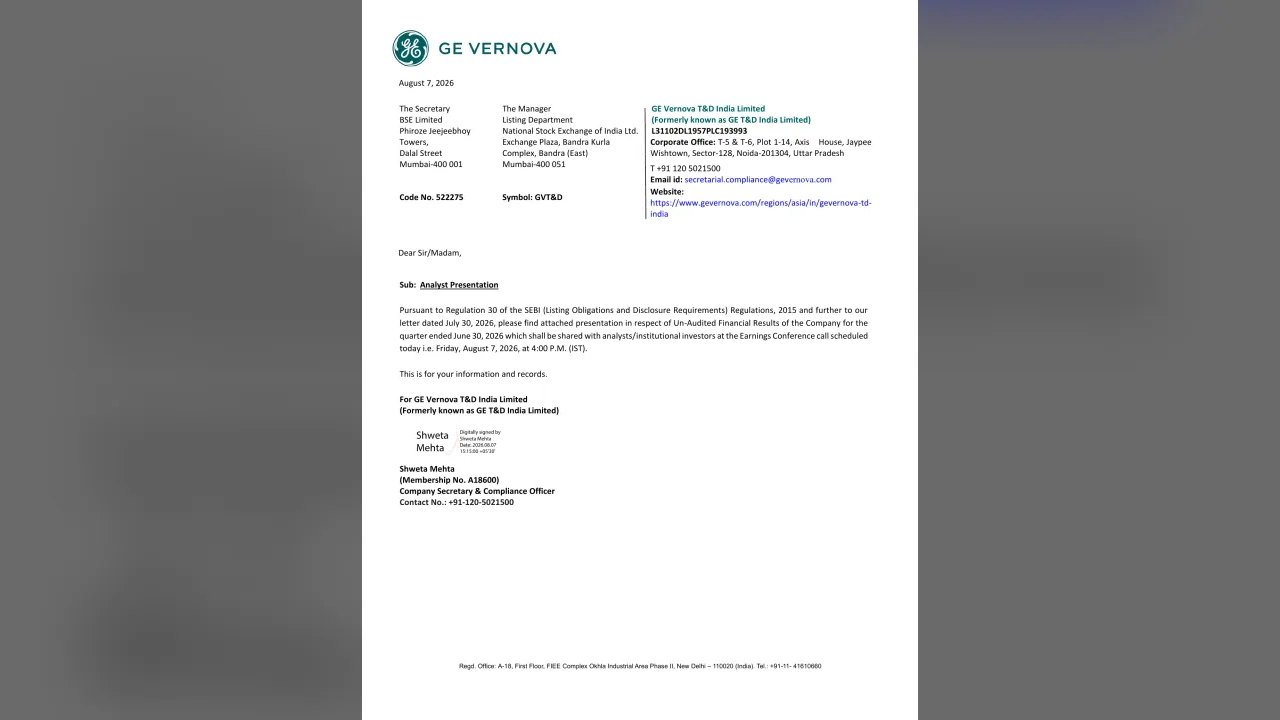
- Company
- GE Vernova T&D India Limited (NSE:GVT&D)
- Period
- Q1 2027 earnings call
- Date
- Fri, Aug 7, 2026, 10:58 AM ET
- Replay
- Watch the replay on this page · 1 h 4 min
On 6ix: 6ix.com/event/ge-vernova-tandd-india-limited-gvtandd-q1-2027-earnings-call
Replay
Transcript
Automated transcript · Written by software from the replay's audio. It can mishear names and figures; the replay is the record.
0:00 Ladies and gentlemen, good day, and welcome to the conference call hosted by GE Vernova T and D India Limited for Quarter one of Financial Year twenty twenty six-twenty seven. As a reminder, all participant lines will be in a listen only mode, and there will be an opportunity for you to ask questions after the presentation concludes. Please note that this conference is being recorded. I now hand the conference over to Ms. Megha Gupta from GE Vernova T and D India Limited. Thank you, and over to you, Ms. Gupta. Thank you, Robin. Good evening, everyone, and welcome to GVTN India Limited Earnings Call for quarter one of financial year twenty twenty seven. I am Neva Gupta from Investor Relations team.
0:54 During the call, we will discuss company's financial performance, including operational highlights and initiate the updates. I'm joined by Mr. Sandeep Sundaria, CEO and MD of the company Mr. Krishikumar, Full Time Director and CFO of the company Mr. Ashish Srivastar, Head Business Operations Ms. Ganitarwala, Communications Leader and Nishweta Mehta. I would like to highlight that today's discussion may contain few forward looking statements, which are subject to risks and uncertainties. These statements are based on our current expectations, and actual results may differ materially from those expressed or implied. Now I'll hand over the call to Mr. Sandeep Sentharia to initiate the discussion. Thank you, Megha. Good evening, everyone, and welcome to our first quarterly first quarter earnings call.
1:42 India is currently executing one of the most ambitious grid expansion plans in the world with the target of 500 gigawatt of non fossil capacity addition by 2030 and the road map towards 800 gigawatt by 2035. The transmission bottleneck is being addressed with unprecedented urgency. Peak power demand is expected to rise meaningfully over the next several years and the government estimates now attributable a material part of that increase is going to come from newer category of loads, which is AI, data center and EVs, which are expected to add around 30 gigawatt of India's peak demand over the next five to six years. At the same time, distribution losses remain a persistent drag on the system.
2:29 The national AT and T losses averaged stood at just over 15% in FY 'twenty five, still well above the government's own target of bringing this down to 10% by 2030. We are successfully translating our order book into revenue through an enhanced manufacturing throughput. Our India for the world strategy continues to yield results as we balance domestic and grid opportunities with strong demand from global markets. The grid aging and renewable integration are creating similar infrastructure pressures. Our recent investment of all our manufacturing facilities are tracking on schedule. These CapEx investments are a strategic necessity to ensure that we can meet the delivery time lines demanded by our customers.
3:18 Coming to financial performance during the first quarter, we saw order book at $11,400,000,000 down 30% year on year compared to $16,200,000,000 in the quarter ended June 25. The primary reason for the lower order intake was due to lower realization of PGCV market in Q4 twenty twenty five-twenty twenty six. Our Q1 revenue stood at $18,400,000,000 versus 13,300,000,000 a growth of 38% year on year. Execution outpaced new orders because of which the order backlog moderated to $209,300,000,000 as of June 26 versus 213,600,000,000 as of March 26, down by 2.5% quarter on quarter. Order backlog stands at more than three years of our revenue for FY twenty five-twenty six.
4:12 Our profit before tax and exceptional items for the quarter ended June's indices was at 4,900,000,000 compared to around INR 3,900,000,000 in the corresponding quarter of the previous financial year, growing by more than 1.25x. We have had a solid start to the financial year, positioning us well to serve India's ambitious energy transition goal. As the nation's power landscape evolves, we remain committed to a disciplined strategy of pursuing margin accretive growth while maintaining operational excellence. We remain committed to the margin profile we established. I'd like to extend my gratitude to our teams on the ground who are exhibiting the increased scale with discipline and safety standards that represent GE Vernova.
5:02 I will now turn over to Abhishek to walk us through specific operational highlights for the quarter. Abhishek? Thanks. Thanks, Sandeep. Good afternoon, everyone. So I will just take you through the key highlights or the key achievements for our company in the last quarter. So in our continuous journey towards the strengthening of transmission network for India and its neighboring countries, the journey continued for the last quarter. We had commissioned first 400 kV substation in Nepal for any at Kinti site, which is going to be the first stone in the backbone of 400 KV in Nepal. Post that, we have also partnered with Agani and have been building substation for the equation of renewable power from the solar park in Aurora.
5:55 In addition to that, we had been partnering with our key customers in terms of augmenting the power transformation capacity at various existing substations. And in this journey, commissioned or added transformation capacity for PGCR, Fresnoea, NLT. And similarly, a lot of new base has been commissioned for our customers like Renu, Tata projects, Adani, BDC. We remain committed and had been working continuously in terms of honoring our commitment through timely completion of these projects and continue in the journey of its strengthening of the transmission network for the country and other neighboring countries.
6:41 So this was our performance for last quarter. Now I would hand over to Prashin for further updates. Thank you, Ashish. Good afternoon, good evening, everyone. Let me move to our order booking highlights for the quarter. While the headline order intake moderated, I want to emphasize the quality and diversity of what we did. We secured CTs and CVTs from GE Vernova entity in North America. This order is different from the material RPT approval that we have secured from the shareholders. For that material RPT order, the group entities are still under discussion and negotiation with the end customer. And now we expect that this is to get finalized in the next three to six months. We also secured 400 kV GIS order from GE Vernova entities in Spain Morocco, 155 NVA to 45 kV transformer for a semiconductor customer, multiple orders for supply of grid automation packages from state utilities, EPCs and data centers.
7:44 This export diversification, which now stands at 46% of our Q1 order, is a trend we have been building forward and had flagged in our earlier calls. Our order backlog stood at $2.00 $9,000,000,000 as of June 2026, down a modest 2.5% sequentially from the record $214,000,000,000 as we closed financial year 2016. I will characterize this as a healthy number given the pace at which we are converting that backlog into revenue. Turning now to the financial performance for the quarter. Revenue for the quarter came in at INR 18,400,000,000, up 38 year on year from INR17.3 billion in the same quarter last year. I do want to address the margins directly here rather than leave it for the question and answer.
8:34 Gross margins moderated to 41.3% from 48.4% a year ago and 47% in the last quarter. However, in our business, comparison with annual margin is a better reference point. So, financial year twenty five-twenty six, we achieved a gross margin of 45.3%. This quarter gross margins are lower at 41.3%, representing a delta of 4%. This can be classified into three categories. Number one, on account of lower export revenue. So in this quarter, we had 30% of revenues from export whereas last financial year was 33%. And also, the execution of very high profitable export order in the last financial year. So this resulted in one to 1.5 percentage of reduction in the gross margin.
9:28 Number two, there is some impact of elevated commodity prices impacting lower savings in execution compared to initial plan. While we are still executing within our expected margin, but the savings that we anticipated during execution are lower versus the anticipation earlier made by the company. And number three, about two to 2.5 percentage points, reduction is on account of ramping up of revenues for the part of our HV business, which has lower gross margin compared to the rest of the business, but overall beneficial at the EBITDA level due to better operating leverage. So this kind of washes out in the EBITDA. Accordingly, we see the 50% of overall gross margin impact gets mitigated at the EBITDA level, and we delivered an EBITDA of 5.1%, in line with mid-20s band we have consistently guided earlier.
10:27 Moving to profit before tax. Profit before tax for the quarter was INR 4,900,000,000, up from INR 3,900,000,000 in the quarter one of financial year 'twenty six, with finance costs remaining negligible and zero debt position. On the balance sheet and capital allocation side, we generated $4,300,000,000 of cash during the quarter, taking our total available cash, including funds that we lent to the cash pool to another 29,300,000,000 Out of this cash balance, company has announced utilization plan of approximately INR 13,000,000,000, which includes INR 10,000,000,000 of capacity expansion program announced in the last financial year and approximately INR 2,500,000,000 of dividend in quarter two, subject to the approval of shareholders.
11:14 The management continues to evaluate various options for utilization of balance cash to optimize the returns to the shareholders. I would also like to highlight the continued quality of our follow book. Private customers now account for 77% of our backlog with central utilities and PSUs contributing another 21% and state utilities exposure just down to 2%. This is consistent with the outer party derisking trend we have discussed in prior calls. So to summarize, before I hand back for the question, order intake for the quarter moderated, but revenue growth, execution pace, cash generation and backlog quality all remain strong and consistent with our full year expectation. And we are confident of converting our $09,000,000,000 backlog profitably over the coming years. So with that, I'll hand over for the question and answer.
12:08 Thank you very much. We will now begin the question and answer session. Our first question comes from the line of Sameer Takur with go ahead. Thanks. So just wanted to check on this U. S. Data center order for which you had RCT approval of up to INR 1,300 crores. So just want to check to have you booked a part of it in this quarter or we should expect more orders or the entire order in the second quarter?
13:00 Thanks. As I highlighted in my opening remarks, we have not booked any part of that order as of now. That order is yet under discussion by our group entities with the end customer. And now we expect the time line to be quarter two or quarter three of this financial year. Okay. And INR 3,000 crores approval, which you already had, and that was that is, I think, supposed to get converted in H2 of this year. So that is still in place, right? And probably, you have to get renew that approval in the AGM in September. Is that right? So we had two approvals. I would like Sandeep to answer that. Question. So basically, the approval was we took for INR 3,000 crores. That project has been put under hold as of today by the customer.
13:55 So when the customer reinitiates the process, then at that point of time, we will again go back to the shareholders. If by that time and because the is going to happen in September itself, so I think I don't see any product getting closed in like by September. So probably when that opportunity becomes alive, we'll have to again go back to the shareholders for revaluation. Okay. And the second question is how do you see the HDC pipeline? It looks like the LaGuardia project is on hold now and Begonia was converted to eHVC. And again, this South Kalam project is still not awarded. So what is your view there? Do you see any risk of delays or cancellations here?
14:42 Put it out along the bidding has already happened for the developers and I think the first stage bid on the first stage bidding bid has been submitted by the developers. So this should happen probably in August or September. It should get decided on the developers. So that's a good thing. Secondly, I think we are expecting maybe one or two more projects to come in the upcoming entities. So I'm not saying that HDD pipeline is going anywhere. The HDD pipeline remains strong. Of course, the pace at which we would like it to come, it's slightly getting delayed, but this is not going away. Okay. Thank you. I will get back in the queue. Thank you.
15:29 Thank you. Our next question is from the line of Parikshit Kanpal with HDFC Securities. Please go ahead. Congratulations on a decent quarter. So my first question is on the export orders in this quarter. It used to be on a very high run rate. Typically, third party export used to be about 800,000 excluding RPT. So what is driving this? I know some of these are GE entities. So if you can help us understand in this quarter, how are these orders driven? Is it certification? Is it like so what is basically driving this new mandates? I think so if I understand the correction sorry, if I understand the question, Parishit, is that normally, the overall yearly order intake from exports, the third party and the smaller ones is not so high. But this quarter, we have seen a much higher run rate, right? That's what you're saying, right?
16:26 Yes, yes, yes. So your voice is also not clear. These if you can come closer to the mic, I'm not able to understand. I'm missing a lot of part of the transaction. Is it better or slightly better. Parekh should basically see that it all depends upon the opportunities which are coming And you know that not only some data center opportunities apart from that when the data center opportunities are being developed in U. S. Then there is a lot of utility pipeline also getting generated in The U. S. So I think there's a lot of orders which have come from utility customers in U. S. As well, which was and then of course we are close to some two packages of 400 kb GIS with customers in different countries as well.
17:22 So, of course, don't have a fixed kind of a target for the quarter because whatever comes whatever is whatever comes and we are able to win those orders get booked into the system. So this time the opportunity is opportunity pipeline for the last quarter was much better and accordingly the instrument transformer a big pipeline got converted. So thankfully, yes, it's about INR $5.50 crores what we did around for the exports. Also, I'm not able to understand it. The voice is really unclear. I don't know why. I mean, can we disconnect and reconnect?
18:08 Can tell Let check with operator. Are you able to hear? Hear us. Ma'am, I will reconnect your line. One moment, please. Ladies and gentlemen, we have reconnected with the management. Over to you, sir., is it better now? Yeah. Yeah. Much better.
18:53 Thank you. I'm sorry for. So the pipeline this time because of the utility customers in U. S, the requirement for instrument transformers, etcetera, was much better. And then we had few opportunities of 400 KV GIS decent side opportunities. So everything contributed to a much better pipeline and further realization in the export side. And sir, I mean, are pretty line back to back. There has been delay in both the RPT, the bigger one, 3,000. I mean, you said now it's put on hold, if the client decides to come back for, again, approval. And same thing happening for data centers. So is it the overall concern around... Is it the geopolitics, or is it concerns around data centers? So why is this delayed decision making from the customer end?
19:44 And how is the RTD pipeline looking for the rest of the new pipeline for the rest of the year? So the first one, it was like into the INR 3,000 crore was into much advanced stage of discussion and negotiation. And that is why we went for the RTT approval of the shareholders. But then suddenly because of budget issues, etcetera, at the last minute, the utility has kind of I do not use the word backtrack, but that has put it on hold for some time. So we are just waiting for them to resolve the internal things and then reinitiate the process of it. Regarding the data center opportunities in U. S, etcetera, so yes, we took the because we were very close to the final negotiation going.
20:36 But then there were certain other aspects like change of location, change of state. And so the... When the state changed and that complete solution is is to be reworked because of different voltages, etcetera. So I think there were certain factors which were beyond the control of the Vernova. That is why this... The whole opportunity has got shifted. Okay. So... But both of them are shifted, but can come back. So as of now, limited clarity. But as and when they come back, then it should be initiated or reapproved. Both of them are not lost. Okay. And just the last thing on the... What are the... Now how's the now new RPT pipeline developing? So any color on that for the upcoming approval season?
21:28 I think so. RPT pipeline, once they are... Once the larger project gets identified, then automatically it comes up. So as of today, it will be difficult to comment on the the new RPT pipeline. But as and when it comes, we'll be coming to the shareholders. Okay. And just one thing I wanted to check on domestic ordering. I mean, we have seen some soft quarters. Q4 was a soft quarter. This was again a soft quarter. So if you can give some color on domestic ordering, when do you expect to pick up? We also not seeing this bulk orders for power grid coming. I mean, they were there last couple of years, but this year we've not seen, I mean, for some quarters. So how is the demand shaping up on the domestic order? I think if you look at January to March for TVT, the pipeline was a pretty soft pipeline. And because of that, you see the order intake, which is impacting the April to June order intake, which is there.
22:27 But we are seeing now the TVT pipeline or decisions now getting much better. The last few if you really look at June, July, the pipeline is much better than what it was in January to March. Only thing is that with a large pipeline getting decided in July, we'll have to see that when the ordering happens, whether it happens in this quarter or it spills over to the next quarter. So that is something to be seen yet. Our next question is from the line of Videesh Shah with CR Kothari and Sons. Please go ahead. Your line has been unmuted. You may proceed with your question.
23:28 As we're not receiving a response from the current participant, we will move to the next questioner in queue, which is Amit Anwani from PL Capital. Congrats for the good set of numbers. My question, one, is on the data centers. Just wanted to understand what is the data center portion in your current order book? And second, how is the data center pipeline building up for you? What is the addressable market in the data center CapEx for you? If you could elaborate more on this side here. So Amit, in the present order intake, the data center ordering is not significant I would say that it's few product orders which are there in the data center.
24:22 Of course, what we are seeing is that now on the drawing board we are seeing much larger data center capacity is being planned, which will be at higher voltages. So we are working with the customers on those data center opportunities, but is it going to materialize in next quarter or maybe next two or three quarters? This is something yet to be seen. Correct. Second, sir, I want to again follow on the domestic ordering question. You did highlighted that ordering during January to March, the tender pipeline was soft and that's why the conversions got impacted. But how one should look for the full year in terms of base orders, especially the domestic one for this year? Will it be a double digit growth or if you could give some medium to long term sense as to how much you're factoring in for this year?
25:22 So when we talk about market, don't expect a double digit growth, but I'm not looking at a slowdown of the market as well for the year. So market will either remain at the same level or we might see about 6%, 7% growth in the overall market, which will be realized this year on the TVCV side. Right. Lastly, sir, on margin, you did explain the margin variation for this quarter and you have been guiding mid-twenty for the full year. So are we sticking to that? Or is there any change to the guidance for this year on margins? Amit, we maintain our guidance of mid-20s EBITDA for the year. There is no reason that we should deviate from that right now.
26:19 Understood, sir. Thank you. Thank you so much. Thank you. Our next question is from the line of Jason Sons with IDBI Capital. Please go ahead. Yes, sir. Thank you so much for taking my question. So my first question just pertains to the I mean, of course, notification of the four Chinese players which have been added. And of course, it increases competition, particularly on the GIS side. So I just wanted to know, GIS is definitely the core product for us as well. So just wanted some color from you on the side of how this can probably play on the margins or the orders. How do you see this shaping up for us going ahead? So thanks, Jason. We are also watching because it has just got approved and subsequent to that, so normally whatever power grid bidding happened had happened before that.
27:15 So they were all with the domestic the non Chinese GIS mix had been considered and the bidding had happened in power grid. Regarding with the private so whatever private has won the TBCD bid, they have not yet started the discussions. So the impact of the Chinese and the GIS will come to know once the thing will start, the negotiation process will start. But we'll also have to understand one thing that the government has approved. So if you look at Chinese before they got before they were restricted from participating in the Indian market, the make in India clause of like 60%, 65% local content was not there.
28:05 So what will be the Chinese leverage to go down on prices with 60%, 65% or 70% local content is also to be seen in the market. And if they were not present or they were not operational in the country for like last three, four years and then suddenly to take orders and deliver in eighteen months with 60%, 70% local content, that capability also needs to be understood. Sure, sir. So my next question pertains to I mean your voice was a little bit muffled as an earlier participant has spoken. So you did mention the reason for the lower gross margins. I got one aspect of it that it was due to lower exports and execution of a higher profitability exported orders in the last quarter.
28:54 But the other two reasons that you mentioned were not audible. Could you just repeat that for just for clarity sake? Yes. Thanks, Jason. Answer it again for the benefit of So all the we are comparing our current quarter gross margin with the entire financial year twenty twenty five-twenty twenty two because in our business, a full financial year makes a better representation rather than comparing on each quarter basis. Last financial year, we achieved 45.3% gross margin. So as this quarter, we are achieving 41.3%. So there is a delta of 4%. I highlighted three broader reasons for this. 2% to 2.5% of the impact is due to the ramping up of higher revenues from the part of the HP business, which gives the lower gross margin compared to the rest of the business, but also it enables a better operating basis because we are growing volume with the help of this business. And hence, that impact largely was eliminated at the EBITDA level. That is why you suggest total EBITDA is 25.1% compared to 27.1% in the last financial year.
30:09 Now other two reasons are approximately 1% to 1.5% of the impact on account of relatively lower export share in the current quarter and also execution of high profitable export order in the last financial year that you rightly highlighted. And the third reason I mentioned is the elevated commodity prices resulting into the lower execution savings that we anticipated compared to our initial plan. Sure, sir. That's very clear. Thank you so much for repeating that. And that's all from my side. Thank you so much. Thank you. Our next question comes from the line of Anuj Chen with Globe Capital. Please go ahead. Hi, Chen. Good evening. I just have one question. I mean, apart from group level, what is our order book?
31:03 Order average overall order that we booked for the quarter was INR 11,000 crores. And out of this, roughly INR 5,500,000,000 was from the export side. And our business largely, I don't have exact split for the quarter, but 80%, 90%, 95% of orders are coming from the group entities. So we can assume roughly 5,000,000,000 of the order on a broader basis coming from the group entities. So excluding that, we can consider INR 6,500,000,000 of orders coming from the third parties, which includes large portion of the domestic customer and small portion from third party customers in the export segment. And total order book, which you are saying about the quarter and talking about the total order book of 20,900 or something out of that. Okay. So that is the order backlog which we have. Yeah.
31:54 Right. Order backlog. Right. INR 2,900 crores. We generally do not give a breakup of the backlog in export versus domestic, but I'll give you some broader color. Export in the total order we had or backlog should be about 10% to 15% in that range. Thank you. Our next question is from the line of Ankush Kandelwal, an individual investor. Please go ahead. Ankush Kandelwan, your line has been unmuted. You may proceed with your question.
32:45 As there's no response from the current participant, we will move to the next participant in the queue, which is Shiram Kapoor with Jefferies. Please go ahead. Hi, sir. Thanks for the opportunity. Just one I have one quick clarification on the RPT approvals that you have. So the you have INR 1,300 crores, which is for The U. S. Data center order. That is not part of the total INR 3,000 crore RPT approvals you've taken, right? Could you clarify what that balance INR 3,000 RPT approval is for? Is that one single project? Or is that multiple projects? That was one project, and that was not a U. S. Project. That was a different project altogether. Understood. Currently, you've got INR 4,300 crores of RPT approvals where the orders are still pending, just to clarify. Yes, but out of that 3,000 is going to expire by this AGM. So then it will be only 1,300 which will be left.
33:43 Understood, sir. And secondly, just on your last earnings call, discussed being confident around base order flow, flows of 7,000 to INR 8,000 crores a year. And this quarter, you've done around INR 1,100 crores. So of course, you mentioned that the pipeline TPCD was a little softer this quarter, but it's picking up. So do you remain confident on the INR 7,000 to 8,000 crores base orders coming through for the full year? Or are you expecting it to miss that guidance? No, we remain confident on it. Got it. And just lastly on the commodity prices. So you mentioned that versus FY 'twenty six, your margins in the first quarter four hundred bps lower. You explained that about 300 to 400 bps from the export mix as well as ramp up in the high voltage business, where gross margins are lower.
34:35 On the elevated commodity price, do you see this continuing to impact us for the next few quarters? Are you taking any kind of price hikes or being able to pass through this to the customers? Just want to understand how that is working out. Thanks, Shilom. I will answer it a little differently and break it into two pieces, just to explain the nature of our business. So first is that, yes, definitely the commodity prices are elevated and quite volatile given the geopolitical and other challenges. And in our business, is a transformer business, whether it is a standalone proprietary transformer to the customer or is a part of HDC project. In that scope, we get a price escalation.
35:21 So all the commodities like ERGO, steel, etcetera, there is a formula embedded in the contract, basically, which we get the compensation. So that part of the business is not impacted. Then the other part of business, rest of the business is switchgear, GIS, turnkey portfolio, etcetera, where we have our approach of building the estimated cost of commodity prices. This is our past trend and the future expectation of the commodity prices. Now with this approach, we have been very successful in the past. And as we see our order to execution cycle has a gap of, say, eighteen to twenty four months when we take the order and then we execute the order. So which effectively means, yes, now as we build for the new tenders, we will continue to improve the new prices.
36:13 But the impact is likely to come in the execution in the future period. And I can just give you a confidence that we have a very disciplined policy in terms of costing and going to market has been confirmed. In the pricing. Please wait. Thank you. Our next question is from the line of Subhadit I'm sorry, that's Subhadit Yes, Sujit ma'am. You're still connected. Let's take a confirmation that my answer to the last question was really audible to everyone. Sir, you are audible. The participant from the queue has dropped.
37:01 All right. Thank you. Thank you. Our next questioner is Subhadeep Sujit Mitra from Nuvama. Please go ahead. Good evening, sir, and thank you for the opportunity. Just wanted to understand that on the export front, do we see more optionality is opening up, especially with GE Vernova Global acquiring 100% in and some larger, I think, you know, transformer orders that ProLake has received over there. Do we see an optionality that the global factories, including the India factories, will likely benefit from these large orders in The US? Yes, it will benefit, Shivajit. Okay. Any ballpark TAM that can come in India's direction?
37:55 That will all depend upon what kind of order, what kind of rating. So it will be a mix. It's hard to predict because that will all depend upon individual opportunities. Understood. Understood. Also on the margin side, do we see any lumpiness in margins possible going ahead? So while we understand that this quarter, there were multiple reasons for margins to have come off. But similar peaks and troughs can happen in the future. So would you expect a range of margin somewhere between the mid- to high 20s? Or you would still want to stick to the mid-20s? So, Shubadeep, as I mentioned earlier, EBITDA margin of the quarter is in line with the mid-20s that we have been consistently guiding for.
38:50 And obviously, last quarter when we guided for, we had seen the commodity prices going up, hence the guidance was there. So we continue to maintain that band for the financial year, 26%, 27% as of now. That's very clear. One last question from my side is, are you able to see the commodity cost pass through carry on through pricing in the existing order inflows? Shubhrant, thanks for this question. I answered this to the previous caller, in the previous question. So as I explained, there are two parts of our business. Transformer business gets the price escalation clause, irrespective of whether it's a direct supplier or as a part of HDD business.
39:39 And it's a well defined formula by EMA, which gets good compensation of the commodity price increase. For rest of the business, which is non transformer business, we anticipate cost of commodity prices, this is our past experience and future expected prices. So we'll continue to work with that same disciplined approach. And as I mentioned that generally there's a lag between the new pricing and the execution. So which means that if for the current orders, we build in the new cost they are tender, those projects will come in execution with a higher compensation in the future, which is a lag of say one year to two year in the execution cycle. Okay, perfect. That's the answer to question. Thank you so much.
40:29 Thank you. Our next question is from the line of Ibrahim, an individual investor. Please go ahead. Hi. My question was on order inflow for this quarter. So we have seen that order inflow as compared to last year as well as compared to previous quarter, the order inflow was less. So I heard that you have covered in the start of the call, but your voice was not clear. So what gives you confidence that the order inflow will like increase from year on? Thank you. So the pipeline for TBCB project is now getting better. So that gives the confidence because where we see from January to March, the pipeline for the TBCB was muted. And now from like May onwards or June onwards, not May, but I would say June onwards, the pipeline has picked up. So that gives us the confidence that the order numbers will be better now.
41:28 Thanks. Thanks a lot. Our next question comes from the line of Venkatesh S. From LogicTree. I wanted to check with you on a kind of a big picture view considering the opportunity in HVDC as well as data centers plus exports. If you take a three year or four year view, what is is there a vision that you have for GE Vernova? And what would are you looking at some kind of a number? And what how can the split be, say, data center exports and domestic HVDC? Can you give me a big picture view? So sorry, I think this is not the forum because this will be like kind of a forward looking statement. So we'll not be able to share any big picture view on the call.
42:23 But would you be able to give me a kind of a proportion in terms of these three key businesses? What could the contribution of exports, domestic HVDC and data centers? Would that be a possibility? Yes. I don't think this is usually on the side. Maybe I'll try to give some color and answer it differently. First of all, the breakup that we are taking, typically we don't give it because we look at this as a one integrated portfolio. And if we see the past trend, this breakup changes significantly year on year, quarter on quarter depending on the execution of different types of projects. But on an overall basis, we have a revenue growth of 38% in this quarter, driven by the ramping up of the execution of the high backlog. So our backlog stands at $2.00 9,000,000,000 now.
43:12 Now so this high backlog gives us a confidence that we have the potential to grow at a significant pace in the future also. Because the current backlog is roughly 3.5x of our revenue and it's a multiyear high and the backlog business, multiyear visibility. However, the growth will not be linear, meaning financial year 2027 and 2028, we'll continue to see a healthy growth in terms of our core portfolio, which is what projected for us export all put together. But the HDDC backlog, that has a back ended execution as per the typical structure of the HDDC project and we see a meaningful growth from the financial year 2029 onwards.
44:00 So our growth trajectory overall is over, meaningful in next couple of years, but had significant improvement in the financial year 'twenty nine onwards. This is the execution of HVDC. Right, sir. So two more questions. One is the guidance, what is the kind of based on the projections for the future, over the next twelve to twenty four months, what is the CapEx that you would probably be planning? So we already announced the CapEx of about INR 10,000,000,000 in the last financial year. And we have INR 29,000,000,000 of surplus cash available. As we mentioned in the beginning, 10,000,000,000 is there for CapEx that we already announced, 2,500,000,000 for the year. So we have roughly another $16,000,000,000 of surplus cash over and above the announced plan.
44:59 So as I said in the beginning, the management and the Board continuously evaluate what are the options available for the company for maximizing the returns to the shareholder. As of now, there are different options under evaluation, that means nothing is concrete. And as per the requirement also, we need to inform to the stock exchange in case of such different plan. So it is difficult to call out a number in this call because nothing is firmed up as of now. Right, sir. Last question from my side. If you look at the competitive scenario apart from the Chinese suppliers, etcetera, the three or four major players in the Indian markets, Siemens or Hitachi or yourself, etcetera, what is what do you think can be GE Vernova's competitive advantage compared to the other serious players?
45:50 So, of course, technology, lean and when we talk about localization. So, these three we feel are the distinct advantages what we have. Okay, sir. Thank you very much. I'll join the queue. Thanks. You. The next question is from the line of Sameer Takur with Ambit. Please go ahead. I just have one. So just coming back to the competitive scenario here. So are you seeing any competition from peer to suppliers? Has that increased recently? And are you seeing any risk of risk to market share in domestic market from tier two suppliers, not the big ones?
46:39 So it started the competition from tier two suppliers only now. The competition from tier two suppliers has been for some time, but that also depends upon product to product. For example, when you look at circuit breakers or when you look at, for example, gas insulated, etcetera, you don't have our automation products, etcetera, you don't have a software that you don't have much of a competition coming from tier two suppliers. So in some domain, it is there, it is not some domain, it is not there. But in the other domain, it has been there for some time now. Okay. I'm not sure whether it's a repeat because I got disconnected in between. But for pricing in the new orders, so how do you see that? Is that flattish over the year? Or has that increased? Because commodity prices have increased, like copper has increased by more than 50% over a year. But how do you see the pricing in the orders?
47:42 Has that stabilized over a year? Or that is also increasing? So the transformers and also whatever is the impact of the material, which is there, have been they're able to pass on to the customer, but they're not being able to pass on like extra margins, etcetera, to the customer. Sandeep, what is the new one? In order to what Sandeep said, I would like to highlight that this commodity price increase is a market phenomenon. It is applicable to all the competitors. Obviously, everyone has to factor in the increased level commodity price and their costing while making the bid. So overall demand supply dynamics doesn't change because of change in the commodity prices. Thank you. The next question is from the line of Omesh Rao with Nomura.
48:35 Please go ahead. Hi, sir. Good evening. Thanks for this opportunity. My first question is pertaining to and there's a packages which are being floated recently. There were, I think, couple of packages and each having project cost of about 7 to 8,000 crore. So what could be our scope of work in these projects? What we can supply from India operations? So, Singer, thank you, Amesh, and good evening. So, synchronous condenser is manufactured by GE Vernova, but that is not part of grid portfolio. But the transformer and the base which comes with the synchronous condenser that can be our part of the scope, which is a very small as compared to the synchronous condenser scope.
49:26 Okay. Okay. So if I understand correctly, that portfolio is available in the parent entity. Is is that that... Is that fair assumption? Yes. Oh, okay. And normally, synchronous condensers are basically a type of a generating equipment. So we are a T and D player. That generating manufacturing capacities are not available with this entity. Understood. Understood. Second question is pertaining to STATCOM. I think there were a couple of, I think, your cases in in the month of June, May as well. And I think there were some certain uncertainties in the grid, and now there is a urgency in terms of floating out tenders for STATCOM.
50:12 So do you think I think these tenders materially pick up in next few months? Yes, it should pick up. I think what you're saying is right that with cover that the amount of generation we lost, I think this should create more opportunities for good stability opportunities. Understood. Understood. Last question is pertaining to capacity allocation. I mean, we kind of cater to domestic demand and at the same time to exports and then with respect to our parent entities as well. So how do you assess capacity, which is kind of available for three different type of opportunities and considering that there were a couple of RPD approvals, which were in place for near term in terms of, I think, the order awarding.
51:08 So would that be a case where you were slightly more selective in domestic market in last six months while going into bidding? So thank you, Mesh. And so I think we have to find a balance. So basically, keep on a very close watch and the opportunities that do come in. Like for example, if it is an opportunity, then what kind of time frame the order is getting decided, what kind of deliveries they are looking forward to, what kind of domestic opportunities are coming up, they're overlapping in terms of deliveries, not overlapping. So we have a constraint mechanism by which these opportunities are tracked. And accordingly, the decisions are taken that, for example, in RPT also, is the maturity stage?
51:58 For example, suppose the majority stage is not there, but it was just like twenty four months delivery, then whether it's going to be twenty four months from now or it is going to be twenty four months after six months, that's a conscious call we take and then accordingly we target whether it is export or whether it is domestic. But that challenge is always there in terms of domestic as well because for example, if you are putting a bid where you have a three months validity and then you have other places where bids are going, there again we have a three month validity. You have to take a conscious call what is more targeted there to put more and and how to plan the capacities. Understood. Understood.
52:46 Last question pertaining to current capacity utilization, how it is faring as of now? I would say it is consistent with whatever we have been explaining in the last few calls that few of the factories we have loaded pretty well and few factories we still have opportunity to grow. So that remains our position and I think that is Understood. Okay. Thank you. Thank you so much. Thank you. Our next question comes from the line of Mahesh Patel with ICICI Securities. Please go ahead. Yes. Hi, sir. Thanks for the opportunity. So my first question is on this power grid mentioning that the TBCD project timelines, they have the approvals have gone up from eighteen to twenty four months earlier to now around twenty four to thirty months.
53:49 So how does that impact us or our calculation in terms of our order cycling and capacity utilization and CapEx plans? If you can just throw some color on Sorry, on the CapEx side, it is not going to impact anything on the capacity utilization. Of course, they are whatever orders we have, they are with a definite time frame, the orders what we have received. I think the impact which can come on the ordering part is that suppose it goes to certain for few projects that have gone to thirty months. So where the customer is, for example, earlier when it was eighteen to twenty four months, as soon as the customer was winning in like one to two months, they were dividing the order in the market.
54:35 But as it becomes thirty months, then they have some probably a quarter like maybe three four months where they can take a decision. So the ordering cycle gets slightly stretched in the case when it becomes thirteen months. Okay. Got it. And sir, second question is on the margin profile. If you can throw some color on the margin profiles of our key market segments, right? Let's say, data center is picking up, then we are doing also transmission. So if you can just throw some color subjectively, how does that vary between our key market segments? Mahesh, so margins by market segment or customer type is something that we don't share. It's a very confidential part of our business strategy.
55:31 However, we do have shared in the past that exports generally have better margins to the extent of 4% to 6% compared to the domestic orders. Okay. Yes, got it. Thank you. Thank you. The next question is from the line of Arunachalam, an individual investor. Please go ahead. Good evening, sir. First of all, congratulations on your numbers. See, I just wanted to know update on the Valam project, the INR 55 crore project, which we had decided to roll out sometime in December 2026.
56:18 Is it the deadline is likely to be met or how is it? So we are working on that project. I think part of the capacity we should be able to come up with in Q1 of 'twenty seven. That is there. But the balance capacity will come, I think, probably by end of twenty seven. So we're working towards it. Thank you. Our next question comes from the line of Vidhi Shah with C. R. Kothari and Sons. Yeah.
57:06 Sir, I wanted to understand what kind of margin profile and asset turn can we look at in the next coming year? We answered this that for the financial year 2627, we continue to maintain our beta guidance of mid twenties. Okay. And asset terms, sir? So asset terms, we don't typically calculate it that way because in our business, assets can be utilized differently because capacities are fungible. For instance, if we use the assets for equity project, that's asset has become quite significant because equity projects have lot of bought out component, etcetera. So internally, as an internal management, we are not working on capacity utilization in terms of acceptance, but as we look forward to specific projects that we can execute using our existing capacity.
58:10 Thank you. Our next question comes from the line of Shivang Pandya from Upper Crust Wealth. Am I audible? Yes, you're audible. With all the dividends scaling rapidly and cash is also growing, how are thinking about the balance between shareholder returns, funding capacity expansions, especially as global peers like Quality Power and Apache are actively acquiring niche capabilities to capture the safe HVDs and banks demand view? Shivang, I already mentioned in the call in the beginning as well as answer to one of the investors that out of the $29,000,000,000 cash we have, we have already announced utilization of almost 45% of that cash in the form of dividend as well as CapEx.
59:10 So we have already announced $10,000,000,000 of CapEx and about 2,500,000,000 of dividend. And as I mentioned, we continuously as management and board look forward to the balance between shareholder return and next type of return on the investment. The amount which remains unutilized is part in the cash flow liquidity and fixed deposit. And we continuously look forward to all the investment options. A good part for us is that our business to a large extent is already comprehensive. We have almost all the product range in terms of the HP equipment portfolio. And wherever we could do the capacity expansion, we have already announced. One important point you will note is that most of the capacity investment that we have announced $10,000,000,000 is largely within our existing plant where we already had the surplus land, which means that we don't need to invest in land, but we can have better return to the shareholder by investing in the existing facility and the land was taken long time ago, so it's at a very, very lower rate as compared to the current prices.
1:00:20 So that is how we try to maximize the shareholder return by making a maximum utilization of our assets and MSN. And the last point is that we have been continuously communicating in last multiple quarters. We also have a very good mechanism of working on lean, which means continuous improvement in our existing facilities. While the CapEx may not look to be significant, but the output of that investment is very significant in terms of revenues and return to the shareholder. Right, right. Thank you so much. Thanks. Thank you. Our next question comes from the line of Prateek Darmshi with Union Mutual Fund. Please go ahead.
1:01:06 Yes, sir. Many congratulations for a great set of numbers. Just one question from my side. Considering so much of capacity additions from the competition expected over next couple of years, do we reckon the demand supply dynamics to be in an oversupply zone maybe after two, three years? Or you are confident on the cycle? How should one look at it? I think you're right. If you look at the only domestic demand that definitely if the capacities which are expanding are going to feed only the domestic market, then yes, we look at the oversupply situation. Today if you look at energy transition, which is happening globally and there's a big shortfall in the availability of the expense globally.
1:01:55 So my assessment is that a large part of this capacity will also be used to feed the export market or the global demand. I think there will be will and of course, we look at India market also growing. So with this growth and the exports, we should still be in a position to retain the balance of demand and supply. Got it. Yes. Thank you. Thank you. Our next question is from the line of Jason Stones with IDBI Capital. Please go ahead. Just basically, I mean, it might sound very basic. But sir, just wanted to understand because this figure kind of varies from project to project. So just some clarity on that. So of course, when an HVDC project comes through Bharma, South Korea, probably 25,000 crore odd worth project cost. So what is the typical size of our addressable market from this? You could just give me a ballpark number. I mean, I understand project to project is different, but just as a ballpark of what will be GE share from this 25,000 crores odd?
1:03:07 So given this project is under bidding, so as of today, we're not willing to share any numbers on this. Okay, sir. For a typical order, probably then you can share what percentage of can be our addressable size? No, sir. But again, you said that it will be different for again, suppose similar projects and there it is 1,000 kilometer line or a 2,000 kilometer line. The share will change. Thank you. We have no further questions, ladies and gentlemen. I would now like to hand the conference over to Ms. Megha Gupta for closing comments. Over to you, ma'am. Thank you all for joining the call today.
1:03:52 Hope the insights provided by our speakers have been informative and valuable to you. We value the trust and support of our investors and analysts and ensure to remain committed to maintain transparent communication and fostering strong relationships. If you have any further questions or require additional information, please do not hesitate to reach out to me or our communications leader. Thank you. Thank you. On behalf of GE Vernova T and D India Limited, that concludes this conference. Thank you all for joining us. You may now disconnect your lines.
Follow GE Vernova T&D India Limited into a list and get an email when it puts out news.