Transcript
Automated transcript · Written by software from the replay's audio. It can mishear names and figures; the replay is the record.
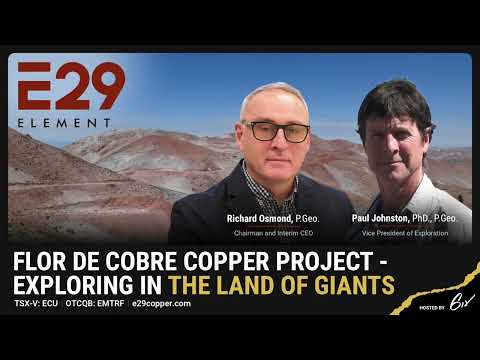
0:07 Hello everyone and welcome to Element 29's live summit today hosted by 6. Today I'm joined by Richard Osman, Element 29's Chairman and Interim CEO, and Paul Johnson, the company's Vice President of Exploration. Today's team is going to take us through their presentation and after they'll be accepting questions during the live Q&A session. You can submit your questions using the Q&A panel found on the right-hand side of your screen at any time today. As always, the summit is being recorded and will be available to watch afterwards on Six.com. Without further ado, Richard, I'm going to hand things over to you to get us started. Okay, thank you, Cam.
0:39 Ellen29 is a copper-focused junior resource company with assets in Peru. The company is actually listed on the TSX Venture Exchange and also on the OTCQB Exchange in the US and the Frankfurt Exchange. The company gets its name originally from the periodic table of elements where copper is actually element 29. Here's a disclaimer. If you want to go to our website, you can read this in full, but I'm going to sort of pass over it at this point. So just getting into why Peru a little bit. Let's take a look at Peru. Peru is essentially the second largest copper producing country in the world. It produces close to 2.5 million tons of copper a year. The slide on the right sort of shows the endowment for Peru.
1:26 And you can see our Florida Cobre project, which we'll be talking about today, sort of sits in southern Peru. And the red circles there sort of show the distribution of large copper deposits throughout Peru. They're mostly associated with porphyry copper deposits such as Florida Cobre. And you can see actual fact Florida Cobre occurs in the Southern Peru Copper Belt, which we have all of the giant copper deposits such as Cerro Verde, owned by Freeport McMoran, as well as Keo Veco by Anglo, and Cahoni and Tukipala by Southern Peru Copper. So very well endowed as a country for copper. Why Peru as well? Well, mining makes up about 60% of Peru's exports and about 13% of its GDP. So it's a huge part of its economy. It's also the second lowest copper producing country in the world.
2:20 The slide on the right was put together by CRU back in 2018. And it sort of shows the operating costs for 5 of the 6 largest copper producing countries in the world. You can see Peru ranks number 2 on that chart. The other thing that's really important about Peru is that it's actually one of the lowest cost exploration,
2:41 well, lowest cost countries in the world for exploration. It costs about $3 a hectare to hold ground in Peru, and that's probably is more likely one of the lowest in the world, really. And one of the other things that's really important in Peru is that mines still get permitted. You know, you hear a lot of noise coming out of Peru on the political side, but in actual fact, if you look at a company like Bear Creek, they just got their Karani deposit permitted in southern Peru, which is a pretty difficult jurisdiction to operate. Element 29 itself is focused on 2 high-quality Copper projects in Peru with excellent potential for resource growth. Those are the Florida Cobra project, which we'll be talking about today, as well as our Elida project in north-central Peru. Both projects have well mineralized intercepts from previous drilling, and I would say they're even very well strategically located at very low elevation and near infrastructure.
3:36 We have a very strong team running the company. We have a lot of experience exploring in Peru. We also have experience operating in Peru. We also have a very tight share structure of, you know, very supportive, strong and diverse shareholder base. We have, you know, insiders, institutional investors, retail investors, and private equity investors. We also have a catalyst-driven 2022 work plan where we're looking to get initial resources on the books and certainly at our Elida project as well as hopefully at our Fort McClubrick project as well. Our strategic focus, well Element 29 was actually formed from the spin out of 2 copper projects from Globetrotters Resource Group. Globetrotters spent about 7 years and probably 1 mine cycle to be able to put this portfolio together.
4:24 Our Elida project was actually a grassroots discovery by Globetrotters in north central Peru. And the Florida Cobre project itself was acquired from a sort of a small scale operator in Southern Peru and it had some historical work done back in the mid 1990s, which we're looking to drill in this current drill program. The strategic focus of the company is really to develop low cost, low risk copper production opportunities in Peru, and we think Florida Cobra provides that opportunity. And we also want to continue to build our copper resource base to over 4 million tons of contained Copper. At this point, I'll hand it over to Paul Johnson, our VP of Exploration, to continue with the project itself. Thanks, Richard.
5:11 To get into Florida Cobre, the property itself is just over 1,900 hectares. It encompasses 2 porphyry targets. The first one is Candelaria, which we'll be drilling in the next few days. And Atrafizado, which is a target that's sitting to the northwest of the Candelaria project. It has an excellent position. It's in the, as Richard said, the Southern Peru Copper Belt, which has a number of large mining operations. That means there's a good workforce nearby. It's not too far from Peru's second largest city, Arquipa. It also is not at a particularly high elevation, in around 2,600 metres. There's a lot of mining infrastructure because of those mine operations in the southern Prufrock and Belp. So power, transportation and workforce, as I said.
6:07 The Cantillaria project has a historical resource that was drilled out in the 1990s, 1994-95, by a Vancouver junior and then optioned to Phelps Dodge who continued the exploration there. That resulted in just over 57 million tons at 0.67% copper. That resource is historical. Obviously we don't have the data to validate it, but that leads us to the current program which will be to actually verify the historical data and then hopefully produce our own resource estimate.
6:49 The drilling that was done there was very encouraging. It returned a very attractive result, 272m at 0.92% Copper. Of that, there was 116m at 1.4% Copper in a secondary enrichment zone. And that continued on into the primary sulphide giving us 156m of 1.58% Copper. Sorry, I'm just working out the details. So Where it's located, we mentioned the Southern Peru Copper Belt, that's a zone of Copper deposits of a similar age, Paleocene in particular, and that spans from the Tocopala deposit up to the Cerro Verde deposit. Those are all large, multi-billion ton resources that have been in operations for many, many years.
7:39 Our project is 26km to the southeast of the Cerro Verde mining operation from Freeport. It's also about 5 kilometers away from a smaller copper deposit that's currently in care and maintenance. As you can see, the location of the project is fairly close to Arroquipa and and you can see also proximity to the to the ocean and the road networks that we can use to access it. It's about an hour and a half drive from Arrequipa, if the traffic's pretty good. The property itself, as I said, encompasses 2 attractive targets. The first one that we'll be drilling is Candelaria, which is off on the southeast side of the project, and about 1.3 kilometers away is a new target that we've just started to get into called Atrophizato.
8:43 It's a large zone about 1.5 kilometers across. It's defined by a geophysical survey. You can see here we're showing chargeability, where there's a high chargeability halo around that lower zone that I've circled with a black line. That's a typical signature that we get where there's a lot of sulphide in the fillic alteration that surrounds a core of what looks like the Tassic alteration and we need to drill test that to determine if it is in fact going to give us interesting copper results. So that's in progress with permitting that and we'll be drilling that as soon as we can get permitting finished and drills on the site. But for now, let's turn our attention to the Candelaria area, which is really the focus of our next 3 or 4 months of field work.
9:36 As I mentioned, it is a zone of enrichment that was drilled out previously in the 1990s. This just gives you an indication of where that is. The actual enrichment zone is about 80 meters below surface on average. It's a sub-horizontal or sheet-like structure of enriched copper that sits above a primary zone. Our drill program will be testing the previous drilling to twin those holes that we think are important and also take a look at the primary resources. You can see from this diagram that there hasn't been an awful lot of drilling into the primary mineralization below that enrichment. Back in the 1990s, the focus of most mining companies was to explore for secondary enrichment and they weren't all that interested in primary mineralization.
10:31 So our program here is laid out just simply showing the color locations in red. These are the holes that we've selected to twin. They're really centered around the bulk of the mineralization that was outlined in the previous drilling programs. I've highlighted here again hole K008, which was the hole that returned that long intercept of enrichment, followed by the attractive sulphide mineralization at depth. The drilling program is actually fairly straightforward. We need to repeat those results from the historical work. We can then use that and reproduce the historical resource.
11:17 That will be done with 9 holes, but we've saved 2 holes to look at the along-strike continuation of that mineralization. One of the problems with the earlier drilling program was the holes were all vertical. We are also dealing with geology that has vertical structures as well, so we can't really get a good sense of what they're doing at depth. So 2 of those holes are going to be angled in order for us to understand the distribution of the contacts. These are intrusive contacts and be able to be able to really see what's going on to the northwest and southeast. So back to you, Richard, if you want to explain the drone video.
12:03 Yeah, thanks Paul. So this video was taken, actually we're hovering over the Astro Visato target and we're looking sort of Southeast towards the Chappie mine which is on my next resources. You can actually see a truck in where my, sort of in the, hopefully you can see my arrow, sort of in there. It's pretty small. There's the outline of the Candelaria deposit sitting in here.
12:30 And You can actually see where some of the infrastructure is located there, all of the iron oxide coloration related to the leaching of the porphyry. You can see also that there's very little in the way of
12:44 agriculture or communities in the area. It's very, very dry, arid, and you know, and there's a look at the, the Chappie deposit by, owned by Nexa, which I think is now currently on care maintenance. Okay. Next slide please. Okay. So just to sort of follow up our sort of our work plan for 2022 is really to get in and start permitting our Atz Rovazato project that we've started that process, but we don't expect to have that done in 2022. If it is, it would be late 2022. So we're sort of hoping to start drilling there in early 2023. We've already started our resource drilling. The drill was on site yesterday and And hopefully, you know We we should be able to get some news flow coming from that. We should be drilling over the next 2 3 to 4 months
13:45 Depending on you know, how quickly that that drilling goes We're gonna start getting news. We're gonna start doing metallurgical studies on the core while it's fresh. We're going to be looking at sequential analysis and things like that. Then we're going to start moving the project towards PEA by getting an initial resource out, if we hopefully get an initial resource out, depending on how the verification process goes. And that's really the key catalyst for 2022 for Florida Cobra. And So yeah, I think, you know, Element 29, why invest? Well, we have great projects in a strategically well located in one of the top mining jurisdictions, copper mining jurisdictions in the world. We have a strong leadership team with, you know, lots of experience operating in Peru, exploring in Peru.
14:35 Our shareholder share structure is still very tight, less than 80 million shares issued and our work plan is really set up to get resources on the books this year. As long as things go as planned. I think that's it. Wonderful. Well, thank you, gentlemen. I'd like to remind everyone in the audience at this point that we'll be entering the live Q&A period. You can ask questions using the Q&A tab found on the right-hand side of your screen, but to begin with, I'd like to ask the question, why are you re-drilling or twinning historical holes,
15:07 and why specifically these 9 holes? I think that's a good question for Paul. Yeah, sure. Yeah, It's a very good question. What we need to do is get our own data on those holes. One of the problems with the earlier programs, when they drilled them and did all their test work, there wasn't any material left
15:31 from the earlier drilling. It left us with nothing to verify the previous assays, we couldn't do any check sampling. So we need to get our own material to do our own test work and validate those results. Also too, of course, the work that was done back in the 90s had a much lower standard for quality control. There was no verification work or QAQC work done on the samples. All that has to be done through our own work. In terms of selecting the holes, what we've done is looked at where the majority of the metal indicated by that previous drilling was done. And we selected the holes just based on what each hole did in terms of estimating that amount of metal. So that's how we picked those 9 holes. They should pick up roughly
16:21 70-75% of the metal that was indicated from those previous drill holes. The last 2 holes, as I mentioned, is just to give us more geological information that wasn't obtained from that earlier drilling. Right. Okay. Thanks, Paul. Another question that's come in is, based on your interpretation at Atravisato, why are you so excited? Well it's large. It has a classic signature in the IP surveys that were done and that coincides with what we've seen on the surface. The central part there that I showed which is actually a resistivity high, That coincides with a lot of the surface features that we can see, the geochemistry, the veining, and the alteration.
17:10 So we see a large target that has never been tested before and we'd like to get in there and see what's happening. There's also a supergene component to that. There's the same potential for a supergene enrichment zone exists there that we have at Candelaria.
17:28 Fair enough and that actually goes to the next question wonderfully. John in the audience wants to know what's the mineralogy of the supergene zone at Candelaria? Yeah, I saw that question come up. That's 1 I'm really anxious to answer. It's a chalcocite blanket for the most part. Now, This is from what we've seen described in the previous data. We're looking forward to validating that from our own work. But it is a chalcocite blanket, fairly conventional. Above that, there's a little bit of oxide mineralization. But the dominant mineral that we'll be looking at is chalcocite. And then that chalcocite will probably, from the descriptions, just a thin transition into cobalite before you get into the primary mineralization.
18:16 Great. Thanks, Paul. Moises in the audience wants to know, at this stage of the exploration, do you need some environmental authorizations from the environmental authority, MINAM, or M-I-N-A-M? The short answer is yes, and that's already been obtained through the FTA process. The FTA is actually an environmental permitting process where the program is put in front of the agencies and they review it and then give you the permit to go ahead and drill. Great, thank you. And Andre in the audience wants to know how do you define social risk since having Tia Maria in the same region? Yeah, that's a good question. I mean we're very fortunate here that The Candelaria project itself is the land is owned by a private group.
19:06 So there isn't much in the way of communities in the area. As you can see, it's mostly desert, but there are communities close by that we have engaged with for our Atzor Fusato project. I think we have some of the community members working on the Candelaria project. The Peruvian environmental assessment is very rigorous and if you can pass through that, I think as an exploration company, particularly at this stage, we're looking at drilling maybe 9 to 11 holes. Our footprint is really just using the existing infrastructure from historical drilling, so our impact will be quite low at this stage of the process.
20:01 Okay, great. Thank you. Another question we've received in advance was, was the hypogene potential not tested by historical drilling? You want me to take that, Richard? Yeah, go ahead, Paul. Yeah. It was just tested a little bit. Typically they would drill holes through the super gene and then and then continue those Far enough to ensure that they've they picked up the entire zone in this case at Candelaria There were a few holes that went into the the deeper super gene really just gave us enough of a glimpse at that mineralization to want to do more work. So it wasn't completely ignored but it wasn't of interest to the companies at the time so that's where we see the opportunity to greatly enlarge the system.
20:49 Many companies, many mines have gone through that cycle of exploiting the enrichment zone and then over time and mining down, they've then turned to a sulfide operation. The best example is Cerro Verde, which went from a supergene operation, an enrichment operation or leach operation, into a full-blown sulphide operation. Right, Okay, great. Thanks, Paul. And another question just about the past, but why did exploration stop after the drilling in 1995? I can speculate on that a little bit, Cam, we don't really know for sure, but likely as a result of copper price. I was just actually looking online about that and it's interesting enough the copper price went up to $1.33 per pound in 1995 from $1.03.
21:43 And then back in 1996 it dropped back down to $1.03 again. So likely there wasn't a whole lot of motivation to keep exploring for copper, particularly for primary sulfides, in this case, and deeper. So lower grade copper, primary copper sulfide mineralization was not overly economic at those copper prices back in that time. So I don't think there was a lot of companies exploring for like half a percent copper, primary copper at those kind of depths. Great. Thank you for that. Love in the audience wants to know, how are you positioned with funding going forward? How far will existing funds in the bank take you? Yeah, that's a good question. Well, we certainly have enough to get through the Forte Cobre drilling. We've got about close to $8M in the bank right now, about $7.9M.
22:37 We did a financing back in the fall of 2021 specifically for that reason. So that will get us through Candelaria drilling and through the Elita initial resource estimate, if we hopefully can get to that point. And we're looking to, we're projected to have likely, you know, about $100,000 in the bank by the end of the year. So if we continue with the LADA drilling later into 2022, we may have to do another financing, but that will really depend on the markets and what our share price is at at that point. Okay, great. Jacques in the audience wants to know if you could go over the historical estimates again. The historical resource estimates?
23:23 I believe so. Jacques, if that's not it, you could also qualify in the chat, please, for us, but I think that'd be a good place to start. Did you want to go with that one, Paul? Yeah, sure. In terms of the numbers, is that what the question was? It was the historical resource that was put out in a just a single news release was 57.4Mt at 0.67%. That's really what was announced. The approach to resources back then was different than it is now and the rigour was certainly a lot lower, which is why we're not using those or trusting those numbers for anything other than our exploration planning.
24:11 They were based on a whole grid of drill holes that were done on the project by Rio Amarillo and Phelps Dodge. They came up with an estimate based on the technology that was available at the time, the estimation technology. So we don't rely on that. I should emphasize that. That's not a number that we really have confidence in and that's what the current program is designed to do is to really allow us to get more confidence in the resources. I hope that answers the question but if not, you know, just come back to me with a follow-up. Yeah, absolutely. Well, thank you for that. As I said and mentioned, Jacques, if that didn't answer your question, make sure you let us know in the chat.
25:02 Ian wants to know how many holes are permitted for though. The permitting in, if you don't mind Richard, I can I can take that? The permitting is based on platforms and disruption. So in this case we have we have 11 platforms permitted and you can drill as many holes as you'd like from those platforms. You have to announce what you're doing and indicate to the government that you will be doing that, but you can drill multiple holes from the platform. Okay, great. Thanks, Paul. Another question, how did you come to acquire Florida Cobra? That's a good question. Certainly, Glowcrotters, the company we founded, L29, had a very, very good relationship with a group of brothers that owned and operated a sort of a Peruvian private mining company called Minera Candelaria.
25:59 And they had held on to the property for quite a while and they were very actively mining it for copper oxides along structures and then selling that ore to local plants. I think they were selling some of it to Nexa as well as to Freeport, but I'm not really sure where. They had gotten to the age where they felt it was time to retire, and because of the relationship we had with them, we were able to work out a deal that was pretty beneficial for both parties, I think. Once Candelaria was acquired, we were fortunate that a large block of concessions actually came open contiguous with Candelaria and we staked most of that block and acquired an additional 1,800 hectares, which we call it that sort of Zotto.
26:45 That's where we made our new potential porphyry discovery. We're pretty excited about that and this entire Florida Cobra project. Great, thanks, Reg. Mark in the audience wants to know if you can expect possible by-product metal reported in drill results from Florida Cobra? Molly, gold, etc. Go ahead, Paul. Yeah, sure. Well, we do know that there's molybdenum in there. We have data from the historical work that there's typical levels of molybdenum that you get in Porphyry Systems. We'll be testing that. There isn't a lot of data on that. Of course, there wasn't much in the enrichment zone. When you produce enrichment, it really just enriches the Copper and all the other elements go away.
27:34 There's also the usual possibilities, although there wasn't a lot of analysis done on some of the other elements, so that's also going to be something that we'll be taking a look at. Modern analysis takes into account multi-element analysis. We'll be looking at 32 elements when we do our work. We'll certainly be aware if there's any credits from gold and silver are the 2 elements that you usually see in addition to molybdenum. But I would say copper molybdenum are the ones that we can expect right off the bat. Great, thanks Paul. Look, as we begin to wrap up, could you remind us again what the deliverables are for Floatacobra in 2022? Yeah, for sure Cam. Well, we plan to complete at least 3,700 meters of drilling at Candelaria to validate the historical secondary resource.
28:26 At the same time, we plan to explore the deeper primary sulfide copper potential, a copper sulfide potential below the enrichment blanket to depths of at least 500 meters, I would think, and certainly for several of the holes. We also plan to complete some metallurgical work on the core while it's still fresh, just to get some recoveries, numbers for that. And We also will be working on a new block model for the initial resource estimate. From there, hopefully start moving towards the PEA and maybe have that delivered sometime in 2023. We're still in the process of getting our Atzer Fusato project area permitted, which we sort of hope to have done before the end of this year and then start drilling in early 2023 as well.
29:16 Great. Well, thanks, Richard. Thanks, Paul. I can't thank you enough for coming on today, but of course, I also would be remiss not to thank everyone in the audience for joining us. If you didn't get a chance to get your question answered or if you think of 1 after the summit, you can find the presentation from Element 29 in the handouts form. You can also of course reach out to them at e29copper.com. But Rich, I'm going to hand things over to you for some closing comments before we sign off for today. Okay, thank you, Cam, for hosting this webinar and thanks to everybody for joining in. We certainly appreciate it. I mean, I would say just stay tuned. We got lots of exciting stuff happening in the company, you know, we're really this we're just getting going and we're gonna have some some news coming out over the next couple of months from the Florida Cove Rate drilling, which we're hoping is going to be really exciting.
30:09 And we'll get some, you know, people and companies will start to see exactly what we have. I mean, we really are exploring in the land of giants, which is a great place to be, to have such a great portfolio of projects.