Transcript
Automated transcript · Written by software from the replay's audio. It can mishear names and figures; the replay is the record.
0:08 Let's just jump right in. Jim is going to walk us through a company presentation and then we'll be accepting questions live. You can submit your questions at any time on the Q&A panel on the right of your screen. And as always, the summit is being recorded and will be available on six.com afterwards. So without further ado, I'll hand it off to you, Jim, to get it started.
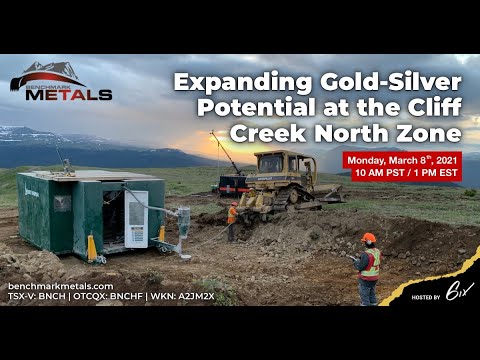
0:29 Good. Thank you, Dasha. Well, welcome all who've signed into the webinar here. This is just an update according to some recent drill results. Joining me on this benchmark presentation will be Malcolm Dorsey. Malcolm is a senior geologist who's intimately involved with this project moving forward. I will go through the general presentation and project, and then pass things over to Malcolm and he can get into more of the technical details. However, on the opening slide here, this just gives you a very, very good look at the general topography of the area and also shows some of the disturbed areas where there was former production from 30 years ago.
1:19 So for those who are new to this story, Benchmark Metals is a gold and silver exploration company. We are working very aggressively to advance this project to a mining and production decision with all capital in our treasury to do all the work. The difference in this story this time is 30 years ago, the company or the miner was working high-grade narrow intersections at depth underground mining. This time we're looking at big bulk tonnage material at surface, which is always more economic and easier to work. So without further ado, we'll go into the presentation here. The normal disclaimers, we are a Toronto venture listed company, and as such, there are inherent risks. However, we are de-risking this project and we are fully funded. So we hope that this value statement invites more to invest in this company.
2:25 Management and directors, we are a senior team and we've been around the block many times. You're looking at experience from anywhere to 10 upwards of 30 years experience. Myself, I have over 25 years experience in the resource sector, having been involved with several firms who have gone from brand new discoveries to production and or production decisions. My partner and senior chairman of the group is John Williamson. John has been involved in numerous new gold and copper base metal stories as well. He's brought them from new discovery to production scenarios and the slew of our cast and crew here are all very technical and senior level personnel in the sector. So we're not a new group, we are very experienced and as always if you're going to wager some money I would bet on the team because the bet a good team will bring you significant projects and pull in the capital and the marketing to bring shareholder value.
3:36 A snapshot of our location, the benchmark project is located in north central British Columbia. You can see the golden horseshoe here. The horseshoe depicts the geological perimeter around the Bowser Basin. You can see that golden triangle is covered with not only mining companies, but also advanced exploration projects. The Lawyers project on the right hand side of your screen or eastern side if you will is located very close to the world-class Khamas gold copper mine which is owned by Sentara.
4:17 Logistically speaking you can see on the inset map to your top left, the Lawyers Gold Silver Project is 45 kilometers from Comas, road accessible. We have improved the ground or road work to get to the mine site. We've improved 3 bridges. It's much more accessible than it used to be. There's no need for helicopter access at our sites. We aren't remote to the point where there's helicopters needed on a daily basis. We can actually drive our trucks directly from site. There's 2 large centers nearby, Prince George, British Columbia and Smithers. We can drive directly from Prince George to the project.
5:05 There's also an airstrip within 13 kilometers of the project center. It's called the Sturdy Airstrip. In the 1980s and 1990s, they were landing Hercules aircraft here. This also provides a very good tie-in point for electricity being so close to the Kamesh mine. This would be a logical place to tie into the British Columbia grid and therefore help reduce overall electricity costs going into the mine when it's put into production. Corporate objectives here. Last year in 2020, we completed over 87,000 meters of drilling. However, we began working on this project in 2018.
5:52 We're still putting out drill results. We put out results on Friday afternoon and then rebroadcast Monday this morning. We anticipate some more press releases on drill results over the coming weeks. However, that will lead into a resource estimate. Our made in bulk tonnage mineral resource estimate, This is still planned for the end of March or early April-ish period. This is indeed a large resource estimate and you and Malcolm and I will go into discussion on why This is a significant achievement and the ultimate size. The resource estimate then will be followed in Q2 by a preliminary economic assessment.
6:40 So this is just a few months away, but we've already began work on the economic study. The economic study provides all the conceptual economics and engineering work needed to put this into production. And, but then into Q3 and Q4, we will begin a 100,000 meter minimum drill program that will be used to advance the project further. This drilling will go to updating the resource again, but also to look at drilling out new discovery areas across the land package. And then into 2022, we hope to leapfrog to a feasibility study and a mining decision.
7:29 And Best of all, through all of this work into 2022, we are in an exceedingly good cash position where the Treasury is filled to complete all of this work going ahead.
7:44 Corporate snapshot of the company. Our share price is starting to lift and we're actually at about a $1.25 share price as we speak in and around that area. We will be moving, we believe the market cap will lift further as we go ahead. Cash in the bank, there's just around $35 million, but we also have $16 million in, 16 million warrants in the money as we speak. These are all priced at near a 40 cent price level. So these warrants are beginning to get exercised and there's an excess of another $6 million that we anticipate coming into the treasury soon.
8:33 On management ownership, management and very close associates hold about 15% of the share position. Our largest shareholder is Eric Sprott, who holds just below 19% of the stock on institutional support. In the fall of 2020, we completed a $52 million raise that was oversubscribed. This included the likes of some investment or institutional support, including ASA Capital, VanEck Capital, and Franklin Templeton. And best of all, these companies don't generally support a firm at this early stage, but this just provides some notice that the institutional support was very happy with where the project was going and the team managing.
9:27 So they got in early, but with full expectancy that there was a resource around the corner. On the analyst coverage, we're getting coverage now from 3 separate boutique bankers, if you will, Sprott Capital Group, Clara Securities, and PI Financial. And this is really a snapshot of the center of the property where the resource will be built from in the coming months. I should say coming weeks rather. This is a topographical picture that has been overlaid with the 3 main resource zones. You can see Cliff Creek, Duke's Ridge and the AGB zone.
10:17 These are the 3 areas that will report to a global resource estimate. These areas are all combined with historical work that we are able to use as relevant data, but also drilling from 2018, 2019 and 2020. But on this snapshot of these potential pittable resource areas, You can see this depression in the ground, and these are pit shells that we designed in 2019, based on all the data up to that date. All of the drilling that we did in last year during 2020 exceeds these pit shells. So we expect these pit shells to be larger and deeper when we release the resource and subsequent PEA this summer.
11:16 So we produced a bulk tonnage exploration target for Cliff Creek zone alone. And this measured up to 1.9 million ounces gold equivalent. So that includes gold and silver. And this graded just over 1.7 grams gold equivalent. So resources are at surface, they extend to depth. We've now moved the
11:47 gold and silver resource potential to beyond 500 meters depth at Cliff Creek. And we're seeing on the AGB zone on the top right portion of that picture, it exceeds to beyond 270 meters, 275 meters vertical depth. So there's tremendous potential here on these 3 zones. They're open at depth, open at strike. And you, Malcolm will go into the potential across the rest of the package. And just to give you an idea here on metallurgy, Benchmark completed gold and silver recovery rates during 2020. This saw recovery of the Gold and Silver that we can take out of these rocks at 98% Gold and up to 97% Silver.
12:41 So this is exceedingly good recovery rates. This is very important towards the economics and engineering. And the conventional recovery method is definitely conventional processing methods that we're looking at. It will go 1 of 2 ways, using gravity and whole or leaching, or gravity and flotation. And these are trade-off studies that are in progress as we speak and we'll release the results on this in the PEA. So without further ado, I'll let Malcolm speak here and speak to the opportunity here at the Cliff Creek North Zone, and also touch base on a couple of the other zones here that we recently put results onto. So go ahead, Malcolm.
13:31 All right, thanks, Jim. So the slide that we see here, if you look up towards the top left, you'll see a plan view. So a view from above looking down on the pit shell for Cliff Creek. And you'll see that Cliff Creek, as in the previous slide, is about 1.2 kilometers in length. So where we'll be focusing is in the northern section, so a sub zone that we refer to as Cliff Creek North, which you can see highlighted in the top left of the plan view map there. So Cliff Creek North measures about 300 meters in strike length, and currently our drilling is going down to greater than 500 meters vertical depth. So that's what you see on the bottom left of the slide here is actually a longitudinal profile.
14:22 So this shows us the profile of Cliff Creek North and gives us an idea of the density of the drilling that has been done. So you can see the density of the drilling that we have. You can also see if you follow that green line, it's the 2019 model pitch shell. And you can see that some of our recent drill results that we released on March 12th, actually go deeper than that 2019 model pit shell. To focus on specifically, hole 72 is now our deepest intercept in Cliff Creek North. We intersected just over 15m of 3.62g per tonne Gold and 143.38g per tonne Silver. This is for a total of about 5.41 grams per tonne gold equivalent over 15 meters and this is 150 meters below the model 2019 pitch shell.
15:18 So that was within that was hole 74. Hole 72 is the deepest drill hole, which you can see in the lawn to the profile there. So that's the 150 meters below the pit shell. So we're further extending the mineralization depth and we fully expect to be able to expand on this mineralization with high-grade material as we continue to drill. On the right-hand side, you can see a cross-sectional view. So you can see some of those recent results and hole 74 that just over 15 meters. And you can see where it is in relation to the pit shell as well, that we're both at 150 meters vertical depth beneath the pit shell. And that mineralization is continuing, the system remains strong, and we continue to get good high grade intersects as we continue at depth.
16:16 Here we can see some of the recent results from our AGB zone. So I'm just highlighting this as we'll be talking about AGB in the next few weeks as we continue. So as to our March 10th release, we released some results including AGB all 46. This returned mineralization from surface up to 122 meters of 1.3 grams per ton gold and 32.16 grams per ton silver. So about 1.7 grams per tonne gold equivalent over that 122 metres. And you can see the location in the plan map on the left-hand side there that we're testing the southern extents of AGV.
17:04 This also includes 54m of 2.22g per tonne Gold and 42.08g
17:11 per tonne Silver. Again, about 2.74g per tonne Gold equivalent over 54m within that drill hole. What we're seeing are broad zones of mineralization and something important to note within that left-hand plan view map is that we're actually 175 metres south of the historical underground working site HEB. So Drilling to date has outlined near-surface Gold and Silver mineralization over the total 650m strike length. And as Jim mentioned, we've now extended that to just over 270 M. Vertical depth so we can see that within the right hand image, the cross sectional view as well. So looking forward, we're waiting additional results from AGV.
18:01 This could increase the total tonnage within this zone. And this area also remains open in all directions for expansion drilling in 2021. Well, I just wanted to quickly go over some of our gold silver discoveries and new exploration targets on the property and some of what we'll be targeting in 2021. You can see that we have 6 initial drill targets. These are going to include Marmot, Marmot East, Engrid, Giffords Edge, Lala and Silver Pond Zones. All of these zones are peripheral to the main resource zones. So you can see the main resource zones on the figure on the right. Those are the red outlines for the pit shelves. So you can see that these initial targets that we've got are all peripheral and could all add some tonnage to future resource.
18:55 So these are all new high priority targets and we've identified them through various means, including geophysics, golden soil anomalies, as well as grab samples and identification of key structures that control the mineralization. As well, if you look to the southeast of our main resource zones, you'll see Marmot. Marmot is our most advanced new discovery. So we're very excited to expand on the Marmot zone in the 2021 season, as some of our first exploratory drilling returned over 100m of 0.82g per tonne Gold equivalent.
19:32 So We will continue to expand Marmot in the coming season and we also have more than 14 targets that are laid out in that figure that we will be continuing to advance up towards drill-ready stage within 2021. We're very excited with just the amount of targets that we've got on the property and where we can expand. So I'll pass this back to Jim at this point. Good, thanks Malcolm. Or Ewan rather, actually Malcolm. My apologies, We have 2 very good senior geologists who I'm often working with, and I seem to be mixing up Malcolm and Ewan's name, but very clearly this is Malcolm.
20:18 On the value proposition here or summary, look there's 5 main points to consider here. We've got an exceedingly good management board and senior level technical team and that includes the likes of Malcolm, who is sharing the webinar with me. The asset, well, we're 100% owned. There's a small 0.5% NSR on this project. It's 140 square kilometre package. We've only explored a small portion of it. Malcolm outlined potential for new discoveries across the rest of the package. We are fully funded with a strong treasury that allows us to do work over the next 1 to 2 years.
21:03 We're embarking on a 100,000 metre drill program in 2021. This will go towards resource expansion and also to test new targets.
21:15 And then on the news flow here, we've got some major milestones coming. In the coming weeks, we'll be publishing a new maiden bulk tonnage resource estimate. This will include the 3 primary areas in the centre of the property. We've already worked towards metallurgy, geotechnical and a lot of the permitting work that already will go towards a PEA this summer. And that PEA is the second big milestone that will show that this is an economic endeavor and the engineering involved is quite conventional.
21:56 And so this is the reward for shareholders who get into this story. There's plenty of more drill results to come over the coming weeks, but we have 2 big milestone events ahead of us and so we think there's an opportunity for the market cap to move much more and Perhaps multiples as we go ahead And so without further ado thank you for listening to this brief update. I'll pass things over now to Dasha to answer or entertain any questions. Great. Yeah, I will not be answering them, but I will be asking the questions now. So if you have a question please submit them under the Q&A tab. But so to kick things off, Tim has a question. He's asking is there a possibility, assuming a suitable good offer, that Benchmark will sell Cliff Creek, AGB and Dukes Ridge Phoenix Zones as a package and continues to explore develop the remainder?
22:58 Well, just on sort of a global scale of the entire package. If a mining entity came along and presented shareholders a winning offer, they would likely want the entire package because that is the reason why this is a compelling story here. Increasingly, miners don't want to be working for 10 years at an Endeavor. Their preference would be to working through several generations. So perhaps 20 or more years. And that's the compelling feature to what we're seeing across this big trend. There's the heart of the property that provides immediate ounces, but the exploration upside on the rest of the package could mean that a mine will be working here for many generations.
23:49 All right, thank you. Helmut is asking, he's saying that the results of the connector drilling between CC and DR are still pending however, the Sprott equity team has called CC a monster in its latest reports. Is there any proof of the connector between CC and DR? Is it conceivable that CC and DR will become one big super pit?
24:13 At this point, I'd say no, they're not likely to connect, but given the current size of Cliff Creek, it is already a monster pit being 1.2 kilometers in strike length. There is some indications that mineralization does extend a little bit further to Dukes. But at this point, I don't think it's going to fully connect with the Cliff Creek zone. I think perhaps some of the bigger opportunities here going forward is the high grade material deeper at depth, not only in Cliff Creek, but perhaps in Dukes, but also AGB as well. All right, thank you. Peter has a question for Malcolm.
24:58 Do you see any evidence for continuation of geological structures of faults, rock types from CC south down to Lala or from Lala down to Marmot? Also, second question is, and from those recently defined new interesting areas, which ones have the highest probability of being interconnected by their geological structures and faults? Yeah, so what we're seeing down at Lala and especially at Marmot and Marmot East is a continuation. We're seeing the same alteration, the same rock types, the same structures that seem to have influenced mineralization over on the Cliff Creek Zone as well.
25:47 So we're seeing a lot of similarities between those 2 different areas.
25:54 All right, perfect. Our next question is, what do you think the cutoff grade of the mineral resource will be for an open pit deeper than 500 meters? A bit early to say without having a technical report in our hands. However, I think in the Cliff Creek zone, we're trending close to what was provided in our exploration target of 1.7 grams. The one note there is in general, if you add more ounces or make a pit larger, you tend to decrease the grade a bit. So there is an opportunity to add more ounces, but that might have an impact of decreasing the grade a little bit.
26:42 But the opportunity there is that as you're insinuating, as we go below open pittable resources at depth, perhaps 400 metres or lower, we're seeing these very, very good continuous high grade areas. So those high grade areas below the pits are no question, much higher grade than the general open pits. But I also have to note that the 3 resource areas, Cliff Creek, Dukes Ridge to Phoenix and AGB will all have slightly different grade. And certainly the grade at AGB will be much higher. It has a much higher silver content, but also in the subsections, if you were going to towards the North end of Cliff Creek, so Cliff Creek North, you'll see a much higher grade as a subsection in that area.
27:37 A good question, thank you. All right, thank you. Dirk is also just wondering if you've found any other important elements. He suggests maybe copper and how much?
27:50 So at this point, from surface down to 3 or even 400 meters, we're seeing quite good consistency with the gold and silver or precious metal content. However, as we do get deeper, there are some anomalous mineralogical features, I'd say, that indicate there's a bit more base metals present. But for the most part, it is a rather homogeneous gold and silver deposit or deposits, plural. Great. Amir is wondering what the risks you see are with the EPA vis-a-vis the Indigenous nations around your projects that might be against mining?
28:38 So Amir is asking about our permitting as we go towards receiving the mining permit. And as always, in Canada and the rest of the world, for that matter, you've got to be very – work with the communities in the region. And so our neighbours and partners are the First Nations communities, and there's 4 in this region. We have existing agreements in place, and the First Nations are very intelligent, I have to say, and informed, because they've already been through this path with the Kameskul copper mine that lies to the southeast of us. So there's already, I'll say, a footprint or a path from exploration to production demonstrated by the Kamesk mine.
29:34 But also, Pretium, who is on the other side of the basin to us, approximately 200km away, went from exploration to production very, very quickly over the last 10 years. And so there's another example of working collectively with First Nations to be granted your mining permit. So look, British Columbia is mining friendly. The First Nations, we're involving them as much as we can and we'll continue to work with them in a collaborative approach. And we see no red flags here. We're proud to be working with them and we're proud to be, as we speak, working towards some new agreements.
30:21 Great, thank you. Helmut has a question here. He's saying that the water supply should not be a problem in the benchmark, what else region were you reminding? And this together with the open pit potential of benchmark indicates to me that the upcoming P.A. Will deliver excellent results. He also says he's aware that the MRE must be completed first in order to make more accurate statements, but is asking, what is your evaluation of this, Jim? Yeah, thanks Helmut. So Helmut's quite right. The first step to go towards producing economic numbers in engineering at the conceptual level is we need to see how many ounces are actually in the ground. And that's produced in the mineral resource estimate.
31:10 As Helmut was saying here, There does not appear to be any major water issues because we're lying on the peaks of these undulating mountains, if you will, and all of the water bodies lie in the valley. There's infrastructure left in place from us from former production 30 years ago, which also helps with advancing things because you've already got a road network directly to site. In addition to that, there's also 5 levels of underground development in the Cliff Creek North area. And so perhaps that will be helpful when this mine or when this project goes to underground mining. So there's a lot of classes here left from former production but also the topography of the area has been very helpful in allowing us to work with very little tree cover.
32:11 Thanks, Helmut. Great, thank you. Peter is wondering, when will you be likely ready to announce a drill plan and the priority of zones for drilling in 2021? Sure, so Peter, once the mineral resource estimate is completed here in the coming weeks, That enables us to build a better plan for expansion and definition drilling in the main zones. We already have an idea of where we're going, but there'll be a more concrete plan following the mineral resource estimate. But we can say that on the regional scale for new discovery drilling, there's no question we will drill Marmot, Marmot East, Lala, Silver Pond as quickly as we can.
33:06 Those are glaring targets where we've already decided on drill collar locations. So it'll be a combination of drilling in 2021 will include a portion of drilling towards resource expansion and drilling, and then a good portion of drilling will go towards adding more ounces across the rest of the land package. Great, thank you. Last question here. Stefan is asking if you can tell us anything regarding Arctic and E-grid. If you have a time frame, first ideas. I could probably let Malcolm answer that, but my cursory quick answer is that Arctic and E-grid are compelling targets, but they require more boots on the ground, if you will.
33:55 They'll require some more, perhaps some tighter geochemistry work, but also some geophysics and also some structural mapping in order to properly advance and get it ready to the drill ready stage. Malcolm, you have any further comments on perhaps some of our more tertiary targets that we're developing? Yeah, I guess one thing to point out would be the fact that one of the first things that Benchmark did when they acquired the land package was to fly a radiometrics potassium thorium survey over the property. And with that, we were able to pick out any potassium alteration on the property. So a lot of our targets are based on that. That was the main resource zones.
34:40 We see a large amount of alteration in that area. And Arctic and Egrid are 2 other targets that also have similar radiometric signatures. And together with that, we do have some samples such as E-Grid. We have some grab samples that ran up to, I believe, 1.45 grams per ton gold and 117 grams per ton silver. So we do have some good mineralization that's corresponding to those targets as well. So like Jim said, it'll require more boots on the ground, more looking into the geology and the controls on mineralization in these zones, but they do offer good tertiary exploration targets. Great, thank you so much. Well, that's all the questions we have for today.
35:27 I would like to thank everyone who submitted questions, and thank you so much to Malcolm and Jim for going through your presentation in the live Q&A. If you didn't get a chance to ask a question or if you think of 1 after the summit, we'll be emailing out a short survey and the Benchmark Medals team will be happy to follow up with you directly. And as always, you can also find more information on their website at benchmarkmedals.com. And quickly, a version of this presentation is available for download on the handouts tab. So if you'd like it, please make sure to download it before we end the webinar. So with that I'll hand it over to you Jim. Good, thank you Dasha and I must thank 6 Media and Dasha for hosting this webinar again on such short notice.
36:16 In conclusion, really the 3 main points for consideration here is we're working towards developing what looks to be a world-class land package and mine. And this will be demonstrated with more upcoming drill results. But a testament to this will be the mineral resource estimate and then a preliminary economic assessment in the summer of this year. And of course we will be drilling a large amount of meters and all of this is captivated within our cash position to fund everything. So, thank you.