Transcript
Automated transcript · Written by software from the replay's audio. It can mishear names and figures; the replay is the record.
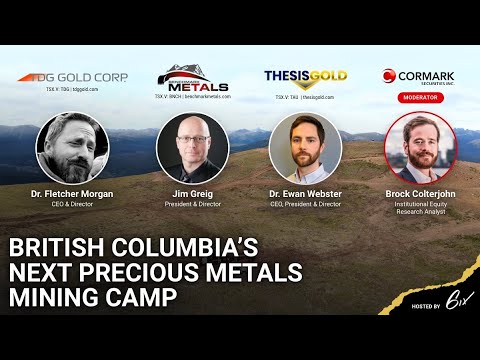
0:11 Hello and welcome everyone to today's panel discussion focusing on the Tutugan, British Columbia's next up and coming precious metals mining district. I'm really pleased and excited to host this thematic panel discussion as I believe it will help shed light on this up and coming mining district and the key companies actively exploring there. Just before introducing the panel, I'd like to introduce myself. My name is Brock Coolejohn and I'm a mining analyst at Cormark Securities covering exploration and development companies, including benchmark thesis in TDG. Before being a mine analyst I was a mining sales specialist on the institutional sales desk at Canaccord Genuity and before that an exploration and production geologist working at a number of projects and mines in Mexico and Canada, including Centara Gold's Comest project located in the Southern part of Tuticorin.
0:56 In terms of housekeeping items, I'd like to take a moment to encourage viewers to submit questions at any time during this panel discussion by going to the right hand of your screen and selecting the Q&A panel. With that, I'd like to introduce our panel. We're joined today by Jim Greig, President of Benchmark Metals, Ewan Webster, President and CEO of ThesisGold, and Fletcher Morgan, CEO of TDHU Gold. While each company is at a different stage of their lifestyle, every company offers investors exposure to high-quality exploration and development assets that have strong potential to become multi-million ounce stand-alone operations or acquisition targets for gold producers looking for growth in tier 1 jurisdictions with good access to infrastructure. At a corporate level, these 3 companies have strong financial backing, a high degree of institutional ownership, and are led by competent technical teams with in-district experience.
1:50 In the highly volatile world of the middle exploration, I believe it pays to back proven mindfinders with superior access to capital. All right, let's kick off the panel discussion. I would like to take a few minutes to let each of you to introduce yourself and provide a snapshot overview of your company and project. Jim, take it off, please. Good. Thanks for the intro, Brock. Benchmark Metals is a silver and gold exploration company that is focused on a path towards production near-term. Our project is located in north-central British Columbia and we neighbor Thesis Gold and TDG Gold, but most relevant to this is all of our projects are road accessible. We do not need helicopter support and there's a clear path to production because of the history and legacy of a former production years ago.
2:44 Awesome, Thank you very much, Jim. I'll pass it to you, Ewan. Thanks, Brock, for the introduction. Just a little bit of background on myself first, I guess. I started out my geological career and back in Glasgow, Scotland, before going on to complete a PhD, Geoscience BC funded and looking at the geology and tectonics in south east BC and how the ore deposits in that region fit into that tectonic model. Then from there I went on to working in the junior exploration space and a few years ago I joined the Metals Group of Companies as the Chief Geologist. I've been working since on a number of projects in North and South America from grassroots with our Cortez Metals generative model in Nevada through to producing copper assets in Chile with Alcaplano Metals and kind of everything in between, I guess.
3:36 But my probably the most relevant
3:39 role I held recently was that of senior geologist for Benchmark Metals. So one of the metals group of companies. And I stepped back from that role recently to take on the position as CEO and President at Thesis Gold, predominantly because of the excellent opportunity I see at the Ranch Project. The project itself is the northern extension of Benchmark, so it's the next 178 square kilometres to the north, so district scale land position. And similar to a lot of projects in the Tutugon, it was explored pretty extensively in the 70s and 80s, and which time they found some fantastic mineralisation. There's 21 known near surface epithermal deposits and prospects. There's a little over 35,000 metres of drilling on the project, so we're certainly not starting from scratch. There are some fantastic numbers in there, 29.9 grams per tonne gold over 25 metres.
4:29 But Most of the drilling on the project has been very shallow, under 100 meters, in fact, probably 95% of that drilling. So they barely scratched the surface historically. And the geochemistry certainly points to a high-sulfidation epithermal style mineralization with roots potentially in the deeper porphyry system. So a very underexplored land position and a great jurisdiction. Awesome. Thank you. And last but not least, I'll pass it over to you, Fletcher. Thanks, Brock. So my name is Fletcher Morgan. I'm a white settler of English ancestry, living as a guest on unceded lands of the Coast Salish peoples, including the Musqueam, Squamish and Tsleil-Waututh. I'm a CEO of TDG Gold Corp. I'm also a director and an owner.
5:15 Our flagship projects are the former producing high-grade gold, silver, Baker, Shasta and Metz mines. Baker and Shasta are actually are full within a permitted mine area, which also includes the Baker camp, the Baker mill and the tailing storage facilities there. Our focus this year is to drill Shasta. We have over 30, sorry 28,000 meters of historical drilling at Shasta, over 30,000 meters of historical drilling at Baker and just under 8,000 meters of historical drilling at Metz. So it's been a lengthy task to recompile all that information from multiple sources, but we're there. We've published multiple news releases over the preceding months where we've started to explain why we're so excited about this. And it really goes back to something that you and also mentioned, the high grade production that's happened here historically, it was already noted that there was the potential for these lower grade mineralized halos around these high grade and ultra high grade veins that the historical mining operations were focused on.
6:20 And the fabulous opportunity that we see in the Tudorgon, and certainly the Tudorgon production corridor, which stretches from ourselves up through Benchmark's property at Lawyers up to Ewan's property up at thesis gold at the ranch property. The opportunity there is to characterize and quantify that mineralized halos and benchmarks already started that with the resource that they published. Our ambition is to publish a maiden resource estimate for
6:46 Shasta in early 2022, and then drive it as rapidly as possible through to a production decision, which we're targeting for 2024. Awesome, thank you. So the Tutugon district may be unfamiliar for some viewers. Could you provide an overview of the district and history? You touched a little bit on the high grade, previous production and kind of reiterate the key camp qualities that originally drew you and your team to the Tujagan. Ewan, let's start with you. Sure. I think it's probably a number of factors from the existing infrastructure, the proven jurisdiction, being able to put mines into production, the fact that the region is seeing very little modern systematic exploration.
7:35 And a lot of it sat dormant for 20, 25 years. And I think in addition to that, it's important to recognize the geological potential of the district. So maybe I'll focus on the geology and I'll let the production and infrastructure and the other side of things to the other guys. But, you know, in my mind, the Tutugan district has gone overlooked somewhat. And it's part of a larger, kind of sticky island terrain, which, you know, and today think of something like Indonesia for example, would be something comparable. But everybody is familiar with the western side of the Stikine terrain. So the tier 1 assets and the golden triangle, but it's the same age of rocks on the eastern side of the Stikine terrain as well.
8:30 This prolific arc formed in the late Triassic and early Jurassic. And at the same time, all of the fantastic mineralization that we see. But it was kind of blanketed by
8:43 later sedimentary rocks of the Bowser Basin and Sustok Basin. And they essentially preserved the mineralization that we see today. But in more recent time, as the rocks were eroded away, it has kind of exposed some of this fantastic mineralization, which is pretty rare because it being quite old, kind of around 200 million year age, most of those types of deposits have typically been eroded away in British Columbia. But it has formed this arcuate shape of deposits around the Bowser Basin, which you know we've been referring to as the golden horseshoe. So there's correlative rocks on the eastern side of the basin with those on the west, similar types of mineralization. And I think the potential here is just as good as those on the West. It's just that it's been overlooked for some time, but with benchmark kind of setting the stage now and showing what the potential is there for multi-million ounce deposits near surface, high grade open pittable resource.
9:45 And I think that's really setting the stage for what is possible in the Tudogon. Awesome. Thanks, Yvette. Jim, what drew you and your team to the Tugada? Well, given our project had former production, just like my 2 colleagues here. Initially, there was a lot of data left for 30 years sitting on our project. And it was glaringly obvious that what was not economic 30 years ago has become very economic now in 2021, given gold's at $1,900
10:23 and silver is at about $27. When benchmark property was mined from 1989 to 1992, Gold was at approximately US$250 to US$300 and I think Silver was around the US$7 range. So, you know, catapult 30-years later, all of that ground is much more economic and we saw this, especially so in some of our drilling. Last year we drilled through some old workings
10:52 and they were backfilled with what was considered waste rock. Well, waste rock back then, they were putting 12m of 8g material in the voids and This is now considered high-grade material that was left for waste, essentially. This is a good component or a reason why this region is very exciting. We're looking at an area that had production 30-years ago. Most recently, Kamesh entered into the scene. Kamesh mines now on care and maintenance, but that mine shut down in 2011, having produced well over 3Moz of Gold and near 800Mlbs of copper. And it still remains open.
11:39 And it's another target here because commodity prices are much higher than what they were in 2011. So Comess has led the way for infrastructure for us. There's a logical tie-in point to connect to the British Columbia power grid for reduced power costs as we get towards production. All 3 companies here have upgraded the roads and the bridges getting to our sites. We can handle heavy capacity trucks and equipment now. And the ground has a footprint
12:13 across all 3 areas. There's a footprint of former production. On Benchmark's ground, you can see where the former mill and the old tailings was settled. So all of this is just tick marks or boxes that allows for easier permitting process when you've got established infrastructure that needs a bit of lipstick on it to improve, but it makes a clearer path to advance things. Awesome, thanks, Jim. And how about you, Fletcher? To build on what my colleagues have just said there, it was the topography attracted us. This is low undulating hills. It doesn't have the topographical challenge, certainly in the Tudor gun production corridor, it doesn't have that topographical challenge as you see of certain parts of the Golden Triangle.
13:02 The infrastructure, just to build on what Jim said, the road, but also the sturdy airstrip is proximal to Shasta and Baker. There was actually an airstrip at Shasta as well, but the sturdy airstrip, you can bring it, they brought a Hercules in there to bring in some of the historical mining equipment. But for us up at Baker, you know, it was also the cutoff grade that they operated it at. So they operated Baker at, you know, just under an ounce a time with a 12 gram a ton cutoff. Shasta, the ore there, they were still putting that through the mill in 2012. It was good grade. But also, just to build on the database and the data set of the historical work that was undertaken, certainly at Shasta and Baker, they didn't assay all of the core. They knew what they were looking for in terms of the controls. And when they hit those controls, so in the case of Shaster, it's fault controlled, they then assayed after it, seeking the high grade and the ultra high grade, and effectively mining the footwall.
14:05 They were drifting sort of 2 and 1 1 meter by 3 meter drifts, chasing the
14:09 veins. So the opportunity, as we see it, where they did assay some of the rest of the core is that that minimalized halo exists. In fact, actually what we've started to do is reverse engineer what it would take to accelerate back as rapidly as possible through resource, through economic assessment, back into a production decision. And we see a clear roadmap to doing that. It's effectively the same playbook that Benchmark has shown everyone. It's the same playbook that Ewan and the team at Thesis Gold will be enacting, but it's also the same playbook as we've seen successfully by the likes of Skeena Resources in the Golden Triangle, with whom I worked with. I was part of the relaunch team of Skeena back in 2015, and was still working with them until 2019. So we're not reinventing the wheel here. And I know it's a cliche, and quite often you hear the best place to find a mine is next to a mine. Yes, But actually in my opinion, the best place to find a mine is a mine that wasn't fully mined. And that's what we're seeing here, not just on our own property, but benchmark is seeing it, thesis is seeing it, and also obviously, you know, hopefully Comess will fire up again and get going.
15:19 No, absolutely. And thank you, Fletcher. And, you know, just on the point of infrastructure, you know, when I was working there as a geologist and then do deep dive and initiate coverage on you guys, like the Tudor Gone does have all that existing infrastructure. Like you mentioned, it's access road connecting to major towns and cities, including McKenzie and Prince George, you know, high power, high voltage power lines running to the district, to existing mills. You know, one aspect that makes TDG stand out in particular is your existing 200 ton per day mill and tailing storage facility. Fletcher, can you speak to the inherent value of this asset either in terms of salvage value or most likely strategic value in this immersion camp? Yeah sure, Brock. So you know it was one of the features that attracted us to the Baker Shasta asset package.
16:07 So when we signed the acquisition agreements in the summer last year, we did send up a mining engineering team to go and look at the mill. It's small scale, 200 tons a day, but it did operate efficiently. Certainly, it seems that up until its close in 2012, the recoveries were on a combined basis over 90%. So, it's a good starting point. But we also had it looked at in
16:32 terms of its scalability. So I can give you some metrics, to double its capacity and add in dry stack tailings and recommission the mill would be around 7 million Canadian. The replacement value of the current mill as it stands is around 16 million Canadians. It's a good starting point, but that's not why we're in this business. We're not small-scale miners. We're in this to make discoveries of bulk tonnage, lower-grade resources that we can then look to scale up and put through.
17:06 We think the Baker footprint there is the perfect location from that. It's downhill from benchmark, it's downhill from thesis, it's close to Shasta and it's close to the airstrip. That was what really attracted it to us. Now, what we get with that footprint, and it's in a permitted mine area. That's important as well. It's not just the mill, it's also the camp and the tailing storage facility in the road that goes between. What that gives us, in our opinion, is almost like a duality. We can, if we, you know, there is a scenario here where we could, for example, do bulk samples or higher grade, smaller scale through there. If, for example, we collectively wanted to generate some cash to help advance our bigger ambitions. But for us, really, it's that infrastructure, that footprint, it's a large area.
17:56 And we think the potential is there to build a much larger facility that could serve not just ourselves but also our colleagues and other companies should they make discoveries you know slightly outside of the Tudor gone production corridor where we know exploration is being undertaken. But I have to say as well though that it is a responsibility to have this. It's an opportunity but it's a responsibility. We've had to negotiate security bonding with the ministry.
18:21 We've had to work very closely with First Nations in order to make sure that we were addressing some of the concerns of the past, but also making sure that we're putting proper programs and controls in place for the future. And so this season, for example, we're going to have a comprehensive environmental program, which will be enacted by 2 wholly owned and operated First Nation businesses. So Chucho Environmental and SASECHAN, which I know the other companies are working with as well. And we're also planning to share that data and information with Benchmark and with Thesis, because we're all connected in the same environmental footprint. Okay, and the other aspect as well, and I know it's a hot topic, is our tailing storage facility. It is small, it wasn't in compliance, but fortunately, Talisker in 2020 brought it back into compliance and our commitment to not just our owners and our shareholders, but all of our stakeholders, particularly the local communities, to make sure that we maintain it in compliance moving forward. So we're very excited about the footprint, but we're walking in with our eyes open and we're fully prepared to accept the responsibilities that come with that.
19:31 Oh, Absolutely. Thank you. Jim, while Benchmark does not have an existing mill on site anymore, your lawyer's project is a past producing asset with road access and an already disturbed footprint. How do you think the disturbed nature of your project will help reduce permitting complexity and potential timelines to production? Yeah, having a legacy of former mining is very helpful. Certainly we've touched base on the roads many times, but the topography here is amenable to building out a mine facility quickly. There's not a lot of earthworks required,
20:10 but the former footprint here look and infrastructure, There's 5 levels of underground developments remaining in the Cliff Creek Zone, which is our largest deposit on the property.
20:23 Because benchmark has shown that there's open pitable, but also potential for underground mining. There's a bit of optionality here in our project where the legacy of this 5 levels of underground, you know, you could actually go straight to high-grade underground mining if you wanted to preclude the open-pitable nature. So there's high-grade narrow vein mining, very similar to what was done 30-years ago, but then there's this new optionality here with moderate to low-grade halos starting from surface. These are actually a theme that's represented in all 3 companies here. Similar mineralization, but absolutely mineralization that was neglected or forgotten about 30 years ago.
21:13 With the road network that we have going straight to the Kamesh mine, there's a beautiful corridor that follows along the valley. And that's a natural area to insert new power lines, high voltage power lines, without the need to build brand new corridors or cut new lines through the ground. And this is a trade-off study that Benchmark's going through right now towards its preliminary economic assessment for this summer. But certainly when You have ground that's already been displaced, and you can see areas where there was a former mill and plant, not to mention living facilities. It's much easier to clear and grub the land without looking for environmental approvals.
22:05 Truly every single project here is a brownfield development story with new production possibilities and it's a legacy to the infrastructure that lies. Awesome, thanks. And lastly, Ewan, Ranch was also past producer of Disturbed Footprint Brownfield Project. You have plans this spring to build a new camp re established road access. To site. Can you take us through these plans in kind of greater detail and discuss how you believe the disturbed nature of your project will also help reduce permit complexity and potential timelines to production? Yeah, for sure. I mean, the ranch project itself has seen a lot less production than either Benchmark or TDG's ground. It really, historically when the Chaney Mine was in operation on the Lawyers Project, so 1989 through 1992, towards the end of the operation, they decided to produce some of the high-grade ore from surface at the ranch project.
23:06 That was from 3 small open pits. Those are still visible today. They're maybe 100m long and several metres deep. They processed about 41,000t of ore grade and 9.2g per tonne gold for about 10,000oz of gold. So, very high-grade mineralisation right at surface. What I would add is that the mineralisation at Ranch is a little bit different than what we see at Benchmark's project and TGG's project, and that it is a high-sulfidation type of epithermal mineralization where it's not veins, it's kind of pervasive silica alteration of the volcanic host rock. So you get potential there for kind of bulk tonnage mining over large areas of altered mineralized rock.
23:53 But I think as part of that historical production, what we did benefit from was, and the significant exploration on the project, was the road network that extends up onto the ranch project. You know, those roads are still in excellent condition, and we're going through the permitting process at the moment to upgrade some of the infrastructure. As Jim said, you know, we've already upgraded some of the bridges in conjunction with TDG and others in the area. But we have one more bridge to replace over the Tudigong River providing complete road access onto the ranch project. That fell into disrepair many years ago and was pulled out. But we are very close to being able to put that back in now. What we did do in the interim was basically work with the ministry, permitted a crossing of the Tudegon River this past winter, where we moved drills and machinery across the Tudegon. Those are now on the ranch project.
24:48 So it's going to result in very cost-effective exploration for this summer's program while we still put that bridge back in. And as you said, the footprint of the historical camp is still intact on the ranch project. It's in a fantastic location and we intend to use that and repurpose the area. As you said, being disturbed ground and already having an extensive road network, it certainly has streamlined the permitting process for us going forward here. Awesome. Speaking of that, 2021 is shaping up to be a better year for each company. Thesis in TDG, you're undertaking your first-ever drill programs on your properties, while Benchmark is undertaking its largest drill program to date. With crews already on the ground and drills expected to start this month, can you discuss your work programs this year and how you plan on allocating capital? Jim, we'll start with you.
25:48 Benchmark just recently produced near 3Moz of Gold equivalent in 3 deposit areas. Part of our drilling this year will be a minimum of 50,000m dedicated towards expanding the current deposits and defining the current causates with more infill drilling. This means that we can move some inferred ounces to the indicated category, but we also see potential within that 50,000m to reach towards over 4Moz globally from these 3 deposits. We're still expanding, we're still growing, we see a lot of minable ounces just from these 3 areas. But in addition to that, we're allocating upwards of 50,000 metres towards regional drilling across the property.
26:39 We anticipate potential at 1, maybe 2 areas for near immediate ounces. Last year, we had a brand new discovery south of the main zones called the Marmot Zone. This area returned 22m of 2.1g Gold that was bounded by a larger intersection of just over 100m of 0.82g Gold equivalent. In this actually, this marmot zone, the surficial area is actually larger than our cliff creek zone which is the biggest deposit on the property. So we think there's many more discoveries to be had across this package and very likely across the entire region that includes thesis and
27:24 TDG. So it's a breakdown of 2 focus points, expansion and definition drilling on the deposits, and then drilling for more satellite deposits across the 20 kilometer trend. Awesome, thanks. And the Marmot Zone is approximately what, 3 kilometers south of Quik Creek? Yeah, that's right. It's straight south of the Quik Creek area and there's another 4 targets that are adjacent to Marmets Zone. So we'll be drill testing those as well. Great, thanks Jim. Over to you, Ewan. Perfect. So We are planning a pretty aggressive drill program for our maiden program. It's 20,000m is what we're targeting. It will be a phased approach to the program with phase 1 beginning in June.
28:13 That's going to be targeting the cahar of the known zones of mineralization, which will help in a number of ways. I mean, firstly, and sadly, we don't have any of the historic core from the project. So it will be some confirmation drilling and really giving us a good idea of what the alteration system looks like, what the mineralization looks like, and that is going to guide the 2nd and 3rd phase of the drill program. So phase 2, which we anticipate beginning in July, will really be looking to expand those non-zones of mineralization. They all remain open a long strike and at depth. And it will really be testing that continuity and building out from what we already have. And then the third phase will be really testing a number of new targets that have never been trial tested before, but they share all of the same characteristics as the known zones of mineralization. I mean, recently we reprocessed an IP survey that was completed in 2007.
29:13 So post all of the historic drilling, We looked at that in conjunction with the geochemistry, the ground magnetics, the drill database, and put together a geophysical fingerprint, you would say, for the gold mineralization. We've identified 8 plus new targets that share all of those characteristics to the known zones. And those will be drilled, tested this year. So I think, you know, part of the program is confirmation and expanding, but also the discovery potential, I think. And it is very strong. And that is really just within the core, kind of 20 square kilometers where, you know, a lot of the historical work has been focused and 95% of the remaining land position is really seen very little, if any, exploration work.
30:00 So we've also planned out a significant ground-based exploration program to test for new targets. And that's going to include extensive soil and rock sampling throughout the property, ground magnetics over key areas. And That has been a fantastic resource for us already on the project and delineating the structural controls on the system
30:22 that, you know, those faults and structures that are kind of basin-bound and faults that acted as the conduits to the hydrothermal fluids. So having a good understanding of where they are and what the controls on the system, it's fantastic for delineating new targets as well. So we'll be expanding that. In addition, detailed geological mapping on the project. I mean, at the moment, there's not been any of that. Historically, we've been using the regional work that Larry Dyko did back in the early 90s. So, with a renewed understanding of the work, the benchmark stand, TDG stand, I think we can certainly expand on that with some prospective targets. I mean, we have the perfect package of rocks here with the stahini outcropping on the project overlaid by the lower Turagon volcanic package and it's those stratigraphic units that are so prospective for porphyry and epithermal mineralization on the project and in this area. So really getting a good handle on the geology and the mapping will be critical.
31:24 And lastly, we'll be flying an airborne LiDAR survey. Again, that's really just gonna complement, and sorry, I'll back up a little bit. What it's going to do is really look for the subtle changes in the topography that are caused by faults and structures. And, and again, that's going to complement the magnetics and really give us a good understanding of what the controls and the mineralization are and allow us to target new areas from that.
31:54 So we have a pretty aggressive program planned for this summer exploration, including expansion of the known zones. So I think the discovery potential on this project is fantastic. We're pretty excited to get going. Awesome. Thanks. Over to you, Fletcher. So our focus this year is our Shasta project. And the reason we're focusing on that is because of all the historical recompilation work that we've done,
32:22 leads us to believe that we can characterize a resource most rapidly. So We plan just over 4,000 meters of drilling in our first phase of our program at Shasta. That is around 80 holes. It will be a combination of twinning some of the historical holes to make sure that we can validate that historical information, but then also testing the extensions and some other ideas that we've got.
32:50 Shasta is open along strike and at depth. Our plans this year really isn't to try and tackle those aspects. We might get to that, but really it's about just making sure we're doing everything that we can to get that inaugural resource estimate out in the first half of next year. And to that end, all of our modeling work that we've done with Moose Mountain Technical Services has all been about working, reverse engineering this for a maiden resource assessment and then to be able to accelerate it through to economic assessment. So that's Shasta. So we'll be doing the standard things that you would expect as well, just mapping work and some surface sampling work around, trying to understand the wider opportunity at Shasta, but it really is about focused drilling. If we get onto our second phase and our third phase, that may well then add additional ounces, but that's about another 6,000m of drilling. We have lined up a second drill rig to come in if we get to that.
33:48 As everyone has to appreciate, there is a season to the work up at the Tudorcon. I know that last year Benchmark managed to explore all the way through to December. You have to winterize, et cetera, to do that. We'll go as far as we can, as rapidly as we can. But really, our focus is that. Get that, do everything we have to do to get that main resource estimate out. Then at Baker, which is a much larger alteration footprint, it's around 5 kilometers by just over under 1 and 1 1-1 1-1 1-1 1-1 1-1 1-1 1-1 1-1 1-1 1-1 1-1 1-1 1-1 1-1 1-1 1-1
34:26 1-1 1-1 1-1 1-1 1-1 1-1 1-1 1-1 1-1 1-1 1-1 1-1 1-1 1-1 1-1 1-1 1-1 1-1 1-1 1-1 1-1 1-1 1-1 1-1 1-1 1-1 1-1 1-1 1-1 1-1 1-1 1 by just over, you know, under 1.5 kilometres. There's multiple zones, historical workings, some super high grade. We're gonna be following up on all of the historical work again. We'll be doing some trenching and some mapping. We're really gonna be focused on the B vein, the historical B vein. There was some extraction, but outside of that, the drill holes have had some fabulous intercepts and we want to follow up on all of those. If we can get around to drilling on Baker, we will. Our third mining lease, I should mention, when it comes to drilling at Shasta, it's in a permitted mine area, which means 90% of our proposed drills are
34:53 within that permitted mine area. So we're not subject to having to apply for a standard notice of work, we have to do something called a notice of departure, which is effectively, there's an aspect to it of self-certification. You still work with the ministry, but it's a fast track process. And so we're very confident about being able to, you know, enact over 90% of our drill program at Shasta. When it comes to Baker, if we get around to drilling, we've had to apply for a notice of work. We're confident that we'll get it in time, but
35:23 people have to understand that there is a process that you have to go through involving, you know, fairly lengthy consultation with First Nations. And it's right and proper that we do that. But then up to our METS lease, which actually is within Ewan's Theseus Gold property package. It's a small 200 hectare mining lease. Again, it's sort of similar style mineralization to which Ewan has mentioned, but historically they characterized some tonnage. They had a small reserve on it. Our understanding is whilst they prepared ore to ship, to truck to the old Cheney Mill, they never actually trucked it and it's still in situ. So our mission this summer is to get up to the METS property and make sure that that ore is still there and then follow up. And we would love to drill there as well.
36:10 To bring our own drill rig up would probably take, as Ewan mentioned, a bridge over the Tudor River, but we'll try and, or we'll have to helicopter in a drill rig. But again, that will be a secondary focus and later in the season. We also have 2 earlier stage properties, our BOP property, which we acquired from Talisker as part of the acquisition package. That's up near Evergold's Golden Lion property. We'll just be following up on some historical work that happened there. There was no extraction, no drilling historically, but we'll be just getting back up there and undertaking the grassroots work that you would expect to try and define drill targets. And then we also have our earn-in project, which is Oxide Peak. It's adjacent
36:52 to Baker. It's just to the north of it. We've identified a target which we think is related to Baker. And we're going through the application process of applying for drill permits to be able to drill there. And as I sit here today, we don't know if we'll get those drill permits in time, but we'll be doing everything that we can. So we've got quite an extensive program, but the other thing that we have to mention again, and we keep coming back to it, is the fact that We're in a permitted mine area, disturbed ground. We have a responsibility to do the environmental work to make sure that we're baselining all
37:24 of the potential impacts in the area of all the work that we've done and also the historical work that's been undertaken. We take it very seriously, but also we believe it's a benefit because once we establish that baseline, it should help everyone to understand more of how this, you know, hydrologically it works, this whole area, and as a massive step forward to potentially turning it back into a mining camp again. Awesome. And I just want to shift gears to the blue sky potential. Like a new independent study from the Mineral deposits research group at UBC basically suggests that the historically mined exploit epithermal deposits are part of a much larger porphyry system, and that actually may be shallower than previously thought. Fletcher at Baker, for example, the mineralization indicates that there's a potential of porphyry quite shallow. And I'd love to just kind of hear your thoughts
38:23 on this potential, all of this kind of blue sky upside potential. Yeah, we're very excited by it. So Historically, they characterized the Baker as a low-sulfuridation epithermal deposit. The work of the MDRU and other research groups indicates, as you mentioned, that that may have actually been an intermittent epithermal zone with an underlying porphyry. Well, this season, we've brought on board Abraham Escalante, the ex-head of exploration for Glencore in Peru, with an expertise in exactly this style of deposits. And so we've been recompiling all that information. Yes, we're excited about that potential. We've developed a new geological model, which we've published.
39:13 We'll be testing some ideas, But as you're all aware, once you get into that sort of porphyry-style mineralization, you have to keep going until you really figure it all out. And TDG as a company isn't ready to take that step yet. We're really focused on making sure that resource at Shasta is published and pushed through. We're really focused on making sure that METS, we understand METS as a potential contributor to Shasta ore body, but also then whether there are high grade pods of mineralization related to the historical production at Baker and seeing if we can characterize those as potentially a way of getting
39:54 the ounces up and the grade up for a fast track to an operation in the midterm. But we'll still do some good science this season and out of this season at Baker, we'll figure out what we do next and we would really like to be drilling up there next season. Awesome, you and any thoughts? Yeah, I mean, I think historically when they did a lot of the work in the Tudogon as well, it probably wasn't really understood that, you know, all of the epithermal mineralization was really linked to a kind of deeper, powerful resource. And it's really just part of 1 continuum, almost. Speaking to the ranch project, I guess the stale mineralization we see there, and as I said, it's kind of high-sulfidation, epithermal mineralization.
40:42 It has that characteristic geochemical element suite associated with that. And if you look at the schematic drawings that they have for this type of continuum, now the porphyry environment certainly feeds the high sulfidation system above it. And those can be offset and adjacent to 1 another and they can move, the fluids can move along stratigraphy etc. But there aren't a lot of examples in British Columbia of high-sulfidation style mineralization so I mean we're looking to modern-day analogs and and Chelly and in Southeast Asia for for information on how to kind of explore this type of system. But I think, you know, with Ranch and the work that MDRU's done, there certainly is a strong possibility of, you know, good, large, part of free discoveries that tick all the boxes for the tier 1 criteria that we talked about earlier.
41:34 And the 2 had gone and Kemenes is a fantastic example of that. What I would add is that, to echo Fletcher's comments as well, at Ranch, with such a high grade gold footprint on surface, testing for porphyry this year certainly isn't the focus of our exploration program. And we want to focus on just delineating the extent of the high grade mineralization we see. But We are certainly working on a geological model as well and have developed a number of targets where we think there may be a deeper source to this system. Do you have any thoughts? Yeah, just on what Ewan was saying there with deeper potential, most certainly the low hanging fruit at benchmark is all of the low-sulfidation, epithermal Gold and Silver mineralization that lies right at surface.
42:29 It's easiest to work what's right underfoot. But there are hints across our package here for some porphyry style targets. And just to the west of the Cliff Creek zone, which is our largest deposit, a few kilometres to the west, there's this target called Silver Pond and it's high-sulfidation, it's an argillic, argillicious, silified cap sitting right at surface. We put some holes in that last year. We did not hit anything material or anything certainly that was economic, but we certainly encountered more high-sulfidation type mineralization that contains some base metals.
43:15 And so On that particular target, we do need to drill deeper. We drill down to over 500 vertical metres. We'll be completing some more work at the Silver Pond target this year and I'm quite sure we'll be drilling some deeper holes because something indeed is feeding this massive system that Benchmark has, and it's likely just a deeper rooted for free. Awesome, thanks. And This is an open question to the panel. We see M&A starting to heat up in tier 1 jurisdictions like Battle North and Red Lake, GT Gold and the Golden Triangle, Monarch Gold in Quebec. Given Freeport McMorrin's recent interest and investment in the camp and Centara Gold's ownership of the Kamesh mine, What are your views on the dynamic in the camp from an M&A's perspective?
44:10 I'm happy to go first. Sure. So Look, we're road connected. We share the use of the airstrip. We're topographically equally unchallenged. It's low undulating hills. Baker and Shastra is downhill, as I've mentioned. I think any larger producer or an intermediate producer or any company with ambition of establishing themselves in, you know, a decent jurisdiction in Canada, in a safe mining jurisdiction, really should be looking at this footprint that we're creating. And I think from our part, we're open and amenable to the whole concept of that Baker infrastructure being leveraged, not just for ourselves, but for our colleagues as well. I've mentioned potentials for bulk sampling. Jim mentioned that there's higher grade underground at some of their zones in benchmark.
45:10 We've got the same at Shasta. METS, 460,000 tons potential at 11 grams a ton is not to be sniffed at. And again, you and seeing something similar there as well. What I think is that, you know, I don't believe the First Nations would like to see a move back, shift back to the past, where there were lots of small scale production happening. And none of us are on this panel today suggesting that. We're all seeking bulk tonnage, lower grade opportunities. So I think there's dialogues to be had about that, but I think we're dealing with First Nation groups that are positive and are pro-mining. The Toltan people are already familiar with. The other 3 groups that we deal with, the Seke Dene, the Takla and the Kordacha, traditionally link up. They're pro-mining, they're interested in what's gonna happen here. And I think that we can put a collective picture together here that should attract any company in the world that has ambitions of establishing a footprint to come and have a closer look at the Tudor.
46:14 But Having said all of that, we as a company are prepared to move forward with our opportunities on a standalone basis, as I've mentioned several times in this webinar that we're a permitted mine area. We were a mine. There were mines at Baker and Chassera, and we're absolutely confident they'll be mining here again, provided we go about it in the right way, respectfully and working in partnership. I think, you know, what I would add to that as well is just that benchmark I think is really, and I mentioned this earlier, but set the kind of stage for the Tudogon now and shown that there are multi-million ounce deposits at surface that are high grade and very, you know, the economics are, we're working on, or benchmark's working on the PEA at the moment, but presumably relatively economic anyway.
47:06 And I think, you know, benchmark form in the kind of core of the Tudogon at the moment is complemented by Fletcher's work at Baker Shasta, at potentially millions of ounces there And some of the other projects, including Ranch, I think with fantastic discovery potential and potentially multimillion ounce project here as well. The camp itself is shaping up to potentially support a major for many, many years. Yeah, I'd have to say our immediate area between these 3 companies here, there is serious potential for a 10Moz Gold camp and perhaps going beyond that. That requires more work and success. But at the stages we're at now, between the 3 companies, it's very clear that 5 million ounces is certainly achievable. And benchmark might hit that number just on its own near term.
48:04 But when you complement some very good technicians on either side of us, 10 million ounces is achievable within a few years. Okay, thanks. And just being conscious of time, and we have some questions here. So just before we move to Q&A I would like to remind viewers to submit questions using the Q&A panel on the right hand side of your screen So to kick it off There's a question for Jim from Peter Vokal. Jim, what is your take on the recent decline of the company's share price by more than 25% since the publication of your major resource estimate, which definitely met, if not exceeded expectations? Yeah, thanks, Peter. I think, look, if you go back at benchmark share price 3 months ago, we were trading at about a dollar level and we traded up relatively quickly towards the resource estimate at about $1.50.
49:04 And I think you're seeing a lot of retail and short-term investors that are taking profits who bought in a few months ago and they've made a good profit. And at some point, Those shareholders will disappear and we insert a new base. And with results coming here soon, drilling is starting. There's a preliminary economic assessment due in August. All of these noteworthy news events will build the share price up very quickly. We're all on this panel here are quite confident on commodity prices. So the gold and silver price most certainly has excellent fundamentals here, especially with the inflation rates that are coming out around the world and especially in the US, those are very supportive of higher gold and silver prices. So I think this sideways movement in the benchmark stock is actually an opportunity to buy. And certainly I have bought some recently and certainly my partner, John Williamson, our chairman has bought some.
50:10 This is the time to be buying not only in benchmark, but every company across the board here, because we're getting into a bull market for precious metals and we'll see gold at $2,000, not long down the line. And in terms of silver and copper, well, they're going to also climb with it. But This is the time to be investing in these companies and not look at short term weakness because in the long term, there's wealth creation to be generated. Absolutely, especially ahead of a strong seasonality in your share price with the news flow and all that's upcoming. It's definitely an attractive entry point. There's another question here from Helmut for Jim again. Benchmark has announced an indicated resource of about 2.1 million ounces.
50:58 It's basically a question about reserve conversion from indicated to reserves, and I guess also with your 50,000 meter program, converting them for to indicated as well and just kind of what your conversion ratios are. Yeah, thanks so much. So the main focus here going towards the Feasibility Study is we only require indicated or measured and indicated category for Feasibility. That is our focus. This total 100,000m of drilling, Approximately more than half of it will go towards moving inferred ounces to the indicated category. But we also believe with some good infill drilling and some expansion drilling on strike and depth, we can get to a 4 million ounce total level, but certainly we will be moving many more ounces into the indicated category and that will go towards an updated resource which then feeds into a feasibility study for 2022.
52:05 Okay, great. And then just one last one, I guess on district consolidation, what do you think is, you kind of touched on it with the last question, but What do you think is the most likely outcome here? I know it's hard to speculate, but who would be likely buyers? Open to anyone. Sure. I'm happy to try and take that. Look, I think this should be on the radar of all major producers, because as Jim mentioned, 5 million ounces is looking like it's going to happen sooner rather than later and 10 million ounces the potential. We certainly agree with that. We think Baker has the potential on its own to be a world-class opportunity, but it's going to take us a lot of time and dollars to figure that out and get there.
53:02 Any major producer should be looking at this at the production corridor, the Tudogon production corridor. Any intermediate producer that wants to step itself up to the next level should be looking at this and any ambitious developer who wants to complement what they've already got going on with a proven track record or otherwise should be taking this very seriously as an opportunity. And you know, again, I have to say we're an ambitious company. If you look at the board of directors that we've got, we're not in this for small-scale production. And so there is an opportunity here, I believe, that we work hard and that we get, you know, we show what we can achieve through our results and at some point in the not too distant future, we talk to each other and we start to say, okay, I'm not necessarily saying we come together, but there are scenarios here where we leverage the infrastructure, we leverage the road accessibility, and we start talking to each other about how we might advance things ourselves with First Nation support. So, you know, I'm really excited.
54:07 I think that sure, companies will start to take notice and start to reach out. They already have. It's just a question of, you know, optimizing the value for our current owners. I think that's what we're all focused on in the next couple of years. I think Fletcher's quite right there. There is no perfect entity that would come in here. It's the full gamut from major international miners to smaller mid-tier producers and then those who are on the development path looking to pull in the immediate ounces within their inventory. The end it might actually be many different entities come in, but certainly as looking for a 10 million ounce type cap or potential to get there. It's more suited for a major, but the mid tier producers are more dynamic in general, and they like to get into companies like ours before they're overpriced.
55:17 So it's all about timing and with success and more ounces, all of our companies, of course, our market cap grows and become more expensive. So it's all up to the suitors on how dynamic they want to be, but ultimately, each company here has the technical capacity to put their minds into production themselves if needed. Awesome. And just before we end our panel discussion today, I'd like to provide each company with an opportunity to make some closing remarks, highlight any upcoming catalysts or news flow that you think we may have missed and you can kick it off. Sure, thanks Brock. The major catalyst for FISA is the start of the drill program, which as I mentioned is beginning in June. It's an aggressive drill program, so 20,000 meters.
56:08 We're expecting strong results from that from some of the known deposits, as well as the discovery potential is fantastic. And then really to complement the drill program as well, we've an extensive exploration program across the greater land package that has seen so little work. So, I'm sure we're gonna be able to deal any new targets across this extensive area. And those are gonna come into the fold for drilling later this year or in 2022. So we will have continuous news flow and drill results beginning July, or sorry, eminently here in June, but drill results beginning in July and then right through into the fall. So those are our 2 main catalysts going forward at thesis. And I think we're really looking forward to this exploration season.
56:56 It's gonna be aggressive, but I think it's gonna act as a catalyst to a much larger program in 2022 as well. Great, thank you. Jim, over to you. Benchmark's got $32 million in the treasury, so we're fully funded for all of our work through 2021. And all of this work is going to support some major milestones. We just released near 3 million ounces of 1.6 grams. 100,000 metre drill program, which is starting soon, that will expand ounces. We're looking towards an updated resource of over 4 million ounces. We have a preliminary economic assessment that should show very good robust economics in August of this year. All of the drilling through this season will go towards, as I said, the updated resource, but also a feasibility study in 2022.
57:50 So we're on a fast track to a mining decision here over the next 12 to 18 months. Awesome. Pfeiffer? Yeah, I'd like To close, please, with just listing what we believe are the key value drivers in the short to medium terms and how we expect to unlock that value for our investors. So the first thing is, we're seeing with TDG, you get a fast track route to mineable resources at Shasta, Metz, and Baker. The permitted mine area, which enables us then to accelerate to a production decision. And then thirdly, it's our strategic location with the disturbed ground, the mill and the tailings. And we're going to unlock that value by focusing on Shasta and looking for smaller tons of higher grade at Metz and Baker, which we have good reason to believe are still in situ.
58:42 And all of that whilst we're going to go elephant hunting at Baker and maintain our operational footprint in the Tudor gone production corridor, working in close partnership with First Nations. So it's going to be a very exciting, very exciting season, and we're looking to springboard from that into 2022. Awesome, great. And so that's all the time we have for today. I wanted to thank our panelists for joining. Jim, Euan and Fletcher, thank you very much. I also want to thank all the viewers for joining today's panel discussion on British Columbia's next up and coming precious metals mine camp. If you have any follow up questions, please don't hesitate to reach out to the company or 6 and they'll be happy to pass along any unanswered questions. So with that, thanks a lot and have a great day.
59:30 Thank you. Thanks everybody.