Dodla Suneel Reddy
Managing Director at Dodla Dairy Limited
Replay available
Dodla Dairy (NSE:DODLA) Q2 2027 earnings call, held 2026-10-29. Watch the replay and read the transcript on 6ix.
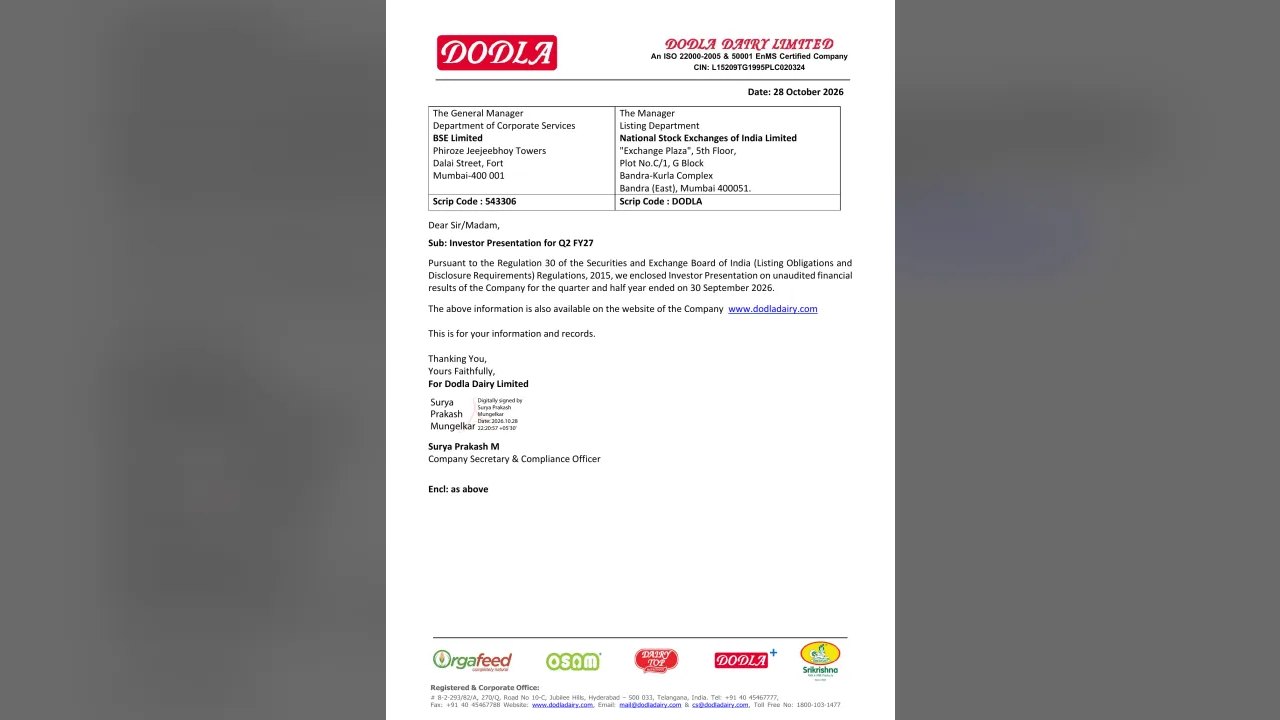
On 6ix: 6ix.com/event/dodla-dairy-limited-dodla-q2-2027-earnings-call
Automated transcript · Written by software from the replay's audio. It can mishear names and figures; the replay is the record.
0:00 Ladies and gentlemen, good day, and welcome to Dodla Dairy Limited Q2 FY 'twenty seven Earnings Conference Call. This conference call may contain forward looking statements about the company, which are based on the beliefs, opinions, and expectations of the company as on date of this call. These statements are not the guarantees of future performance and involve risks and uncertainties that are difficult to predict. As a reminder, all participant lines will be in the listen only mode, and there will be an opportunity for you to ask questions after the presentation concludes. Please note that this conference is being recorded.
0:47 I now hand the conference over to Mr. Dodla Suneel Reddy, Managing Director. Thank you, and over to you, sir. Thank you very much. Good morning to all the participants. On behalf of Dodla Dairy Limited, I extend a warm welcome to everyone joining us today on our call. I would also like to take this opportunity to wish everyone a very happy and prosperous Diwali. On this call, I'm joined by our CEO, Mr. D. V. K. Reddy CFO, Mr. Mudhimaan Raju and SGA, our Investor Relations Advisers. I hope everyone had an opportunity to go through the financial results and investor presentations, which have been uploaded on the stock exchange on our company website. Coming to our performance during Q2 FY twenty twenty seven, we reported a revenue of INR1196 crores, registering a healthy year on year growth of 17.4%.
1:39 EBITDA impact for the quarter stood at INR64 crores and INR37 crores, respectively. The performance was a combination of volume growth as well as some improvement in the realization, which is supported by a price increase of INR2.5 per liter implemented during the back end of the second quarter. Full impact of the price increase is expected to be visible in the next quarter. However, the milk procurement price increase also remain elevated, keeping the profitability under pressure. Additionally, the margins are compressed due to the inflationary environment in terms of logistics costs, packaging costs and other overheads. Despite a challenging and uncertain operating environment, Dodla achieved healthy revenue growth, demonstrating strong market presence, superior product quality, farmer relation and execution expertise.
2:28 The raw material supply stayed healthy during the quarter as we strategically built adequate inventory to cater to the demand in the upcoming quarters. Coming to our value added portfolio, the revenue from this category grew 11.7% on a year on year basis. However, the demand for the higher margin summer related products such as bread, butter milk, flavored milk, ice cream, etcetera, remains softer as compared to the previous quarters due to seasonality factor. We are focused on strengthening our existing VAC portfolio and expanding to well established categories like paneer and ghee where the demand is stable throughout the year, and there is potential to build scale over time. Moving on to Africa business. It delivered a strong quarter with a record of INR179 crores, representing a year on year growth of 56%.
3:17 We continue to focus on strengthening our presence across Uganda and Kenya. The planned greenfield expansion in Uganda is expected to support growing demand and provide additional capacity for future growth. In Kenya, our focus remains on increased market penetration and strengthening our own procurement network. I would also like to inform you that the Board has approved a proposal to establish a joint venture in India with Metals India Holdings Limited, with Dodla Dairy and Metals India Holdings Limited having an equity stake of 4060%, respectively. The proposed joint venture will focus on marketing and selling high quality dairy ingredients to the B2B market. The proposal is subject to execution of the joint venture agreement, completion of the requisite formalities in the receipt of applicable regulatory and statutory approvals.
4:06 If again, we will keep you informed about any future material development in the regard. Going forward, the operational environment remains dynamic as elevated raw milk prices and inflationary pressure arising from geopolitical uncertainties continuing to pose challenges. We remain focused on strengthening our procurement and distribution capacities capability, sorry, driving operational efficiencies, expanding our value added portfolio and executing our planned expansion initiatives, which are progressing as planned. With a disciplined approach towards product quality, cost management, capital allocation, we remain committed to strengthening our market position and deliver long term profitable growth. With this brief, I will now hand it over to the CEO of our company, Mr. D. V.
4:54 Keralik. Thank you very much. Thank you, Mr. Sunil Reddy, and happy Diwali to everyone. I will now walk you through the quarter performance highlights of our business. Starting with our Indian operations. The overall milk supply situation began to improve during the quarter, supporting to recovery in our milk procurement volumes for Q2 FY twenty twenty seven. The milk procurement stood at 21.3 lakh liters per day, registering year on year growth of 9.3%. Average milk procurement costs increased 43.2 per liter in Q2 FY 'twenty seven compared to with INR 41 per liter in previous quarter and INR 37.3 per liter in Q2 of FY 'twenty six.
5:43 In response to the rising procurement cost, we implemented the price increase of approximately 2.5 per liter. Consequently, our average mix sales region improved to 61.9 per liter in Q2 FY 'twenty seven compared with 59.4 per liter in the previous quarter and 57.3 per liter in the corresponding quarter of last year. However, the increase in selling price was not sufficient, fully offset the impact of the higher mill procurement cost. And profitability therefore remained under pressure during the quarter. To put this into perspective, the spread between the mill sales relation, procurement cost narrowed to INR 18.7 per liter in Q2 FY 'twenty seven compared with total increase per liter in Q2 of FY 'twenty six.
6:35 In addition, operating costs remained elevated primarily due to input cost inflation and shift in product mix from bulk sales towards milk value added products, P and P, cost related transportation, pre l packaging minimum wages and other overheads continue to remain higher than the normal level. Going forward, we intend to gradually pass on the portion of these costs to increase the consumers over the next coming months. Our pricing strategy remains aligned with the broader industry trends, where high single digit price hikes have been taken by the regional cooperatives. We will continue to maintain a balanced approach to consumer affordability and profitability. Coming to Wassam.
7:22 Wassam Dairy, the business delivered healthy revenue growth and during the quarter and supported by strong sales volume. Although the profitability remained muted due to elevated raw material costs, witnessing a similar trends as our domestic dairy business. Speaking about our Argo Food business, it has continued to deliver a strong growth with the revenue increasing 40% on year on year. In Q2 FY 'twenty seven, our margins were impacted by higher raw material cost, which could not be fully passed on to the farmers. We are also exploring opportunity to expand our fleet business in Maharashtra once our new integrated facility becomes operational. Our Africa business delivered very strong revenue growth of 56% on year on year, largely driven by a 68.5% increase in milk sales. As Mr. Sunil Ripi mentioned earlier, in Kenya, we continue to focus on gaining market share, growth strategic pricing while simultaneously strengthening our market presence and procurement network.
8:29 These targeted efforts are supporting our growth momentum and positioning the business for future expansion. So now coming to the product sales mix. Our mill sales volume stood at 14.2 lakh liters per day, raising year on year growth of 8.4%. During the quarter, our lab sales increased to INR $3.27 crores from INR 292.8 crores of Q2 FY 'twenty six. While the current and current listed products recorded high volume growth of 23% year on year, reaching 444.7 metric tons per day. Demand for our consumer oriented products across the border, lab portfolio moderated during the quarter due to seasonal factors as Q2 coincides with the monsoon season.
9:24 Looking ahead, with milk availability improving and festive season approaching, we expect demand for the certain wrap categories, particularly sweets, d and other festive imported products to benefit. We remain focused on capitalizing on these opportunities while maintaining the cost discipline and the optimal pricing strategy. Further, as our new facilities in Maharashtra and Uvenda become operational, we expect them to be accelerate our growth and contribute to a stronger, more profitable performance in the years ahead. Now I would request our CFO, Mr. Murali Mohan Naju to share the financial highlights for the quarter. Thank you. Thank you, Mr. B. V. Karendi, and a very good morning to all the participants on the call.
10:12 I wish everyone a happy and prosperous Diwali. Talking about consolidated financial performance in Q2 FY twenty twenty seven, revenue from operations stood at $11.96 crore, reflecting a year on year growth of 17.4%. Gross profit for the quarter amounted to INR275.7 crores with a gross margin of 23.1%. Employee expenses increased to INR55 crores in Q2 FY twenty twenty seven from INR 49.9 crore in the corresponding quarter last year. Register India year on year increase of 10.1%, mainly due to people addition for workers as well as labor costs. Subsequently, the employee cost remained in line.
11:00 Other expenses for the quarter stood at INR156.6 crores and again is INR139.3 crores in the corresponding quarter last year. Although other expenses remained broadly stable as a percentage of revenue, the increase in absolute terms was mainly attributable to higher overhead costs per liter due to inflation and geopolitical situation. In addition, Taki metal cost rose 41.6% year on year for the quarter owing to macro factors and changing product mix. EBITDA for the quarter stood at 64.1 crore translating into an EBITDA margin of 5.4%. Depreciation expense for Q2 FY twenty twenty seven increased to INR23.6 crores compared to INR20.6 crores in the corresponding quarter of the previous year. Other income for the quarter amounted to INR10.9 crore.
11:58 Net profit for the quarter stood at INR36.6 crore with a net profit margin of 3.1%. Now moving on to our H1 FY twenty twenty seven performance. Revenue from operations grew by 18.2% year on year to INR 2,394 crores compared to INR 2,025.7 crore in the corresponding period last year. Gross profit stood at INR $5.54 crore with a gross profit margin of 23.1. EBITDA stood at INR 129 crore, while profit after tax stood at INR 77.2 crores, translating into a hard margin of 3.2%. In H1 FY twenty twenty seven, we recorded a deferred tax charge of INR 5.77 crore, which includes INR 4.6 crore in CDDLA, that is the first time deferred tax liability designation and INR 1.17 crore in HR4 due to a tax rate change.
13:00 During the period, we incurred capital expenditure of INR66 crores, primarily towards our Maharashtra expansion project. As of September 2026, we maintained a healthy cash and bank balance of INR659.4 crores, which is sufficient for our future CapEx requirement. In H1 FY 'twenty seven, we are able to build up inventory of INR76 crores, which includes SAP and better for our future requirement. As of September 2026, our inventory stood at $2.32 crores. With this, we conclude the presentation and open the floor for further discussion. Thank you very much, sir. We will now begin the question and answer session.
13:59 Call. The first question is from the line of Abhishek Mathur from Systematics.
14:53 Sir, I've noticed that our gross margin trend for the past three quarters has been quite firm. Gross margins have stayed in that range of 23% or so despite the high raw material inflation that we've seen. In that context, the question was that what is now our outlook on the milk procurement cost? What is the trend that we are seeing in October and for the next one to two months? And with our gross margin maintenance background in mind, what would be the pricing approach here? Can we assume that we will take price hikes equivalent to the sequential increase in mill procurement costs in the near term. Just wanted some clarity on that. Morning, Abhishek. Thank you very much for joining the call.
15:42 Procurement, we assume will remain at the same elevated levels and we don't see the procurement prices dipping down in the coming quarters or even the next quarter. What has happened is we were waiting for other price increases to happen, for example, like the Karnataka state government announcement of INR 8 price, which did happen on the ground. Therefore, we took our price increase calls a little later in the second quarter, which is mostly in the September, which the effect of improvement is showing in the future quarters going forward. Subject to that, if there is even further price increases done by the cooperative after the price increase that we have taken, we will also increase our prices commensurately. So I think the next quarter that we're looking at, at the current price increase levels that we have done itself, we should come back to a 7.58% kind of an EBITDA level. If the cooperators take a significantly larger price increase as announced but not yet implemented, we will be able to take a further price increase to improve our profitability further. With this, I think we have put behind the bad quarters and we are assuming our quarters going forward will be improved.
16:43 Got it. So just a quick follow-up here. Again on the mid procurement cost, so we have seen a 5% sort of sequential inflation in the procurement cost in 2Q. If I can just probe a bit here in October, what is the sequential inflation that you're seeing now building? Just wanted to check that. So as well, we are not building inflation in procurement because we are assuming that this is reached its peak. There might be a slight difference of twenty thirty five depending on the locations of where we are procuring and the mix variation coming into place. But other than that, we don't see an immediate price increase happening further in the coming quarters in procurement. Understood. So that's good to hear. And then so then fair to assume that if the procurement cost stays where it is sequentially going forward, let's say, for the next few months, we will not require to take any incremental pricing, is that understanding correct?
17:34 The status quo again, yes, we won't take the price increase. Whatever we have taken in September, that implications will come throughout for the full quarters. But if there is further increases done by the cooperatives as announced by them, we will also react accordingly and increase further prices of sales prices. Very clear, sir. And the 7% to 8% guidance that you gave is for what period, For the next quarter that is coming in as October, November, December quarter is the guidance that we are giving. And I hope unless there is some other major changes that should continue for the future quarters also. Very clear, Secondly, just some bookkeeping questions, you can disclose the overall realizations for the quarter, CONSOL overall realization, CONSOL VAP realization and the stand alone and Africa realizations.
18:22 So the realizations we will give you including product, Mudli will give you including the product and everything as console and the breakup between Africa and India. Am I right in asking that that's what you wanted? Yes, sir. The consolidated and everything included here. Yes. Okay. The consolidated for the quarter is 65.06%. Last year, it is 62.53%. So that is the control. For the India, it is 63.59 and last year the same quarter it is 63.07. Overseas for the current quarter 73.14, last quarter the same year previous year it is 60.11. And the difference in India quarter is because we had bulk ghee sale, which was there, which was not there this quarter. That is the reason you will not find much of a difference in the India overall number.
19:16 HR had HR Foods were tracking separately. It is sixty seven point zero five and sixty three point three six. Right. And for the value added products, the realization sir, consolidation for value added? Consol realization for the 66.46. Great, sir. And finally, sir, the Awesome sales have not been disclosed or the VAP sales have been disclosed, but if you can help with the sales for the quarter for Awesome. Yes. So the sales growth for the quarter of Ausum has been around, I think, 141.43 lakh liters. We have not seen any significant increase in volume there. That is the reason is because even in BR, our procurement prices have gone up significantly, we have passed it on. But to keep the margins, otherwise, if I increase my sales a lot more now, my margins will come under pressure. So we are holding back on that till we get our procurement own procurement improvement happening there, and then we will again start pushing from a market. Right now, there is a reason we are maintaining our status quo. But I think in this quarter, again, the festivities coming in where the East Of India has a surge in products during the festivities that will help us improve our margins and also our volume.
20:33 But we will take a call more appropriately to start pushing the market further once our procurement prices stabilize. Sir, meant a rupee sales for Awesome, if you can give. So, sir, 1.33 lakh is the NPV and the total revenue is for the quarter is INR 82.37 crore. Great, sir. Thanks and all the best. That's it from me. Thank you. The next question is from the line of Nikhil Upadhyay from Simple. Please go ahead. Yes. Hello. Good morning. Am I audible? Yes, Vikram. Go ahead. Yeah. I have one question on the procurement prices. See, you mentioned in the call just to the previous participant that the procurement prices may not go up from where we are other than that $20.30.
21:28 But, generally, in q four, we see when the season dries up and the supplies get difficult, the procurement prices do, again, see an inflationary pressure. Would that scenario be very different this year?
21:44 Or is it like a lot of it has already been like front loaded and you don't see that scenario playing out? B. D. I'll answer the question regarding the Q1. See, this is a front loaded already in the first, second quarter. So this is unusual in earlier years, two prices used to come down quarter two and quarter three and quarter two quarter four used to go Now this year, see quarter one and quarter two already prices have gone up quarter two also substantially. We don't see any price hike. We don't see as of now Q3 and Q4 coming quarters, there is any price hike.
22:23 But sir, there is there are two ways to look at it then. One is the reason why Q1, Q2 prices have gone up because the availability has been constrained. And considering the kind of rainfall and the environment we are seeing, won't it get further constrained in q four, which generally is the same... The pattern every year? Yes, sir. It's more or less because already, like you're saying from a price point of view, it's built up. And also what's happening is like we had earlier informed like our inventory levels are building up. Everybody now is able to get their little surpluses and the inventories are also building up. So when I have enough of volume and the inventory buildup takes place, that is a sign that the volumes have come into place. So the question of, I think, like we said earlier, the production is also changing where we are not seeing significant drops like we used to see earlier in the Q4s.
23:17 In fact, the LEAP volumes are maintaining a steady state. So that is the reason we think prices have already been front loaded. My opinion, the farming
23:25 variabilities are coming down. So therefore, we will not see further increases because there won't be a steep drop also. So then the price increase, just last point here, then the price increase which we have seen in Q1 and Q2, is it more driven beyond the supply issues like because what we understand theoretically is like, the prices increase when the supplies dry up
23:51 or the supply is constrained. But as you are saying, there is supply. People are building inventory, but still the pricing has gone up in q one, q two. So are there other factors than the pure demand supply?
24:05 Yes. But there is demand supply plays a role, but also the actual cost of the inputs also plays a role. There has been a significant cost increase even from the pharma level in terms of wheat and water. If that does not happen and we don't give a remunerative price, which will not help him also, then we'll lose in the long run. So it's not us, but the industry as a whole has also increased the prices, keeping into consideration the other input cost increase to the pharma side also.
24:30 Okay, fine. And lastly, on the VAT side, if we look at the can you talk about how the business other than curd, which are like categories like paneer or categories which sell throughout the year, how is our performance improving on those other than the seasonal categories?
24:53 So our categories in terms of paneer has improved significantly, for example, in terms of volume and also our other products like flavored milk and others have also improved. For example, paneer has improved by 64%, if I take it as a volume, although the volume is smaller, it is roughly it has improved by 2.5 tonnes per day for us in terms of increase in volume. And if you take products like Lasi, they have grown up to be almost double, almost 163%, again, with the volume of now around
25:22 differences being around 15,000 liters or so. So and ice cream has also grown as a volume for us. So all the other volumes have also considerably grown, but it is not showing there is a significant uptake because the previous year we have taken our bulk sale of ghee into the VAP and that was there as a large number. That is the reason why it is not showing a significant increase in overall VAP, but each product other than that has increased significantly. Sure. I'll come back in the queue. Thanks.
25:59 The next question is from the line of from Maximal Capital.
26:11 So just one question. If you can give us some color on the card realizations. I mean, what kind of gross margin that we own in card, you know, product? And any price action that we have taken in the last few quarters? You can give us some Y o Y and Q o Q. Yes. Mubhi will give you the specifics. We have taken some price increases in Kurd also. Go ahead, Mubhi. The Kurd realization per liter, now we are at 59.15. And again, last year, it is a 56.16. That is a realization. But profits are in the range of 12% now. Yes.
26:52 EBITDA only 12%. So EBITDA, you're saying 12%?
26:57 Yes. EBITDA is at 12%. The gross margin is at 19% for the quarter, is that correct?
27:04 And, Kodi, sir, like within our BAB portfolio, like adjusting for the seasonality, it will be 60% to 70% of our BAB, right? Yes.
27:16 Butter milk and lastly, we'll have a higher margin. Those are about 20%, between 20% to 23%, we have a margin for the buttermilk and the Understood, sir. Thank you.
27:31 Thank you. The next question is from the line of Yash from Avrigha Capital Advisors, LLP. Please go ahead. Hi, sir. Thank you for taking my question. Can you talk about the JV which you announced for selling high quality b to b daily investments?
27:49 Will it be milk or more like cheese wrap?
27:52 And how will it help your consumer facing business?
27:57 So this is JV that we have done. Basically, Meadows is a U. K.-based entity, which is of the similar size that we have. And we are just trying to explore the probability of how do we get into B2B ingredient space, not necessarily the B2C phasing. As we'll be overall expanding our volumes of milk significantly in the years to come, we assume that we will have a balancing factor with the B2B that we will be able to sell at a higher realization in terms of ingredients. So it's just an exploratory JV that we are doing from both
28:29 the sites. This is a small venture where we are investing INR 1 crore and for our 40% that they'll be investing the remaining for the venture where we will look at it in the long term as supply agreements versus them being our front end of marketing, and we'll see how do we take it forward. They are also the global ingredient suppliers for all the large entities. So I think in the long term, we're just looking at it and seeing how these entities will be able to merge to help each other in terms of expanding our horizons beyond just the milk and B2C milk, but also into the value added ingredient space.
29:03 So if I got it right, it will just be milk or it will be value added products like cheese and paneer as well for them, which will help your scale?
29:12 No. No. It's not going be cheese and paneer, sir. It will be other things like if you take it as, you know, there are these mixes that they make in terms of what goes as inclusions into ice cream taking. It goes as some kind of a sweetener, like, for example, the caramels that you eat, how do we make those caramels that go into other products. So it won't be a consumer selling product. It will be ingredients that are used by the consumer selling terms.
29:37 Okay. And so next question would be, is your Maharashtra plant online? Because I checked measures which you put in the presentation. It doesn't seem like it will be commissioning by end of FY twenty seven. No, it will go ahead. So March will be March to April, we'll start our the equipment cooperations will start. And by September, we will September to I think we'll start our powder operations. Okay. Thank you. I'll get back in the queue.
30:14 You. In The next question is from the line of Ujjar Sawant from Oclane Capital.
30:31 Sir, just continuing with the previous participant's question on the JV that we have recently signed. If I got correct, we are investing INR 1 crore for 40% is what you mentioned? Correct. So this is basically like we're doing it as an exploratory
30:47 JV that both of us are going to look at it and see what ingredients will be created and how to take it forward in the years to come. Understood, sir. And sir, when we talk about high quality ingredients, so what type of ingredients are this? Are we currently making these, or is it something like a skim milk powder? Or how... Exactly if you can elaborate, you know, what type of ingredients are this when we talk about high? We will start with the basic ingredients, like you said, skim milk powder, but it will be only like low heat, high heat, where it will be specifically tailor made for certain requirements or certain products that certain people need. But later it does progress into other inclusions that come into the food industry per se. So that is the reason it's a very small start that we are going to do research of which ingredients, what is possible, what is not possible. And therefore, we will take it forward there. So
31:38 keeping that in view, we're just announcing it because we will be entering into the JV to start exploring the process going forward. Clear, sir. And sir, a similar initiative that we have already taken is in the 2% stake that we've taken in fixed form. So sir, how has been the development there? Like how has been our learning there? And do we see like a potential increase in stake in the recent times in zero marking as an entry into high value added products through Sid's firm?
32:10 So I think it's very early for us. It's hardly been nothing because right on the agreement that we have signed. It was only a month ago, although we had earlier we have talked about it and the paper was done. Like we said, it's a very small investment for us. We keep looking at it and seeing because they are exactly what we have not. We will learn from them as to see where it is going. And in the future, as things progress, we will have to take a call as it when it happens. Understood, sir. Sir, and one last question on so if you can just give up what were our margins for the OSRAM business for this quarter? The OSRAM business in terms of for the quarter of second quarter has been one minute. I'll give you the exact number. Margins are for this quarter, EBITDA margins are 1% this year this quarter.
32:59 Last quarter, we had a 2.6%. It was reduced due to the milk prices increasing, we are now very aggressively going and we are more focusing on stabilizing the operation rather than
33:11 focusing on the EBITDA. Once we stabilize, then we can able to increase the margins. Understood, sir. And if I got it correct, is it 7% to 8% margins that we're expecting in second half is what we mentioned? Overall, so that is India, that's what we're operating is what we're looking at those kinds of margins, not OSA, but consolidated also, we will look at it to be maintaining at those levels. Yes, sir. That's it from my end. Thank you so much for your answers. Thank you. Thank you. The next question is from the line of Ritesh Shah from Investec. Please go ahead.
33:50 Hi, Thanks for the opportunity. Sir, just two questions. One is on procurement volumes. Would it be possible for you to dissect it by state? One minute we'll just state by state in terms of India side of procurement volumes, right? No, sir. Yes, I'll just give it to you one minute. So the procurement volumes, AP we have done 4.76 and Karnataka is 5.1 lakh, Maharashtra 2.99 crores, Tamil Nadu 2, 4.25 crores and Telugu order of 45,000 crores.
34:27 Correct. And sir, just a related question, what will be the volume weighted distance? Volume, come again with the question? Sir, volume weighted distance. So basically, when we procure the mill, what will be the weighted average distance, basically, if we do a sum product on volume to distance?
34:48 From where sir? From chilling center to plant or farmer to chilling center? Sir, both basically. Both included. I think I don't have a specific number right now, We'll get it back to you and later offline. But roughly, look at procurement, which we have multiple operations. If it is a chilling center, we will have around 40, 45 kilometer kind of a radius. If it comes down to bulk cooler, the radiuses will come down and village level chilling will be absolutely at the village level itself. From the chilling centercooling air cooled milk into the plant, if you look at it, it will be anywhere between 300 to 400 kilometer radius for the plants to be able to pick up them. As a specific setting, we'll work out on it and get back to you,
35:30 Sure. Sir, second, I just wanted to understand on the comfort on procurement volumes given rot in a few states and given the El Nino impact, does it have yield on the cows with respect to
35:46 how much milk did they give? Like how should we look at these two variables?
35:52 See, immuno effect is more in actually Maharashtra compared to Karnataka, there is no much impact. Karnataka, we have a very good growth in procurement and also E. C. Also not very much impacted as we really know. A slight impact is there in Tamil Nadu and Maharashtra.
36:13 Okay. And sir, just last question, are we looking at further cost inflation with respect to the feed that we sell? Or I think we call it concentrate, right, on what we sell to the farmers?
36:28 Yes. The price increase will get inflation a little more going ahead because I think it is not only going to be for us, but for the industry as a whole because of ethanol coming into play, compressed biogas coming into play. I think we have to wait and watch how the government policies will come into action because of the amount of the maize being the basic crop they use the poultry and dairy for their concentrate feed is also the one that is being fed into ethanol. So we'll have to take a call as and when it ever happens.
36:56 Sir, would it be possible for you to quantify rupees per kg for Q1 and Q2? Yes. Sure. So basically, there is an increase of 3.3 for
37:09 the sales relation last year quarter to this quarter, whereas the procurement price, the blended price was increased by INR 4.84, okay? But when you talk about the last quarter, it is INR 129% increase, whereas the procurement cost was increased by INR 2.93. Basically a lag once the procurement prices go up into raw material, there is a lag before we pass it on to the farmer. But there also it's the same that we keep passing it on to the farmer. Right. So so just a follow-up. Just to understand, you indicated a lag from procurement to... When we pass it on to the pharma. But, again, when we look at it from the economics of the pharma, they also see certain cost escalation, and hence, they would also demand a higher price.
37:55 So when we earlier indicated that we don't see procurement prices to go up much, does it take into account this particular variable as well? It's a minor variable if you look at it because it's a multiple factors of fodder also availability, feed availability and the volume of milk that the farmer is producing for animal. Concentrate will form, let's say, 30% to 40% or 50% of his overall
38:20 cost that he feeds the concentrate capital and if it goes up by rupee or rupee and 0.5 on a per liter basis, it doesn't show significant variation unless it moves up by 5 or INR 7 per kg kind of an impact that you look at it. Because the rationing comes in that we use concentrate only to balance the protein requirement of the animal, whereas the fiber and energy comes from the other sources. Part of the energy also comes from concentrates. So in the farmer, when we look at the overall requirement, the concentrate feed element doesn't have significant overall as much as it is paid by fodder and productivity based on the climatic conditions. Perfect. Sir, this is very useful. Thank you so much for the answers. All of it, guys. Thank you. Ladies and gentlemen, in order to ensure that the management is able to address questions from all the participant in the conference, please limit your questions to two per participant.
39:14 Should you have follow-up questions, please rejoin the queue. The next question is from the line of Suresh Pardeshi from Motilal Oswal.
39:25 Sunil and team, thank you for the opportunity. Just quick question on OSAM. Can you share what are the things which we have solved and what are the things we have to solve before OSAM really takes off? And maybe some color of competition, how the competition is behaving specifically in the area of OSAM geography? Yes. I'll answer your questions. First of all, Husam we acquired a year back, now just one year we completed. In Chile, we have done lot of modifications in the plant. See, there were so many things, automatic CAP system, proper equipment, proper layout, all that it took six to seven, eight months, once we identified the shortcomings and then we bought out all the equipment and replaced and corrected.
40:16 And a lot of corrections have been done in the plant and in the operation side, number one. Number two, on the procurement side also, slowly we are going with Dodla model. There see we are there, it is a agent model. Total collection is a agent model. So where we have in Dodla is a direct farmer payment model. So that we have already done 25% to 30% that more and balance we are expecting by March. So at least 70%, 80% of that procurement model also will bring it to development. So that is the major changes what we are bringing, number two. Number three, the market, see the major market holder is by Suda, both in Jharkhand as well as Bihar. So Jharkhand though they made a different name called Suda since from Bihar when they separated Jarkhand state. So Suda still Suda also is there in Jarkhand and also they have created one more cooperative, separate cooperative for Jarkhand is a Neva. And apart from that,
41:13 see the ITC also is there since five, six years onwards. And recently a couple of years back, Amur also entered. And there are also some one or two UP brands also invented, Gya and AD, number three, Lia. But since now slightly it is now coming here competition, so compared to last five years. But overall market is there, but still there is a good scope for the VAP. So maybe it will take a little time to catch that market. That's helpful. I'm just trying to compare because ITC has also been there and Amul is now getting into. It's a little hard and sticky market to my understanding. So obviously, the traditional players and you have been dealing with the corporate is across all other states also, which are larger, for example, than the the end of the trade.
42:03 So I think what I understand, you definitely have some understanding of this competition. But then what are the things which we can see actually a scale up which can happen in this business?
42:14 I I I suspect whether is giving you a kind of competition. There is a different league and price point. So if you really need to develop a value add portfolio, if the market is ripe or we'll... You will do the seeding and maybe over a period of time, we can expect the. Yeah. See, first of all, Sudha and Medha, Medha of course it is a very recent one. But Sudha and all, usual, a very lazy cooperative, they are not very active. So that's why see that other people are now occupying the market and they're taking the market share. So their payment cycles are not up to the mark. So there is a lot of issues as far as Sudha is concerned. Almost 70% of the market share is Sudha. But Sudha is not very active. As usual, the payment running late by one or two months, there are lot of market complaints, so many things are there.
43:07 So definitely, we will have advantage, especially see VR market, the very good market actually compared with Japan. There is a big scope. And also sir, it's going to be GDP driven. BR GDP was always lower. As the state is improving and the GDP improves, we will see the shift happening. That is why we always say that we see a significant offtake during festivals for base products like sweets or paneer or other value added products is because of affordability. And as the growth of VR and improvement of VR happens and affordability comes in, you will see a significant growth in the value added profile because the consumption pattern there has a lot of the value added as a part of the daily diet. It's only affordability that is holding it back. Sunil, you are bang on. I recently visited and I saw that Yad is really doing well.
43:58 And follow follow to that is Jharkhand. So I think it's a it's a big market. But then, I mean, it's the right strategy, but I'm saying this execution needs to ramp up or really the market dynamics or product profile has to change for us?
44:14 Yes, we are looking at it and changing it, yes. Okay. Okay. Last question on the Africa business and this is related to more of CapEx side. I think in the past you said about INR600 odd crore. Is there any change in CapEx which will happen for India and even Africa? This is not much of change actually in Africa as we said, we acquired 70 acres of land and we have already started greenfield work. So our sales work already commenced in March batch. So that we are targeting by FY twenty twenty eight beginning running the operations. So as far as the operator, we have very good growth. And Kenya also has done very well, actually very good growth market share we have taken from Kenya.
45:04 As far as Assi, even EBITDA level also is very good. As far as other CapEx in Maharashtra, what we are doing, there's not much of increased CapEx what we projected earlier. Yes. So basically, happens is INR600 crores that you are asking as CapEx, we had earlier assumed Africa to be around the INR60 crores, INR70 crores, Africa coming Maharashtra to be INR280 crores and the acquisition of Osam that we did net of cash of what was available in Osam to be around INR600 crores. I think that it might marginally go up by 5% to 10% as we the inflation takes into place and the overall project period, but nothing significant in terms of movement otherwise. So our major CapEx going forward will be completion of Maharashtra and Africa to be implemented. Africa and feed also. And feed, we are looking at it now as we have mentioned as BBJ, but in Maharashtra once a Itkal plant comes to more of production and facility, we might consider looking at another feed operation to cater to the Maharashtra area rather than moving it all the way from Chitur to Maharashtra.
46:10 As is, I think, slowly our cattle feed has also come to six seven thousand tonnes out of installed capacity or utilization available capacity of around eight nine thousand tonnes that we can do. So we are coming closer to the full capacity utilization of our old feed plants. So by the time these are done, we'll get another feed plant also. That is not considered at the moment, which we might take a call in the six months later.
46:32 Thank you and all the best, Sunil. Thank you, sir. Thank you. The next question is from the line of Sandeep Dharamsi from Antra Growth Capital. Please go ahead. Hi, sir. Thank you for the opportunity. Just one question. Dairy sector for obvious reasons has been impacted by weather related challenges for all these years. So the next two, three, five years, do you think is there anything that industry can do differently to make sure that these impact, these weather related challenges impact us slightly lesser than what they do today, maybe some kind of sale development or inventory buildup, I don't know what, but do you think we are thinking in that perspective or is it possible?
47:25 Yes, sir. Basically going forward, I don't think only us but the whole industry per se, we will see that the country will move with the same trajectory like the rest of the world, which was the dairy farming, which was backyard farming, which had more of the impact on weather or feed is slowly moving to organize. So what I mean by that it was backyard farming of one, two animals. And if you look at our own history of those days, the average being two liters per animal kind, it's now moved to eight to 10 liters per animal average lactation period. I think now we are seeing some states taking the lead forward like Punjab or Gujarat or Maharashtra, where the farmers are moving away from the backyard farming and bringing it to a per acre mainstream farming, where it will become more in terms of productivity and efficiency. Once that comes into place, you will find that because the farmers have more control in terms of not have a pan to cool down the animal, the temperatures go up, stocking of feed and water in the form of silage or other practices, we will be able to move forward. I think already we are seeing the impact of artificial insemination coming into play, where sex semen plays a role of having only more female
48:28 animals than having male animals and also improving of the productivity of the breed. So all the companies are also along with the way taking their own respective part in trying to see how best we can associate and help the farmers grow. Some companies are creating their own breeding. We, for example, conduct common health camps, education of farmers and trying to get more farmers to become more in terms of organized structure. With this going, I think the signs are showing, as you can already see that the fluctuations in volume earlier when it used to be in buffalo milk, it used to be around 50%, 60%. Now that has dropped to 25%, 30% and cow has hardly come to a 10% variation in terms of volume. If these continue that means it's showing signs of the farming industry itself becoming more organized rather than being unorganized back half farming.
49:16 Understood. Okay, sir. Thank you so much. The next question is from the line of Nishita from Sapphire Capital. Am I audible? Yes, Nishita, go ahead. Yes. So I just wanted to understand again on our EBITDA margins. So you mentioned that our OSAM margins have fallen this quarter. And you also mentioned that consolidated, we can still do around 7.5% to 8% of EBITDA margins for H2 FY 'twenty seven. So I just wanted to understand how are we going to achieve that margin because since we're not going to focus on EBITDA margins in OSAN, so like isn't the margin going to still be under pressure only because of OSAN?
50:04 See, originally, what we projected, OSRAM is only 4% to 5% EBITDA margin only. See, the main margin, we were expecting only from the main company from Dodla only. So already in third quarter, we have seen that change. So definitely, we will see even some first and second quarter also not performed at the expectation level. But in Dodla also now we are seeing that third and fourth quarter, they also do around 4% to 5% EBITDA. And overall EBITDA of Dodla will be around 7.5% to 8% coming quarters. So I'll also add here, Manishita, is the basic thing is when you look at OSAM can be a revenue of $2.50 crores or 300 crores. The 4% on INR 300 crores is around INR 12 crores. And even if we do 2% or 3%, we will make up the absolute difference of OSRAM pulling down the overall EBITDA is very small and the absolute number of INR 3 crores, 4 crores difference only.
50:56 Whereas the India side of the operation is substantially larger, maybe we'll add another INR 1,000 INR 1,000 crores to INR the next large year, India will be adding more than INR 1,300 crores to 1,400 crores of revenue. And that is where we are seeing the improvement coming and therefore because of the price increase, which will therefore bring it to INR 7.5 crores. So OSAMA ROAD won't drag it down much. It is the overall India improvement that will take us to be at a higher level. Okay. So we can expect India revenue to be around INR 1,300 crores, INR 1,400 crores for H2 for 2021, is that right? Basically, current year, we have come around INR 900 crores 1,000 crores. So maybe depending on seasonality of summer is coming earlier or later, we can be between INR 1,100 to INR 1,200 anywhere in that range. But we are talking about our India operations. Overall operations is around INR 1,200 crores. So we'll We'll again doubling of that then India total operation. We have now including Africa, OSAM and feed put together, it is roughly about INR500 crores half yearly. So INR330 crores operation business, Africa business, INR173 crores from OSAM and INR100 crores closed from our field.
52:09 So it is coming close to INR600 crores. Out of INR2391 crores, close to INR2400 crores minus INR600 crores is around INR1800 crores we have done only India Dodla. So in coming quarter also, are going to do a similar number. Okay. Okay. Understood. Yes, that is it. You so much. The next question is from the line of Siddharth from CWC.
53:02 Few questions. Did the buttermilk, KFC and paneer volume increase come with similar gross margins as earlier? I mean, were you able to pass on the price increase, the cost increase to consumers? Okay. So the impact really comes in terms of not being able to fully pass on only in milk. Milk products you are able to pass on the cost increase to customers. Is that a fair way of understanding? And also certain amount of it, we do not pass on on third also. We wait for some time to pass on. It is basically the question of the time lag. So when the prices increase, they are passed on much later in terms of a month or two because of, again, waiting to see how the prices will react and waiting to see when they stabilize for us to pass on is where the delay happens in terms of profitability getting impacted.
54:12 So for example, when the procurement prices went up in April and May, the impact of that increase is only coming in terms of June is when we pass on. Similarly, when it happened in the second quarter, we were anticipating procurement to come down and it didn't come down. Our effective price increases happened in September. So we got into a little bit of that first quarter, second quarter impact of three, four months, which is showing the overall profitability being lower. But once we have passed it on, like we were saying the coming quarters, you'll see the improvement in profitability going back to normal. Got it. So but on outside of that lag, is it fair to understand that structurally you're able to pass on the cost increase for milk products? But for milk and curd, you may not always be able to pass on the cost increase completely to the customer.
55:01 Is that We will not pass on immediately, but over a period of time, it will be passed on to the customers. Instantly, we will not pass it on. We'll wait and see because if there is a correction that we were happening as if the procurement prices come down, then we don't want to bring it down. So we wait for a while and they do. But average, it will be passed on. Got it. And what is the trend that you're seeing in the procurement challenge between cow and buffalo milk supply, especially in Maharashtra and AP, which are decent buffalo salients. Are you seeing buffalo milk being a bigger challenge or cow or is it both? See, overall, this year on year, it is going down because there's a big demand for the buffalo meat.
55:49 And also, see, it is not viable for the farmer to raise the buffalo. So because these are huge variation between plus season to summer season. So because of that variation, so farmer is preferring only a cow. That's why year on year cow milk entire India cow milk portion is going up. Even if it is in Andhra Pradesh also earlier predominantly in a coastal area, it is a buffalo milk. Even Maharasht also some portion of buffalo milk. But buffalo milk slowly see the year on year diminishing. Cow milk ratio only is going up. Sure. But this year, did you see buffalo milk fall more sharply than cow milk? Because and I'll tell you where I'm coming from, right? We have seen fat shortages in in, you know, the market at a different level, and that's I'm sorry to interrupt you, sir. If you have follow-up questions, please rejoin the queue.
56:50 Sure. It's it's just a clarification on this, but happy to rejoin it. Yes. Sudhak, you can also reach out to me or anybody directly, so that will will give you the answer. You can get the number from ACM to reach out. Thank you. Thank you. Thank you. The next question is from the line of from HDFC Mutual Fund. Please go ahead. Thank you for the opportunity. So this INR $3.27 crore of VAT sales we had, what is the split between various categories? One minute, sir. The revenue of INR $3.27 crore, so it basically is the five eighty. Which quarter are you talking about? So you talking about the quarter of the India
57:42 sales. Only India sales, right? Is basically the core yogurt, recipe and butter will call the classified as a card product, which is around INR $2.51 crores and the ice cream is INR 11 crores, flavor milk is INR 13 crores, padi is INR 21 crores, sweet tea is INR 6.6 crores and ghee and butter is around INR 22.7 crores. So that should be INR33 crore. And sir, the share of that will by and large will remain the same at like around 30% on medium term basis?
58:18 So normally, we keep saying that we will grow by 1%, 2%, sir, because it depends also on which one you grow. For example, it's a difficult revenue will grow up by two three percent because, for example, if I sell more of Pani, the six liters being sold in the form of one kg. So from a revenue person, it will be a little higher, maybe 2%, 3% in terms of revenue. But from a volume perspective, it cannot be apple to apple because some of them are in liters, some of them are in kgs of solid. If we add ghee to it, it will go substantially larger and it can reach up to 40%. Actually, we have grown in VAP compared to last year this year by 1.5. But last year, there was some key portion. So this year, that key portion is not there. That's why it appears that so the VAP there is no much of variation. But actually VAP we have grown.
59:05 VAP including buttermilk, curd, everything we have grown.
59:11 And sir, last question, this milk procurement price, can we safely say that the INR 62, INR 63 a liter is now a top and going forward, the increase should not be there? And I mean that is one part. And another part is how do you see this aluminum impact on milk availability? Yes. See, now see because in the first and second quarter itself, they have loaded enough in the procurement. We are seeing the availability of milk also now. So last one month, we have seen some rains in the southern part coastal area and also availability also has been improved. We are hoping that this third quarter and fourth quarter there won't be much price hike in the procurement side. It may be it will stand still.
59:57 Okay, Thank you. Thank you. Thank you. That was the last question for today. I now hand the conference over to the management for closing remarks. One minute, ma'am. So I thank everybody for joining our conference, and we're looking forward to meeting you guys up next quarter. Thank you very much, everyone, for joining our conference call. Thank you. On behalf of Dodla Dairy Limited, that concludes this conference. Thank you for joining us, and you may now disconnect your lines.
Follow Dodla Dairy Ltd. into a list and get an email when it puts out news.
Managing Director at Dodla Dairy Limited
CEO at Dodla Dairy Limited
CFO at Dodla Dairy Limited
at Systematics
at Simple
at Oclane Capital
at Investec
at Motilal Oswal
at Antra Growth Capital