Transcript
Automated transcript · Written by software from the replay's audio. It can mishear names and figures; the replay is the record.
0:08 Hello everyone and welcome to Chesapeake Gold's live event today, hosted by 6. I'm pleased to introduce their speaker, Jean-Paul Sosos, Interim CEO of Chesapeake Gold. Today, he will provide a quick overview of the preliminary metallurgical test results at the Lucy project, as well as what we can expect for the next drill program at Lucy. Afterwards, we'll be answering questions. So during the presentation, throughout the presentation, feel free to submit your questions in the bottom right corner in that chat box right there, and the Q&A
0:38 will take place after the presentation. As always, the summit is being recorded and will be available on six.com to watch afterwards. So without further ado, I'll hand things over to you, Jean-Paul, to kick things off. Yeah. Good morning, everyone. And good morning, Kyle. Thank you for attending this, this event this morning. I'm happy to share news on LUCI and the work that we've, we've done over the past few months and work that we're doing going forward. To start off, you know, obviously some of the statements I'll be making today, they're forward looking. And so there's these cautionary notes at the start of the presentation that I would ask that you take the time to read and understand the risks.
1:20 So just to take a step back and just go over what LUCIE is. So we staked LUCIE back 2017, 2018 and acquired some of the claims. And LUCIE has been within our portfolio for several years now. It's located in Sinaloa, Mexico. There's about 500 hectares and it's 5 kilometers away from a paved road. There are pathways and roads on the property that can get us to all of the mineralized corridor so we can continue drilling and exploring on the property. The program that we put out and updated to the market last October is very exciting. You know, our best result was 24 meters of 6 grams.
2:08 And The origin of going there and actually doing the work is we saw a plethora of properties within Chexpeak's portfolio and we've been basically holding onto them. It was the idea of our Paseo Allen to do some exploration on them. We're holding the claims and we're paying to hold them so you might as well do a little exploration. This is one of the ones where we had done a whole bunch of channel sampling. In the bottom left corner, you can see several of those trenches. 83m of 2g Gold in trench 3. We had 4.4g over 40m in trench 10. It was a no-brainer that, this is an exciting prospect. And so last year we went there and we drilled a total of 14 holes in 1700m, but 8 of those holes were targets specifically at Lucy and the Scarn corridor.
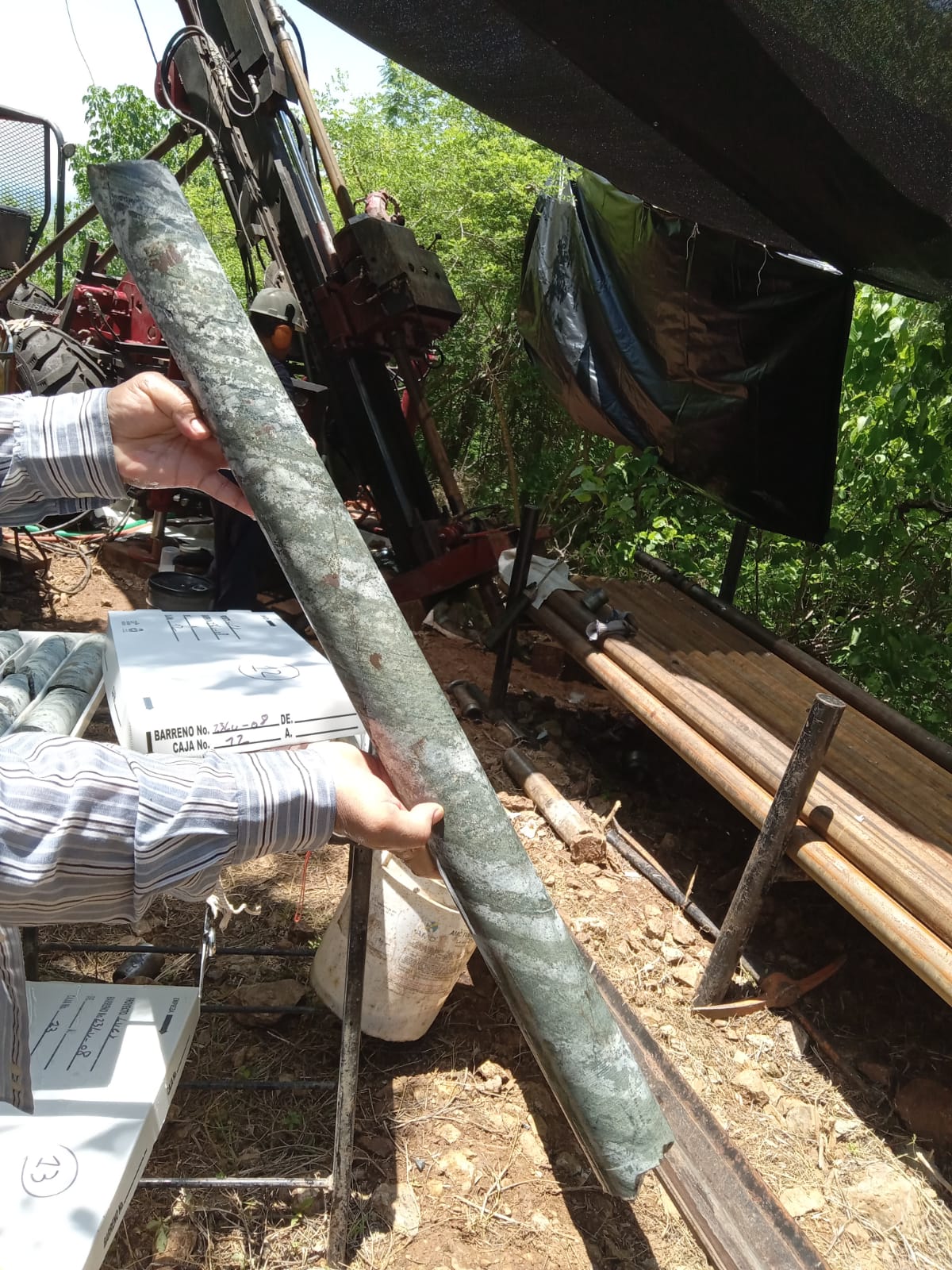
3:06 All the holes that actually drilled, all 8 of them hit mineralization right from surface. Other holes that were of interest is hole 10, we had 21 meters of about 2 grams, and then hole 13, which was 24 meters of about 4 grams. And those are holes across 500 meters of strike length on this corridor, showing that there's good mineralization incepts, not only at surface, but across the 500m corridor. Some of the ones that are exciting is in hole 6, we had 3m of 19.4g, and when our geologists looked at it, they saw what looked to be oxide Gold mineralization. The next hole was in the center there.
3:55 This is hole 13, 10.5g. Again, it looked like there was some oxide Gold mineralization in there. And then the final hole definitely right in the center, hole 13, 6g over 3m on this one sample. And so it came to our attention that we should test to see what kind of recoveries we can get on this oxide goals that we're basically visibly seeing. That was the origin of the next step, which we press released earlier this week. We're happy to share with the market that we took 4 composites across the corridor and they have different lithologies, Scarn, Scarn Hornfelds, and they also have different levels of Gold grade in each of the composites.
4:49 And all the composites, we were able to achieve over 91% Gold recoveries. Our best recoveries were 97%. And this is in a standard bottle leach test program. And so everything was ground down to about 70, 80% passing 75 microns and then put into bottles and then cyanide leached over 72 hours. And within that, we achieved maximum recoveries at about 24 hours, which is a good outcome for this program. We actually even ran them a second time to 92 hours, and we ended up getting the same results within 1%. So they're reproducible and it gives us a pathway to Goldore that is much simpler through either a CIL, CIA plant, or there's even opportunities to, you know, look at other methods as well.
5:51 But this is very exciting, especially given that the grades that we're seeing here are quite high. The last part here is looking at exploration going forward, you know, based on the results from the Phase 1 program and the results of this program here, we're going back to do some more exploration. And Kyle, Can you see the map there I'm holding up?
6:18 Okay. So, you know, we basically shared a whole bunch of drill results in this area here. So far as we know, the gold is still open to the west and also to the east. And then we still also don't know which direction it's heading underground. So it's still open at depth as well. Basically, all we have is 500 meters of strike line. And we've basically touched the surface down to about 25 meters below the surface. So there's a lot of potential still on the property and that's really what the phase 2 program is all about. So the phase 2 program, as I mentioned in the press releases 10 holes and about 900 meters of HQ drilling and we're focusing on 2 aspects. So On the western side here, we have another 3 trenches where we haven't drilled.
7:08 You'll see on the section on my screen there, there's 1 trench, trench 1, 55m of 1.74g. There's a second trench of 15m of 1.78g Gold at surface. And then there was another scarn of 32m of 2.1g, all in this area here that we haven't actually drilled yet. So one of the areas of focus is to drill over in this area and continue to extend the mineralization to the West. The other aspect of the program is trying to determine which direction it heads underground. Within this corridor here, there's at least 2 trenches that we sampled. One was 0.63g of Gold over 50m and the second one was 10m of 1.5g. We're going to go back and we're going to drill under those trenches as well. But in this program, we're going to focus on holes drilled to the south and holes drilled to the north. And why do we do that? So if the mineralization tends to go to north underground, if we're drilling to the south, we'll get an idea of the dip direction and actually where the mineralization heads underground.
8:14 The next section we'll actually drill from the south to the north. And the purpose to see, you know, is the mineralization heading to the south. And we're doing it on individual sections in order to reduce the amount of holes that we're going to miss the mineralization. So within this program, we'll have 10 holes, and at the end of it, we're hoping to have extension of the mineralization to the west, and also an idea of which direction the mineralization is going underground. On top of that program, you'll see that we're going to be doing a whole bunch of mapping. The mapping is going to be focused on the western side where we have limited mapping right now. We're looking at where the mineralization and the scarn continues to the west. Then to the east, we have a soil geochem program with over 250 samples to be taken both on soil and rock to get a better idea of which direction the mineralization goes to the east.
9:07 We're also considering a mag survey on top of that to do across the whole property, but we're still in early stages of figuring out what that would look like. And why are we doing this? So we're doing this, we're doing the exploration, the geochem, the mapping, potentially the geophysics, because, you know, when I worked as a geologist back in the day, every program that I worked on, we started with those 3 things first. All right, we went and we did the actual ground exploration, because those are the 3 cheapest methods available to any geologist to know where the mineralization goes, both on long strike as well as at depth. And so once we have a better idea of where the mineralization goes, then we can do drilling over in areas where we have less information and we can increase the likelihood of continuing to hit good intercepts and to have a better idea of the footprint of this deposit and the strike length of this deposit, as well as where it goes down underground.
10:07 So it's a really structured approach that we're using in order to continue to expand what we already know at LUCI and have a better idea of what this whole deposit will look like in the coming months. The last thing I wanted to chat about is, you know, we were recently added to the NASDAQ metals focused miners index. And I've received several inbounds, you know, why has Chesapeake been added? You know, it's Chesapeake Gold in the name, you know, we're a gold company. But the truth is Metates, our flagship property in Durango, also has 500 million ounces.
10:53 This was a visual put out by Mining Visuals, which highlights a whole bunch of projects globally. Metates is actually ranked number 1 on that. And so the people over at the NASDAQ and the ones that are choosing companies to add to the ETF, you know, they look at not only where silver is being produced at mines and within companies, but they're also looking at the future. Where is the future silver deposits that are important to the global economy and our future? And Metate is ranked number 1 on that list. And so it was a no brainer for us to be added to the list. And it gives us recognition for the work that we're doing and an additional clout with the fact that we are one of the larger deposits out there.
11:45 Okay, The great thing about being added to the index, it puts more eyeballs on our story, gets more people looking at Chesapeake, looking at our technology, looking at Lucy, but it also adds
11:58 additional volume to our stock. Prior to being added, if I look back at January or before we got added, we were trading about 10,000 shares a day on average. Post being added, we're now closer to 30,000 shares. So that's great in the sense that more movement in shares means that more efficient markets, when we put out good news, our share price will move. It also means that there's opportunities for us to access markets and to access equity research and additional sources of getting our news out there because there'll be more people talking about both Metates as a silver repository, but also as a Chesapeake as a company for the future.
12:52 And so that's actually all I have Kyle, I can open up to questions now. Excellent. Excuse me. Thank you, John Paul for the thorough explanation of the drill program that's about to commence here. As a reminder for anyone that came in late, we are asking JP questions here, so please feel free to submit them in the chat. We do have one here from Kevin. With your current results and future drilling, do you feel a PFS is warranted or a PEA? For Lucy, I'd say the first step is the program we're doing now. And the program we're doing now gives us a better idea of where to look next. And so the next program, which would be phase 3, that would be a much larger program where we do a whole bunch of step-out drilling, extension drilling, as well as infill drilling with the purposes of building a resource.
13:51 And that's really the first step that every company takes is building a resource. And then on the back of that, we would look to doing a PEA on it. What's really great about Lucy is that it's very high grade and it's at surface. And so what does that mean? It means that we have a lot of options available to us to build a resource quite quickly. So through drilling, we can end up expanding the resource pretty quickly. And if it ends up, we have several options. If it continues to be very high-grade, there's an option that we could do underground, depending on the shape and the direction of the deposit, or it could be an open pit as well. This is still early days
14:34 and that's actually what's very exciting about this. We don't know how big it is. We don't know what Lucy could potentially be. And so that's what I've been doing in the background here and continuing to work to give us a spotlight on Lucy relative to the global market out there of other discoveries. With this exploration program, you will hopefully figure out how much longer the strike is here? Tim Lee is asking, how far further along strike is the potential at Lucy and is it all on Chesapeake's property? I'll start with the Chesapeake's property. So far, based on the drilling and the work that we've done, the mapping, the whole scarn that we're looking at right now is definitely on Chesapeake property.
15:24 And it's in a good position, it's kind of central. So it gives us a lot of opportunity to continue expanding and keeping it within the Lucy property boundaries.
15:35 With regards to how far it goes, I'd probably be able to answer that more after this next program is done. But based on the mapping that's done currently and the fact that we have some trenches, we can add definitely meterage on the western side and maybe on the eastern side as well before we get the geochem and additional mapping and potentially geophysics done. Paul is asking, does LUCIE change your vision of how the project will evolve toward production versus the bulk mine plan? Sorry, can you just repeat that one more time, Kyle? Sure. Does Lucy change your vision of how the project will evolve toward production versus the bulk mine plan?
16:22 Okay, so LUCIE, based on the grades that we're seeing, if we continue to expand the deposit at the similar grades or better. The opportunity to do underground mining is available to us and where we can get more specific and target the higher grade areas and continue to mine a more consistent system. There is a possibility too, given that it's right at surface, that there could be some bulk mining at first to pick up the grades that are at surface. But It's still too early to tell how the deposit goes and what the mineralization looks like around the deposit that we've discovered so far.
17:10 This might be too early to ask until you get the results from phase 2 here, but 10 holes, 900m, you're drilling shallow just to figure out the direction of the resource as well as extend westward from what I gathered. How deep would you go in phase 3? Does that all depend on this program?
17:34 My experience is you just keep doing step backs and you keep drilling deeper. And if it keeps going, then you keep doing that. The point is here to expand the mineralized corridor as much as you can. I've seen other companies put out results recently. They had a pit basically, and they keep drilling and it keeps extending further. So with any discovery out there, the larger we can make it, the more value I'm creating for my shareholders. And so we've continued drilling in order to expand out something that is a meaningful deposit size. And then we would take that to the next stage, leaving some additional exploration upside. Thank you. And Steve is wondering, how are you assessing the current political situation in Mexico?
18:22 Will this make permits any issue in the future? Yeah, so what's happening in Mexico, you know, we are in an election year. There's a lot of noise currently, and I don't expect that to slow down. I expect it to be noisy until the election is over. And that's what we see in Canada and what we see in the US and globally. Anytime there's an election, there's going to be a lot of promises. And there's going to be a lot of noise. And you know, I have the view of I'm just going to continue doing what I'm doing first and foremost. And I'm going to work with whatever government is elected at the end of the day. But what what what can we do right now?
19:04 We are actually right now at Lucy Drilling, so we're using our permits that we have currently. We also have in the judicial system 2 imperos, which is basically injunctions for both of our Mexican entities. And they're currently pending and the result of the judge's decisions. But what those imperils allow us to do is they allow us to continue working under the previous mining regime and set of regulations. And those regulations and that regime is much more favorable. And so we're working to push those through. I heard an interesting statistic. Durango State has the most imperils that have been granted.
19:51 I think it was something like 90% of imperils have been granted. So we have really good a chance here to get one of these imperils for both of our entities in Mexico that would give us the additional protection and also consistency with the work that we're doing down there. Thank you for that. I've got another question here from D. Did the Mexicans revoke and permits precipitate the decision to work more on Lucy? So the changes in Mexico isn't putting more of an emphasis on Lucy at all?
20:29 Well, First of all, the work that was happening in Lucy had already begun. We did those channel sampling back in 2021, 2022, previous to that announcement on San Vicente 3. And no matter what happened, we would have went and did the exploration at Lucy. It's pretty exciting when you do channel sampling and you get those kinds of grades. It would not be in my interest to not follow up with drilling and continue to explore on that. My first and foremost job is to create value for my shareholders. And when I find something like this, the momentum has been shifting towards Lucy because we're able to access it and do the work and continue to advance it. But also because the news that I can get out is much faster.
21:19 You go and you drill the property. 6 weeks later, I should have assay results, some interpretation, then I can put that onto the market. When it comes to Metates, Metates is more mature. A lot of the exploration has already happened there. There's definitely still potential. But the next step at Metates is obviously to do the metallurgical work. And that's really the focus of the technology in the background. And the technology, you know, it's moving ahead and very excited to continue to move that ahead. But it also takes time. You know, that's something that you've noticed over the last 2 years is, you know, there's, you know, 2 press releases on where the technology is because it just takes time. Whereas Lucy, I've been able to put out 2 press releases in just a handful of months here. So Lucy will look like that's the priority right now, but There is still work happening at the lab. I visited the lab last month. I'm probably gonna head to the lab very shortly again.
22:23 What's happening in the lab is very important to us, but I wouldn't say that we've transitioned away from Metatis. Our focus, it's still our cornerstone deposit
22:35 and it's still a high priority for us and we believe that the work that we're doing in the legal system right now to appeal and get San Vicente 3, It's very promising that that will happen in the future.
22:51 Thank you. You covered a lot of Steve's question here. I'm gonna try and rephrase it a bit, but I will read a word for word first. Do you expect Lucy to be cash generated before Matate's? And I'll just add onto that, If Lucy is successful in the resource, do you see Chesapeake being mine builders at Lucy? Yes. So there's definitely potential at Lucy to get fast-tracked and not because of the San Vicente III or because of the technology. What comes down to it is, we're doing the work right now. And if there's continued momentum, then there's a possibility. It's gonna be, if the grades stay the way that they are and we're able to expand the footprint, then we can have something that the economics look quite promising, just like Metates.
23:42 And it's much more bite-sized as well because it's a smaller operation right now, but with higher grades, so higher margins. And so there's a potential that, you know, Lucy could move into the first position. But, you know, again, when it comes to Matates, you know, Matates is very important. And, you know, when it comes down to it, it's a decision, a portfolio decision, which one will go first. In the light that everything goes well on the metallurgical side and we're able to get San Vicente 3, it's further along, exploration wise. We've drilled it out to PFS level currently, under the 2016 PFS.
24:27 So it is further along the development level. So there's still chances that can continue going. There's also baseline expert environmental work that's happening at the property ongoing. So, you know, it comes down to a decision that we'll make in the future, but both of them have a chance of being our first opportunity. Thank you for that, Jean-Paul. It looks like we are running out of questions here. I'll ask you 1 just as we're filling in just in case someone has a last minute question here, but I'm sure many people on the call are familiar with the incident that happened in Turkey. Do you have any comments on that? Yeah, you know first of all it's very sad. I know there's 9 people that are still missing And my heart goes out to the families of those 9 individuals.
25:21 And I hope that the search party is able to locate them. It sounds like some of them might have been in some safety shelters or in vehicles. There's still a chance that these people are alive and can be rescued. So, you know, Godspeed to their search efforts. When it comes to something like this, you know, it's very tragic. You know, I can't comment on what happened or how it happened because it's still, you know, new and I'm sure the investigation is ongoing. And some of it could be the fault of the operator or it could be there's something external that we don't understand. Turkey for 1 is a very active area for earthquakes.
26:10 And so it could be something that was unexpected. And I would wait to see what the investigation comes through. But I can tell you for sure that with any sort of situation like this, even when I worked with previous companies and the things that happened with tailings in the past, you know, there's a big effort to continue to adjust the regulations, to review every tailings facility, every heap leach, to ensure that this event never happens again. Nobody wants something like this to happen. And companies are gonna be spending millions of dollars to ensure that this doesn't happen at their site. And it just shines a light on, there's still risks, but there's also solutions out there to mitigate these in the future.
27:04 And I'm sure our industry as a whole will focus on fixing their sites, fixing past sites that previously operated to ensure that this doesn't happen again. Certainly, definitely. Well, Jean-Paul, thank you so much for the update. Really appreciate it. And thank you all that asked questions and joined us. If you did join a little late, this is being recorded. So expect it to be on YouTube probably within the day, if not, most certainly tomorrow. Is there any closing remarks you'd like to give to the audience before we end it here? Thank you so much everyone for taking the time out this morning to come and attend. I was very excited to share this new update on Lucy and on our metallurgical work.
27:49 There's still a lot of catalysts going forward, both with the metallurgical work with the technology as well as our exploration drilling. In the next couple of months, I'm hoping to share more of that with you and share the excitement that our team internally has about our projects. Perfect. Thank you so much, Jean-Paul.