Replay available
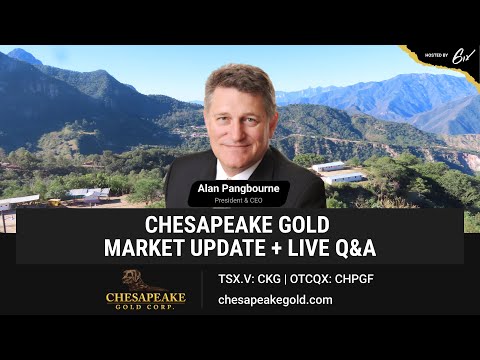
Chesapeake Gold Market Update + Live Q&A
Join us for a great event!
- Company
- Chesapeake Gold Corp. (TSXV:CKG)
- Date
- Mon, Jul 10, 2023, 2:00 PM ET
- Replay
- Watch the replay on this page · 44 min
On 6ix: 6ix.com/event/chesapeake-gold-market-update-live-qanda
Replay
Transcript
Automated transcript · Written by software from the replay's audio. It can mishear names and figures; the replay is the record.
0:08 Ladies and gentlemen, sorry for those technical difficulties. Alan, while we get started, why don't you bring up your PDF presentation in your PowerPoint, and then we'll get your screen shared and then we can begin the event in earnest. While you do that, Alan, ladies and gentlemen, thank you for joining today. This is Chesapeake Gold's live market update and Q&A session. So we're gonna be having this event broken down into a rather unique format. Just because people are familiar with the story, they may all have the same questions. So we're going to first address the most common questions about the cancellation of the San Vincente III mineral concession, followed by a high-level overview of Chesapeake to listeners that might be new to the story. After that we can have a live Q&A session if you have further questions still. So Alan, with that what I'd like to do is ask this question to begin with.
0:58 Why don't we start with first of all and foremost what is St. Vincent 3 Mineral Concession and how important is it to move the Metats project forward? Sure. So, before I answer that, can you see the corporate presentation cover slide? We can, yes. Okay, fine. Technical issues solved. So yeah, Cam, thanks for the question and I'm sure many, many people have the same question on their minds. San Vicente 3 is one of about a dozen concessions that cover the entire Matatus project. That includes the deposit, the where we're going to put all the infrastructure, so the heap leach pads, where we're going to put the waste dumps, where we're going to bring the road in.
1:44 So it's one of multiple leases that we hold over the project area, and all of which are about as key as any other one. So, it's important. It's obviously something that we obviously want to get changed and get the lease back. And, you know, there was a press release out saying that we've started legal proceedings against the DGM to change their ruling on the on that lease. So it's it's quite important. Some people have asked, well, how much does it affect the project? It doesn't really matter which lease it is. Any of them all impact it.
2:30 It's very hard to necessarily develop the project as originally thought without some of our leases. So we're working on getting the complete package of leases back how we had them 2 months ago. Okay, great. So just generally, this next question boils down to, so how and why did this happen? It's stated in the press release that it was canceled because Chesapeake didn't provide adequate evidence to support the company's performance of the exploration work required to maintain the concession. Is that true? We obviously disagree with that. Yeah, that's why we started the legal proceedings.
3:19 And we have very strong evidence and support from the legal team that the ruling is incorrect. So, maybe to educate a little bit the people that are listening. The process in Mexico, you have a lease and there are certain things you have to do every year to maintain that lease. So, twice a year you have to pay some fees to the government depending on how many hectares you've got and how long you've had it. We did that, we've done that, we've been doing that for a very long time and never had a problem with it. You also have to provide a report every year that says what work you did and how much money you spent on the lease doing that work.
4:07 And there's minimum spend requirements that you have to meet on all your leases. And again, we've been doing that with all of our leases, not just Metatis, but we've got other exploration leases around Mexico as well. Part of the government's process is they often select 1, 2, I'm not sure exactly what percentage it is, but we usually get 2 to 4 requests for additional information every year. And that happened again for the 2021 year. So, the calendar year 2021, after we submitted the report in 2022, sometimes they take quite a while to get around to it and we've got some others elsewhere that are going through the same process at the moment where they've asked for additional information. We've got others that they asked for additional information. We gave it to them and it all went away and we still got those leases.
5:07 And so for Sanvers NT3, they asked for some additional information, predominantly around invoices to prove that you spent the money you said you spent. So we sent them all of that. They came back and asked for some more. We sent them some more. We suggested they come do a site visit. They didn't particularly want to do that, so they didn't. And then they said, well, given what you've given us, it doesn't support that you've done what you're supposed to do with cancelling the lease. That's where, you know, we made the decision that we believe they're wrong and we take legal action for them to get them to review their decision.
5:53 As is the case with anything with most government departments, you have a right to appeal a decision. That's what we're doing. Whether it's the CRA in Canada or the IRS in the US or in Mexico, in our case, with the DGM or with the tax department in Mexico. It's just it's unfortunate and it's something that is very significant to us and obviously it's not something you can't divulge to the public. So we did. And we're working through that process now. Oh, understood. Thank you for that. The next question, of course, is just how long will this take to get resolved? That's really hard to say, because it depends on both sides of the table.
6:47 So, you know, we submitted our claim or our lawsuit. And so then the judges take a look at that, decide whether they're going to accept it or not. And then if they do, they advise the DGM that it's been accepted and they need to do something. The DGM then has a period of time where they respond. The judge then looks at that response and our complaint, decides what he thinks, gives a decision, depends what the decision is. The DGM also has the right to appeal the decision if they don't like it. We have a right to appeal that decision if we don't like it. So there's a whole process that can take, you know, it could be as short as 5, 6 months, depending on summer holidays.
7:42 And as you know, courts and the government and all the rest of them take summer holidays and stop work for a month or 2. It could be a shorter sort of 6 months. It could be 2 years. It's really hard to say. And each time there's a decision, obviously we'll put out a press release when we get a formal decision, but then there's who doesn't like it, and are they gonna just accept it and walk away, or are they going to appeal it again and so that as is meant often the case can lead all the way to Supreme Court if it has to. Right, absolutely.
8:29 Oh sorry go ahead. No, no. The next question we have is just when do we expect to know something about the process? I think I've sort of answered that in the 2 previous answers. It's a process. It takes time. There's multiple steps to it. And it could go all the way to the Supreme Court. Really depends what the DGM responds, whether they say, oh, oops, we made a mistake, it goes away quite quickly. If they believe they're right as well, it will keep going until we exhaust all opportunities to get that lease back.
9:18 Okay, fair enough. At this juncture, we've gone through the questions that we believe we wanted to get in front of and answer. Alan, I believe at this point, we can go through your corporate presentation and after which we'll go through any questions that the audience has otherwise. Yeah, I'll just add a couple other things around this. Just keep in the back of your minds, it's not just a legal process. We're also obviously in conversations with the local government, the state government, on what do they think of what's going on. There's also all of the issues related to the new mining law that seem to be overlaying some of this and some of the actions that the DGM has been taking.
10:07 And that one in itself is now being appealed at the Supreme Court. They went straight to the Supreme Court because of the way it was approved and what was in it and it may get struck down as well. So there's a whole bunch of things going on at the same time. San Vicente is 1 very specific thing related to Chesapeake and the Matantas project, but there's a whole raft of injunctions and appeals all related to the new law because it's not just San Vicente 3. There's a bunch of people who've got issues with their applications for leases under the new law were all cancelled and they've got to do them again, which is unconstitutional in Mexico.
10:57 So there's a big mountain of legal things going on in Mexico around the mining industry at the moment. Some people have been successful. Some people have already got injunctions in place so that they can continue under the old law with the process they were doing. First Majestic put out a press release a couple of weeks back. That's all going on in the background as well. It's complicated, difficult to work out how long it will take. We are moving forward. We're doing everything we can to obviously maintain what we believe are our rights. So with that, if you can see the screen, I'll walk through the presentation.
11:45 I think, Cam, I've got another 20-odd minutes or so and then have time for questions afterwards. Yeah, absolutely. Why don't you advance that first slide and I'll confirm that we're good to go. Yep, sure. There we go. So as typical. We should be good, go ahead, Alan. Great. As typical with all presentations, cautionary notes, we will be making forward-looking statements. I've just made a whole bunch of them earlier. So I guess the first thing for those of you not tuned into one of these webinars before, I'll walk you through what the project is, what we're trying to do and why it's different. We believe we have something unique in how we're going to attack Matatus.
12:34 Matatus is not an exploration story. We know where the deposit is. Previously, there was some PFSs done on it, showed it had 18 million ounces of gold, 500 million ounces of silver. We've maintained that resource in our current PEA. What has changed is we believe we've come up with a smaller project that we can do as Chesapeake, because the market has changed and people aren't buying large in the ground deposits at the moment. And so you need to find a project that you can advance yourselves, which we believe we have. We came to the project with a new technology that allows us to heap leach sulfides and then leach the gold and silver out.
13:21 And I'll talk to some more about that as we move forward. Starting in way smaller, much, much lower capital, 90% less capital, still have a significant mine life at 31 years, and about 150,000 ounce a year gold equivalent production, which is a nice size to start for a smaller company. And it would supply us with a cornerstone asset that's operating and a base cash flow that we can then build the company on going forward, and a significant NPV to go with it. So that's what we're aiming to try and do. So I'll walk you through where we're at with that. First off, the deposit itself, it is massive. It is one of the largest undeveloped gold and silver deposits in the world.
14:13 So for 1 billion tons, as I mentioned, 19 million ounces of gold, 580 million ounces of silver. We're targeting a small piece of that, about 20% or so, which is about a gram a ton equivalent, 200 million tons. It's focused on the higher grade core, starting at 15,000 tons a day, which would then be expandable because obviously, with a 31-year mine life, why wouldn't you cut that back to 15 years in double production? The reason we're starting at 15,000 tons a day is to do with our ability to fund something of that size, prove the technology works and then expand and having de-risked the project as we move forward. And that process gives us significantly lower capital as you've seen, 90% less capital, lower operating costs, gives us much better returns.
15:09 So, first things first, the resource. During 2021, 2022, we put out some results of some drilling that we'd been doing. We did an initial 5 holes that showed there was an increase in the gold grade, in particular, in the intrusive breccia, and the intrusive and intrusive breccia area. We did another 17 holes after that, and then we put all of that information into a new block model and rebuilt the block model. That resulted in an almost 16% increase in the gold grade to what it was in the previous PFS studies. This will be the block model that we will use for a PFS, and I'll talk more about that in a moment.
15:55 So, an increase in grade, that's really important because in the intrusive and intrusive pressure, that's what we're focused on for the starter project. That's the 31 years of ore supply, 15%, 16%, it all goes to the bottom line. So a significant improvement in the resource. The second thing that we brought to the table is this technology. So, this slide shows one of the very first columns we ran back in 2021. And the results for this were put out September of last year, I think it was. And as you can see in the photo, very clearly, the sulfide ore that started as gray has slowly changed to that creamy brown color.
16:45 That is iron oxide. So the sulfide, iron sulfide, pyrite has changed from pyrite to iron oxide. As it does that it means that the gold and silver become available to leach with cyanide as if it was a typical oxide ore body. So these are the curves we put out. Now I'll try and explain this. It's a two-stage process. You have to oxidize the sulfides first. There's no point trying to leach them with cyanide if you haven't oxidized the sulfides so you can get at the gold and silver that's locked inside. So the graph on the left shows the oxidation time and percentage related to those pictures on the previous slide.
17:33 So, interesting things with this, we ran it for 128 days, we achieved 30% oxidation. And as you can see, that line is still a straight line and it's still going up. So if we oxidized it longer, will we get a better gold and silver recovery? So once we'd oxidized it for that 128 days, we rinsed it to take sulfate out. So the 2 products you get from the oxidation is sulfate and iron oxide or iron hydroxide. We then mixed it with lime and cyanide, leached it in a heap leach column, the same as is typical for an oxide ore body. And we got these 2 curves. So over the following 90 to 100 days, we were able to get almost 60% gold recovery, which is an increase over non-oxidized ore from about 30%.
18:30 So we doubled it, and we got about 50% silver recovery, which typically was around 15 to 20% with non-oxidation. So we can clearly show that by oxidising it with this process in a heap leach, and then leaching the gold and silver, we can improve the gold and silver recovery. It's not quite as good as we put in the PEA and we're working diligently at the moment to try and improve these curves. And obviously the main thing we're looking at is can we run this either faster in the oxidation stage or for longer, which would then give more gold and silver available to be leached in the with the cyanide. So that's what we're working on at the moment.
19:18 The PEA that we put out in 2021, as I mentioned, the recovery numbers aren't quite as good as we had hoped for, but they're close. And we believe we can close that gap and get the numbers that are in this table. So what this table shows is the preliminary results from that preliminary economic evaluation. So CAPEX of $360 million is something that we believe we'll be able to fund, operating at 15,000 tonnes a day, combined Gold and Silver grade of about a gram a ton equivalent, 70 Gold, recovery 75 Silver, mine life of 31 years, initial Gold production of about 112,000oz a year for the first 15 years, half of the mine life, and then also an additional 2.5 million ounces of silver gives me a combined production for the first 15 years, about 147,000 ounces a year. The other thing that's important is the cash flow. That would generate, using $1,600 gold and $22 silver, which is quite a bit lower than current gold prices, about $110 million Canadian a year.
20:35 So the life of mine over $3 billion of cashflow that we would obviously be able to use for expansions or other opportunities, which is another thing we're looking at with this technology. As we gain more and more understanding of how it works and which type of projects look best with it, we do plan to look at acquiring other projects to add to the portfolio, but would also be able to take advantage of this technology. So, as I said, gold price of $1,622 silver that we used in the study gave me about a $1.4 billion NPV in Canadian dollars and an IRR of 35% and a payback of 2.5 years. So, good, robust project. Cash cost of $686 an ounce, all in sustaining at $750.
21:26 So, that gives us the justification to continue developing this towards a PFS. This slide just shows the sensitivities. Pick your pair, whichever 1 you want. This presentation is on our website if you want to look through it at a later time in more detail. And there's multiple slides in the appendices afterwards as well. This is the obvious slide that we're significantly undervalued. Given the impact of the San Vicente 3 issue, we're actually even cheaper than that at the moment. We're down at about $3 an ounce. And as you can see, many of these, the average is about $50 an ounce. So that's almost a tenfold increase as we continue to de-risk this project, that we believe we will eventually start to see reflected in our share price.
22:16 The other thing that's important about this process, and it's something that people don't often think about, heat bleaching inherently is significantly greener than the alternative processes. Because when you start milling and using autoclaves and oxygen plants, you use a lot more water and a lot more power, and you need a tailings dam. So the graph below, we took this data out of Barrick's sustainability report. The reason we used Barrick's information was because I know they have individual assets that are 100% diesel electric, diesel trucks, and a particular process, in this case, autoclaves or heap leaching. The 2 projects we use were Pueblo Viejo and the Dominican Republic, which is 100% autoclave production.
23:09 And the other project is Valadero in Argentina, both in South America, both Spanish speaking, both have the advantage of cheaper labor. But at the end of the day, the significance of this slide is reducing your power consumption reduces the amount of CO2 you produce, so less greenhouse gas. Changing from a autoclave to a heat bleach reduces your water consumption significantly. Almost half of the water consumption in an autoclave plant is flashed off to reduce the temperatures. Because the autoclave operates at 200 degrees C, obviously before you can leach the product you have to bring that back down to atmospheric temperatures and pressures. When you do that a lot of the water flashes off to drop it from 200 centigrade down to hopefully 70 or 80 degrees centigrade at least.
24:01 So as you can see for that significant That makes it a lot easier to permit. It should make it environmentally more acceptable. 90% less water, 90% less power, no tailings dam. Local communities are always concerned about water supply and obviously anything that's going to use significant water is an issue. And also nobody wants to live near tailings dams anymore because of the obvious reasons you've seen around the world over the last few years. So we believe that will help us significantly when we get to the permitting stage. So overall in summary, and I've done this a lot faster than normal so I hope there's a few questions, Massive deposit, one of the largest undeveloped gold and silver deposits in the world in Mexico. It's in Durango.
24:52 Durango is a very positive mining jurisdiction in Mexico. I've had recent meetings with the government down there and they are very, very supportive of the project despite the issues that we've got at the moment with San Jacinto 3. So, that's encouraging. We've confirmed a higher grade core and the gold grade went up by almost 16%. So, that's great. The technology allows us to have a much lower environmental footprint because of lower power and water consumption and no tailings dam. The PEA is important because it demonstrates that there is essentially a financeable, deliverable, and then an expandable project that only starts on 20% of the ore body, and even that standalone project would be expandable without having to go into the rest of the ore body as well.
25:48 I mentioned the jurisdiction. Currently, we've got about $26 million in the treasury. To give you some idea, over the first 2 years, we've spent about $5 million a year. That included all the drilling in 2021 and 2022. So, that burn rate is around that 5 million or less moving forward. Shareholders, Ericsprot is our largest single shareholder. Sun Valley is our third largest shareholder. Eric's got about 11 or 12%. Sun Valley is a bit under 11. Management, I personally own about 11% of the company as well. And then a couple of my partners own another bits and pieces. And then Randy Rifle still owns about 5% of the company. So when you put that together, there's a block of about 40%.
26:43 And we are trading an incredible discount to our other development peers. So with that, Cam, back to you and Q&A. Yeah, absolutely, Alan. Thanks so much. And just as a reminder to everyone in the audience, now's the time if you have any questions, feel free to submit them in the chat from the right-hand side of your screen. First question we have, Alan, is how does the new changes in the Mexican mining laws affect us? You may have reviewed this already in the opening, but maybe if you want to just reiterate. Yeah, I think I covered off a lot of it. So there's 2 different pieces to it. There's the new mining law, which is now law. It's been passed into law and the government has got a timeline of about 6 months to put all the new regulations in place.
27:37 Apart from it being challenged, the other thing is the regulations, the devil is in the detail. Some of the things that are in the new law actually already exist in the old law. And so, you know, and it's also good practice to have a good, solid agreement with the local community around how they're going to share, what are the benefits they're going to get out of the project coming forward, then mandating it to a certain percentage is fine. And when I say the devil is in the detail, that's a perfect example of, for instance, in the case of Chesapeake, we've been giving the money for the exploration access over the last decade or more. Is that deductible from future required payments to the community or not?
28:36 We don't know. It will be in the regulations. We haven't seen the regulations yet. The Mexican Chamber of Mines is trying to work with the DGM as they write those regulations. There's a whole bunch of other things around leases, life of leases, extensions, whether it's being bid for, how do you get a new lease, when do you have to get the various things you need. Again, most of the stuff in the law doesn't scare me. There's nothing in there that isn't done elsewhere. It's all about the detail. Another example, in the law, they now require a closure bond.
29:25 Any of you that are involved in the mining industry anywhere in the world, there are a lot of countries that require closure bonds. The question is, how is it calculated and when do you need it? And when does it have to be put in place and how does it have to be put in place? Can it be a closure bond insurance policy or does it have to be hard cash? Is it from day 1 or is it as you disturb areas and do you get it reduced as you rehabilitate areas as well? Depends, We don't know. So that it's a bit of a black box at the moment. And as I'm sure they put together, we'll have the opportunity as an industry to influence how the regs are written.
30:15 Absolutely. Absolutely. Great. Next question is, do you think that the BRICS gold currency will finally get gold back over 2K for good? Thank you, Paul. Look, there certainly seems to be a move to move away from the US dollar. I think if you move away from the US dollar, how do you have confidence in the Brazilian Riai, the Russian ruble, the Indian rupee, the Chinese currency? How do you have confidence in that? And How are they going to give other trading partners confidence that a dollar is worth a dollar or a rupee is worth a rupee and that it's inter exchangeable.
31:12 If you back it with gold, that obviously helps significantly. Yeah, because an ounce of gold is an ounce of gold and it will trade at whatever it trades at in your currency. So, I'm not sure if that answers your question, Paul. And trying to predict a commodity price is probably Russian roulette. I think we all realize that the Western world's ability to print money is unsustainable and the US, Canada, Australia, and Europe have all been guilty of it. How do you support the value of the currency? If the gold price will go up for 1 of 2 reasons, either because you printed so much money that it's paper, and so gold is worth more because paper's worth less, or because you end up with a separate, a different second reserve currency.
32:11 Take your pick. OK, fair enough. Next question is just regarding when the next re-rate. So I would hope the sooner I can sort out San Vicente, that would be 1. We've been crawling back up from where we got hit down to, I mean, today we're trading at a buck 70 something. We got down to almost a dollar. And so obviously sorting out San Vicente would be a key one. What happens with the new mining law, potentially is another one for the entire industry. The Mexican elections, which are about 12 months away, is another one.
32:57 The key one, obviously, for us, is the next round of test work results, and then moving into the PFS. And we expect those met test results towards the latter half of this year. And then moving into a PFS either very, very late this year or early next year. And that should take me 6 months or so to do. So those are sort of the catalysts that are out there in front of us. In the meantime, we've been sitting, working on all of the stuff that I need to support a PFS and then permitting. That includes detailed discussions with the local community, the AEDO, on a benefits agreement. What do they get out of allowing us to build the mine on what is their surface land.
33:51 So that environmental monitoring, we're continuing along the de-risking line of piece by piece, knocking over, We've sorted out this, we've sorted out that. We're moving on to this one, this one, this one. I know very clearly what I need for a PFS, and that's what we're working towards. Okay. Then I'll read the questions myself, and I'll keep going. Thank you, everybody. Where were we? Paul, Andrew, recovery update. Andrew, I think I've covered that one off. We're working on that and expect it towards the end. Bill, are there any other projects under review?
34:38 Have you been approached by other companies to use the technology? When will we get another update on the technology I've addressed? Any activity on other Mexican projects in your portfolio. So, other projects. We have other leases around Metatus, as some of you are aware. We've been going through and reviewing all of those over the last year or 2. If you've been reading the MD&A, you'll notice there's been some comments that we've reviewed and dropped some of them because we don't believe they've got any geological potential. We've got others that we're looking at and going back and having another look at them and deciding whether we'll drill them or not drill them or what we'll do with them. We're working through those in a consistent basis with my team and the help of Carl Edmonds, who used to be the chief geo at SSR, who I've known for a long time.
35:41 And so we're working through those one by one. Bill, also your question about has the Canadian government weighed in on the dispute? Yes, they have. There was a meeting of the mining chamber of mines in Mexico just after the new law was announced and passed, but hadn't been gazetted yet. And the head of the DGM, the head of CERMENAP, which is the environmental authority, and the head of the water authority were in that meeting and so was the Canadian ambassador and I was very surprised to hear the Canadian ambassador actually say in that meeting that Canada believes the new mining law infringes the equivalent of NAFTA, the USMCA or something.
36:46 I understand, but I haven't seen a copy of it, and only a couple of people have confirmed it to me, but the American government has also expressed their concerns. So I think that's part of what's behind some of the legal cases to try and get the new mining laws. David Barron wants the issue on the land packages resolved. How long will it take to come to a construction decision and then to build a mine and first pour. Oh, so process, Met test work, land decision, PFS. I can do all of that as normal. Permitting, I can't start permitting until I have the land package issue resolved, because I have to have clear title to the mineral rights.
37:43 I also have to have an exploitation agreement with the AHIDO. Once I've got those, I can put in my permitting application. With the PFS, I'll have everything else I need. So, that will all come together. As I said earlier, I expect to do the PFS early next year. It'll take me about 6 months, so that puts me in the middle of next year. Once I've got the PFS, I'm into the permitting process. Permitting is a piece of string. In a schedule I put together sometime, I think I allowed up to 18 months to 2 years. Typically, it has in the past taken about a year.
38:33 That's not so clear now with the new law until we see all the new regulations, because in the new law, there's a bunch of stuff around the HEDO agreements and bonds, closure bonds, and those sorts of things. We don't know when they need to be put in place and how you get through the permitting process. Once I've got my permits, And while I'm waiting for them, I'll be doing more test work on all variability and commence a feasibility study. Permits plus feasibility study allows me to make a construction decision that is 2025-ish. 15,000 ton of a process plant takes about a year to build. So, that's if I can get my money in time, 2026, startup is 2027, roughly.
39:31 That is a very forward looking statement. There's a lot of ifs and things that have to align. But that's about what it takes. The rest is everybody telling me they can hear me, which is great. How much stock does management own and what are cash salaries of the top 4 managers? I'm not sure whether the cash salaries is public information. If it is, it's in the AIF, and I can't remember if it is. I'll tell you what mine is. I earn 350,000 Canadian before tax, potential short-term bonus, potential long-term bonus.
40:20 I personally own 7.456 million shares in the company, which is about 11 and a half cents. That is by far the biggest single investment I have in anything. And represents what most stock brokers would advise you never to do. It is a very concentrated position. Other members of management, Randy Rifle owns, I think it's 4.5 million shares, so 5, 6 percent. And every so often he buys a bit more. His cash salary, I'm not sure if that's public, so I'd rather not say, but it's less than mine.
41:10 He's the exec chair. And then the others, Gary's isn't public, but he earns significantly less than me. My acting CFO is a contractor. Again, he's significantly less than John Paul, who's on the call. Again, that's not public information, so I'm not prepared to share that. Fair enough, Alan. That looks like all the questions, oh, actually, we have another question just regarding the title. Takes a long period of time. Would we be stuck for the next stage? Potentially, yes. A lot of things have to come together to be able to do the PFS at the same time, and I'm not suggesting that some of the others could be later.
42:06 If the legal stuff rolled out to 2 years, yeah, it would impact, wouldn't necessarily impact my PFS, it would impact permitting, the ability to submit the permit, as would if it takes a long time to get an agreement with the AHIDO. So wherever you're negotiating with the other side, that can take longer than you expect. The other things that are under our control, like gathering environmental impact data, gathering water data, sorting out where we're going to get water permits from, where power is going to come from, getting all of that information, that won't be impacted. And we can continue to do that. So technically I could do the PFS. It would just have a big rider on it. Depends on title being sorted out.
43:02 So I hope that answers the questions. Awesome, Alan. That looks like all the questions that we have for today at this point. I want to thank you for coming on, and of course I want to thank everyone in the audience for joining us. But with Alan, before we wrap up, if you have any closing remarks, it would be wonderful to hear them now. No, just thank you, everybody, for coming on the call today and listening to me, and I appreciate all of the questions. I hope I addressed them. If you're looking for more information, There are other webinars I've done that are on our website. There's also some on Six's site. There's the full presentation is available on our website as well. And once again, thanks for coming on and listening to our story. And I hope a lot of your investors and we see that rewrite.
Follow Chesapeake Gold Corp. into a list and get an email when it puts out news.
Latest news releases
- TSXV:CKG — Chesapeake Mobilizes a Drill Program at Lucy · Mon, Nov 2, 2026
- TSXV:CKG — Chesapeake Announces Proprietary Heap Oxidation Technology Updates · Tue, Sep 22, 2026
Companies on this call
More from Chesapeake Gold Corp.
- Oct 01, 2026 Chesapeake Announces Proprietary Heap Oxidation Technology Updates
- Jul 31, 2026 Silver's Next Chapter: Scarcity Meets a Shifting Market
- Apr 16, 2026 Beneath the Surface: The People of Chesapeake Gold
- Oct 21, 2025 Chesapeake Gold Update Call
- May 28, 2025 Introducing Justin Black, Chief Metallurgical Officer
- Feb 19, 2025 Exploring Mexico: From Discovery to Development