Rob Buchanan
Chief Executive Officer
Replay available
Channel Infrastructure NZ (NZX:CHI) Q4 2025 earnings call, held 2026-02-26. Watch the replay and read the transcript on 6ix.
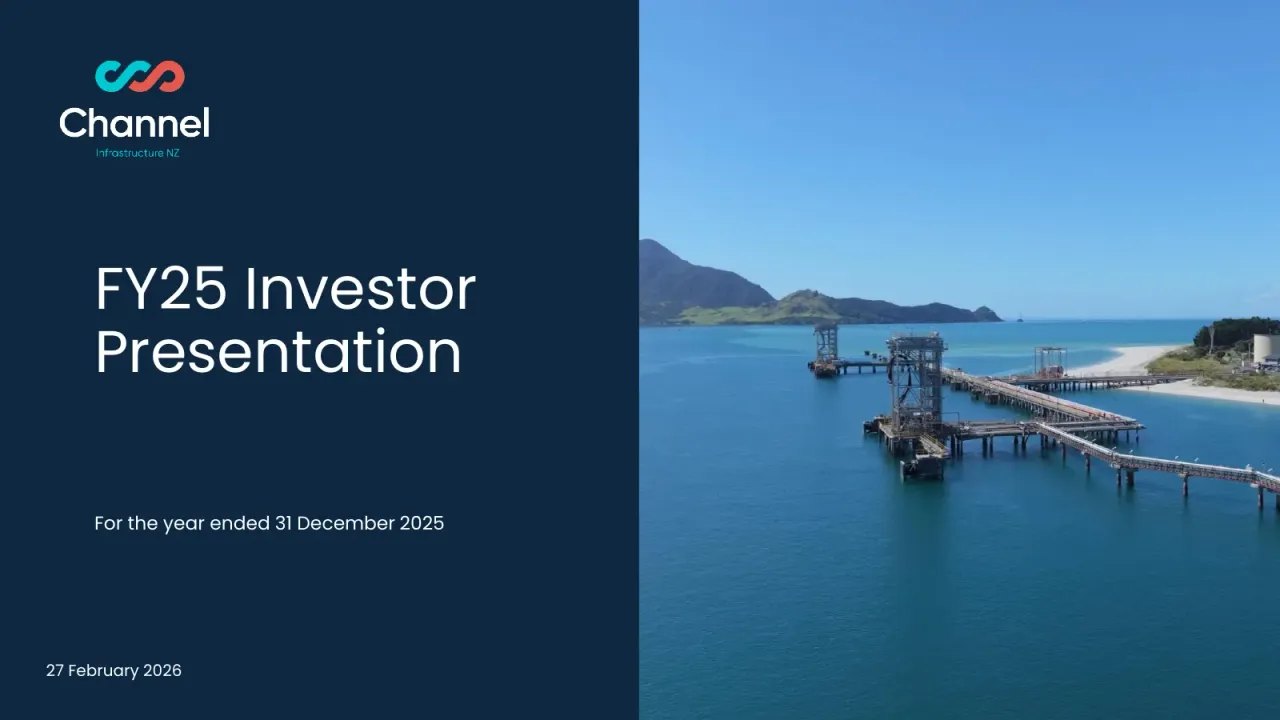
On 6ix: 6ix.com/event/channel-infrastructure-nz-nzrff-q4-2025-earnings-call
Automated transcript · Written by software from the replay's audio. It can mishear names and figures; the replay is the record.
0:00 Welcome to the Channel Infrastructure FY25 results briefing. I would now like to hand the conference over to Rob Buchanan, Chief Executive Officer. Please go ahead.
0:10 Good morning, everyone, and thank you for joining us as we run through our financial and operating results for the 2025 year. I'm joined here today by our Chief Financial Officer, Alexa Preston, and we will speak to the presentation we disclosed on the NzX this morning. As usual, I'll cover up our company highlights and the operational update before I leave the talks to the financials in more detail. I'll then pass through our strategic highlights before we have some time for questions at the end. Let's start with our financial highlights on page three. Excluding the one-off impact of the WERI lease, EBITDA agreed 4%. This reflects PPI escalation, an increase in throughput, and the benefit of the full-year contribution from the Transmitz contract.
0:57 Normalised free cash flow increased by 5% and our free cash flow conversion increasingly increased from 57% to 72%. Today, the board declared a final dividend of 6.75 cents per share. With a continued focus on stable and growing dividends, the board remains committed to our dividend policy of 70% to 90% of normalised free cash flow, payment equally between the interim and final dividends. However, this year we had higher than anticipated free cash flow, reflecting stronger jets and petrol throughput than anticipated, and we now have good visibility on the finishing line for our jet storage and bitumen projects. As such, the Board decided to declare a dividend higher than we had guided to, recognising the need to continue to be efficient with shareholders' funds.
1:49 We've listed the 2025 highlights on page four. I'm very proud of everything the channel team has done this year. To say it's been a busy year would be an understatement. We continue to execute, deliver and drive shareholder value year after year. This is reflected in our 2025 total shareholder return of 63%, which significantly outperformed the NZX50 over the same period. Our safety track record continues with consistent safety performance. We deliver strong financial results in line with the guidance we provided at the beginning of last year. Madison Point reliably delivered over 3.5 billion litres of fuel through our infrastructure, and while throughput was relatively stable, as we had anticipated, Q4 was the highest throughput since import terminal operations began, and jet fuel the highest since 2019, despite Air New Zealand's well-known aircraft issues.
2:46 The Z Energy Jet Storage project is on track to be delivered in Q3 ahead of schedule. The new bitchin' and import terminal is well underway and expected to be operational in Q4 this year. As we announced in August, we signed another storage contract. This was a contract extension which adds $50 million of revenue prior to PPI over the extended nine-year contract period. We'll start seeing benefit of this from Q1 2028. In November, we made our first steps into the Australian market with the acquisition of a strategic position in Melbourne's jet fuel supply chain. Reflecting our confidence in the Martenswain Energy Precinct, we've committed to and started the process of relocating the control room and construction of a new administration building. This will not only support the energy precinct redevelopment plans, but is important for improving the safety and environment of people working every day.
3:42 We updated our capital allocation framework and importantly increased our dividend payout ratio. We listed on the ASX, which is a real milestone for our company, reflecting how far we've come and the growth opportunities ahead of us. Lastly, but definitely not least, we've been progressing growth and development opportunities, and I'll come back to this later in the presentation. Moving to page five, starting with safety. There were no tier one and tier two process safety incentives Looking at the availability chart at the bottom of the page, our pipeline and tank availability remain at world-class levels, which is something we're very proud of. As you can see, the number of ships in our jetty continues to fall.
4:27 Our customers are bringing in larger ships, utilizing a contracted storage on our site, and the supply chain benefits our high-throughput facility offers. These ships are carrying more products on average, so awkward revenue received continues to remain steady. Moving to page 6. Jet throughput was relatively flat in line with our expectations at the beginning of the year. NZ aircraft challenges are still anticipated to continue for some months. However, we saw Q4 jet throughput the highest since Q1 2019, despite many of the NZ planes being on the ground. This chart excludes the volumes going through the Somerton pipeline that we recently acquired. But it is worth pointing out that Melbourne Airport, which gets a significant amount of its fuel through the Solentine pipeline, is undergoing significant growth.
5:15 The third runway has been built and will be operational in the early 2030s. And in December last year, we saw the largest number of passengers on record going through Melbourne Airport. Moving to page seven. Diesel remains stable year on year as forecast by advisory. Petrol was slightly ahead of the advisory forecast And partly we believe this is because our customers are taking advantage of the supply chain efficiencies offered by our high throughput master and point site, along with the payoff of our world-class work, which is helping create efficiencies for our customer supply chains and boosting our resiliency as an operator. And now we'll hand over to Melissa to take you through the financials.
5:56 Thanks, Rob. Looking at the P&L on page nine, We have delivered yet another solid result in line with our guidance reporting EBITDA of $93.4 million and an EBITDA margin of 57%. The pro forma table at the bottom of this slide shows our results adjusted for the impact of the expiry of the legacy-wearing lease. Excluding this, we have delivered EBITDA growth of 4%. The higher depreciation chart reflects the revaluation of the import terminal system assets in 2024 and the capitalization of a number of new assets this year. Lower financing costs for the half reflects the benefit of interest rate hedging and the successful refinancing in November 2024, which lowered the all-in cost of drawn facilities by 0.6%. Moving to page 10.
6:54 Overall, revenue for the period was broadly flat. We saw the contracted $5 million nominal step down in the annual fifth terminal fee from 1 April 2025, and the impact from the expiry of the mega-severary lease, which ended at the end of February. Fees were offset by CTI indexation and a full year contribution from the TransMix contract. Revenue for the year also includes one-off earnings of around $700,000, and a non-cash investment property revaluation of $200,000. Turning to operating costs on page 11. Channel continues to exercise operating cost discipline, delivering flat underlying costs for the year. However, we have an ambitious growth strategy and some investment is needed in order to execute growth opportunities and grow the value of the business.
7:49 In 2025, we incurred $1 million of costs associated with our foreign exchange ASX listing, and $1.5 million of costs relating to the decision of growth, which included the successful acquisition of a 25% interest in the Somerton Jet Fuel Pipeline to Melbourne Airport. Going forward, we will incorporate the revenue and operating costs associated with our share of the Somerton Pipeline in the relevant lines in our ANL. Page 12 provides the details of our investment in resilience and growth. I just wanted to take a moment to talk to the photo on this slide. Earlier this month, the Zen Energy Jet Storage Tank achieved a significant milestone, with the geodesic dome roof being constructed inside the tank and then lifted up on top of it. The tank is now fully enclosed and hydro testing is being completed, with other compliance checks scheduled over the coming months.
8:46 He would have anticipated early commissioning in Q3 this year. Maintenance capex for the period was $12.3 million and growth capex was $27.1 million. The growth capex programs of the year included completion of the private storage fund program, ongoing work on the Z energy jet tank conversion, and the initial construction works related to the Higgins, Richmond and Port Terminal. Conversion CapEx includes the last remaining water stream in the overall program, being the bundling upgrade, which will be completed over the period to 31 December 2027. Turning to the cash flow on page 13, net debt as of 31 December closed at $330 million, normalised free cash flow at $56.9 million, and free cash flow conversion was 72% after a 37% last year.
9:44 The board declared a final dividend of 6.75 cents per share. As Rob spoke to you earlier, we aim to split our dividends equally between the term and final dividends. However, this year we had higher than anticipated free cash flow. As such, the board determined to declare a dividend higher than guidance and return the surplus to shareholders. Page 14 shows our strong balance sheet position. The group sits at 3.6 times net debt to EBITDA, up from the prior year, reflecting the acquisition of the Southern Jet Fuel pipeline. Serial interest cover ratios remain well inside our covenant levels. We have no debt due for refinancing this year, following a one-year extension to our banking facilities in 2025.
10:34 Let me finish up with the outlook for FY26 on page 15. We are expecting EBITDA of between $95 to $100 million. This reflects the early completion of the Z Energy Jet Storage project and the bitumen import terminal being ready for service in late 2026. The producer price index applicable to 2026 is 3.25% and approximately 95% of Channel's revenues are indexed by this factor in 2026. While positive signs of growth emerged in jet fuel throughput in Q4 last year, Auckland Airport continues to anticipate only modest passenger growth, some of which is likely to be absorbed by available seat capacity on existing flights.
11:23 In addition, Air New Zealand has outlined the disruptions it is expecting from its aircraft availability issues, and as a result, tournament has paid modest jet fuel growth of 2% for 2026. Lastly, it's worth noting that only $23 million of the conversion budget remains to be spent, spread evenly across 2026 and 2027. I'll now hand back to Rob to give an update on progress towards delivery of our strategy.
11:53 Thanks, Alexa. Moving to page 17. We've talked for some time about our ambition to become a world-class operator. The reason why we've relentlessly pursued this work is to demonstrate our operating capability and New Customers, who are generally global organizations that expect outstanding operational performance. Ultimately, our expectation is that this will help us to unlock growth opportunities that attract product flow to maximum point. We're already seeing the benefits of this work, not only through our fuel volumes, but the wider growth we're going to unlock. I wanted to give you an update on the significant progress we have made towards our world-class ambition. We are a significant way through this piece of work. On the infrastructure and performance front, we've taken a number of steps to improve the reliability and resilience of the import terminal system for our customers and for New Zealand. This helps entrench Marston Point as a key import location, an integral part of our customer supply chain. In terms of systems and processes, we've made it easier and cheaper for our customers coming to Marston Point by, for example, seeking to reduce ship alongside time at our jetty.
13:03 And in people and capabilities, which is critical to the successful operation of a high-end facility, we've seen a significant increase in overall staff engagement over the past few years. Through building organisational culture, we're seeking to drive improved safety, operational and efficiency outcomes as well as align our people with our company's strategy and delivery for shareholders. Page 18 is the strategy that we announced back in October 2023. As I've just mentioned, we have made great progress on becoming the infrastructure partner of choice for our customers and demonstrated strong financial discipline while being a good neighbour and good citizen. This is now positioning us well to drive harder on the middle pillar of the strategy, which is growth. I won't spend much time on page 19, as you've seen in slide 4 of the August results.
13:52 So this is a reminder that we are very focused on our growth ambitions and discipline is how we allocate shareholders' capital. Our third priority is near-term opportunities identified for additional product storage and fuel and energy security projects at Marston Point. Beyond Marston Point and the Auckland supply chain, we're taking a measured approach to incremental growth, and we saw this action with the acquisition of a 25% share of the Somerton pipeline. Moving to page 20. The purpose of this slide is to demonstrate our proven track record of delivering growth and large projects safely on budget and on time. The conversion project, which is a significant six-year project with a budget of $220 million, remains on track and will be completed by 31 December 2027.
14:38 On top of this, we've executed an impressive four new growth projects over the past two years. This will deliver an additional $170 million before PPI indexation and incremental revenue over 15 years. And we completed our first measure step-out last year in Australia. Moving to page 21. We announced to the market our Master Point Energy Precinct concept back in October 2024, which was the framework for how we saw a wider use of our site and the way we want to maximise the significant opportunities of our highly strategic and unique assets. This plan is never going to be static with market opportunity evolving and we always knew that the final shape of our precinct would change over time.
15:23 Therefore, it's no surprise there have been a few updates to the summit which I wanted to draw your attention to today. All of you have noted the New Zealand Government's announcement regarding LNG procurement and the preference for a facility based in Taranaki. We've been clear for some time that LNG was unlikely to be the best option at the although we remain open to considering viable projects should the market happen. From our perspective, we see better uses for our sites than LNG and therefore removed it from the plan. We have now completed the conversion works for increased jet fuel storage amounting to a total of 120 million litres capacity in the new jet compound. We support the energy resilience of New Zealand by enabling our customers to increase the size of the ships they bring to New Zealand in the amount of fuels that are paddled here. You will note that the jet compound is now in blue with only two tanks left to contract, and we continue to see opportunities for these assets with projected jet growth and local airport in the long term.
16:23 We've previously spoken to a potential ESA plant on the last important site. With the timelines for this project now looking longer, we are now supporting several new scoping studies by international parties considering further biofuels opportunities, as well as hydrogen production and export at this location. Lastly, the more contested geopolitical environment we live in means energy security is becoming more and more relevant. As New Zealand's Prime Minister has said, energy security is national security. While we previously thought the use cases for our largest export tanks would be limited, we have reconsidered this assumption in light of changing potential customer interest. I do want to stress, however, that any opportunities for these light tanks are outdated.
17:10 What we have now are potential projects for the Marston Point site. The Marston Point biorefinery project is progressing well. Team New Zealand have now joined the consortium, enhancing the project's offtake profile. This project would make the scarce supply of renewable fuel more accessible for New Zealand, and domestic fuel manufacturing capacity using domestic feedstock would also further enhance New Zealand's fuel security. Engineering work has progressed and the final form of the feedstock supply and key product offtake agreements have now been prepared. A select group of lenders have been shortlisted to participate in the formal declaration process and the preliminary information memorandum has been developed and being finalised will be issued to financiers. Channel continues to support the consortium in progressing the project in its capacity as a landlord and ancillary infrastructure provider.
18:00 We continue to anticipate a final decommissionment decision by the consortium later this year. Channel has completed a phase phase with a 72 megawatt diesel powered electricity picking plant with a cost of 1.2 electricity market participants. Electricity market participants with whom we have engaged so far see this project as useful as a means asset for fermenting renewables. Channel's project will be relatively fast to construct. and benefits from significant fuel reserves already stored on Channel's mass-influenced site, provided the near-immediate start is required. Channel was in advanced discussions with several parties regarding a long-term capacity contract to underwrite development costs of the project to be funded by Channel.
18:45 Following New Zealand Government's announcement that it is considering proposals relating to a potential energy import facility, development of the project has been forwarded pending the outcome of the government's work on the facility. This decision to pause development reflects Channel's disciplined approach to developments and prioritising growth spend. In November, we acquired 25% share in front of the Jetfield pipeline. We read through all the details of the acquisition, but just to remind you, we talked about this asset not only being attractive on a standard basis, but also the significance of the growth opportunities we see in the subject supply chain. One of these is the significant latent capacity in the fastening pipeline that is constrained from use by downstream pipeline capacity.
19:34 Parties to the JV have several options for demodelling in which are currently being considered. These opportunities will take time to unlock. Pleasingly, we are already seeing throughput for the pipeline late last year exceed our base case assumptions. Melbourne Airport had a record total number of passengers in December and a record number of international passengers in January. Just this week, the airport announced $4.5 billion in investment to expand its international terminal to complement the CERN runway, which will be complete in the early 2030s. Flyer 24 is our investor scorecard, which you're all familiar with by now. We set ourselves ambitious targets every year. During 2025, we had one lost time injury, which was a minor back strain.
20:22 We didn't quite achieve our ambition with regard to our customer assessments, reflecting that our customers had demanding expectations. But I'm confident that our world-class work will see us meet this year's target. However, all of our other targets were met, reflecting the number of achievements we've discussed in this presentation. It's been another outstanding year for Channel, and I'm incredibly proud of what our team has delivered. And with that, I'd like to open the phone lines for any questions you may have. Thank you. If you wish to ask a question, please press star 1 on your telephone and wait for your name to be announced. If you wish to cancel your request, please press star then 2. If you're using a speakerphone, please pick up the handset to ask your question. The first question today comes from Andrew Harvey Green from Forsyth Bar.
21:10 Please go ahead.
21:13 Morning, Rob and Alexa. Good to see the delivery continues. A couple of questions for me. First one just around the dividend and I guess the comments that the increase related to the fact that there was better cash generation than anticipated. Should we consider there as an element of a special dividend in there or are we setting a new benchmark for the dividend going forward?
21:40 You've seen our board before pay special dividends and the choice to make this an ordinary dividend was intentional.
21:48 Okay, I think that's pretty clear. Thanks, Alexa. Second, a couple of questions just around, I guess, the biorefinery and that looks like that's going ahead. Well, should I say progress has been pretty positive. I just want to get a sense over the last sort of six months or so relative to your expectations, has there been any slippage in the timetable or is pretty much everything continued to progress on track?
22:17 I think from my perspective, broadly, it's on track. I think, you know, this is a big year for that project around an FIT decision and there's still a lot of work to do to get to that point. But we're happy with how the project's been progressing. And I think, you know, one more thing to say, you know, obviously you'll have noticed that we paused work on the diesel peaker and so we're pretty ruthless about applying our resources to projects that we think are viable. And so, you know, that's why we are continuing to see that as a good opportunity for us
22:53 Yeah, okay, good. Thanks. And the second question I just had related around that was, I guess some of the, in terms of the information that you've provided to the market, I think October 24 gave a little bit of a sense of what the revenues, et cetera, could be. Are you able to sort of give any update, given how things have progressed since then, sort of the upsides and I guess the revenue streams that we can expect if the biorefinery goes ahead?
23:22 So, Andrew, there's been no change to the update we made in October. And that update, just when I was on the call, was lease revenue of between $6 and $7 million for the site the biorefinery will occupy. And then we indicated that any avoided demolition costs as a result of the transaction would need to be requested in incremental storage. So, our role will continue to be as landlord and as an infrastructure provider has got an established pattern of how we price storage assets. And so, as I said, no change to that guidance, but those are the indications that we've articulated today.
24:04 Okay, thanks, Alexa. And just the last question, I guess, which I think you kind of alluded to a wee bit, but I guess the government's security of supply storage requirements. Are you able to give us sort of any update on that and your current thinking on that?
24:25 There is a question in relation to minimum stock holding obligations, Andrew.
24:32 Yeah, that's right. Yeah, that's right. Yeah.
24:35 Yeah. Look, when we've got an update, we'll give it. I think we're still engaging with customers around opportunities to convert those tanks. I will note every time I get asked this question, I talk about the fact that we see as much if not more opportunities for commercially driven storage contracts than we do for government ones and we continue to have some of our commercially driven ones and so there's plenty of those discussions as well.
25:07 Okay, that's great. That's all from me for now. Thank you. The next question comes from Neville Gluyas from Jarden. Please go ahead.
25:19 Good morning, team. Hopefully you can hear me. Absolutely, Neville. Very good. I have pushed the mute button off. A couple for me as well. Just a question. With New Zealand sort of joining a CEDRA consortium, does that change in any way the timetable it does bring forward? Or I have in my mind that I should think about this as sort of a late calendar 2026 decision. Should I keep that in mind?
25:44 Yeah, I don't think any change to the timetable driven by that. I think it just demonstrates building momentum for that project.
25:53 Yeah, that's useful. Thank you. And obviously a bit of discussion already about the OPEX and FY25, which obviously includes some of those one-off items. What are you guiding for OPEX this year? What commentary can you add? And I guess to add to the two one-offs you noted last year, There's also a question of what kind of level of CEDRA-related OPEX was built in 2025 and how much we might expect in 2026, or whether perhaps it's been catalyzed instead. Can you offer us any thoughts there?
26:25 Thanks, Neville. So our guidance state is pretty clear, but I'll give it a little bit more color around what you've just discussed. Effectively, the biggest impact on the outturn for FY26 will be in this growth spend category. And so, optically, whilst the guidance range is in line with what the market's expecting, we don't normalise out any growth investment from that number, and so that's embedded in that range. You've seen the sort of spend levels that we are undertaking each year in growth. So I just flowed through our OPEX lines and then we highlighted transparency.
27:12 FY25 number was higher because ASX listing fees are significant. But the baseline level is around that $1.4 to $1.5 million for the last couple of years. As we move forward, I think you can expect us to continue to exercise discipline around our costs. It's quite challenging to deliver an underlying cost out term that's flat. And we are ruthless with the prioritisation of our spend. Procedure costs are all expensed. And then, obviously, we'll signal that some of that one-off growth spend, FY25, related to the acquisition, you'll be aware, due diligence costs. And I'm like, we'll fly through that line.
28:07 Okay, that's, that's helpful. Thanks. And I guess the things I'm taking from part of your answer there is that while we might identify some of these one off items, Cedra, for example, or Somerton JV, there's an element of sort of continued growth focus you've got that means that you will have outlays for other projects that we may not know the names of yet.
28:29 So yeah, good.
28:31 Okay, that's useful. Thanks. And the last one for me, and there's sort of a brief allusion to it in the pack, is about the Summit and JV sort of debottling options. And can you give us just a rough idea of timing? Could we think some of those options might come in front of your desk sort of in the course of this calendar year? Or when you sort of talk about long-dated, should we be thinking about options coming across for you to consider next year or later?
29:02 I think the thing to do here is to work backwards from what the demand will be for jet at Melbourne airport and so you know we've got a new runway which is scheduled to be going into around 2031 and the airport had announced I think yesterday and the day before around four and a half billion dollars worth of works particularly around reconfiguring their international terminal and other to support what they expect to be quite strong growth. And so that's the sort of back end around what the jet fuel supply chain needs to deliver. I think one of the things that I'm not sure has been picked up is there are actually multiple opportunities for debodimenting, which have pros and cons and different costs and benefits.
29:56 And so there's a bit to do to work through all of that. And in particular, obviously, the consistency of the JV structure where different parties have different views. So I think the headline I'd give you is we've owned the asset for about 13 weeks. And we're sure that we're working on these things. But I think it's got to give us time to compete ourselves with the other parties and work through these things with them.
30:26 Okay, that's useful color. Thanks, Tim. That's all for me. Thank you. Once again, to ask a question, please press star one on your telephone. The next question comes from Cameron McDonald from E&P. Please go ahead.
30:44 Good morning, Rob and Alexa. Two questions for me. One sort of detailed one for you, Alexa. Just the tax rate and how we should be thinking about that. given the first half tax rate looked to be 28.8, same as last year, but the full year result ended up in excess of 34. So there's a big step up in that second half. What drove that and how do we think about that going forward?
31:13 And every key thing to remember with our tax can, and we're not a cash taxpayer at present, and so these are all accounting interests. The variance really is around some adjustments to do with taxes from previous years, so wash-ups of various findings from our internal reviews and other matters. We did have the abiding ruling for our tax losses, which involved factual review from the Inland Moving Department, which can drive some of that variability as well.
31:55 Okay, so we shouldn't be thinking that that 34 is an ongoing that's just one off. Okay, excellent. And Rob, can I just delve into I'm always interested in, you know, in incentives and LTIs, etc. And it's been an announcement today that you've been granted some additional shares with some with some hurdles. that relate to the successful execution of the Marsden Point Energy Precinct designated projects. Can we just get some clarity about what the designated projects actually include and then what the targeted... And then they've also made comment about the M&A projects sort of opportunities and activities as well.
32:43 So interested in what makes the definition of designated, please.
32:48 I think there's quite a bit of detail in that in the annual report, Ken, so I would encourage you to just spend a bit of time going through that. What I'd say at a high level is, you know, the thresholds and hurdles are pretty challenging and we're talking about some pretty significant about today.
33:16 Okay, thank you.
33:20 Thanks, everybody. I really appreciate you all dialing in and the interest you show in our company, and we look forward to catching up with you as we further engage with investors over the next couple of weeks.
Follow Channel Infrastructure NZ Limited into a list and get an email when it puts out news.
Chief Executive Officer
Chief Financial Officer
Analyst, Forsyth Barr
Analyst, Jarden
Analyst, E&P