Transcript
Automated transcript · Written by software from the replay's audio. It can mishear names and figures; the replay is the record.
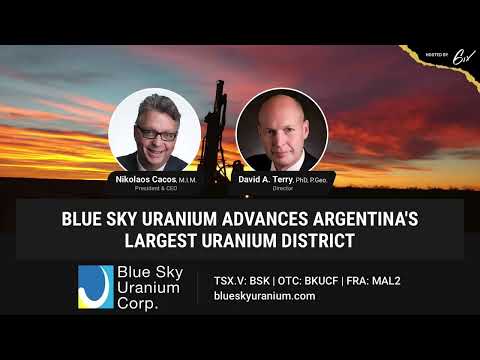
0:07 All right, well, hello, everyone, and welcome to Blue Sky Uranium's live summit today hosted by 6. I'm very pleased to introduce our speakers for today. We have the President and CEO, Nicholas Kakos, and the Director, David A. Terry. So the team's going to walk us through a company presentation and after we will be accepting questions live. So as a reminder you can submit your questions at any time using the Q&A panel on the right hand side of the screen. We're going to try to get to as many as possible afterwards. And as always, this event is being recorded and available to watch afterwards on six.com. But without any further ado, I'm going to hand it over to you, Nicholas, to kick it up. Thank you, Dasha. Good day, everybody. Thank you for joining Blue Sky Uranium Corps presentation. Today we'll be talking about uranium, uranium more specifically in Argentina.
0:55 It's where we have all our exploration efforts right now, and we've discovered something very, very unique. I mean, not only do we have right now, we'll see in the presentation, the Evanna deposit, which underpins our thesis here, But also what we'll see the real opportunity is that with this deposit, it lies that this occurs in a new uranium district, the district scale potential of this project. It's over 145 kilometers wide, long, and what we'll see, it has the potential to rank as among some of the largest uranium districts in the world with some of the lowest operating costs. Next slide here is a disclaimer page, and I do encourage you to read this carefully as there will be making both of us actually be making some forward-looking statements in the presentation and this presentation by the way is available for download for you on our website.
2:02 Just to give a brief very high level overview of the investment highlights of Blue Sky. First of all, let's look at the uranium market. We'll talk about all these topics in more detail as we go through the presentation. We see that there is a structural supply deficit of uranium. What that means is the demand is exceeding supply and that we're seeing the price of uranium actually has gone up quite substantially. Just a few years ago, it was under $20 a pound and it's over, it's about $53, $54 a pound now and still rising. And we'll also see that Argentina, of all places to have a new uranium discovery is probably the best suited for us Because there's a in-country demand. We'll see that Argentina's uranium is a nuclear country with a need for uranium and we can be setting up Blue Sky for our first business opportunity there.
2:59 Second of all, The project itself, like I said at the outset, there's a floor value just under 23 million pounds of uranium, 11 and a half pounds of vanadium. This is all open for expansion, but really that's really the key. We've got lots of targets that we've identified. We've worked on this district for the last 15 years or so. We have a fairly good understanding of it, and it's this district scale and potential for additional deposit that I think sets our project apart from all our competitors. Now, let's take a look here where we're located. This is a map of Argentina, and our project is located in the province of Rio Negro. Oops, right here.
3:46 That's the deposit where I attempted to draw that blue arrow. That's the Amarillo Grande project. It's composed of just about 300,000 hectares of property, and it's where 100% of our efforts are focused on right now. The company itself is managed by Grosso Group Management Limited. Grosso Group is a very successful and pioneer of mining exploration in Argentina for nearly 30 years now. The group, the management team has had a lot of success in that country. We've made 4 major discoveries in the Guacamayo gold mine, which is now still in production in Argentina, discovered Navidad silver lead deposit, which remains the world's largest undeveloped silver deposit and more recently the team discovered the Chinchilla silver lead zinc mine which took from discovery all the way into production and in partnership with SSR mining and of course there's the Amarillo Grande Uranium Vanadium Discovery, which is of course the subject of this presentation.
4:55 More specifically on the team, chairman and the board of directors is Joe Grasso. Of course, Joe Grasso is president and founder of Grasso Group Management. He lends the company a tremendous competitive advantage in Argentina. He's been awarded, inducted rather, into Argentina's Mining Hall of Fame. He's been an exploration mining man of the year in Argentina, extremely well-known and helps bring us a tremendous number of contacts throughout government and in the industry. Myself, I've been with the company since inception. I've also worked with the Grosser Group since together when we started back in 93. So I've had a long experience also in Argentina.
5:44 David, who's on the call here is a director and he's been with Blue Sky since the company was started, I guess back in 2005, 2006. And he's helped lend a tremendous hand in helping guide the company from a strategic and geological point of view. Guillermo Pensado, our VP of exploration. He's an Argentinian with a very extensive uranium experience having worked with companies like Cameco and he too is an award-winning geologist, having won exploration geologist of the year, awarded to him just a couple of years ago by his peers. Jorge Bariso from the Argentine Atomic Energy Commission has been there to advise us and helped us make this discovery in Argentina.
6:34 And more recently, Chuck Edwards has joined us. Chuck is a mining process processing engineer and a metallurgist. He was a chief metallurgist for Cameco for many, many years, extremely well known
6:50 in the industry, and he just brings a tremendous amount of talent to the company. Now looking at the uranium, supply and demand, we're seeing this chart shows very basically that demand is outstripping supply. This has been happening over the last few years, and that's why we're seeing the price of uranium go up. One of the main factors driving this is the fact that, you know, as the world seeks a safe, secure, and reliable, and carbon-free way of generating electricity, nuclear power has a very, very key role to play. So here in providing that, especially as base load power. So we're seeing nuclear reactors being built around globally, around the world, or the lifespan of existing reactors being extended, creating a real organic demand for for uranium. Of course, more recently, we're also seeing financial players getting involved in the uranium business in which they acquire, buy uranium and hold it, so limiting the supply.
7:57 And that's helping to exacerbate the demand gap here. And then the price, of course. Just very briefly, where does the uranium come from that's produced globally? We see here that almost half of the world's uranium originates from Kazakhstan. And that has, of course, as more recently, there is a geostrategic and political implications about that so there is a need to find additional uranium from other more stable and safe countries. And of course, Australia and Canada produce about 25% of uranium and the rest comes from other countries, including those in Africa.
8:45 Pricing for uranium. I'm not going to get into too much detail on this, but suffice to say that there's no stock exchange for trading, commodity exchange rather, for trading uranium. The way that uranium is priced is strictly between a uranium mine and the nuclear utility. Mine and the nuclear utility, they buy their fuel and these they typically strike contracts that range up to about 15 years and they do pay a premium in order to have a sureness that there will be a stable supply of uranium coming through. And like I said at the open, Argentina is a nuclear country. Most investors don't realize that, but this is a very, very important factor for us for a few reasons. Number 1, the legal framework is already in place. So in terms of moving around and handling your radioactive or nuclear materials, these laws are already in place. Typically we don't have to wait years and years for them to be legislated by parliament and so forth. Argentina right now has 3 nuclear power plants in operation.
9:51 They've got another one under construction. They're planning and building additional ones. They're also involved in all different other aspects of the nuclear cycle. They even have a pilot enrichment plant in the country. So the only element that doesn't exist currently in Argentina is your production of uranium. So they have to import all the uranium. Most of it actually comes from Kazakhstan and they pay a real premium for that. And for this reason, with our current deposit, even at this early stage, it ranks amongst the largest and most advanced deposit in Argentina. We're setting up Blue Sky to be a net supplier of uranium to Argentina and of course to be in a position to export thereafter.
10:41 And this brings us to the Amarillo Grande project and I'm going to pass it over to David who will give us a good overview. Thank you, Nico. This photograph that's up on the screen right now is a picture of a reverse circulation drill rig right over top of the Havana deposit at the Southeast end of the Amarillo Grande project. So you can see what the landscape looks like there. It's basically flat, scrubby brush land with not a lot of population. It's not good for agriculture or livestock. So it's an excellent place to discover a mining project. A little bit of history here. You can see the time scale on the left-hand side here. The initial discovery was made by us in 2006 up at the Northwest end of the, I'll just circle this, up in the northwest end of our land position.
11:48 And that really got us going on exploration in this area and resulted in us flying a large airborne geophysical survey that resulted in the discovery of a need about 60, 70 kilometers to the Southeast. And that's located here. And it's a very long linear airborne radiometric anomaly. It covers about 15 kilometers. And we discovered that in 2008. And We carried out quite a bit of surface pitting and trenching and an air core drilling program and defined a 5.5km long zone of mineralization at surface, averaging about 2.6m thick and averaging 0.03% U3O8 and 0.075% V2O5, which is vanadium. So that was a pretty substantial discovery.
12:42 And that led to a second large airborne survey further along to the Southeast on this trend. And we discovered the Havana area in 2011. Up here, there's a bunch of of radiometric anomalies that that identify that area on surface. And and we carried on with with our work over the next several years and discovered the Havana deposit actually just off the area that was covered by the Airborne Survey, which is shown by these colored backgrounds down here in 2017. We quickly drilled that deposit to the point where we could put out an initial resource estimate and that was in 2018. And then that resulted in us carrying out some more drilling and expanding the resource and putting out an updated resource in conjunction with the preliminary economic assessment in 2019.
13:37 So over this time period from 2006 till now, we've assembled this large package of mineral rights that cover a 145 kilometer trend. So it's a massive land position, covers about 300,000 hectares of mineral rights.
13:57 Few words about the jurisdiction again. We're in Rio Negro Province, as Nico mentioned. That province has a broad nuclear experience. There's a research reactor in the western part of the province, a hydrometallurgical lab and a pilot uranium enrichment plant. The area where the project is, despite being very low population, has good infrastructure, power lines across the property. There's good road access, water at depth. There's a lot of groundwater in this area and a rail network. It's an open mining jurisdiction where we've been able to permit all of the work that we've done to date. And there's other projects moving forward as well, including the CalPetro Gold Project a little bit further west from our area.
14:52 The topography in the area is flat, as you can see. It's less than 200 meters elevation, a low average amount of annual rainfall. You can work here on a year-round basis, good access to airports and some major cities, and we're about 200 kilometers from a deep sea port. As I said, a lot of the early exploration was actually carried out with pitting and trenching. Here you can see a pit that we excavated here in the Anit area back in 2008-9. This is what the mineralization in that area looks like. The yellow mineral you here see coating all the grains is the yellow Uranium Vanadium mineral Carnotite.
15:38 And it's clastic sediments that all of the mineralization is hosted in. So we have 2 kind of genetic models that we think are relevant to the mineralization we found to date. One is the sandstone type, which is typical of the Kazakhstan deposits and a lot of the U.S. Deposits, and surficial style of mineralization, similar to the Langer Heinrich deposit in Namibia and a number of the deposits including Uliri in Western Australia. Hosted in clastic sediments, most of the mineralization that we've identified to date has been located either at or near surface generally within about 25m. That's not to say that there's not more potential at depth. There certainly is, but we just have not had to explore at depth yet. We've been focusing on the lower cost and easier to discover mineralization.
16:32 As I said, hosted by plastic sediments, so no drilling, blasting or crushing would be required for developing these type of zones of mineralization. And they tend to be laterally extensive, often kilometers in scale at surface. This is a geological comparison between the deposits in Kazakhstan. This one here is one of the largest uranium deposits in Kazakhstan, where You have Uranium-rich groundwater coming off of a Uranium-rich source area and being precipitated out as Uranium minerals at these redox fronts, reduction oxidation fronts. So this is what's causing the precipitation of uranium minerals and sort of pulses. And so they call these roll front type deposits because there's a number of different sort of locations where they precipitate.
17:25 We have a very similar situation in the Amarillo Grande area where We have a large height of land here, which is comprised of granitic and felsic volcanic rocks, which are a good source area for uranium.
17:40 And those groundwater leaching uranium minerals out of this highland collect in this basinal environment here along this 145 kilometer trend of mineral rights that we have and basically precipitate out uranium minerals at reduction oxidation front. So a very similar geological environment. And this is the mineral resource or current mineral resource that we have at the Havana deposit. As I said, it's near surface, all less than 25 meters from surface. The primary Uranium minerals are Carnotite, which I showed a picture of to you, and another mineral called Coffinite, which is very common in these sandstone type deposits. And you can see we have about 20 million tons that grade 0.037% U3O8 and 0.019% B2O5, giving a total of almost 23 million pounds of Uranium or U3O8 and 11.5 million pounds of Vanadium.
18:42 This is a plan map here of that deposit, the Evanna deposit from end to end. It's about 5 kilometers and it forms this arcuate shape around an area of high bedrock. It varies from 200 to 500 meters in width and it's up to 23 meters thick. It actually doesn't outcrop in the area where the mineral resource is outlined by this red line, but it's only a meter or 2 below surface. It's open to expansion and I'll talk about that in a subsequent slide. We did some pit sampling earlier on indicating that there's good potential for expanding the deposit here off to the Southwest.
19:20 I guess I'll highlight that for you in this area here. And I think that's it on this slide. We'll move over to the next slide. One of the real important parts of the preliminary economic assessment that we did is that with the help of Chuck Edwards, the metallurgist that Nico spoke about, we've designed a very successful and simple cost-effective processing plan for the deposit, which involves a simple two-stage process. The first stage in extracting material to recover Uranium and Vanadium is really just excavating out the run-of-mine material and subjecting it to a simple scrubbing and wet attrition screening, which would result in about a 4x increase in the grade of Uranium and Vanadium of the resulting concentrate, and recover approximately 89% of both metals at that stage.
20:25 So basically you're rejecting more than 75% of the mass of the in situ material. And then that would carry be carried out with a mobile unit that would move around the mine site. And then the resulting concentrate would be piped to a hydro-met facility where it would be subjected to alkaline leaching. So no harsh chemicals or acids involved in the process that we've developed. Alkaline leaching just involves sodium carbonate and bicarbonate. And at this stage, we're able to achieve a 95% recovery for Uranium and 60% for Vanadium, resulting in an overall process recovery of 85% for Uranium and 53% for Vanadium. And that's all documented in the preliminary economic assessment. We're currently engaged in a next level of metallurgical test work at SRC in Saskatchewan, which are a group which is very sophisticated in Uranium metallurgical test work.
21:36 This is a plan of the mine site that's contemplated in the preliminary economic assessment. It's really a staged conventional surface mining operation with shovels and trucks. And the deposit would be mined out in stages with the waste material being stockpiled here in the center and the concentrate being piped to the hydromet plant. And as each cell in this deposit is mined out, the waste rock and tailings would be returned and redeposited back in, because basically it would just be a coarse clastic material or gravel, resulting in the landscape of this area looking very similar to what it is today at the end of the mine life cycle.
22:27 Next slide here is a summary of the preliminary economic assessment results. As you can see, a very robust project based on the parameters that were used, NPV of 8%, giving $135 million NPV, the IRR almost 30% in payback of the capital costs in 2.4 years. The reason that we did this preliminary economic assessment at the time that we did was really to establish what would it cost to put a project or a deposit of this size into production and what would the operating costs look like?
23:06 And so that came in the capital cost at $128M. And that includes a $28M contingency. And the life of mine sustaining capital costs was $35M, including $7M contingency. The cash costs net of credits, which would be Vanadium in our case, came in at $16 a pound and the average life of mine, all in sustaining costs, just over $18 a pound. So obviously we were very pleased with this outcome. And I think putting a new Uranium deposit into production today, this is where you want to be in terms of costs. So you can see the parameters that we use, $50 for Uranium, $15 for Vanadium, 13 years of full production. Obviously because of the geometry of this deposit, it's got a very low strip ratio.
23:58 We contemplated a 13,000 ton per day operation, processing 6,400 ton per day of concentrate and producing 1.3 million pounds of U-308 per year. And if Avana was in production today, this is where it would be on the cost curve of Uranium deposits. We'd be down in this lower quartile of costs amongst all the ISR-type deposits that are typical of what's being developed and mined in Kazakhstan. The only exception in terms of a conventional mining operation being the Olympic Dam deposit here, which recovers Uranium as a byproduct. So again, I think this is where you want to be with a new Uranium deposit coming on stream in this environment.
24:49 I'll just say a few words about exploration potential. Obviously, as Nico said, this is a huge property. We've got a number of Uranium occurrences and the event of deposit down here at the Southeast end, but we think there's tremendous potential for discovery on this property. And really we've just been a junior company scratching the surface on this massive land position. So obviously we've talked about the expansion potential at Havana deposit, 2 and 3, I've got a subsequent slide on that, but 10 and 20 kilometers North of the Havana deposit, we've got the central and North target areas that we've been drilling on. 4 and 5 are also areas of very similar geology that we believe that have good potential as targets and we'll be testing as we move forward.
25:41 This area number 6 here, just circle that, is an area which the perspective rocks are covered up by younger sediments, but we believe there's potential at depth in this area here. 7 we talked about is a neat, it's a very significant at surface zone of Uranium mineralization and a much larger expanse of Vanadium around the outside of that. And then our initial discovery here up at the Northwest end, Santa Barbara. So just to wrap up, I guess in terms of conclusions for Blue Sky, we've got an area that's easy to work in, a good provincial jurisdiction within Argentina where the mining is regulated provincially. We've got a geological setting and characteristics which are similar to the Kazakhstan producing areas, which are the biggest in the world.
26:35 We've got an initial resource of 23Mlbs of Uranium and a significant by-product in Vanadium that we believe there's potential for expansion and discovery of additional zones of mineralization. We've got a preliminary economic assessment, which is establishes the baseline potential economics of a deposit like this. And we believe that with the further exploration investment that we have potential for really putting the world's view on this as a significant uranium district with very low operating costs. And we're currently drilling on the Havana central target right now, And so there'll be lots of news flow coming over the next little while.
27:24 Very good. So just to summarize a little bit, is basically we've got a very exciting new project with the district potential, like David outlined in detail there, potential to rank amongst the biggest in the world, some of the lowest operating costs. I think with the drill programs that are ongoing right now and the rising, very favorable environment for uranium, the timing for investing in the uranium companies now and the timing, I think, for Blue Sky is right now we're at, I believe, a value inflection point where if we continue to discover new uranium deposits with our ongoing drill program, I think we're gonna see our evaluation get revalued very, very quickly.
28:18 With that, I think we can open up for questions. Dasha? Perfect. Yeah, thank you so much. Yeah, we're going to jump right into the live Q&A portion. So if you do have a question, feel free to submit them now. We do have a few here already. Have you had any interest from any major uranium companies? Yeah, we have had, we do have interest from major uranium companies. We are, we're happy to show our deposit to, and our district to uranium companies. But I think at this point, because there's so much more potential, so much potential value that we can add with the ongoing drill program, which is relatively low cost, I think we're not willing to do any kind of deals we're not quite at this time.
29:05 Okay, thank you. Richard's asking, is the permitting done at Amarillo? We've got permitting for drilling, but if you're using acquiring with respect to permitting for going into production. We're not quite there yet. I think the steps that we need to go forward are, first, we need to complete our exploration program over the next couple of months here. And then afterwards, we're looking to move our project towards a pre-feasibility study. That's a study that will probably last between 10 to 12 months and it's at the end of that study that a production decision can be made. It's at that point that we would proceed to a permitting stage. With respect to permitting, because Argentina is a very nuclear-friendly country and with all the laws like I stated in the presentation are already in place and the regulations, the actual permitting for production, I believe, won't be that difficult. It's not that indifferent than putting into production a copper or a gold mine.
30:15 Great, thank you. Do you foresee any permitting issues as you move forward to production? We don't foresee any. This is like David covered, the project is in a very remote area. In fact, the project is in a very flat line area that's actually a bit of a depression. So in terms of environmental spills or stuff like that, that it's all self contained. It's the way that it's set up like that. We are always in conversation with both the provincial and the federal mining authorities. They're very aware of what we're doing. They're supportive of what we're doing. At this point, we don't anticipate any problems.
31:01 And we're carrying out all of the required baseline work to support the pre-visibility study that will feed into the permitting process down the road. Yeah. Great, thank you. Adrian saying, the trend appears to continue Southeast beyond your border. Might you add to your land package at some point? I'll punt it to David. I mean, we're always evaluating the, you know, our land position and it's a massive land position as it is, but we're always, you know, continually, you know, modifying it in terms of releasing areas that we don't feel have potential anymore and acquiring new areas that we feel do. So that's something we're very alive to.
31:52 Scott saying with recent moves in Mexico, is there any risk of nationalization in Argentina? Well, From my vantage point, I don't see that. Having been active in the mining industry in Argentina over the last 30 years, having seen many types of government get elected, come and go, both on the left and the right. The one constant message that I've always heard is the outright support for mining. It was only in 1993, 92 rather, that Argentina basically invited foreign investment into the mining industry. And they did that simply because there was no mining, there wasn't enough money in the country to explore and to develop its mining industry.
32:42 So, with all the foreign investment that's come in, many new mines and deposits have opened up and this generates royalties and jobs for the government. And I think no matter which government is there, I think they recognize that this is something they'd like to continue. And I feel very sure that this is not a path that Argentina would go. Thank you. Another question here from Adrian, are others actively exploring anywhere close to your property? Not for uranium. I think we're the only explorer right now in that province. There's some uranium occurrences and deposit in the province to the south of us, the province of Chibut, but I don't think there's any ongoing exploration there. David, Are you aware of anything else?
33:32 Yeah, I'm not, I don't know if there's any currently active exploration, but there certainly has been on similar types of systems in Shibut. There's a known smaller deposit that the government holds, And then there's also some other companies that have been active, but not in the last little while that I'm aware of. Okay, thank you. How long will it take to complete the feasibility study? Typically about 10 to 12 months. So from the moment of that we begin and to get a head start on that where we've started on some of the baseline environmental studies and some more advanced metallurgical studies.
34:22 Okay, the question here, do you plan to capital raise? If yes, when and how much money do you plan to raise? And what is your money burn rate per quarter? And then third question is, what is your actual cash position? OK. Yes, we do plan to raise cash as an exploration company. By definition, we we drill, we we spend money and then we go back to raise some more cash on the basis of those results. So we had announced a drill program a few months ago and then we came back and we expanded that and we announced a second drill program on the deposit itself, where we got some very favorable results and showing the potential for expansion there. So we need to raise probably in the vicinity between around a couple million dollars in the next couple of weeks here in order to be able to continue to explore those programs and to do follow-up work as required and of course to get a head start on some of these pre-feasibility programs.
35:35 All right, thank you. If all went well, would the first production be sometime in 2025 or after, say, an 18-month build? Well, it's a complex question because it's asking to peer into the future. But if in a hypothetical type of situation where in a year from now we've got a pre feasibility study and we can you know everything looks good and we can say let's snap our fingers let's go forward and build a mine. 2 things need to happen. Number 1 we wouldn't be doing that on our own. We would be looking for a seasoned and experienced large uranium producer to either joint venture with or to partner up in order to go forward.
36:27 We recognize even with a simple project like this and a very simple method of going into production, we recognize that the production part of mining is very different than the exploration part. We're very good at being explorationists. I think to help ease some of the risks inherent in production, we'd like to see an experienced seasoned producer take that forward. So with that, and then the permitting, it's conceivable 2025, that we could be 2025, 26, that it could be in production. But that's just, you know, that's just pie in the sky right now. Great, thank you. Adrian's wondering, are you experiencing any effects at all from the supply chain disruptions or the wider knock-on effects from the conflict in Ukraine?
37:19 Are we, The only effect we're experiencing is probably a little more demand for an interest actually from investors for companies like Blue Sky that are operating in the very safer jurisdiction, where geopolitically it's more aligned with the West. Kazakhstan, we saw a few months ago that there were disruptions there. I think what that's causing is probably an increase, helping to increase the price of uranium a little quicker. And it's in, I guess, is benefiting us. I don't, I don't, in terms of inflation, Argentina has got quite significant inflation and that's, that doesn't harm us, but it harms the local people with higher prices.
38:12 Yeah, Stegberg wants more information on your actual cash position. Oh, we're sitting, I guess the last between just under 1 million dollars right now. And Adrian's asking how many people are working on site and are there pandemic protocols in place? How many people on site? We're drilling right now. David can probably provide a better accurate number than me, David. Yeah, I'm not sure exactly, But I think there's probably around 15 people on site and there's still pandemic protocols in place from what I see in the question here. Okay, well, perfect. Well, I think that's all the questions we have for today. I just want to thank you both so much for taking us through the presentation and the Q&A portion. And of course, thank you to everyone who joined in and asked great questions.
39:08 If you do have any follow-up questions, feel free to reach out directly to Blue Sky Uranium. Their contact information is on the slide here. And of course you can find more information on their website, blueskyuranium.com. But before I close out, I'll just pass it back to you, Nicholas, if you have any final remarks. No, first of all, I wanna thank you, Dasha. Thank the audience for partaking and listening to our presentation. I thank everyone for the good questions. Like you stated, we're happy to engage and answer any other questions shareholders may have. I think Blue Sky is a very unique uranium exploration company. I feel very privileged to be leading this team. This types of deposits come once in a lifetime and having a potential to rank amongst the biggest with some of the lowest operating costs is something that can provide a lot of positive and excellent investment returns in the future.