Transcript
Automated transcript · Written by software from the replay's audio. It can mishear names and figures; the replay is the record.
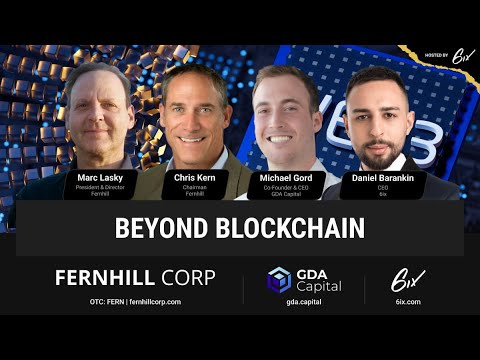
0:08 Hi everyone, I'm Daniel Berwick and I'm your host today, CEO and founder of 6. And it's my great pleasure to introduce our panelists at Beyond Blockchain. We have Chris, Mark, and Michael. In terms of today's panel, I just wanna do some general housekeeping real quick. First order of business is that this is a live interactive panel. So we're all here with you right now in real time. What that means is you can use the public chat and we will see it. You can submit questions to the Q&A. You can also submit questions into the chat and you'll notice that it'll probably disappear and move to the Q&A. All of these questions are going to be... We'll do our best to answer all of these questions throughout the panel towards the end. In terms of the format for today's panel, there are 3 main components. The first bit is to begin with introductions.
0:53 So everyone, all the speakers will have an opportunity to introduce themselves, their projects, and their thesis to the Web3 space. Then we're gonna move on to some broad panel discussions, mostly themes around the future of Web3. We're going to be looking at debates like C5 or C5, talking about things like the Bitcoin Lightning Network, exploring things like NFT decoupling from crypto, global adoption, compliance, metaverse, and B2B applications in the blockchain and various other themes as well, as I'm sure that the conversations will evolve. And then we'll move lastly into the open Q&A. And so With that bit of housekeeping in mind, I'll also highlight that you can access handouts. You'll notice in the handouts, we have a number of things you can download, including the 6th disclaimer of liability. If you want to understand our role in all of this, feel free to read that. Without further ado, let's jump right on in. Chris, I'll pass it over to you for a brief introduction about your role, Fernhill, and anything else you'd like to share with the audience.
1:52 Sure, thanks, Daniel, for hosting today and appreciate everyone for attending the live event here. So I'm Chris Kern, I'm the chairman and CEO of Fernhill. We are a Web3 and digital asset infrastructure company that focuses on digital asset trading, NFTs and NFT marketplaces. And we're really all about embracing the Web3 world and believe Web3 digital assets in the metaverse are literally a multi-trillion dollar marketplace that's in its early formative stages and we plan on taking a nice piece of that and growing the business going forward.
2:27 And with that, I'll turn it over to My colleague, Mark. Hi, everybody. Thanks for coming, as Chris said. Yeah, so just a little background about me. My background, I lived in Hollywood, California, for years. My background is in the movie, TV, production world, writer, producer, director, lots of commercials, infomercials. A few years back, though, I started getting the entrepreneurial bug and went out to try to raise some funds. I found an investor, and we ended up becoming a public company. So next thing I know, I'm running a public company. I learned a whole bunch about being public, being in the OTC markets. Cut to about 3 years ago, I got involved with Fernhill Corp.
3:07 Met Chris a couple of years ago, and we started talking, brought him on as an advisor, and created this direction that we're still very excited about in terms of crypto space, digital assets, NFTs, blockchain. It's something we believe is the future. And yeah, there's a little, you know, slide right now, but I think it's all shaking out and it's going to eventually, 2023, we think is going to be a very, very big year. So that's a little background and I'll hand it over to Michael.
3:39 Thanks, Mark. My name is Michael Ward. I'm a serial entrepreneur and investor. I've been focused on the mainstream adoption of digital assets for the past decade pretty much. I'm now one of the co-founders and the CEO of the GDA Group of Companies. We're focused across the digital asset capital market. So we focus on public offerings, digital assets, trading of digital assets, lending, fixed income of putting bonds on the blockchain, everything from metaverse to asset management. So yeah, pretty diversified across the digital asset common market. Happy to be here. Thanks, Daniel, for having us. Yeah, my pleasure. So the first thing I'd like to ask is, all of you are operating at some capacity in the Web3 space. What are you most excited about, and how are you taking advantage of the opportunity?
4:28 I'll throw it over to you first to kick things off. Wow, so I think that the most exciting thing is the fact that we're in a very early stages of a very large, massive market that's gonna see exceptional growth over the next decade. You know, If you look at some of the research reports that are out there, all the major firms are claiming that Web3 and digital assets are literally going to become trillion dollar industries.
4:57 And the fact that we can be in the forefront of that and participate in that growth to me is really exciting. It's like being involved in the internet in the early and mid 1990s, when that was just coming around. And here we are again with blockchain, web 3, digital assets and the metaverse. And I think just the opportunity is just incredibly
5:20 huge, of course, also very important. We're in a very critical time as a society and I think you know the things like the metaverse and Web3 are going to help us get through certain aspects of finance,
5:37 how people can control their wealth and manage their data and their identities. And I think being part of that is really important and very, you know, for the future. So that's my piece. Very cool. And Mark, I'll go over to you to extend on that idea but further. I would just like to add to that, that I think what's exciting about Web3 and where we see it heading is that users are gonna start controlling their ID and their data, whereas Web 2, the Facebooks of the world control your data, you know, monetize your data. I think Web 3 is heading towards much more decentralized and people can control their own data, their ID, and that's, you know, something I'm passionate about. I feel that's the future. And we very much look forward to being part of that and have lots of plans moving forward.
6:26 Cool. Michael? I think ultimately with digital assets, we're expanding on the Internet of Information and creating the Internet of Value, so all value will be interoperable, be able to transact share of the Mona Lisa, for a share of Apple, for a share of a hut, maybe not a hut, but for a share of a villa in Los Angeles. And I like the idea of democratized access to financial services and interoperability of everything. So that's kind of cool. Very cool. And so I guess I'll play devil's advocate here for a second and I'll make the bear case, which is we've seen a tremendous amount of capital over the past few years flow into the web 3 sector. We've seen a lot of promises and many projects come to some degree of success, but not fully transform or change the world.
7:22 What would you say to those that would say, you know, this was a phase for 2 years. It's over and done with and never coming back. What is the reason that you still believe? I'll throw it over to Chris. All right. I mean, just like any new burgeoning industry that's just coming around and figuring itself out. I mean, you could say all those very same things in the early days of the internet. You know, people didn't believe in it, people were wondering why, you know, and would want to do that. Even before that, you know, people were saying the same things about the personal computer or the mobile phone or whatever it is. So there's always this kind of technology adoption curve
8:05 where you have the early adopters and then it takes a while for technology to catch up for mass adoption and mass scale. And I also think, and especially when you're dealing with a very highly technical infrastructure and framework around digital assets and crypto and whatnot. There's an education curve, there's a technology adoption curve. I think it's just really a matter of having those kind of catch up and merge to a point where it can be massively adopted at scale, which easy on ramps. There's also, of course, the proper safeguards and frameworks in place to help really so people don't get hurt with what they're doing on there and the security is at the highest level.
8:52 But in respect to, you know, the potential, I think the potential certainly is there. But it's really again, it's there's a lot of elements that need to still merge together for it to really get to that level. And I think we're kind of seeing that first wave of the adoption curve. We got, of course, a few blowups that have taken place this past year, which didn't help things in any great shape or form. And then I think once the technology catches up to where it needs to be. We have a regulatory framework in place that safeguards people. I think you'll see some really amazing things happen very soon here.
9:27 Very cool, Michael, Mark, anything to extend? I would just like to add that I think, you know, digital assets and crypto and NFTs were definitely the gold rush of the last few years. And every time there's a gold rush, people rush to the industry, right? So there's millions of people coming to the industry, the gold rush, everybody's excited, we can all make money, it's easy money. And what that ends up bringing is, it does bring unfortunately some scammers, some nonsense products. But what we believe is ultimately those get shaken out. Those people are hopefully will be gone. And We look forward to real people, legitimate people continuing on because this industry is not going away. It's going to be here to stay and we're glad we're in it and we're waiting for this nonsense to shake out a little bit and we can move forward and build some great products.
10:24 Yeah, just to just touch on Mark, your statement for a second, then Daniel, go back to your question. But There's scammers in every industry. So the traditional capital market is not immune to scammers. And actually the biggest scam of all time is still Bernie Madoff's Ponzi. Commodities has scammers, technology has scammers, every industry has scammers. So crypto is not immune to that. The fact that Crypto is new
10:47 and as a result is less mature of a market. So people don't have as ingrained business partners, trusted business partners, perhaps makes it easier for scammers to also, you know, non-transferable transactions, potentially anonymous transactions make it easier for an easier playing field for scammers. But scammers aren't going to go away and are going to be persistent in any industry and anywhere where there's capital and ways to earn income. But Daniel, to your question about if someone is a naysayer today, I think that's 10 years ago. That, I think, would be an interesting discussion of whether or not this will work and would be worth some time to explain the thesis of why it might work.
11:37 At this point, it is working. So if someone is a naysayer sitting on the sidelines explaining how it's not going to work, in my opinion, then, you know, get it right. It is already working. So
11:47 that's the perspective that's at this point in the document is kind of ignorant.
11:54 Forgive me for anyone in the audience that's a naysayer, but as far as the potential, the use cases are already there. So they're not massively adopted yet in Western nations specifically, because in Western nations, we all have access to banking. But in El Salvador or in Argentina, there's actually a significant need for digital banking. And the fact that I can move money internationally instantly for free from Toronto to China, I can move a penny or I can move 1 billion dollars, that I have 1 billion dollars to move, but you can move an infinite amount or a minuscule amount instantly for free. That's already disrupting industries. It's just a matter of time for the rest of the world and particularly Western nations
12:45 for that to add tremendous value. Although if you're trying to send a penny to China from Canada, it costs $30. So I mean, it's already 1100 thousand X in that use case, more valuable to use crypto than CAD. Sort of more in the blockchain, in the bank, cause you could send CAD on the blockchain as well. Certainly, and I think it's actually it's really interesting, right, because we began talking about compliance and the regulatory frameworks and immediately we discussed this idea of adoption And it seems to me then from this discussion, that there's very close relationship between compliance, regulatory frameworks and global adoption. And so what I'd ask for you folks, I recognize that no 1 here is necessarily involved in the policymaking at this stage or as a lawyer. However, what I would ask is, what are your views about the regulatory framework and the ways in which governments can either accelerate or decelerate global adoption?
13:49 I'll take a stab at that one. So I think you're already seeing, you know, multiple countries, you know, create their own central bank, you know, currency or central bank, you know, coins. I think that's a first off where they're definitely embracing the notion of creating a token that's a form of value and can be transferred just like money and adopted into the mainstream of business and life.
14:16 In terms of more of a regulatory framework, and I think, unfortunately, the United States is one of the lesser established countries with a solid framework in place or any guidance in that respect. We have other countries like the UK and several others that have more established framework in place. But I think once those are put in place, it gives people comfort that there's a certain way of doing business and it's gonna safeguard
14:46 their hard earned money and their investments. And there's gonna be certain operations standards that these companies need to abide by in order to participate in the industry. Just like you have with traditional financial services, whether it's equities or bonds or FX or what have you, there's a whole wide range of policies and procedures and laws and rules and things that need to be done to safeguard people's assets and safeguard their investments. And also have a certain kind of order of conduct that must be done when onboarding a new client, things like that. Yes, we have, you know, KYC and AML laws and, you know, most of the exchanges and, you know, platforms out there are adopting those, but they need to really be put in place on a much deeper level.
15:34 And then I think big things like, how does an exchange work, a centralized exchange,
15:41 where they're taking people's money, they're trading their tokens and whatnot, the people don't actually have their tokens, it's not their keys per se. I think that's one of the first areas where some regulatory guidance should be put in place. FTX is a prime example of that blowing up because there wasn't any safeguards or a framework in place. And then, you know, taking that further and defining things like what token is a security, what token is a commodity.
16:11 Those are, you know, very basic kind of formative and, you know, fundamental issues that still have yet to be defined. And I think once we do, we'll have a really, really big, you know, jump into the market, both individually and even more so institutionally.
16:30 I guess I would just add that, go ahead Michael, you go first. I would just add that, yeah, I think regulation of some sort is coming. We're not sure what it's going to be. Unfortunately, a lot of people in Congress are pretty clueless, especially when it comes to digital assets and crypto. But I am encouraged by Senator Cynthia Lummis, is her name, from Wyoming. She's really taken the lead in educating Congress as to why they need to take crypto seriously and look at it properly, not just say it's bad, it's bad. It's actually got some great use cases and it's something that they need to take seriously. She's done a great job. I'm really supporting her and watching what she's doing and she's doing a great job educating Congress though. I'm hopeful that they'll do the right thing, you know.
17:21 Yeah, just clear goalposts. Regulation, I think, certainly has value. Unclear regulation pushes businesses out of countries like Canada or the United States that have unclear regulations and it pushes them into jurisdictions that do have clear regulations like Switzerland, Singapore, devisement pro, offshore jurisdictions, the unfortunate part of regulations or unclear regulations
17:44 in Canada aside from it pushing businesses like mine out of the country and further operating outside of Canada instead of continuing to hire Canadians in Canada, is that the jurisdictions that are faster to move are oftentimes unregulated, which is not much better. And then you end up with situations like FTX, where there's a multi-billion dollar global conglomerate that is structured in an unregulated jurisdiction and $10 billion of customer funds get stolen. So I think it's pretty bad for Canada, especially, to be slow.
18:35 Canada had, I think, Ethereum story is the best Canadian entrepreneurial story I think ever, aside from the Royal Bank of Canada. And I don't even know what the market cap of RBC is. I wonder whether it's more than 500 billion, more than what Ethereum was at the peak. So the fact that you have, you know, one of the smartest kids ever, building 1 of the biggest businesses ever in your country and you fail to create an economic regime and a regulatory regime that keeps them investing into the country is kind of unfortunate, but hindsight is 20, 20, it is what it is.
19:14 Certainly, I think there was some very, very interesting perspectives here. B. Hastings submitted a great question, which I think flows all with this discussion, which is, do we think governments will ever try to push against crypto on environmental grounds? What is the risk profile there?
19:31 What are your thoughts? Sorry to interrupt, but I just looked up the market cap of RBC and Ethereum had a, I think higher market cap than RBC at the peak. Actually it still has a higher market cap than RBC at the peak and that business now has 0 operations in the country. But yeah, that's what we want today. So on the theme of continuing with regulation, a regulation that pushes operating companies out of the country. Do we think global governments will ever try to push against crypto on environmental grounds? What's the risk profile there? I think we've already seen that take place in China for sure. I mean, they pushed out all the miners in most respects or shut them down or put special restrictions and regulations on them. And we saw a whole massive move out of China for mining operations. We saw anti-miners flood the market at massive discounts.
20:35 So I think yes, governments will certainly play the environmental card, however warranted or not. We've already been hearing certain groups and senators or what have you, you know, praise Ethereum for going to proof of stake because it's quote unquote environmentally friendly.
20:54 And so I think, you know, there's certainly some pieces there that have to be contended with. But I think, yeah, the environment is a big concern. It's a massive concern. It affects everybody worldwide. I think though, you know, we need to look, stand back a little bit more and address it more carefully as well as really understand the data and the facts around it. You know, just because it sounds good and people are saying it, doesn't mean it's necessarily true. So I think in light of that, yes, governments will impose their environmental initiatives on any industry that they can, and I think crypto will be one of them. I think you could
21:34 safely assume that the CCP is banning something. It's probably actually a good thing. Not that they ban it, but it's a good Whatever they say, it's the opposite, basically. It's obviously they weren't doing it for environmental reasons. They're the biggest polluter in the world by far. There's not even a second place. So yeah, I think I'll leave it at that. Yeah, I think it's a fallacy, a logic that Bitcoin and digital assets are more energy intensive than the existing financial system that cuts down trees to print paper money, uses cars all around the world and armored vans to transport that paper from one place that has tons of printers, heating, electricity, all that stuff, to another place that has heating, electricity.
22:29 So I think that, I mean, if you add up the energy efficient or the energy cost of Visa, MasterCard and every bank in the world, it's gotta be drastically higher than digital assets. And the ability for digital assets to all of a sudden become green is as simple as miners paying 0.x percent of every transaction to a carbon negative plan. It's a simple shift
23:02 in protocol. Whereas for the traditional financial system to all agree on a go green strategy is, I think, more complicated than rocket science and is like impossible to actually execute on because it becomes a prisoner's dilemma. It's game theory. If 1 bank doesn't do it, then they're gonna, anyways, I think that it's a fallacy logic that the digital assets are more energy intensive. And I think it's a smear campaign from the banks that are concerned the fact
23:34 that blockchain technology is eating their lunch from all sides and they're trying to slow down the growth and the progress. Absolutely, I agree.
23:47 I think some very interesting perspectives. Going back to some of the earlier discussions where we talk about and looking at some of the decisions that are being made by governments, by corporate entities, there seems to be a sense that everyone wants to have their own network. So in the case of central bank digital currencies, the argument is, well, we're a country, this is our network already, we can just launch a crypto and build it out. What's interesting and what I want to lead into is the idea of where does crypto go from here in terms of things like NFTs, metaverse, and in particular B2B applications. Do we imagine, for example, in the future that global companies, let's say Disney as an example, are going to be launching their own NFTs on their own chains or will they be using a singular unified chain? What are your views about this and why?
24:46 Go ahead, Michael. I think that question is like asking is Disney going to create their own Chrome extension, like their own browser and their own programming language, or are
25:04 they going to use Chrome and Safari and Mozilla? I think the answer is if they're smart, then they realize, wow, Chrome, big business. Google, big business for fast market, and we can have a market share of the search business, that's bigger than our entertainment business. But there's only room in the market for 10 search engines, and only the top 5 have any real market share. And there's only enough market share for 10, 20 programming languages. And there might be a lot of others, although a little bit different use case because with programming languages it's difficult to monetize, whereas on the blockchain programming languages protocols, you can earn, you can create a market capitalization of the network and require people to hold the token to use as transaction fees and stuff.
26:07 But yeah, will Disney create
26:13 their own protocol? If they did, then they could put every Disney application on their own protocol natively and then they could migrate it to every other protocol. But I mean, the future of protocols is like Chrome extensions, or not Chrome extensions, is like browsers. If you're making a website or you're making an application, you're not thinking, do I make the application usable for Chrome or do I make it usable for Safari? You make it usable for the internet and it becomes 1 line of code to make sure that it's added to other programming or to other browsers.
26:54 So, yeah, I think that I think companies like Disney will be slow to create protocols. Will they make a metaverse? So, like, Will they put their assets on the blockchain's NFTs? 1000 percent. We've had conversations with Disney and a lot of companies like Disney about their blockchain and metaverse roadmap. And Metaverse is certainly on every enterprise's roadmap these days. Although the Metaverse and NFTs is less, like digital currencies becomes competitive to banks. In theory, Disney could issue a stablecoin that is backed by the Disney billions of dollars of reserves.
27:40 And all of a sudden, Disney becomes a bank and challenges the US dollar. They could ensure that or they could encourage their customers, their employees, their suppliers to hold their digital dollar, to get paid in their digital dollar to earn additional value or discounts or whatever in the Disney network. So that also would add tremendous value to a company like Disney. Will Disney be first or will Twitter be first or will Facebook be first? Which company is going to be first? I think that it's inevitable that
28:15 Facebook and Twitter become banks and issue currencies that stable coins and loyalty coins that challenge the currencies of today. Facebook has more users
28:32 than the United States. So Facebook turns on a digital dollar, they become the biggest bank in the world by users. It becomes the most widely used currency in the world by users, aside from maybe the Chinese yen Or the US dollar, I guess people use the US dollars globally. And yeah, I mean, I think that all value will be on the blockchain, same as how all information is found its way to the internet. And as soon as information has value, then there's a website for it or there's a web page for it. All value will find its way on the blockchain one way or another.
29:06 Thought of a good name. I was listening to you. I thought of a good name for the Disney dollar. They could call it the Donald Buck. Nice. Nice. Yeah. To expand upon that now, that was awesome, Michael. To expand upon that, yeah, I think there's just massive, massive, multi-trillion dollar use cases and business cases for NFTs and the metaverse. I think, you know, if you look at traditional finance, honestly, where that is going is into the NFT space. Transactions, anything that's going to be sold will be tokenized and connected to a blockchain. There'll be an immutable record of that transaction of that asset. It'll be easily transferable. It'll be easily traded in Solon exchanges or private trading venues like an ATS.
29:57 And you'll see more and more of that come around as we go forward here. And that's actually a big part of what we'd like to see is our future vision with our DigX NFT platform is really getting into the tokenization of assets and high quality investments, whether it's commercial real estate, high-end art, collectible cars, expensive wine, or part of a villa in the Swiss Alps, you're going to see more and more business and financial products be tokenized and be part of a blockchain. And then of course, once the metaverse develops further and becomes more of a mainstay place where people can hang out and do
30:40 their thing, you'll see, you know, kind of a marriage of NFTs into the metaverse, where you'll just see an explosion of utility on both sides. And I think that will be literally the marriage of $2 trillion industries in the forefront of what's happening. And so I think in that respect, you see massive market opportunity in front of us that we, all of us here want to take advantage of as much as we can. And in terms of companies utilizing or creating their own protocols or their own blockchains, I think there will be certain use cases that does take place. I mean, I think they'll use their existing blockchains out there, whether it's Bitcoin, Ethereum, Polygon, Cardano, or whatever.
31:30 I think they'll be leveraging existing blockchains that are already established, are already well maintained, already have a very strong following, already have a lot of liquidity in the marketplace, and just launch their own token on that blockchain versus trying to create their own. I think anyone trying to create their own blockchain understands and knows that there's a lot involved with that. It's a fairly expensive
31:54 and time consuming endeavor to create that and maintain it on a go forward basis, unless you spend the time and effort and money to create a strong community around it that could help manage it and maintain it more on a decentralized basis. But then, in terms of most of these brands, they want to have control. They want to have brand authority. They want to have their value stake to that. And so I think if anything is done, it's typically going to be done on a more centralized fashion around that company and around that brand. So that's just my piece on that. Thank you, Grace. I thought this panel, each of you have touched on themes like interoperability, the portability of identity and tokens, and the resounding belief that we're really at the early innings of what is ultimately going to be a world changing.
32:45 And so we have a great question from Brittany Huey asking, you know, given all of these things, why is there
32:52 a steep learning curve to the buying and selling of digital currency and assets? You know, this is missing out on a large market of non-tech savvy people. It's so obvious to us yet most folks aren't using it. Why is there that steep learning curve and do you have any views around how to resolve it?
33:15 I think it is still a little bit of a barrier to entry, and that's something that's, it takes a little bit of effort and knowledge and know-how to enter. So a lot of people are just like, I can't figure it out, it's not for me. And then the things that get reported in the mass media are that NFTs are selling for 1 million dollars for an image of a monkey or ape, and people are like, what the heck is that all about? And so, you know, they just don't really understand and the actual use cases, the utility of, for example, NFTs And it's way beyond, you know, they're just looking at it from the surface level, not really getting deep enough to educate themselves. And ultimately that's gonna happen. You know, people will get educated. A lot more people will come on board as they realize that actually are really great use cases. And there really is a, it's not just some scammy industry.
34:04 It's, it's really real. And it's really got like real estate. There's so many proof of ownership and NFTs, things like that, that are really, you know, really valuable and will absolutely improve everyone's life and improve the world, I believe. So that's what I think is coming in the near future. Yeah, and I think the real, I'll say there's probably 3 top things that really will help foster mass adoption and we'll see that big upswing in use and exposure to the market. One of course is interoperability. Right now there's a decent lack of that. I mean there are technologies and protocols that help with that but they haven't gone mainstream per se. So I think interoperability is a big one. I think, you know, for the general user, easy on ramps, I think is also another thing. Yes, you have things like MetaMask and you have exchanges and now you have, you know, DeFi places that it's easy to get to, but it's still, you know, fairly complex.
35:06 So I think simplified, easy access is a big thing. And then the third one is just really, as I mentioned before, you know, having those safeguards in place and security in place where if you get in, you don't feel, you're not worrying about, am I gonna get my token stolen or is someone gonna hack my wallet? So I think having the proper security and safeguards in place is really gonna help. So once all those 3 things kind of come together, which I think we're literally right around the corner from, I think, 2023 is going to be a big year for that. I think we'll see a massive upswing. But until those 3 things are solved, I think there'll still be some hesitation for people to really come in mass and really jump into the crypto web 3 and metaverse space.
35:58 Yeah, I think also business models need to be more fleshed out. So in any new industry like internet for example, when there was 1 million monthly active users of the internet or even 5 million, 10 million monthly active users of the internet, businesses like Pets.com famously failed not because it was a bad idea and actually Pets.com now is probably 1 billion dollar business just for the domain. Not only is Pets.com 1 billion dollar business, but Pets.ca is probably a $70 million business. Dog.com is probably a $70 million business. Cat.com probably a big business, animal.com, big business, catfood.com, probably at least an eight-figure business. Business doesn't need to be, because as we've gone from 1 million monthly active users of the internet, when a lot of businesses famously failed, to 1 billion daily active users, or billions of daily active users.
36:54 Business models that initially were not that they were wrong, but just there weren't enough users or eyeballs to justify the business models. So they didn't work out in the short term and the businesses didn't have enough runway to prove their thesis accurate. I think we're seeing the same thing in digital assets. I mean, actually, fungible tokens, certain business models have achieved enough scale that their institutions at this point, unless they're fiscally responsible, NFTs in the metaverse are a bit newer, but even businesses like Decentraland and Sandbox that have I don't know if they have 1 billion dollars at the moment, but certainly hundreds of millions of dollars in their treasury, their interest on their treasury covers their bills, unless they're fiscally responsible. So those businesses aren't going anywhere in just a matter of time until they continue to be adopted.
37:53 If you look at the numbers for the metaverse, for example, but NFTs are even more exponential. But I'm just going into the metaverse because someone asked a question about whether real estate can be profitable in the metaverse. The simple answer is yes. I've got about 20 tenants that pay me monthly to rent my space in the metaverse, including businesses you've heard of like Skechers Forever 21, Dolce & Gabbana, KPMG, the United States Postal Service, or not the UPS. I don't know what the abbreviation is for that. But so yeah, certainly profitable to own real estates and there's a lot of new business models that are gonna be created. But if you take a look at the numbers, Last February when Decentraland came to market, there was 15,000 monthly active users, which is basically 0. Today, a year and a half later, there's maybe 1 million monthly active users of the entire metaverse, like the dozen plus metaverses that exist, which is still a very low number, and still a small enough number that the economics are, there's not a huge amount of commerce happening, but if that growth continues, actually if 10% of that growth continues, then by the end of the decade, there will be over 1 billion daily active users of the metaverse. Or maybe I'm wrong and it's 2 years later, but it's certainly worth thinking about now and looking into and investing into.
39:17 Very cool. And touching on that subject, how do you think the inclusion of Web3 has benefited educational and industrial development? This is a question from Adam in Mexico. Can you repeat that? How did, how did, how does Web3 benefit education and what? And industrial development. Industrial development, I'm not really sure what you mean by that. But education, gamify networks. So democratize access to education. So you'll be able to have classes in the metaverse. We've already hosted conferences in the metaverse where we have family offices participating, which if you're someone like, let's say from Zimbabwe that doesn't have the good fortune of being able to get on a plane and go to a conference, a capital markets conference in Toronto or New York or London or Zurich or Monaco or wherever, and you can go into the metaverse and firstly hear the people speak, but I would say more importantly, connect to the other people that are also interested in the subject matter and also might not be able to...
40:28 To show up in person is quite elite anywhere in the world. Not everyone has that luxury, but if someone from Zimbabwe, someone from Brazil, someone from Australia, from Bangladesh all connect at a capital markets conference in the metaverse that they're still developing a global network of people that have similar thoughts and are similarly on trend. So that's pretty cool. But also, I'm really bullish on a learn to earn model, learn and get paid, or learn and earn a token that gets you food. So instead of for a lot of people that don't have the fortune of education and need to spend their days trying to earn a couple of dollars to buy rice and maybe an egg.
41:22 There's business models that are coming to market now where learn, spend your day learning, and in the background, the food and stuff is sorted. And if you finish the class, then you're educated and you can find a way to earn actual income. And I think also, yeah, expanding upon that, if you really kind of break it down, the metaverse is truly an exponential technology. It demonetizes, it dematerializes, it democratizes. So it really kind of opens up all the resources to the world. It takes away costs, it takes away the need to be someplace physically. And so, you know, when you do all those things together in a very simple, you know, format, where you just literally need a browser and a wallet to get in and participate.
42:20 It really, really opens the doors for exceptional things to happen. And that's certainly on the education side. I think there's, you know, People have access to more education more freely. I think that's huge, especially for underdeveloped nations. And I think also, even on the industrial side, having access to information, designing products together in a collaborative environment, being able to see and experience it in a metaverse or a virtual type world. I think that's all really gonna be part of what we're looking at going forward is where, again, it becomes this exponential technology and exponential experience that really can elevate education and sharing and access on a more universal basis.
43:16 Very cool. Zooming out of the metaverse side and going back on the Bitcoin side, Kirk Stewart has a really interesting question. He asks, what happens when the halving cycle makes it uneconomical for the majority of crypto miners to mine Bitcoin. Is there going to be a mass exodus in a couple of halving cycles? Because as an asset, there is a concentration of large holders of Bitcoin specifically. Perhaps one last bull run and an exit of the early adopters. What do you think? Yeah, I think it's a great question. I think in terms of mining versus staking, I think the yield story is much more favor in staking.
44:02 And there's, I think, a lot more options out there. With mining, you got to deal with equipment, you got to deal with the declining nature of the algorithm and how your yield decreases over time as the algorithm gets more harder to perform tasks or what have you. So I think it's not necessarily going to be a mass exodus per se. I think it's just going to be just a matter of attrition by way of yield opportunities. So It's a yield question. And I think you'll see as some of these protocols get through their end cycle of the yield curve, you'll see people taking better options, whether it's another token that's gonna be mined or more preferably a staking token or some other platform or methodology of proof.
44:56 If there's a better yield opportunity and it costs less to participate, or you don't have to worry about setting up a rig in a data center or what have you, they're going to take the least pressure and go for the better yield play. Right. So I think it depends on what the price of Bitcoin will be at that time, which I believe it's going to continue to go up. Some people might disagree with me, but I think it'll be worth it for miners to continue to mine Bitcoin as the price increases over the next few years. We will see. Incredible. Thank you. Now, we have a number of questions that are specific to Fernhill so I'm going to touch on some of these But just for the sake of the dialogue, what I'm going to do is I'll ask all of the questions all at once, and then I'll throw it over to Chris and Mark, and then we can move back to more of the panel-specific themes.
45:55 So the questions in summary are, can we get an update on the state of the Q4 deliverables? Are we still on hypergrowth, and can you project future revenue based on hypergrowth status? Can you reconfirm the verticals currently generating revenues? How close are we to the completion of the audit? Where are we with uplisting and are there still plans for Q1 uplisting? Wow, that's a lot of questions. So as people, I'll deal with a couple of those. Number 1, as you guys know, in any of these events, we can't talk about projections. We never will. It's just not good form to do that. And we don't want regulators on our butts about it. So we're not going to talk about projections or forward guidance in that respect. But you know in terms of uplisting, yes we do intend to uplist. As you may have known the IPO markets have been decimated along with most of the other markets and crypto market this past 08:10 months.
46:50 I think going for an uplisting while the market is as soft as it is, is probably not the best decision. If you've seen, if you know anything about the IPO markets, you know, literally hundreds and hundreds of listings and new issues in Uplist have been pulled just because of the market's not there for it. And so we're going to track where the market is in that respect and we'll do that when it's appropriate and we have all the pieces in place to Uplist to a senior exchange. In terms of where our focus is, we are still focused principally on the main block platform. We think there's a massive growth in revenue opportunity there. That's been the principal force of our revenue to date. We still have the DigX platform. Again, the NFT marketplace has been pretty tough beaten up this year.
47:41 We will be pushing that out on a more higher level next year. But I think for now we're basically doubling down on digital asset trading and, you know, that business aspect of what we have. Mark, do you want to cover anything else? Yeah, it's as Chris said, it's been an interesting year. But we're very, I think today is, we were talking earlier, today's the winter solstice, which is the shortest day of the year. So I predict that things will get brighter and the sun will be out longer and things will start coming together. We're in this for the long haul, and it doesn't have to be done tomorrow. But we are plugging away and working hard and lots of very interesting things we're working on that we'll disclose at the right time.
48:29 But yeah, we're very excited, and we're not dissuaded by the slow last several months. We're just it actually gives us more, you know, push to to get things going for 2023 and beyond. That's that's that's my story. Now, Given how tightly connected crypto and Bitcoin in particular and Web3 are, what do you think about the current Bitcoin price? Do you believe, Kyle Jones asks, do you believe Bitcoin was overvalued when it peaked or is today's level a more realistic price point and what are your thoughts about the future? Who are we asking that one? Michael, you want to take that one? Well, I could be alone on this, but I think a lot of people do believe that Bitcoin is heavily undervalued right now.
49:23 And I believe that it is. I think there was an article I read by Fidelity a couple of months ago that said it could easily be 1 million dollars a coin by the end of this decade. I think you know here's all I say you know I question people say when they question Bitcoin how is it a real source of money? I say well how is fiat a real source of money? If you keep printing it, there's 0 value. It's 30 trillion plus in debt. How's there any value to fiat currency? That's the risk. So yeah, well, so I think that, but ultimately, you know, I think because of fiat, this keeps going deeper and deeper and there's no plan to cut back on budgets and try to balance the budget.
50:09 All I would say is we need a plan B in this world. And I think Bitcoin could be that plan B. That's why I'm a Bitcoiner at heart. If you look at a logarithmic chart of the growth of Bitcoin relative to the halvings each year since it started. It's 100% in line with the logarithmic charts, which I'm going to share in the thread in a second. I have no reason to expect that it's not going to continue to just like that. I actually can't add stuff.
50:57 Maybe, excuse me, I'm gonna share my screen for a sec. Yeah, I think it dramatically increases, right? Prior to having, right? Usually the year or 2 before. Yeah, I mean, it just has been in this logarithmic trend since it started. All time lows have always been the same. The all time highs have always been the same. So it's looking like by next cycle, which is 26, the high will be 1 million bucks. Take that, do your own research, not financial advice. Very cool, so folks, we're now towards the end of the panel. And so I'll move to the closing remarks. And what I'll do is I'll pass it over to each of you to give a final closing remark to leave the audience with. Chris, over to you.
51:59 Yeah, I mean, I think, you know, where we are in terms of the industry of Web3 and the metaverse, we're literally in the very, very, very early stages, similar to where the internet was in 1995, 96. I think crypto and Web3 Metaverse, it's a much higher velocity business in general, because now we have full access to the internet, and it's a much wider audience already partaking in it. So I think we're literally at the dawn of multi-trillion dollar industries. And we're just super excited to be part of that and really want to go forward and create great products that people love and can use and also just create value for our shareholders. And I think being part of this industry is just a great place to be at this point, even though we've had a few ups and downs regarding the industry and things like FTX happen. It's just part of any industry.
52:53 You can look at any industry over their years, especially in the earlier formative years, and you'll see that there's always some pain and carnage. That's part of the process. That's part of a cycle. It's part of the early adoption of what the industry is all about. I think as we go forward, it's just going to get better and better. Just happy to be part of this all and really appreciate everybody being here and joining us today. I would just say, you know, reaching out to our shareholders, thank you for your patience. And we understand there are frustrations over the last few months. Things aren't maybe progressing as quickly as we all hope, but ultimately we're in for the long haul. We're not trying to please day traders here. We're in for the long haul and the best time to get in is when the price is low. I think it's a great investment to come on board right now because we have a lot of very exciting things we're working on. And again, as I said earlier, we're not going away. We're in this for the long haul. We believe the industry is not going away. It's going to continue to grow.
53:57 And so we're in this for the long haul. We're excited. And come along for the ride. Concluding statements, still the beginning of the next, I guess we're under 1 trillion, but certainly multi-trillion dollar market, all assets will find their way on chain, just real estate's multi-hundred trillions, eventually that's all going to be on the blockchain. So we're at less than 1% adoption, growing from less than 1% to 100% adoption is going to happen faster than we think, and it's going to be exciting for everyone that contributes. I encourage everyone, if you're not contributing, to think about how you can contribute to good industry to be a part of.
54:45 Well said. Awesome. Incredible. Stephen Godfrey from the chat says, great discussion and I'm inclined to agree. Chris, Mark, thank you so much for joining us. I think this has been a really interesting discussion and we touched on a number of different themes. And thank you to everyone in the chat for asking your questions, you're what made this discussion really come to life. With that I'll close the conversation for now and please be sure to join future events especially featuring Vern Hill and GDA Capital and others. With that, Have a wonderful rest of the day.