Jorge Flores
COO
Replay available
Amplitech Group (NASDAQ:AMPG) Q2 2026 earnings call, held 2026-08-13. Watch the replay and read the transcript on 6ix.
On 6ix: 6ix.com/event/amplitech-group-inc-ampg-q2-2026-earnings-call
Automated transcript · Written by software from the replay's audio. It can mishear names and figures; the replay is the record.
0:00 Good day, ladies and gentlemen, and welcome to Amplitech Group's Quarterly Investor Update Call, where the company will discuss its Second Quarter twenty twenty six Financial Results. Present in this call, we have the executive team of Amplitech Group, Pawat Bhattvoh, CEO, CTO and Board Chair George Flores, COO Luisa Sanfantello, CFO. At this time, all participants are in a listen only mode. Later, we will conduct a question answer session and instructions will be given at that time. As a reminder, today's conference
0:32 call is being recorded. I would now like to turn the call over to Amplitech's COO, George Flores. Please go ahead. Thank you, operator. Thank you for joining today's call to review the Amplitech's second quarter twenty twenty six financial results, review of our company's outlook and to answer investor questions. Following initial management comments, we will open the call to investors' questions. An archived replay of today's call will be posted to the Investor Relations section of the Amplitech's corporate website. This call is taking place on Thursday, 08/13/2026. Remarks that follow and answers to questions may include statements that the company believes to be forward looking within the meaning of the Private Securities Litigation Reform Act of 1995.
1:21 These forward looking statements generally include words such as anticipate, believe, expect or words of similar importance. Likewise, statements that describe future plans, objectives or goals are also forward looking. These forward looking statements are subject to various risks that could cause actual results to be materially different than expected. Such risks include, among others, matters that the company has described in its press releases and in its filings with the Securities and Exchange Commission. Except as described in its filings, the company disclaims any obligation to update forward looking statements, which are made as of today's date. With that, let me turn the call over to our CEO, Mr. Fagwan Macphault.
2:08 Thank you, George. Good afternoon, everyone. Thank you, everyone, for joining us today. Second quarter was an important period in Amplitech's continued transformation and growth. We recognize that investors will focus on our total revenues, gross margins and total expenses and bottom line results. We want to address those items directly and more importantly provide our investors with additional color behind the numbers. Investing ahead of growth. Our second quarter results reflect both meaningful progress across our underlying businesses and a deliberate increase in investment as we position Amplitech to pursue and support significantly larger opportunities across five gs, telecom infrastructure, satellite communications, semiconductor technologies and other advanced communications markets.
2:59 Establishing a meaningful and sustainable position in the telecom infrastructure market is neither easy nor accomplished overnight. It requires a significant technical expertise, sustained R and D investment, product development, testing, certifications, customer qualification and ultimately, the ability to perform at scale. We believe the investments we have made in these areas have been instrumental in the progress Amplitech has achieved and are an important part of building a durable competitive position in this large and expanding market. While these investments impacted near term profitability, we believe they should be viewed in the context of the larger opportunity we are building toward.
3:46 We are encouraged by our strong revenue performance and equally important by the continued commercial and technical progress we are making in markets that historically have presented substantial barriers to entry and were only for the industry giants. There are no shortcuts to building a lasting presence in the telecom infrastructure. Our strategy has been to invest in the technology deliberately, people, the capabilities and customer relationships necessary to compete for increasingly meaningful opportunities and to support them successfully as they scale.
4:23 We remain focused on disciplined execution, converting our technology investments into commercial opportunities, expanding our customer base, scaling the revenue responsibly and improving operating leverage as the business grows. Our long term objective is to build Amplitech into a significantly larger and more valuable communications technology company, and in doing so, create substantial and sustainable value for our shareholders. This doesn't happen overnight, and it takes a lot of resources to put all of this together to compete with the giants that we are in. Q2 was, in many respects, a quarter to invest in the future growth of Amplitech Group. We invested in customer driven R and D, customer driven, supply chain resilience, production readiness, strategic sales and marketing, specialized personnel and outside expertise, cybersecurity and IT infrastructure, internal controls, and the organizational capabilities required to support larger customers.
5:30 Building the commercial organization. We also increased our investment in sales and marketing during the quarter. The 10 Q reflects increased marketing and business development activity, including additional industry trade shows, expanded promotional initiatives and hiring of two senior business development representatives to support the company's expanding five gs Open RAN commercial strategy and our five gs product portfolio. To establish our brand and position us for growth, We've engaged a strategic marketing and communications firm also, whose principals have deep experience in complex industries. They're building our marketing and communications foundation from the ground up. They already over hold our website and messaging, and they'll be assisting us with sales campaigns, rebuilding the e commerce portion of our site, strengthening our SEO, and building the brand equity that positions us as a leader in the market. We recognize these as essential ingredients, especially the website, to portray an image that we really need to show our investors.
6:37 Historically, Amplitech has been a highly engineering driven organization. As our product portfolio and addressable markets expand, we believe we must put an equally capable commercial organization around the technology we have developed. The objective is not simply greater marketing exposure. It's to improve access to strategic accounts and convert technology validation, customer engagement and engineering activity into commercial opportunities. We believe that next stage of Amplitech's evolution requires both technology leadership and market access. With this, I'll turn the call over to our CFO, Luisa Sanfretello, to review our financial results in more detail. Thank you, Fuad. Good afternoon, everyone.
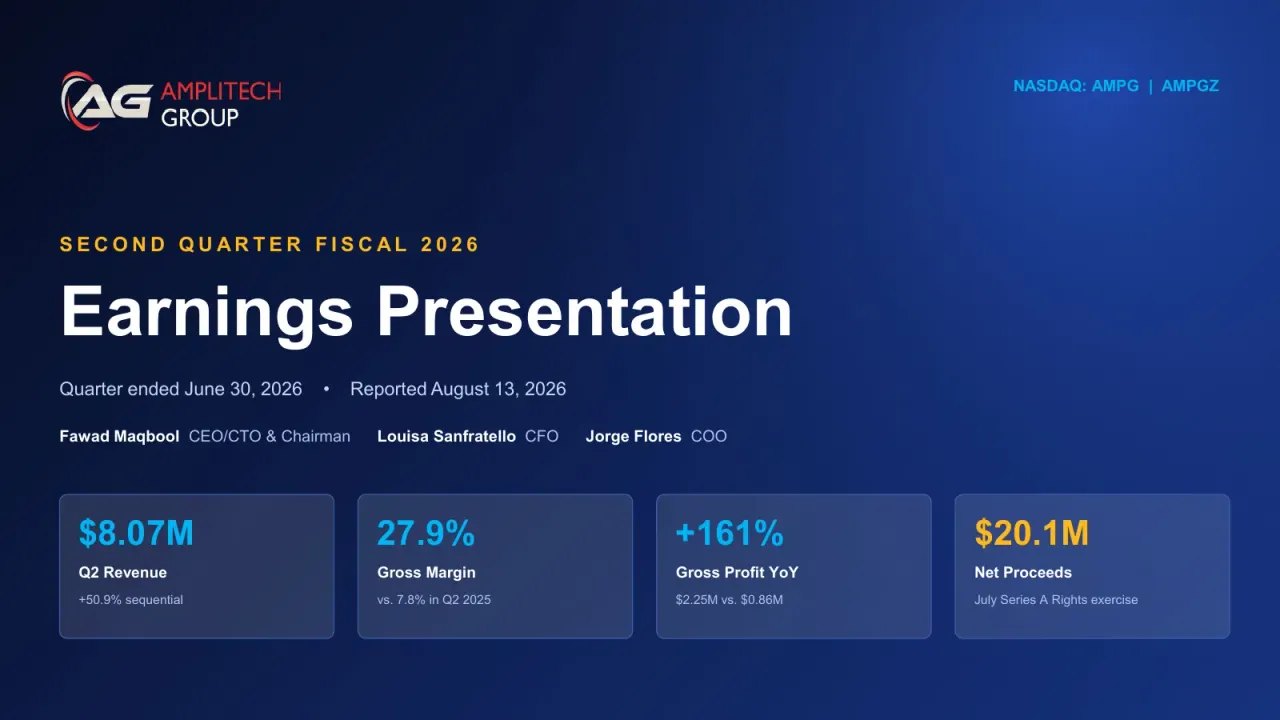
7:26 Second quarter revenue was approximately $8,100,000 compared with approximately $5,350,000 in the first quarter, representing sequential revenue growth of approximately 51%. Although revenue declined year over year when comparing second quarter results, the comparison requires important context. The prior year quarter included acquired five gs product sales associated with the Titan Asset acquisition. Those sales increased reported revenue but carried significantly lower gross margin. The difference can clearly be seen in our gross profit performance.
8:13 When comparing gross margins from Q2 twenty twenty five and Q2 twenty twenty six, this year's second quarter gross profit increased from approximately $863,000 to $2,250,000 an increase of approximately 161%. Gross margin increased from approximately 7.8% in Q2 twenty twenty five to 27.9% in Q2 twenty twenty six. For the first six months of 2026, gross profit increased approximately 135% from $2,050,000 to 4,820,000 while gross margin increased from approximately 14% to 35.9%.
9:10 The 10 Q attributes this improvement primarily to a more favorable product mix and the absence of the lower margin acquired five gs product sales included in the comparable prior year period. Sequentially, gross margin decreased from approximately 48% in Q1 to approximately 28% in Q2. We believe investors should consider this in the context of quarterly product mix and our current stage of commercialization. At our present scale, individual customer programs and product mix can have a significant effect on quarterly margins. More importantly, as we prepare to support larger customers, we are incurring costs associated with production readiness, supply chain capability, product development, and customer specific requirements ahead of the full revenue contribution we are seeking from those programs.
10:11 Our longer term objective remains to increase the contribution from our differentiated internally developed technologies and higher margin product offerings as those programs progress toward commercialization. In line with what our CEO just shared, our S and G expenses increased to approximately $4,080,000 in Q2 twenty twenty six compared with approximately $2,130,000 in Q2 twenty twenty five. This increase relates primarily to higher parent company expenses, including amortization, legal fees, and stock based compensation, together with greater investment in marketing and business development, additional trade show participation, and expanded consulting resources supporting the company's five gs portfolio.
11:04 There was additional strategic context to that we believe is important for shareholders. As we engage with larger M and Os, the telecommunication infrastructure providers and enterprise customers, their expectations extend well beyond the product performance. These organizations increasingly expect suppliers to demonstrate strong internal control, cybersecurity practices, IT governance, operational resilience, and infrastructure necessary to support larger deployments. Accordingly, we have engaged specialized consulting resources to further strengthen our SOX related controls and protocol, cybersecurity framework, and ISO aligned IT security practices.
11:57 We are also transitioning toward a hybrid IT infrastructure model, combining appropriate internal resources with specialized external expertise. Our objective is to improve security, redundancy, scalability, and technical support as the company grows. These initiatives are also relevant to enhance written documentation of internal controls and procedures, information technology, general controls, and personnel resources necessary for appropriate segregation of duties. We therefore view these required investments as critical, both from a corporate governance standpoint and from a customer readiness standpoint.
12:42 We expect operating expenses to grow more efficiently than revenue going forward. Certain elevated expenditures were associated with implementation, consulting, customer development, commercialization, and infrastructure initiatives undertaken as we prepare the company for a larger scale of operations. Some ongoing investment will clearly remain necessary. We intend to continue investing where management sees an appropriate potential return. However, our objective is to build the infrastructure now and leverage that infrastructure across a substantially larger revenue base. That is where we believe future operating leverage can ultimately come from.
13:32 Second quarter R and D increased to approximately $1,370,000 compared with approximately $659,000 in Q2 of twenty twenty five. Of Q2 R and D, approximately $1,080,000 related to five gs development and approximately $297,000 related to mimic design. As stated on our 10 Q, this increase is primarily due to the expanded five gs product development activity, including higher prototype and testing costs and increased consulting expenses supporting product innovation and development. From an operational standpoint, this quarter also required increased engineering support for new and customized requirements from existing and prospective customers.
14:25 This is an important distinction. As our engagement with larger customers increases, those customers may require specific configurations, prototypes, testing, validation, and technical modifications before programs can progress toward commercial deployment. That means the company can only can incur engineering and development expenses before the associated production revenue is recognized. We view much of this work as supporting commercialization opportunities rather than research conducted without an identified market application. We are investing engineering resources today with the objective of creating products and configurations capable of generating future commercial revenue.
15:16 The combination of these investments resulted in a second quarter operating loss of approximately $3,200,000 and a net loss of approximately $3,090,000 We recognize that these numbers are important to shareholders, and we are not minimizing them. However, we believe it is equally important to understand what contributed to the increase. During Q2, Amplitech simultaneously invested in product development, customer specific engineering, sales and marketing, supply chain readiness, production capability, cybersecurity, IT infrastructure, corporate controls, and the broader organizational infrastructure required to support larger customers.
16:03 Our focus now is on converting those investments into commercial revenue and ultimately operating leverage. With that said, our balance sheet provides us with significantly greater capacity to execute this strategy. At June 30, Amplitech reported approximately $13,000,000 in cash and cash equivalents and marketable securities. Accounts receivable at approximately $6,300,000 and approximately $31,250,000 in current assets, representing approximately $22,900,000 of working capital. Total liabilities decreased to approximately $11,750,000 from approximately $18,620,000 at December 31, while stockholders' equity increased to approximately $46,750,000 Not included in our Q2 results as this transaction occurred following our quarter end, the exercise of the company's Series A rights in July 2026 generated approximately $21,920,000 in gross proceeds and $20,120,000 in net proceeds.
17:22 We believe the rationale for strengthening our capital position should also be viewed strategically. Large M and Os and telecommunication infrastructure providers need confidence that their suppliers have the financial resources, manufacturing capability, inventory availability, engineering support and supply chain resilience necessary to execute significant programs. For Amplitech, a stronger balance sheet is therefore not simply a financial asset. It is also a commercial capability.
18:00 It provides greater flexibility to support working capital requirements, secure production capacity, strengthen the supply chain, support customer qualification and testing, and pursue larger opportunities without placing undue pressure on day to day liquidity. We believe that is particularly important as the scale of the customers and opportunities we pursue increases. I'll now turn the call over to our COO. Thank you, Luisa. I'd like to comment from the operational perspective. From an operating perspective, Q2 was about preparing Amplitech for a different level of customer engagement.
18:45 As our opportunities expand within five gs and telecommunications infrastructure, customer requirements became more demanding. Major telecommunication customers evaluate much more than product performance and price. They do evaluations on engineering capability, customization ability, quality, manufacturing readiness, supply chain reliability, cybersecurity IT systems, financial stability, testing capability, delivery performance and ongoing technical support. Our investments during Q2 were designed to strengthen these capabilities. Supply chain resilience is particularly important. At June 30, long term deposits totaled approximately 3,080,000 including approximately $2,470,000 associated with dedicated production capacity.
19:41 During the first six months of 2026, we made an additional $1,300,000 of advanced payments towards this dedicated production line. We believe these investments are important and critical as we pursue larger opportunities. The goal is to ensure that as a customer demand scales, we have access to the capacity and resources required to support that demand. For a growing technology company pursuing much larger customers, we believe preparation must occur before the volume arrives. We do not want to secure a significant commercial opportunity and then discover that our production capacity, supply chain, or supporting infrastructure cannot meet the customer deployment requirements.
20:30 The same principle applies to engineering. During q two, our team supported increased product development, prototype, and testing activity. The 10 Q reflect the resulting increase in five g r and d. In addition, existing and prospective customers are requesting custom configurations and technical requirements for their specific applications.
20:55 Supporting these opportunities requires engineering investment before production revenue is necessarily recognized. There is therefore an inherent timing difference between development expenditure and potential commercialization. Our objective is to use our core technology platforms to address customer specific requirements while developing solutions that can transition into production programs. That is why we view most of the increased engineering activity as an investment supporting potential new business.
21:29 We are also making a deliberate investment in our commercial organization. As our CEO previously mentioned, to establish our brand and position us for growth, we have engaged a strategic marketing and communications firm whose principals have deep experience in complex industries. They are building our marketing and communications foundations from the ground up. They have, as Pablo mentioned, already overhauled our website and messaging,
21:58 and they will be assisting us with sales campaigns, rebuilding the ecommerce portion of our site, strengthening our SEO, and building the brand equity that position us as a leader in our market. Combined with our internal business development efforts and increased presence at important industry events, the objective is to improve our ability to engage with the strategic customers across the markets we serve.
22:23 Our second quarter reflects increased marketing and business development activity, which includes our participation in critical trade shows and conference like IMS, the Mobile World Congress in Barcelona, Spain and NetworkX in Florida, USA during the first half and the engagement of consultants supporting the company's five gs portfolio. We believe the technology foundation is increasingly in place.
22:49 The next objective is to ensure that the market understands what Amplitech can provide and that we have the commercial resources necessary to turn technical engagement into customer relationships and commercial programs.
23:05 We have also been strengthening an area that may be less visible externally, but it is increasingly important to major customers, cybersecurity and IT infrastructure. As we pursue larger MNOs, telecom infrastructure providers, other global customers, we believe robust security and IT governance become increasingly important parts of the supplier qualification and ongoing customer support.
23:33 We have, therefore, engaged specialized consultants to strengthen our cybersecurity environment and further develop SOX related protocols and controls and ISO aligned IT security practices. As Luisa mentioned, we are also transitioning towards a hybrid IT platform, which is more or intended to combine our internal oversight with a specialized external IT capabilities to provide greater security, redundancy, scalability, monitoring, and support.
24:05 For all, this is part of the same broad strategy as strengthening our production and supply chain capabilities. We're simply building the infrastructure behind the product. These include the physical supply chain, engineering resources, commercial organization, cybersecurity environments, IT systems, financial control, and most importantly as well, customer support capabilities which are ever present with MNOs.
24:33 We believe all of these elements become increasingly important as the size and sophistication of our customers increase. Larger programs require larger preparation from our part. With this, I would like to transfer back to our CEO, Mr. Parmak Mahboud.
24:53 Thank you, George. I'd like to follow-up with our strategic perspective and outlook. When we say Q2 was an investment quarter, we're not using that phrase simply to explain higher expenses. There was a deliberate strategy behind those expenditures. We invested ahead of the revenue opportunities we are pursuing. We invested in customer driven R and D. We invested in production readiness and supply chain resilience. We invested in sales, marketing and global business development. We invested in strategic talent and specialized outside expertise.
25:33 We invested in cybersecurity, IT infrastructure and internal controls. And we strengthened our balance sheet so that we can support opportunities of a greater scale. These investments increased our near term operating expenses near term, but they were made with a clear objective to position Amplitech to support larger programs, larger customers, and ultimately a greater contribution from differentiated higher margin products.
26:01 Every time we go to a customer and we say, okay, where's the PO? After we demonstrated something, they keep adding something else. So we have to keep adding all those things that you saw that we mentioned in order to properly serve and get more business from these customers. Now looking at the margin perspective, we also want to emphasize the importance of revenue quality. Although the first half of twenty twenty six revenue was approximately 8% below the comparable prior year period, gross profit increased approximately 135% and gross margin improved from approximately 14% to approximately 36%. This is demonstrating the impact of product mix on the business.
26:48 It's very important. We have many different products and each one of them carries its own profitability. Our objective is not simply to maximize the revenue without regard to profitability. We're focused on increasing the contribution from differentiated technologies and products where Amplitech's engineering, intellectual property and performance provide meaningful value to the customer. All the different divisions have a different have a purpose for supporting the customer in every different way.
27:20 As those products and customer programs move further towards commercialization, we expect the opportunity for a more favorable mix of a higher margin revenue. This is the beginning. It's like priming the engine with gas. This is what we have to do to set up the engine so we can get to speed. We should also be clear that quarterly margins can fluctuate based on product mix, customer mix, timing and stage of individual programs.
27:52 But strategically, the direction we are pursuing is clear. From the investment to the operating leverage. The next stage is about converting investment into results, converting the investment into results. Much of the infrastructure we are establishing today is intended to support a significantly larger revenue base around the corner.
28:14 We do not expect every dollar of the revenue growth to require a corresponding dollar increase in corporate infrastructure. We've been investing ahead of the anticipated demand so that when larger opportunities progress, the company has the ability to support them. That's how we intend to create operating leverage over time. Our priorities remain for the remainder of twenty twenty six:
28:40 one, convert customer engagement and develop programs into commercial orders and production revenue two, increase the contribution from differentiated higher margin products three, leverage our expanded sales and marketing capabilities to broaden our customer base and global footprint four, continue strengthening production and supply chain readiness for larger deployments five, complete key customer driven engineering and customization programs
29:08 Sixth, strengthen cybersecurity, IT systems, and internal controls appropriate for the larger customers we are pushing. The larger customers ask for all kinds of questionnaires that we have to demonstrate that we have all the systems and protocols in place to support them.
29:27 It's become very, very important now to cybersecurity, so we have to expand accordingly to make sure we support them. Number seven, finally, maintain disciplined capital allocation as these opportunities progress. Now, my closing remarks. Amplitech today is building substantially broader organization than it was several years ago. That can be seen. Everything is growing. Yes, including our expenses, but it's for a greater good. We have expanded beyond our traditional RF component business into semiconductor distribution, mimic development, advanced RF solutions and five gs infrastructure.
30:06 This gives us independence from individual vendors. It gives us our own IP and technology. This makes us more of a one stop solution for our customers rather than them going 10 different places. So that's the attractive part, but we have to build that. We have to show them that. That transformation requires investment, but we believe we are now building not simply individual products, but the technology, operational and commercial platform necessary to participate in this significantly larger markets. There are trillion dollar markets, multibillion dollar markets in everything that we're doing. Second quarter reflected that transition. Revenue increased approximately 51% sequentially. Our first half gross profit increased approximately 135% year over year.
30:55 We strengthened our production and supply chain capabilities. We increased customer driven R and D.
31:01 This is something that customers have asked, so what does that mean? If they don't have any interest, they wouldn't ask us to do the R and D and we wouldn't spend it. We expanded our sales and marketing research. And reach, we are strengthening our cybersecurity, again, IT infrastructure and corporate controls. Following the Series A rights exercise, we substantially strengthened our financial resources. This is the reason why we did that. We need to do all these things and without the capital investment, we cannot do that. We cannot compete.
31:33 Q2 was an investment quarter. It should be noted as such. Our focus now is on converting those investments into sustainable growth, higher margin commercial revenue and over time improved operating leverage.
31:48 We believe we have strengthened the foundation necessary to support larger customers and opportunities we are pursuing as we have mentioned in many calls before and many PRs. We appreciate the continued support of our shareholders, customers, employees and strategic partners. We look forward to updating you on our progress
32:08 not far away in the near future. And now I'd like to go back to George, AMPGeck Group's COO, to address previously received questions into our email. Thank you, Fawad. And I would like to immediately address the questions received so far at our investors at amplifytechgroup dot com e mail address.
32:30 The first question came in as revenue increased substantially from Q1, but gross margin declined. Why? The primary factor is product mix. At our current scale, the timing and composition of individual customer orders can materially affect quarterly margins. What we believe is important is the broader trend. For the first six months of twenty twenty six, gross margin was approximately 35.9% compared with approximately 14% in the first half of twenty twenty five, while gross profit increased approximately 135%.
33:07 Our objective is to increase the contribution from differentiated products and technologies as newer programs progress towards commercialization. We therefore will not view any individual quarter's margin as necessarily representative of the longer term mix we are working towards. Next question, why did operating expenses increase so much?
33:29 Well, as we basically, know, commission during this conference call, during Q2, we incurred increased amortization, legal fees and stock based compensation as well as greater marketing and business development activity, additional trade shows participations and consultants supporting our five gs portfolio. R and D also increased because of higher five gs development, prototype, testing and consulting activity.
33:56 In addition, we have been investing infrastructure that we believe is necessary to support larger customers, including customer specific engineering cybersecurity, IT systems, internal control, supply chain readiness, and commercial capabilities. We don't believe investors should assume that these elevated expenditures will necessarily increase proportionately with revenue. Some costs are ongoing, while others are associated with implementation, customer development, or building capabilities that we expect to leverage over a larger future revenue base.
34:33 In other words, the next question is, are you saying these expenses are nonrecurring? Well, we will not characterize all of them as nonrecurring. A more accurate way to describe the quarter is that certain expenses were elevated because of a specific implementation, development, consulting, and commercialization initiatives. We will continue investing where we believe there is an appropriate potential return. The objective is to increase revenues at a faster rate than expenses. That's the objective of our business. We're building capabilities today that we expect to leverage at the business of scale.
35:11 Next question, why was it necessary to raise additional capital?
35:16 We believe financial strength is increasingly important when dealing with much larger customers. Large terminals and telecommunications infrastructure providers need confidence that their suppliers can support production, can buy inventory, supply chain requirements, engineering, customer support at the scale.
35:36 Following the Series A rights exercise, we received approximately $20,000,000 in net proceeds, significantly strengthening our financial flexibility. We view the liquidity not simply as cash in the balance sheet, but as part of our ability to support larger commercial opportunities.
35:56 Next question, when should investors expect this investment to translate into revenue? Our focus is on converting the customer engagement, engineering programs and commercial activity already underway into production opportunities. The timing of large telecommunications programs can depend on customer testing, qualification, network requirements, purchasing decisions, and deployment schedules, many of which are just simply outside our control. For that reason, we do not want to provide timing beyond what we have formally disclosed.
36:32 What we can say is that we have intentionally strengthened our engineering, supply chain, commercial and financial capabilities so that as opportunities progress, Amplitech is positioned to support them. And this concludes the questions previously received up to this hour into our email address. Operator, please open the lines for questions. We will now begin the question and answer session. First question comes from Jack Vander Aarde with Maxim Group. Please go ahead.
37:26 Okay, great. Good evening. Thanks for taking my questions. So, Saad, I guess my first question is on the 2Q results, total revenue of 8,000,000 I was thinking through the 10 Q here. And at the segment level, I was surprised to see more than half for about just over $4,000,000 was actually from the Spectrum division. And it also seems that Spectrum's gross margin seemed relatively stable in the mid-forty percent. This expected? And it seems that the drop off in gross margin was from the engineering services and Amplitech segment. So just trying to understand why that is and if that's the case going forward.
38:13 Yes. You are correct in the Jack, how are doing? George, do wanna answer that? Yes. That's correct. Certainly, though, we are very pleased that our Spectrum division is doing a lot better this year. We seeing up demand from from their side. So this is a pleasant surprise. You know, like, we are finally seeing that they they are receiving a lot of inquiries, and we are also developing new ways of revenue for our Spectrum division. And this quarter was a good testimony of what we have been doing with them while maintaining the gross margins that we that we already accustomed from them.
39:01 And let me add to that Thanks, George. Jack. Yep. Let me add to that, Jack. Jack, the difference Spectrum is a distribution company. Right? They're distributing standard parts. They don't do any engineering. Our company, the rest of divisions are engineering focused. Right? So they have to basically do r and d almost all the time to keep up with all the requirements and meet all the requirements of our customers, especially in a newly developing business. So there's a significant contrast between the kind of business that Spectrum does, which is stable. That's why we acquired them many years ago. Stable with a net profit margin, and it will be scaled up as our five g business grows as well because they're going to be receiving our packages for distribution and our certain products for distribution also.
39:49 So there's a significant difference between their their business model and our business model, but that's why it's there, to give a balance and diversity. Understood. Understood. And I guess my next kind of follow-up question to that though is if I look at 2Q last year, the Engineering Services segment gross margin, I think, was actually quite high. It was this math is wrong, it's actually closer to 90% in the second quarter of last year. Or kind of a 22% in Q1. So just maybe it is just product mix and then also different types of products that you've been investing in, obviously, in that segment. But does that seem accurate to you that the the gross margin difference in the Amplitech engineering segment?
40:41 Well, the the Amplitech engineering segment includes the LNA business as well as the as as the five g no. The the LNA business as well. Right? And the five g division is a little bit separate. So if you take the five g division separately, you'll see that, you know, the gross margins as we said before are lower, but our revenues are getting higher. But that since we are a group, it impacts the profitability of the other divisions. And overall, it looks lower. But in general, the idea is the product mix. This is what differentiates everything. So that will change as we go and build more and more business. This mix will keep changing, but it'll be be it'll be more towards the probability side because right now, we're just setting up a larger business that will eclipse almost all the other divisions.
41:32 Okay. Understood. And then I guess next question just on your outlook for the rest of this year. It's good to see the 6,000,000 purchase orders come in during the month of July alone. Last quarter, I think you reiterated a revenue guidance for $50,000,000 for the year that was assumed to be kind of low visibility, back half loaded. Obviously, you have this very large LOI with another reseller here. Can you maybe just touch on that? Are you what is reaffirmed there guidance? Are we withdrawn from the guidance based on visibility at this point? Just trying to understand the interim change. George, do wanna handle it? Yeah.
42:17 Jack, this is George. So when basically, when we established our 2026 outlook, right, it was based on customer deployment schedules. Like, we had backlog on hand as well. And, also, though, we tied in some expected conversion of our l LOI programs into funded purchase orders that we had visibility at that time. Right? So over these first six months, we have seen or experienced a shift in the timing of certain anticipated volume shipments volume shipments. Right? Particularly within one of our international five g programs. So this shift is is affecting the timing on the follow on purchase orders associated with that deployment overseas.
43:06 So, importantly, what we're seeing is primarily a timing issue rather than a change in the underlying customer opportunity. So the programs remain definitely very active. We see continued and meaningful commercial activity. And as we mentioned in here though before, we just received 6,000,000 in follow on orders in July alone. So we're still definitely expecting meaningful year over year revenue growth in 2026 and a stronger second half of the year. However, though, given the customer control timing associated with these larger deployments, we believe it's prudent at this point not to reaffirm a specific full year revenue number today until we have better visibility into the timing of these volume shipments and follow on orders.
43:57 Again, our focus remains on converting these opportunities in front of us into funded orders, shipping those orders efficiently and building the business for sustainable growth beyond any individual quarter. Okay. Understood. And that makes sense. Maybe just one more for me then. Sawhad, can you just confirm, is that LOI that was I think it was $76,000,000 at the time for that with that reseller, That LOI is still active, I believe. And then also, is there any incremental testing or certification that they are asking you for before we see orders start to roll in? Yes. It's still active. It's still active. And, since since these individual countries that George just mentioned the same thing, it's basically timing related.
44:52 I mean, everything is still active. It's just the fact that adoption of this technology, final testing is all done. We were going through the final testing, the point and now what happens is the adoption has to take place and the larger orders have to come through. We were getting smaller orders which we had delivered already, and they were already deployed and they're testing that whole thing. But these Asian countries, they have a lot of bureaucracy, if if I can use that word. Yep. There's a lot of things that that that that are hindrance to to closing something. So that's the only thing we're facing right now. But the technology has been proven. We have good IP, and that IP can be deployed in other countries and other areas as well, which you will you'll be seeing as as in the coming months as we will be announcing.
45:48 Okay, great. And I said that was my last question. Maybe just one more flawed. Can you just touch on your kind of your business development activities recently in terms of opening up new potential LOIs or partners, just customers in general, since we've seen these two large LOIs, I think that you entered originally in the first half of twenty twenty five. Is there anything else on the horizon here that maybe you can touch on or go ahead. Yes. Yes. So first of all, the LOIs were, again, because we want to show that we are in touch and engaged with these customers and they are willing to work with us, so we get LOIs from them. Right? But at this stage right now, because of the development of our infrastructure, our customers are feeling more secure with us.
46:38 So we've already exceeded the original LOIs for the original 40,000,000 LOI that we had before. We exceeded that from the same customer. We've got more orders than the LOI and the deliveries are just being rolled out now. And the technology that we have, it took us a while to get that fully transferred. Now that IP is in our hands, and so now that will be converted into into revenue streams as well in the in the coming months towards the end of this year. So the customers are now going to go straight towards POs. Right? We're not gonna go through any any more LOI type of engagement because we have insisted to customers new customers, not the same ones. In some cases, the same ones are going to to renew their orders and give us larger orders, which we'll be announcing, you know, so in in next month or so.
47:31 But newer customers, other customers are also gonna be interested in our technology, which is very unique. So this IP expense that we've done so much so spent so much on, the r and d that we have spent so much on, it's it's for the reason that it is more common for being deployed by many and multiple MNOs rather than just one right now. Alright. So that's the whole idea. The idea is that IP now becomes unique and nobody else has that. No other vendor has that. So we are able to supply all these MNOs with similar technology that's been proven in the field. So we're getting very close to that time where we're just gonna get the appeals and we'll be announcing them. The business development that we put in place with the two new people that we hired is specific to strategic hires.
48:18 They have positions in the companies that they work for, and they they they have expertise in conveying what our technology means to them. So that will show also that will be shown in in the coming months as well, the results of that. Okay. Great. No, that sounds very encouraging. I appreciate the time. I'll hop back in the queue. Thanks. Thank you for the questions, Jack. The next question comes from Thomas Fortune, Private Investor. Please go ahead. Hello, everyone. Everyone doing? I'm doing great. Thank you, and thank you for taking my call. I'm a small investor compared to most everybody probably on this call.
49:11 Mister Fawad, I, of course, have never spoken to you, but the inability to answer the question to the previously announced 50,000,000 yearly guidance, I didn't hear anyone on your team or an Amplitech Group confirm that guidance. It it seemed to me like y'all walked around that. Did I mishear something, or can you expand on that? No. You didn't mishear anything. We explained that it's a timing issue, and we don't have the foresight to give you any number or anything specific supporting that right now. Everything is in I'm place sorry. The timing has changed. Timing has been the the timing is the difference right now.
50:02 I understand. When you say everything is in place, does that mean customers are in place? Well, we don't have any cancellations of orders or we don't have any changes in the LOIs. I mean, the the forecast timing has changed, but everything else is still in place. So we can't say yes or no exactly this is what's going to happen. So I could read what you're I could read into your answer of you saying that 50,000,000 could happen before the end of the year. It could. Okay. Alright. Well, thank you for your time, and I'm in a large Amplitech Group investment community, and everyone in our we've been anticipating this earnings, but the lack of guidance, has really been an issue in our group chat. So I just I really wanted to just ask you directly. And if I was rude in doing so, I apologize.
51:00 That's no no problem. It's I don't know if it's the lack of guidance, Tom. I mean, it's it's is it specifically to this subject that you're talking about or everything else in general? I think guidance is very important because I'm I'm an investor in Amplitech Group. I'm not a trader. And Mhmm. Initial initial guidance in q one was 50,000,000 revenue for for '26. And you were asked by the Maxim reporter that that direct question. If you could still confirm that Amplitech Group's guidance for fiscal year two thousand twenty six was still on pace for $50,000,000. And no one answered that question directly with a yes or a no, and that just drew some red flags to me as an investor in your company.
51:54 Well but when it when it comes to that, mister Palmer, this is this is George. Right? It is that, you know, we cannot we we cannot, you like, tell you, like, a 100 that we're going to hit it, but we're not going to hit it. Right? Because we see that we have seen we are seeing a shift, right, in the in our customers' deployment plans. Right? So at this point in time, so, you know, we see that we are lagging behind the projected deployment schedule. We're talking about five g radius in which they they have to schedule tower sales, implementation. They have to send the staff out there to climb the towers, remove whatever technologies they are removing, and then putting hours in. Right? As and then as they consume their inventory, right, then they placed follow on orders. Right?
52:45 So while we are not reaffirming this 50,000,000 figure today, we continue to expect significant growth for the year on on on ourselves. But right now, we just believe it would be premature to replace any prior outlook with another specific number until we have greater visibility into the timing of this volume deployments. You know? So that's that's that's the case in here, though. You know? Because we we don't want to mislead anybody, and we just want to show in here, though, that, you know, we are prepared. We are doing the necessary and taking the necessary steps, right, not just to fulfill the orders that we currently have, but also to support new large opportunities that we have with new customers in which we are spending a lot of engineering resources, and we are spending a lot of business development hours.
53:36 So you know? Okay. So then we do have larger opportunities also that are going to start contributing to the revenue number yet. However, though, we are not able to publish or comment on who are we dealing with right now because we are subject to NDAs. Right? And we need to be very careful because we are also very, very jealous on not sharing to our competitors who are we working with because we don't want, you know, get them to also impede the the the the progress on our negotiations with our current customers. And we also can reaffirm that no orders that we have in our backlog have been canceled. Absolutely not. So it's just a timing on on deployment, the speed on the deployments, you know, because I wanna make sure that everybody understands here, though, not just you, but everybody else that is is listening to this call.
54:32 George, thank you so much for your transparency. This is the first microcap company that I've invested in, and the two things that drew me to Amplitech was, a, the technology that y'all have, and b, the management. I think most everyone I'm involved with with Amplitech Group, those are the two reasons why they're investors also. And your transparency right there, I'm I I really appreciate that. And my concern is not with a delay. I am totally fine with delays. I still believe in Amplitech's thesis. My only concern was I wasn't asking for a firm guidance is just guidance. We're guiding you that we see this on the horizon.
55:18 And I understand that you wanna be conservative, and I appreciate that. I just think a lot of us are missing the guidance. We're not trying to to stick a number on the wall to raise a stock price, But a thorough, honest guidance, I think, is what has been missing, at least on my end from this call. Now if I missed it because I'm not as smart as y'all, then that's on me. But I really, really appreciate your time taking my call, and I'll get off because I'm sure you have other people that would like to ask questions too. Is that alright with you, gentlemen? Yeah. Thank you, sir. Absolutely. Appreciate it. No. Thank you. Have a good evening. Thank you. You too. The next question comes from Lennox Brooks with Fort Washington Investment. Please go ahead.
56:05 Hey, team. Congrats on the progress and on the quarter. Thank you, Lennox. Thank you. Yes. One question for me. Can you provide any color on your inquiries or engagements from customers related to Quantum Computing? Has it increased over the past year? Yeah. Lennox, quantum quantum computing seems to be a very static business right now. If you look at the companies that are involved, the quantum computing adoption has been slow. AI is very quick. Right? AI is artificial intelligence and all that. But my my belief and my thinking is that the AI has to progress into quantum computing because as you get more and more AI heavy into everything, two things have to change.
56:59 One, the mode of of wireless communications. Every every piece of data has to go wirelessly somewhere at a very high speed. That's number one. That's why we're into this five g infrastructure and making it the fastest and most higher capacity there is. That that differentiates us. We are also in the low noise area. Right? The low noise arena. We are the lowest noise figures in the world, which leads us into the quantum computing. But right now, IBM and the companies like IBM, D Wave, we're getting all those companies, they have not found a terrific application that will join the AI to the quantum computing. Because right now, it's not a productionized it's not a productionized market, let's say. One quantum computer would serve thousands of businesses. It's a b to b to b or b it's not not like you and I can get on to a quantum computer and try to start working. Right?
58:00 Not like a PC. So that's why the production phase has not been there. And it likely may not be until AI sees the need to now use quantum computing to do all its functionality. Right now, we're building huge data centers and everything. So our belief is that the production phase of that has not really begun. It's really still into a smaller quantity applications because each supercomputer that these companies have. And some of these computer the companies, by the way, like D Wave and all these other companies, they don't really have any real product. IBM has a quantum computer, but again, I don't wanna get into details, but they're not productionizing it. You're not gonna sell thousands and thousands of quantum computers.
58:48 We have sold into the core computing systems just for r and d and development work. And we have we are the only US company that has these LNAs capable of operating at four Kelvin. But it has not become productionized, so it's kind of static right now. We don't see that tremendous growth in the quantum component area. All totally makes sense. Yes, yes, it does. I appreciate it. Okay. Great. The next question comes from Richard Krieger with Moody Capital Solutions. Please go ahead. Hello. Congratulations on a record revenue quarter.
59:36 Quick question for you. Notice that the gross margin of the business is up significantly year over year. It looks like first half gross margins went from about 14% to almost 36% for the first half year over year. And curious how you expect with revenue growth, gross margins may be impacted for the second half of the year. Should we expect a similar improvement year over year in both revenue and gross margins? And then also curious about Q1 versus Q2. We saw a dip quarter over quarter, but the big growth year over year.
1:00:22 So it seems a bit choppy there. Yeah. Rich, thanks for the question. Well, of course, we do we do we have explained that this gross margin and the revenue is lumpy right now quarter to quarter because of the product mix that we're working on. But we also want to make sure everybody understands that our focus is in building up the five g product lines, and we're investing heavily in that. And that's the reason for all these expenses. But as we go forward in the second half of the year, we expect to have orders that have higher margins that we were been looking for, you know, all these for the last two or three years of building the company so that we can structure a company that can support these large orders.
1:01:10 Every time we go to these large companies, they keep asking us, do you have this? Do you have that? So this all the things that you're seeing now comes from the need to have all these things. Otherwise, we don't get an order. Right? The companies are billion dollar companies. Do you think they're going to give us an order because we're they like us? They don't do that unless they see a strong balance sheet. They see that we can support all their requirements for program management and all the other things that are tremendous requirements in this kind of business. So yes, we do see that the second half of the year will have good bookings and good orders, higher margin orders, and that will help us to take the lumpiness out and smooth out the curve of growth.
1:01:58 And if I can ask one more question. Obviously, you've been following the company for a long time. We're very familiar with the Open RAN story and the growth you're experiencing with Open RAN technologies. But noticed that recently you joined the AI RAN Alliance. Can you talk a little bit about who's involved with the AI RAN Alliance and what was the purpose or reason behind joining the AI RAN Alliance? Yes. So there are different alliances. We're also part of the ORAN Alliance, by the way. I think everybody knows that. We received certifications from there. Our radios were certified from them, and they're the ones making the standards for ORAN adoption. Right? Similarly, the AI RAN Alliance is an organization that is that has all the major telecoms, all the major big names you can think of, AT and T, Verizon, Nvidia, what you name it, they're in this alliance.
1:03:03 Right? The reason is that along with the adoption of the hardware interface as well, software, now they want to make sure that everything that we build is going to have some layer of AI operability interoperability. Because AI is what speeds things up. Right? It makes things more accessible, and the radios will become more accessible if they have a uniform AI ran layer. So we have already, let's say, leapfrogged many of our competitors by being part of this alliance that allows us to share information openly as well as be able to give them hardware that they can test and put their AI ran into the hardware and then make it work and show the world that it's doable.
1:03:50 So that's a big step for us because it puts our technology in front of all the major players to see. And for that reason, it kind of singles singles us out. We're the only ones that have radios that are AI ran enabled. So being in addition to the fact that we are ORAN certified, we also have AI RAN accessibility to all the major players and major MNOs and with major software providers like Nvidia as well as the deep sig and all these other guys. So so the universities are using our radios to demonstrate this capability, so our platform becomes more and more powerful. Do you mind if I ask one more question? Do you mind if I mind if I ask one more question about the AI RAN Alliance?
1:04:41 Sure. I saw a press release that was released by Northeastern University that mentioned both Amplitech Group as well as Navidea in its press release. But I didn't see any press releases from Amplitech discussing that certification or what the relationship is with Navidea. Do you mind perhaps elaborating and explaining why you did not mention Navidea in any of the press releases about the Northeastern certification? Thank you. Well, we work with NVIDIA as a partner in the the the ecosystem that Northeastern is putting together. Right? They need hardware and there's so many more elements that put together an AI RAN capable radio or hardware or network to go even further.
1:05:39 So since we don't have any direct communication or direct product placement with NVIDIA itself, we can't really mention them. Right? But NVIDIA is using our radios and it is their their aerial layer as mentioned in the article is in our radios, and we're the only radio that have. We cannot directly mention any radio specifically because we're not doing anything contractually with them. Okay. Thank you. No further questions. No problem. You're welcome. The next question comes from Andrew DeAngelois with Venture Capital. Please go ahead. Hey, thanks for taking my questions guys. I know this has been a long call. I just was hoping to get some additional context on the eight ks that you guys released yesterday night in regards to the Titan acquisition amendment, both how that's impacted the first half of the year and any continuing impact into the back half as it relates to that?
1:06:46 Yes. So there's going to be a press release tomorrow addressing that eight ks. But in summary, I mean, we basically have just negotiated a penalties or damages for late delivery of those parts. And that really just means that we have been delayed in rolling out our IP, which we have reengineered as well, so that it's more feasible for all our customers and it's in big demand right now actually. And that is really just a delay. So it now that we are almost 99% complete in all the asset transfer that we have done and we have embellished it with our own technology, we are now ready to roll out to the customers these productionized versions which are going to appear to start shipping. We already have orders for these by the way. So these are gonna start shipping towards the end of the year or early next year. There'll there'll be a press release out tomorrow detailing this.
1:07:50 Okay. Helpful. And then just real quickly, are you able to disclose your fully diluted share count as of the end of July post the the series? I don't think end of July, we can do that. Louisa? I could if you would like, Andrea, you could send me an email, and I could disclose that information if I'm if I'm able to. I would have to check if it's legal because I if I disclose it to you, I would have to disclose it to the rest of the other shareholders. Understood. July July would be would be outside the June thirtieth quarter. Right? So we can only disclose the information up to June 30. Yeah. The only reason I'm asking is just to to to have that that that current number with with the series a and that I I understood that that may not be disclosable. If I could just squeeze in really one one more just around, you know, as you think about the cost related to the infrastructure that you're billing out and the run rate of costs that are kind of ongoing versus more onetime in nature.
1:09:05 How are you guys thinking about recurring SG and A run rate? And if you are able to kind of break out maybe the size of onetime expenditures on that line and just maybe overall? So if you look at SG and A and gross margins, they're connected in the fact with revenues, right? So if we have higher revenues and increased revenues and we keep our expenses close to what it is right now or a little bit higher, then you you you see that you basically have a lower and lower SG and A because your revenues are much higher and your gross margin is higher. So when we reach, you know, 50,000,000,100,000,000 or so, whatever the revenues are, which is our goal, right, more than that, then you'll see the drop in SG and A. This is this is only because we have a fixed expense right now and which is increasing, but the revenues have not accordingly caught up to it.
1:10:04 But as soon as the revenues start catching up to it, you'll see that drop. Thank you. Thank you all. Have a great evening. Welcome. Thank you. This concludes the question and answer session. I would like to turn the conference back over to Fuladh Nakpouw for any closing remarks. Please go ahead. Thank you, operator, and thanks to everyone who joined today's call to hear about the progress we've made and the plan we have to further our company's mission of providing the communications systems of tomorrow today. We look forward to updating you further in our third quarter financial results call sometime in November. Until then, please contact us directly should you have any questions or wish to schedule a call with management.
1:10:53 Our Investor Relations team can be reached at the contact information listed at the bottom of our press releases. Thank you and be well. The conference is now concluded. You may now disconnect.
Follow Amplitech Group, Inc. into a list and get an email when it puts out news.
COO
CEO, CTO and Board Chair
CFO
Analyst, Maxim Group
Private Investor
Analyst, Ford Washington Investment
Analyst, Moody Capital Solutions
Analyst, Venture Capital