Jason Gursky
Vice President of Investor Relations
Replay available
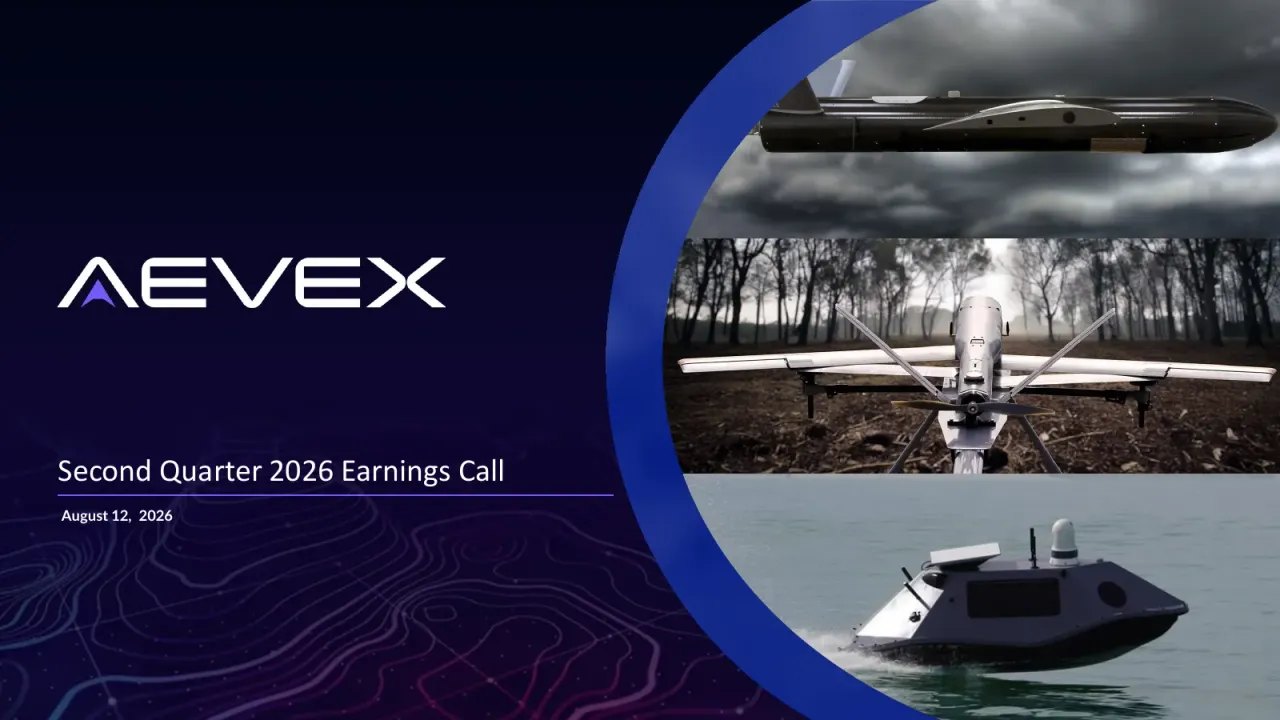
AEVEX (NYSE:AVEX) Q2 2026 earnings call, held 2026-08-12. Watch the replay and read the transcript on 6ix.
On 6ix: 6ix.com/event/aevex-corp-class-a-avex-q2-2026-earnings-call
Automated transcript · Written by software from the replay's audio. It can mishear names and figures; the replay is the record.
0:00 Hello, everyone. Thank you for joining us and welcome to AVEX's Second Quarter twenty twenty six Earnings Conference Call. After today's prepared remarks, we will host a question and answer session. If you would like to ask a question, please press star one to raise your hand. To withdraw your question, press star one again. I will now hand the conference over to Jason Gursky, Vice President of Investor Relations. Please go ahead.
0:29 Thank you for joining AEVEX's second quarter twenty twenty six earnings conference call. I'm Jason Gursky, Vice President of Investor Relations. Joining me on the call today are Brian Redines, Executive Chairman Roger Wells, Chief Executive Officer and Todd Booth, Chief Financial Officer. Before we begin, please note that on this call, certain information presented contains forward looking statements, including those related to the proposed acquisition of Black Sea Technologies, multi domain strategy and technology integration, our 2026 outlook, backlog, growth in M and A strategy and capital allocation priorities. Our forward looking statements are based on current expectations, forecasts and assumptions, and they involve risks and uncertainties that could cause actual results to differ materially.
1:16 Additional information concerning these risks are described in AEVEX's reports filed with the SEC. I'd also like to note that we will discuss a number of non GAAP financial measures on this call. Our earnings press release and presentation, which were also published earlier today and can be found on the Investor Relations section of our company's website, contain a reconciliation of any non GAAP financial measures to the most directly comparable GAAP measure. The content of this conference call relates to information that is accurate only as of today, 08/12/2026.
1:48 Except to the extent required by law, the company undertakes no obligation to make any revision to any forward looking statements contained in our remarks today or to update them to reflect the events or circumstances occurring after the date of this conference call. I would like to now turn the call over to Brian for some opening remarks. Brian, go ahead. Thanks, Jason. Good afternoon, everyone. AEVEX delivered another very strong quarter, our second consecutive beat and raise, driven by sustained demand and strong execution across the business. We're scaling production, expanding mission and customer reach, and strengthening our position as one of the most impactful providers of autonomous capability in the market today. And our momentum is being recognized. AVEX was recently identified by the Department of War as one of a select few defense technology primes, accelerating the development and production of systems for real world missions.
2:45 Roger was invited to brief the secretary and his staff at the Pentagon outlining how we will continue to make an impact for the warfighter. It's a powerful validation of the role AVEX is playing as the department moves decisively toward autonomous, affordable multi domain solutions, which is exactly what we built this company to provide. Against that backdrop, today we're announcing another meaningful step forward, the proposed acquisition of Black Sea Technologies. For those not familiar with Black Sea, they're a leading developer of autonomous and unmanned surface and subsea vessels for the US Navy, SOCOM and various other customers. Their USB platforms are among the most widely produced and most operationally deployed systems in the Navy's inventory.
3:36 Just as AVEX has established leadership in Group two and Group three unmanned aerial systems, Black Sea has likewise established leadership in unmanned surface and subsea capability, delivering fielded systems at scale with real operational history.
3:54 By bringing these two organizations together, we will unite two battle tested air surface and subsea portfolios in the market at exactly the moment the department is accelerating procurement of unmanned systems. Both companies are delivering in theater. Both are producing at volume with additional capacity beyond today's deliveries. Together, we expect to expand our ability to support customers across domains, including meaningful new access to maritime pathways where AVEX has not previously participated. This acquisition is another major proof point of the strategy we've laid out, building one of the nation's most impactful providers of autonomous and unmanned systems capability.
4:42 It reinforces our momentum, it strengthens our trajectory, and it advances the larger vision of what we set out to build a company with the scale, relevance and operational credibility to lead in this new era of defense. We could not be more excited about what this combined team can do together and we can't wait to get started. With that, I'll hand it over to Roger to walk through the strategic rationale and transaction details, as well as a review of our very strong second quarter. Thanks, Brian, and good afternoon, everyone. As Brian mentioned, today marks two important milestones for AVEX. We've entered into a definitive agreement to acquire Black Sea Technologies, and we announced our second quarter results, posting
5:30 robust growth and strong operational performance across the business, leading us to raise our outlook for the year based on continuing strong demand signals and significant deployment of our mission critical systems in theater. What Todd and I plan to do today is walk through the strategic rationale for the acquisition and to provide more details on both the transaction and the company. We will then quickly review our second quarter results and open the line to your questions. Our remarks today will be a bit longer than normal given the importance of both events. Let's go to slide four in the presentation deck. The transaction story is straightforward and clear. By bringing these two leading companies together, we believe we will create one of the largest and most comprehensive multi domain unmanned systems providers in the market.
6:20 We expect this merger to deliver significant production capacity, access to new markets, and the ability to credibly deliver a broader portfolio of multi domain unmanned capabilities, all underpinned by AVEX's core autonomy stack, Compass X. In addition, both AVEX and Black Sea employs a hybrid business model that can both produce and operate assets for our customers. This provides predictable long term revenue and valuable operational insights to beat back into platform development. Very few companies can credibly claim a multi domain unmanned portfolio of this scope, and even fewer can claim one that's actually in the fight.
7:06 Finally, we expect to retain strong financial flexibility post transaction, which will allow us to continue to invest in innovation, production capacity and future M and A. The bottom line is this, with the acquisition of Black Sea, we believe we will create one of the most capable pure play multi domain autonomous systems providers in The US, delivering effects to the battlefield across air, surface, and subsea domains
7:35 at a time when the Department of War is leaning into unmanned system spending. This transaction aligns perfectly with our strategic direction and our mission focused culture and also represents the kind of opportunity we signaled we pursue. With that as a strategic framework, let me turn it over to Todd to walk through the transaction itself. Thanks, Roger, and good afternoon, everyone. Please turn to slide five. Let me walk you through the key economic terms. AVEX intends to acquire Black Sea Technologies for a total consideration of up to $650,000,000 structured in three components: first, approximately $250,000,000 in cash at closing. Second, roughly $350,000,000 in AVEX common stock at agreed price of $27.50 per share, which amounts to approximately 12,700,000 shares issued to the sellers.
8:32 Lastly, the transaction also includes a $50,000,000 earn out that is contingent on the achievement of certain performance targets by Black Sea through fiscal year twenty twenty seven. We designed the earn out to align incentives so that the incremental $50,000,000 becomes payable only if Black Sea's financial performance creates long term shareholder value. We expect the transaction to be accretive to earnings per share in the near term before giving effect to non cash purchase accounting amortization. Black Sea, we expect the transaction to be accretive to earnings per share in the near term before giving effect to non cash purchase accounting amortization. Black Sea is expected to generate approximately $150,000,000 in revenue in fiscal year twenty twenty six, with adjusted EBITDA margin roughly in line with AVEX.
9:26 While we are not providing formal guidance for Black Sea for fiscal year twenty seven today, we expect its growth to be at least in line with its addressable markets. I think it's worthwhile noting that Black Sea's leadership and shareholders were particularly excited about the opportunity to be a part of AVEX and share our go forward vision. As such, the equity consideration was very important to them, and we feel the purchase price was quite favorable given those dynamics. A few other items worth noting. We expect the transaction to close in September 2026, subject to the expiration of the HSR waiting period and satisfaction of our customary closing conditions.
10:12 Black Sea will operate as a third business unit within AVEX, which we believe will preserve the mission focus and customer relationships that make the business valuable. I'd like to note that Bob Putney, Black Sea's CEO, is expected to stay on to lead the business at AVEX. Roger, back to you. Thanks, Todd. Please turn to slide six. When our team evaluated this transaction, we came back to five reasons why this combination is so compelling for us, and I want to spend some time on each one. First, this acquisition is expected to create one of the largest providers of battle proven autonomous air and maritime platforms at a moment when unmanned systems spending is entering into what we believe is a genuine global defense supercycle.
11:01 The operational needs from the Department of War, the combatant commands, and our allied forces across the globe have moved from experimental projects to shorter cycle, high production procurements as they work to get systems fielded. Being one of the largest battle proven providers matters because in this environment, customers are buying from companies that have proven solutions and can deliver at scale today. Second, the capabilities are highly complementary, not overlapping. AVEX delivers launched effects, precision strike, loitering munitions, and full scope ISR capabilities. Black Sea brings unmanned surface, subsurface, and contested logistics vessels to the market. From a growth perspective, based on our due diligence, Black Sea has deep relationships with all key maritime USV and UUV customers.
11:56 Not only do we believe that Black Sea and AVEX will benefit from an anticipated increase in funding for USVs and UUVs, we expect the combination to also unlock a large Navy UAS market for AVEX, which is an exciting expansion opportunity for us. Third, Black Sea brings well capitalized facilities, infrastructure and tooling to deliver USVs and UUVs at scale. I will walk you through the company's footprint in a few minutes, but the short version is that we are not acquiring a prototype shop. Like AVEX, Black Sea is a company already producing at significant industrial scale in line with the DOW's objective for the defense industrial base.
12:42 Fourth, Black Sea comes with significant backlog that gives us real visibility into above market growth in fiscal year twenty seven. As of today, Black Sea has more than 110,000,000 in funded backlog and over $250,000,000 in unfunded backlog tied to programs associated with the production, sustainment and operations of the company's marquee small USV, the Global Autonomous Reconnaissance Craft or GARC, and its Block two variant Chaser, as well as contested logistics vessels contracts such as the recently awarded Sea Based Petroleum Distribution System or SPDS. This isn't driven by speculation on whether a market will develop, it's anchored on contracted demand.
13:31 As mentioned before, the transaction further diversifies our program portfolio and customer access, opening new growth opportunities for both companies. And fifth, and this is one that's easy to overlook, Black Sea has an exceptional management team and a mission focused culture that is genuinely aligned with AVEX. To realize a successful M and A transaction, cultural fit is critical. It's a major driver of value creation. We've spent significant time with Black Sea's leadership and like the AVEX team, they are firmly committed to the mission and the warfighter and we are confident that they will continue to thrive as part of the AVEX family. With that, let me tell you a little bit more about Black Sea, its platforms and its track record.
14:19 Please turn to slide seven. When you look at Black Sea, the first thing that stands out is that this is a company measured in outputs. They have delivered more than three fifty USB since inception, and installed base that we believe is unmatched among American USB manufacturers. In addition, we understand that those platforms have accumulated more than 25,000 operational hours, including nearly five hundred hours in support of Operation Epic Fury. As mentioned earlier, the company is expected to generate approximately $150,000,000 of revenue in fiscal year twenty six. And it does all of this with a workforce of approximately two seventy five highly skilled and motivated employees, the vast majority of whom hold active security clearances.
15:10 Black Sea serves a host of customers within the Navy, US Special Operations Command and the intelligence community to name a few. As one of the first movers in The USV market, Black Sea has developed deep relationships with key customers that have been forged in real world operations. While the company is primarily known for its flagship USB, the GARC, Black Sea continues to innovate in the small USB space with Chaser and Comet and in the undersea space with Raptor. In addition, Black Sea is a first mover in the growing contested logistics market, where it has developed a number of platforms including Night Train, Revenge, and SPDS. Not only does Black Sea develop and manufacture these platforms, it also employs a highly technical team with deep operational experience with the ability to deploy, operate, and sustain USVs and UUVs in support of real world missions.
16:11 This has provided a significant force multiplier for our customers, as well as a valuable feedback loop that has helped to enhance these platforms. The pattern here is important. Black Sea does not sell hardware and walk away. They both deploy platforms and support their customers in the field, who then come back with bigger, longer and more strategic scope of work. That's the flywheel that underpins our growth expectations for the business. The takeaway on this slide is simple. We're buying a company that is already delivering, already deployed and already trusted. With the infrastructure, workforce, and customer relationships to keep scaling. Please turn to Slide eight. Building on the last slide, I want to give you a sense of the product roadmap because this is where near term revenue is expected to meet long term value creation.
17:04 The GARP platform, the one that has generated the operational track record we just discussed, is designed to carry a payload of up to 1,000 pounds, has a range of more than six forty miles, cruises at 40 knots, is survivable through Steam State seven, and can operate for up to ten days at a time. That is a highly capable platform and it is in the fight today. Chaser is the successor to GARC, offering next generation capabilities. Relative to GARC, Chaser offers approximately 38% more payload weight, 33% more payload volume, 25% greater range at cruise, and does so at an estimated 10% lower unit cost, all while adding advanced platform autonomy and next generation perception.
17:56 And critically, it's packable in a standard 20 foot ISO container, which is a real logistics advantage for rapid global deployment. In addition, Black Sea has delivered specialized variants with custom capabilities and proprietary intellectual property for classified customers. And importantly, Black Sea's platforms like those at AVEX are built on a modular open systems architecture, which is exactly aligned with the department mandates to drive rapid capability insertion and interoperability. This architecture creates the opportunity for us to leverage our Compass X technology stack to enable autonomy and multi domain interoperability across all of our combined platforms.
18:43 Additionally, as the department shifts towards contractor owned, operated or COCO structures and larger USB and UUV programs, having an extensible architecture becomes a durable competitive mode. Here's how you should think about Black Sea's small USB leadership. The current platform is operationally deployed and delivering revenue today. The next generation platform improves on it across every dimension and the underlying architecture is aligned with where the customer is going. Turning to the right side of this chart, the best way to understand why Black Sea is differentiated asset is to look at what it is actually doing for the customer. And there's no better example than the US Navy's fifth fleet.
19:32 The mission is to deploy additional Garks and personnel to Bahrain to support fifth fleet operations in a highly contested maritime environment. Black Sea is solving three core problems for the customer. Rapid force projection through immediate large scale unmanned surface vessel deployment, operational risk mitigation by using unmanned combat support to reduce risk to human life, and capability versatility across a diverse set of mission needs, including mine clearing from a single adaptable platform. What sets Black Sea apart on this mission is a specific set of capabilities. Its USVs are multi mission with rapid payload integration and true modularity.
20:18 Black Sea also provides end to end expertise for 20 fourseven maritime operations, and they have a proven ability to both surge production and deploy in support of operational missions as required. Please turn to slide nine. One of the things that made Black Sea attractive is its well capitalized infrastructure. This is not a company that needs capital to meet near term demand. The company operates across five U. S. Locations: Maryland, Virginia, North Carolina, Florida and California. And the headquarters and manufacturing facilities waterfront location in Baltimore, Maryland is a genuine differentiator. The research development test and evaluation facility is 57,000 square feet equipped with two thirty ton bridge cranes.
21:07 The production facility is 47,000 square feet and today has the capacity to produce approximately 40 small USVs per month. Just to frame that, at current run rate, that's meaningful headroom relative to the three fifty plus units delivered to date, which we expect would give us room to convert the backlog we've highlighted without incremental capacity investment on day one. The facilities also have three attributes that are hard to replicate. Deepwater access for testing and delivery, a robotic welding machine for consistent high throughput hull fabrication, and facilities that support classified program work. And of course, the true value of Black Sea is it's roughly two seventy five hardworking employees across the organization.
21:57 These are talented people that are dedicated to the missions they serve, many of which have decades of experience helping to solve our nation's most complicated challenges. The bottom line on this slide, we are buying a company with the physical plant, location, security infrastructure, and the workforce already in place to deliver on the growth we've described. Please turn to Slide 10. Let me pull the pieces together before we go into a discussion of second quarter results. Strategically, we believe this transaction has the potential to make AVEX one of the largest providers of battle proven autonomous air and maritime platforms right as the department enters a multi year super cycle and unmanned systems investment.
22:43 Financially, it's disciplined. We are acquiring a business that is expected to generate approximately $150,000,000 of revenue in fiscal year twenty six, with an expected growth rate at or above the market moving forward. The transaction is expected to be accretive in the near term and the consideration mix is structured to align sellers with long term AVEX shareholder value creation.
23:10 Operationally, we are acquiring proven platforms and already built in a highly scalable production operation, highly skilled, highly cleared and highly mission focused talent, and most importantly, customer trust that has been earned over decades mission by mission. On next steps, we expect to close in September of this year. Between signing and closing, our integration team led jointly by AVEX and Black Sea leadership will finalize day one in our one hundred
23:42 day integration plans. After closing, Black Sea will operate as a business unit within AVEX to preserve the customer relationships and the mission focus that make it valuable. We will provide updated financial guidance when appropriate after close. We are confident that this is the right combination at the right time, and we're excited about what AVEX and Black Sea will build together for our customers, our employees, and our shareholders. And with that, let's turn to a brief discussion about our second quarter results. Please turn to Slide 12 for an update on what we are seeing across the industry today.
24:18 To begin, the geopolitical environment remains complex, and the conflicts in Ukraine and The Middle East are pushing global defense spending higher. We are seeing increased interest in and demand for autonomous systems, air and maritime, both here in The US and from allies overseas. Of note, we've seen a growing set of use cases for these types of systems over the last several months. The Ukrainians have increasingly demonstrated the impact of long range precision strike capabilities against military and infrastructure targets deep inside enemy territory. And we've seen widespread use of autonomous systems in The Middle East, including unmanned surface vessels across multiple mission sets. For years, AVEX has provided these types of critical capabilities to the US military and its allies, and we are confident that we are well positioned to continue to do so given our scale, innovative technology, and battle proven systems.
25:18 On the budget side of things, the president's fiscal year twenty seven budget projects materially higher spending, particularly for autonomous systems. And house passage of the NDAA is a supportive indication that our market is likely to see significant growth in the years ahead. At this point, it appears the next fiscal year will start with a continuing resolution,
25:40 which has become commonplace over the past decade or more. However, we don't expect that to have a material impact on our financial results in 2026. And moving forward, we expect to see follow on production orders from existing contract vehicles across launched effects, one way attack and long range precision strike. As far as the contracting environment goes, demand signals for unmanned systems remain robust and
26:08 interactions we had with DOW leadership during the quarter. That said, the Middle East conflict, changes to the acquisition force and processes, and operational reprioritization have elongated award cycles in some cases. Let's now turn to slide 13 to walk through the key highlights from the quarter. First, we posted roughly 100% year over year growth driven by higher UAS production and our trailing twelve month book to bill landed at 1.08. From an operational perspective, we continue to make progress with unit volumes up 114% year over year with continued investments in our supply chain helping to drive throughput. Of note, we made the decision to both
26:54 expand and consolidate our Tampa production facilities. We expect this investment will provide greater operational flexibility, and it will more than double our capacity over the next year to meet what we see as robust demand. Margins continue to expand this quarter, driven by operational efficiencies, pricing discipline and OpEx leverage. With regard to cash flow and working capital, we continue to post metrics that reflect a keen focus on lean operations, disciplined capital deployment, and the need to balance the growth our customers require. On teams and culture, we continue to make investments in workforce planning and team excellence, and we've made key hires to drive this initiative forward.
27:41 We expect these efforts to improve operational effectiveness and produce additional efficiencies throughout the organization.
27:49 We've also put in place public company retention tools such as an equity program and an expanded incentive compensation plan. This is helping to drive improved retention across the organization and reinforce the behaviors that are important for the business. And finally, we recently announced two key hires. First, Berali Krishnan is serving as our Chief Growth Officer responsible for continuing to scale our growth operations and delivering next generation solutions to our customers.
28:21 He has a long tenure of demonstrated success in the defense industry, most recently with Northrop Grumman, and I am excited to have him on the team. Secondly, I am equally excited to have Chelsea Thomas join us as the VP of Government Affairs. Chelsea comes to us with more than two decades of experience both on the Hill and in the defense industry, and she will lead AVEX's government engagement strategy for both federal and local levels as the company continues to expand. Let's now turn to slide 14, where I want to talk a bit about order and backlog highlights. We've announced several key awards since the beginning of our second quarter, including recent new orders to deliver long range precision strike systems to The U. S. Government customers, demonstrating the strong demand signals we are seeing today.
29:12 Demand is dynamic and robust as our customers want flexibility given their changing mission needs. As a result, we are seeing increased levels of shorter cycle production orders, which is leading to a greater amount of what we described as book and ship revenue. That is revenue we generate from orders we receive inside any given year.
29:34 As you can see in this table, backlog coverage for us at the beginning of fiscal year twenty five was 41%. And for fiscal year twenty six, it was roughly 86% of our expected revenue at the time of our IPO. That stepped down to 82% in the first quarter given the short cycle order activity we saw then, and it's now stepped down even further to 71% this quarter given the recent orders and subsequent increase in the midpoint of our revenue outlook for the year. In our view, this demonstrates that we have a system and a team that is highly capable of converting bookings and delivering revenue in a short cycle environment. And that's important as our customers are focused less on traditional long tail programs of record and more on procuring systems from companies that possess innovative technology, production scale, and battle proven systems that can be delivered on rapid timelines.
30:32 From our perspective, this is a great outcome for AVEX as we can deliver across all of those metrics, and we're excited to be able to take advantage of future growth in the market, which leads me to Slide 15. Our pipeline of opportunities this year has grown from 8,100,000,000 at the end of twenty twenty five to roughly 10,500,000,000 today. That growth has been driven by increased clarity on government budgets and priorities, our own product development efforts, and the expansion of the production capacity I mentioned earlier. As budget dynamics continue to evolve and become clearer, we expect our pipeline to continue to grow. At the current pace, our proposal levels are on track to increase roughly 30% year over year in 2026.
31:21 And finally, we continue to see roughly $2,000,000,000 in potential contract value across launch effects, one way attack, long range precision strike and support to operations
31:33 in the CENTCOM AOR, with several of our recent award announcements aligned with these four areas. And with that, I'll hand the call over to Todd for a discussion of quarter two financials and our upwardly revised outlook for the full year. Thanks, Roger. Please turn to Slide 16. Revenue in the second quarter was up approximately 100% year over year to $201,800,000 driven by the tactical systems business, where we are executing on a large unmanned aerial systems program named UCOM Deep Strike that was awarded last year.
32:08 Net income was $6,700,000 in the quarter compared to a net loss of $11,800,000 in Q2 twenty twenty five. The increase was driven by higher revenue and margins and lower interest expense, offset by increases in transaction costs, income taxes, and change in fair value of derivative liability. As you all know from our historical financials, both revenue and profitability improved in the second half of twenty twenty five as programs were put on contract and production ramped up. This trend has continued into 2026, with adjusted EBITDA margins in the first and second quarters improving significantly year over year, driven by higher revenue, production efficiencies, and lower operating expenses as a percentage of sales.
33:00 Going forward, we continue to expect margins to resemble the second half of last year and the first half of twenty twenty six than what we experienced in the first half of last year. Please turn to Slide 17. Our Tactical Systems segment saw revenue growth of 142% year over year to $174,200,000 driven largely by the execution of the UComD strike program. The higher revenue led to operational efficiencies and segment adjusted EBITDA margins of 17% of sales in Q2 twenty twenty six. In our view, margin levels in the first half of the year are more reflective of the longer term potential of tactical systems, though quarter to quarter fluctuations are likely to be driven by volume levels, sales mix, and the timing of research and development spend.
33:53 Let's turn to slide 19. Our Global Solutions segment revenue decreased 5% year over year to $27,600,000 driven largely by the timing of an aircraft sale in Q2 twenty twenty five that did not repeat this year and was offset by growth across the rest of the portfolio.
34:14 This led to favorable sales mix versus last year and to segment adjusted EBIT expansion of roughly 700 basis points to 14.2% in the quarter. Please turn to slide 20.
34:31 Net cash generated from operating activities for the six months ended 06/30/2026, was $8,600,000 compared to net cash used in operating activities of 27,900,000 for the six months ended 06/30/2025. The $36,500,000 favorable change in cash flow from operations was primarily due to the $66,800,000 increase in net income, offset by higher working capital, primarily due to the timing of our cash payments to fulfill the UCom DeepStrike program. Going forward, we plan to closely manage working capital and capital expenditure, but note that we expect to invest in inventory levels to support our customers as need arise, as well as capital equipment and leasehold improvements to expand capacity.
35:25 Turning to the balance sheet, we ended the quarter with $99,100,000 in long term debt and $215,200,000 of cash on hand, driven by operating activities and the net proceeds from the April IPO, which were roughly $345,900,000 As I mentioned on the Q1 call, we used those proceeds to retire existing debt and subsequently entered into new credit facilities. As of now, we have a $99,100,000 term loan on the balance sheet and have access to two undrawn facilities: a $75,000,000 delayed draw term loan and a $200,000,000 revolving credit facility. In our view, the collection of these transactions currently provides the company with sufficient liquidity to execute its near term growth strategy, including the acquisition of Black Sea.
36:18 Of note, the company did not receive any proceeds from the 06/03/2026 secondary offering. That transaction involves sales by our private equity sponsor, Madison Dearborn Partners, and other related parties. For clarity, this transaction did not increase our total shares outstanding and did not lead to shareholder dilution. Now let's turn to slide 21 for a discussion of the outlook for 2026. At this point, we expect total company revenues to land in the range of $700,000,000 to $720,000,000 and adjusted EBITDA in the range of $105,000,000 to $111,500,000 for full year 2026. Other noteworthy items include depreciation and amortization, which we expect to be roughly $21,700,000 and net interest expense to be roughly $11,500,000 in 2026.
37:17 Please note that this outlook does not contemplate the completion of the Black Sea acquisition. As discussed throughout the call, we had a great start to the year with strong performance in both our reporting segments, including higher accelerated material receipts that continued into the second quarter and which drove higher revenue recognition. In the second half of the year, we will have more deliveries but less revenue given this phenomenon. The increase in our outlook is being driven largely by our tactical systems segment, where we are seeing significant demand signals and award activity. Importantly, as of this call, roughly 95% of the midpoint of our revenue outlook for the year is currently in backlog, with the remainder expected through renewals of long standing contracts in our Global Solutions segment.
38:11 And with that, I would now like to hand the call back to Jason for Q and A. Jason, go ahead. Great, thanks Don. Operator, we are ready for the Q and A session. I just want to ask those that are queued up to ask a question to perhaps in the first go around limit yourself to one single part question and then hop back in the queue. We went a little long today and I want to give everybody an opportunity to ask some questions. So operator, over to you for some instructions and to get us started. Thanks. Thank you. We will now begin the question and answer session. If you would like to ask a question, please press star one to raise your hand. To withdraw your question, press star one again. We ask that you pick up your handset when asking a question to allow for optimum sound quality. If you are muted locally, please remember to unmute your device.
39:05 Your first question comes from the line of Peter Armen with Baird. Peter, your line is open. Please go ahead. Yeah. Thanks. Good afternoon, everyone. Nice results, and congrats on the Black Sea deal. Hey. Thanks, Peter. Great to great to hear you. Hey, Roger, maybe if you could just, know, UCOM DeepStrike has been such a major contributor and maybe you could just give us an update of how that how much of that program maybe has been recognized to date or how much you're thinking about for the second half? And I assume it lingers a little bit into 'twenty seven, just because it is such a major contributor. Just thoughts on that or any of the other kind of big pursuits that you've been pursuing regarding that?
39:52 Yeah, thanks, Peter. So UCom DeepStrike continues to be a major program for us in fiscal year 'twenty six. As we've talked about on previous calls, we will likely roll off the vast majority of revenue on this program and deliver the vast majority of systems this fiscal year. The first half of the year was largely driven by UCOM DeepStrike as we received material that allowed us to drive deliveries in the back half of the year. We are continuing to roll off the UCom Deep Strike program as we deliver, and we will be going through a transition in the second half as we move from UCOM Deep Strike program to other programs that we're in the process of winning and delivering on in the back half of the year for US forces across the four portfolio areas that we talked about, launched effects, long range precision strike, one way attack, and then certainly support to the combatant commands across multiple areas of operation to include CENTCOM.
41:00 So we feel extremely confident about our ability to continue to execute UConn DeepStrike. We've got the vast majority of material in house or on order, and we don't see any challenges relative to the delivery of this program in this fiscal year. And Peter, this is Todd. Just, Lizette, we don't give exact percentages, but the Q3 percentage of total revenue is less than what was in Q2 and Q1, and Q4 goes down quite a bit, and then there's a little bit in '27. Got it. I appreciate the color. I'll leave it at one jump back in the queue. Thanks, guys. Thanks, Peter. Your next question comes from the line of Seth Seifman with JPMorgan.
41:46 Seth, your line is open. Please go ahead. Seth, you might be on mute if you're there. Your next question comes from the line of Brian Jaswale with Raymond James. Brian, your line is open. Please go ahead. Yes. Hi. Good evening, and congrats on the quarter and the acquisition here. Thanks Brian. Wanted to dig in a little bit to the pipeline continues to grow.
42:38 Can you give us some color around two areas? One, maybe the product type if you're seeing any differentiation amongst the products like Atlas, Disruptor, etcetera. And then also, how you think that might matriculate into order flow and backlog through the end of the year? Yeah. So right now, we're seeing a significant amount of interest in our group two and group three, in particular, the group three long range precision strike and one way attack systems. This is the disruptor and the Raker product line within our portfolio. This demand is really being highlighted by current activities that we see in Ukraine as well as activities in The Middle East surrounded by epic fury. So as part of the elevation and growth of our pipeline, 8.1 to 10.5, we really see it in three major categories. The first is that product differentiation and expansion that we're getting through execution of our innovation engine and our product development plans and processes.
43:53 Two, better clarity around the pipeline, the demands and the needs of the US government as we think about operations into the future. And that the third piece is capitalizing on the scale and the capitalization we've done in order to increase the capacity of the organization. So we believe that we're well positioned to execute on the pipeline that we see with the platforms that we have today, as well as the new products that are going to be coming on over the next several years as we look out through 2030. Fantastic. I'll jump back in the queue. Thank you. Thanks, Brian. Your next question comes from the line of Connor Desert with Goldman Sachs.
44:40 Connor, your line is open. Please go ahead. Hey, good afternoon, guys. You've got Conor on for Noah today. Thanks for taking my question. Hey, Conor. Hey. So when I look at the implied margin guide for 2026, now it's about 20 basis points higher than the full year outlook you guys gave last quarter. And that's despite revenue being about $100,000,000 higher. Can you walk us through the margin assumption you're making for the full year and whether or not there's some conservatism assumed in terms of the operating leverage you might see on that much higher of a revenue base? Yes. So right now, if you take our midpoint guidance, we have $710,000,000 of revenue for the year, which translates to about approximately 291,000,000 second half of the year. And, you know, we're at the midpoint on the adjusted EBITDA.
45:32 We're at 15.3% approximately. And so we're seeing 15% roughly, if you do the math, taking out the first q one and q two of 15%. You know, mix and operational efficiency, you know, we could do a little higher, could be, but we're right now, we're forecasting at that level, which is pretty consistent to the first half on a little bit we have a little bit lower revenue, obviously, in the second half compared to the first half. Okay. Yeah. Okay. Thanks. Your next question comes from the line of Sheila Kahyaoglu with Jefferies. Sheila, your line is open. Please go ahead. Yes. Hi, this is Adam Samuelson on for Sheila.
46:21 I guess the question is on the backlog coverage and kind of where we end the year with the amount of book to ship activity that you've seen. I think in your prepared comments you alluded to having 95% coverage for the second half in backlog based on the second half revenue. Is there a that would seem to work down most of the funded backlog that you have. So just can you help us help us think about what amount of book to ship is actually assumed in the second half of the year? Or how much of that backlog that you have is actually twenty twenty seven shipments? Yes. So as you've mentioned, over 95% of our fiscal year 'twenty six revenue at the midpoint of our new guidance is funded backlog.
47:11 And the remaining 5% or so is going to come through long established incremental funding on existing contracts. So we've got a high degree of confidence in our fiscal year twenty six revenue as well as our fiscal year twenty six EBITDA. When we think about the bookings that are going to roll in as we move through the back half of fiscal year 'twenty six and into fiscal year 'twenty seven, we're seeing strong demand across our key portfolio areas, launch effects, both short range as well as long range, our Atlas product as well as our disruptor family, long range precision strike, one way attack, and as we talked about support to combatant commands across multiple different areas of operation.
47:59 When you look at those portfolio areas, we see roughly $2,000,000,000 in potential contract value, and that includes several contracts that we are in active negotiation on that will result in bookings in the near term. We do anticipate a book to bill near 1.0 given the raise that we just given our guidance. And that will lead to an inflection point as we move through the back half of '26 and in 2027, where we're expanding funded backlog and moving into '27 revenue. So we feel really good about our book to bill. We feel great about our position in the strong demand signals and active contract negotiations that we have going on.
48:50 And we feel equally good about our ability to operate in a short cycle environment. Now, what we're really seeing here is a dynamic where the acquisition system, the process and the team is focused more on shorter cycle production contracts as they work to get systems into the field. This not only sets up for the stockpiling, but also the operational evaluation, exercises, and test events that gets our sailors, soldiers, airfoilers, and Marines reps and sets on the system. So we think the dynamic here is really set up and we feel good about our position ending '26 and rolling into fiscal year twenty seven with a set of conditions that's conducive to long term growth.
49:41 Thanks. If I could just clarify, you said the book to bill in year one, is that a second half book to bill or is that the full year '26? That's for the full year '26. Okay, that's very helpful. I'll pass it on. Thank you. Thanks, Connor. Your next question comes from the line of Austin Boleg with Needham. Austin, your line is open. Please go ahead. Guys, thanks for taking my questions and congrats on the results and acquisition. Wanted to maybe just dig a little bit into the Black Sea opportunity here. I think you guys said it was a $100,000,000 funded backlog and $250,000,000 unfunded, But there's a ton of money up for grabs, it seems like, in this USV and UUV category. So we'd just love to get a sense of what, like, the pipeline opportunity looks like, for this acquisition, And then maybe a sense of kind of like what the growth profile should be as we look into next year. Yeah. First, let me start by saying we couldn't be more excited about the Black Sea acquisition and having them join the AVEX team.
50:45 It's strategically aligned and it's exactly the type of acquisition that we signaled when we discussed our capital allocation approach and priorities. We believe that we are in the process with this acquisition of creating the largest pure play multi domain air surface and subsurface autonomy and unmanned company in the market today. Both of these companies are delivering at scale battle proven systems that are on timelines that are operationally relevant and really supporting real world operations. It's that position, it's that capability of scale that really underpins a lot of the growth expectations that we have.
51:31 We see significant growth opportunities and pipeline expansion as a result of this multi domain capability that we're building, especially when you factor in the ability to cross leverage the Compass X autonomy sweep. It's really a differentiator when it comes to leveraging technology across these platforms. As mentioned, we are tracking 110,000,000 in funded backlog and $250,000,000 of unfettered backlog across The USV, GARC, Chaser and Comet, UUV, Raptor, and certainly the contested logistics areas, SPDS, Night Train and Revenge, with SPDS being an active program today.
52:22 So we see a dynamic globally where USVs and UUVs will become an increasingly large part of force structures. We're seeing this in The Middle East, we're seeing it in Ukraine, and we believe that structurally over the long term, it's going to be a well funded supported priority as part of the budgets moving forward. So without giving specifics on what their pipeline looks like and what near opportunities do, which we will as we move through close and provide additional financial guidance. I think the setup and the dynamic is there for significant year over year growth in the maritime systems piece of what will be AVEX.
53:16 Thank you, guys. Thanks Austin. Sumit, I think we've got time for one more question. Thank you. Your next question and final question comes from the line of Louis De Palma with William Blair. Louis, your line is open. Please go ahead. Roger, Todd and Jason, good evening and nice work on the Black Sea deal. Thanks, Louis. Given AEVEX's specialization in in mass manufacturing, particularly for the Phoenix Ghost and and DeepStrike programs and your existing relationships, is there the potential that you can supercharge Black Sea's growth. I think you indicated that the historical growth has been 15% annually.
54:12 So are there expectations that cross selling and your manufacturing expertise can potentially accelerate that over the coming years? Thanks. Yeah. Thanks, Louise. So first off, both companies are extremely well capitalized. They're capable of delivering at scale today. And as we think about the headroom that both of these companies have to meet the strong demand in both unmanned air surface and subsurface, we think that we're we're very well positioned. You know, when you think about where Black Sea is today, they've delivered over 350 systems to date, which we believe is one of the largest small USB installed bases in The US, and at a capacity of over 40 systems per month in their 47,000 square feet facility, there's a lot of headroom there.
55:15 When you combine that with the production capacity, the footprint and the ability to deliver at scale at AVEX, especially when you combine the fact that we just secured an additional 83,000 square feet of production facility space based upon the demand that we have forecasted. The capacity to be one of the largest scaled providers of autonomous unmanned systems in the country is unique. It's highly differentiated capability. We absolutely see the opportunity to cross sail unmanned air, unmanned surface and subsurface as multi mission, multi domain capabilities are going to continue to be needed across multiple different operational scenarios.
56:08 Our modular open technology stack, Compass X, really facilitates this collaborative capability across all of these different assets. So we really, again, think the power of these two companies together leveraged against our Compass X differentiated technology stack, makes for a unique and highly capable set of multi domain, multi mission autonomous unmanned systems, which is perfectly positioned in our mind for where our customers are going. Fantastic, Roger. Thanks. Thanks, everyone. Thanks, Lee. We have reached the end of the Q and A session. This concludes today's call. Thank you for attending.
56:55 You may now disconnect.
Follow Aevex Corp. into a list and get an email when it puts out news.
Vice President of Investor Relations
Executive Chairman
Chief Executive Officer
Chief Financial Officer
Analyst, Baird
Analyst, Raymond James
Analyst, Goldman Sachs
Analyst, Jefferies (on behalf of Sheila Kayaolu)
Analyst, Needham
Analyst, William Blair