Replay available
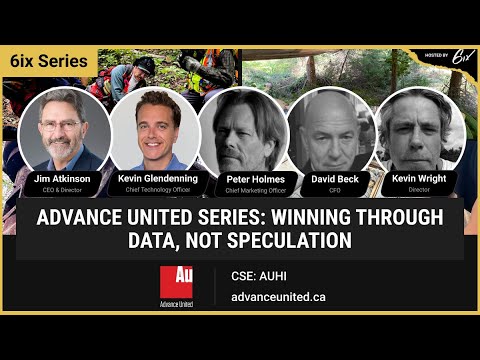
Advance United Series: Winning Through Data, Not Speculation (Ep. 1)
Join us for a great event!
- Company
- Advanced Gold Exploration Inc. (CSE:AUEX)
- Date
- Mon, Jan 23, 2023, 12:00 PM ET
- Replay
- Watch the replay on this page · 41 min
On 6ix: 6ix.com/event/advance-united-series-winning-through-data-not-speculation-ep-1
Replay
Transcript
Automated transcript · Written by software from the replay's audio. It can mishear names and figures; the replay is the record.
0:07 Hello everyone and welcome to the first episode of Advanced United's monthly series hosted by 6. I'm pleased to introduce our speakers for today, Jim Atkinson, their CEO and director, as well as Kevin Wright, their director. Jim and Kevin are going to be walking through a series of presentations, and after we're going to be taking questions live. So remember, you can submit your questions on the Q&A panel found on the right-hand side of your screen at any point during today's presentation and conversation. As a note, today's presentation is going to be available in the handout tab on the right-hand side of your screen. And as this is a part of Advanced United Monthly series, with your registration and attendance of today's event, you'll automatically be notified of the next upcoming episodes. So look out for that. As always, this event is being recorded and it's going to be available in the coming days on Six.com. Without further ado, Kevin, I want to hand things over to you so we can get started. Thank you very much, Cam, and thank you very much everyone for joining us today for our first summit.
1:00 I'd like to introduce Advanced United Holdings, a Gold exploration company that, as we like to say, never mines the Gold. So Advanced United is a junior mining company. We're listed on the Canadian Stock Exchange on the CSC. We're listed in the United States on the over-the-counter QB. And we're listed on the Borscht Frankfurt in Europe. Our expertise is in identifying undervalued gold-bearing properties and exploiting new and modern technology to help make them current and therefore prove the value that's in the ground and increase their long-term value for our shareholders while reducing their risk and introducing these properties and past producing mines to our production partners.
1:49 Which brings us to the problem of most junior mining companies face today is their development stage to production stage is a great area of concern for them to be able to properly cross that chasm known as Lausanne's curve. Only a small number of junior exploration companies are able to develop their properties and then bring them into production. At Advance United, we try and stay in our lane, which is to look for past producing properties, ones that have resource or reserve, use modern technology that may not have been available to them 10 or 20 years ago, bring them currents in terms of their permitting in their properties, and then presenting them to mid-tier or large-tier producers to help them exploit the true potential of that property.
2:41 So, our team, working together under Jim Atkinson, our CEO and next speaker, who will be talking about our current portfolio of properties that we've accumulated over the course of the last 2 years in partnership with our technology platform, the AU marketplace, helps us to evaluate a large portfolio of properties quite efficiently and work with those property owners to help them develop them suitably, quantifying their resource and reserves through current technical reports like the national instrument 43-101 in Canada, or SAMROC or JORC. So this Lausanne's curve, familiar to a lot of junior mining investors, talks about the excitement that builds between the exploration stage and the production stage, which sometimes can take years, if not decades.
3:42 So in terms of grassroots exploration, this is not an area that we're actually focused on. We're looking for properties and projects that have spent quite a bit of time and resource previous to our involvement in developing the properties, resource and reserve calculations, either through geophysics or drilling. And of course, a lot of this was done back in the 1980s and 1990s for properties that are more relevant to our portfolio. And of course, the price of gold at that time was quite low, fluctuating maybe between $400 and $600 an ounce, with actually the cost to get the gold out of the ground remaining at that time to be about the same. So there was very little profit available. Of course, with the gold price today in Canadian dollars over $2,400, and the cost to extract that Gold still being in and around the $600, maybe a little more $800 range, that leaves quite a return on investment that's still available.
4:43 So in terms of the lane that we look to maintain for Advance United and the properties and for our shareholders is a development phase that we can see here identified in Lausanne's curve in the Orphan Period Valley. So a lot of the projects that had quite a bit of work done to them historically, the relevancy of those is as accurate then – today, rather – as it was then. But the challenge sometimes is that these properties were never put into current technical reports, including, as I mentioned, the 43-101, which actually just came into passing in the early 2000s. So we then take a look at the existing data that had been, say, coming in from previous geophysical programs or geochemical programs or drilling programs.
5:35 And we say then using modern technology, we look at using today's mapping programs or we twin drill holes or we bring the permits to current and we're able then to produce from existing data, resource and reserve calculations, which then are very interesting for potential joint venture partners to bring them into the production stage. So Our focus then is not the exploration and production, rather the middle lane of the development to hand off from exploration to producing mid-tier and large production companies. The following graph shows, of course, the six-month Gold price. So again, the data that we're looking at that maybe was $5M or $10M worth of drilling that was done in the 1980s and 1990s, bringing that information current, There's quite an arbitrage of value then between what the price of Gold was back in the early 80s and 90s to the price of Gold today.
6:39 So we've been actively now then looking at a number. We've probably looked at this over the course of the last year, dozens of different properties that had existing gold resources were large properties in geographically relevant areas like Canada and the United States, have good infrastructure and access to past information. So therein is the value proposition for Advance United. The opportunity that we're looking for is to increase the value of these properties, realize that value and then be able to sell these properties or joint venture with these properties to the larger producers. Our leadership team has a track record of working for some of the largest mining companies in the world.
7:29 We have a strong board of directors. Unlike many other junior mining companies, actually have a very strong technology department as well, as some board members and senior management consultants and advisors that have had many successful exits from technology and mining companies. This one case study that we present very briefly here illustrates the sale of one of our properties and doing exactly the model that we've described here and that was the Wall Wall Gold property, that we acquired and invested in total about 250,000 dollars. And we were able to sell that then about 2 years later for over 1.4 million. So this is the model now that we're continuing to develop for return on investment to our stakeholders and our shareholders.
8:25 With that, I'd like to introduce then Jim Atkinson, Advanced United's CEO and chairman of the board. And he will introduce our properties in our portfolio currently and the pipeline of properties that we'll be looking at here over the course of 2023. Thank you. Over to you, Jim. Thanks, Kevin. Thanks for that good introduction. I would just like to say that we will be talking about our portfolio of properties, and these are properties that we've acquired either because we've taken over other companies or we've acquired them on our own. And in total, there are actually 6 of them.
9:13 3 are gold properties in Ontario. One is a copper property which I'll talk about a little bit and it's a little bit outside our sort of our stated mandate but that that has a special circumstance and then in the pipeline we have some properties in the United States and South Carolina which we'll talk about a little bit, and then we'll talk a little bit about our upcoming work program. So the first interesting property to talk about is the Melbourne property. The Melbourne property is 15 kilometers from Kirkland Lake. It's in the Abitibi belt and situated between 2 of the major gold bearing structures in the Abitibi. One is the Dester Porcupine and the other is the Cadillac Larder break.
9:59 And it seems to be situated on a linking structure between these 2 major regional features. It is also on strike from a past producer, which is the Ross mine, which produced 1.2 million ounces of gold and 1.5 million ounces of silver. It's on this major Northwest trending structure. And it seems from some, let's call it recent work, that these structures may be the things that were instrumental in preserving some of the gold mineralized areas during the folding and tectonic history of the Abitibi. You know, it has on surface 4 veins which have gold, visible gold in them. In the past, there was a shaft that was sunk and some underground workings were put in place.
10:51 The interesting thing is that all of the material from the underground workings is still on site. We think this has a fairly good grade because it was not taken off. And we know the grade of the underground workings was fairly high. We are planning a drill program there of 1500 meters, which is approximately, let's call it 75% completed. We have intersected some of the veins. Interestingly though, for us, we've also intersected some gold bearing areas, which are not in veins. And this of course expands the potential of the property to actually add tonnage. The 43-101 non-compliant resource that was calculated back in the day is approximately 50,000 ounces of gold. And this is situated basically in the underground workings where they've actually done sampling in the old drips and a little bit of drilling. The other thing that we'll be doing is we'll be exploring to the North and South of the exposure, just as an aside. So, you know, the exposure is basically a, you know a 3 acre area that's totally surrounded by swamp.
12:06 And in the past, the only area, only work that was ever done was done in the exposed area. What we plan to do is actually do some exploration to the North and South in the swamp covered areas, which of course were never prospected and to our knowledge have never been drilled or even covered by any kind of geophysics. The next property, the next goal property we'll talk about is called Doyle. This is a property in the north of, in the Batchewana Greenstone Belt, which is to the west and north of Sault Ste. Marie. The interesting thing about the Batchewana Greenstone Belt in general is that it really hasn't been that well explored since some work was done in the 1960s and early 70s.
12:53 The Doyle property itself has really been compared to Hemlo. It has the same kind of geological situations, geological sort of associations, And the comparison to Hemlo has actually been made by people that worked at Hemlo. And in fact, were some of the discoverers of Hemlo who had actually had this property in the late 80s and early 90s and actually dropped it because of the price of gold was so low. In the meantime, they had drilled about 8,500 meters of drilling in 37 holes. And they intersected 3 areas of very high-grade Gold. You know, 1m of 44g in quartz veins, 1m of 14g of Gold in a zone which is 9m wide of 2.5g per tonne zone, the dis-disseminated pyrite zone is really where the resemblance of Hemlo is quite apparent.
13:57 And we also have some high-grade Gold in massive sulphide zones on the property. It's a very large property and has really been, you know, sort of explored only a little bit and our new work that we've done on it, some prospecting and some sampling and a little bit of VLF geophysics is showing that there are targets still there that are unexplored, as well as our plan would be to duplicate these intersections and expand them. Interestingly enough, none of the intersections that were known were ever really followed up in detail. And I think because one of the reasons was because the price of gold was low at the time when these intersections were made and there probably wasn't a lot of motivation to do more exploration.
14:45 So this will be a major focus of our work for next summer. We have a drill program planned here and we'll be raising money to finish that off. Our third goal property is a really interesting property, I think, because it's situated approximately 5km from Westdome's Mishy Pit, and the case study that Kevin mentioned at the very beginning actually took place in this same area. So I can say we have a bit of expertise in the area. The interesting thing about the Paint Lake Road joint venture, first of all, it's a joint venture, so we're funding half of it and Frontline Gold, another publicly traded company, is funding the other half of it, but it really has not been explored, even though it sits right in an area that has had lots of exploration.
15:36 It overlies a major structure, which is called the Iron Lake Pasqua Shear Zone. And this shear zone has gold deposits on it, both to the east on a property that was owned by Abbey Lake Resources now, or sorry, Argo Resources now owned by Argo, Angus. I'm sorry, it was owned by Argo, It's now owned by Angus. And if you go farther to the east, you actually end up at the Island Gold property owned by Alamos. And to the Southwest, there's a deposit called Davis Lake, which is owned by Westo. And they've just optioned that off and another company is doing some work on it. So this summer we completed a small program. The access to this property is not as good as some of our others. So we will have to develop a program probably including helicopters and some camps and things.
16:31 But we completed a VLF survey this summer. And the interesting thing about it is that it did show up some anomalies which look like they are subsidiary structures off the main shear zone. The other interesting thing is that our neighbour to the west and north, which is called Bold Ventures, actually did a VTEM survey this year. And some of those VTEM anomalies trend off of their ground onto our ground, and that will have to be followed up. And we are planning in 2023 to do more prospecting and sampling. The only work that's ever been done before on this property was an airborne survey that was completed in 1986.
17:17 It showed up some anomalies which were never followed up and you know it's always been interesting to me because it it sits right in an area where there's lots of structures coming together and lots of gold occurrences. So the other property and this I mentioned earlier, this is called Buck Lake and it's a VMS target, hosting critical metals copper and zinc and as I said it's a little bit outside of our main focus which is mainly gold but we acquired this property when we acquired Talisker, the original company. To me, this is an interesting property because again, Copper and Zinc are both critical metals. We've done a significant amount of drilling and work here already. You know, we drilled about 2,500 meters.
18:09 13 of the 15 drill holes we completed had copper mineralization and zinc mineralization, and we had results up to 15% zinc, of sorry, 15% copper in the drilling. The trenching that we completed and stripping exposed up to 14 meter wide zones of massive sulfide, which contained copper. But the most interesting thing I think about this whole area it really hasn't been explored. And it's a huge area. Our property here alone is 4,100 hectares. It's a huge area of let's call it prospective stratigraphy which is very similar, very typical Abitibi-type, you know, mafic and falsing volcanics and, you know, with mineralization.
18:55 So we have acquired a lot of ground here. We have at least 8 other known mineral occurrences, including dredging, which holds 12% to 15% Zinc, and some drilling, and at least another dozen or so anomalies that really haven't been explored at all. So we're kind of interested in this area. This one, I would say we're actively looking for a partner because as I mentioned earlier, it kind of falls outside our focus of trying to be, you know, really focused on gold. I think we'll be able to find a partner for this because it is copper and you know, everybody knows what's happening with copper these days. The other thing about the mineralization that we discovered, first of all, it was all covered. So it has not been prospected.
19:46 We found it because in 1986, Miranda drilled a single drill hole here and intersected 2 four-meter-wide zones of massive sulfide, which they claimed contained copper and zinc, although they didn't report any assays, which was typical of reporting in that time. And so what our work started off with basically completing, you know, an EM survey identifying where the anomalies were, doing some overburden stripping and sampling, and you know it's progressed to the point now where we think we have a very nice occurrence of massive sulfide with copper and zinc and we'll be looking for a partner for that. The other interesting area which I'd like to talk a little bit about is South Carolina, where we have some properties that we're doing due diligence on.
20:40 And most people don't really know that much about South Carolina as a gold mining area in the United States. People don't realize that the very 1st gold rush in America was in fact in North and South Carolina and you can still pants gold from some of the streams in South Carolina. There's 2 properties here that we're looking at basically and some extensions, but Landrum, which is the first one we're looking at, is basically a typical orogenic Gold Quartz-hosted system. It has a non 43-101, but a resource that was calculated by some pretty reputable people. It's around 68,000 ounces of gold there. Average grade of 4.8, which is pretty much the typical grade of the other deposits that are known in the Carolina Gold Belt.
21:37 Interestingly enough, we went there on a site visit. We picked up 4 samples. All samples contain gold, including 1 that contained 115 grams per ton. And I was telling the people that either I'm very good at picking up gold bearing samples or there's gold everywhere there. I'm tending to believe that the latter is the case. There has been a compilation done with a model actually on this project. And we'll be following up on that when we get involved. The model shows that the high grade area is actually open to the Southeast and it's pretty concentrated looking system. There are multiple veins there that show up in the model. So it needs some good work. The other good thing about South Carolina is that you can work there in the winter time.
22:29 So When we're not working in Canada, we can work there. The other property that we have looking at in South Carolina is called Rattlesnake. Rattlesnake is only a few kilometers away from the former producing Ridgeway Mine, which produced 1.5 million ounces of gold, 700,000 ounces of silver. Ridgeway was a open pit resource. It looks like Rattlesnake, which is very similar, would be an open pit, probably heap leachable deposit. The area there is deeply weathered and in that way sort of resembles what the projects look like in say, in Nevada or Arizona. And that's one of the interesting things about it. We also know from a compilation that we had recently done, but there are several similar type, let's call them mineralized occurrences.
23:24 Some have drilling, some have, say, IP, and some of the ones that have been drilled actually have gold. So this could turn into a much larger, almost regional type play in South Carolina. I'll just take a quick little speak here about our sort of next steps. You know, we're finishing the drilling at Malva for starters, receive assays. For the rest of our assays from Buck Lake, we've only received 10 holes so far. The laboratories have been very busy this year, so results have been quite slow coming in. We'll review the results of the Rattlesnake compilation and maybe even evaluate whether or not it's worthwhile to acquire some additional properties there. Our preliminary thought is that it probably is and then you know we're trying to do a financing of up to 250 to $500,000 at with hard dollars and flow throughs.
24:30 I think, you know, the next 3 months will also be busy. You know, we will finish interpreting a LIDAR survey that we completed at the Doyle property, which will help us trace the structures, the gold bearing structures that we already know exist and also probably discover some new structures that we don't know exist and that may in fact help us by being intersecting with no instruct you know that's kind of the target there would be intersecting structures larger structures you know which are gold bearing We know that some of the structures are gold-bearing, and there's probably more. We will get the final assays from Malba and evaluate what we know about the veins that are there, but also as I mentioned, something even more interesting, which is the disseminated mineralization that we are starting to encounter, which as I said, gives us a potential for larger tonnage than just single gold veins.
25:32 We will look for a partner, as I said, for Buckley Copper and look for, I don't know, someone to take help us out with that one and kind of allow us to focus our attention more more seriously on the gold will probably acquire more ground in South Carolina as well and That's it. There's contact information there. And if you have any questions later be good And I'd like to introduce Kevin Glendening, who I think should be on the line. If not, Kevin Wright will talk a little bit about our technology. I don't think Kevin Glendening is able to join us today, everyone.
26:17 Kevin is traveling on business and is out of the country where internet is a little sketchy. So we'll talk a little bit about then the Advanced United Marketplace and this is a platform designed to connect property owners of mineral commodities and deposits with the developers and producers. In essence, how the marketplace started under Jim and the technical team on the Geo side, we looked at probably, I guess, over about 50 or 60 different projects over the last 2 years, trying to identify those that had criteria that we thought would be of interest to mid-tier and large producers. In doing so, Jim and the team developed a set of standard operating protocols, Boolean if you will, in terms of if then and and or if the property has this size or has this resource or this reserve, then that would pass to further qualify during the due diligence phase.
27:21 These protocols then became the basis of quite simply intake forms for various potential partners that were bringing properties to us. Since then, over the course of the last year and a half, we brought the challenges of developing these protocols into a technology group led by Kevin Glendening, who is our Chief Technology Officer. Kevin's worked in the open source space now for gosh just over 20 years and they developed over the course of the last 6 months the third version of the software which can be seen on our website at advancedunited.ca where anyone with a property now is able to create an account and upload the information about their property that allows our technical team to go through it efficiently and effectively to show where there may be opportunities or gaps in the data that they have and the qualifications that they may be looking for to qualify for our assistance in helping to advance their projects together and present them to potential production partners.
28:41 The technology features and functions that I know the team is looking at developing over the course of 2023 include broadening our access to various government databases and private databases that are available both in Canada and the United States for varying gold properties as they may have been recorded over the last several decades into these archives and library systems. In addition to machine learning and artificial intelligence technology that they've been looking at to help draw different correlations between properties that we're seeing in quantifiable and qualitative ways happening inside various areas. As an example, inside the current portfolio up in the Northern Ontario or West Kirkland Lake area and certainly down in the Carolinas where Jim and I and the team have been looking at a number of properties.
29:41 The marketplace as well in terms of its developments in sort of the open source technology and the features and functions surrounding the gold properties, the technical teams, both from the programming side and the geology side, have been working at developing the protocols now to use the same technology programming base to be able to now look at new properties and or pardon me new commodities as an example like copper as Jim was alluding to that are currently in the portfolio. So I guess then thank you very much everybody and in summary with you know Advanced United we've got 2 really distinct opportunities in front of us. The continued development of our portfolio of past producing properties with loads of potential and the Advanced United and the AU marketplace which we're looking forward to launching later this quarter our fourth version of the software and introducing a number of different new commodities that we can help partner with. So I guess then back over to Cameron, our gracious host here with 6 today to answer any questions and answers that anybody may have. Thank you very much, Cam.
31:00 Yeah, absolutely. Jim, Kevin, I want to thank you for the great presentations, great overview of the company. I'd like to remind everyone in the audience that if you do have any questions, feel free to submit them in the Q&A chat found on the right hand side of your screen. But gentlemen, we've already got some questions come in. So let's dive right in. First question from Brittany. Why do you think your Copper project is important to the portfolio? Isn't gold the focus? Yes, gold is our focus. And as I mentioned in my presentation, we acquired the Copper property when we merged with Talisker resources, the company that had it. Why do I think it's important? I think copper is very important. Everybody would agree with that. I think it's important to us because we've spent a significant amount of money and done a significant amount of work to upgrade that property. And now I think it's a very attractive joint venture or even option target for a third company that's interested in Copper and understands the need for Copper going ahead.
31:58 Fair enough. Could you provide a bit more information and clarification about how Advanced United is going to be, you know, quote, winning through the data? Well, I think as Kevin's, you know, mentioned, one of the things I think that's been, you know, sort of neglected in the mining business has been the amount of data that exists and also the amount of information that is out there. And what really is needed is a way to take all of that data, to run it through a system of algorithms or whatever, to actually pull out the good properties. And when our tech people ask me, you know, what algorithms they should have, I said, well, you know, it sort of depends on each company will have their own specific needs. For instance, a company with a producing operation, their primary need might be something within, let's say 100 kilometers.
32:52 Whereas a company that's raised a lot of money, their primary focus might be a good property with some resources. So the algorithm, because it's the way it's designed, can be changed and modified for anyone's needs. And I think the other thing that's interesting about that is that we're not only using that information for our own properties, but we're also going to be able to connect that information and those properties to people that are looking for projects. So, you know, a company that's looking for a project might come to us and say, what do you have that's this and that and this and that, whatever their criteria are, we can run it through our algorithm say well here's here's a couple or whatever I think that's where the real benefit is going to come out of it by connecting producers and you and you know vendors and producers shall we say absolutely something one other thing cam yeah go ahead one other thing I would add to Brittany's question is, very tactfully speaking, very pedantically, some of the properties that we're looking at today come in from geologists that are, as an example, retired, if we use the Kirkland Lake area. So this might have been, by way of example only, the senior geologist at XYZ Mining Company, who's now 65 or 70 years old, when the mining company that had been operating previously and the price of gold was down at 600 had to close because they couldn't
34:24 operate profitably, the mining maps or this intellectual property, the work, if you will, of this gentleman's geologist career, you know, is documented. And in many cases, there are scrolled up maps or technical reports that were done on typewriter back in the 1980s and 1990s. So digitizing the data may be as simple as scanning in those maps, digitizing those printed documents into PDFs, and then looking at those maps as an example with modern technology programs, geomapping programs that weren't available or the computers didn't have their processing power. It allows them for us to be able to compile different geological data. So for example geophysics and geochemistry and drill data where these tools were not available in the 1980s.
35:17 So when we're able to do that, and I will add like rather inexpensively today, so we're able to produce as an example, a technical report that might cost 50 or $100,000 to create that technical report. But that could be predicated on millions of dollars of drilling and geophysics and geochemistry that had been previously done on the property. The challenge that geologists face to try and exploit that product today in 2024 is that very likely they may not have the funds, the $50,000 or $75,000 or $100,000 to create that technical report to be able to present to a mid-tier producer. As an example, XYZ, I want to say Barrick or Newmont or any of the mid-tier, or pardon me, some of the world's largest gold producers.
36:11 So in order to get audience on what could be a very qualified project, sometimes these, what we would consider at a corporate level, a minimal spend of 50 or 100 thousand dollars is very significant and almost a barrier to entry for an individual property owner to be able to do that independently. And that is our, that would be a great example of a sweet spot of us winning through data. Thank you, Cam, for allowing me the opportunity to add to that. That was a great question. Thank you. Oh, absolutely. I mean, thank you, Kevin, for providing extra context. Another question, though, could you clarify why South Carolina is interesting for mining, especially when compared to other US jurisdictions? Well, I think for me, one of the most interesting things about it is that nobody knows about it. So that gives us almost like a free hand there. Not quite. I mean, there is a big mine operating there owned by Oceana and it has had 5 operating mines in the past. So it is somewhat known, but it's not like Nevada or Arizona where there's a lot of people, a lot of prospectors, a lot of mining companies working there. So it does give us a little bit of free reign, not to mention the fact that it does have tremendous potential.
37:27 And the geology there has been compared. And if any South Carolina geologists hear this, they'll slap me, but it has been compared to Newfoundland and very similar geology, similar terrain, the Avalon terrain. And so that has that aspect of it as well. The other thing about it, sort of a little bit of what Kevin mentioned, the data in South Carolina doesn't reside with the government. It resides with local people, with past workers, geologists, mining companies. So we have an advantage there of the 2 people we have working with us down there have between them over 75 years of experience working in South Carolina. They've worked for small companies, large companies, they've worked for Niranda, Kennecott, so they also know where to get all the information we need to do our evaluations.
38:19 And that's another reason why I think South Carolina is very important for us. And one other thing that I would add, I think is quite interesting about South Carolina, it was actually in fact the 1st gold rush in the United States long before California or Yukon or Alaska, pardon me, rather. So there's always had a history of gold production. And again, when gold wasn't in favor in terms of, you know, 40 back then, $40, $50 an ounce or maybe several hundred, certainly at today's commodity prices, it can be looked at in a very different economic model. And I think that that's also a very interesting area play where we've been able to, again, as our name would imply, Advance United, is we're looking to bring together a lot of independent property owners to work together in these areas to understand the geology and the elements of the area where we would all be able to move forward and win together. Traditionally, the mining industry has been quite secretive in terms of their data and area of plays.
39:31 We're finding a bit of a paradigm shift, using technologies today outside of just mining technologies, but the internet itself. We look at things like platform economies like Uber, Alibaba, Airbnb. Certainly a platform economy and this type of technology has never been applied to the mining industry the way that the advanced United Marketplace is doing. So we believe in today's economic state, boundaryless borders, that collaboration and sharing is a way that we could all win together, which I think is a unique paradigm shift that we're finding some success in that others haven't tried before. That's awesome to hear.
40:16 Another question, just about how much money or how much cash was spent on your properties through 2022? We had raised 2.1 million dollars of flow-through which we spent on our Canadian properties and before that we had in the year before we had raised, I think around 5 or 700,000, which we spent on some of the properties. So that's kind of the total. Last year was our big year because of our, our really significant flow through raise. All right. Well, listen, gentlemen, that looks like all the Q&A for now. So I want to thank you for going through such a great presentation and overview of the company. And I also, of course, want to thank everyone in the audience for joining us, especially those who asked questions. But before we wrap up today, I want to pass things back to you guys just for any closing remarks you might have.
41:02 I would just like to say thanks for introducing us and thanks for allowing us to talk to your, speak about the company to your people and just say, you know, thank you again. Thank you very much.
Follow Advanced Gold Exploration Inc. into a list and get an email when it puts out news.
Latest news releases
- CSE:AUEX — RETRANSMISSION: Advanced Gold Signs MOU to Acquire Corcoran Silver Gold Property with Historical Inferred Silver Resource · Mon, Oct 5, 2026
- CSE:AUEX — Advanced Gold Signs MOU to Acquire Corcoran Silver Gold Property with Historical Inferred Silver Resource · Fri, Oct 2, 2026
Companies on this call
More from Advanced Gold Exploration Inc.
- May 31, 2024 The Significant Copper Opportunity at Paint Lake Road & Buck Lake
- Apr 30, 2024 How a Strong Gold Market May Impact Juniors in 2024
- Apr 10, 2024 Charting the Course: Meet Advanced Gold's New President & CFO
- Mar 28, 2024 CEO Site Tour Update With Jim Atkinson
- Feb 27, 2024 Investing in Exploration: Which Teams Have What It Takes?
- Feb 15, 2024 Fireside Chat: James Atkinson, CEO of Advanced Gold Exploration