Terramin Australia Limited · ASX:TZN
Terramin Australia — Technical Presentation (July 2017)
47 slides from Terramin Australia's technical presentation, Jul 26, 2017
Slide 1: Bird in Hand Gold Project Woodside Community Consultative Committee
TERRAMIN AUSTRALIA LIMITED Bird in Hand Gold Project Woodside Community Consultative Committee Water Technical Reference Group Meeting Wednesday 26th July 2017 Woodside Bowling Club
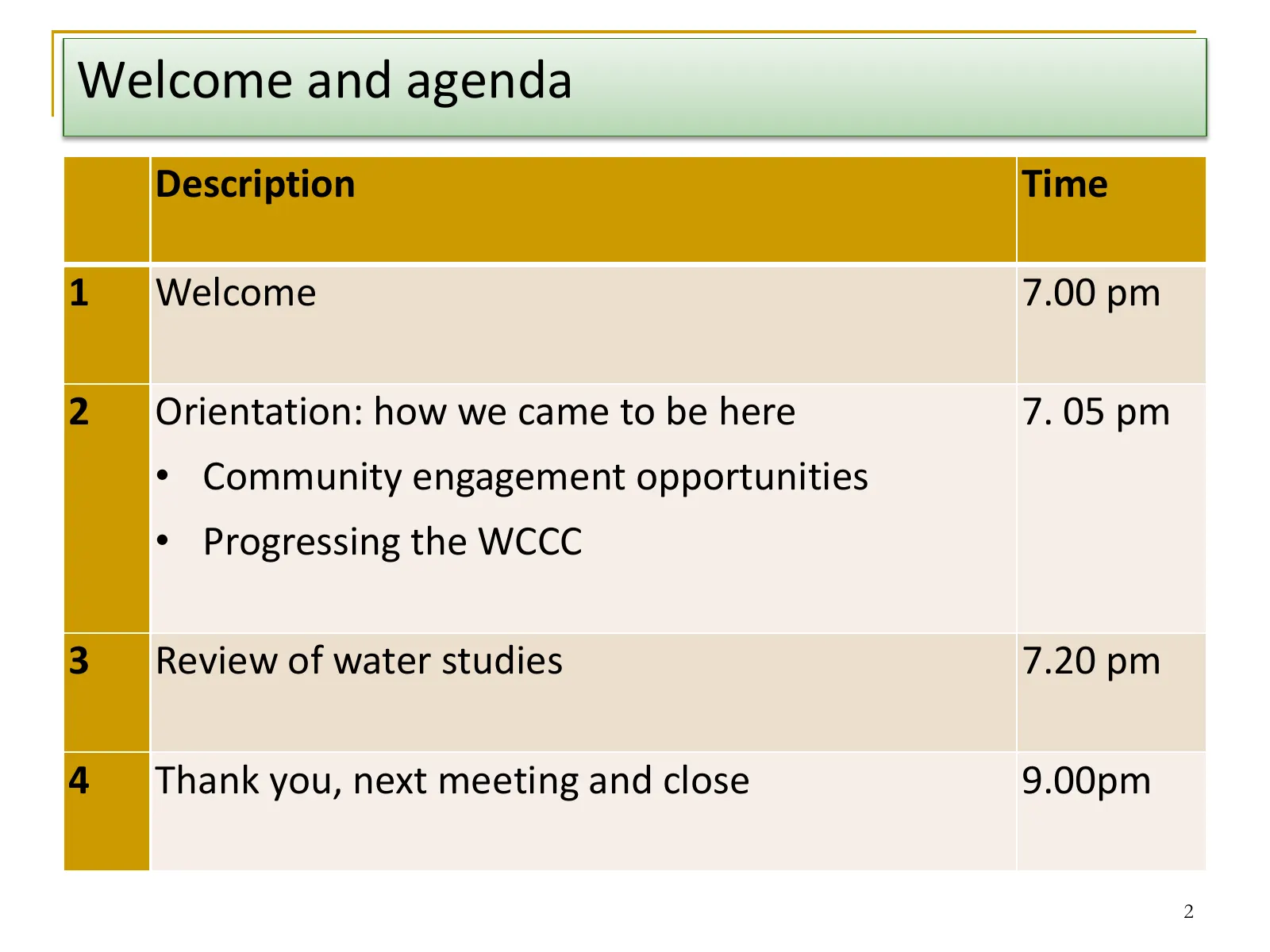
Slide 2: Welcome and agenda
Welcome and agenda Description Time 1 Welcome 7.00 pm 2 Orientation: how we came to be here 7. 05 pm • Community engagement opportunities • Progressing the WCCC 3 Review of water studies 7.20 pm 4 Thank you, next meeting and close 9.00pm 2
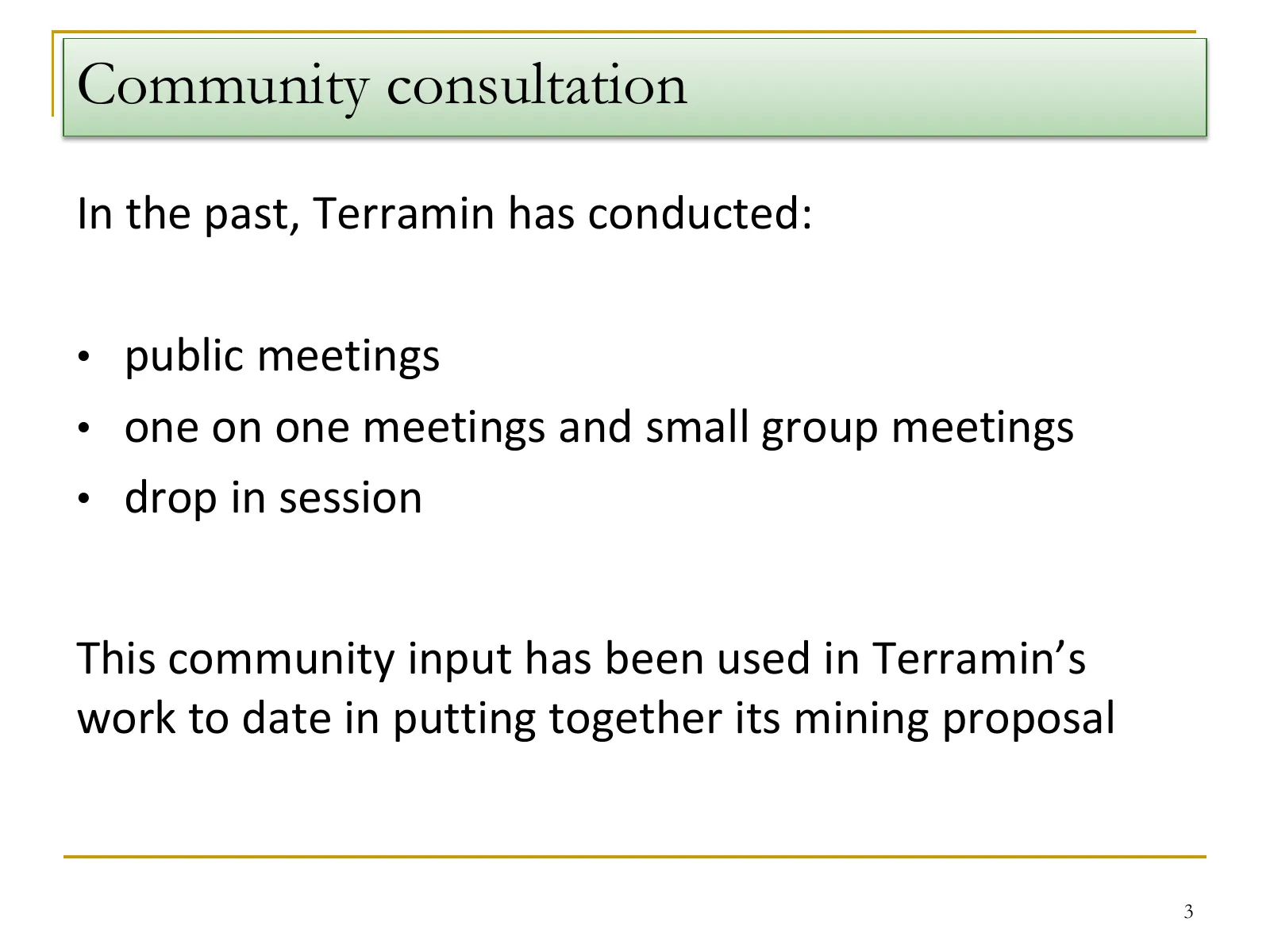
Slide 3: Community consultation
Community consultation In the past, Terramin has conducted: • public meetings • one on one meetings and small group meetings • drop in session This community input has been used in Terramin’s work to date in putting together its mining proposal 3
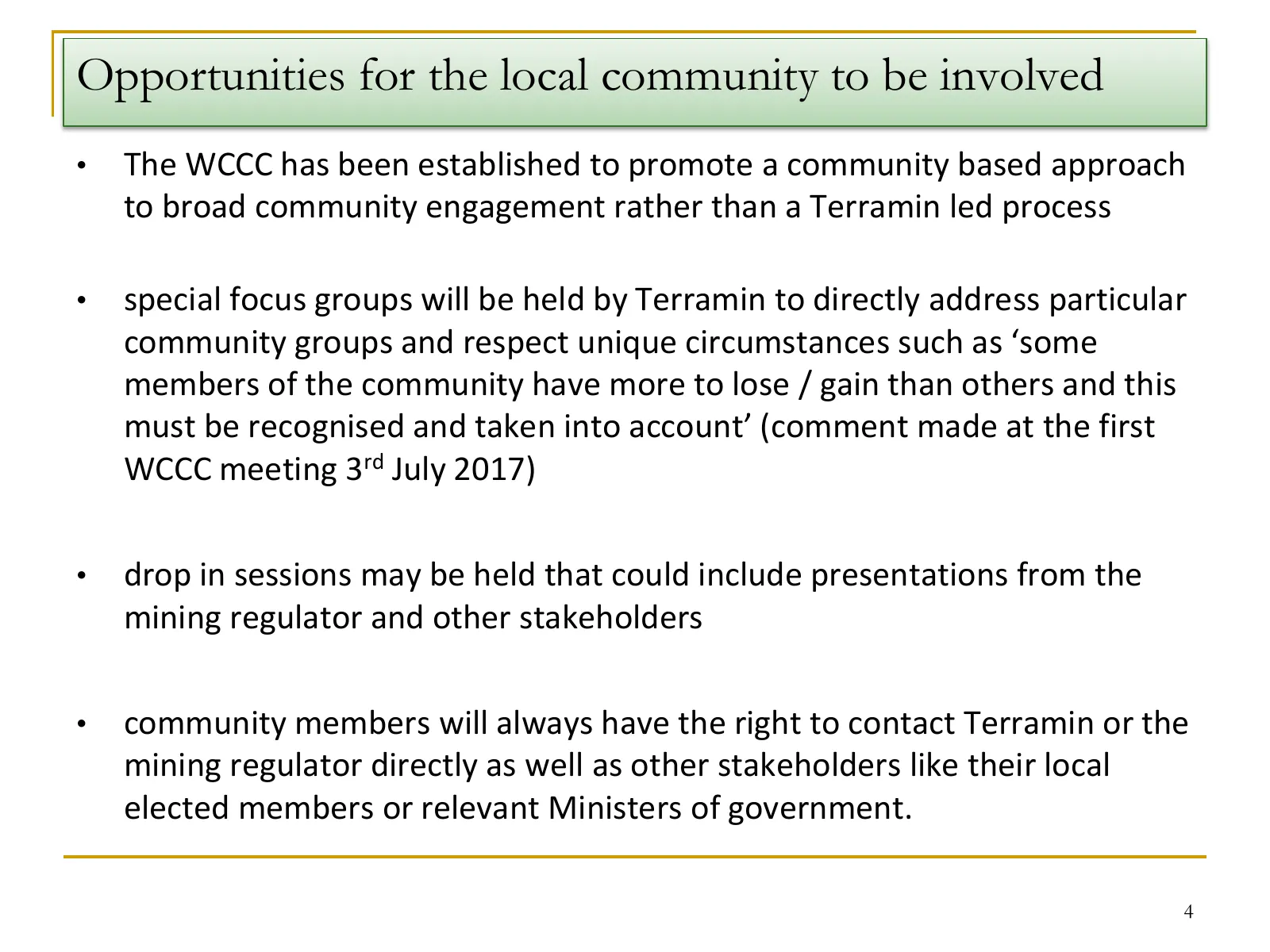
Slide 4: Opportunities for the local community to be involved
Opportunities for the local community to be involved • The WCCC has been established to promote a community based approach to broad community engagement rather than a Terramin led process • special focus groups will be held by Terramin to directly address particular community groups and respect uniq
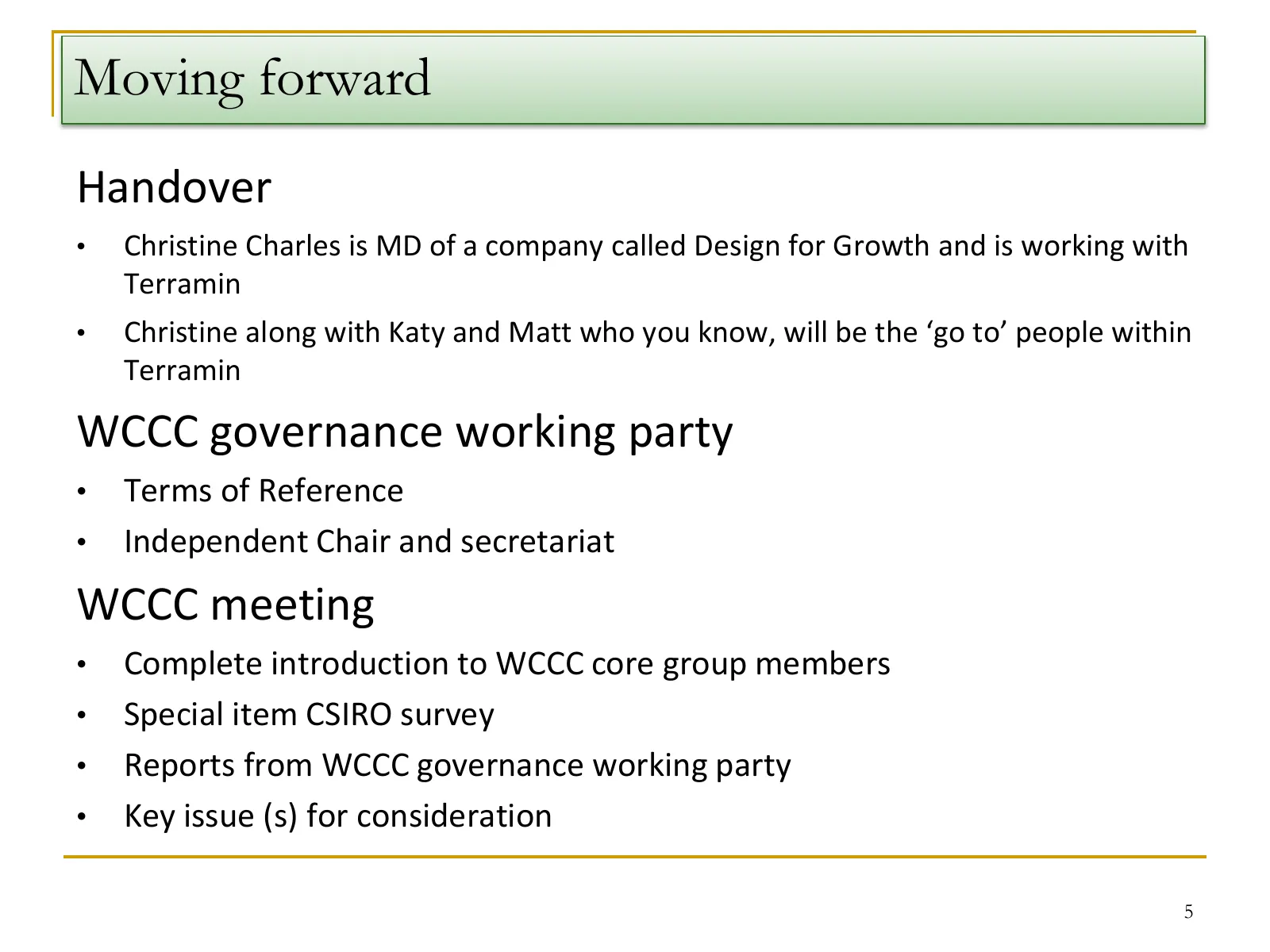
Slide 5: Moving forward
Moving forward Handover • Christine Charles is MD of a company called Design for Growth and is working with Terramin • Christine along with Katy and Matt who you know, will be the ‘go to’ people within Terramin WCCC governance working party • Terms of Reference • Independent Chair and secretariat WC
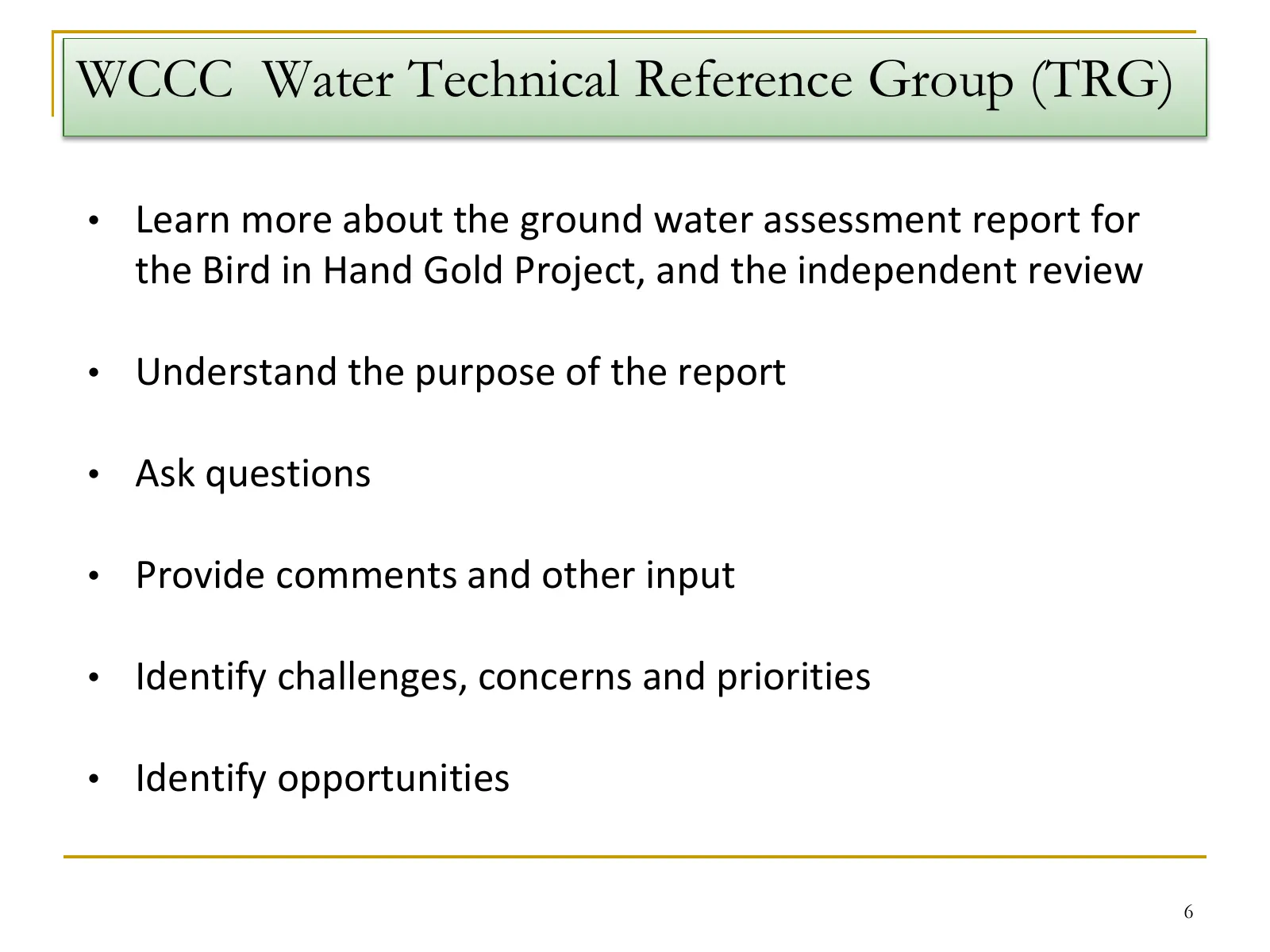
Slide 6: WCCC Water Technical Reference Group (TRG)
WCCC Water Technical Reference Group (TRG) • Learn more about the ground water assessment report for the Bird in Hand Gold Project, and the independent review • Understand the purpose of the report • Ask questions • Provide comments and other input • Identify challenges, concerns and priorities • Id
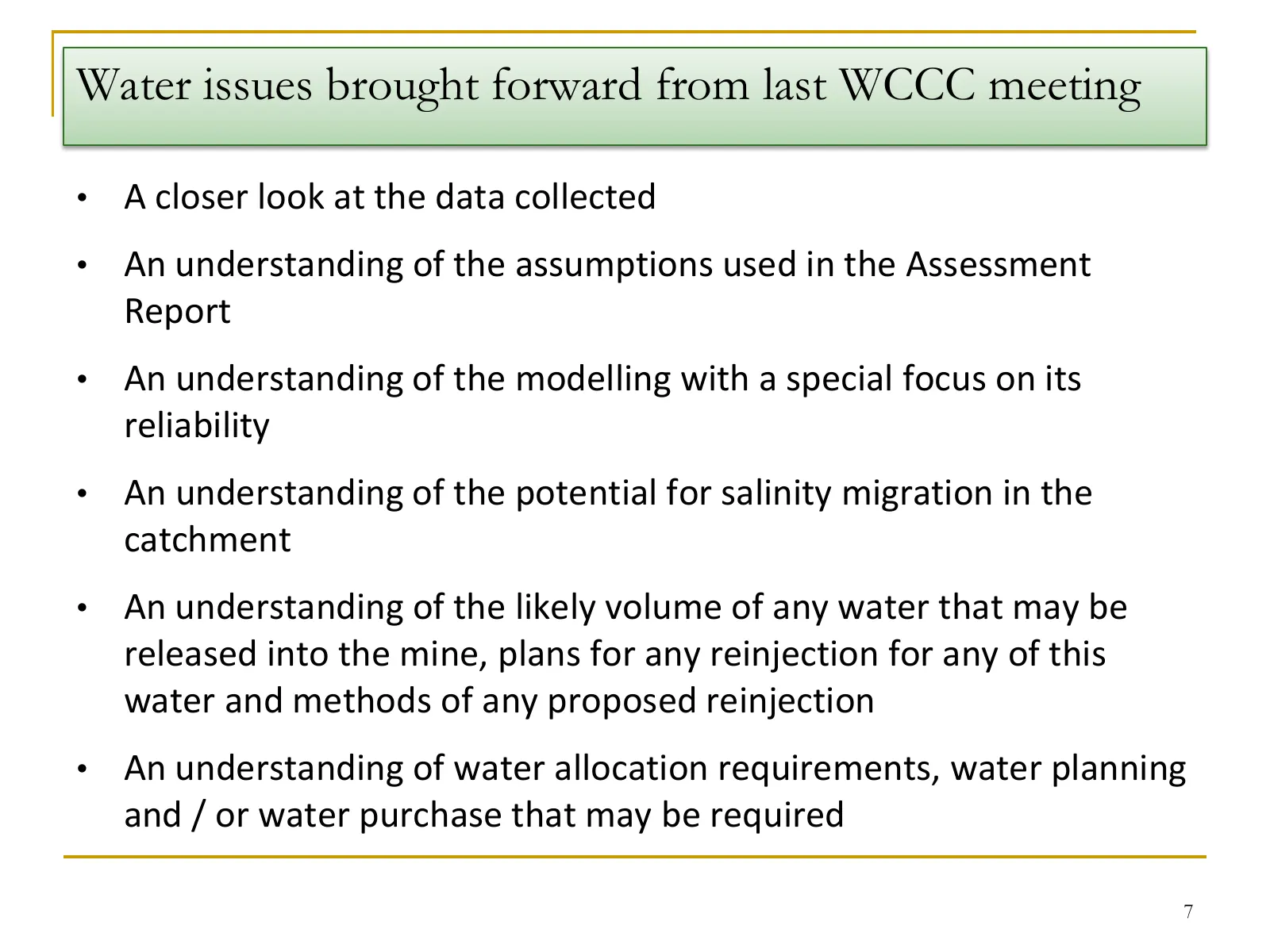
Slide 7: Water issues brought forward from last WCCC meeting
Water issues brought forward from last WCCC meeting • A closer look at the data collected • An understanding of the assumptions used in the Assessment Report • An understanding of the modelling with a special focus on its reliability • An understanding of the potential for salinity migration in the
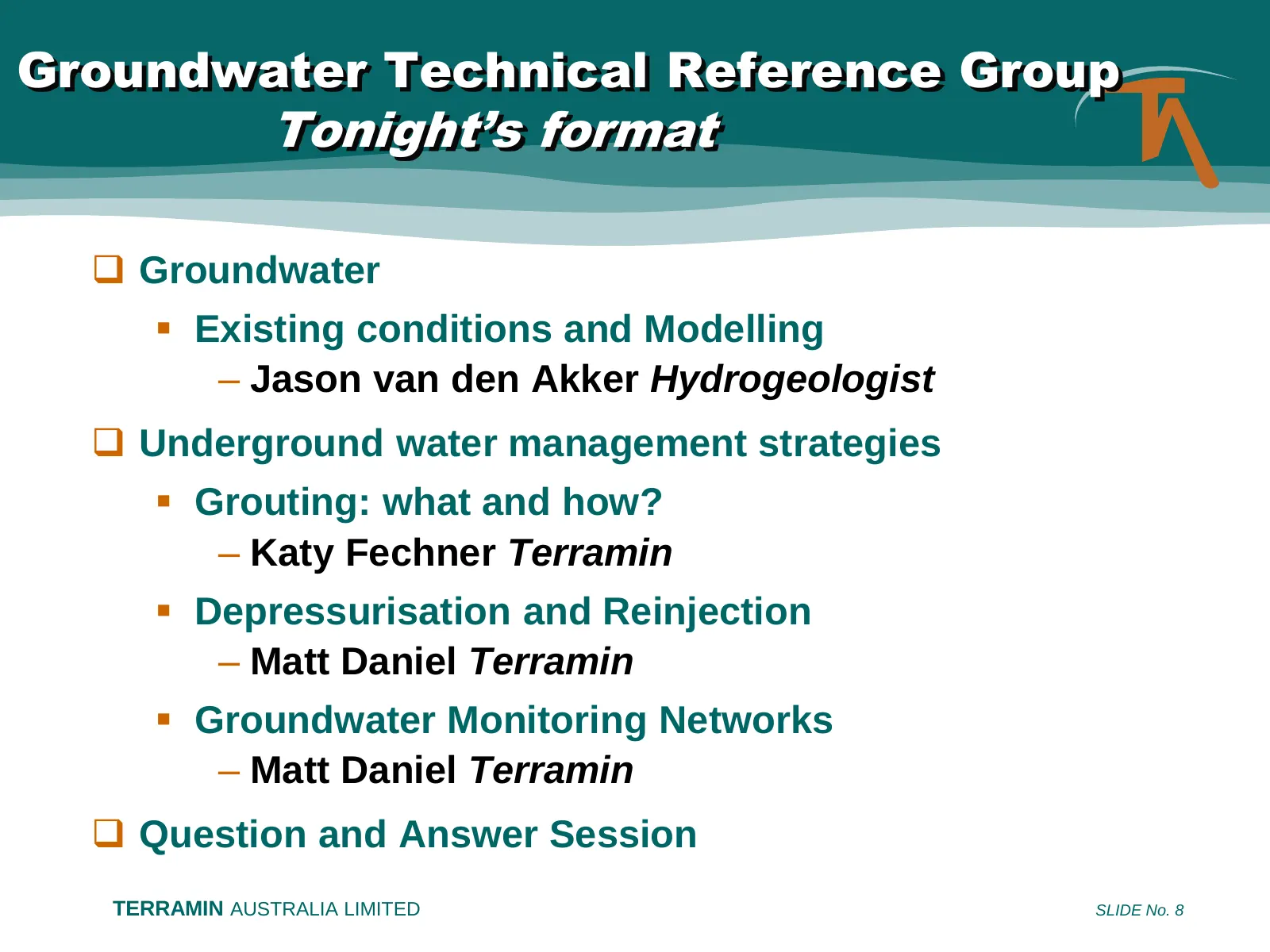
Slide 8: Groundwater Technical Reference Group Tonight's format
Groundwater Technical Reference Group Tonight’s format Groundwater Existing conditions and Modelling – Jason van den Akker Hydrogeologist Underground water management strategies Grouting: what and how? – Katy Fechner Terramin Depressurisation and Reinjection – Matt Daniel Terramin Ground
Slide 9: Approach
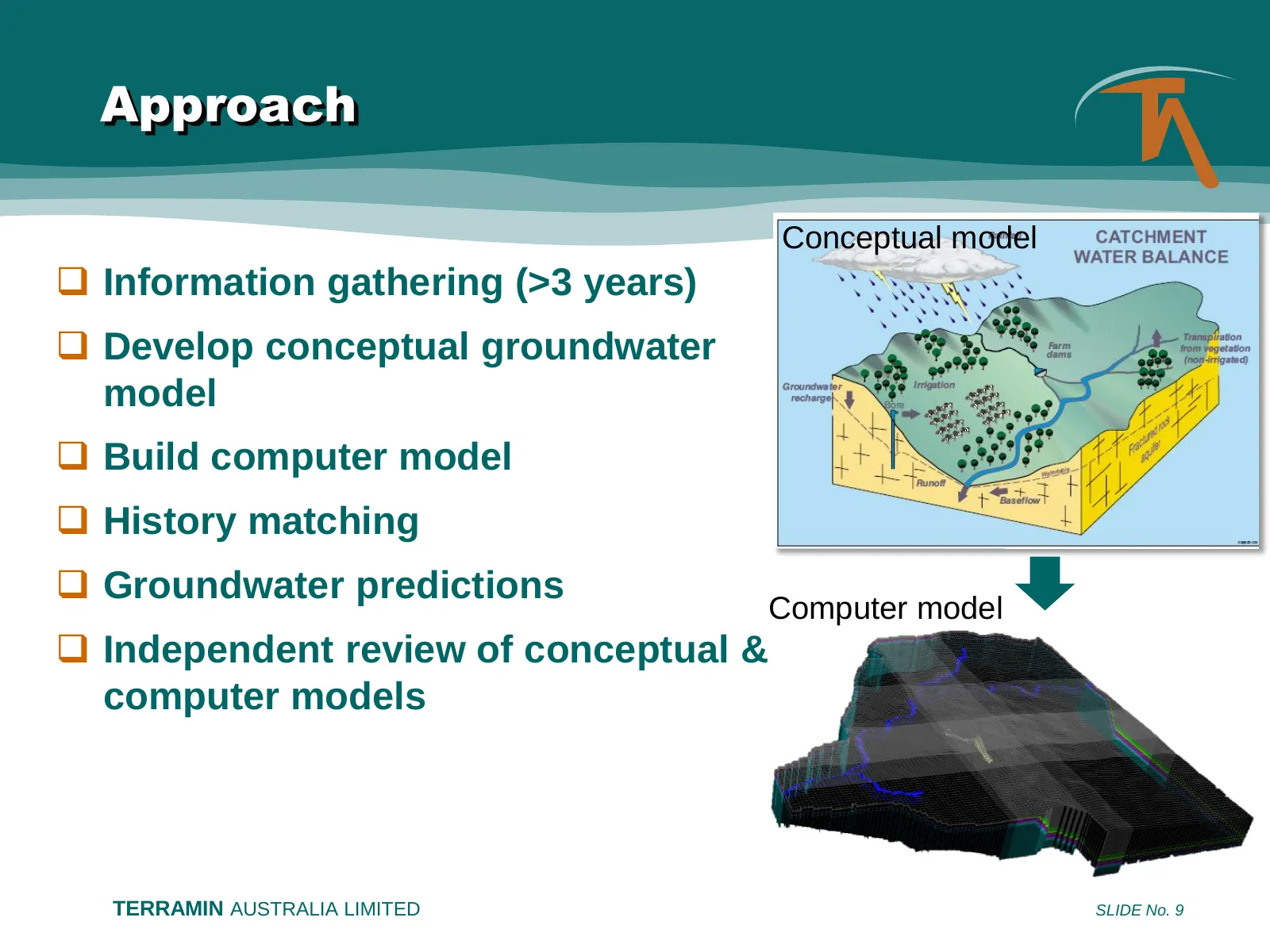
Approach Conceptual model Information gathering (>3 years) Develop conceptual groundwater model Build computer model History matching Groundwater predictions Computer model Independent review of conceptual & computer models TERRAMIN AUSTRALIA LIMITED SLIDE No. 9
Slide 10: Information gathering
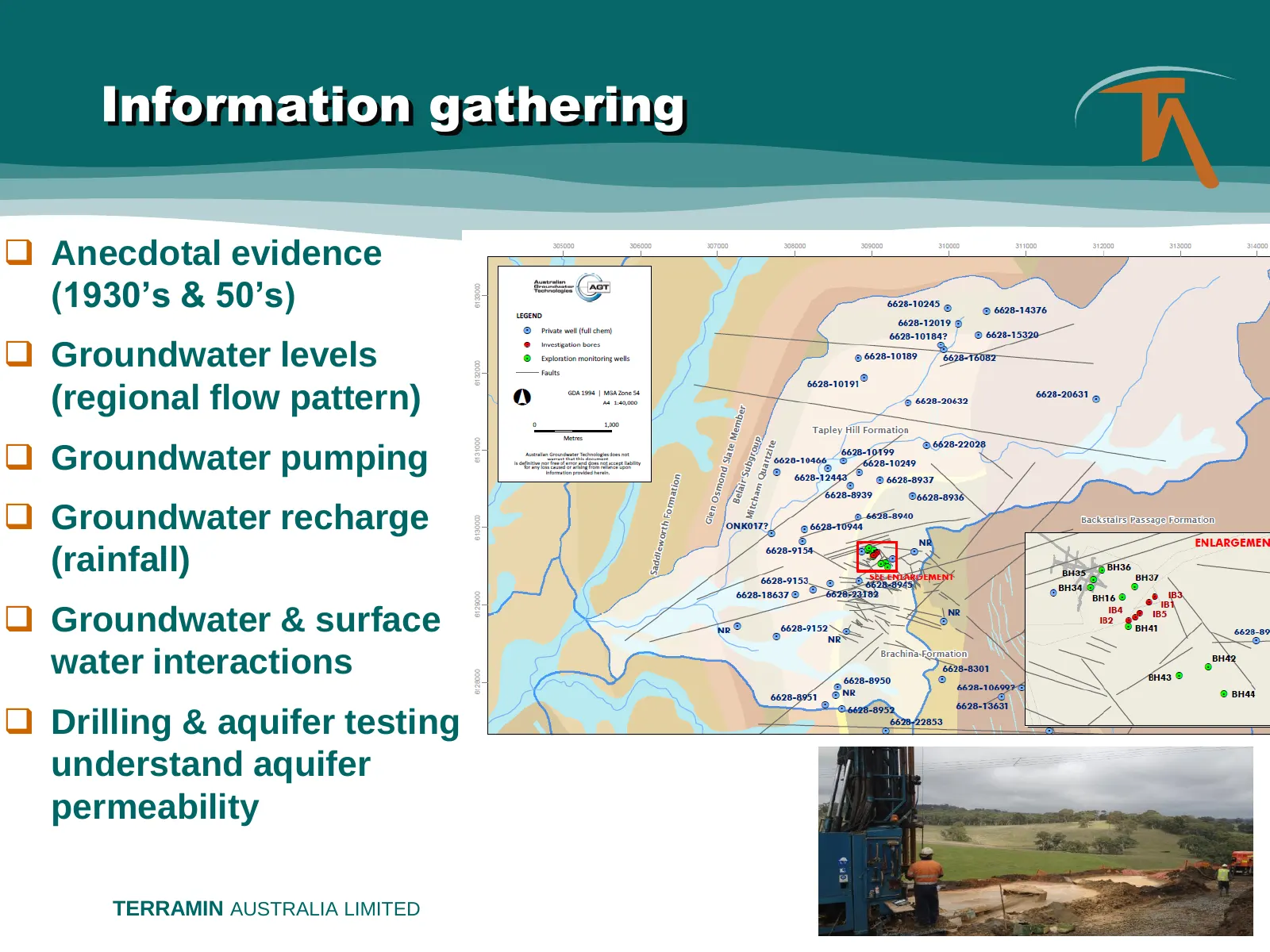
Information gathering Anecdotal evidence (1930’s & 50’s) Groundwater levels (regional flow pattern) Groundwater pumping Groundwater recharge (rainfall) Groundwater & surface water interactions Drilling & aquifer testing to understand aquifer permeability TERRAMIN AUSTRALIA LIMITED SLIDE
Slide 11: Conceptual groundwater model – Regional scale
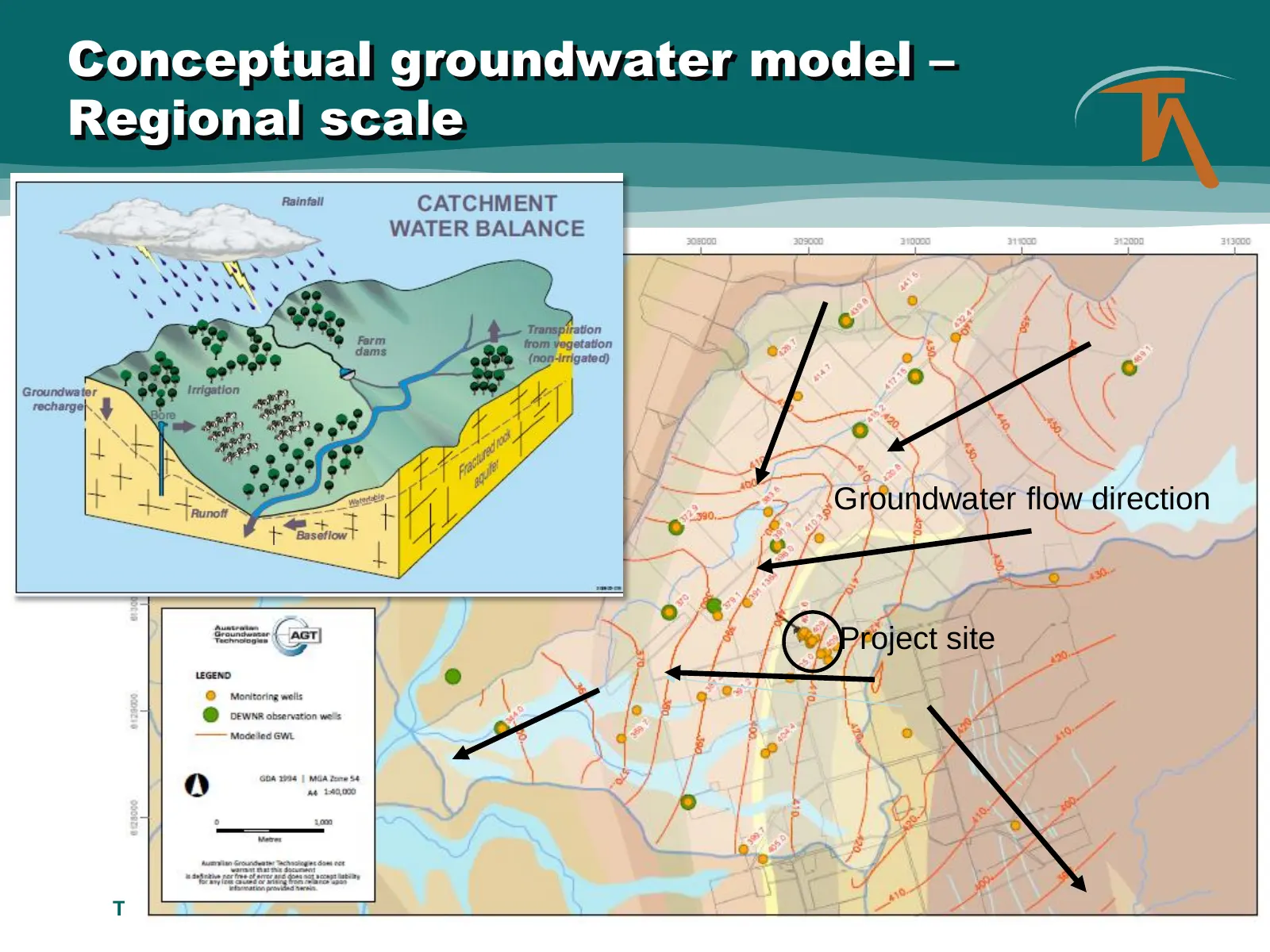
Conceptual groundwater model – Regional scale Groundwater flow direction Project site TERRAMIN AUSTRALIA LIMITED SLIDE No. 11
Slide 12: Conceptual groundwater model – Local scale
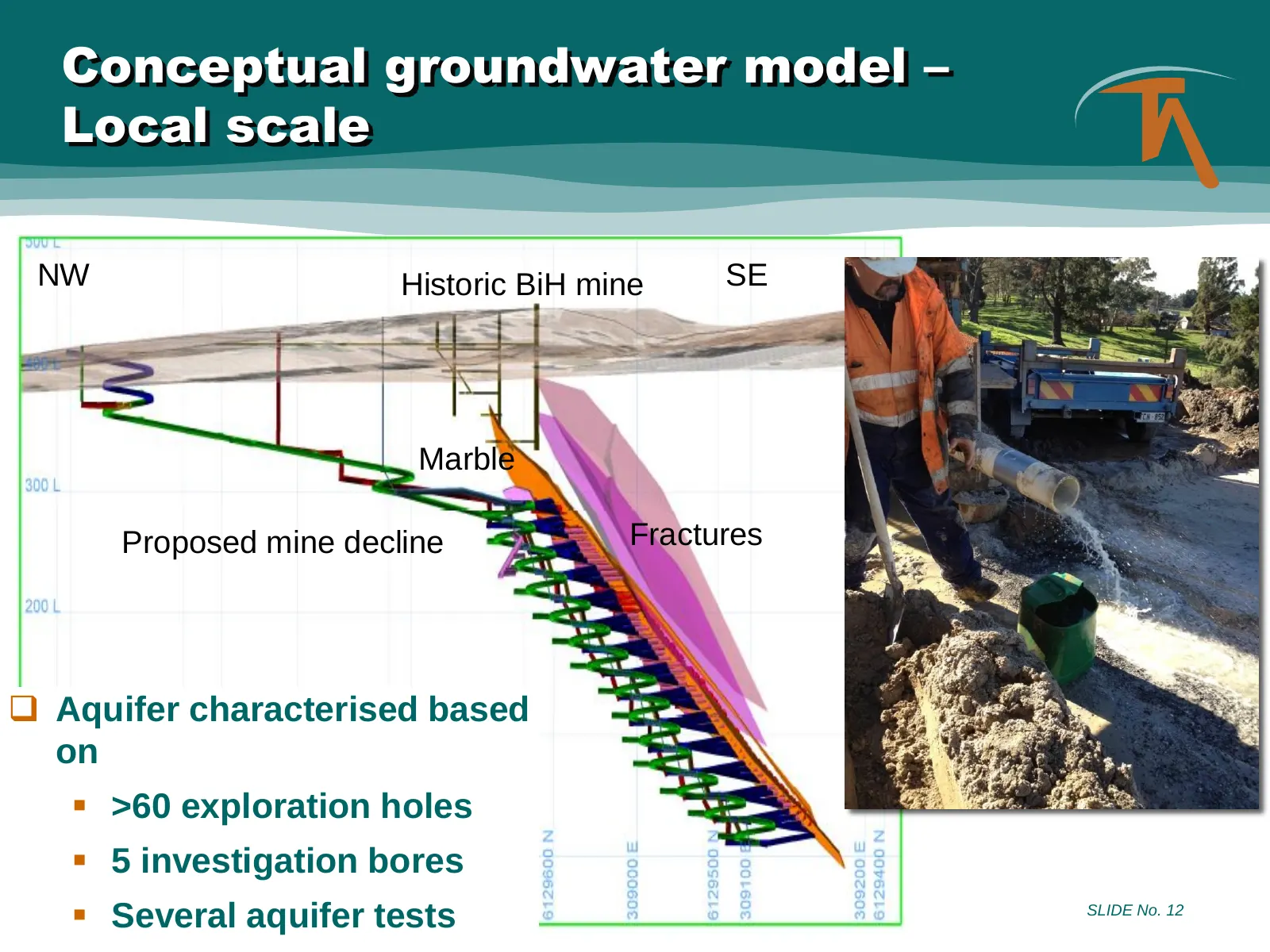
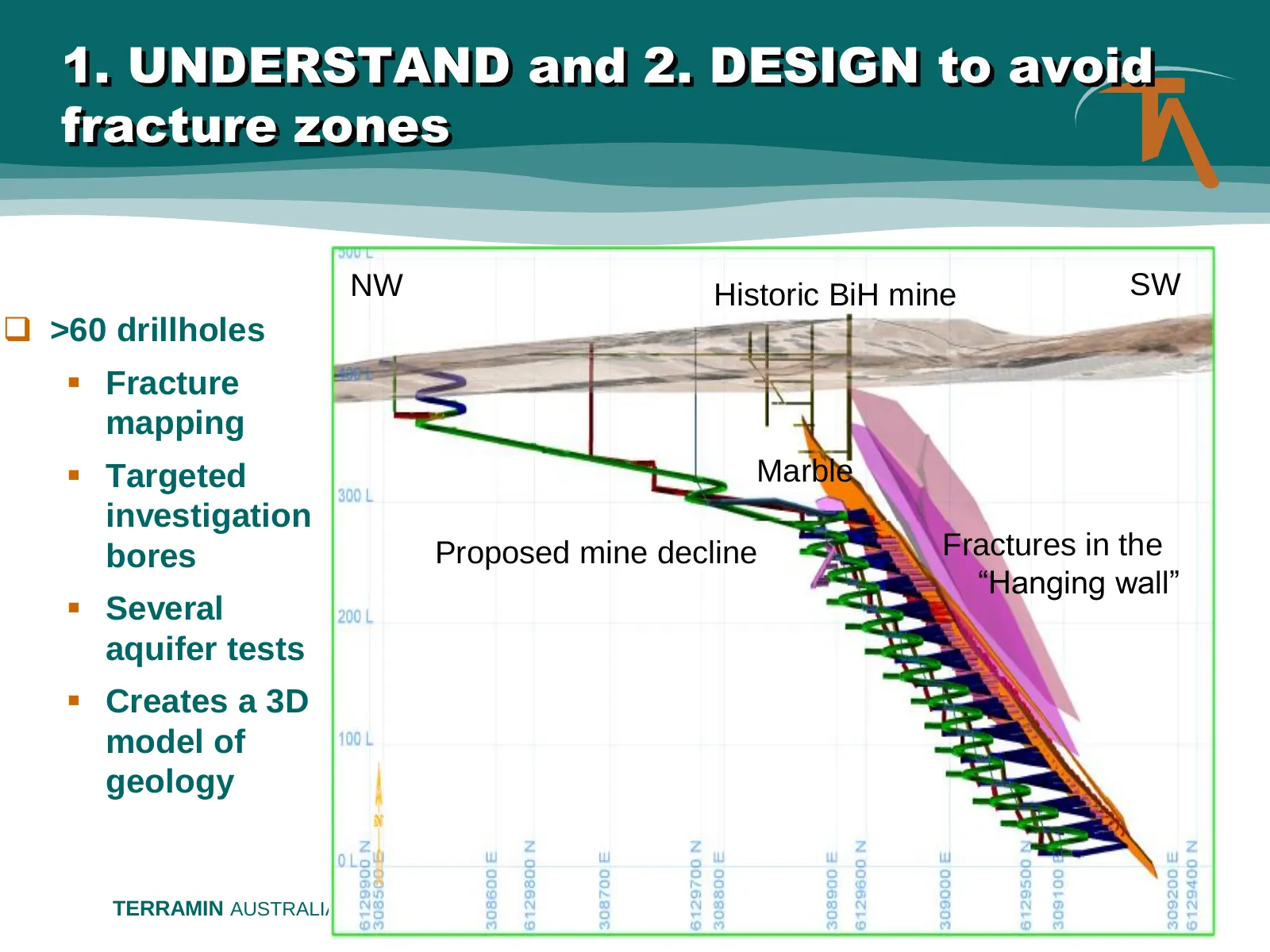
Conceptual groundwater model – Local scale NW Historic BiH mine SE Marble Proposed mine decline Fractures Aquifer characterised based on >60 exploration holes 5 investigation bores Several TERRAMIN AUSTRALIA LIMITED aquifer tests SLIDE No. 12
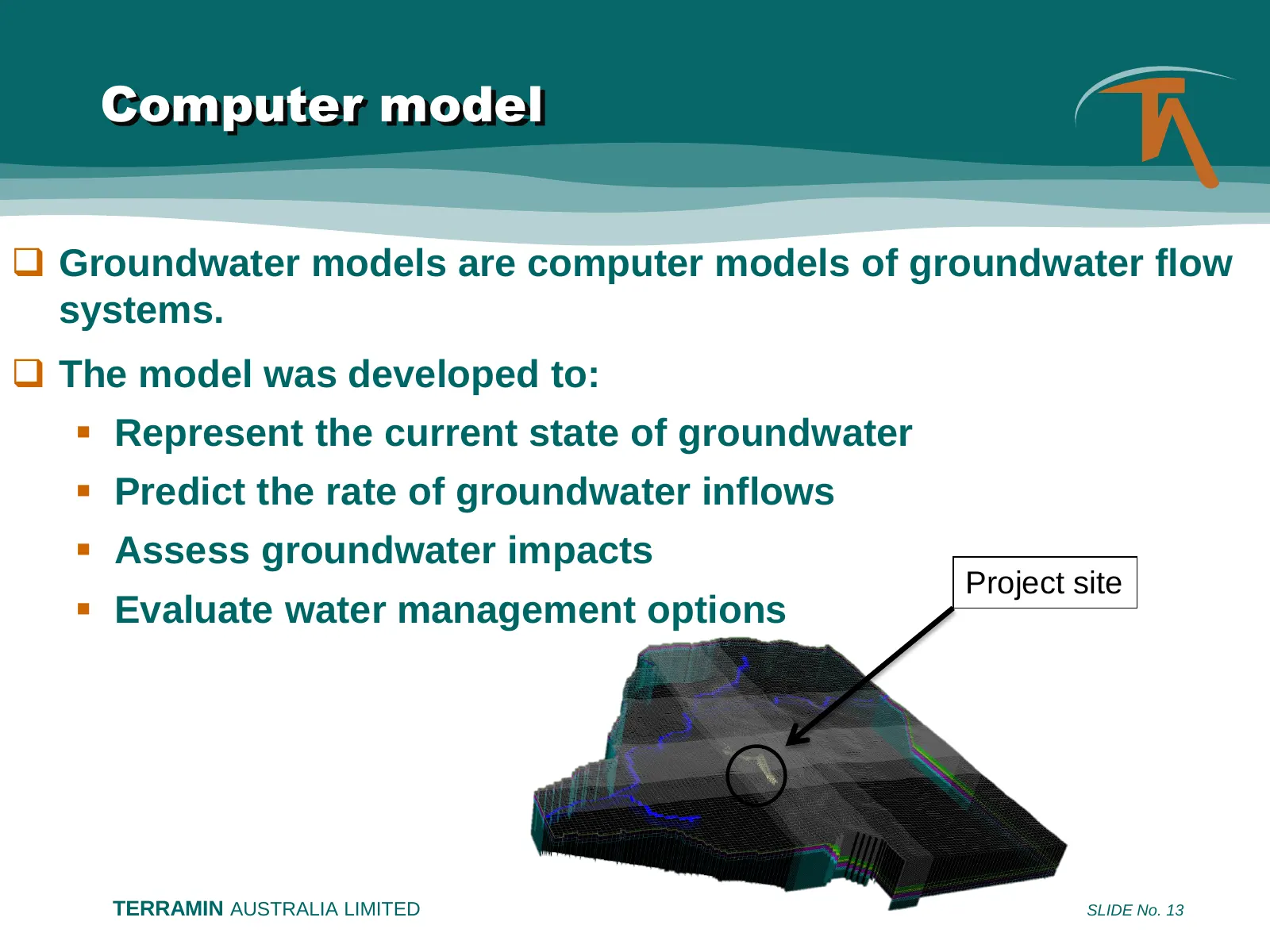
Slide 13: Computer model
Computer model Groundwater models are computer models of groundwater flow systems. The model was developed to: Represent the current state of groundwater Predict the rate of groundwater inflows Assess groundwater impacts Project site Evaluate water management options TERRAMIN AUSTRALIA L
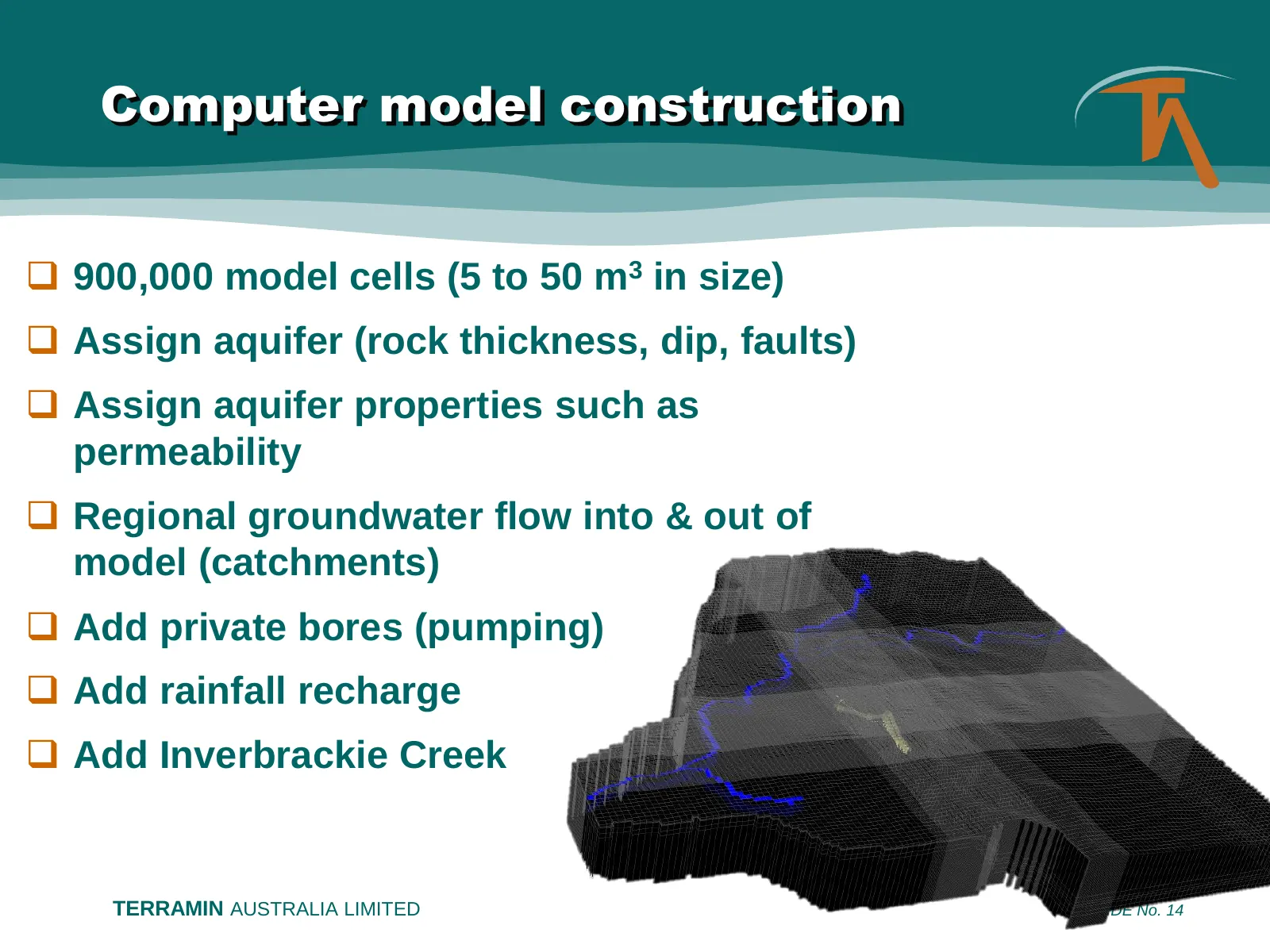
Slide 14: Computer model construction
Computer model construction 900,000 model cells (5 to 50 m3 in size) Assign aquifer (rock thickness, dip, faults) Assign aquifer properties such as permeability Regional groundwater flow into & out of model (catchments) Add private bores (pumping) Add rainfall recharge Add Inverbrackie
Slide 15: History matching
History matching Model Calibration – matching historic observations to model predictions The model needs to replicate: Current groundwater flow pattern – 35 observation bores Seasonal groundwater level change due to pumping – 28 observation bores The results of the 6 day pumping test – 20
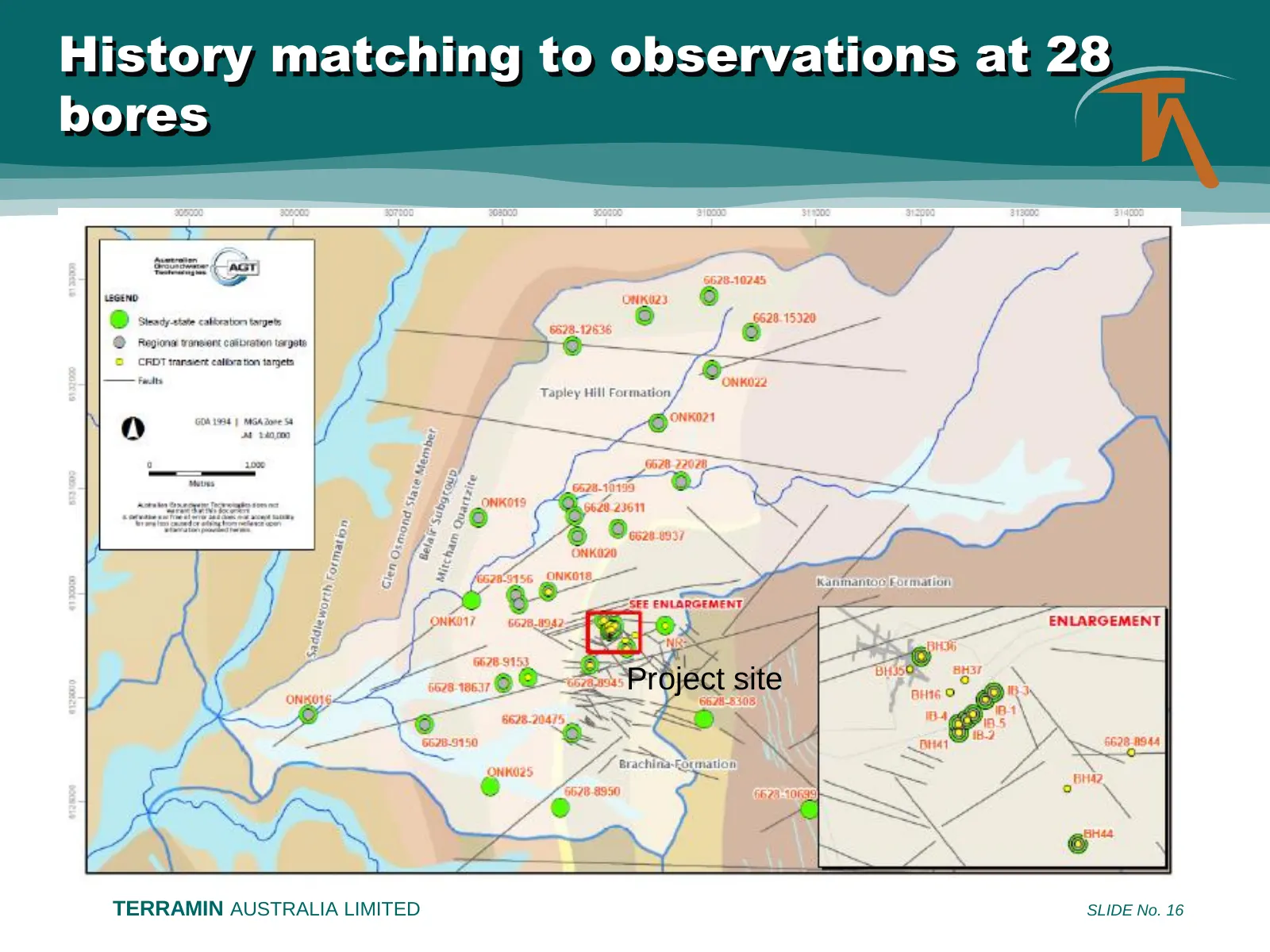
Slide 16: History matching to observations at 28 bores
History matching to observations at 28 bores Project site TERRAMIN AUSTRALIA LIMITED SLIDE No. 16
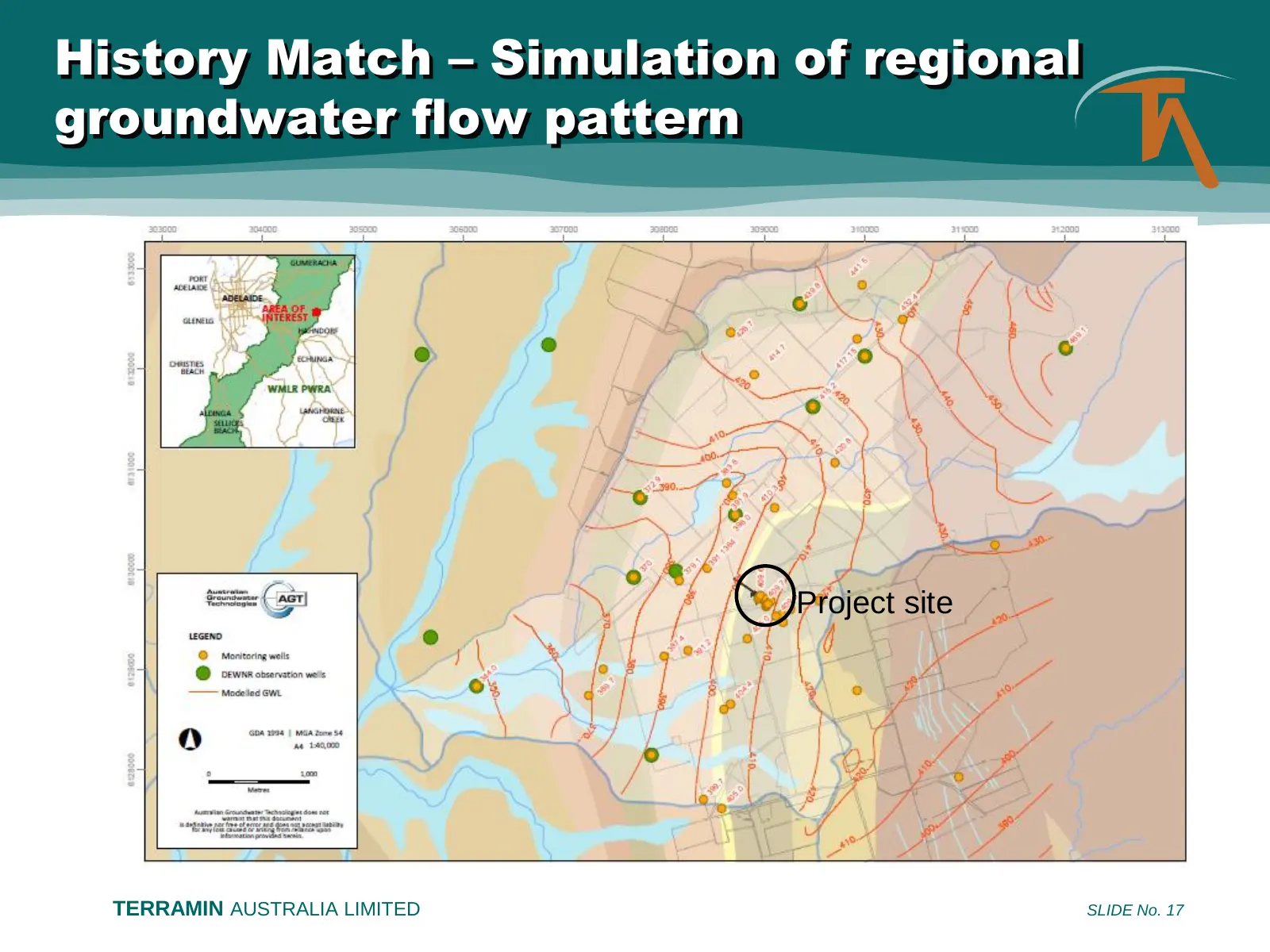
Slide 17: History Match – Simulation of regional groundwater flow pattern
History Match – Simulation of regional groundwater flow pattern Project site TERRAMIN AUSTRALIA LIMITED SLIDE No. 17
Slide 18: Model review process
Model review process Groundwater modelling guidelines 120 compliance criteria Iterative process looking at Planning Conceptual model Design and construction Calibration & sensitivity analysis Predictions of impacts Model is fit for purpose Government will conduct its own review T
Slide 19: Model uncertainty
Model uncertainty Robustness of the model is based on the amount of information available to inform construction Limited info = low confidence (need to make assumptions) More info = higher confidence (less assumptions) This model has evolved over 3 years Sensitivity analysis: What parame
Slide 20: Uncertainty
Uncertainty Worst case Interception of water bearing fault (beyond 60 L/s) Different grouting effectiveness (reduce inflows to 4 to 12 L/s) Increase aquifer permeability (+7 L/s) Reduce rainfall recharge TERRAMIN AUSTRALIA LIMITED SLIDE No. 20
Slide 21: Water Allocation Plan
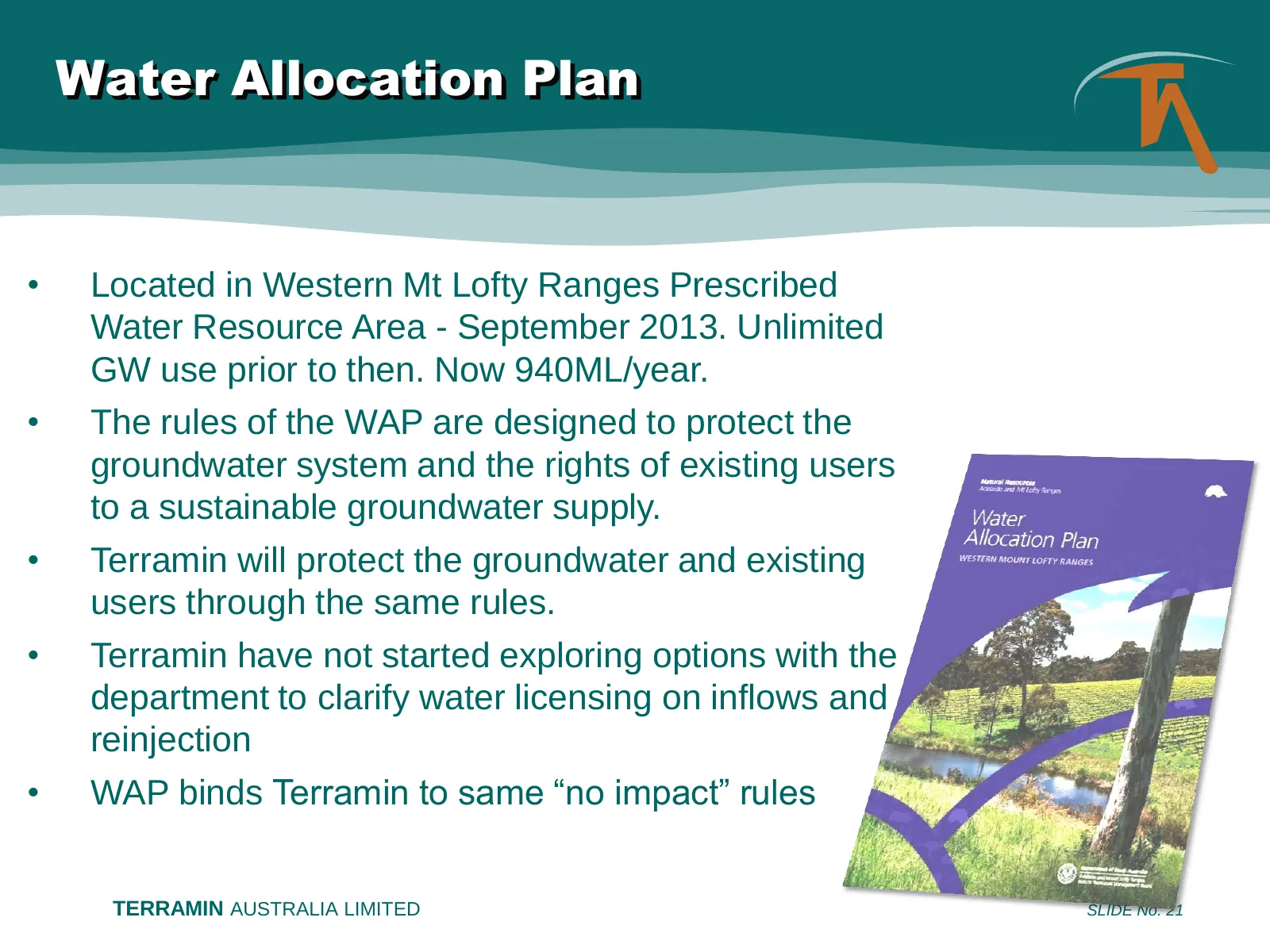
Water Water Allocation Plan Allocation • Located in Western Mt Lofty Ranges Prescribed Water Resource Area - September 2013. Unlimited GW use prior to then. Now 940ML/year. • The rules of the WAP are designed to protect the groundwater system and the rights of existing users to a sustainable groundw
Slide 22: Water Allocation Plan Principles
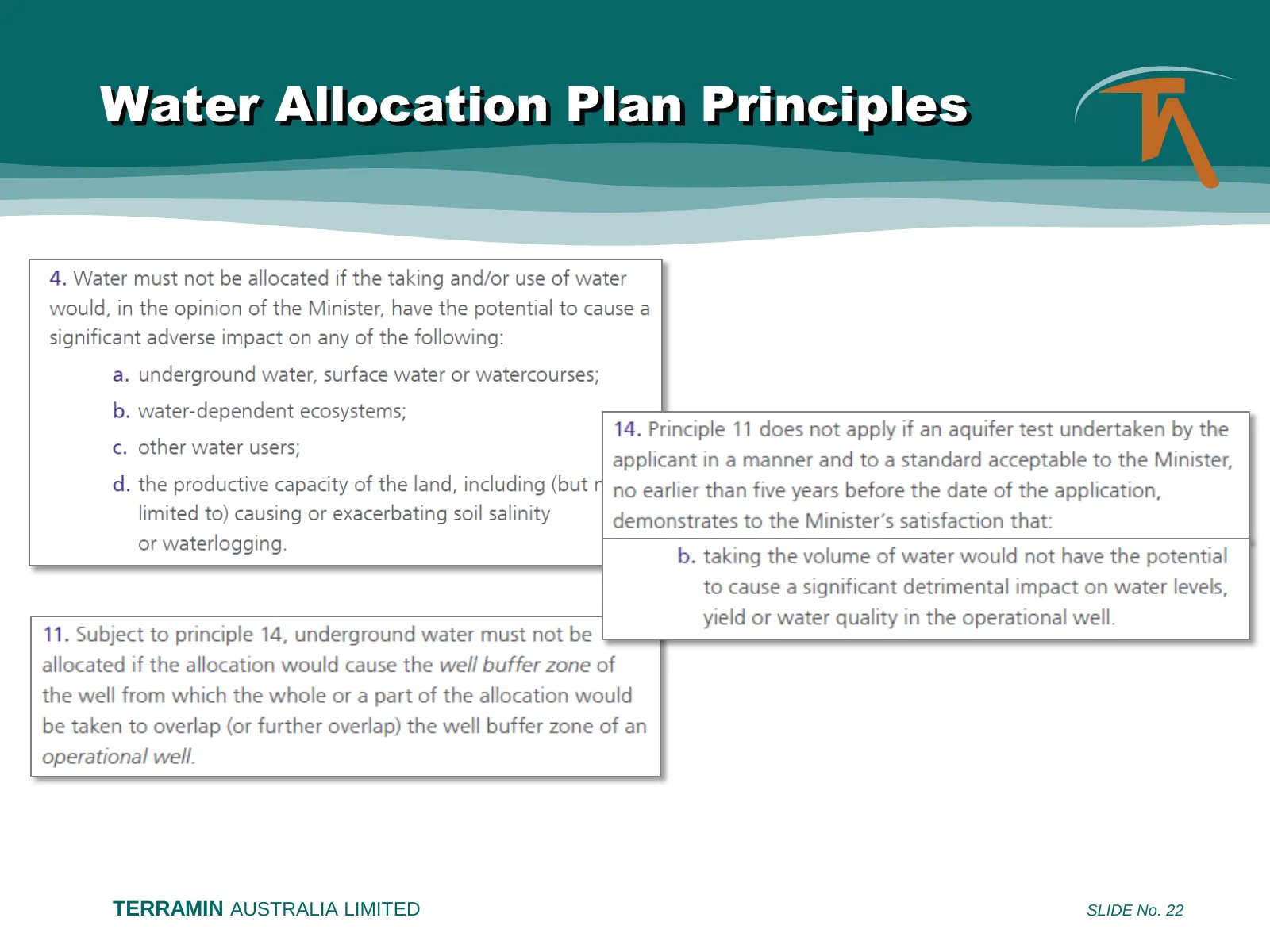
Water Allocation Plan Principles TERRAMIN AUSTRALIA LIMITED SLIDE No. 22
Slide 23: What we are proposing to be monitored against
Law - Proposed Outcome Criteria What we are proposing to be monitored against All aspects of the project have outcome statements like these Provide the basis for all design and monitoring WATER “No adverse impact to the supply or quality of water by the mining operations to existing users and
Slide 24: Groundwater Management Strategy
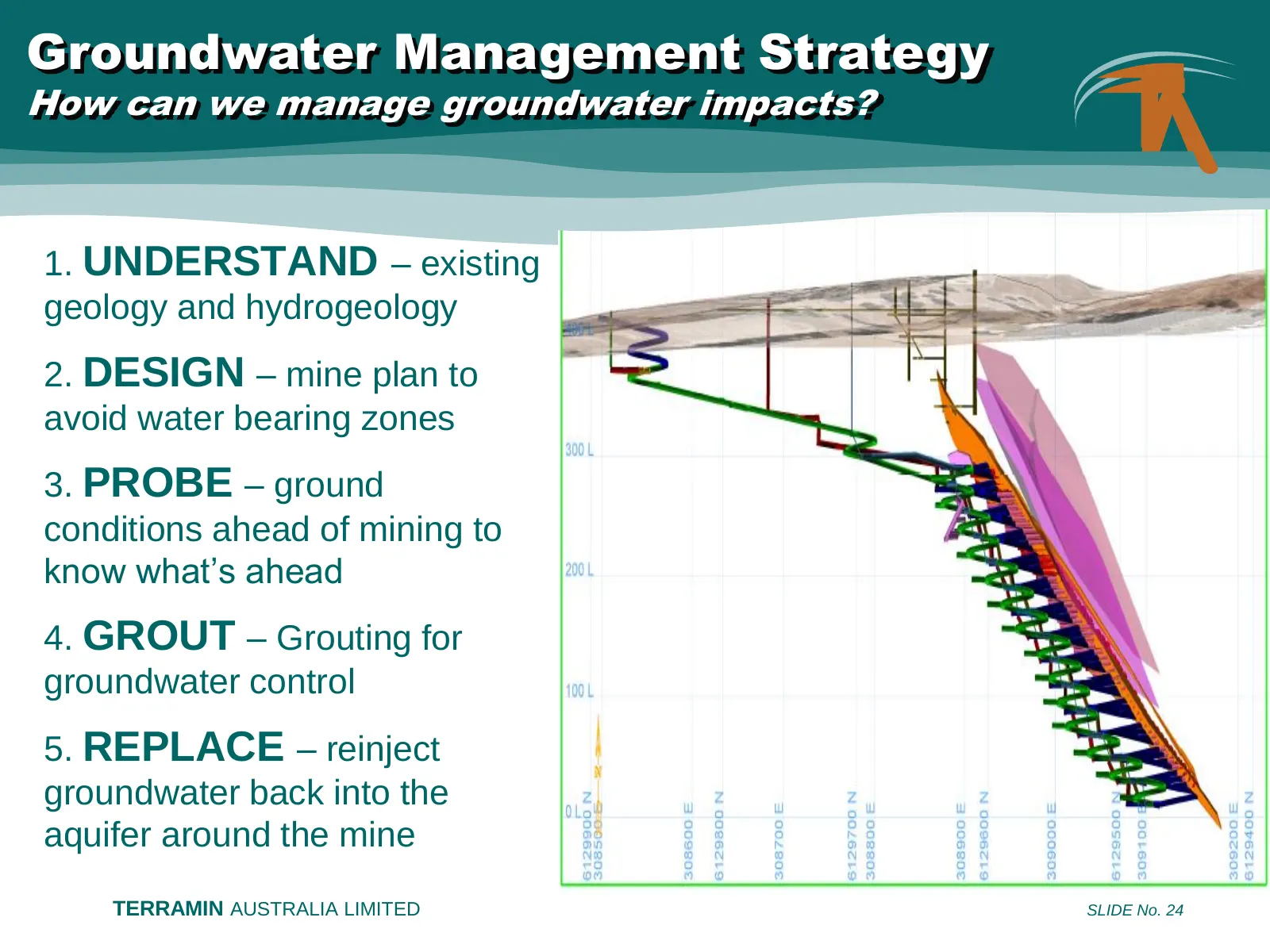
Groundwater Management Strategy How can we manage groundwater impacts? 1. UNDERSTAND – existing geology and hydrogeology 2. DESIGN – mine plan to avoid water bearing zones 3. PROBE – ground conditions ahead of mining to know what’s ahead 4. GROUT – Grouting for groundwater control 5. REPLACE – reinj
Slide 25: 1. UNDERSTAND and 2. DESIGN to avoid fracture zones
1. UNDERSTAND and 2. DESIGN to avoid fracture zones NW Historic BiH mine SW >60 drillholes Fracture mapping Targeted Marble investigation bores Proposed mine decline Fractures in the “Hanging wall” Several aquifer tests Creates a 3D model of geology TERRAMIN AUSTRALIA LIMITED SLIDE No. 25
Slide 26: 3. PROBE and 4. GROUT process
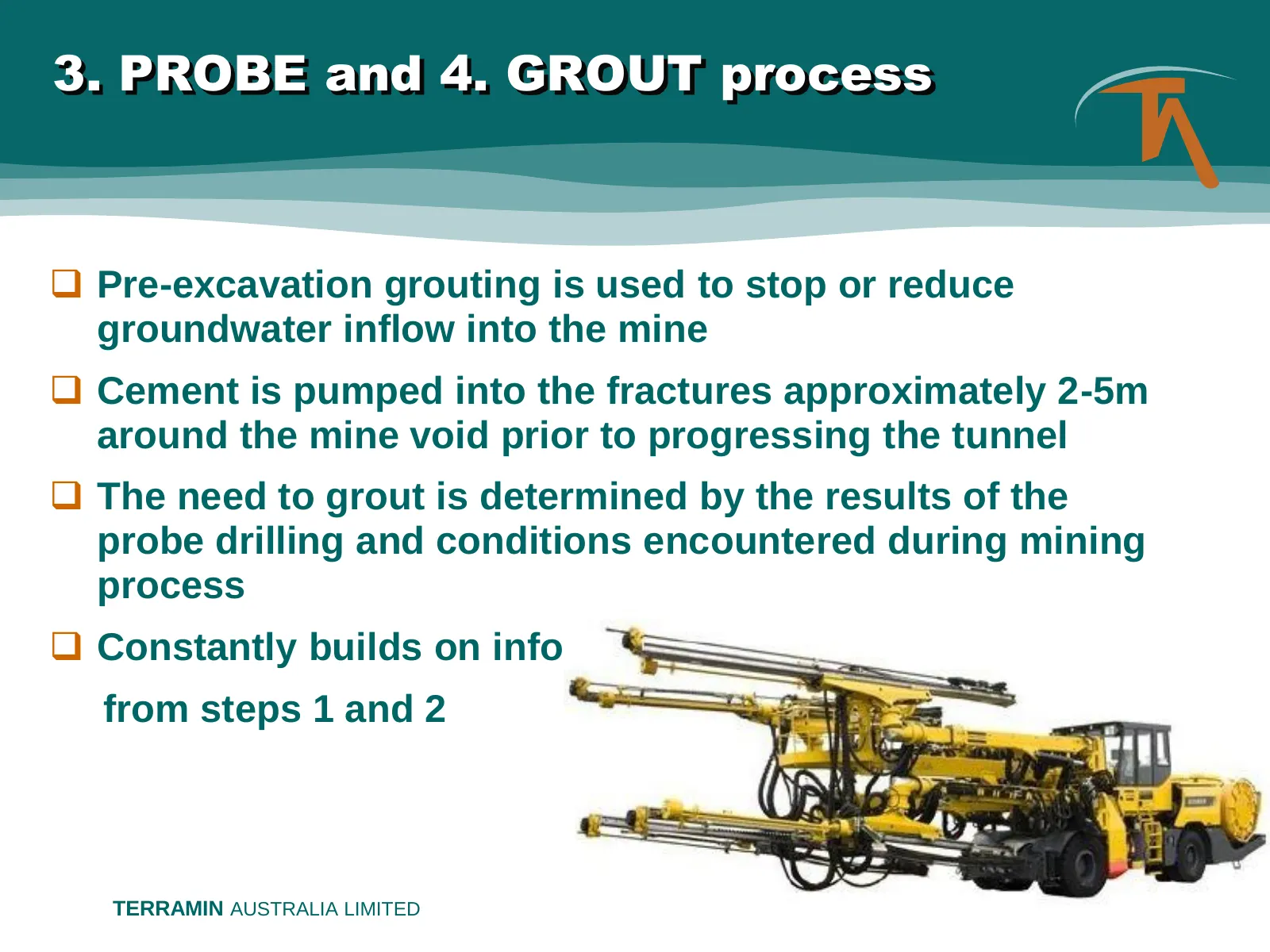
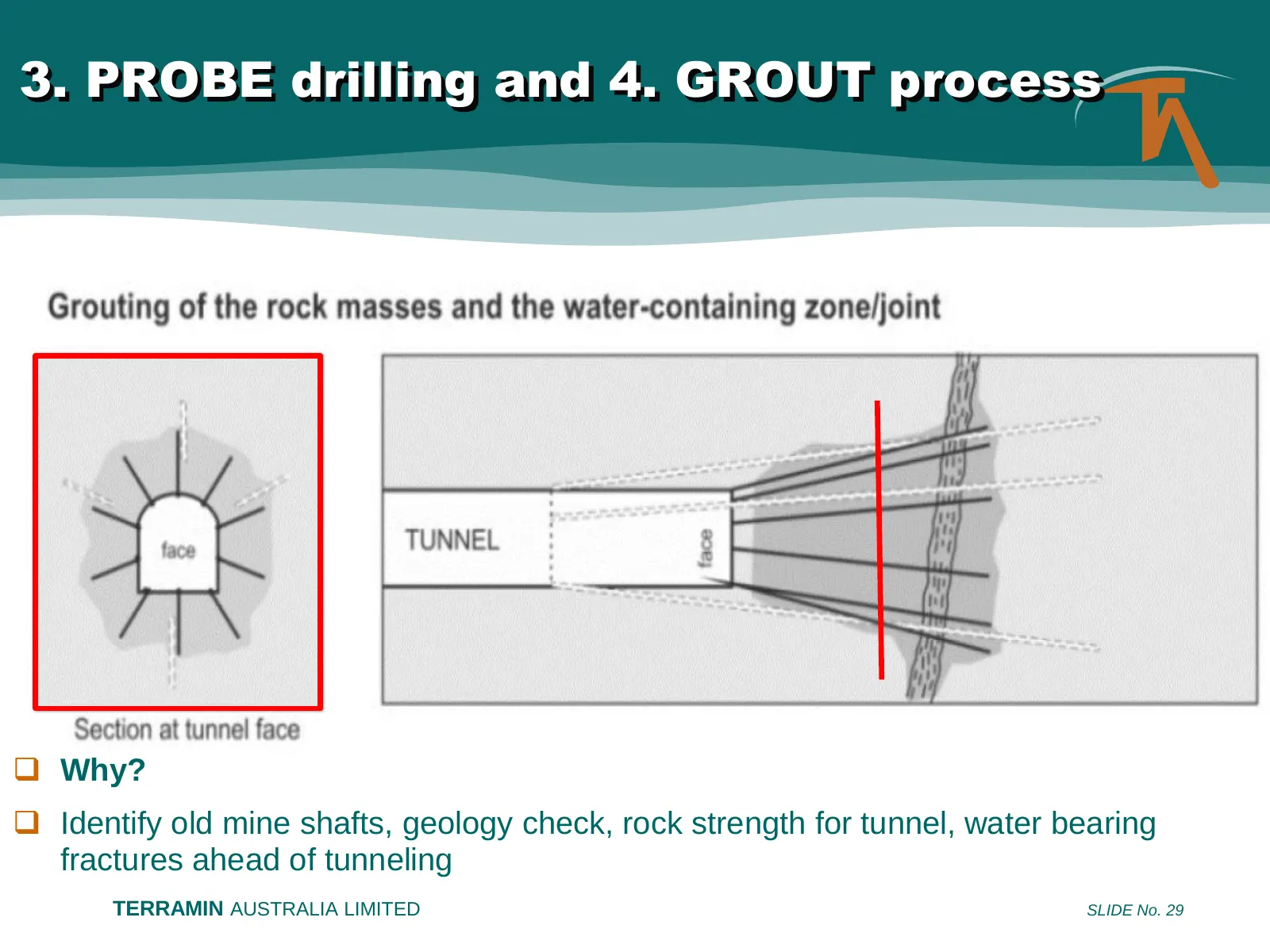
3. PROBE and 4. GROUT process Pre-excavation grouting is used to stop or reduce groundwater inflow into the mine Cement is pumped into the fractures approximately 2-5m around the mine void prior to progressing the tunnel The need to grout is determined by the results of the probe drilling and
Slide 27: 3. PROBE drilling and 4. GROUT process
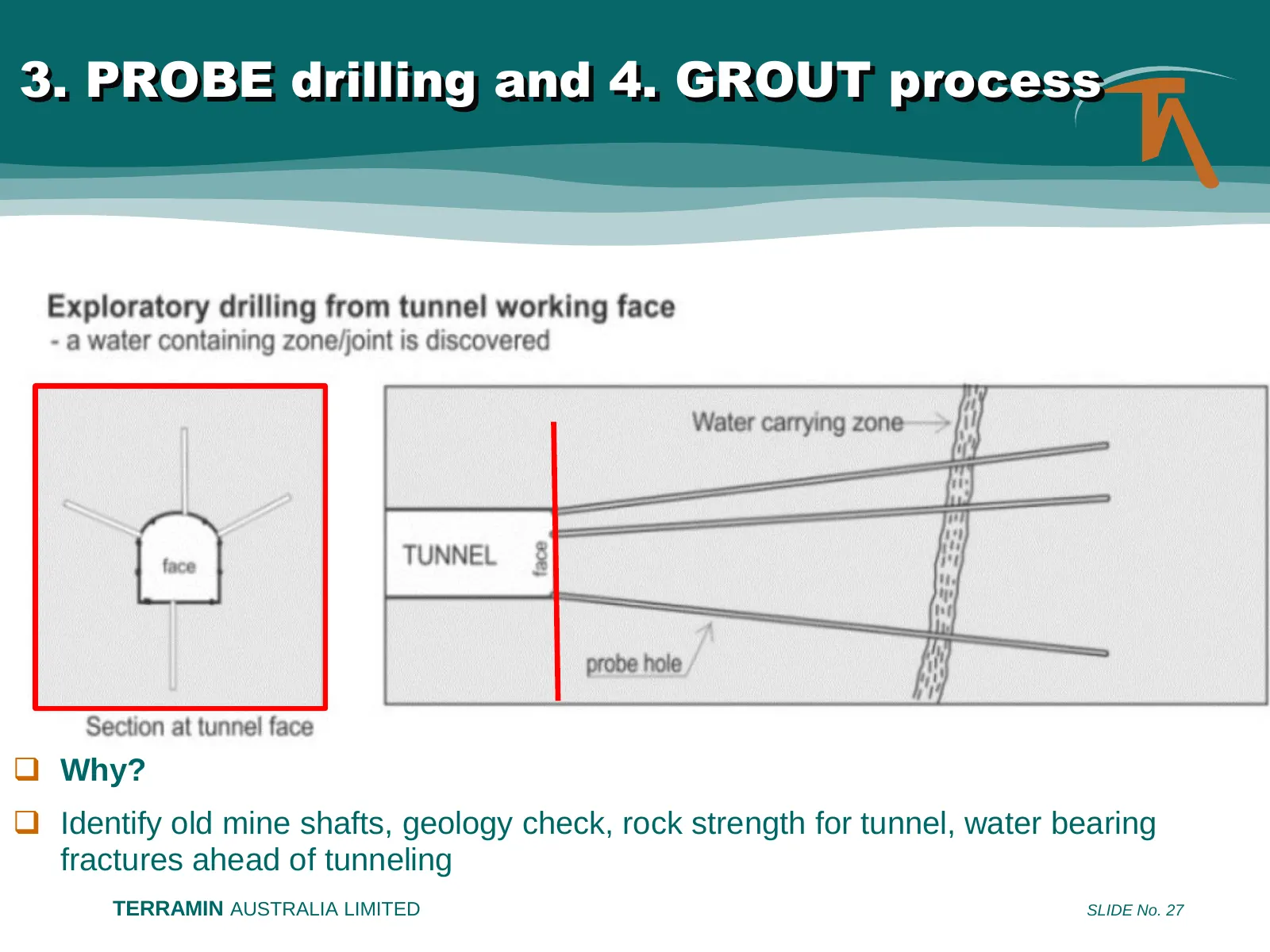
3. PROBE drilling and 4. GROUT process Why? Identify old mine shafts, geology check, rock strength for tunnel, water bearing fractures ahead of tunneling TERRAMIN AUSTRALIA LIMITED SLIDE No. 27
Slide 28: 3. PROBE drilling and 4. GROUT process
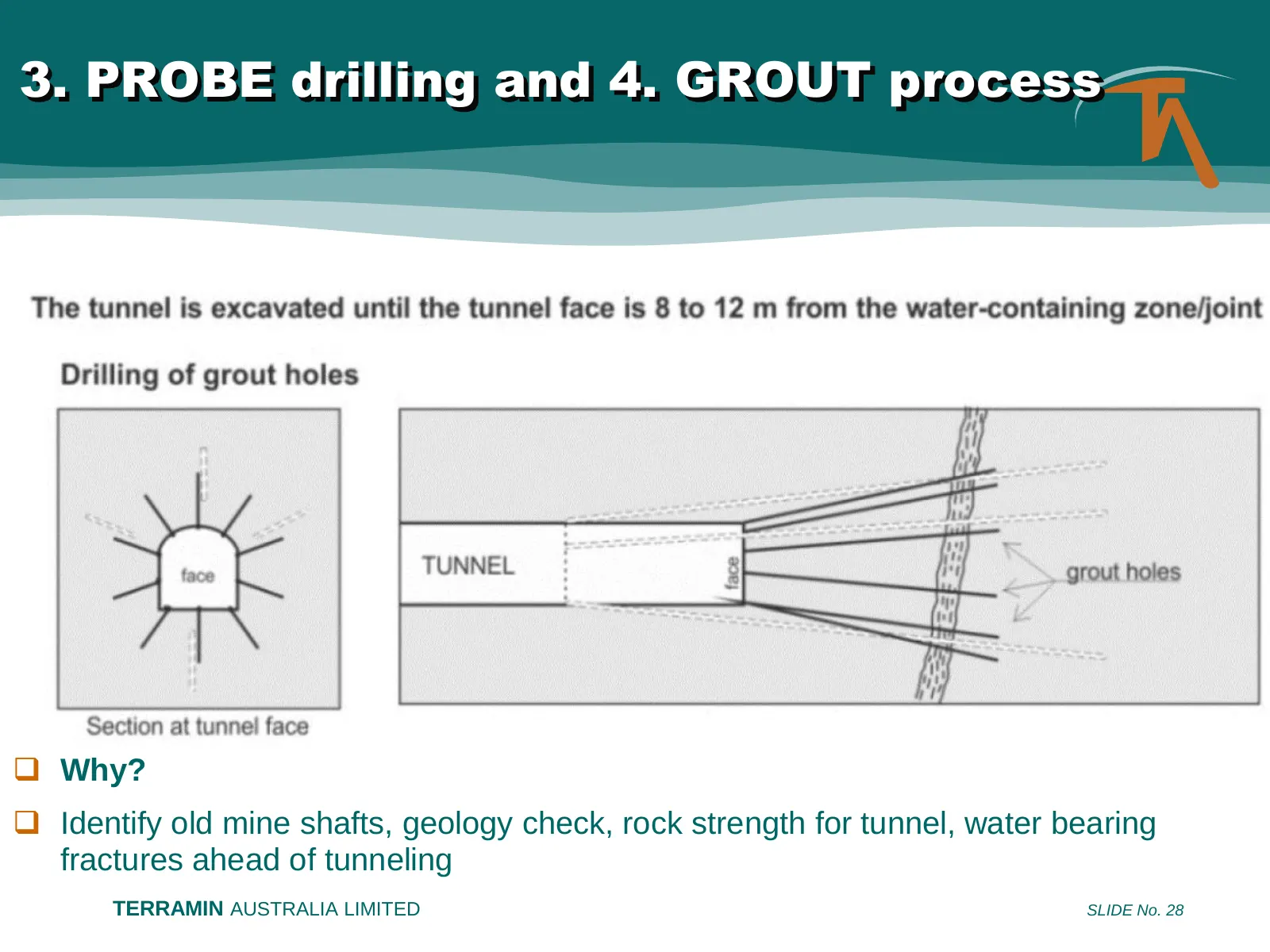
3. PROBE drilling and 4. GROUT process Why? Identify old mine shafts, geology check, rock strength for tunnel, water bearing fractures ahead of tunneling TERRAMIN AUSTRALIA LIMITED SLIDE No. 28
Slide 29: 3. PROBE drilling and 4. GROUT process
3. PROBE drilling and 4. GROUT process Why? Identify old mine shafts, geology check, rock strength for tunnel, water bearing fractures ahead of tunneling TERRAMIN AUSTRALIA LIMITED SLIDE No. 29
Slide 30: 3. PROBE and 4. GROUT process Continuous checking
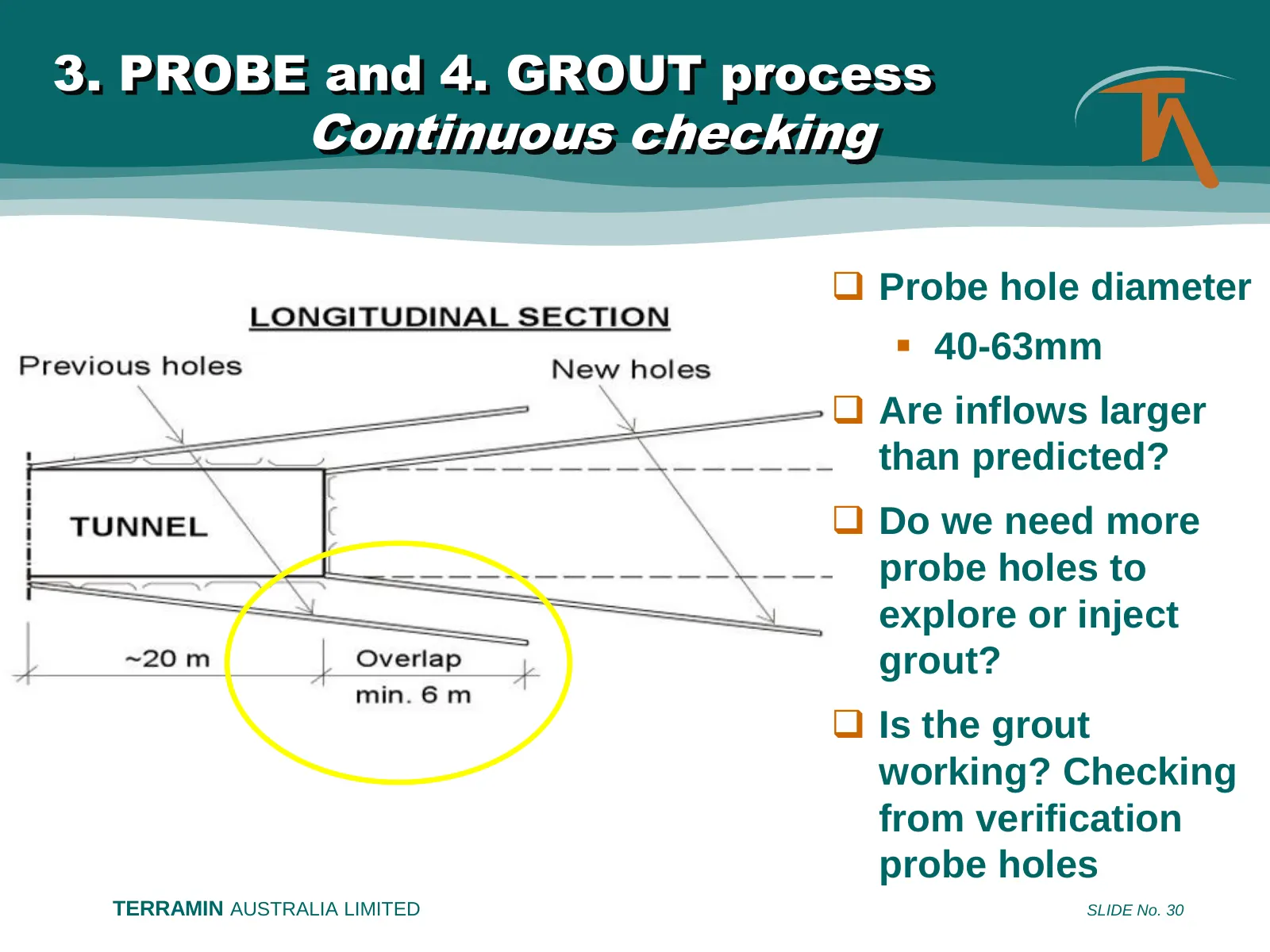
3. PROBE and 4. GROUT process Continuous checking Probe hole diameter 40-63mm Are inflows larger than predicted? Do we need more probe holes to explore or inject grout? Is the grout working? Checking from verification probe holes TERRAMIN AUSTRALIA LIMITED SLIDE No. 30
Slide 31: Water Pressure Entering Through Probe Hole and Engineering Formulas for Grouting
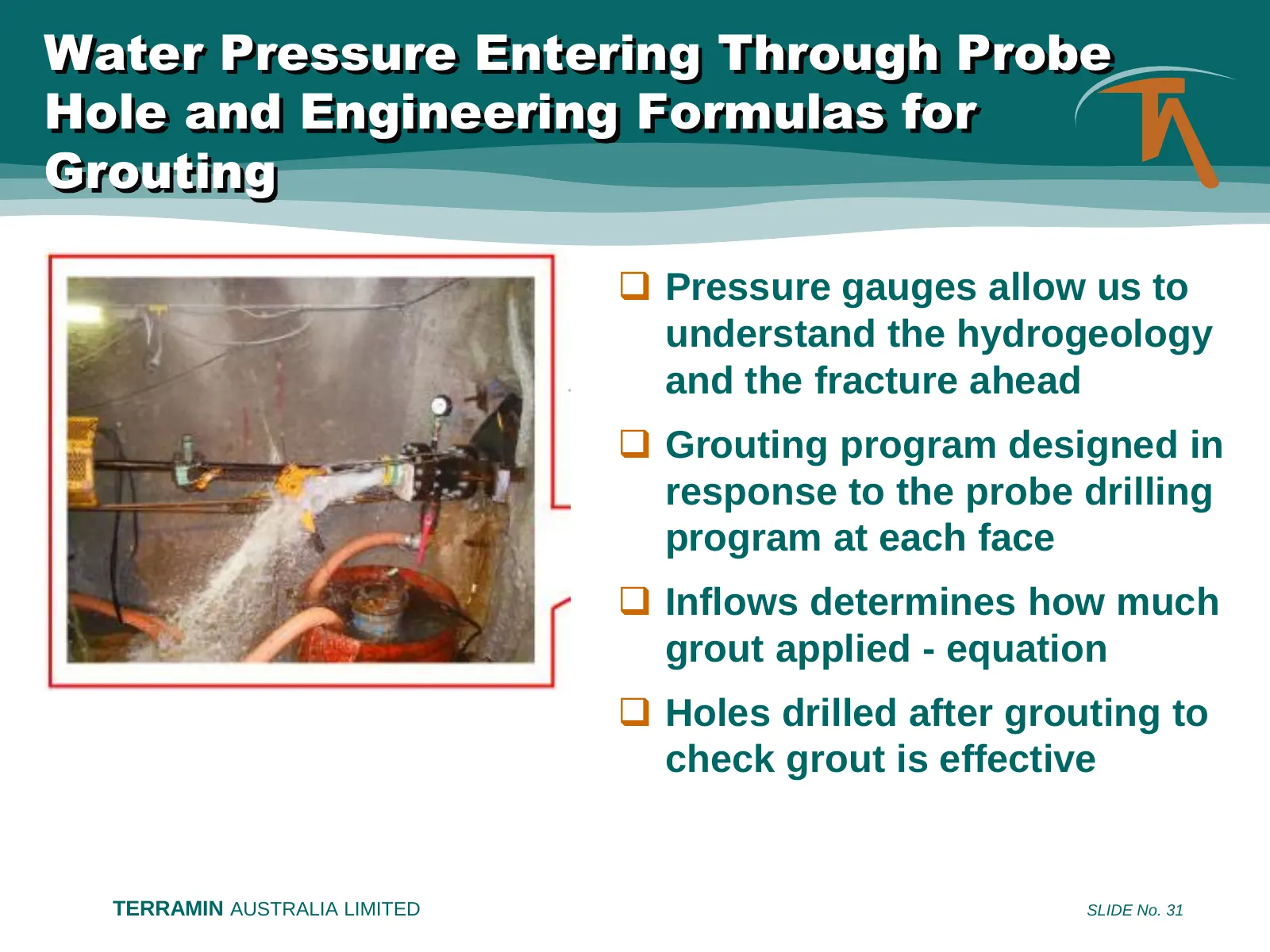
Water Pressure Entering Through Probe Hole and Engineering Formulas for Grouting Pressure gauges allow us to understand the hydrogeology and the fracture ahead Grouting program designed in response to the probe drilling program at each face Inflows determines how much grout applied - equation
Slide 32: The mining cycle with grouting
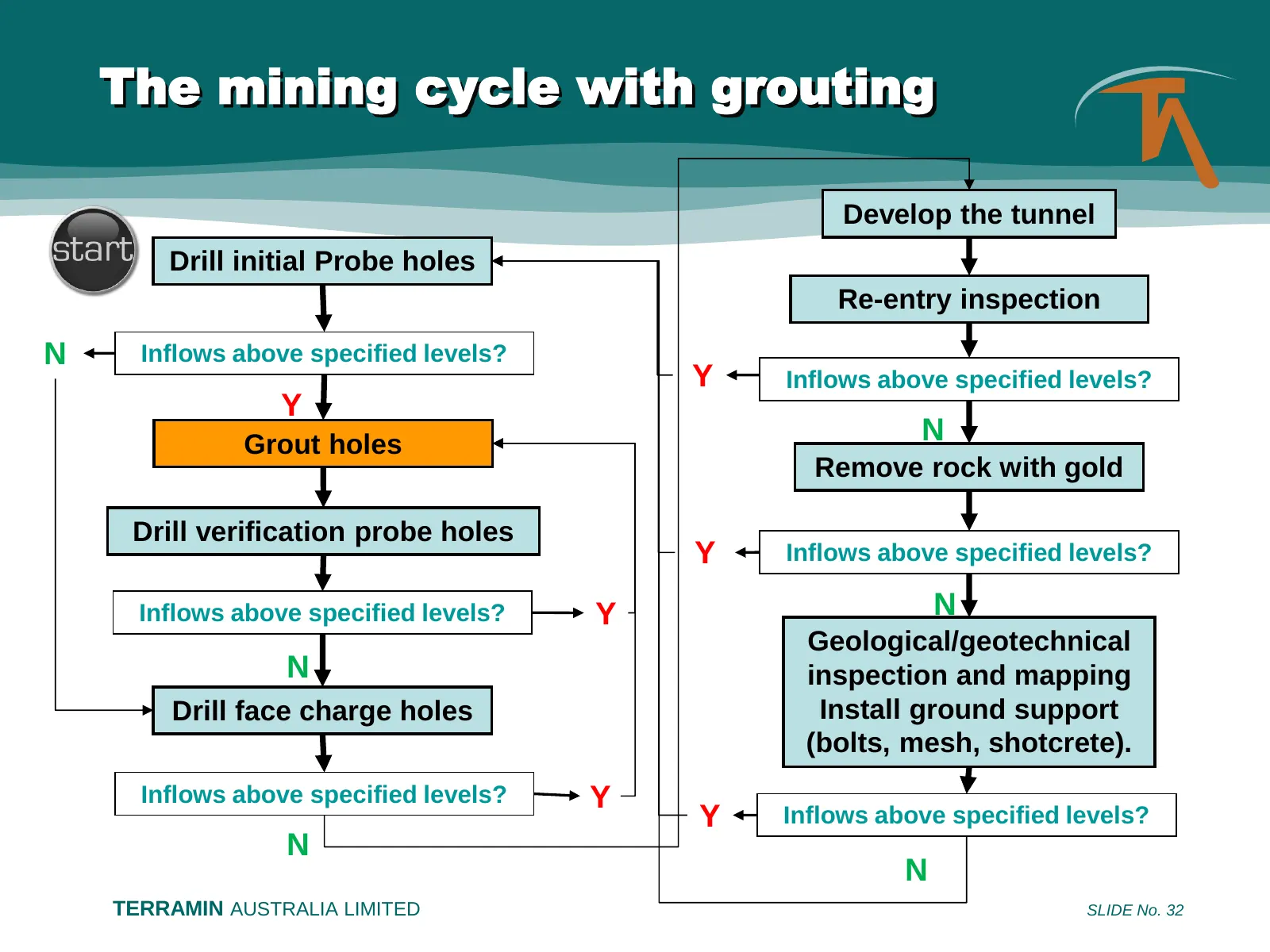
The mining cycle with grouting Develop the tunnel Drill initial Probe holes Re-entry inspection N Inflows above specified levels? Y Inflows above specified levels? Y Grout holes N Remove rock with gold Drill verification probe holes Y Inflows above specified levels? Inflows above specified levels? Y
Slide 33: Interest point - 1945 Government Report on 381 day BIH pump test in 1934
Interest point - 1945 Government Report on 381 day BIH pump test in 1934 Government pump test 9th June 1934 – 13th July 1935 381 days at 4.4ML/day 11th November 1934 “Shear filled with altered slate in crosscut 35 ft. west of the shaft at the level responsible for increased flow. Shear enters shaft
Slide 34: Shotcrete
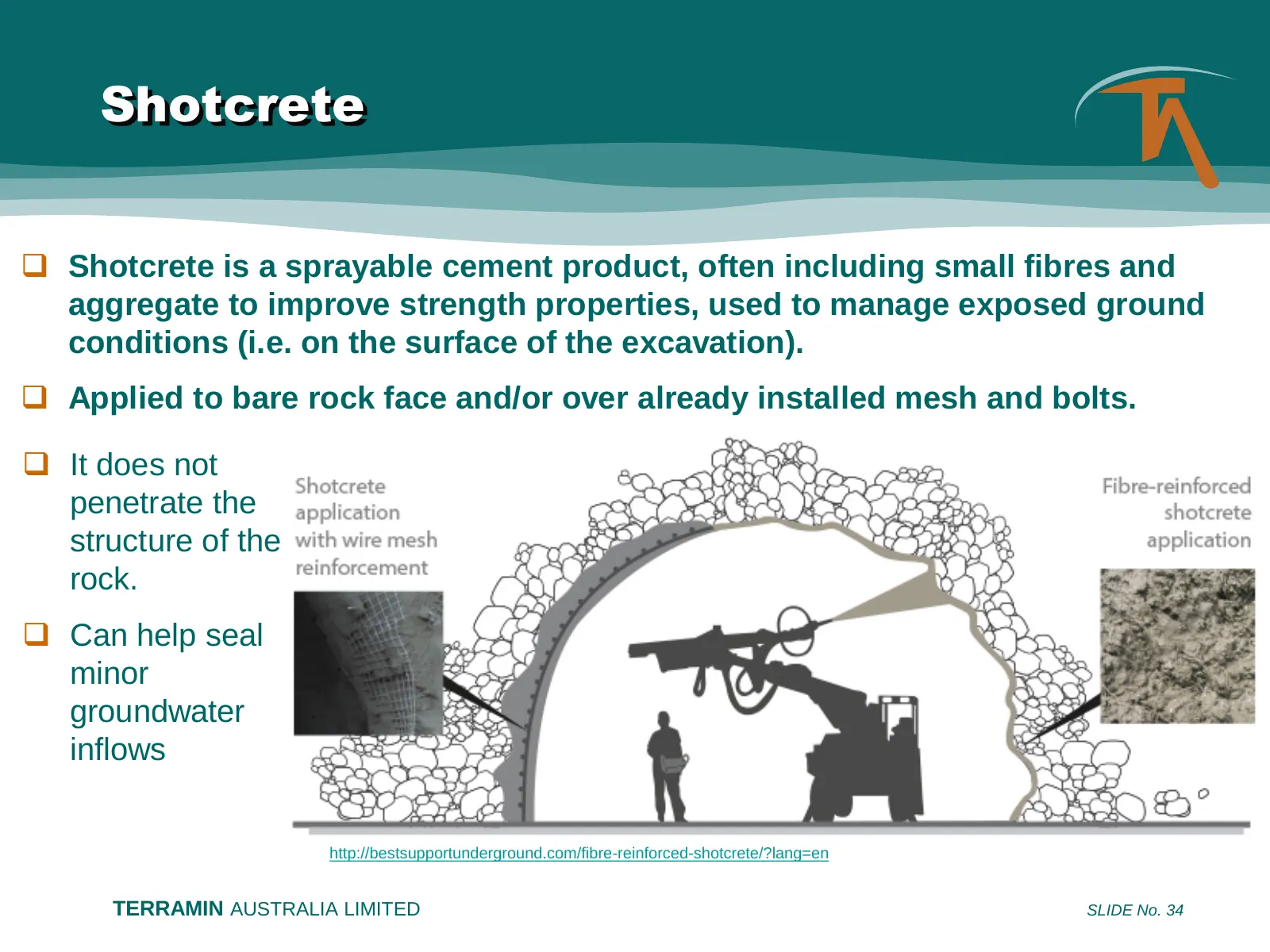
Shotcrete Shotcrete is a sprayable cement product, often including small fibres and aggregate to improve strength properties, used to manage exposed ground conditions (i.e. on the surface of the excavation). Applied to bare rock face and/or over already installed mesh and bolts. It does not pe
Slide 35: What if – we developed the tunnel and inflows are larger than expected?
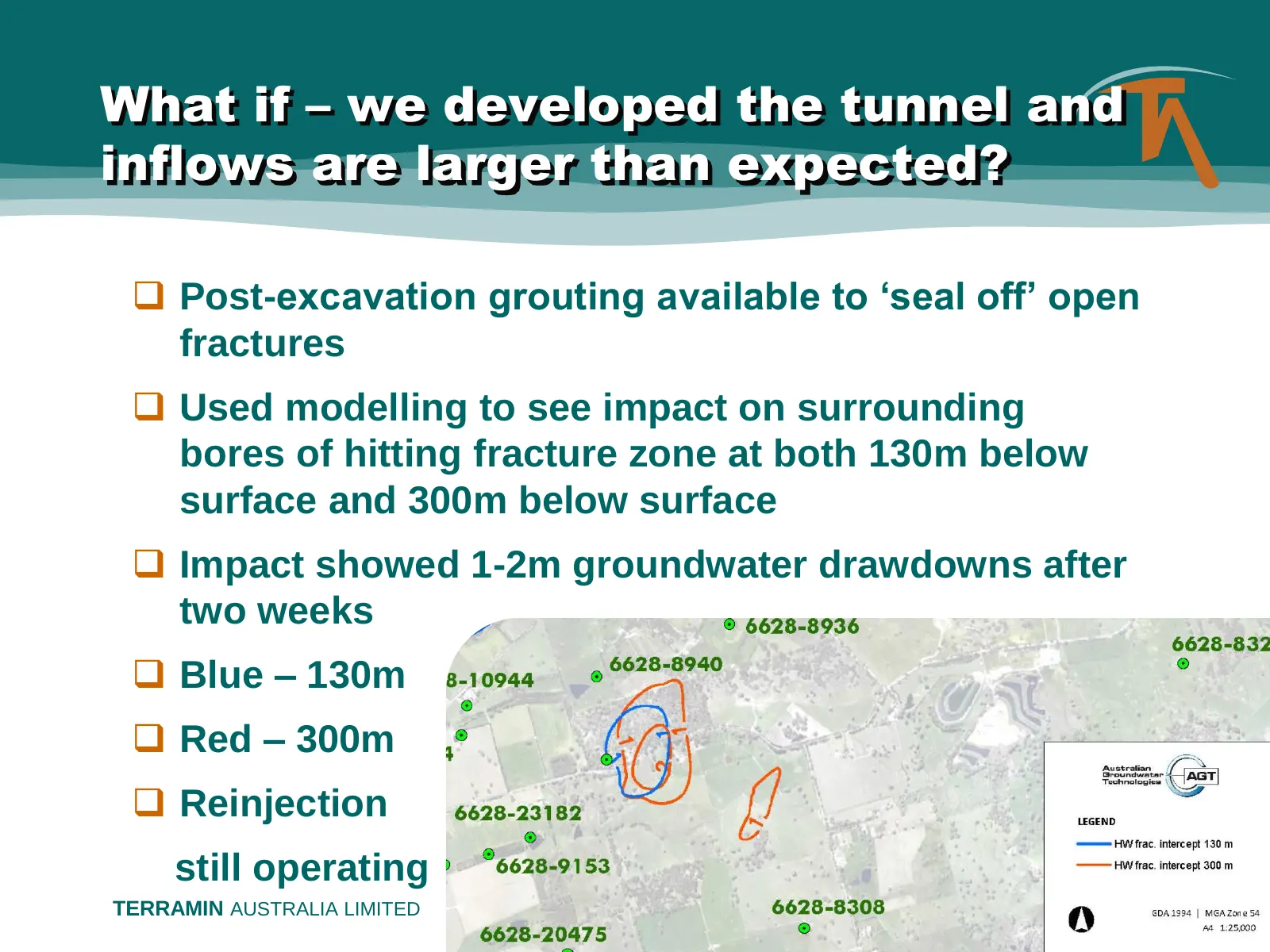
What if – we developed the tunnel and inflows are larger than expected? Post-excavation grouting available to ‘seal off’ open fractures Used modelling to see impact on surrounding bores of hitting fracture zone at both 130m below surface and 300m below surface Impact showed 1-2m groundwater dr
Slide 36: 3. Depressurisation and Managed Aquifer Recharge
3. Depressurisation and Managed Aquifer Recharge Decreases pressure head above mine void Increases effectiveness of grouting system Reduces risk of grouting failure Keeps water out of mine – take it out above mine before it enters and reinject around mine (radial) Reinjection allows for th
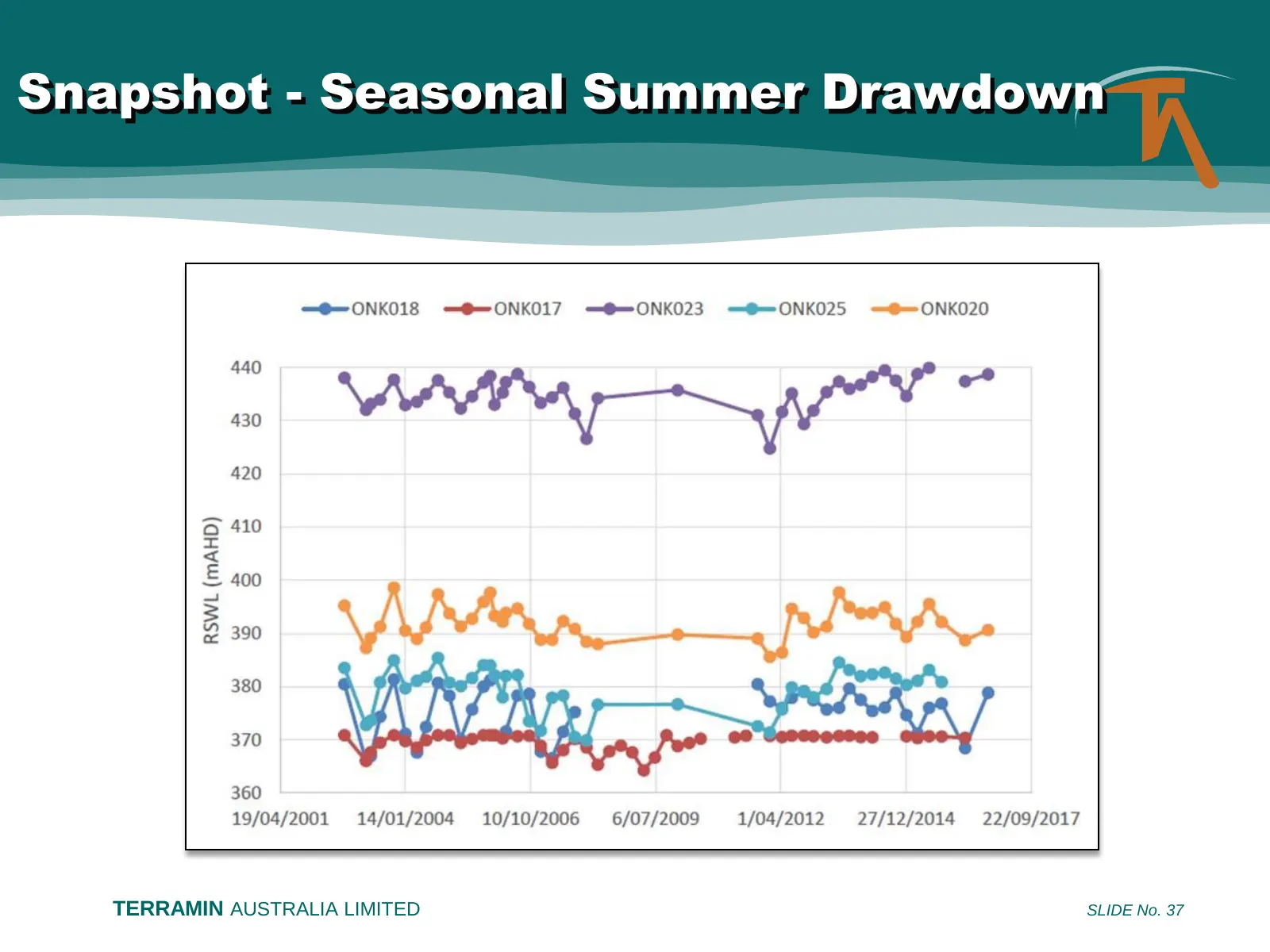
Slide 37: Snapshot - Seasonal Summer Drawdown
Snapshot - Seasonal Summer Drawdown TERRAMIN AUSTRALIA LIMITED SLIDE No. 37
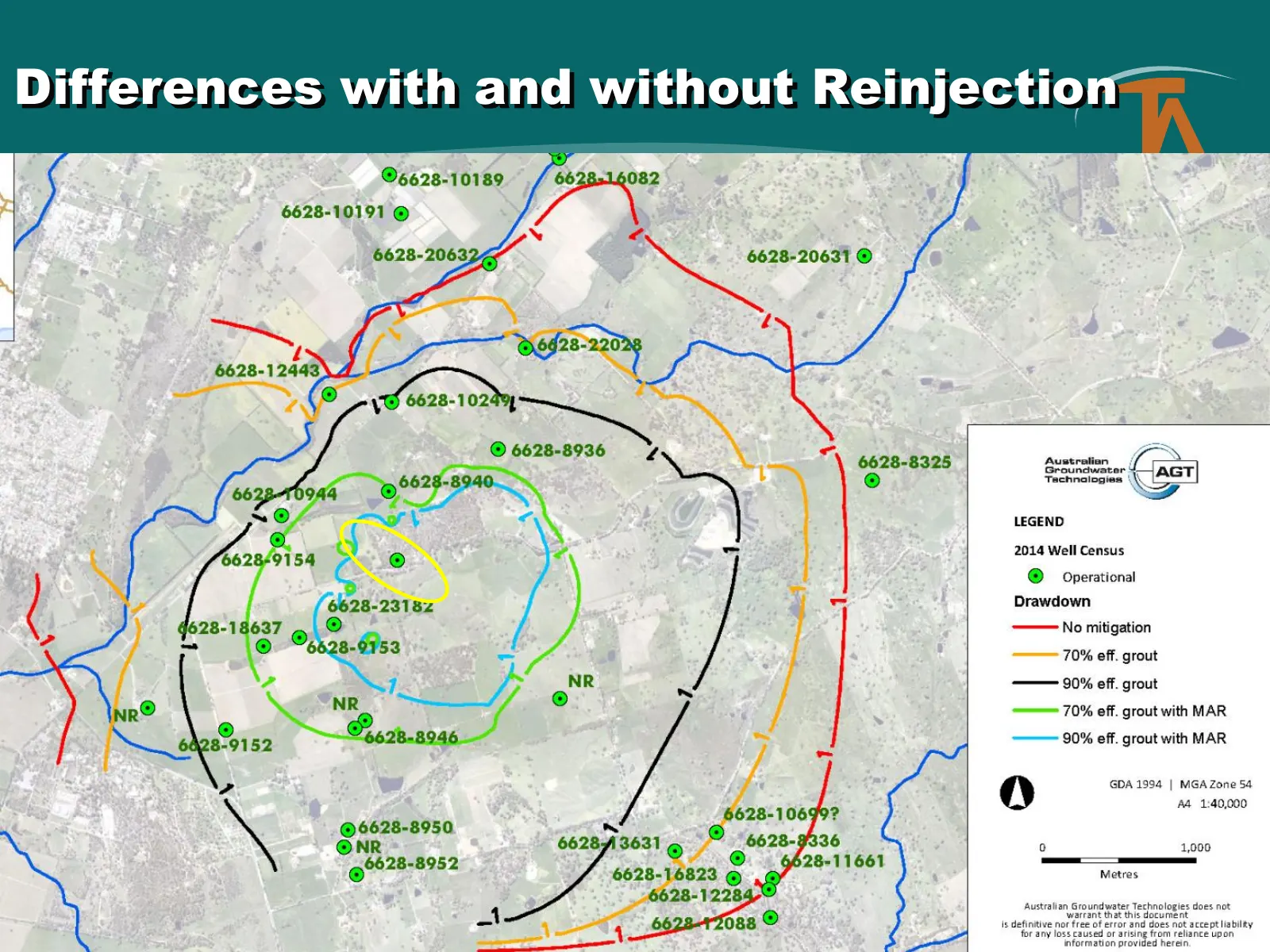
Slide 38: Differences with and without Reinjection
Differences with and without Reinjection TERRAMIN AUSTRALIA LIMITED SLIDE No. 38
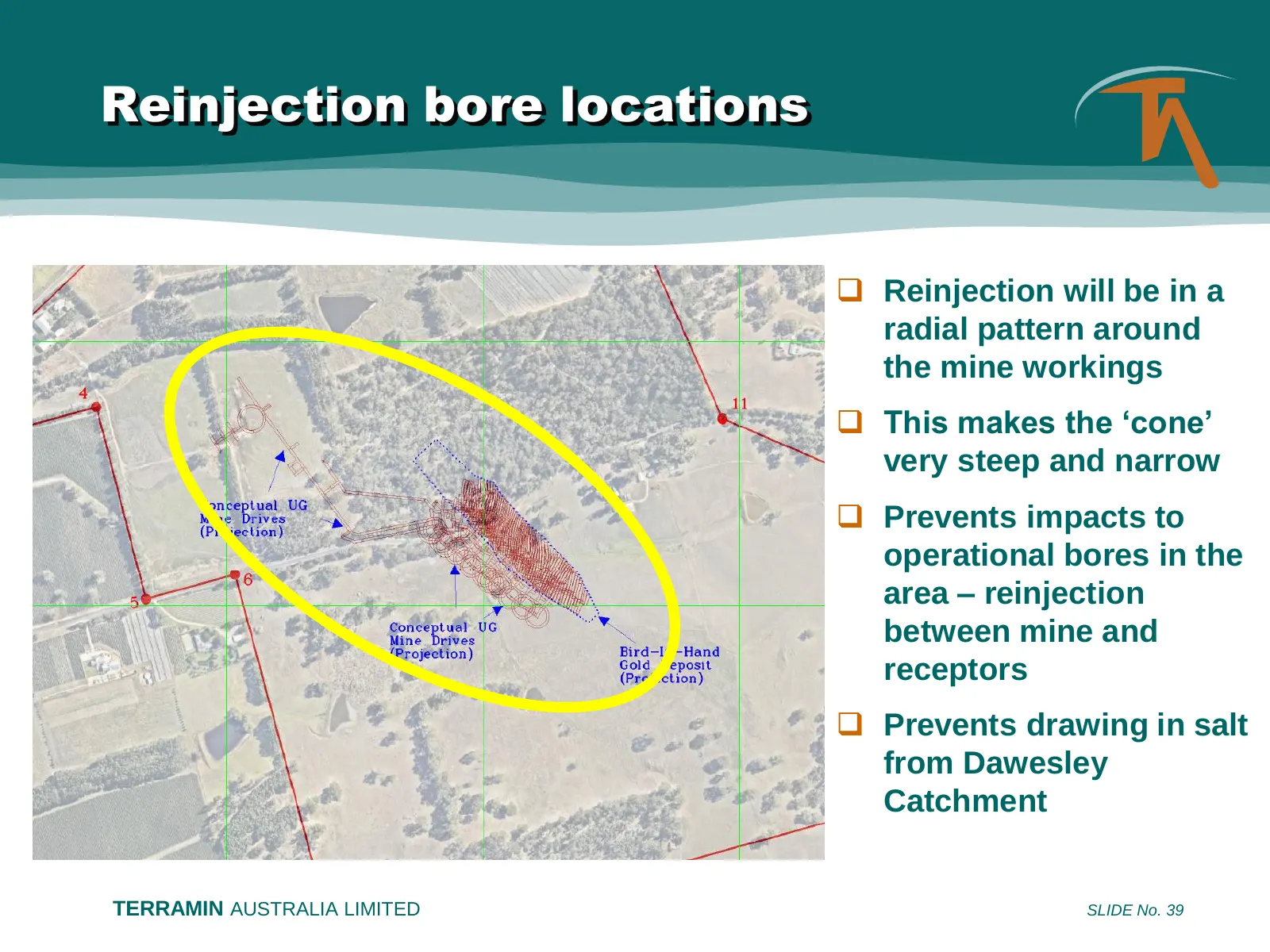
Slide 39: Reinjection bore locations
Reinjection bore locations Reinjection will be in a radial pattern around the mine workings This makes the ‘cone’ very steep and narrow Prevents impacts to operational bores in the area – reinjection between mine and receptors Prevents drawing in salt from Dawesley Catchment TERRAMIN AUSTRAL
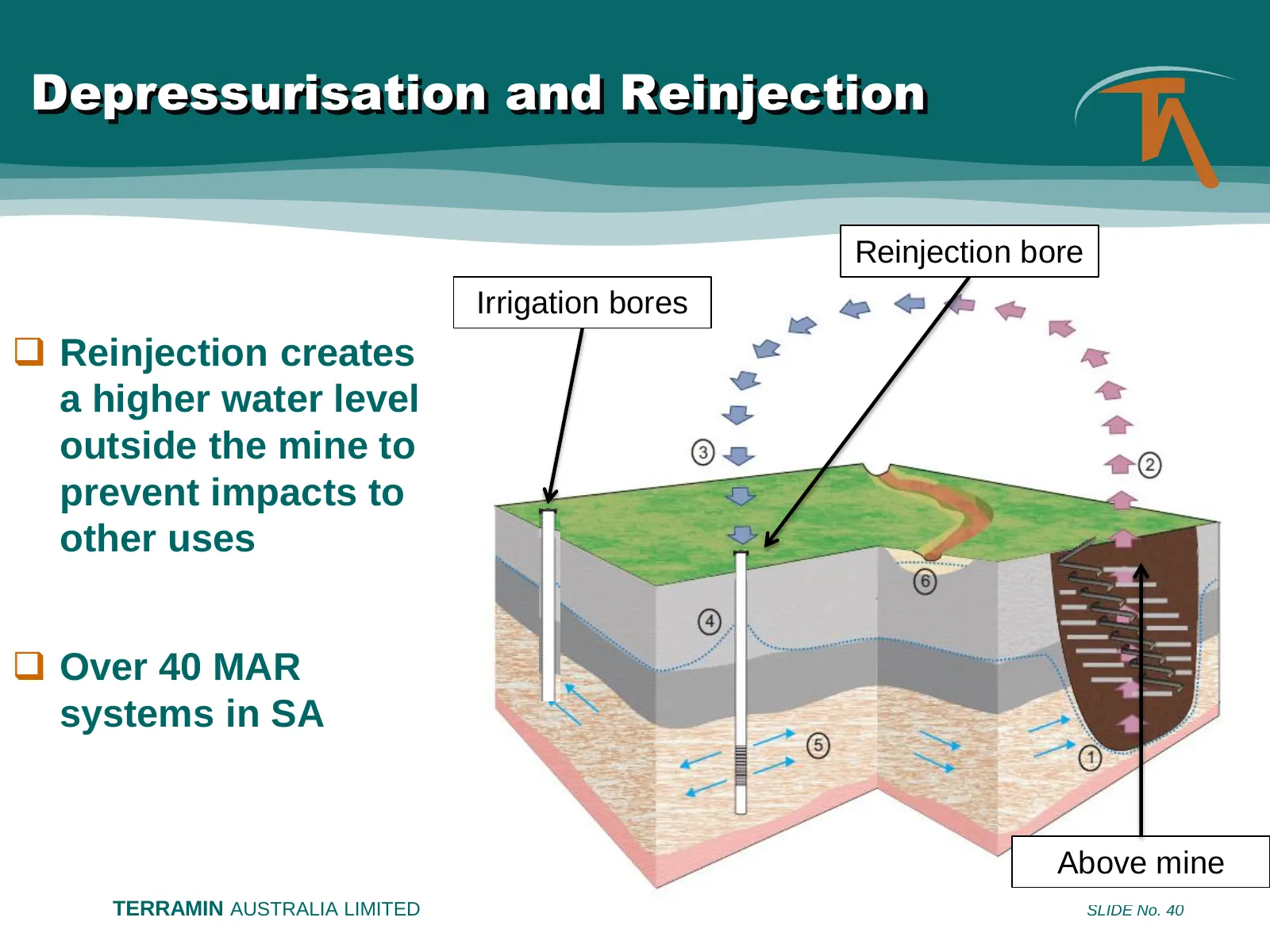
Slide 40: Depressurisation and Reinjection
Depressurisation and Reinjection Reinjection bore Irrigation bores Reinjection creates a higher water level outside the mine to prevent impacts to other uses Over 40 MAR systems in SA Above mine TERRAMIN AUSTRALIA LIMITED SLIDE No. 40
Slide 41: Water Quality of Receiving Environments
Water Quality of Receiving Environments Reinjection water must be of same quality as receiving environment Salinity Metals Nutrients Environment Protection (Water Quality) Policy 2015 TERRAMIN AUSTRALIA LIMITED SLIDE No. 41
Slide 42: Volumes from Modelling
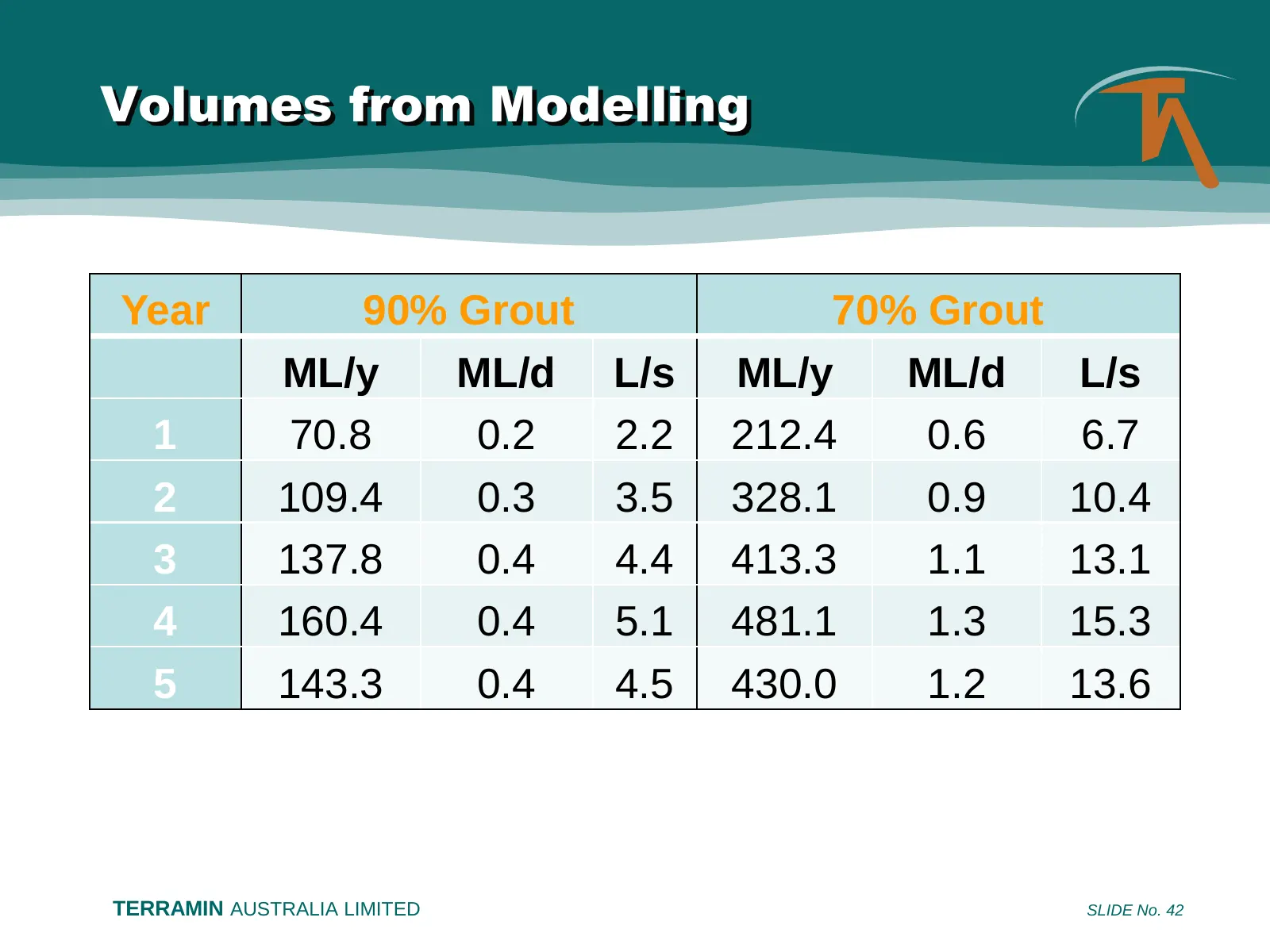
Volumes from Modelling Year 90% Grout 70% Grout ML/y ML/d L/s ML/y ML/d L/s 1 70.8 0.2 2.2 212.4 0.6 6.7 2 109.4 0.3 3.5 328.1 0.9 10.4 3 137.8 0.4 4.4 413.3 1.1 13.1 4 160.4 0.4 5.1 481.1 1.3 15.3 5 143.3 0.4 4.5 430.0 1.2 13.6 TERRAMIN AUSTRALIA LIMITED SLIDE No. 42
Slide 43: Groundwater Management Summary
Groundwater Management Summary Built in capacity for water management contingencies Strategies are designed to prevent water inflows from the fracture zone and manage water inflows Probe drilling allows active and adaptive management Allows actions before inflows become an issue Grout will
Slide 44: Groundwater Monitoring Network Conceptual
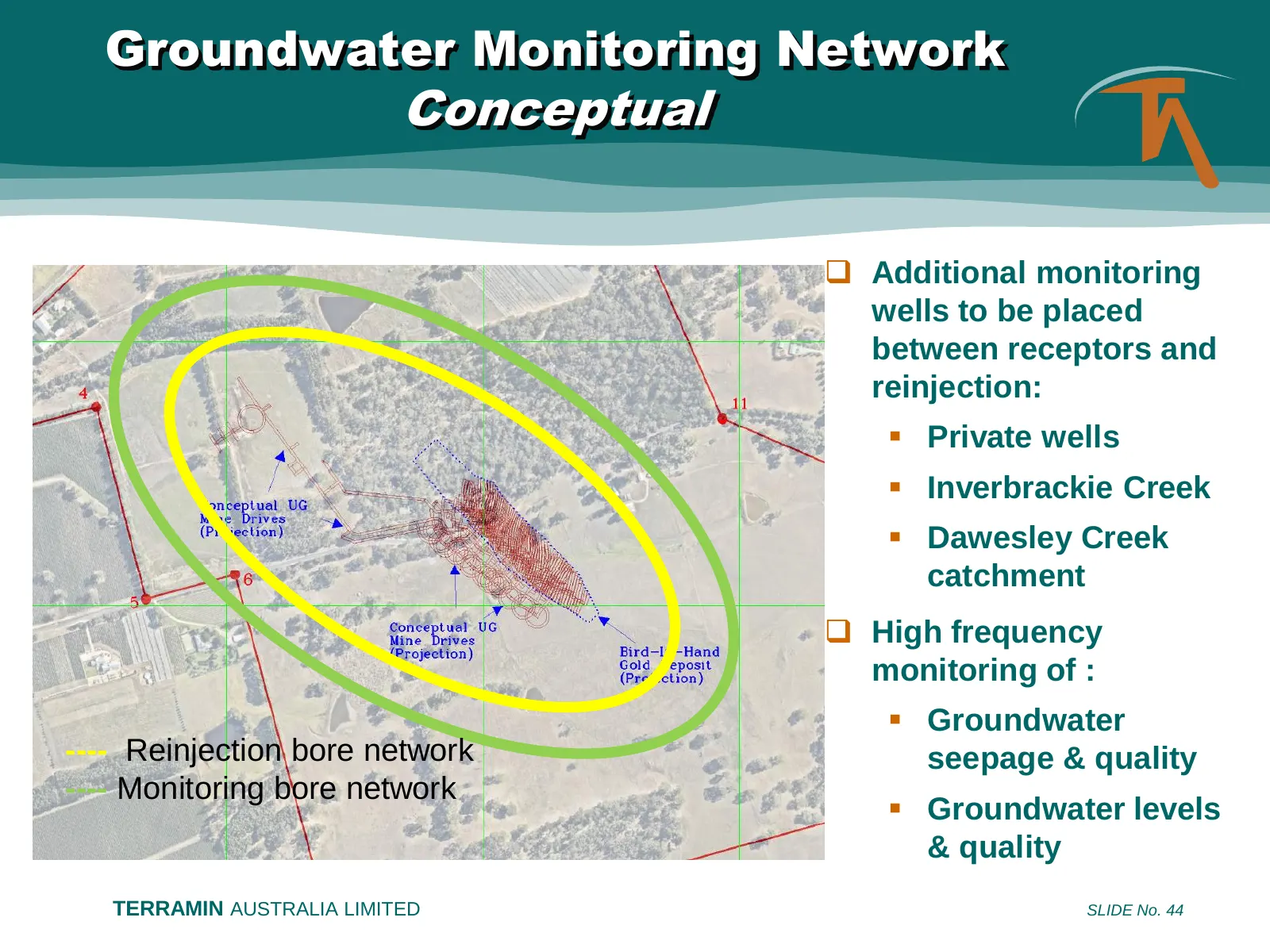
Groundwater Monitoring Network Conceptual Additional monitoring wells to be placed between receptors and reinjection: Private wells Inverbrackie Creek Dawesley Creek catchment High frequency monitoring of : Groundwater ---- Reinjection bore network seepage & quality ---- Monitoring bore
Slide 45: Responding to Monitoring "Trigger Action Response Plans"
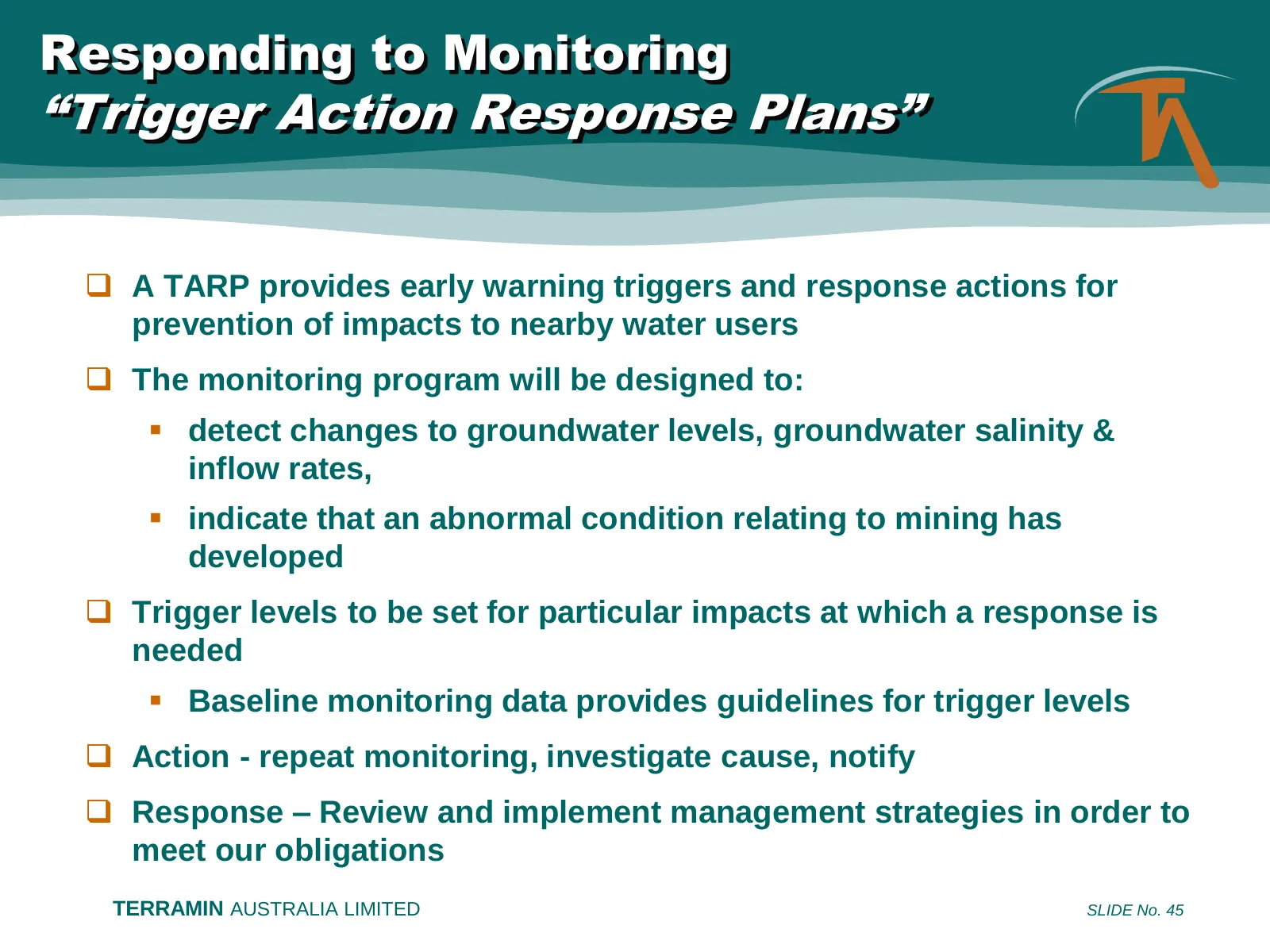
Responding to Monitoring “Trigger Action Response Plans” A TARP provides early warning triggers and response actions for prevention of impacts to nearby water users The monitoring program will be designed to: detect changes to groundwater levels, groundwater salinity & inflow rates, indicate
Slide 46: What's Next?
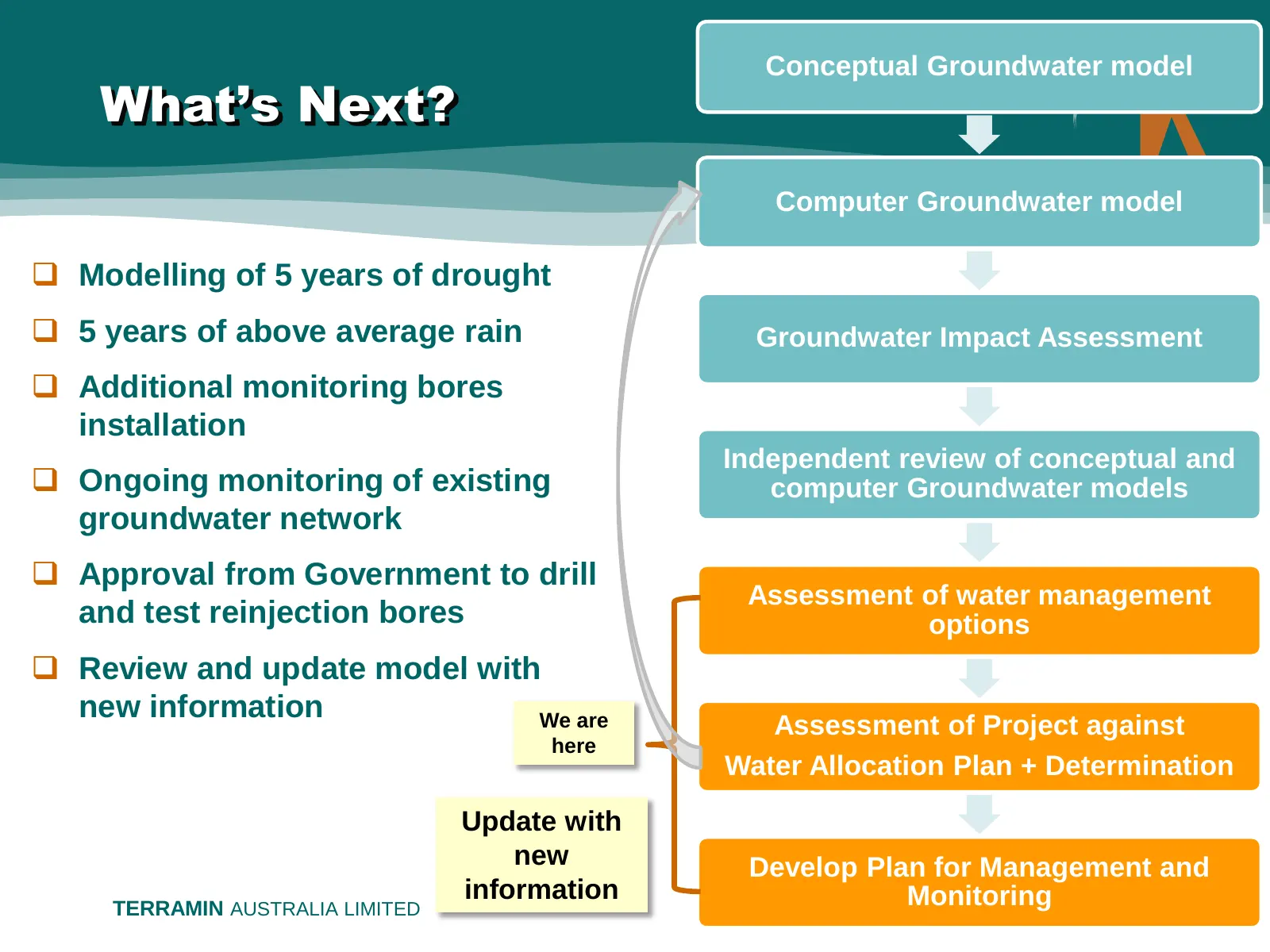
Conceptual Groundwater model What’s Next? Computer Groundwater model Modelling of 5 years of drought 5 years of above average rain Groundwater Impact Assessment Additional monitoring bores installation Independent review of conceptual and Ongoing monitoring of existing computer Groundwater m
Slide 47: Next meetings and close
Next meetings and close Next Water TRG meeting WCCC governance working party Next WCCC meeting Great to meet you My very best wishes to you all 47
Source: Internet Archive copy of terramin.com.au
More decks from Terramin Australia Limited
 Shareholder Meeting (May 2026)15 slides · May 2026
 Shareholder Meeting (May 2025)12 slides · May 2025
 Shareholder Meeting (May 2022)12 slides · May 26, 2022
 Investor Presentation (October 2019)23 slides · Oct 31, 2019
 Investor Presentation (October 2019)22 slides · Oct 30, 2019
 Technical Presentation (June 2019)20 slides · June 2019