Tapestry Pharmaceuticals — Investor Presentation (January 2005)
36 slides from Tapestry Pharmaceuticals's investor presentation, Jan 10, 2005

Slide 1: Investor Presentation
.-. 90 TAPESTRY Pharmaceuticals Investor Presentation
Slide 2: Forward-Looking Statements
Forward-Looking Statements ‘Statements in this presentation that are not historical facts are “forward-looking statements” that involve risks a uncertainties. Forward-looking statements can be identified by the use of words such as “opportunities,” “trends,” “potertial,” “estimates,” “may,” “will” “
Slide 3: Focused on proprietary therapeutics for the treatment of cancer
.-. We TAPESTRY QP Pharmaceuticals Focused on proprietary therapeutics for the treatment of cancer
Slide 4: History of the Company
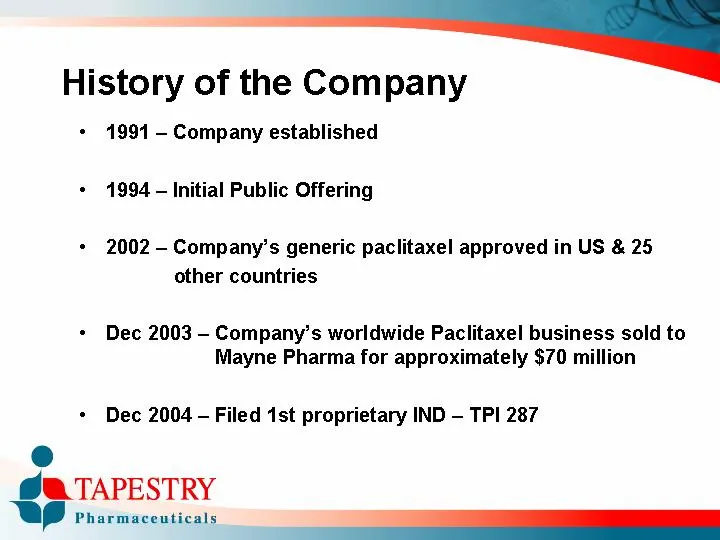
History of the Company + 1991 —- Company established + 1994 — Initial Public Offering + 2002 —- Company’s generic paclitaxel approved in US & 25 other countries + Dec 2003 - Company’s worldwide Paclitaxel business sold to Mayne Pharma for approximately $70 million Dec 2004 - Filed 1st proprietary IN
Slide 5: Development Pipeline
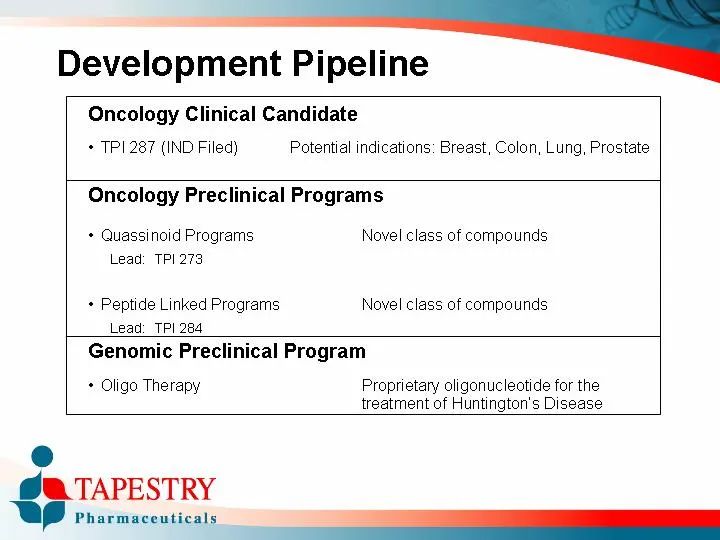
ws Development Pipeline Oncology Clinical Candidate + TPI 287 (IND Filed) Potential indications: Breast, Colon, Lung, Prostate Oncology Preclinical Programs + Quassinoid Programs Novel class of compounds Lead: TPI273 + Peptide Linked Programs Novel class of compounds Lead: TPI284 Genomic Preclinical
Slide 6: TPI 287: A Third Generation Taxane
en TPI 287 A Third Generation Taxane e 93 TAPESTRY ll
Slide 7: TPI 287: A Third Generation Taxane
TPI 287: A Third Generation Taxane Taxanes are highly active chemotherapeutic agents in the treatment of advanced common malignancies such as NSCLC and cancers of the breast, ovary, prostate and head and neck. However, many of these neoplasms ultimately become resistant to the effects of currently a
Slide 8: TPI 287 Tubulin Binding Model
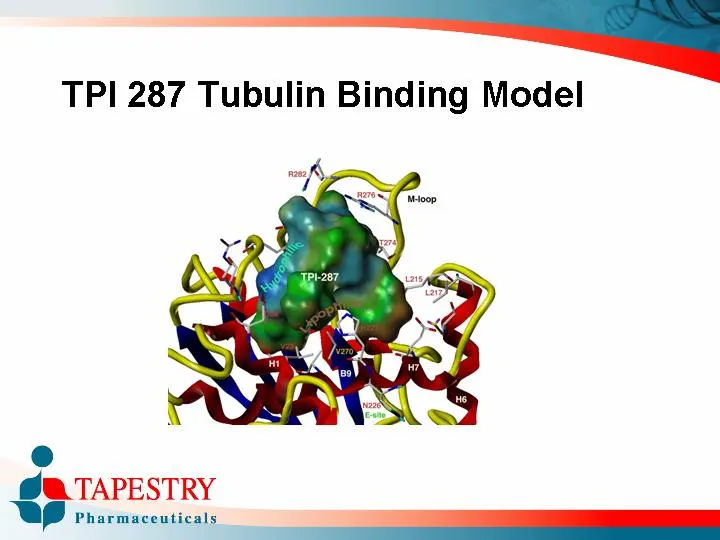
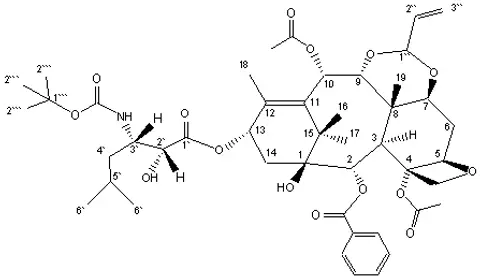
TPI 287 Tubulin Binding Model te TAPESTRY
Slide 9: Design of TPI 287
| aa Design of TPI 287 * The Company leveraged its extensive paclitaxel chemistry experience in order to develop this novel taxane. * The molecular construct was optimized for desired attributes such as MDR independence and mutant tubulin binding. + Potential exists to treat both chemoresistant and
Slide 10: TPI 287: A Third Generation Taxane
ard ceneaton ese TPI 287: A Third Generation Taxane « Preclinical data shows more activity than paclitaxel or docetaxel in a variety of taxane resistant human tumor cell lines * The compound: + May circumvent MDR-1 seen in breast, colon, lung and prostate cancers + May be active in tumor cells that
Slide 11: In Vitro IC50 Studies for TPI 287
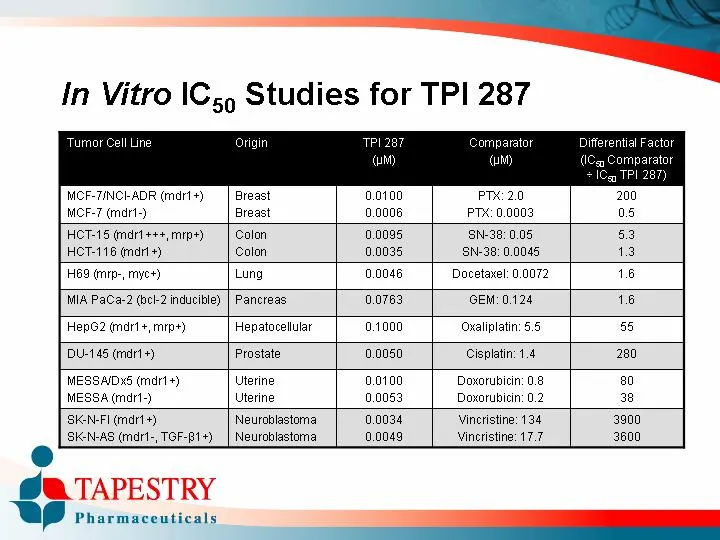
In Vitro IC,, Studies for TPI 287 MCF-7/NCLADR (mart +) Origin Breast TPl (uM) Comparator (i) PTX: 2.0 MCF-7 (mdrt-) Breast 0.0008 PTX: 0.0003 0s HCT-16 (mdri+++,mep+) | Colon o.o09s SN-38: 0.05 63 HOT-116 (nat +) Colon 0.0035 SN-38: 0.0045, 13 H69 (nrp-, myc+) Lung 0.0048 Docetaxel: 0.0072 168 MIA
Slide 12: Xenograft Models — Breast Tumor (mdr1+)
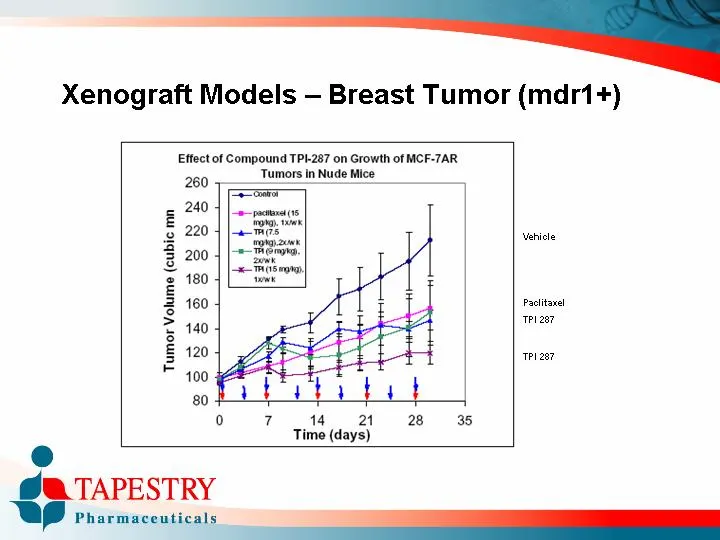
Xenograft Models — Breast Tumor (mdr1+) Effect of Compound TPI-287 on Growth of MCF-7AR Tumors in Nude Mice 260 240 220 200 180 160 140 120 100 80 Vehiole Praolitacel Tei2ar Tria Tumor Volume (cubic mn oO 7 14 21 28 35 Time (days) e @@ TAPESTRY
Slide 13: Xenograft Models — Breast Tumor (mdr1-)
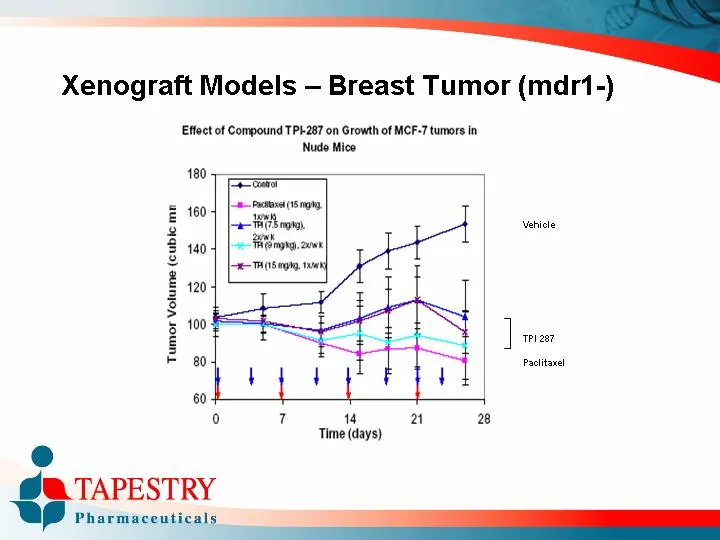
Xenograft Models — Breast Tumor (mdr1-) Effect of Compound TP287 on Growth of MCF-7 tumors in ‘Nude Mice 180 aaa zon] [+ poms ‘ Le titra, votit B40) | RRPhon. 200 S| Leper eH 120 3 100 F 80 Paclitaxel 60 0 7 14 ra] 28 Time (days) e @@ TAPESTRY
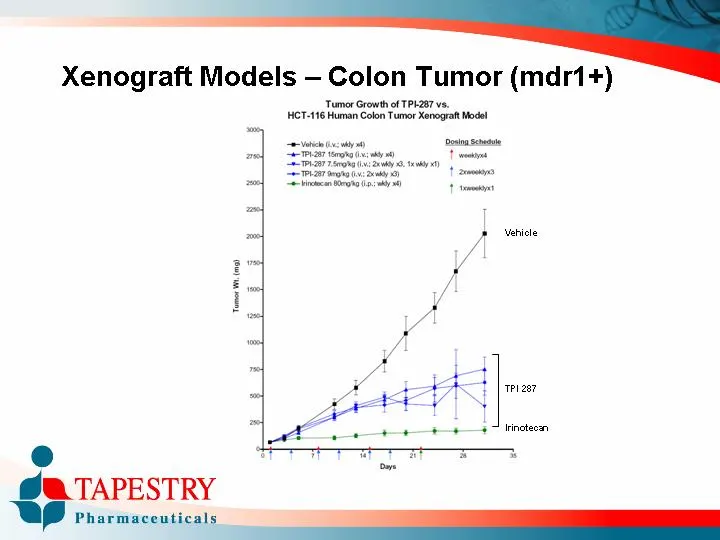
Slide 14: Xenograft Models — Colon Tumor (mdr1+)
Xenograft Models — Colon Tumor (mdr1+) a Tumor Growth of TPLZ87 vs. HCT-116 Human Colon Tumor Xenograf Model eT rnatecin e aoa 9B TAPESTRY
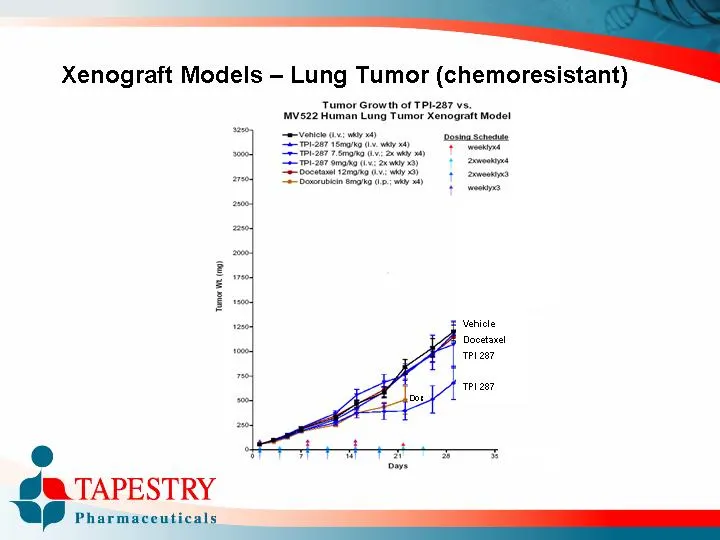
Slide 15: Xenograft Models — Lung Tumor (chemoresistant)
Xenograft Models —- Lung Tumor (chemoresistant) mt Tumor Growth of TPL-287 vs. 1vs22 Human Lung Tumor Xenograft Mod! 7) ee venice v y ot) sina Schade Vehicle Dooetarel Tel2a7 Tria ® erat a tg a te TAPESTRY
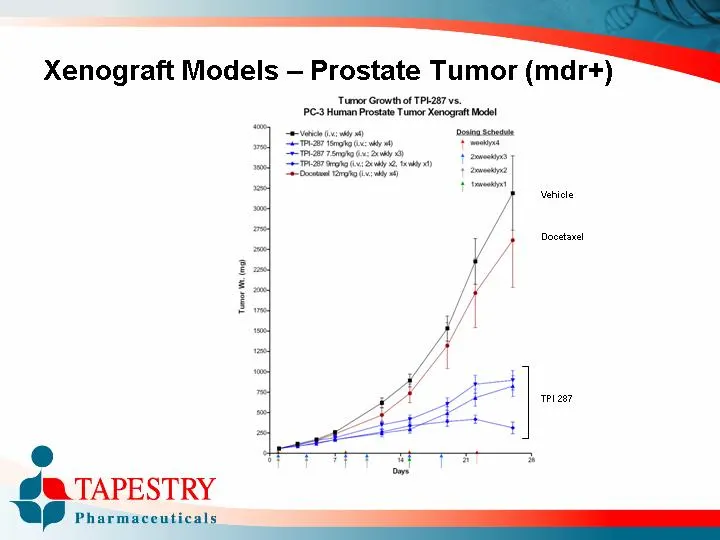
Slide 16: Xenograft Models — Prostate Tumor (mdr+)
Xenograft Models — Prostate Tumor (mdr+) aud e @@ TAPESTRY ay Pharmaceuticals
Slide 17: Toxicology: Single Dose Studies
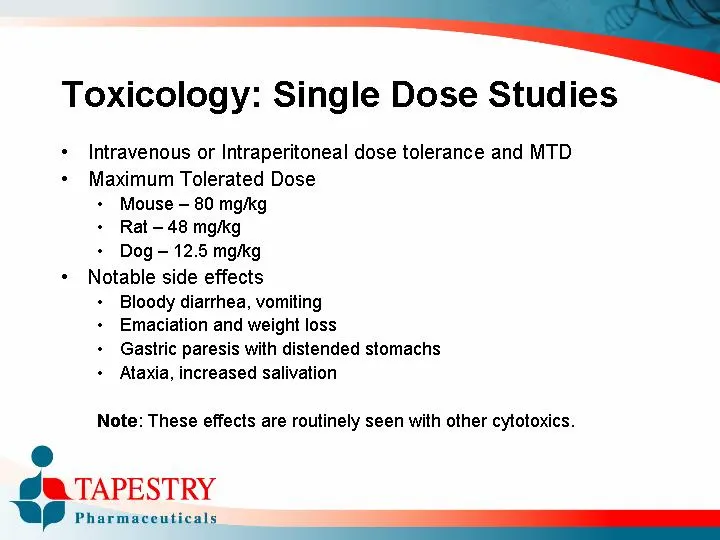
Toxicology: Single Dose Studies + Intravenous or Intraperitoneal dose tolerance and MTD + Maximum Tolerated Dose + Mouse — 80 mg/kg + Rat-48 mg/kg + Dog - 12.5 mg/kg * Notable side effects + Bloody diarrhea, vomiting + Emaciation and weight loss + Gastric paresis with distended stomachs + Ataxia, in
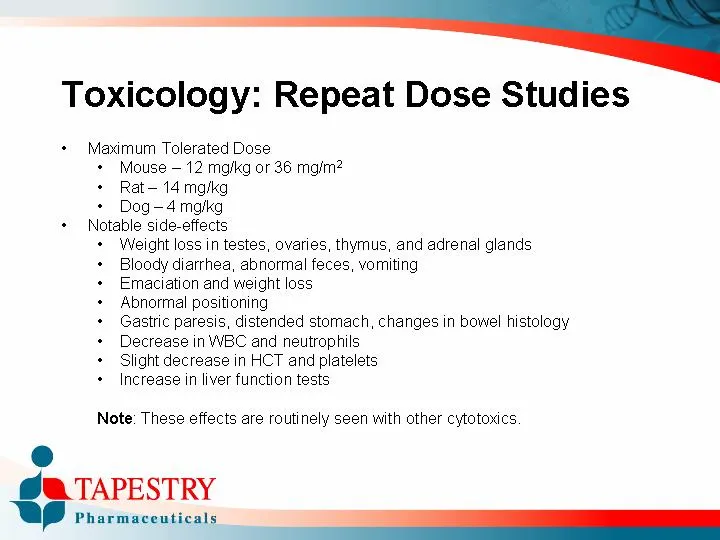
Slide 18: Toxicology: Repeat Dose Studies
Toxicology: Repeat Dose Studies + Maximum Tolerated Dose + Mouse ~ 12 mg/kg or 36 mg/m? + Rat— 14 mgikg + Dog-4mgika + Notable side-effects + Weight loss in testes, ovaries, thymus, and adrenal glands Bloody diarrhea, abnormal feces, vorniting Emaciation and weight loss Abnormal positioning Gastric
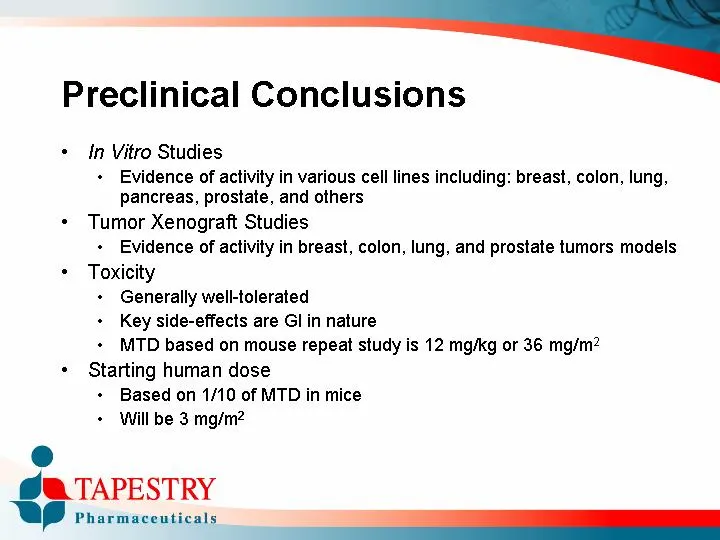
Slide 19: Preclinical Conclusions
Preclinical Conclusions In Vitro Studies + Evidence of activity in various cell lines including: breast, colon, lung, pancreas, prostate, and others Tumor Xenograft Studies + Evidence of activity in breast, colon, lung, and prostate tumors models Toxicity + Generally well-tolerated + Key side-effect
Slide 20: Phase I Clinical Program
en Phase | Clinical Program TPI 287 e 93 TAPESTRY ll
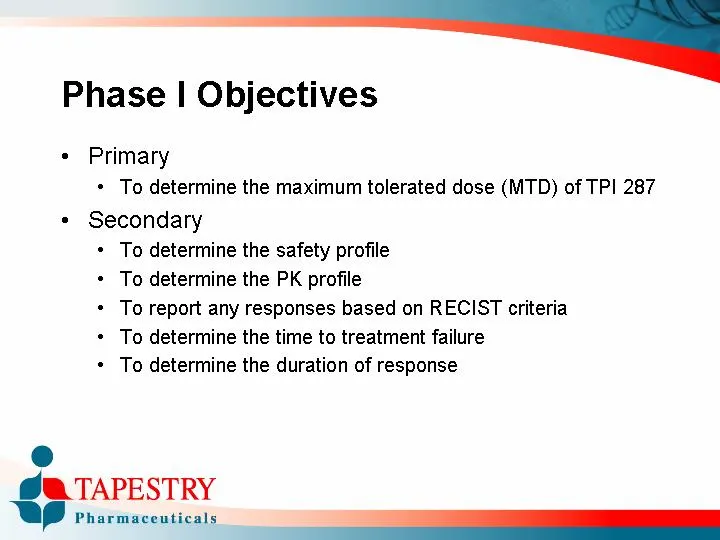
Slide 21: Phase I Objectives
Phase | Objectives « Primary + To determine the maximum tolerated dose (MTD) of TPI 287 * Secondary + To determine the safety profile + To determine the PK profile + To report any responses based on RECIST criteria * To determine the time to treatment failure + To determine the duration of response
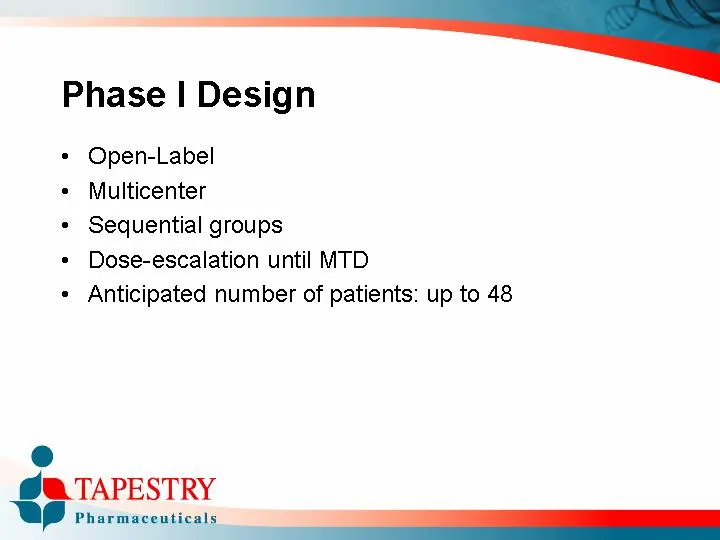
Slide 22: Phase I Design
Phase | Design * Open-Label + Multicenter * Sequential groups + Dose-escalation until MTD + Anticipated number of patients: up to 48 e 93 TAPESTRY
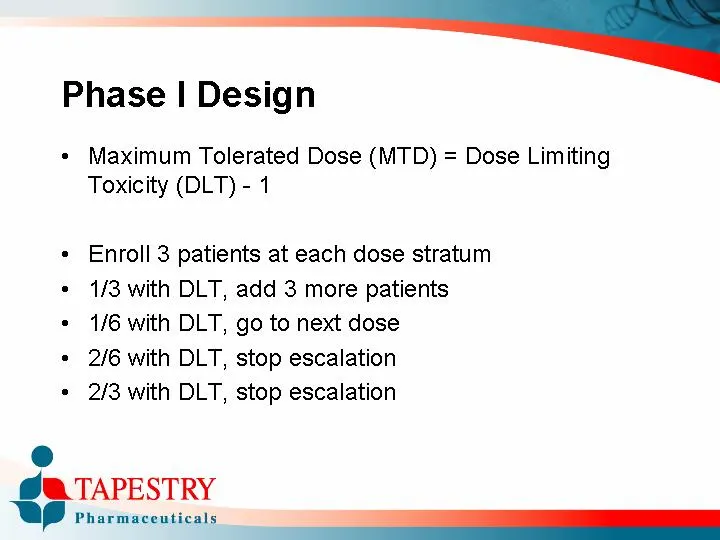
Slide 23: Link
Link to searchable text of slide shown above
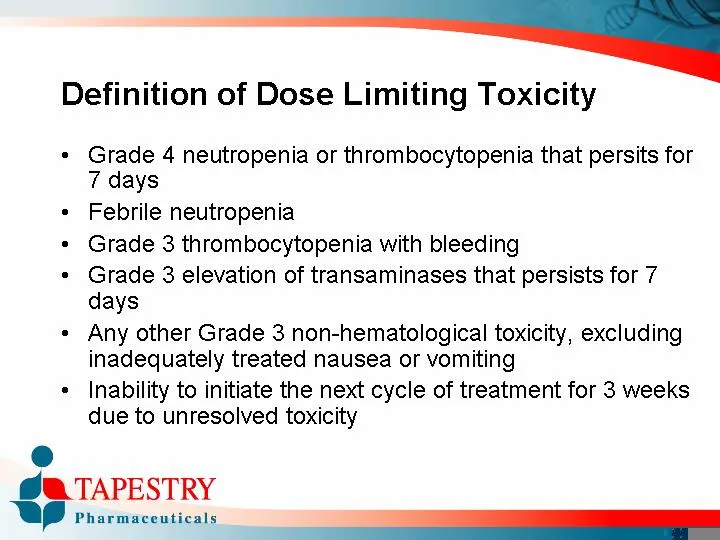
Slide 24: Definition of Dose Limiting Toxicity
Definition of Dose Limiting Toxicity « Grade 4 neutropenia or thrombocytopenia that persits for 7 days « Febrile neutropenia « Grade 3 thrombocytopenia with bleeding + Grade 3 elevation of transaminases that persists for 7 days « Any other Grade 3 non-hematological toxicity, excluding inadequately t
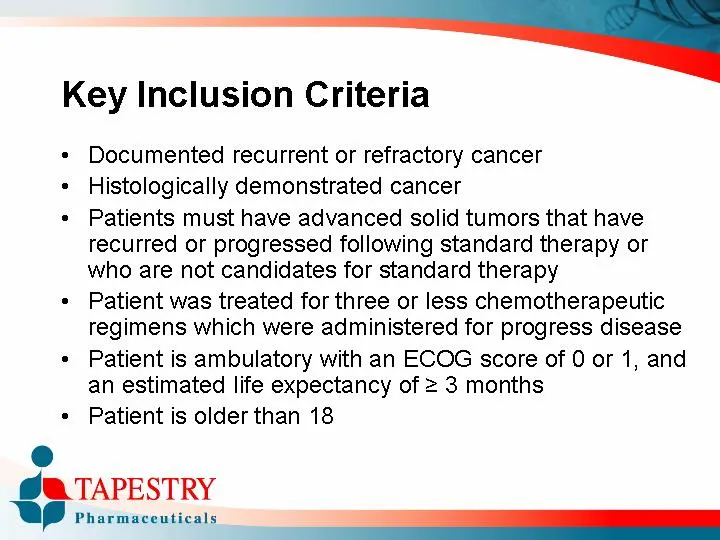
Slide 25: Key Inclusion Criteria
a Key Inclusion Criteria + Documented recurrent or refractory cancer * Histologically demonstrated cancer + Patients must have advanced solid tumors that have recurred or progressed following standard therapy or who are not candidates for standard therapy + Patient was treated for three or less chem
Slide 26: Key Exclusion Criteria
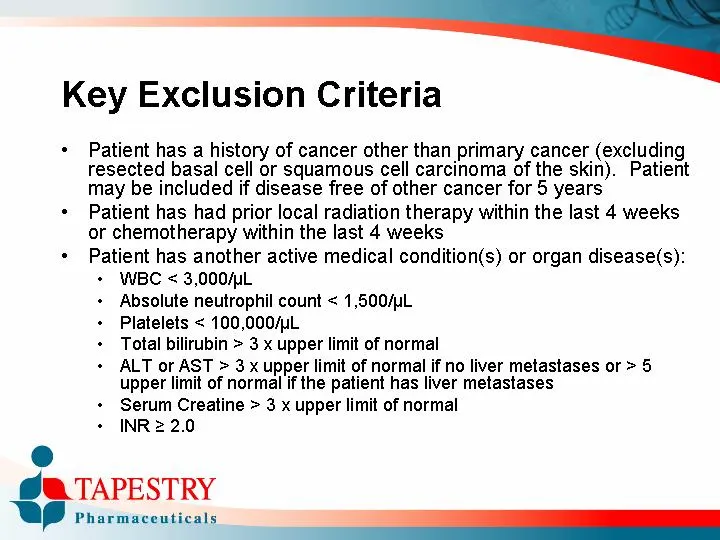
Key Exclusion Criteria + Patient has a history of cancer other than primary cancer (excluding resected basal cell or squamous cell carcinoma of the skin). Patient may be included if disease free of other cancer for 5 years + Patient has had prior local radiation therapy within the last 4 weeks or ch
Slide 27: Key Exclusion Criteria — (continued)
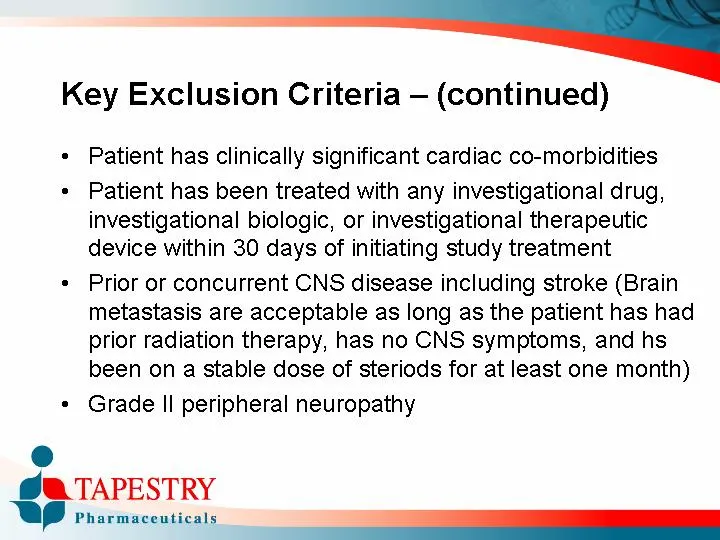
Key Exclusion Criteria — (continued) « Patient has clinically significant cardiac co-morbidities + Patient has been treated with any investigational drug, investigational biologic, or investigational therapeutic device within 30 days of initiating study treatment « Prior or concurrent CNS disease in
Slide 28: Dose Escalation
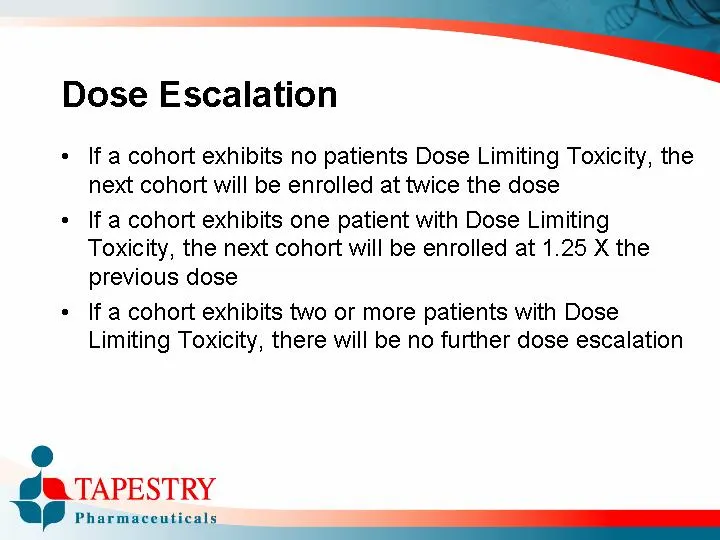
a Dose Escalation « Ifa cohort exhibits no patients Dose Limiting Toxicity, the next cohort will be enrolled at twice the dose « Ifa cohort exhibits one patient with Dose Limiting Toxicity, the next cohort will be enrolled at 1.25 X the previous dose « Ifa cohort exhibits two or more patients with D
Slide 29: Study Duration
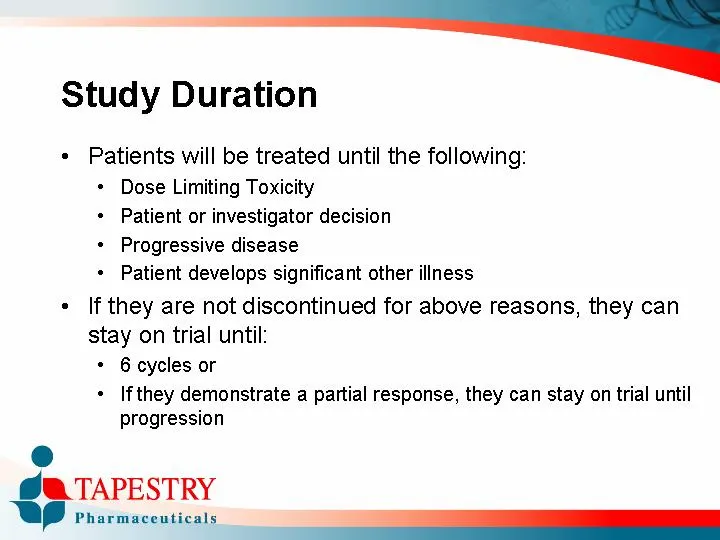
Study Duration « Patients will be treated until the following: + Dose Limiting Toxicity + Patient or investigator decision + Progressive disease + Patient develops significant other illness « If they are not discontinued for above reasons, they can stay on trial until: * 6 cycles or + Ifthey demonst
Slide 30: Timelines
— os Timelines « IND Submission: December, 2004 + First patient enrolled: Q2, 2005 e 93 TAPESTRY
Slide 31: Overview
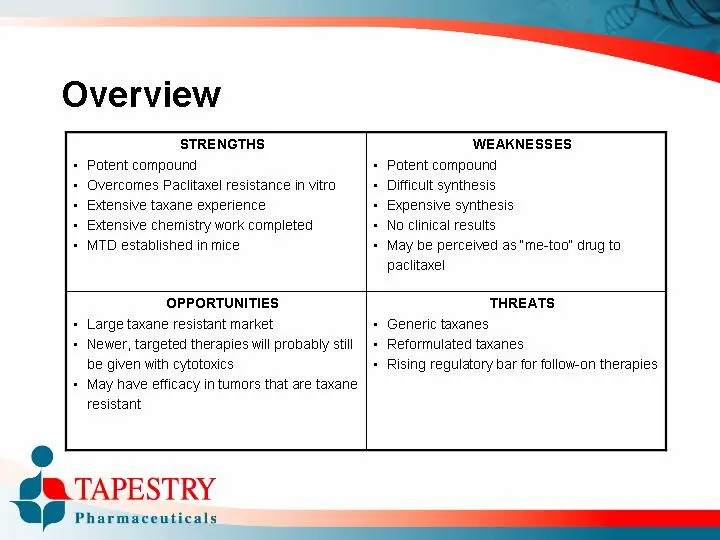
Overview STRENGTHS + Potent compound + Overcomes Paclitaxel resistance in vitro + Extensive taxane experience + Extensive chemistry work completed + MTD established in mice WEAKNESSES Potent compound Difficult synthesis Expensive synthesis, No clinical results May be perceived as"me-to paclitaxel dr
Slide 32: Oncology Advisory Board
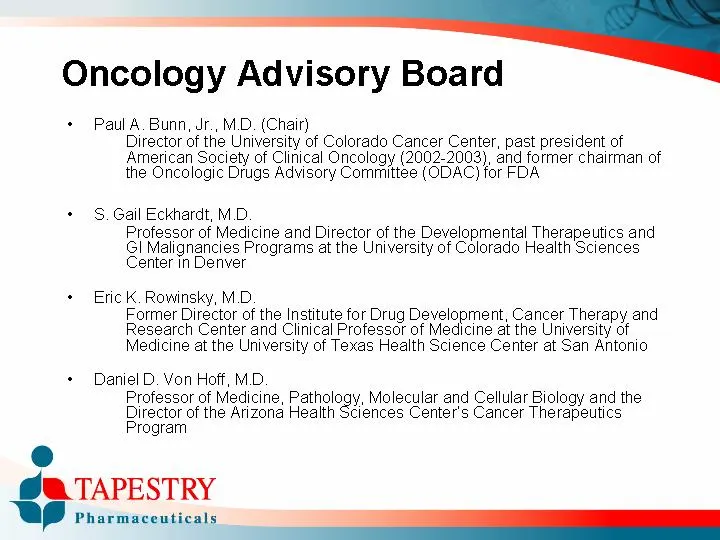
Oncology Advisory Board + Paul A. Bunn, Jr. M.D. (Chair) Director of the University of Colorado Cancer Center, past president of American Society of Clinical Oncology (2002-2003), and former chairman of the Oncologic Drugs Advisory Committee (ODAC) for FDA +S. Gail Eckhardt, MD Professor of Medicine
Slide 33: Board of Directors
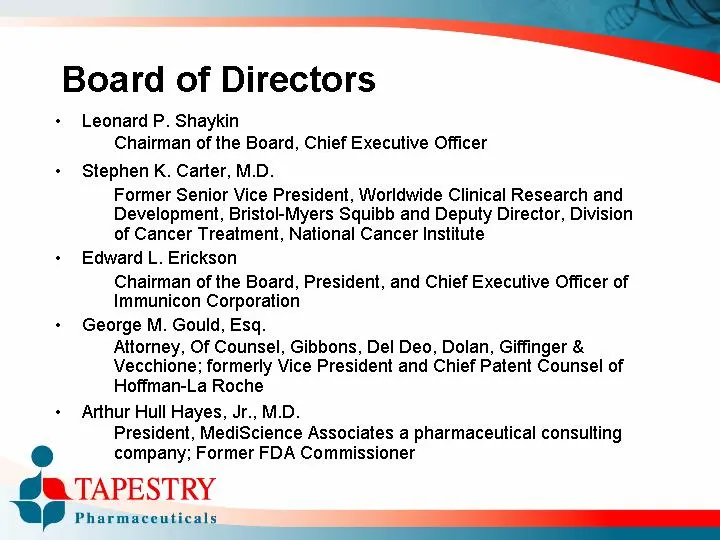
Board of Directors Leonard P. Shaykin Chairman of the Board, Chief Executive Officer + Stephen K. Carter, M.D. Former Senior Vice President, Worldwide Clinical Research and Development, Bristol-Myers Squibb and Deputy Director, Division of Cancer Treatment, National Cancer Institute + Edward L. Eric
Slide 34: Board of Directors (cont'd)
Board of Directors (cont’d) Elliot M. Maza, J.D., C.P.A. Chief Financial Officer of Emisphere Technologies, Inc. + The Honorable Richard N. Perle Former U.S. Assistant Secretary of Defense; Former Director of Hollinger International, Inc.; Autonomy, PLC Patricia Pilia, Ph.D. Executive VP, Secretary,
Slide 35: Investment Opportunity
Investment Opportunity + IND filed for TPI 287 in December, 2004 — Phase | studies to proceed pending regulatory & institutional approvals + ~ $42 million cash resources available to advance development programs as of September 29, 2004 + Experienced drug development team + Experienced business deve

Slide 36: Searchable text section of graphics shown above
Searchable text section of graphics shown above [ LOG O] Investor Presentation For ward-Looking Statements Statements in this presentation that are not historical facts are “forward-looking statements” that involve risks and uncertainties. Forward-looking statements can be identified by the use of w
Source: SEC EDGAR · 8-K filed Jan 10, 2005
More decks from Tapestry Pharmaceuticals Inc
 Investor Presentation (November 2007)27 slides · Nov 6, 2007
 Investor Presentation (August 2007)36 slides · Aug 21, 2007
 Corporate Update (July 2007)5 slides · Jul 17, 2007
 Technical Presentation (June 2007)6 slides · Jun 13, 2007
 Needham & Company Biotechnology and Medical Technology Conference 200733 slides · Jun 13, 2007
 IPO Roadshow (May 2007)30 slides · May 14, 2007