SenzaGen AB · OMXSTO:SENZA
SenzaGen AB — Conference Presentation (October 2019)
25 slides from SenzaGen AB's conference presentation, October 2019
Slide 1: In vitro skin sensitization testing of Medical Devices
= = GE SE & “ z In vitro skin sensitization testing of Medical Devices €& = All you need to know about the GARD™ technology for in vitro sensitization testing of Medical Devices Rose-Marie Jenvert, PhD
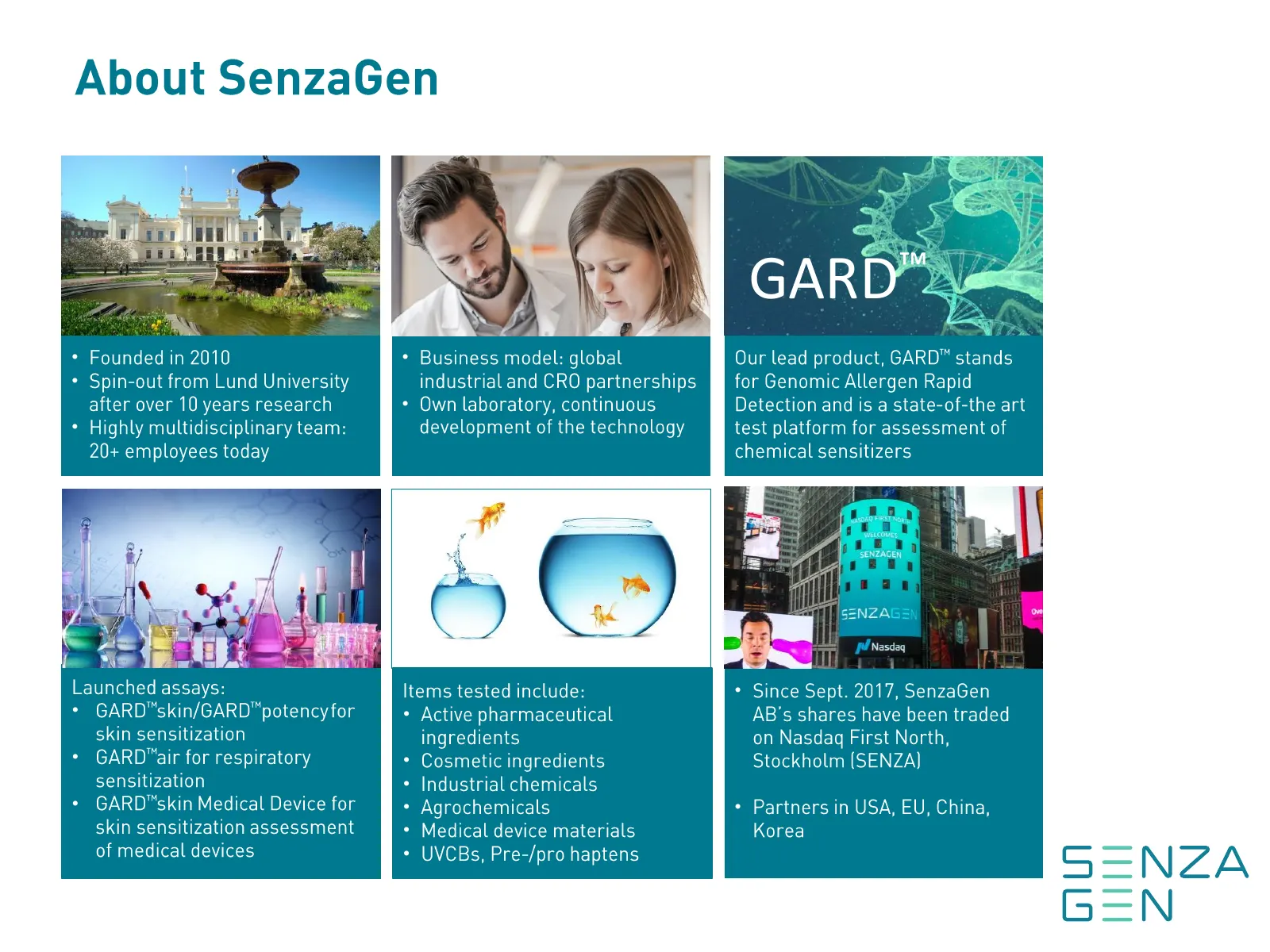
Slide 2: About SenzaGen
About SenzaGen Founded in 2010 Spin-out from Lund University after over 10 years research Highly multidisciplinary team: 20+ employees today Launched assays: * GARD™skin/GARD™potency for skin sensitization * GARD"air for respiratory sensitization GARD™skin Medical Device for skin sensitization asses
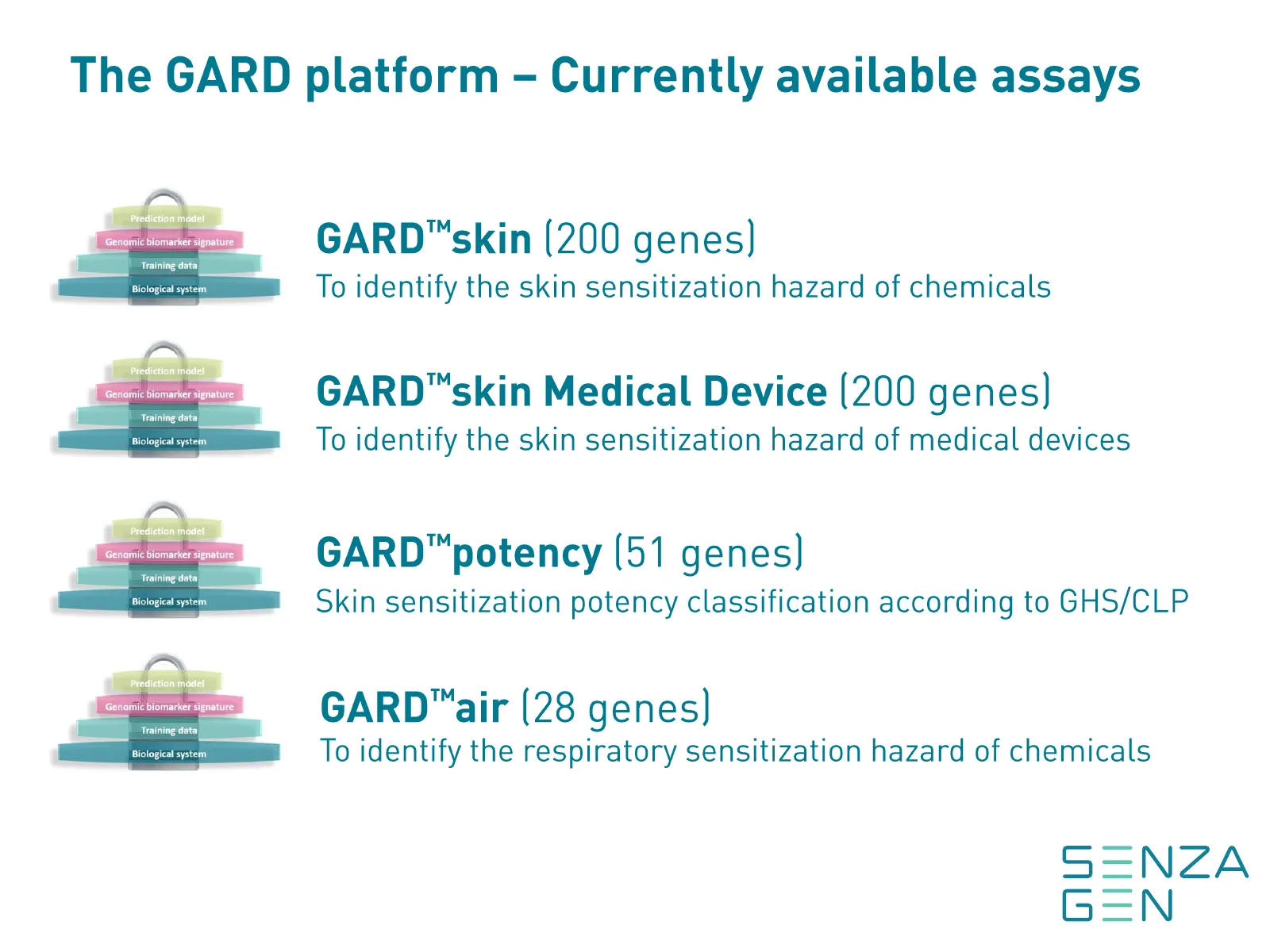
Slide 3: The GARD platform - Currently available assays
The GARD platform - Currently available assays GARD™ skin (200 genes) To identify the skin sensitization hazard of chemicals GARD™skin Medical Device (200 genes) To identify the skin sensitization hazard of medical devices GARD™ potency (51 genes) Skin sensitization potency classification according
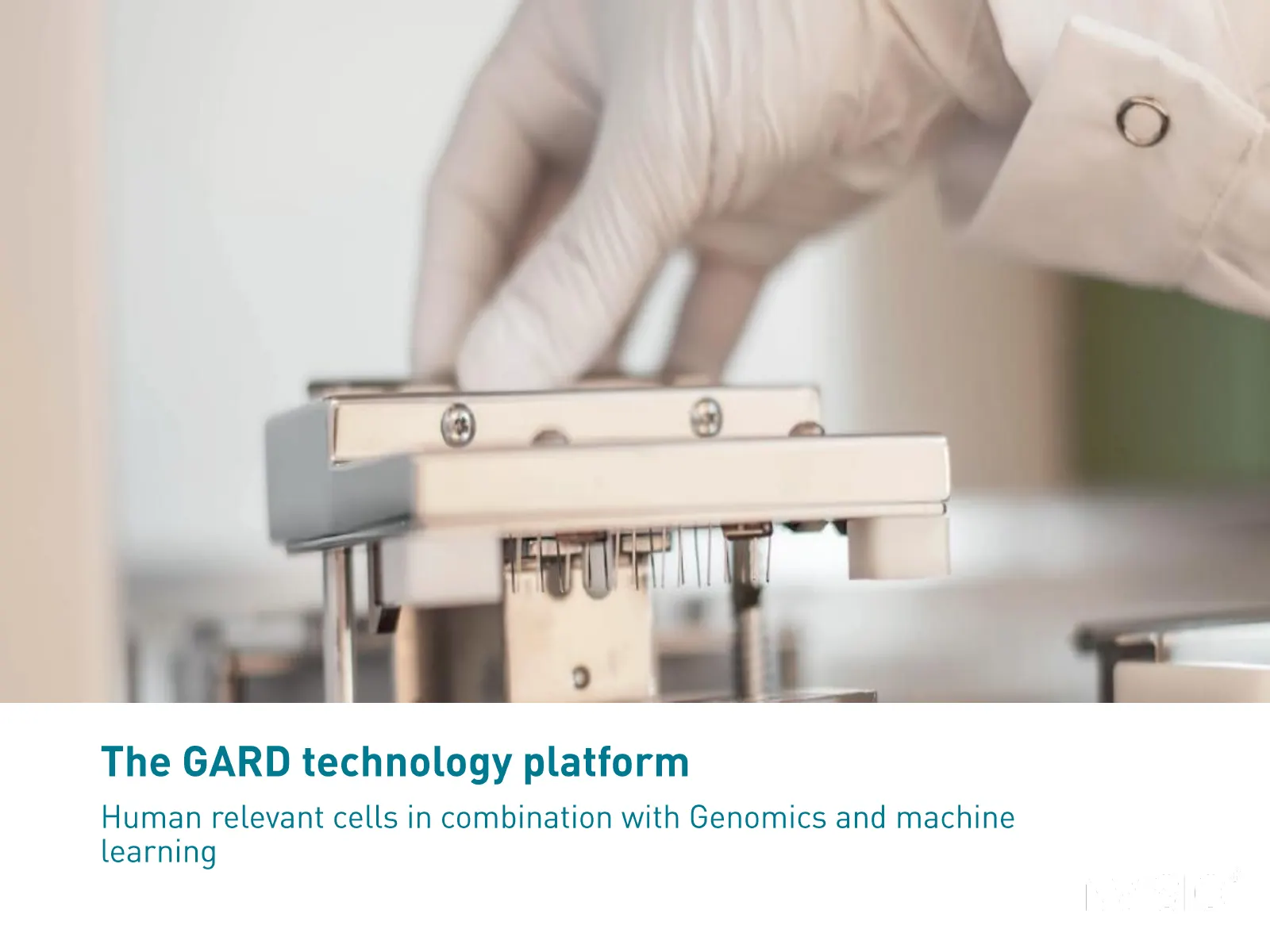
Slide 4: The GARD technology platform
The GARD technology platform Human relevant cells in combination with Genomics and machine learning
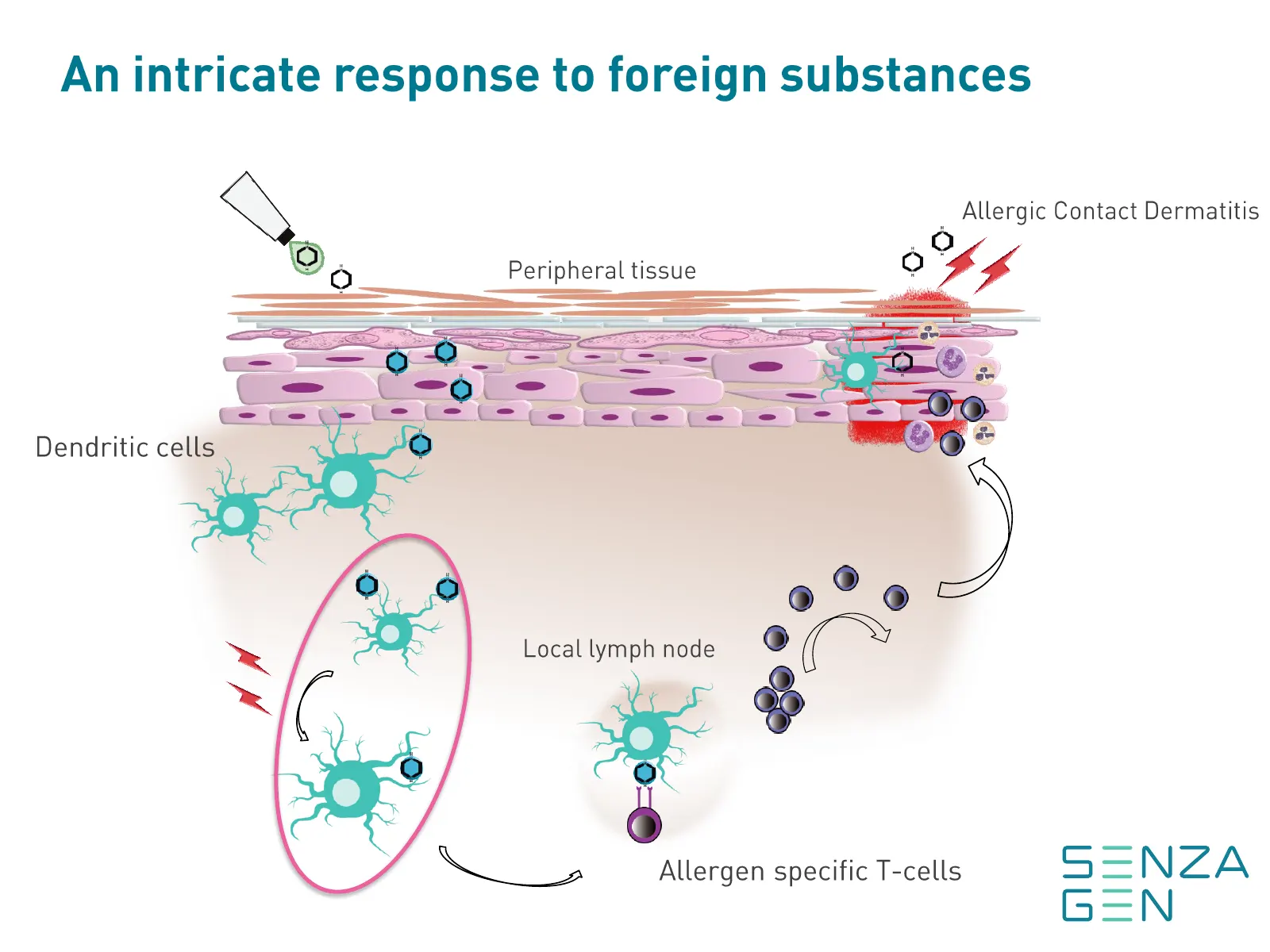
Slide 5: An intricate response to foreign substances
An intricate response to foreign substances _ Allergic Contact Dermatitis ~O ; Peripheral tissue - Dendritic ce Local lymph node ® ~- ¥? NO Allergen specific T-cells S=NZA
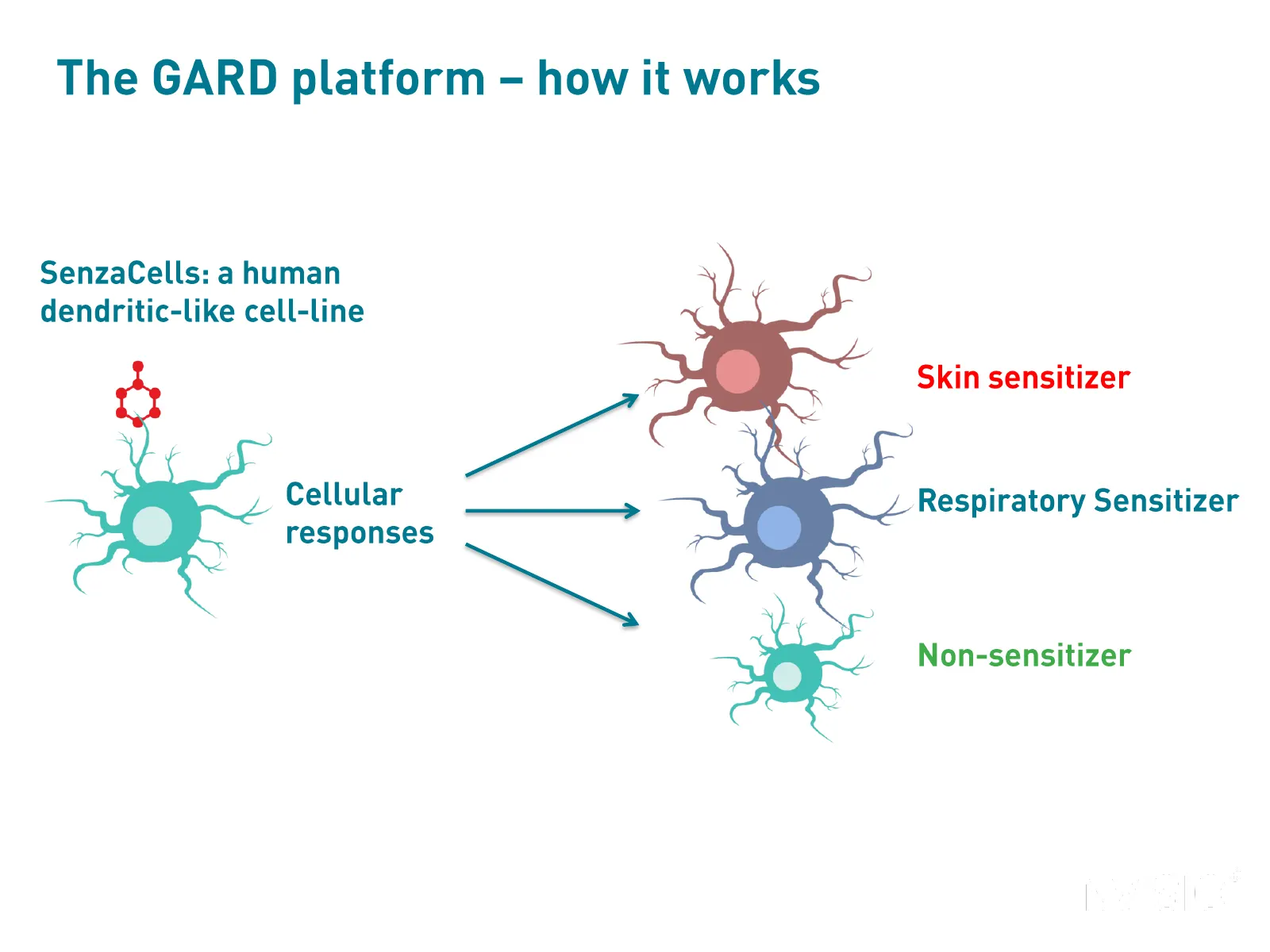
Slide 6: The GARD platform — how it works
The GARD platform — how it works SenzaCells: a human dendritic-like cell-line Skin sensitizer Cellular responses Respiratory Sensitizer Non-sensitizer
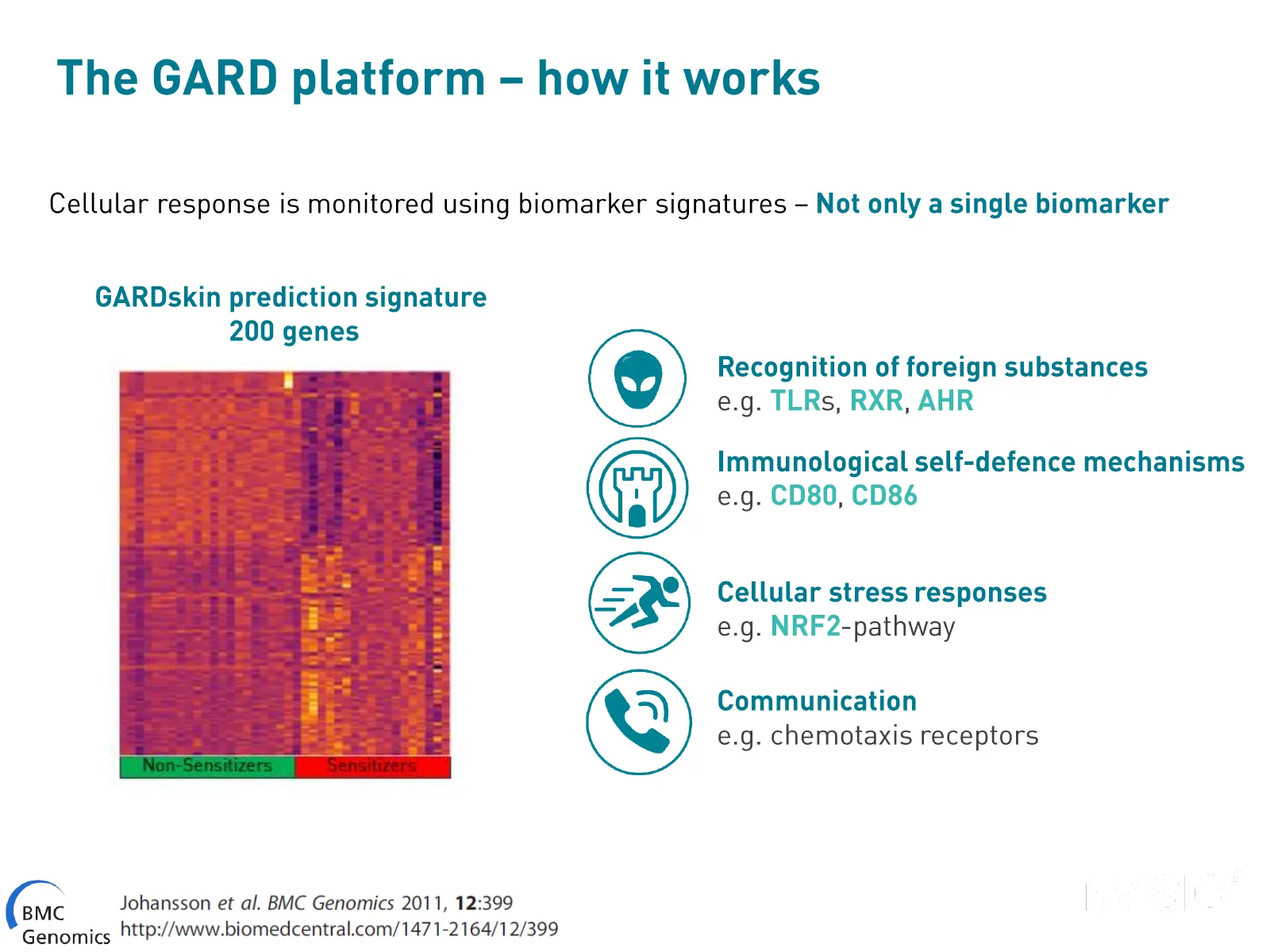
Slide 7: The GARD platform — how it works
The GARD platform — how it works Cellular response is monitored using biomarker signatures — Not only a single biomarker GARDskin prediction signature 200 genes Recognition of foreign substances e.g. TLRs, RXR, AHR Immunological self-defence mechanisms e.g. CD80, CD86 Cellular stress responses e.g.
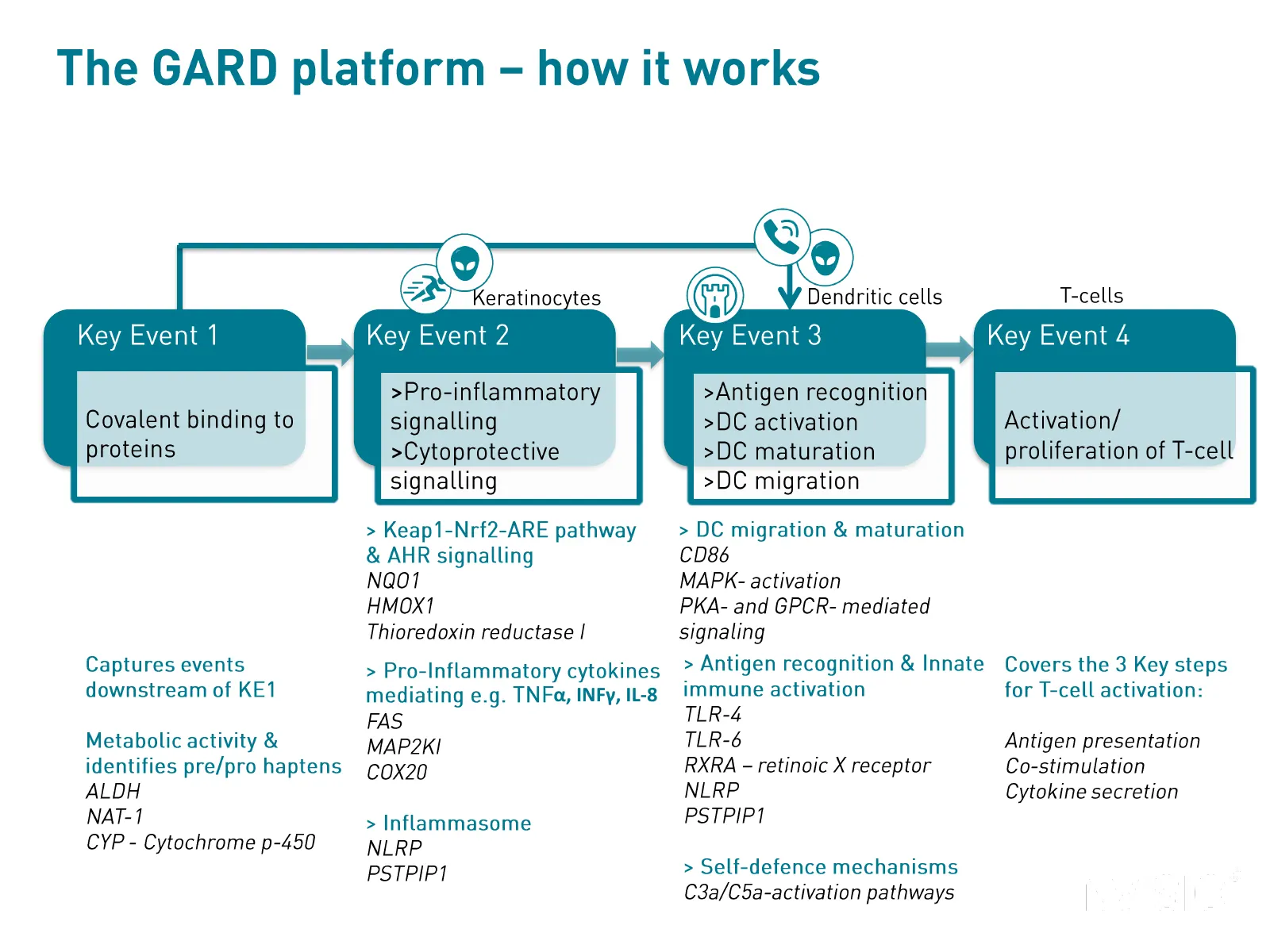
Slide 8: The GARD platform - how it works
The GARD platform - how it works Bs i @) Dendritic cells Key Event 1 Key Event 2 Key Event 3 Key Event 4 >Pro-inflammatory >Antigen recognition Covalent binding to signalling >DC activation proteins >Cytoprotective >DC maturation signalling >DC migration Activation/ proliferation of T-cell > Keap1-N
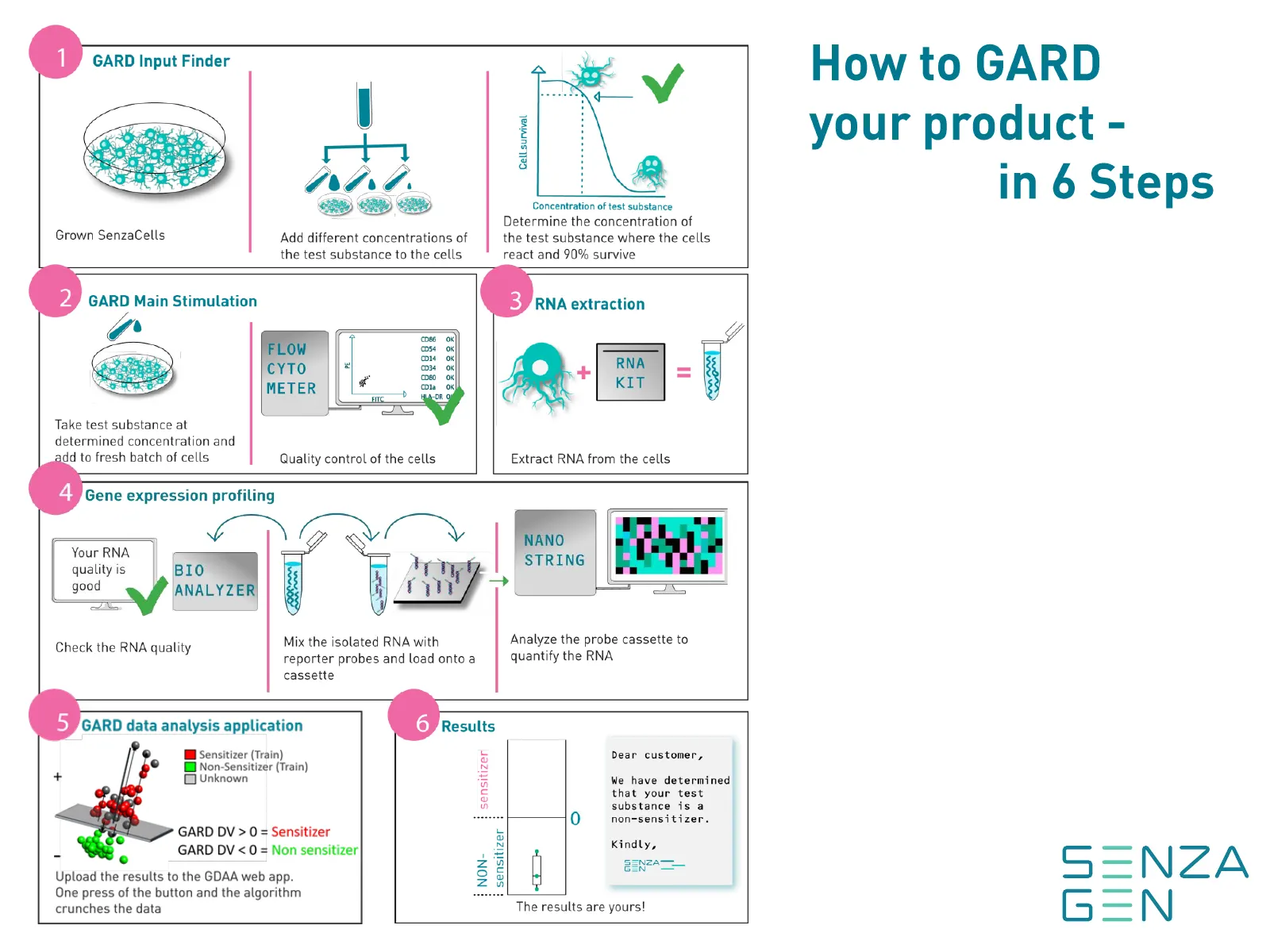
Slide 9: GARD workflow: Input to results
GARD Input Grown SenzaCells Finder Add different concentrations of the test substance to the cells Cell survival Concentration of test substance Determine the concentration of the test substance where the cells react and 90% survive dd to fresh batch of © GARD Main Stimulation Take test substance at
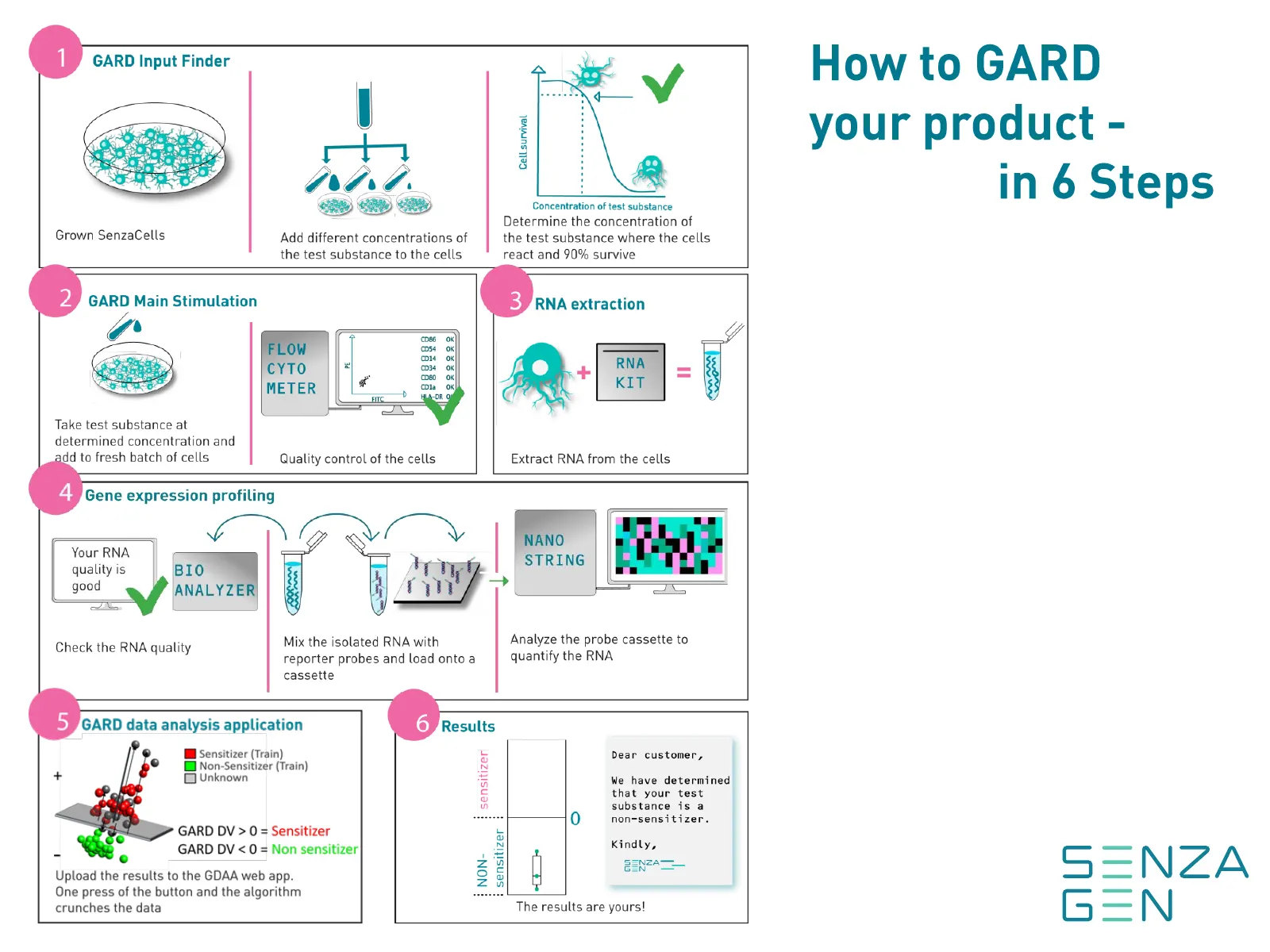
Slide 10: GARD workflow: Input to results
GARD Input Grown SenzaCells Finder Add different concentrations of the test substance to the cells Cell survival Concentration of test substance Determine the concentration of the test substance where the cells react and 90% survive dd to fresh batch of © GARD Main Stimulation Take test substance at
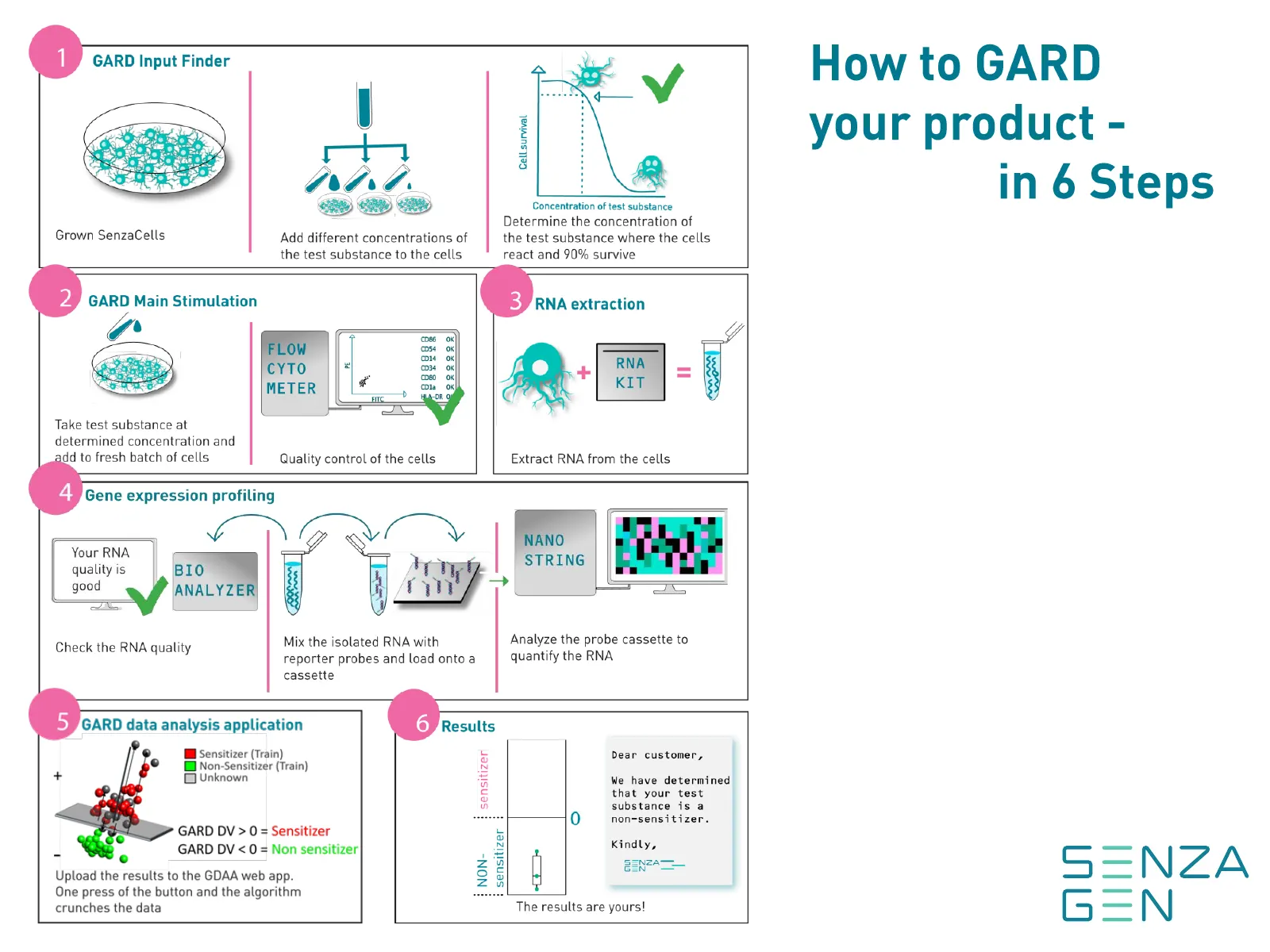
Slide 11: GARD workflow: Input to results
GARD Input Grown SenzaCells Finder Add different concentrations of the test substance to the cells Cell survival Concentration of test substance Determine the concentration of the test substance where the cells react and 90% survive dd to fresh batch of © GARD Main Stimulation Take test substance at
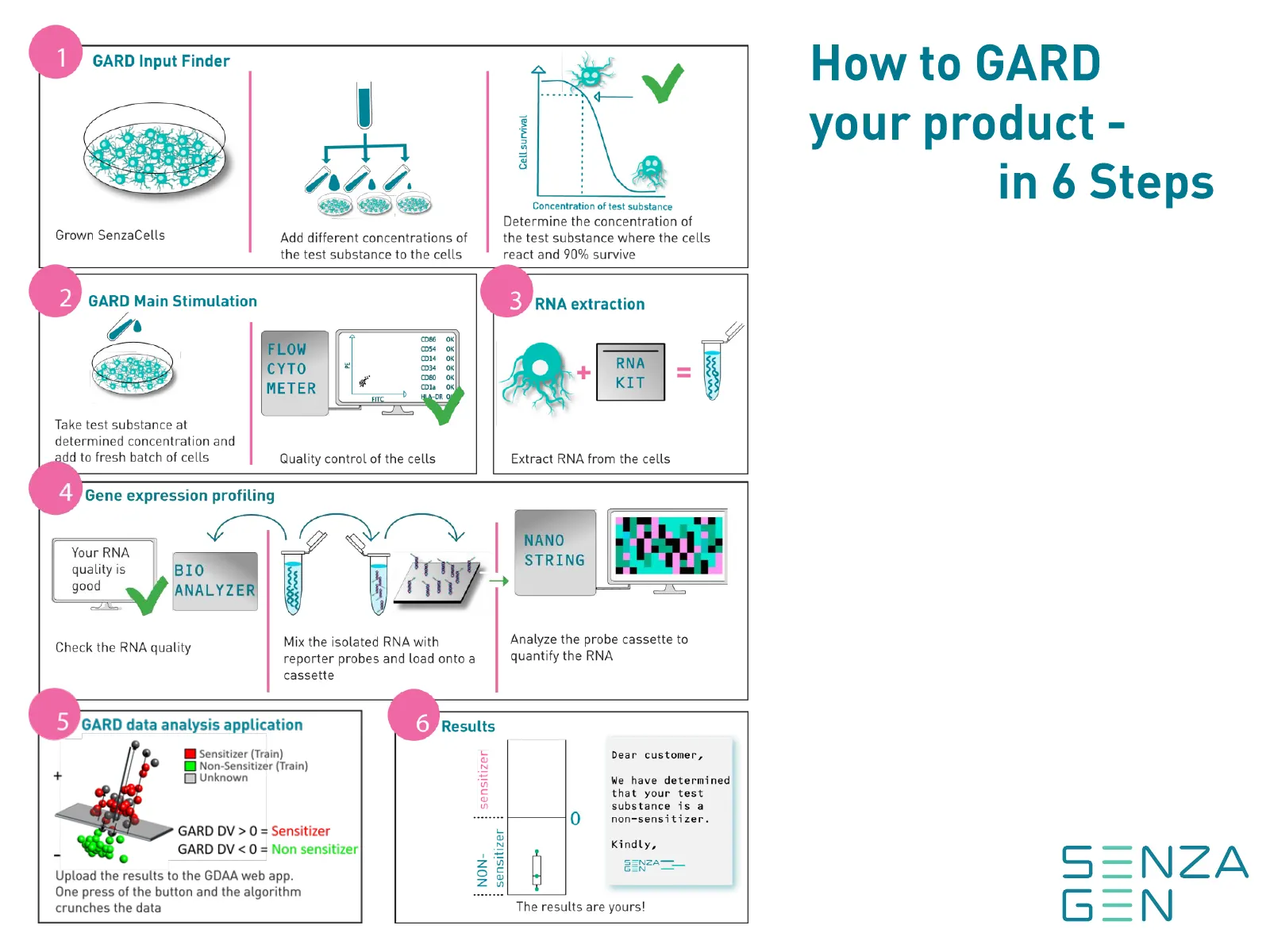
Slide 12: GARD workflow: Input to results
GARD Input Grown SenzaCells Finder Add different concentrations of the test substance to the cells Cell survival Concentration of test substance Determine the concentration of the test substance where the cells react and 90% survive dd to fresh batch of © GARD Main Stimulation Take test substance at
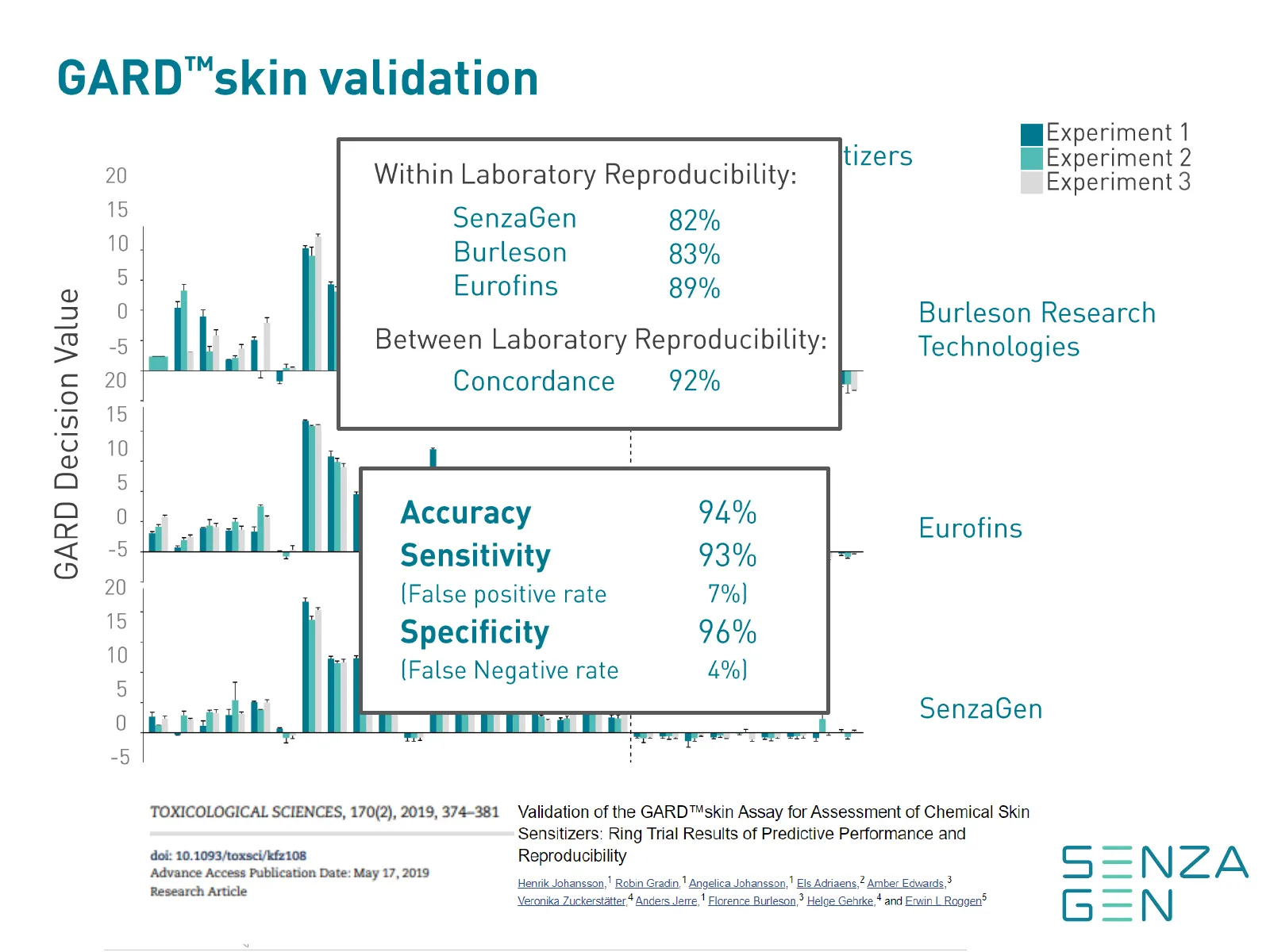
Slide 13: GARD skin validation
GARD" skin validation GARD Decision Value WExperiment 1 Within Laboratory Reproducibility: lizers eeeperimont 3 SenzaGen 82% Burleson 83% Eurofins 89% Burleson Research Between Laboratory Reproducibility: Technologies Concordance 92% i 1 Accuracy 94% Eurofins Sensitivity 93% a (False positive rate 7
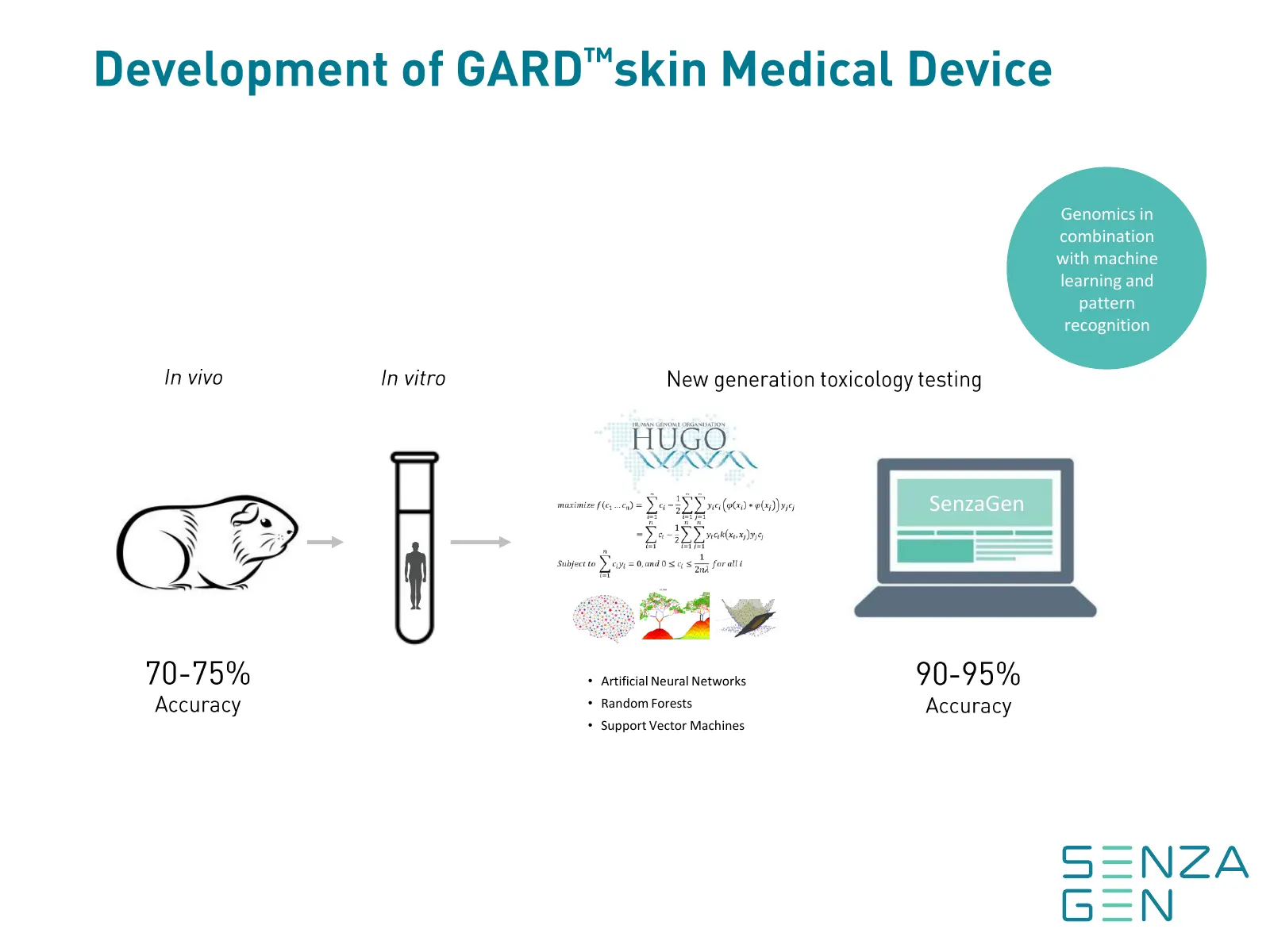
Slide 14: Genomics in combination with machine learning and pattern recognition
Genomics in combination with machine learning and pattern recognition SenzaGen • Artificial Neural Networks • Random Forests • Support Vector Machines
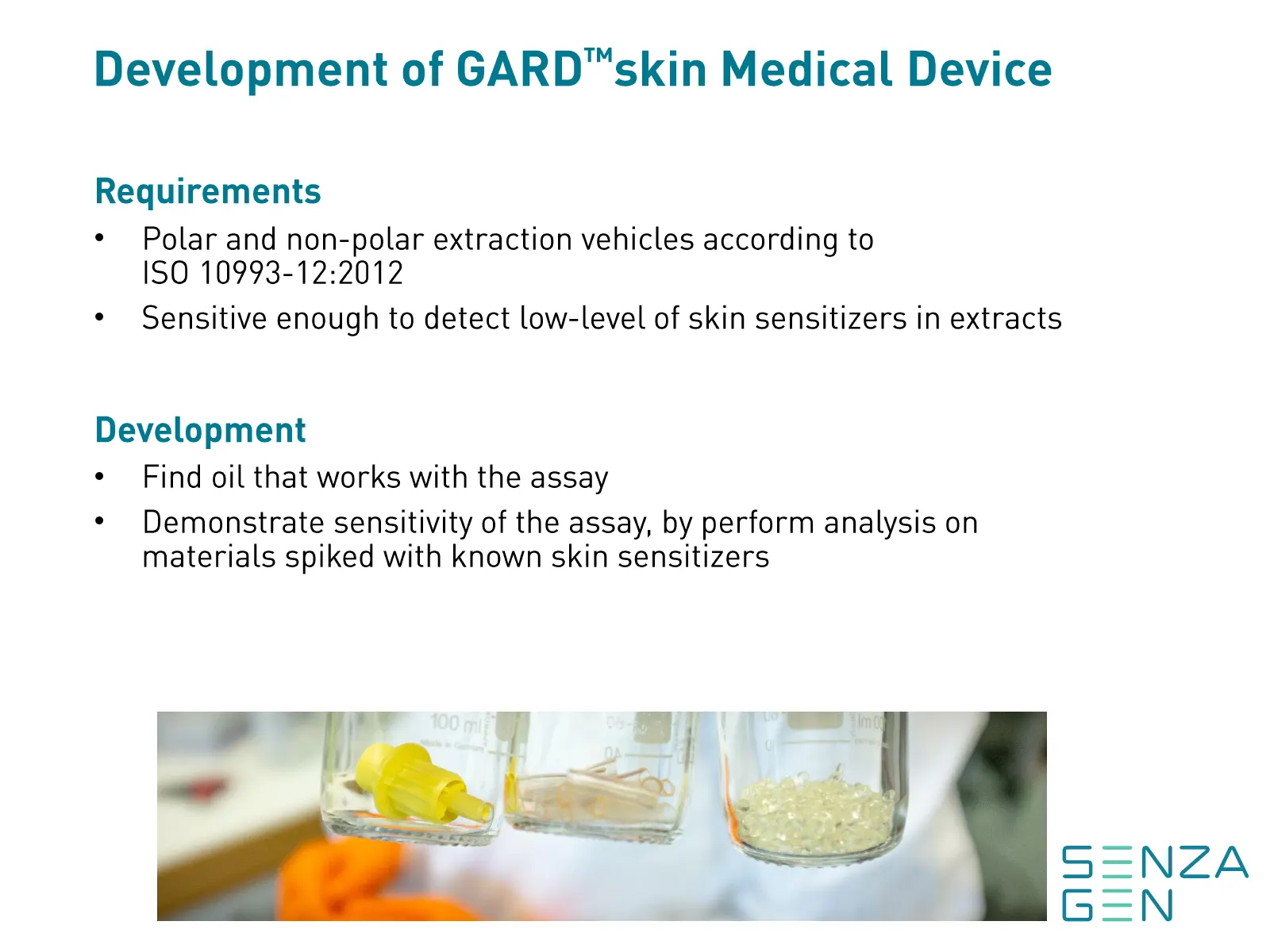
Slide 15: Development of GARD skin Medical Device
Development of GARD™ skin Medical Device Requirements ¢ Polar and non-polar extraction vehicles according to ISO 10993-12:2012 * Sensitive enough to detect low-level of skin sensitizers in extracts Development ¢ Find oil that works with the assay * Demonstrate sensitivity of the assay, by perform an
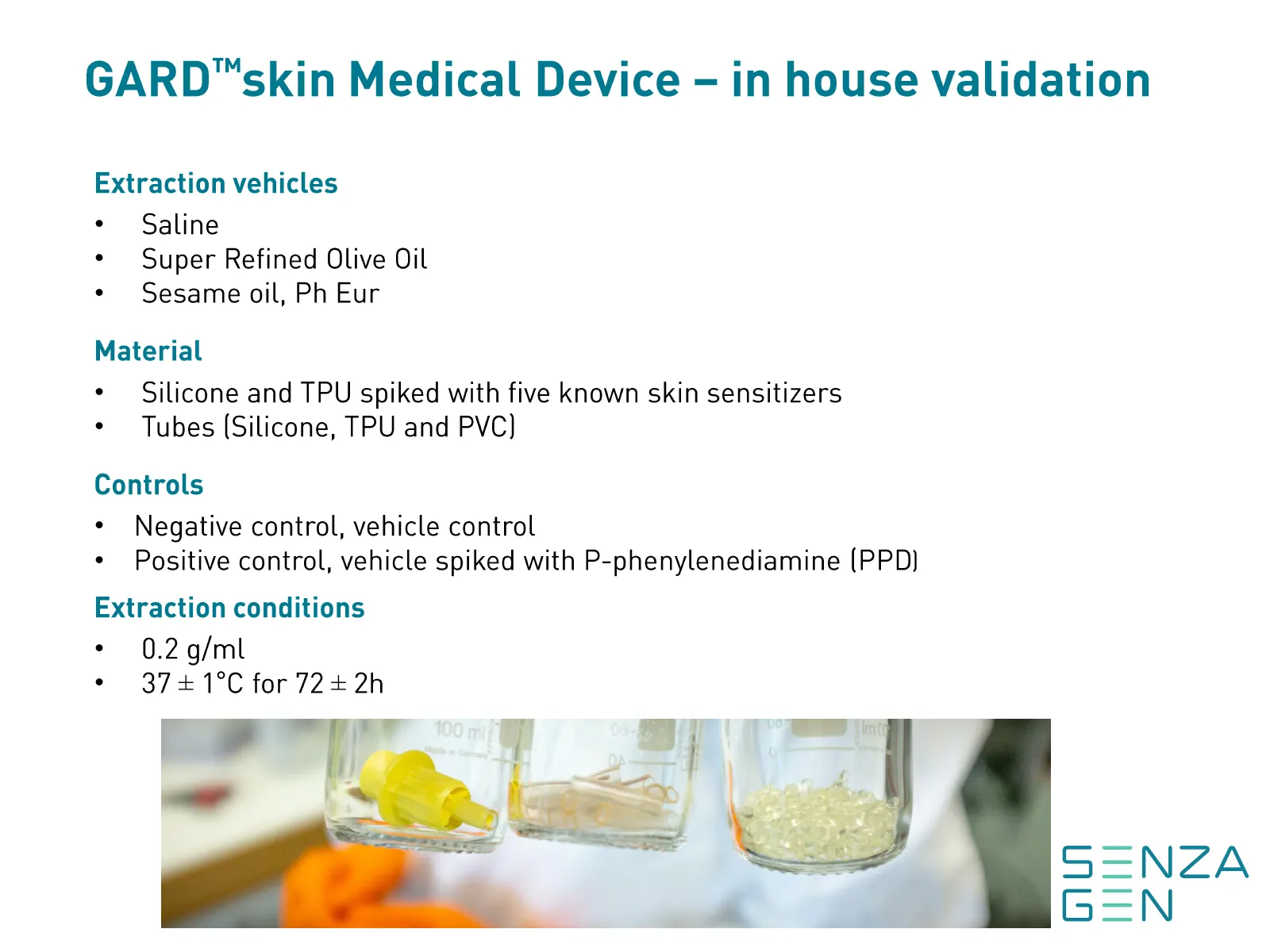
Slide 16: GARD skin Medical Device - in house validation
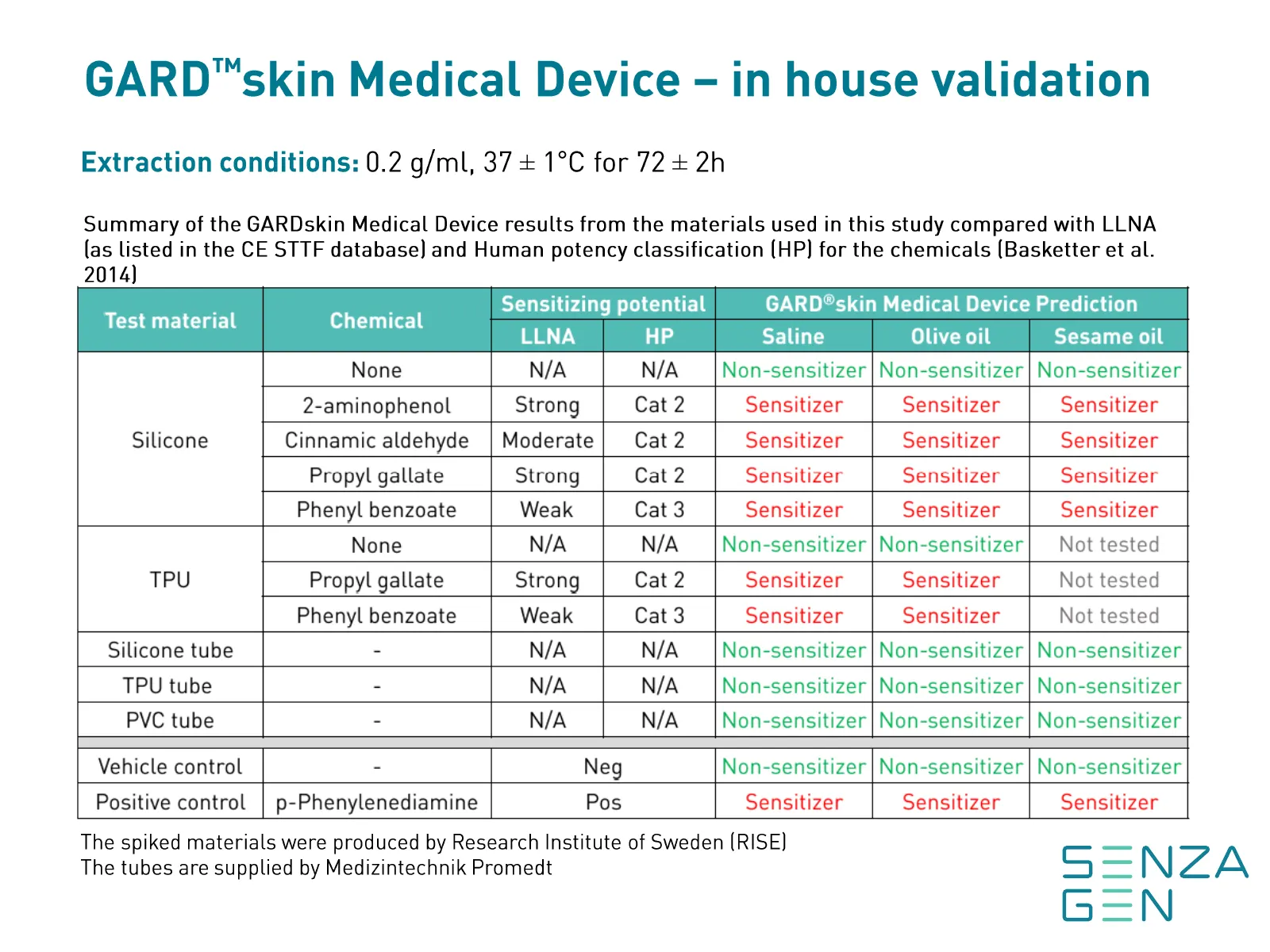
GARD™ skin Medical Device - in house validation Extraction vehicles * Saline * Super Refined Olive Oil * Sesame oil, Ph Eur Material ¢ Silicone and TPU spiked with five known skin sensitizers * Tubes (Silicone, TPU and PVC] Controls « Negative control, vehicle control * Positive control, vehicle spi
Slide 17: GARD skin Medical Device - in house validation
GARD™ skin Medical Device - in house validation Extraction conditions: 0.2 g/ml, 37 + 1°C for 72+ 2h Summary of the GARDskin Medical Device results from the materials used in this study compared with LLNA (as listed in the CE STTF database) and Human potency classification (HP) for the chemicals (Ba
Slide 18: How can you use GARD for skin sensitization testing of Medical Devices
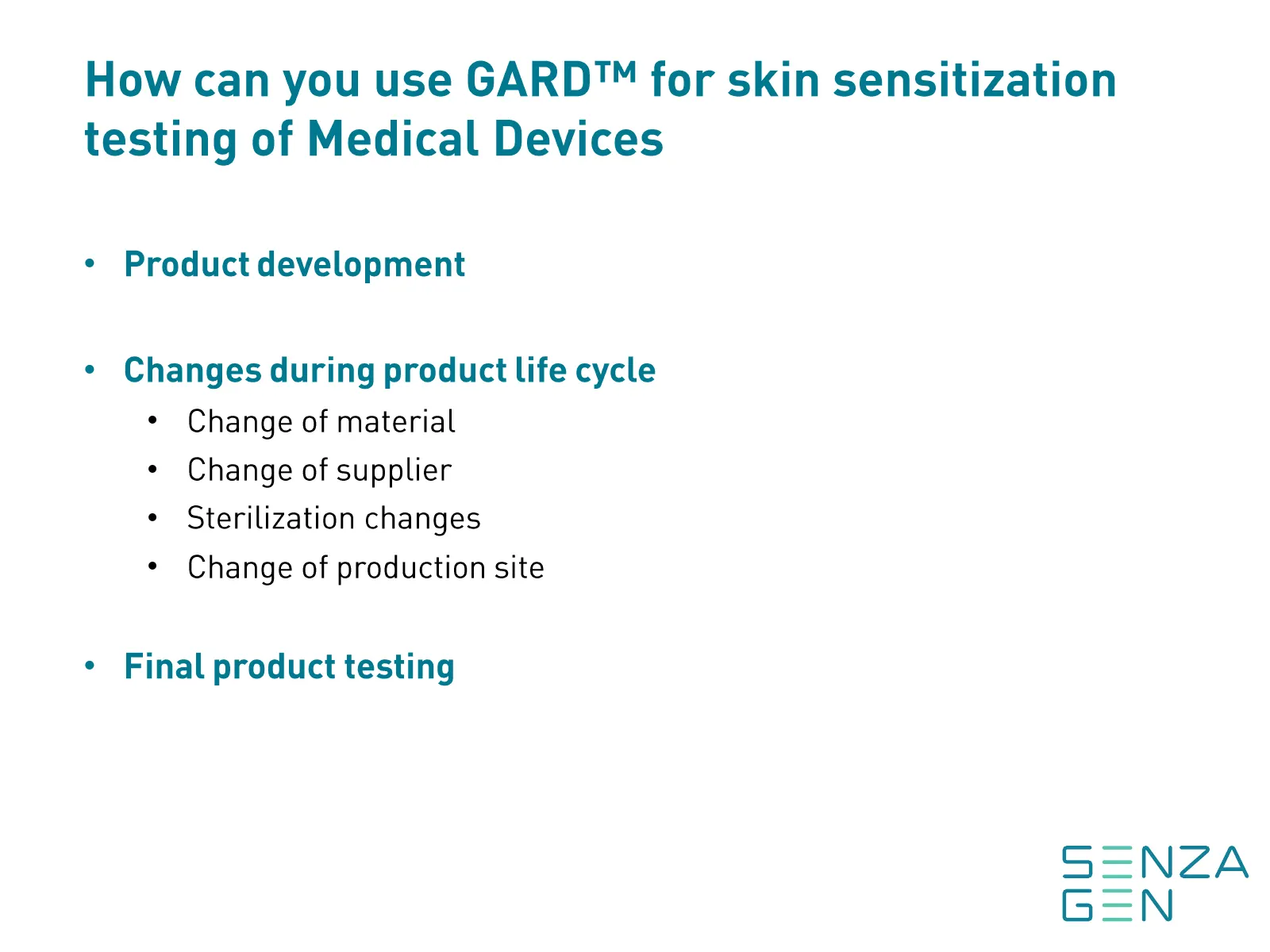
How can you use GARD™ for skin sensitization testing of Medical Devices ¢ Product development ¢ Changes during product life cycle * Change of material ¢ Change of supplier * Sterilization changes ¢ Change of production site ¢ Final product testing
Slide 19: Case study I - Change in sterilization procedure
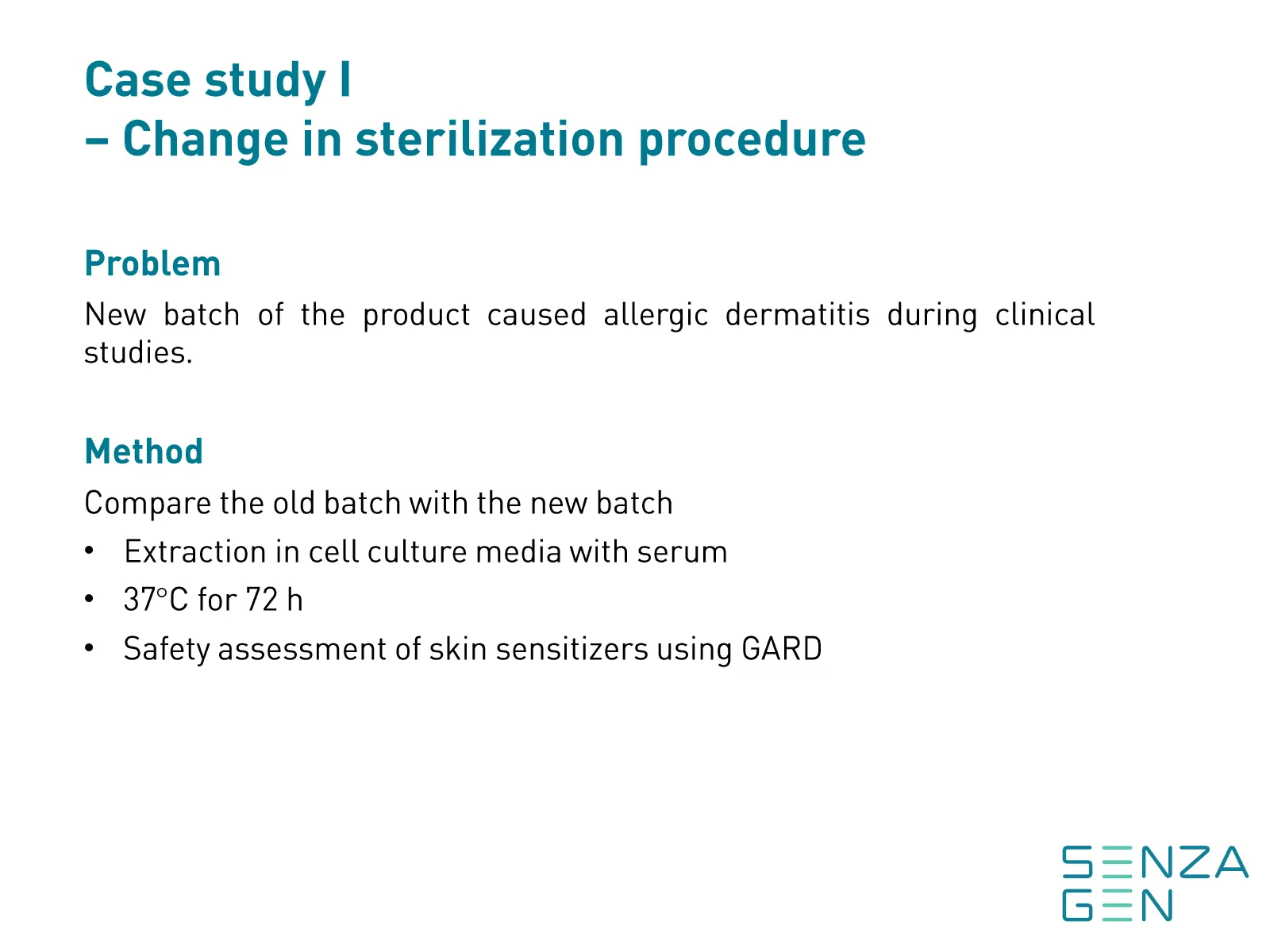
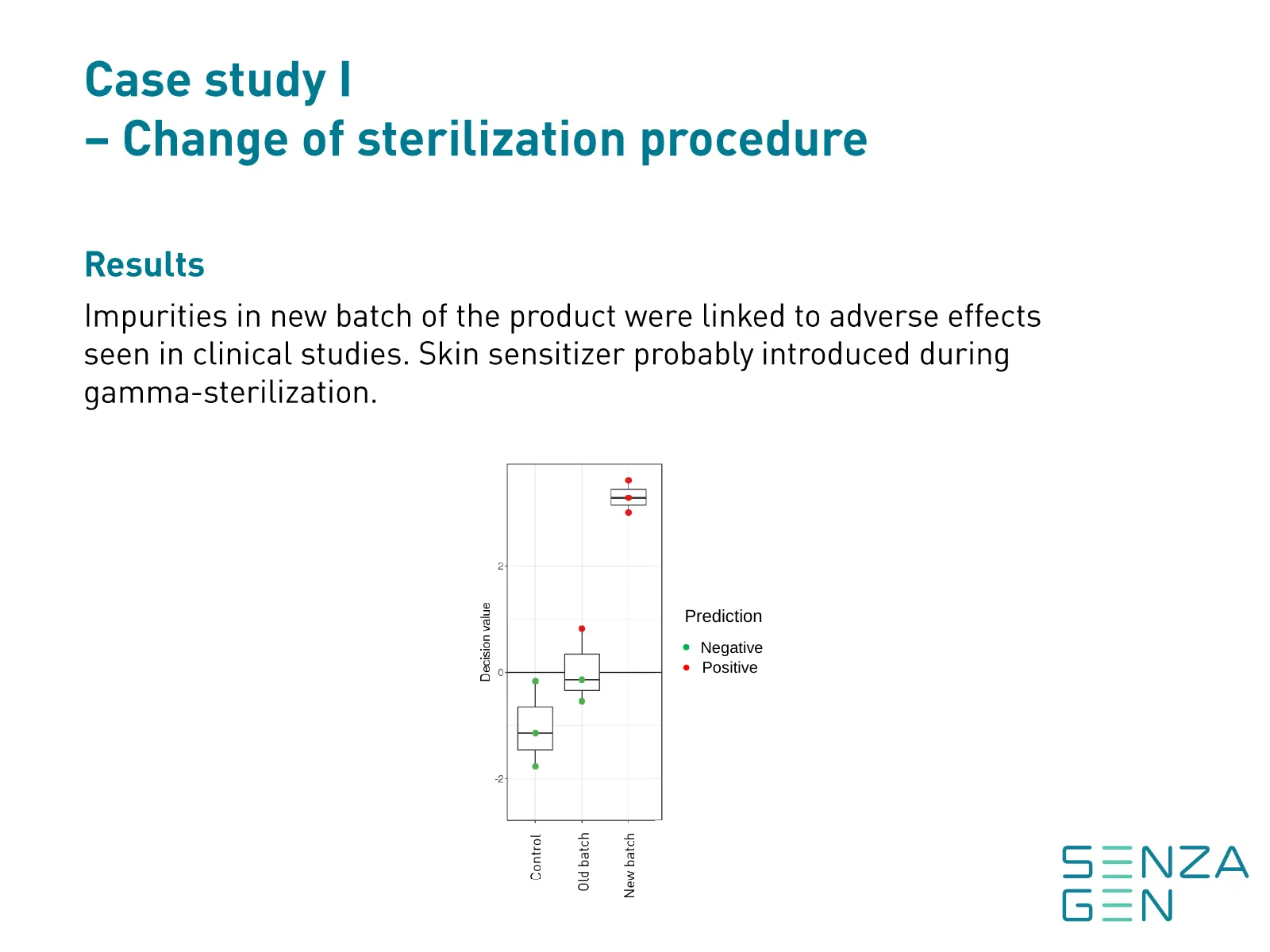
Case study | - Change in sterilization procedure Problem New batch of the product caused allergic dermatitis during clinical studies. Method Compare the old batch with the new batch * Extraction in cell culture media with serum * 37°C for 72h * Safety assessment of skin sensitizers using GARD
Slide 20: Prediction Negative Positive
Prediction Negative Positive
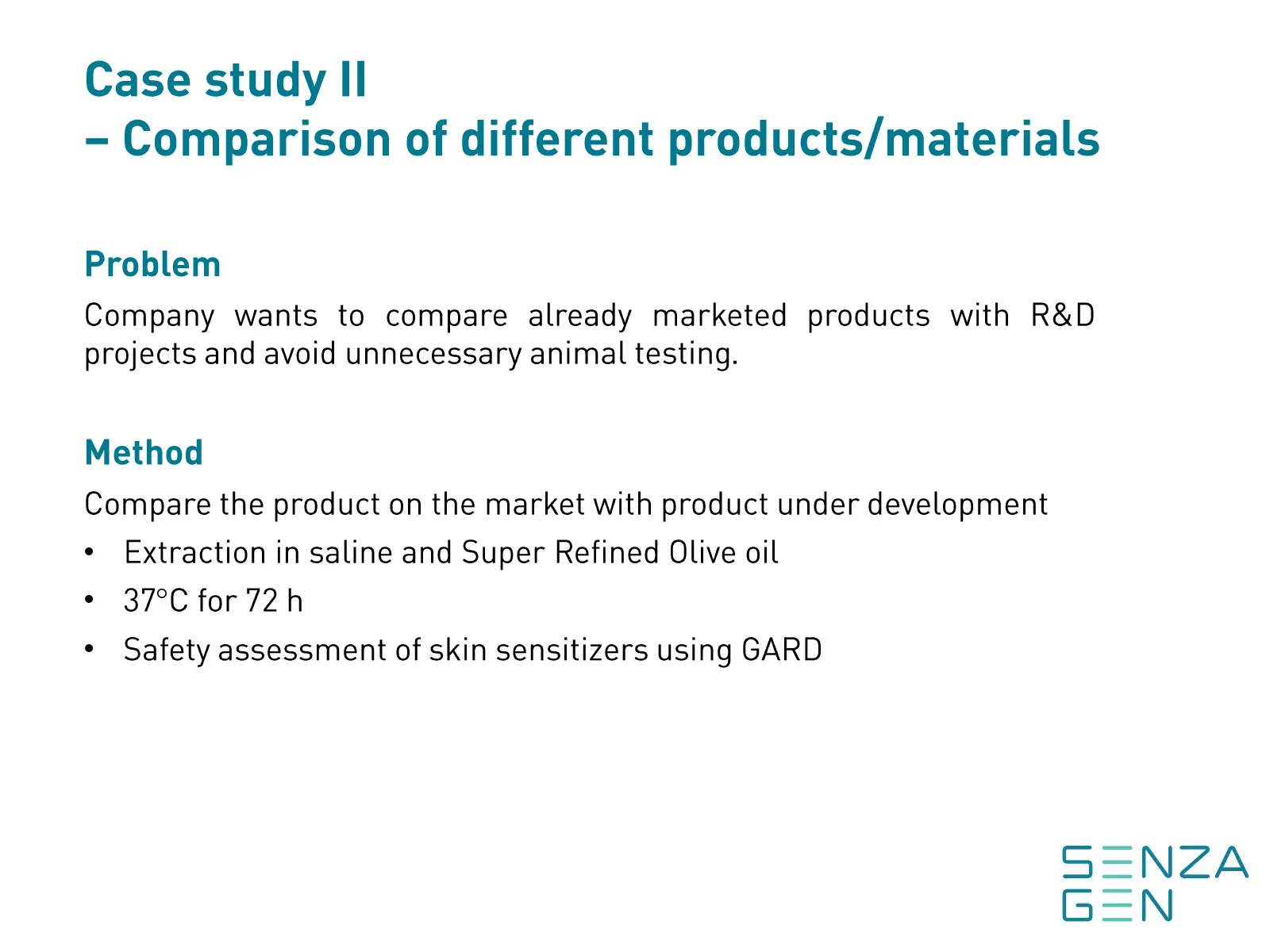
Slide 21: Case study II - Comparison of different products/materials
Case study Il - Comparison of different products/materials Problem Company wants to compare already marketed products with R&D projects and avoid unnecessary animal testing. Method Compare the product on the market with product under development ¢ Extraction in saline and Super Refined Olive oil * 3
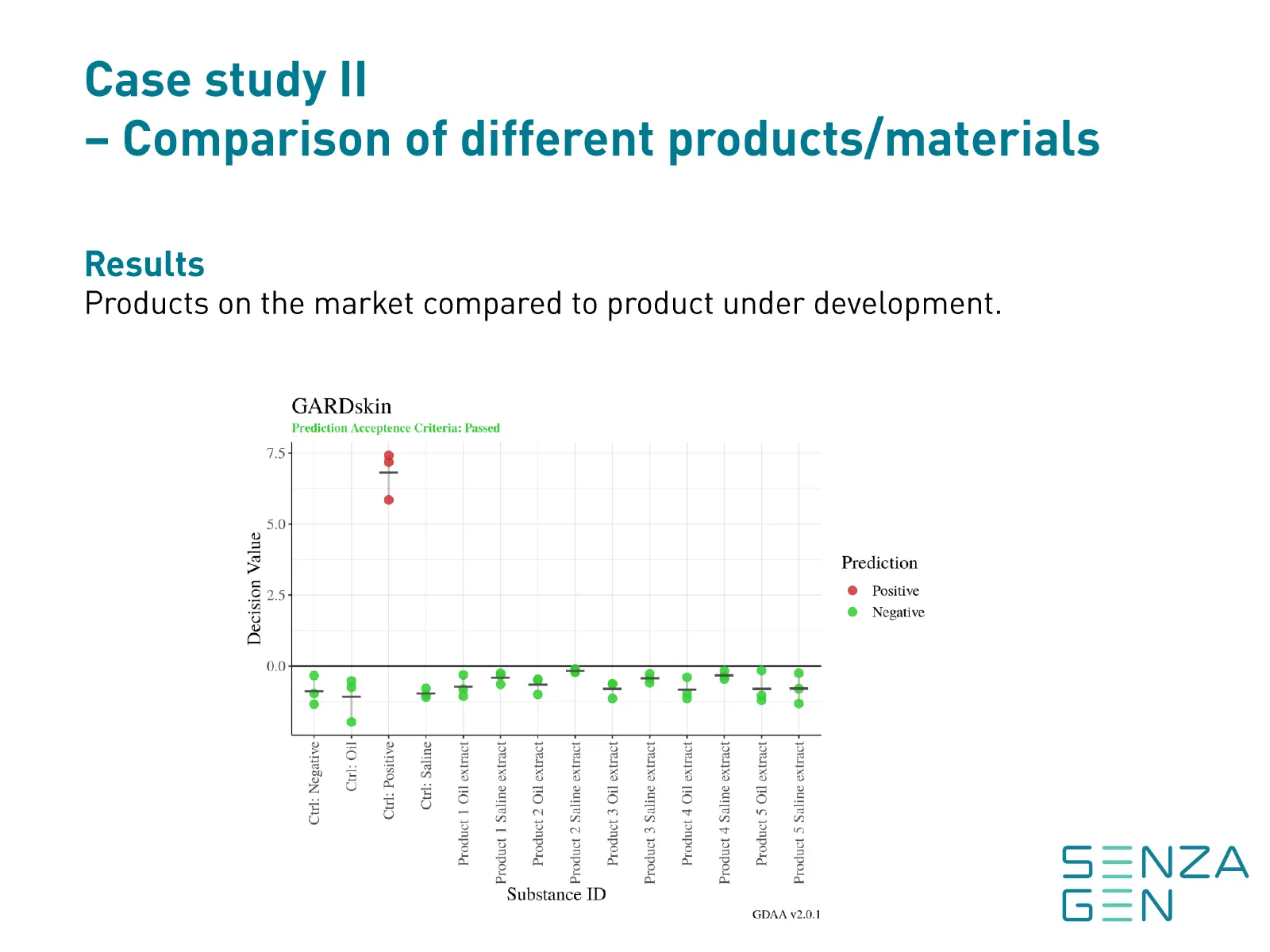
Slide 22: Case study II - Comparison of different products/materials
Case study Il - Comparison of different products/materials Results Products on the market compared to product under development. GARDskin Prediction Acceptence Criteria: Passed 75 8 ° 5.0 ay a S$ Prediction Sos © Positive Z . oO @ Negative 2 a 0.0 ° eta * etety? 2 + ae 3 $$" s +t Ctrl: Oil] @—}eo Ct
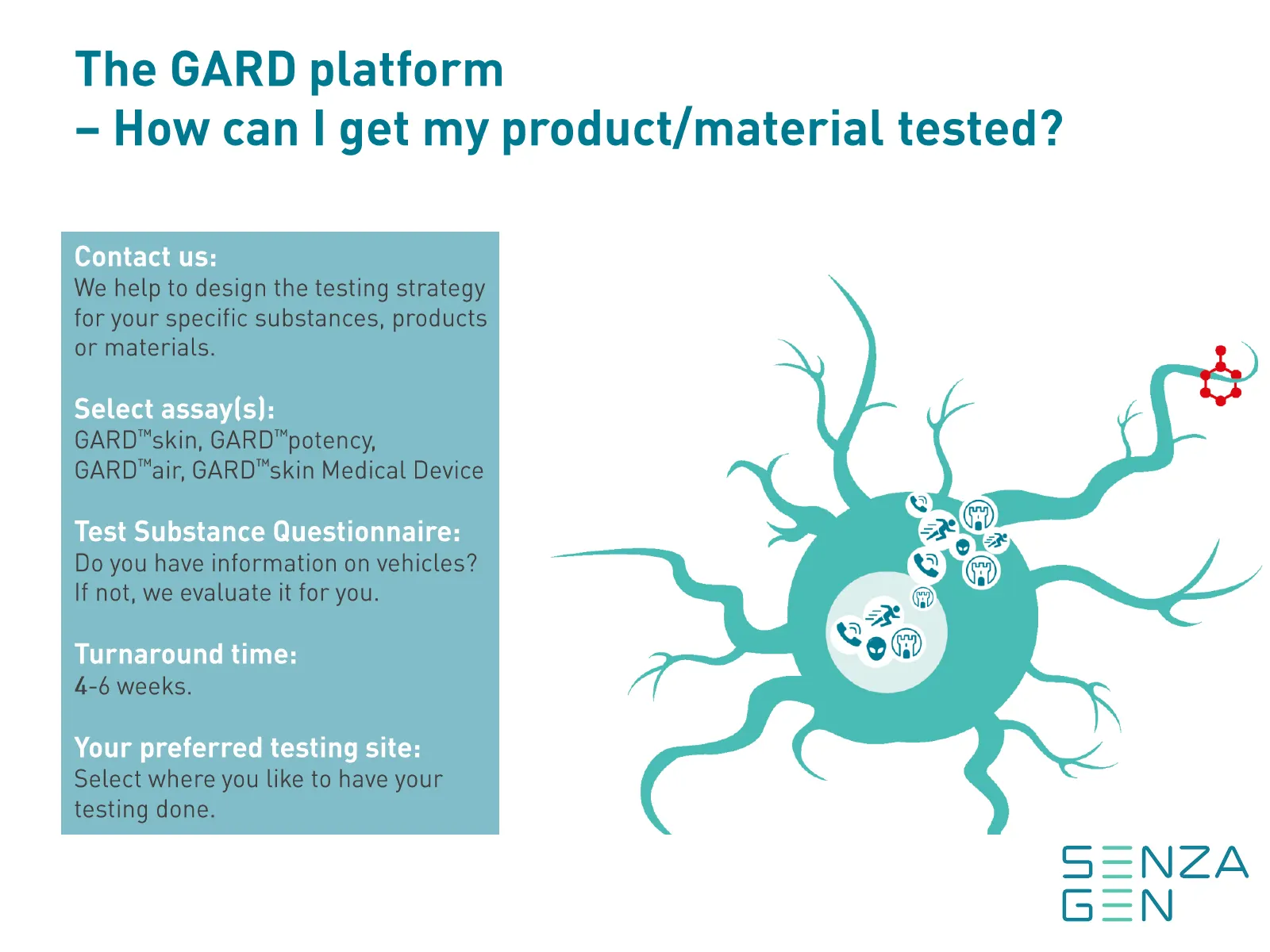
Slide 23: The GARD platform - How can I get my product/material tested?
The GARD platform - How can | get my product/material tested? Contact us: Select assay(s): Test Substance Questionnaire: Turnaround time: Your preferred testing site:
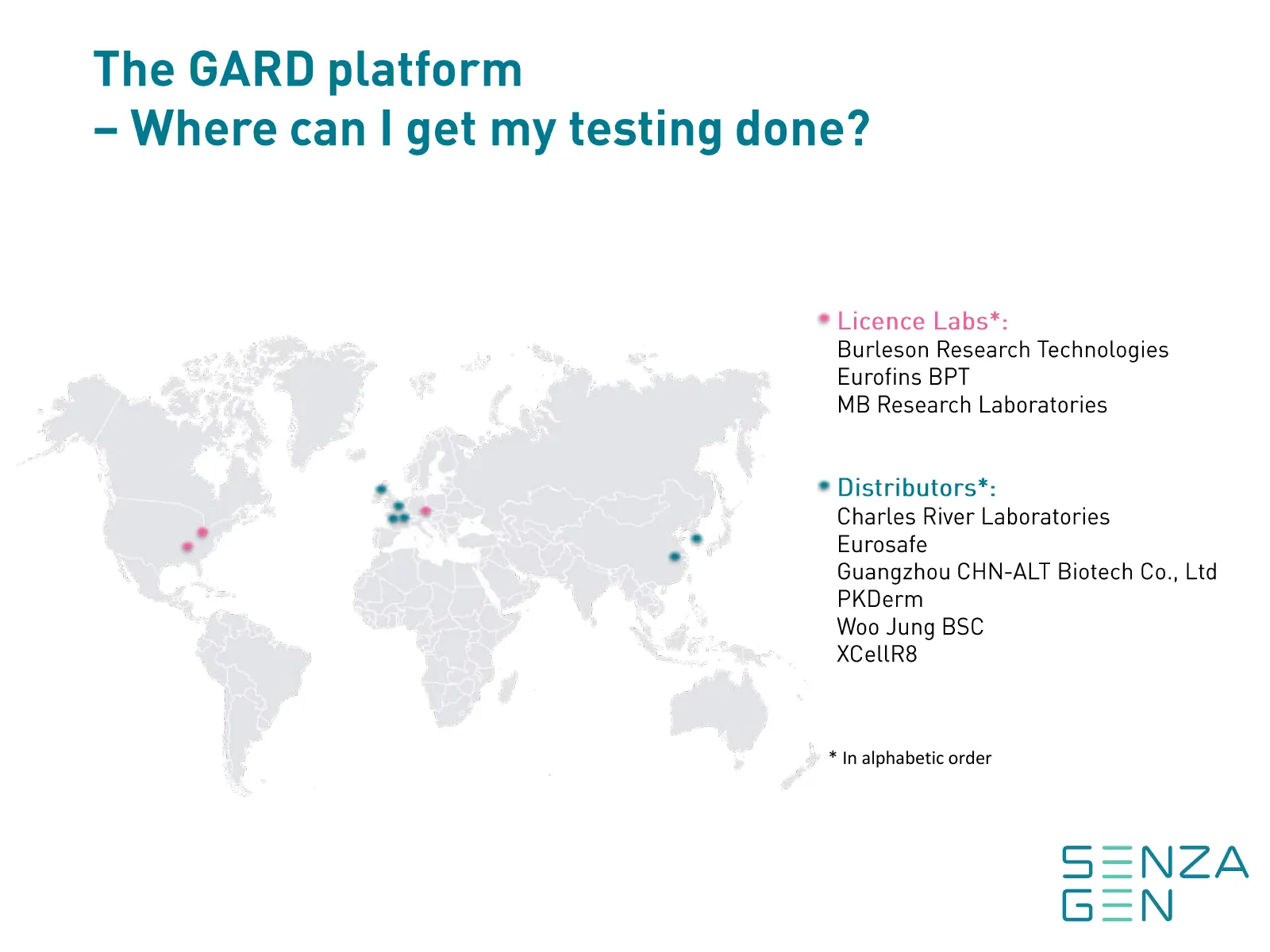
Slide 24: The GARD platform - Where can I get my testing done?
The GARD platform - Where can | get my testing done? tt * Licence Labs*: Burleson Research Technologies Eurofins BPT MB Research Laboratories * Distributors*: Charles River Laboratories Eurosafe Guangzhou CHN-ALT Biotech Co., Ltd PKDerm Woo Jung BSC XCellR8 * In alphabetic order
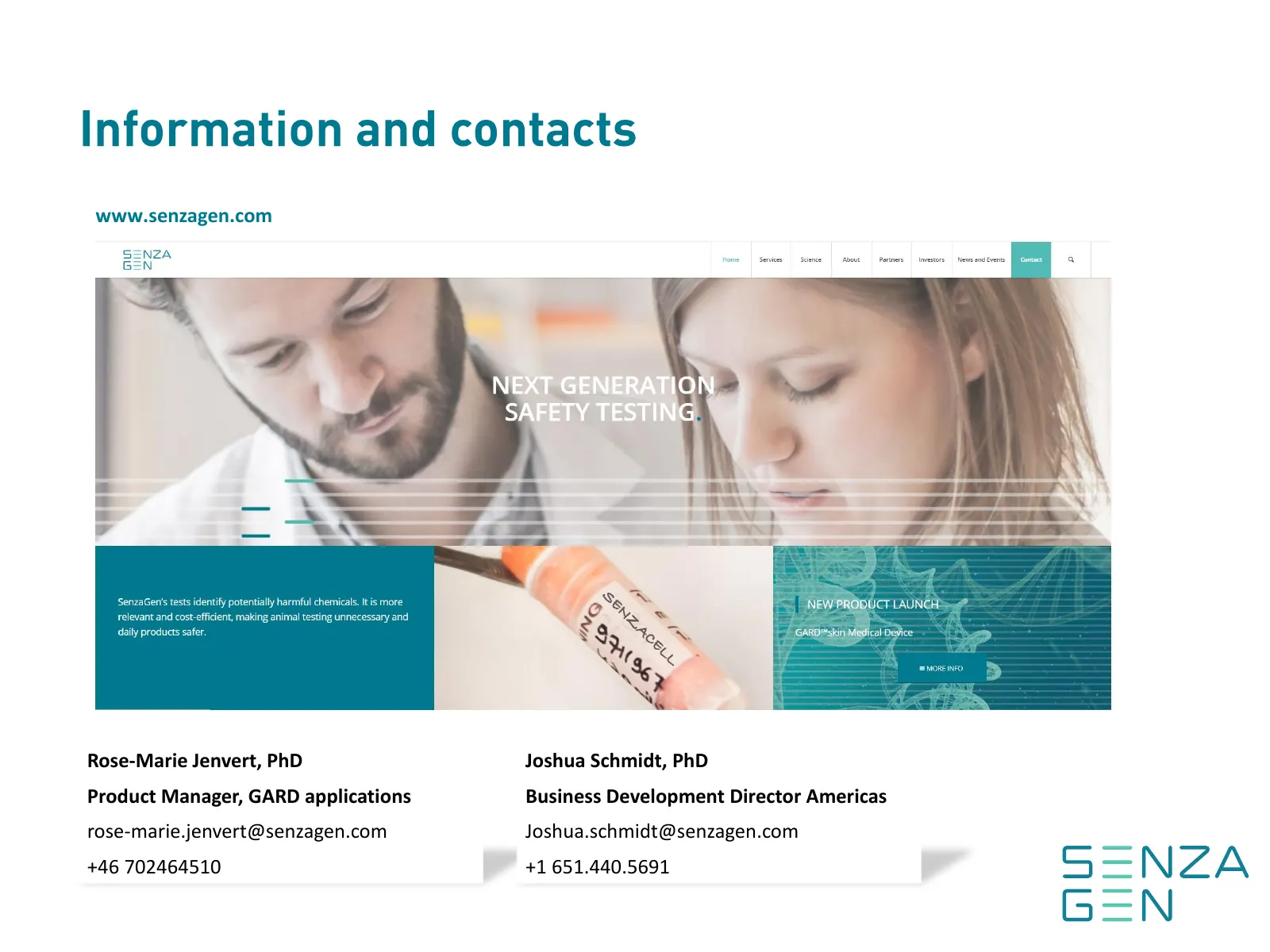
Slide 25: www.senzagen.com Contact details
www.senzagen.com Rose-Marie Jenvert, PhD Joshua Schmidt, PhD Product Manager, GARD applications Business Development Director Americas rose-marie.jenvert@senzagen.com Joshua.schmidt@senzagen.com +46 702464510 +1 651.440.5691
Source: Internet Archive copy of senzagen.com
More decks from SenzaGen AB
 Investor Presentation (October 2021)27 slides · Oct 28, 2021
 Technical Presentation (October 2020)59 slides · Oct 6, 2020
 Technical Presentation (February 2020)59 slides · Feb 25, 2020
 Technical Presentation (September 2019)36 slides · Sep 23, 2019
 Technical Presentation (September 2019)33 slides · September 2019
 Technical Presentation (April 2019)61 slides · April 2019