Tapestry Pharmaceuticals — Rodman & Renshaw Techvest Conference (October 2004)
34 slides from Tapestry Pharmaceuticals's conference presentation, Oct 26, 2004
Slide 1: Investor Presentation — Oncology Focus
an Investor Presentation — Oncology Focus October 27, 2004 e ae TAPESTRY ae Pharmaceuticals
Slide 2: Forward-Looking Statements
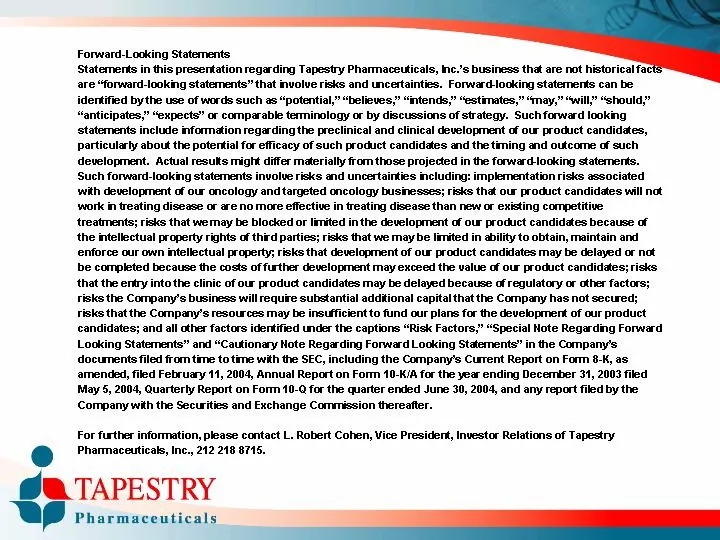
Forward-Looking Statements ‘Statements in this presentation regarding Tapestry Pharmaceuticals, Inc.’s business that are not historical fa are “forward-looking statements” that involve risks and uncertainties. Forward-looking statements ean be identified by the use of words such as “potential,” “bel
Slide 3: Company focused on proprietary therapeutics for cancer and hereditary disease
a company focused on proprietary therapeutics for the treatment of cancer and hereditary disease e @@ TAPESTRY ‘ag Pharmaceuticals
Slide 4: Development Pipeline
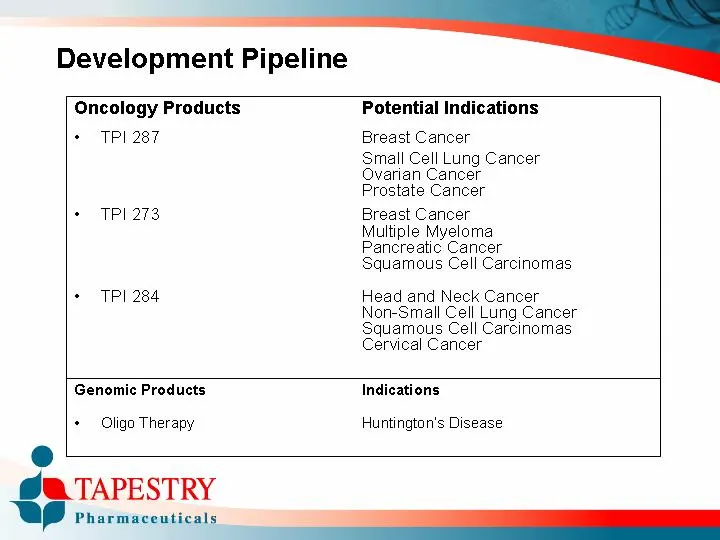
Development Pipeline Oncology Products Potential Indications + TPL 287 Breast Cancer Small Cell Lung Cancer Ovarian Cancer Prostate Cancer «TPO Breast Cancer Multiple Myeloma Pancreatic Cancer Squamous Cell Carcinomas + TP 284 Head and Neck Cancer Non-Small Cell Lung Cancer Squamous Cell Carcinomas
Slide 5: Therapeutic Development: Oncology
an Therapeutic Development: Oncology ae TAPESTRY ae Pharmaceuticals
Slide 6: Oncology Portfolio
Oncology Portfolio « Applying our oncology expertise in natural products to advance our portfolio of cancer therapeutics + Significant IP in all programs * Third Generation Taxane: TP 287 + Designed to overcome resistance caused by MDR-1 + Proprietary Quassinoid: TPI 273 + Protein synthesis inhibito
Slide 7: TPI 287: A Third Generation Taxane
en TPI 287: A Third Generation Taxane e 93 TAPESTRY ll
Slide 8: TPI 287: A Third Generation Taxane
TPI 287: A Third Generation Taxane Taxanes are highly active chemotherapeutic agents in the treatment of advanced common malignancies such as NSCLC and cancers of the breast, ovary, prostate and head and neck. However, these neoplasms ultimately become resistant to the effects of currently available
Slide 9: Rationale for TPI 287
ns Rationale for TPI 287 « Leveraged extensive paclitaxel chemistry experience * Optimized for desired attributes (e.g., MDR independence) e 93 TAPESTRY an)
Slide 10: TPI 287: A Third Generation Taxane
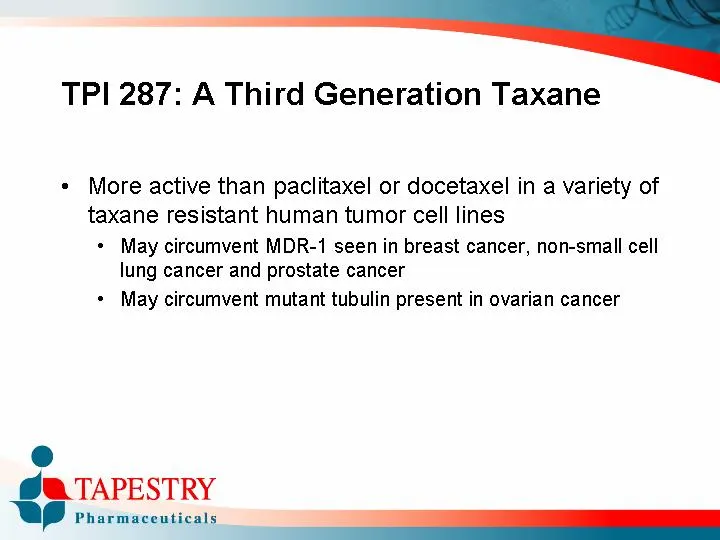
TPI 287: A Third Generation Taxane « More active than paclitaxel or docetaxel in a variety of taxane resistant human tumor cell lines + May circumvent MDR-1 seen in breast cancer, non-small cell lung cancer and prostate cancer + May circumvent mutant tubulin present in ovarian cancer e 93 TAPESTRY
Slide 11: TPI 287 In Vitro Data
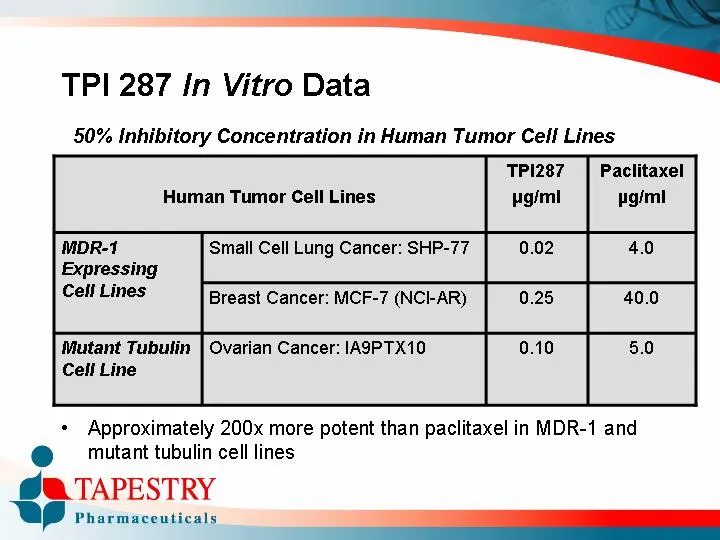
TPI 287 In Vitro Data 50% Inhibitory Concentration in Human Tumor Cell Lines TPI287 Paclitaxel Human Tumor Cell Lines Hgiml yg/ml MDR-1 Small Cell Lung Cancer: SHP-77 2 Expressing Cell Lines Breast Cancer: MCF-7 (NCI-AR) | 978 | 400 | | ey | Mutant Tubulin | Ovarian Cancer: IAQPTX10 Cell Line + Appr
Slide 12: TPI 287 Clinical Opportunities
TPI 287 Clinical Opportunities + Potential for taxane-resistant and taxane-naive patients « Breast, ovarian, non-small cell lung, and prostate cancer ® 93 TAPESTRY an)
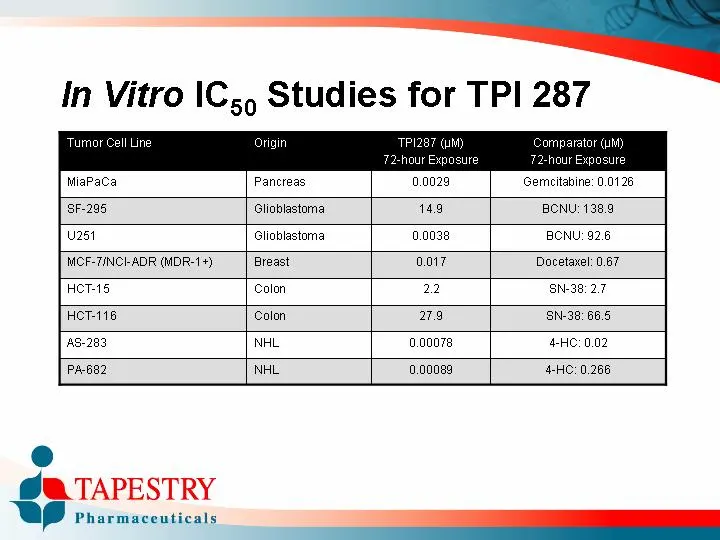
Slide 13: In Vitro IC50 Studies for TPI 287
In Vitro IC, Studies for TPI 287 Origin Comparator (uM) ur E MiaPaca Pancreas, 0.0029 Gemcitabine: 0.0126 8F-296 Glioblastoma 149 BONU: 138.9 U261 Glioblastoma 0.0038 BONU: 92.6 MCF-7INCEADR (WDR-1) Breast O07 Docetaxel: 0.67 HOT-1 Colon 22 SN-38: 2.7 HOT16 Colon aa) SN-38: 66.5 9-283, NHL 0.00078 4
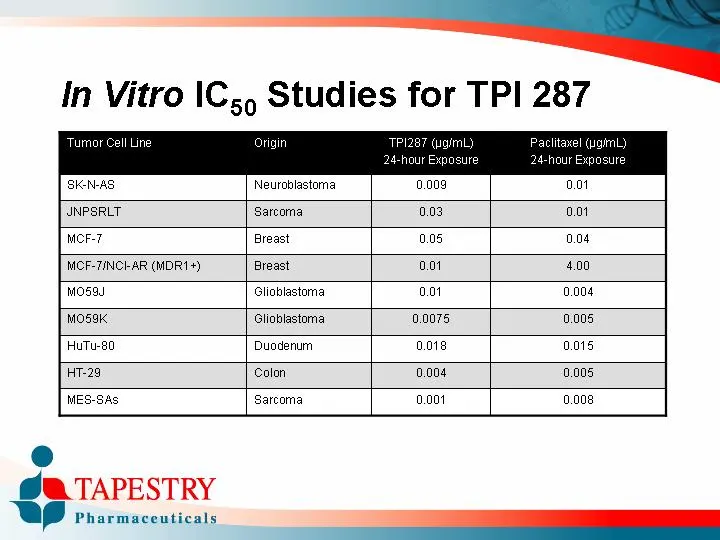
Slide 14: In Vitro IC50 Studies for TPI 287
In Vitro IC, Studies for TPI 287 Origin aclitaxel (ugimL) 4-hour E SKN-AS Neuroblastoma ot INPSRLT Sarcoma 008 ot MORT Breast 0.08 008 NGF-TINGLAR (MORI) Breast ont 700 wO5GI Glioblastoma ot 0.004 WOES Glioblastoma 0076 008 HuTW-80 Dudenum ante ats Hag Coen 04 0008 WES-8As Sarcoma 0.001 0.008 e 93 T
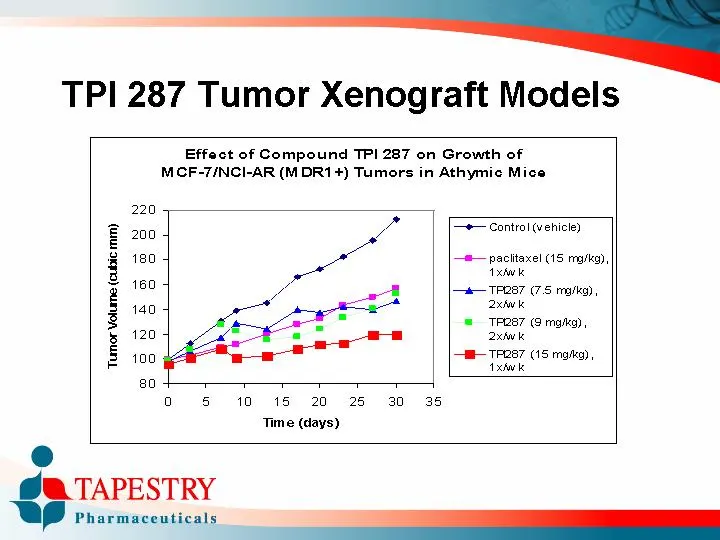
Slide 15: TPI 287 Tumor Xenograft Models
TPI 287 Tumor Xenograft Models Effect of Compound TPI 287 on Growth of MCF-7/NCI-AR (MDR1+) Tumors in Athymic Mice or < =r) € 200 F Bass pails : ne gq 160 |e — TPE (7.5 mavkg), 5 ao Pow 3 = TPO87 (@ mans), 20 Bi! : i eer Cal = fo Axdw ke an o 5 10 18 20 2 30 36 Time (days) @@ TAPESTRY TOP bharmacent
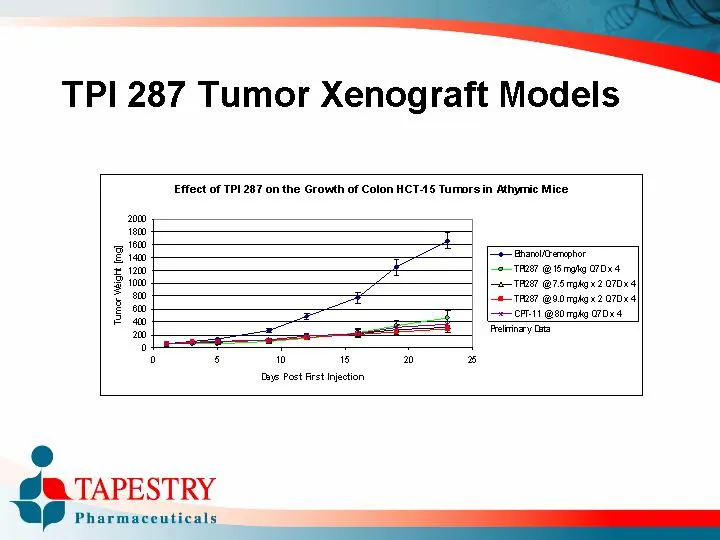
Slide 16: TPI 287 Tumor Xenograft Models
TPI 287 Tumor Xenograft Models Effect of TP! 287 on the Growth of Colon HCT-45 Tummorsin athymic Mice 2000 ‘0 10 4 3 Bian [-o Brarlerephor ¥ 20 EE —o- TRE? @ trokg O74 Pad 2 TRE? @75 akg x? O7Dx4] 0 res? @80 maka x2 a7Dx4| 2 ew = 5 a [et @e0matg cre bee ee 0 a 5 0 6 20 s (ye Post Fst jection @@ TAPE
Slide 17: TPI 287 Tumor Xenograft Models
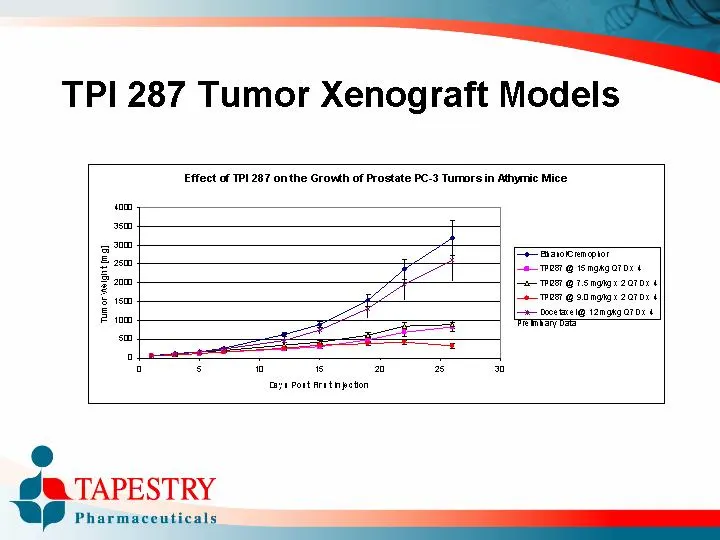
TPI 287 Tumor Xenograft Models Effect of TP! 287 onthe Growth of Prostate PC-3 Turrorsin athymic Mice e 93 TAPESTRY I
Slide 18: TPI 273: Quassinoid
ns TPI 273: Quassinoid e 9B TAPESTRY
Slide 19: Quassinoids
a, Quassinoids The quassinoids are a class of organic compounds with growth inhibitory properties discovered in the early 1970's. The quassinoids were originally isolated from the Simaroubaceae family of plants indigenous to Guyana. Subsequently, quassinoids have been found in plants indigenous to A
Slide 20: Quassinoid Mechanism of Action
a Quassinoid Mechanism of Action * Quassinoids inhibit protein synthesis in HeLa cells by 90% at a concentration of 2 uM. « Ina rabbit reticulocyte system, quassinoids inhibited protein synthesis in 79% at a concentration of 0.1 UM. * Quassinoids are believed to act at the level of the ribosome, i.e
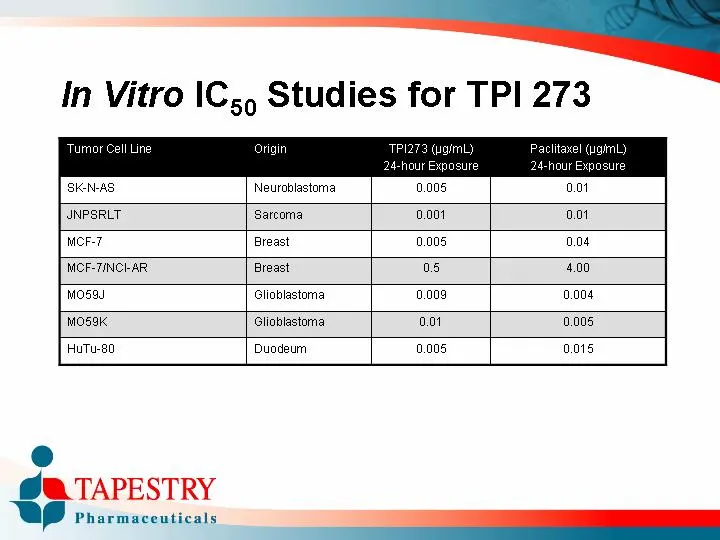
Slide 21: In Vitro IC50 Studies for TPI 273
In Vitro IC,, Studies for TPI 273 Tumor Cell Line Origin SKN-AS Neuroblastoma ot INPSRLT Sarcoma 01001 ont MORT Breast 0.008 008 MOPTINGCAR Breast 08 700 MO5GI Glioblastoma 0.008 0004 WOBGK Glioblastoma ot 008 HuTu-80 Duadeurn 0.008 ats e 93 TAPESTRY Pharmaceuticals
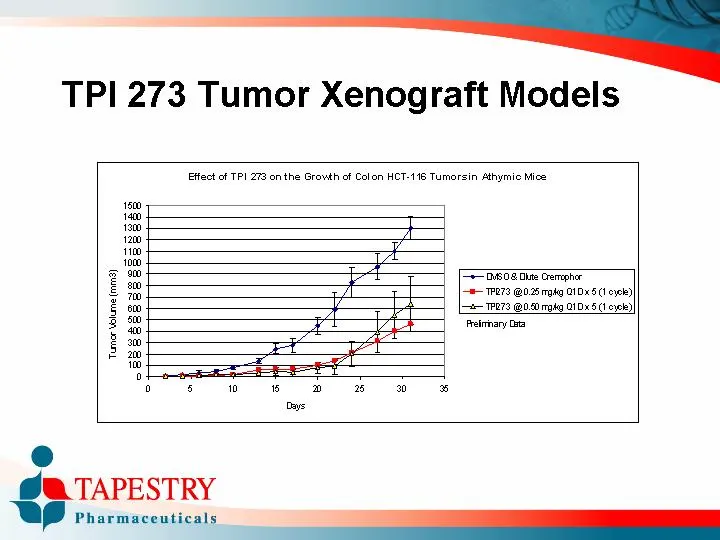
Slide 22: TPI 273 Tumor Xenograft Models
TPI 273 Tumor Xenograft Models Effect of TPI 279 on the Grovth of Colon HCT-148 Tumarsin Athymic Mice === as08 le Creepher EK 2a goat 1048 on) : [Lex e078 @0.0 maka O10*5(1 ee) “Tumor Volume (mm) Ey et aye met ae e 93 TAPESTRY Pharmaceuticals
Slide 23: TPI 284 Targeted Oncology Platform
on TPI 284 Head and Neck Tumor Targeted Oncology Platform e 93 TAPESTRY
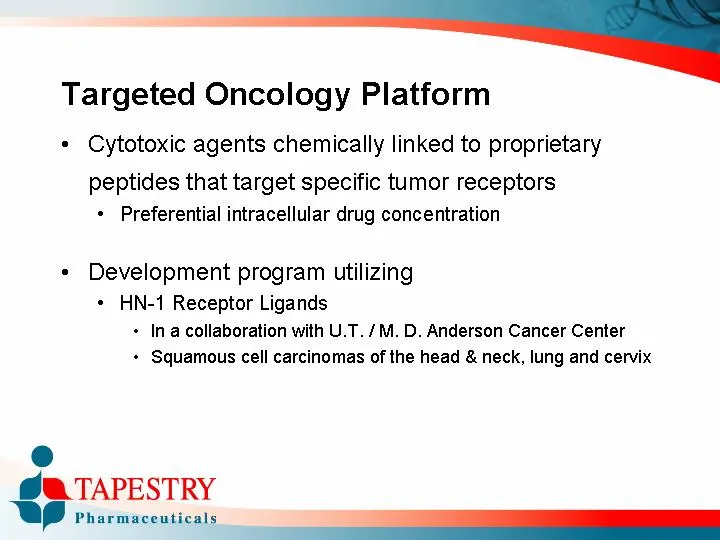
Slide 24: Targeted Oncology Platform
Targeted Oncology Platform * Cytotoxic agents chemically linked to proprietary peptides that target specific tumor receptors + Preferential intracellular drug concentration « Development program utilizing + HN-1 Receptor Ligands + Ina collaboration with U.T. /M. D. Anderson Cancer Center + Squamous
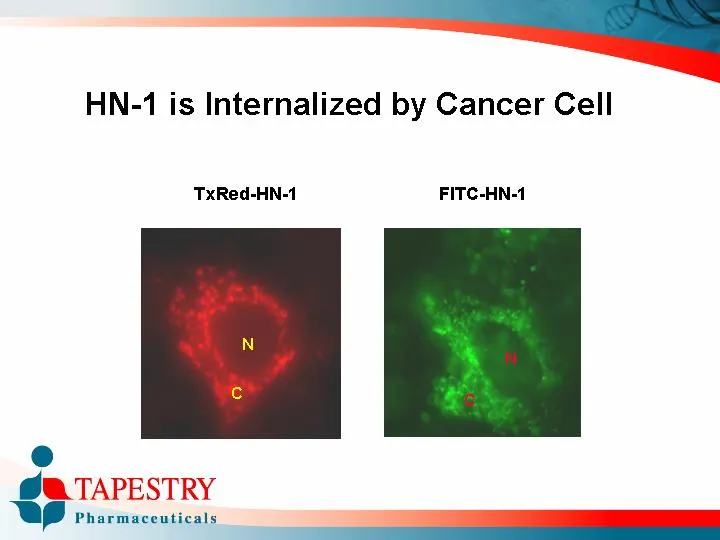
Slide 25: HN-1 is Internalized by Cancer Cell
HN-1 is Internalized by Cancer Cell TxRed-HN-1 FITC-HN-1 a Pharmaceuticals SS
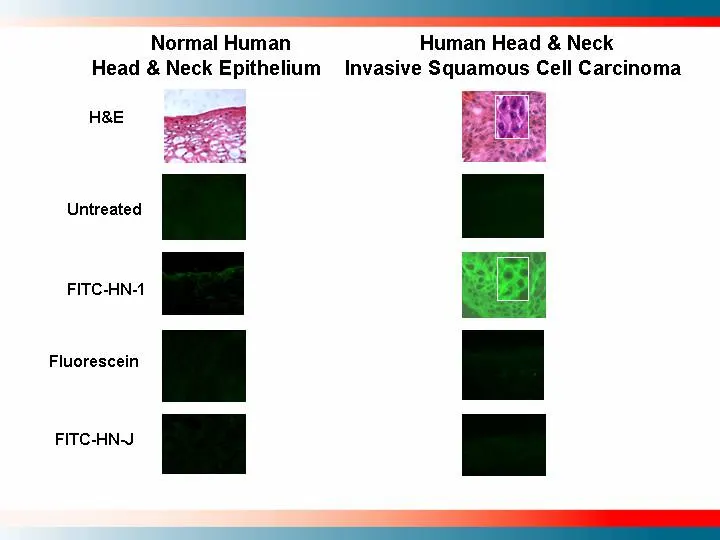
Slide 26: Normal Human Head & Neck vs Invasive Squamous Cell Carcinoma
Normal Human Human Head & Neck Head & Neck Epithelium Invasive Squamous Cell Carcinoma H&E mee ie 3 a FITC-HN-1 mad ay — ie lees FITC-HN ae re
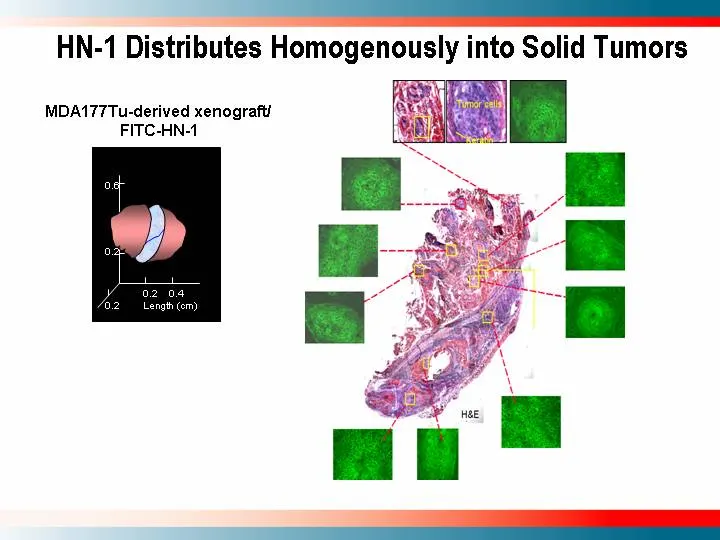
Slide 27: HN-1 Distributes Homogenously into Solid Tumors
HN-1 Distributes Homogenously into Solid Tumors MDA177Tu-derived xenograft! FITC-HN-1
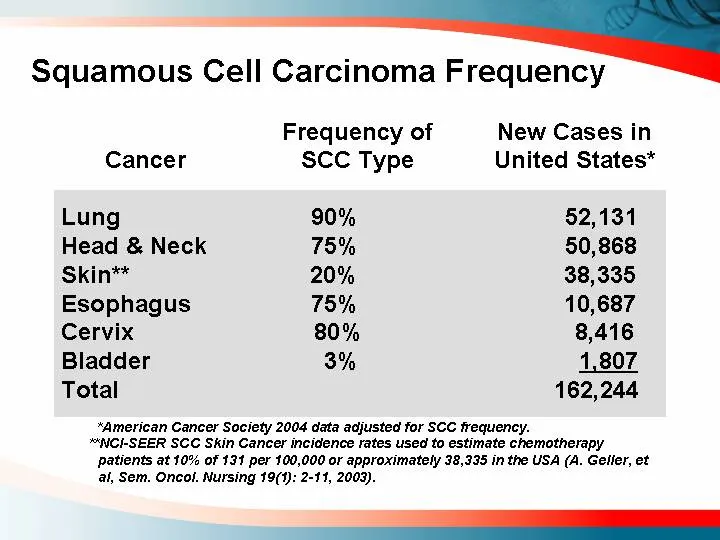
Slide 28: Squamous Cell Carcinoma Frequency
Squamous Cell Carcinoma Frequency om Frequency of New Cases in Cancer SCC Type United States* Lung 90% 52,131 Head & Neck 75% 50,868 Skin** 20% 38,335 Esophagus 75% 10,687 Cervix 80% 8,416 Bladder 3% 1,807 Total 162,244 “American Cancer Society 2004 data adjusted for SCC frequency. *NCI-SEER SCC Ski
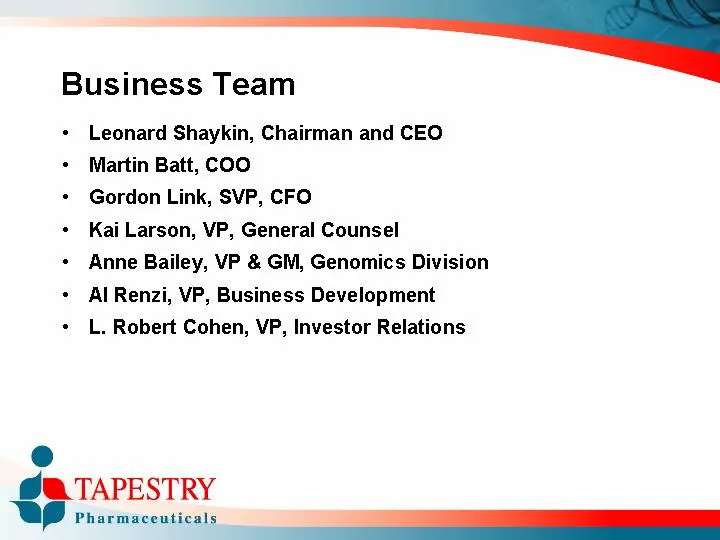
Slide 29: Business Team
Business Team + Leonard Shaykin, Chairman and CEO + Martin Batt, COO * Gordon Link, SVP, CFO + Kai Larson, VP, General Counsel + Anne Bailey, VP & GM, Genomics Division + AlRenzi, VP, Business Development L. Robert Cohen, VP, Investor Relations e 93 TAPESTRY
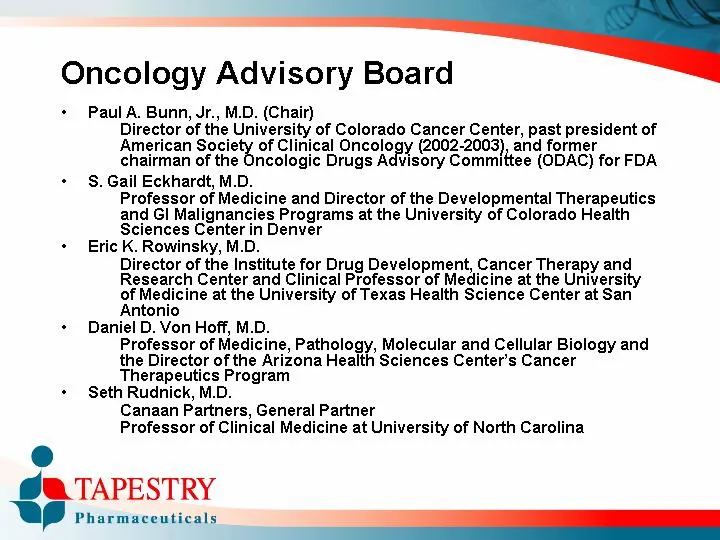
Slide 30: Oncology Advisory Board
Oncology Advisory Board + Paul A. Bunn, Jr., M.D. (Chair) Director of the University of Colorado Cancer Center, past president of American Society of Clinical Oncology (2002-2003), and former chairman of the Oncologic Drugs Advisory Committee (ODAC) for FDA S. Gail Eckhardt, M.D. Professor of Medici
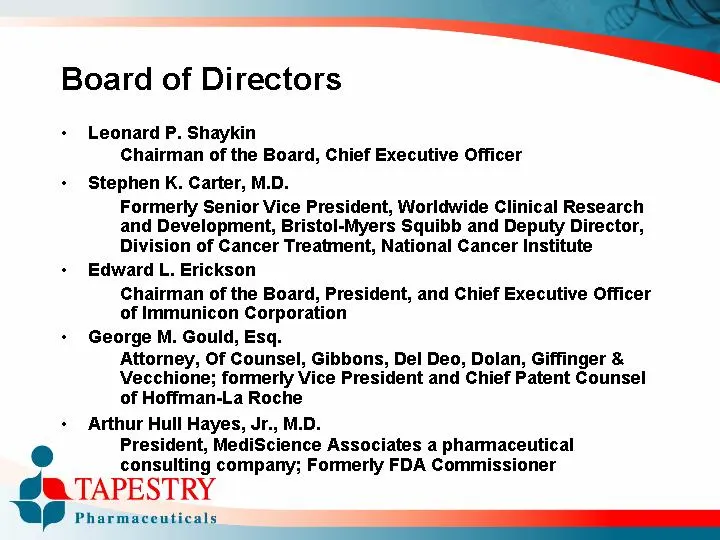
Slide 31: Board of Directors
Board of Directors Leonard P. Shaykin Chairman of the Board, Chief Executive Officer Stephen K. Carter, M.D. Formerly Senior Vice President, Worldwide Clinical Research and Development, Bristol-Myers Squibb and Deputy Director, Di ion of Cancer Treatment, National Cancer Institute Edward L. Erickson
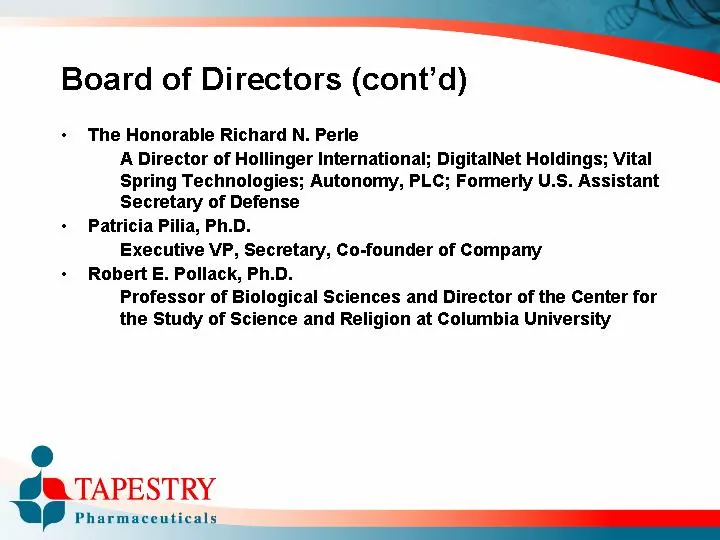
Slide 32: Board of Directors (cont'd)
Board of Directors (cont’d) + The Honorable Richard N. Perle A Director of Hollinger International; DigitalNet Holdings; Vital Spring Technologies; Autonomy, PLC; Formerly U.S. Assistant Secretary of Defense + Patricia Pilia, Ph.D. Executive VP, Secretary, Co-founder of Company + Robert E. Pollack,
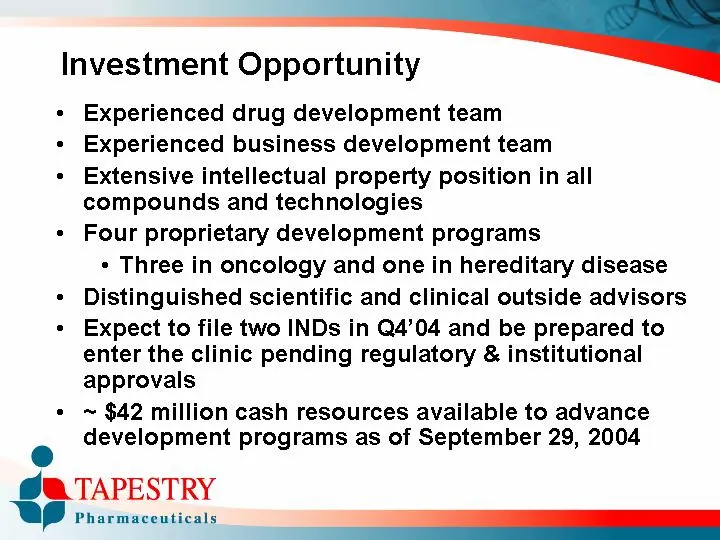
Slide 33: Investment Opportunity
Investment Opportunity a + Experienced drug development team + Experienced business development team + Extensive intellectual property position in all compounds and technologies « Four proprietary development programs * Three in oncology and one in hereditary disease * Distinguished scientific and c
Slide 34: Searchable text section of graphics shown above
Searchable text section of graphics shown above Rod man & Renshaw Techvest Conference Investor Presentation – Oncology Focus October 27, 2004 [LOGO] For ward-Looking Statements Statements in this presentation regarding Tapestry Pharmaceuticals, Inc.’s business that are not historical facts are “forw
Source: SEC EDGAR · 8-K filed Oct 26, 2004
More decks from Tapestry Pharmaceuticals Inc
 Investor Presentation (November 2007)27 slides · Nov 6, 2007
 Investor Presentation (August 2007)36 slides · Aug 21, 2007
 Corporate Update (July 2007)5 slides · Jul 17, 2007
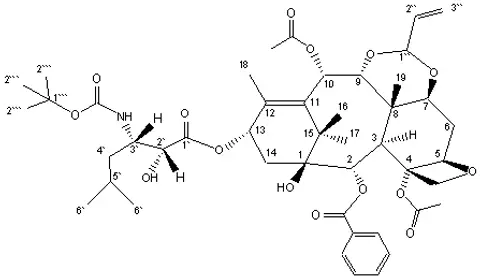 Technical Presentation (June 2007)6 slides · Jun 13, 2007
 Needham & Company Biotechnology and Medical Technology Conference 200733 slides · Jun 13, 2007
 IPO Roadshow (May 2007)30 slides · May 14, 2007