Tapestry Pharmaceuticals — Investor Presentation (May 2006)
40 slides from Tapestry Pharmaceuticals's investor presentation, May 16, 2006
Slide 1: Forward-Looking Statements
Forward-Looking Statements Statements in this presentation that are not historical facts are “forward-looking statements" that involve risks and uncertainties. Forward-looking statements can be identified by the use of words such as ""may,""will" 9F comparable terminology or by discussions of future
Slide 2: Investment Proposition
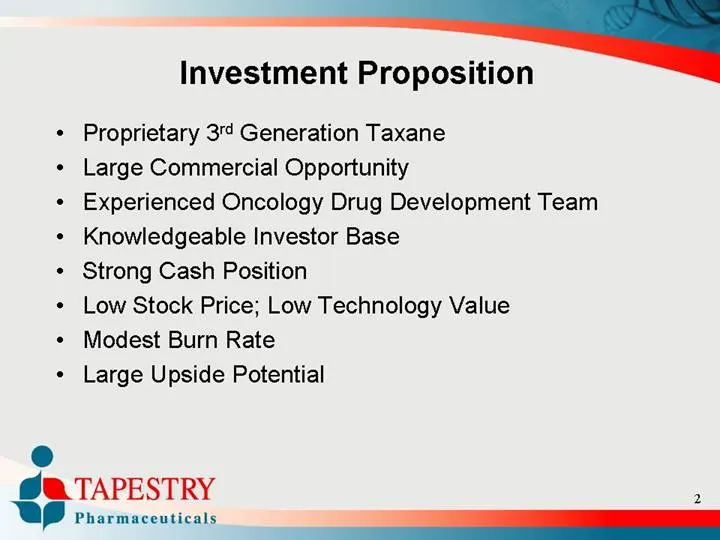
Investment Proposition a + Proprietary 3" Generation Taxane + Large Commercial Opportunity + Experienced Oncology Drug Development Team + Knowledgeable Investor Base + Strong Cash Position + Low Stock Price; Low Technology Value « Modest Burn Rate + Large Upside Potential e 9B TAPESTRY 3
Slide 3: Experienced Management Team
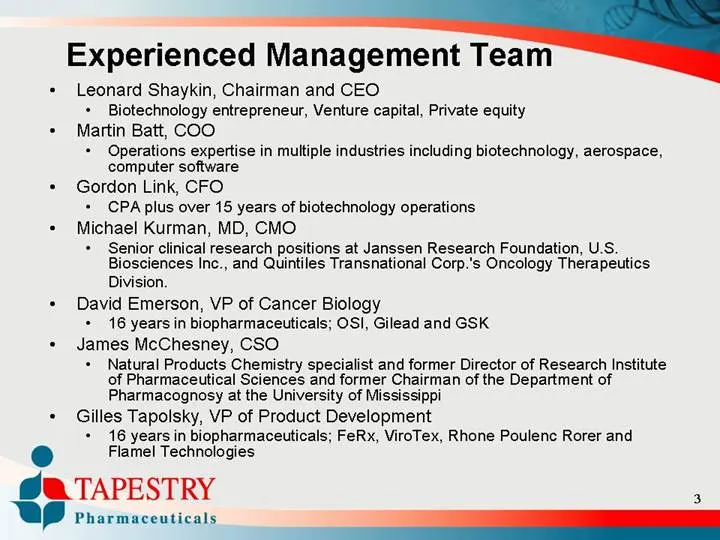
Experienced Management Team + Leonard Shaykin, Chairman and CEO + Biotechnology entrepreneur, Venture capital, Private equity * Martin Batt, COO + Operations expertise in multiple industries including biotechnology, aerospace, computer software * Gordon Link, CFO + CPA plus over 15 years of biotechn
Slide 4: New Investor Base
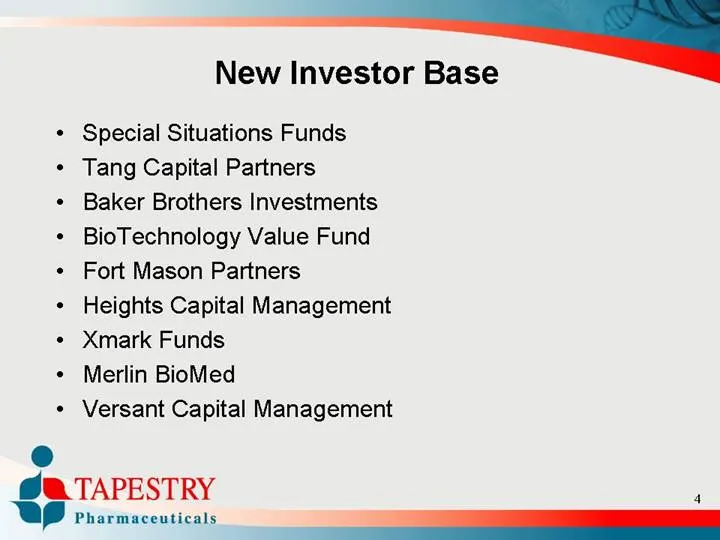
New Investor Base a * Special Situations Funds * Tang Capital Partners * Baker Brothers Investments + BioTechnology Value Fund + Fort Mason Partners + Heights Capital Management + Xmark Funds + Merlin BioMed + Versant Capital Management e 9B TAPESTRY 4
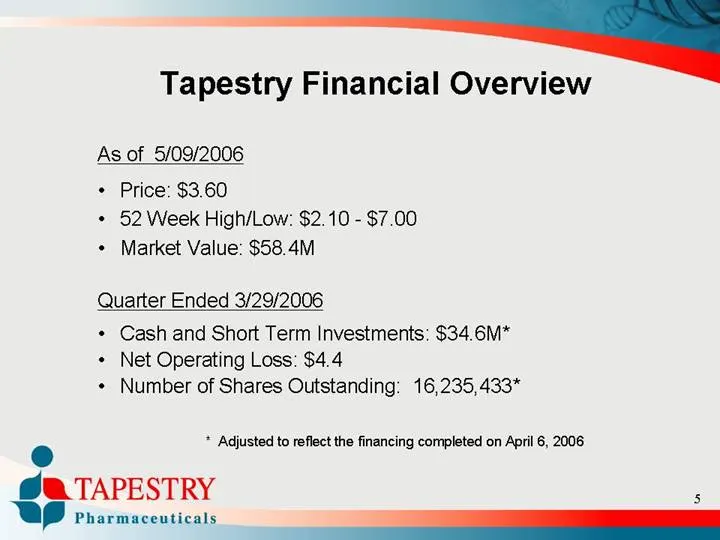
Slide 5: Tapestry Financial Overview
Tapestry Financial Overview As of 5/09/2006 + Price: $3.60 + 52 Week High/Low: $2.10 - $7.00 + Market Value: $58.4M Quarter Ended 3/29/2006 + Cash and Short Term Investments: $34.6M* + Net Operating Loss: $4.4 + Number of Shares Outstanding: 16,235, 433* e * Adjusted to reflect the financing complet
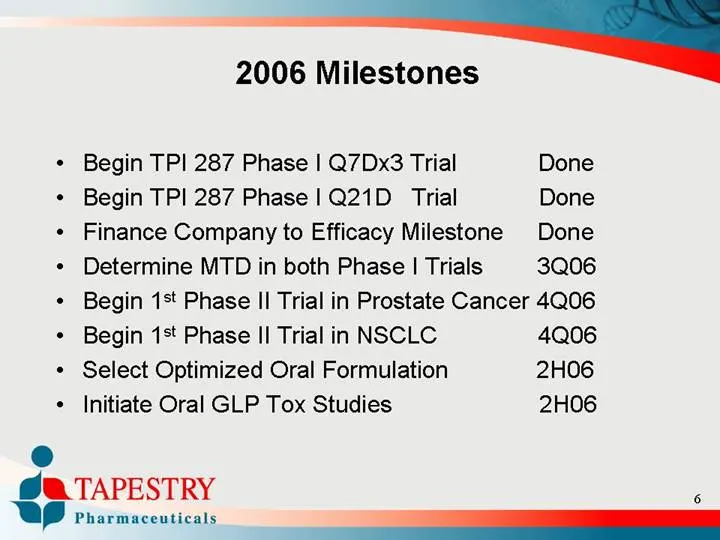
Slide 6: 2006 Milestones
2006 Milestones a + Begin TPI 287 Phase | Q7Dx3 Trial Done + Begin TPI 287 Phase | Q21D_ Trial Done + Finance Company to Efficacy Milestone Done + Determine MTD in both Phase | Trials 3Q06 + Begin 1* Phase II Trial in Prostate Cancer 4Q06 + Begin 1% Phase II Trial in NSCLC 4Q06 + Select Optimized Or
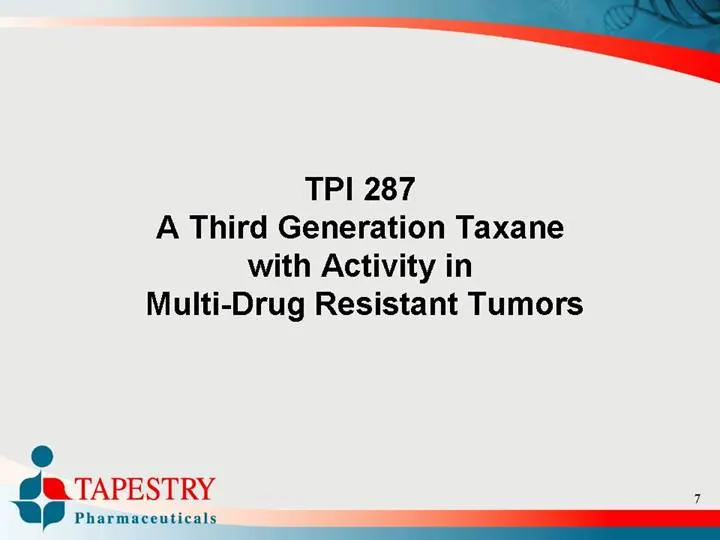
Slide 7: TPI 287: A Third Generation Taxane with Activity in Multi-Drug Resistant Tumors
as TPI 287 A Third Generation Taxane with Activity in Multi-Drug Resistant Tumors e 9B TAPESTRY 4 w
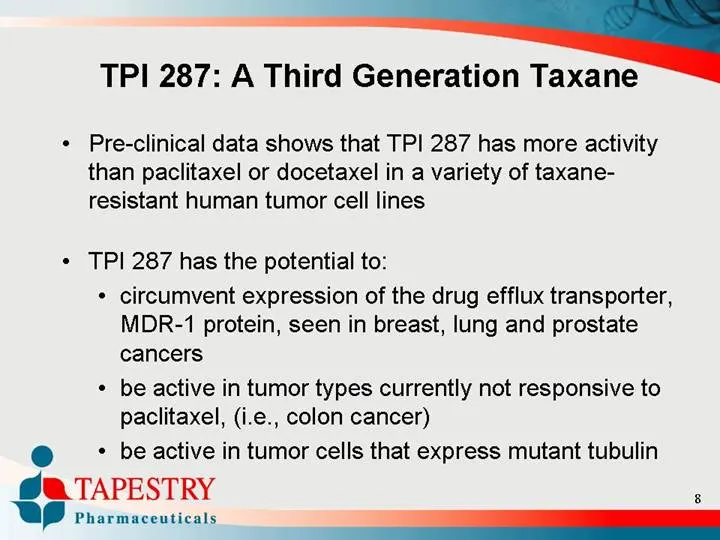
Slide 8: TPI 287: A Third Generation Taxane
i TPI 287: A Third Generation Taxane "a * Pre-clinical data shows that TPI 287 has more activity than paclitaxel or docetaxel in a variety of taxane- resistant human tumor cell lines + TPI 287 has the potential to: * circumvent expression of the drug efflux transporter, MDR-1 protein, seen in breast
Slide 9: TPI 287 Pre-clinical Biology Studies
TPI 287 Pre-clinical Biology Studies © @@ TAPESTRY
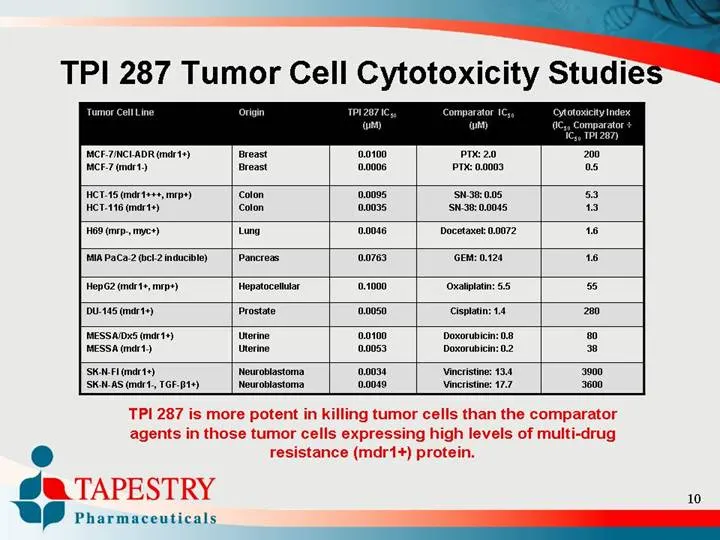
Slide 10: TPI 287 Tumor Cell Cytotoxicity Studies
TPI 287 Tumor Cell Cytotoxicity Studie T1287) NCF-7INCLADR (mart) Breast CET omar) Breast HETA6 Gnarts+s emp) Colon ‘006 'SN38: 005) 53 HCT-116 (mart) Colon ‘0.0035 ‘SN.38: 0.0045 3 He9 (mr ye) tong ‘0.0086 Docetaxot 0.0072 16 MAPaca2(bei2inducwie) | Pancreas ‘0763 ‘GEM O28 16 Hep62 (mdr, mp) epatoc
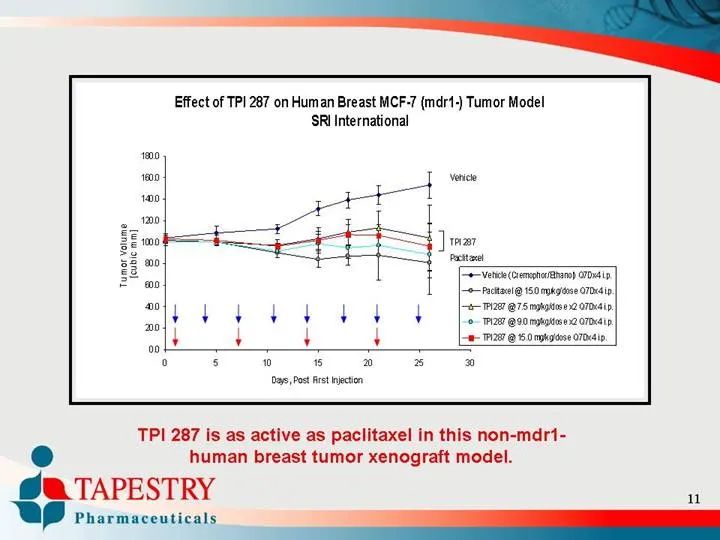
Slide 11: Effect of TPI 287 on Human Breast MCF-7 (mdr1-) Tumor Model
Effect of TP! 287 on Human Breast MCF-7 (mdr1-) Tumor Model ‘SRI International ae in i 1 mo 52 ao Ee Fv emai OA o | -o— Pacitacel @ 150 mpkgiénse O7Dxs ip. a4 be PS aa FP eee | i i i Peereicmeon oe 5 0 5 » B » re TPI 287 is as active as paclitaxel in this non-mdr1- @ human breast tumor xenograft mod
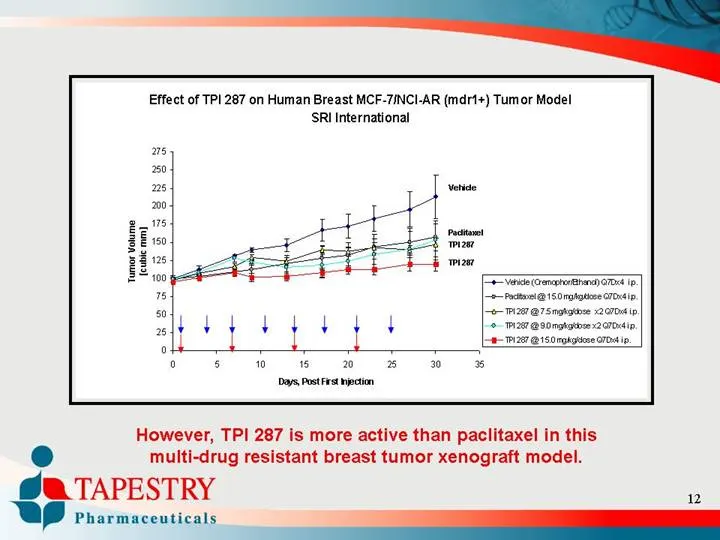
Slide 12: Effect of TPI 287 on Human Breast MCF-7/NCI-AR (mdr1+) Tumor Model
Effect of TPl 287 on Human Breast MCF-7INCI-AR (mdrt+) Tumor Model SRI International [Weise Gararersianap aro Te |e recssl@ 150 nptgtoe Gros. -¢- P27 @S0nghatbee:2 TOI, a TH257 @ 15D Maks" OTD |-e— Wize @75 none 22 ort i, However, TP! 287 is more active than paclitaxel in this @ multi-drug resistant
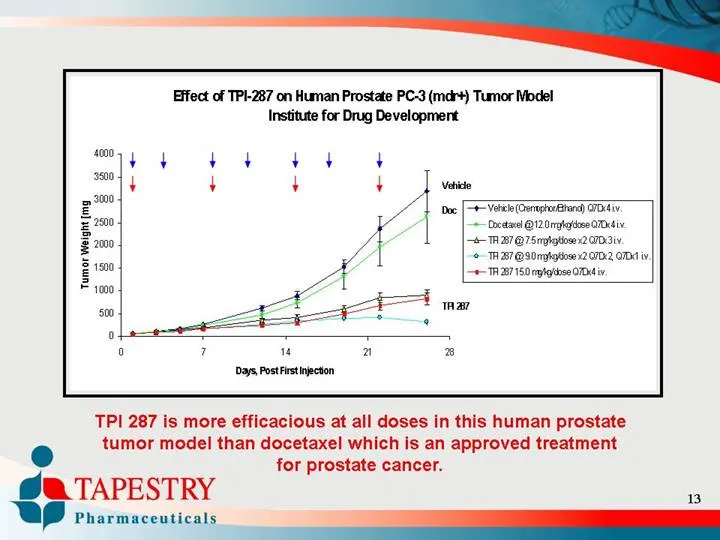
Slide 13: Effect of TPI-287 on Human Prostate PC-3 (mdr+) Tumor Model
Effect of TPI-287 on Human Prostate PC-3 (mdr+) Tumor Model Institute for Drug Development = Dredd O12 Orgad Det 2 TAT @7Snaigtow 2 TDi. -¢- TB @8Omggtiow x2 702 CPD iv TBI Spigibse Det ‘bays Position TPI 287 is more efficacious at all doses in this human prostate e tumor model than docetaxel which
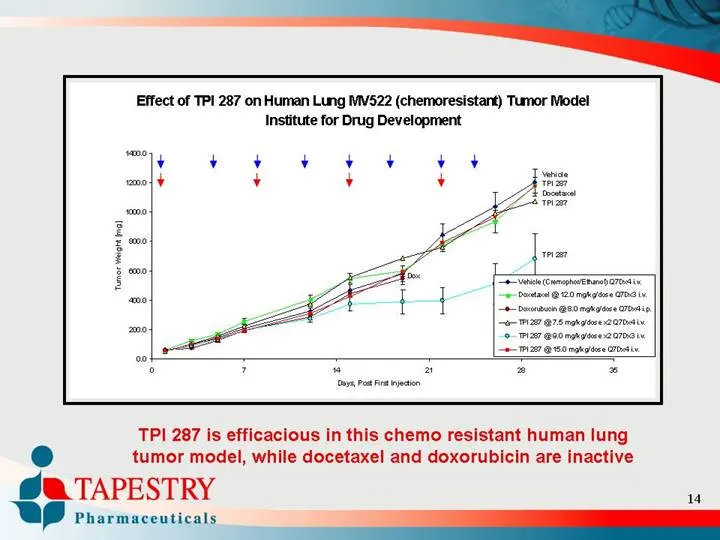
Slide 14: Effect of TPI 287 on Human Lung LX-1 Tumor Model
Tenor ight fol Effect of TPI 287 on Human Lung IMV522 (chemoresistant) Tumor Model Institute for Drug Development Y Y i = “+ ies amet ora cp Souda 20mg ee A —o eaten Gel npepsea rong e113? 7s makysaes2O7Da« © Pir @oOmpgtne zaTO IK e137 g onptolsee Die ‘ay Ps Fit on lm TAPESTRY ws TPI 287 is efficaci
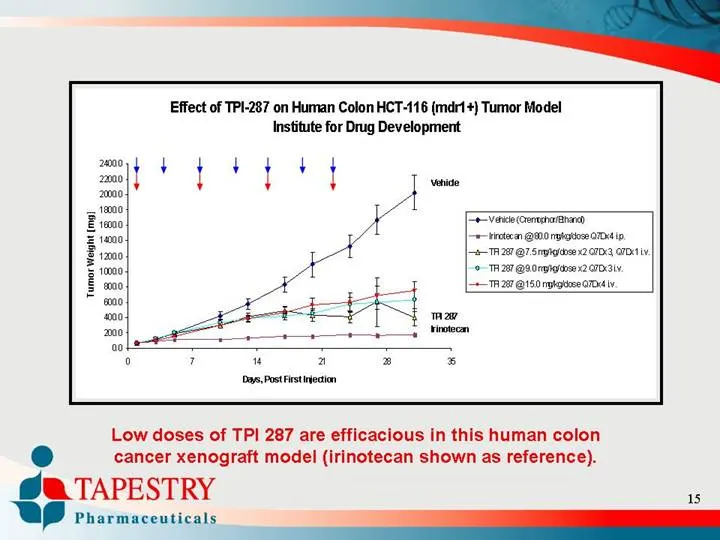
Slide 15: Effect of TPI-287 on Human Colon HCT-116 Tumor Model
Effect of TPI-287 on Human Colon HCT-416 (mari #) Tumor Model Insfitute for Drug Development ated tt 4 aan: Wehide 20. = 100 F seono Vi eae 1400. —a Hotaran 800 rgtagose FOX kp, Samo. Tra @ Smprgnex2 FDA aTOAtW, § soo. °-TRaW @R0rwigwe 2 ON Emo Tze @s0rpia oA. © eno. a0. ed mo eres 00. — Q 7 a a 2 F
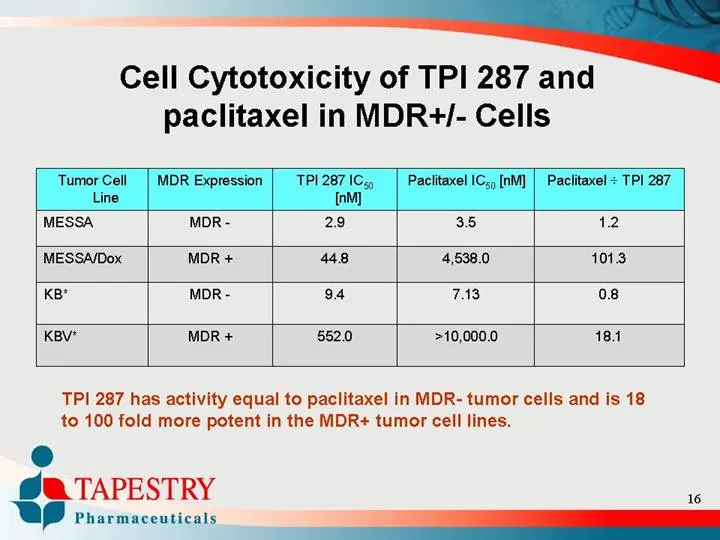
Slide 16: Cell Cytotoxicity of TPI 287 and Paclitaxel in MDR+/- Cells
Cell Cytotoxicity of TP!I 287 and a paclitaxel in MDR+/- Cells KBr MDR - 94 7.43 08 KBV" MDR + 5520 >10,000.0 184 TPI 287 has activity equal to paclitaxel in MDR- tumor cells and is 18 to 100 fold more potent in the MDR+ tumor ceil lines. e 9B TAPESTRY e
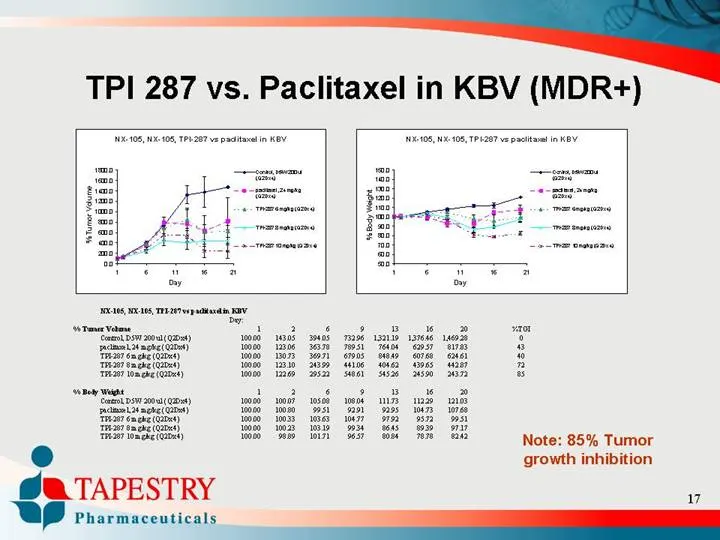
Slide 17: TPI 287 vs. Paclitaxel in KBV (MDR+)
el TPI 287 vs. Paclitaxel in KBV (MDR+) Note: 85% Tumor growth inhibition @@ TAPESTRY . TOD Pharmaceuticals
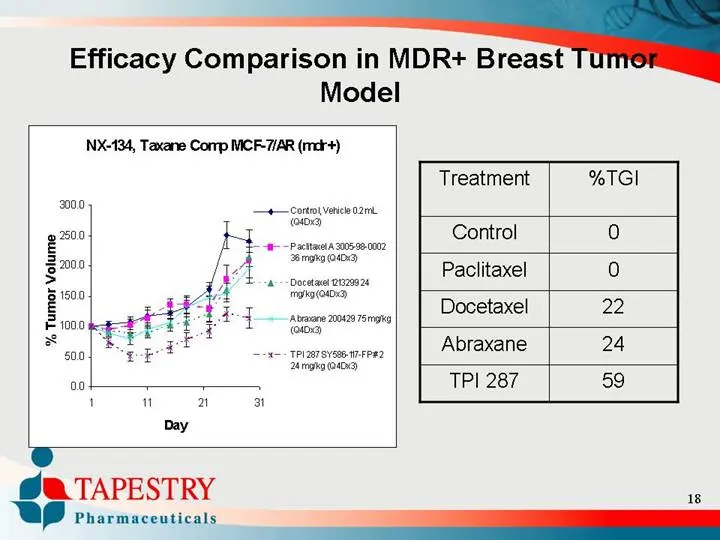
Slide 18: Efficacy Comparison in MDR+ Breast Model
Efficacy Comparison in MDR+ Breast Model NX-134, Taxane Corp MCF-7/AR (mart) Treatment %TGI ae —+— Corto Veticle 02m _ Control (0) me Paclitaxel 0 mmr Docetaxel 22 rts 000875 99 ome eiersvsse w-rP82 Abraxane 24 Bria to TPI 287 59 9B TAPESTRY .
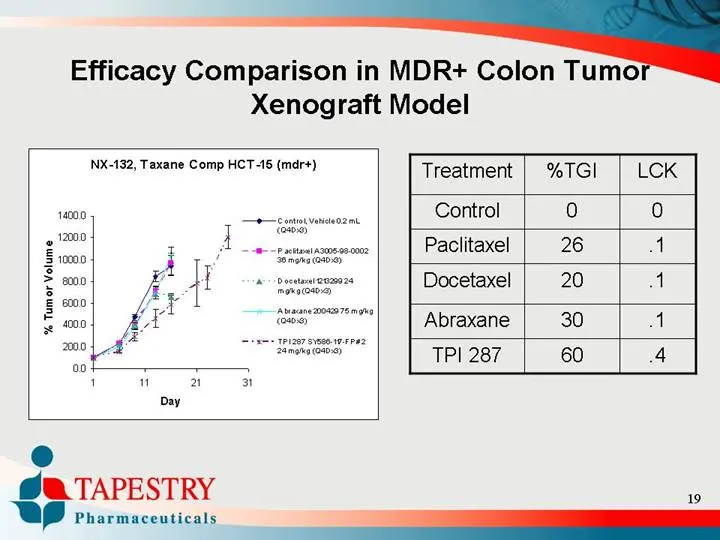
Slide 19: Efficacy Comparison in MDR+ Colon Tumor Xenograft Model
Efficacy Comparison in MDR+ Colon Tumo! Xenograft Model NX-132, Taxane Comp HCT-46 (mdr+) Treatment | %TGI Lok Control ie) ie) nee _s-tmarcenon | | Paclitaxel | 26 4 3 m0 ‘Somong ano) $ coo Docetaxel 20 4 E cao 00 Abraxane 30 “al “a sees" | Tei 287 | 60 4 {a8 by e 9B TAPESTRY 2 Pharmaceuticals
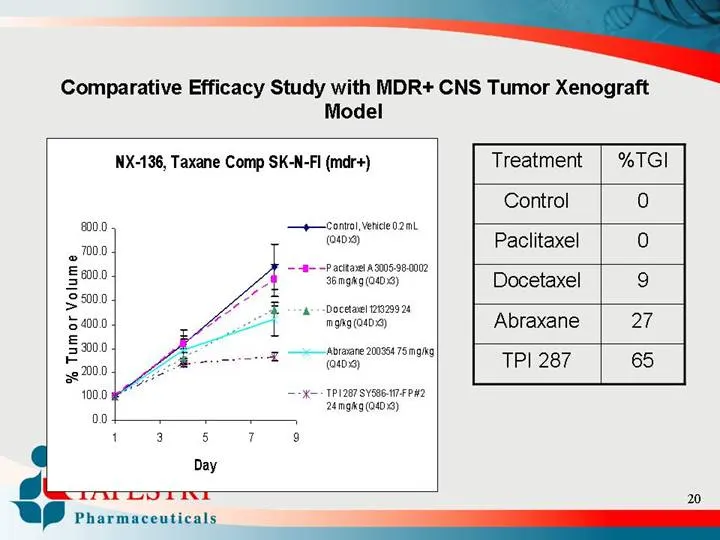
Slide 20: Comparative Efficacy Study with MDR+ CNS Tumor Xenograft Model
Comparative Efficacy Study with MDR+ CNS Tumor Xenograft Model NX-136, Taxane Comp SK-N-FI (mdr+) 00 contol ence zat (0102) 7000 z 4+ ~Pactaesansse0nm 500 ‘36mgkg (040) © 500.0 = ae Doce 02992 54000 mmgig(240x) = 2 300.0 -Abravane 200354 75 mg/kg (04033) e700 000 xo Tener syeee mer H renga O10) oo 1
Slide 21: Comparative MT Polymerization ED50s
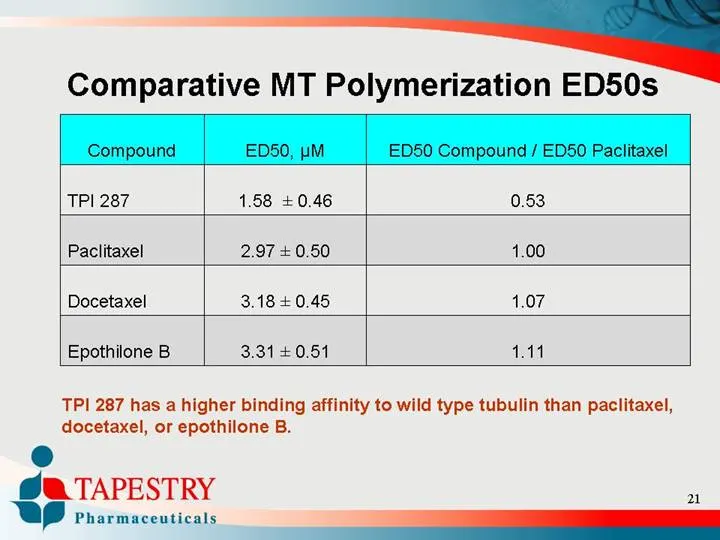
Comparative MT Polymerization ED50s TPI 287 1.58 +0.46 0.53 Paclitaxel 2.97 + 0.50 1.00 Docetaxel 3.18 £0.45 1.07 Epothilone B 3.31 40.51 1.11 TPI 287 has a higher binding affinity to wild type tubulin than paclitaxel, docetaxel, or epothilone B. TAPESTRY 2
Slide 22: TPI 287 Oral Efficacy in Mice
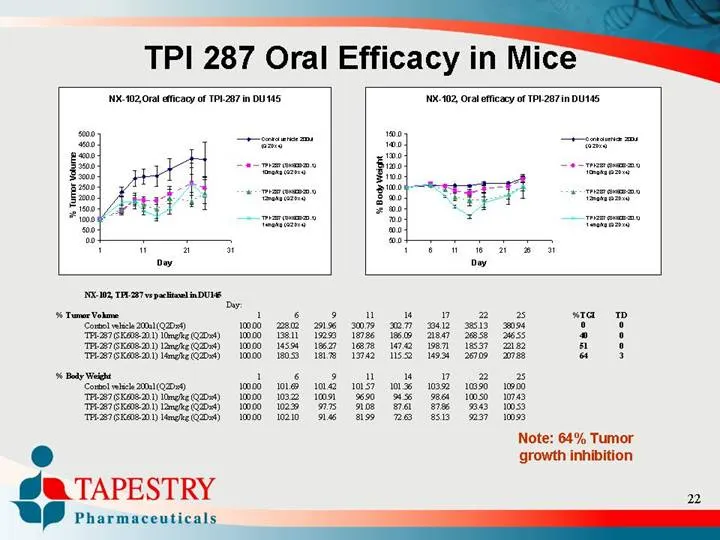
TPI 287 Oral Efficacy in Mice 1012 nyo 127m DUNS Y0C2, racy of 11.267 n DUNKS real ——. ony sm aT Coca mccoe9 wm met wis me mm mit xb som ae GieeaeaN ince) Im Bn ine ine im men Seis sh oo: TavressyimacGes im ix inn iam ia sen ies ie aot Taictaabiccees) imo is ime Ima tee tom lm an aS spa yae : 2 Yo!
Slide 23: TPI 287 Rat Oral Bioavailability
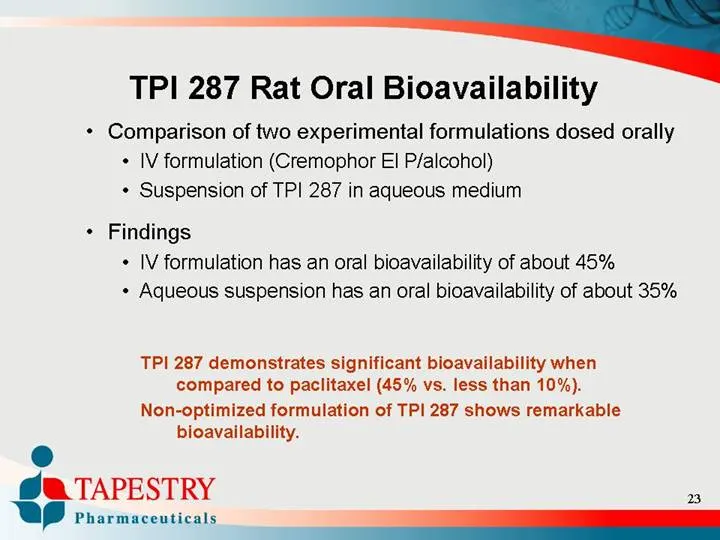
TPI 287 Rat Oral Bioavailability + Comparison of two experimental formulations dosed orally + IV formulation (Cremophor El P/alcohol) + Suspension of TP! 287 in aqueous medium + Findings + IV formulation has an oral bioavailability of about 45% + Aqueous suspension has an oral bioavailability of abo
Slide 24: TPI 287 Single Dose Toxicology Studies
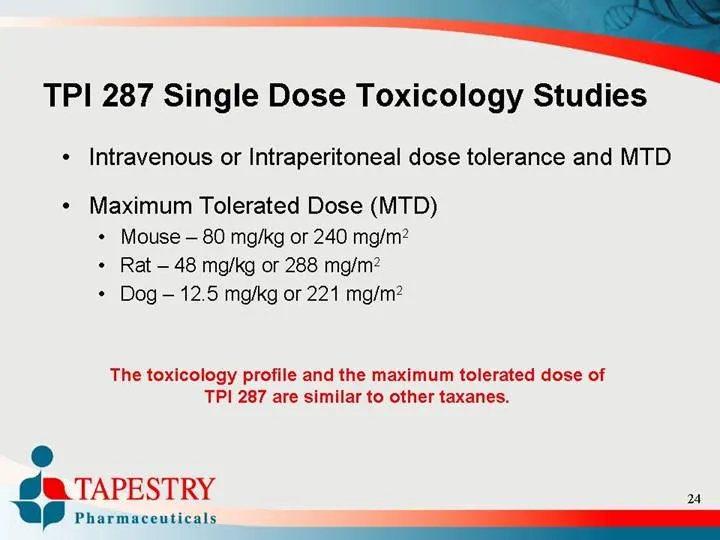
TPI 287 Single Dose Toxicology Studies « Intravenous or Intraperitoneal dose tolerance and MTD « Maximum Tolerated Dose (MTD) + Mouse — 80 mg/kg or 240 mg/m? + Rat — 48 mg/kg or 288 mg/m? + Dog - 12.5 mg/kg or 221 mg/m? The toxicology profile and the maximum tolerated dose of TPI 287 are similar to
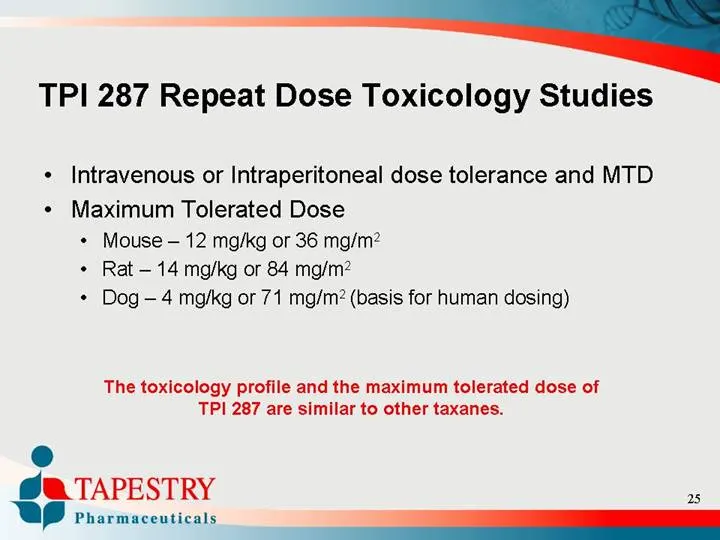
Slide 25: TPI 287 Repeat Dose Toxicology Studies
TPI 287 Repeat Dose Toxicology Studies « Intravenous or Intraperitoneal dose tolerance and MTD + Maximum Tolerated Dose + Mouse — 12 mg/kg or 36 mg/m? + Rat — 14 mg/kg or 84 mg/m? + Dog —4 mg/kg or 71 mg/m? (basis for human dosing) The toxicology profile and the maximum tolerated dose of TPI 287 are
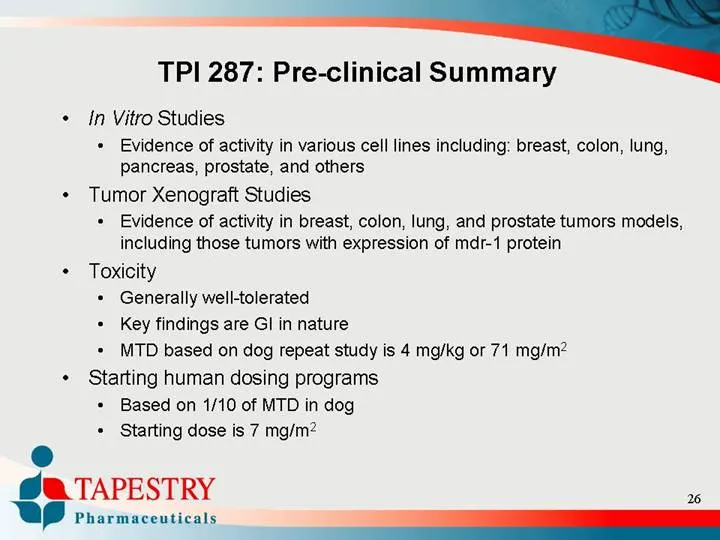
Slide 26: TPI 287: Pre-clinical Summary
TPI 287: Pre-clinical Summary In Vitro Studies + Evidence of activity in various cell lines including: breast, colon, lung, pancreas, prostate, and others Tumor Xenograft Studies + Evidence of activity in breast, colon, lung, and prostate tumors models, including those tumors with expression of mdr-
Slide 27: TPI 287: Q7D (7-day dosing) Phase I Study
TPI 287: Q7D (7-day dosing) Phase | Study e 9B TAPESTRY * a
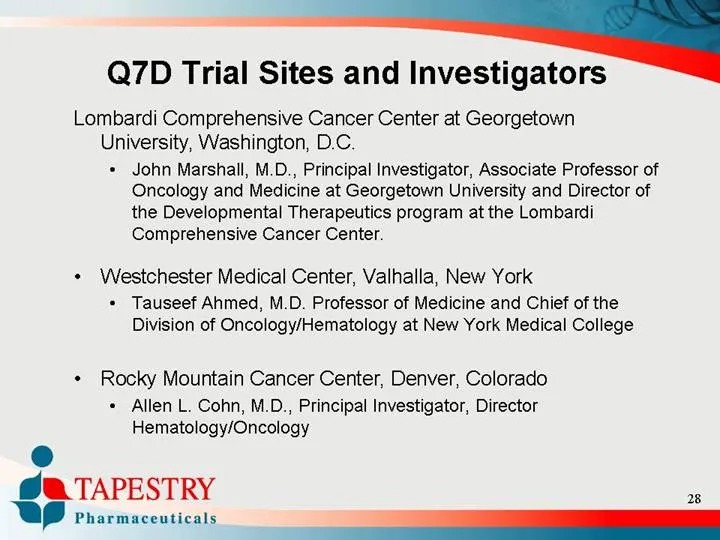
Slide 28: Q7D Trial Sites and Investigators
Q7D Trial Sites and Investigators Lombardi Comprehensive Cancer Center at Georgetown University, Washington, D.C. + John Marshall, M.D., Principal Investigator, Associate Professor of Oncology and Medicine at Georgetown University and Director of the Developmental Therapeutics program at the Lombard
Slide 29: Q7D Phase I Trial Objectives
a Q7D Phase | Trial Objectives Primary Objective: * To determine the maximum tolerated dose of TP| 287 Secondary Objectives: * To determine the safety of TP] 287 * To determine the antitumor activity of TPI 287 * To determine the pharmacokinetic profile of TPI 287 * To determine the pharmacodynamic
Slide 30: Q7D Phase I Trial Design
Q7D Phase | Trial Design - 1 ag Open-Label Multicenter Sequential groups Dose-escalation until MTD Anticipated number of patients: up to 48 e 9B TAPESTRY
Slide 31: Q7D Phase I Trial Timelines
Q7D Phase | Trial Timelines a + IND Submission Completed : December 2004 * First patient in Q7D Protocol: May 2005 + Expected Q7D Phase | trial MTD: 3Q06 e 9B TAPESTRY A
Slide 32: TPI 287: Q21D (21-day dosing) Phase I Study
TPI 287: Q21D (21-day dosing) Phase | Study e 9B TAPESTRY S
Slide 33: Q21D Trial Sites and Investigators
Q21D Trial Sites and Investigators * Rocky Mountain Cancer Center, Denver, Colorado + Allen L. Cohn, M.D., Principal Investigator, Director Hematology/Oncology * Sheba Medical Center, Tel Hashomer, Israel + Jacob Baram, M.D., Principal Investigator, Acting Director Inpatient Department ¢ Arizona Cli
Slide 34: Q21D Phase I Trial Timelines
Q21D Phase | Trial Timelines a * Q21D Protocol Submission Completed : July 2005 ¢ First patient in: January 2006 + Expected Q21D Phase | trial MTD: 3-4Q06 e 9B TAPESTRY a
Slide 35: TPI 287 Oral Program
os TPI 287 Oral Program e 9B TAPESTRY a
Slide 36: Oral Program for TPI 287
I Oral Program for TPI 287 a + Results of oral efficacy studies in mouse xenografts and oral bioavailability studies in rats were presented at the AACR/NCI/EORTC International Conference on Molecular Targets and Cancer Therapeutics in Philadelphia in November 2005 * These studies were performed usin
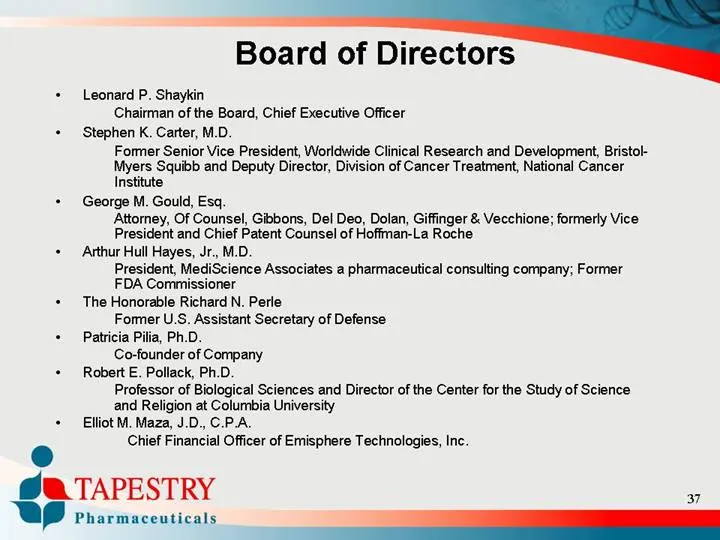
Slide 37: Board of Directors
Board of Directors Leonard P. Shaykin Chairman of the Board, Chief Executive Officer ‘Stephen K. Carter, M.D. Former Senior Vice President, Worldwide Clinical Research and Development, Bristol- Myers Squibb and Deputy Director, Division of Cancer Treatment, National Cancer Institute George M. Gould,
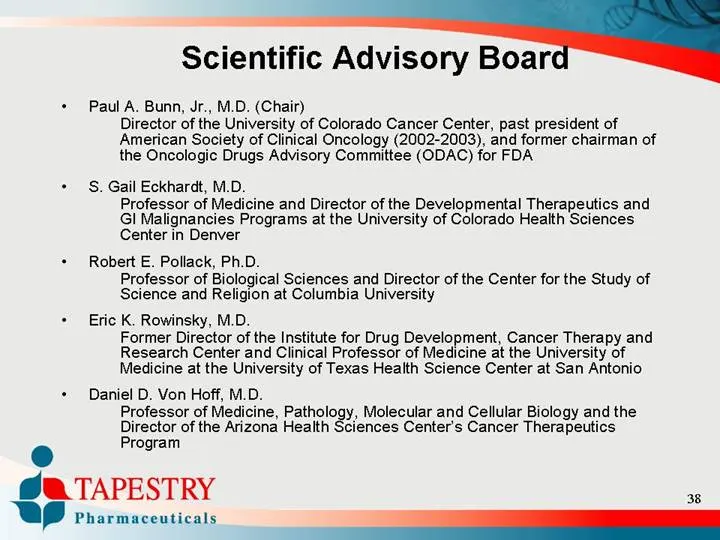
Slide 38: Scientific Advisory Board
Scientific Advisory Boar + Paul A. Bunn, Jr., M.D. (Chair) Director of the University of Colorado Cancer Center, past president of American Society of Clinical Oncology (2002-2003), and former chairman of the Oncologic Drugs Advisory Committee (ODAC) for FDA +S. Gail Eckhardt, M.D. Professor of Medi
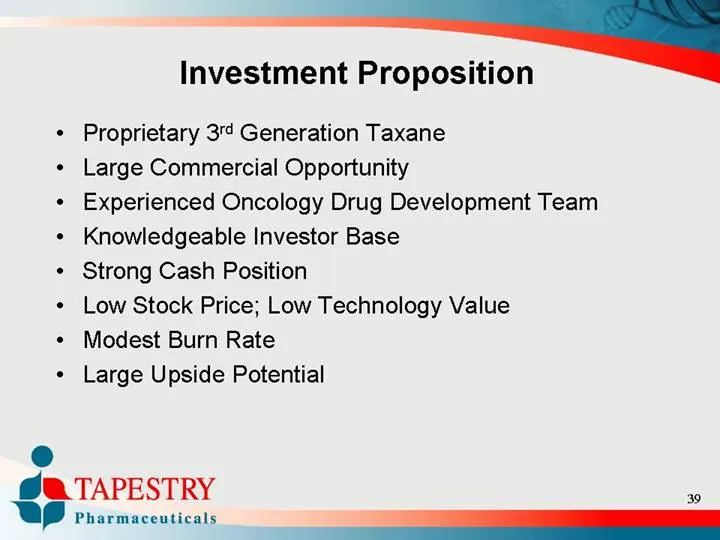
Slide 39: Investment Proposition
Investment Proposition a + Proprietary 3" Generation Taxane + Large Commercial Opportunity + Experienced Oncology Drug Development Team + Knowledgeable Investor Base + Strong Cash Position + Low Stock Price; Low Technology Value « Modest Burn Rate + Large Upside Potential e 9B TAPESTRY ae
Slide 40: Searchable text section of graphics shown above
Searchable text section of graphics shown above Forward-Looking Statements Statements in this presentation that are not historical facts are “forward-looking statements” that involve risks and uncertainties. Forward-looking statements can be identified by the use of words such as “may,” “will,” “sho
Source: SEC EDGAR · 8-K filed May 16, 2006
More decks from Tapestry Pharmaceuticals Inc
 Investor Presentation (November 2007)27 slides · Nov 6, 2007
 Investor Presentation (August 2007)36 slides · Aug 21, 2007
 Corporate Update (July 2007)5 slides · Jul 17, 2007
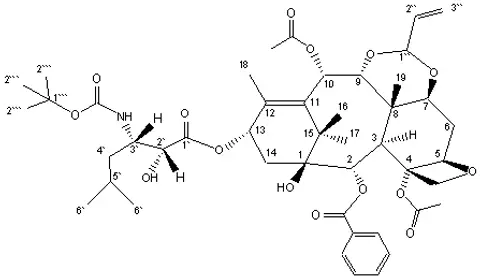 Technical Presentation (June 2007)6 slides · Jun 13, 2007
 Needham & Company Biotechnology and Medical Technology Conference 200733 slides · Jun 13, 2007
 IPO Roadshow (May 2007)30 slides · May 14, 2007