Assured Guaranty Ltd. · NYSE:AGO
Assured Guaranty — Investor Presentation (February 2011)
20 slides from Assured Guaranty's investor presentation, Feb 1, 2011
Slide 1: Assured Guaranty Ltd.'s Comments on Standard & Poor's Proposed Bond Insurance Criteria
Assured Guaranty Ltd.’s Comments on Standard & Poor’s Proposed Bond Insurance Criteria February 1, 2011
Slide 2: Safe Harbor Disclosure
Safe Harbor Disclosure • Forward-looking statements are being made in this presentation that reflect the current views of Assured Guaranty Ltd. (“AGL” and, together with its subsidiaries, “Assured Guaranty” or the “Company”) with respect to future events and financial performance. They are made purs
Slide 3: Summary
Summary Speaker: Dominic Frederico, President & Chief Executive Officer A replay of this call will be available at 888-286-8010 (in the U.S.) or 617-801- 6888 (International), passcode 47220665 until March 1, 2011 3
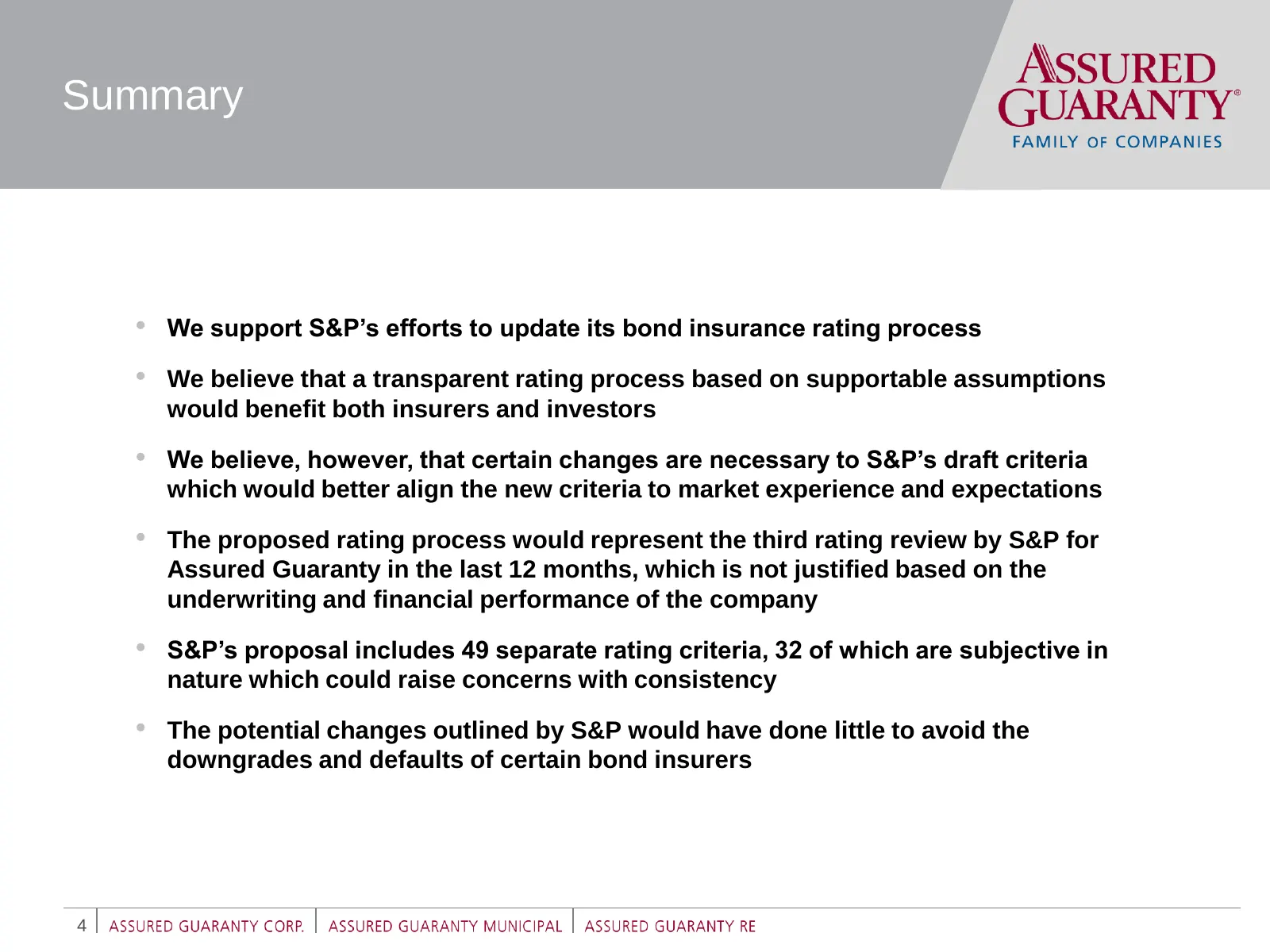
Slide 4: Summary
Summary • We support S&P’s efforts to update its bond insurance rating process • We believe that a transparent rating process based on supportable assumptions would benefit both insurers and investors • We believe, however, that certain changes are necessary to S&P’s draft criteria which would bette
Slide 5: Summary
Summary • The purpose of our call and this presentation is to provide investors with Assured Guaranty’s preliminary views with respect to the new bond insurance criteria outlined by S&P in their January 24, 2011 publication of “Request for Comment: Bond Insurance Criteria.” Our presentation will: -
Slide 6: Summary of Proposed Criteria Changes
Summary of Proposed Criteria Changes • Four fundamental changes in proposed criteria could materially impact required capital levels for Assured Guaranty on a consolidated basis: - Addition of a new aggregate leverage test - Significant increases in the capital charges associated with municipal expo
Slide 7: New Leverage Test
New Leverage Test • S&P is proposing an aggregate leverage test that applies a cap on a financial guarantor’s overall rating • While we support the addition of an aggregate leverage test, we believe such a test should be further refined to: - Consider all of Assured Guaranty‟s claims paying resource
Slide 8: New Leverage Test: Unearned Premiums Excluded
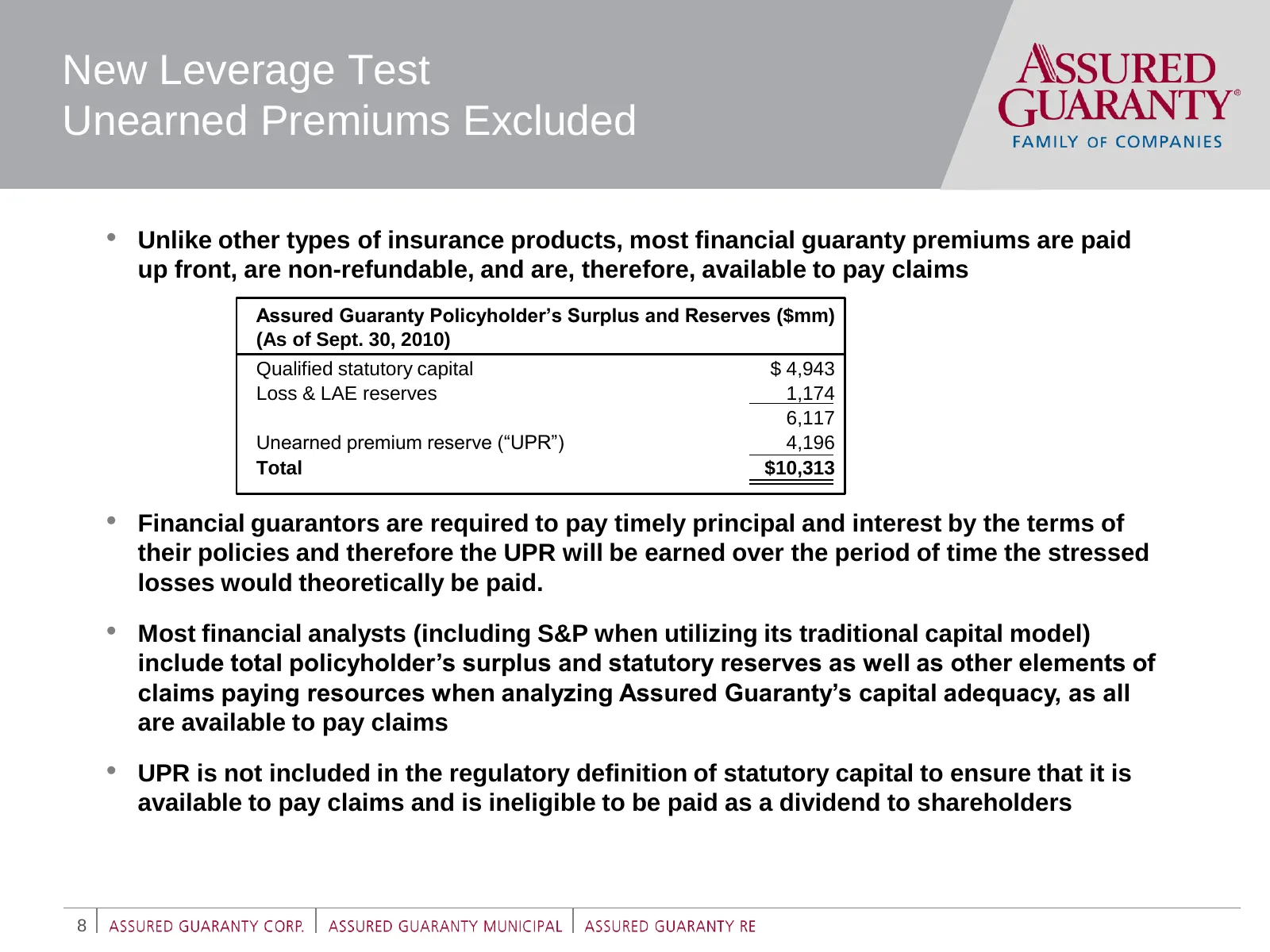
New Leverage Test Unearned Premiums Excluded • Unlike other types of insurance products, most financial guaranty premiums are paid up front, are non-refundable, and are, therefore, available to pay claims Assured Guaranty Policyholder’s Surplus and Reserves ($mm) (As of Sept. 30, 2010) Qualified sta
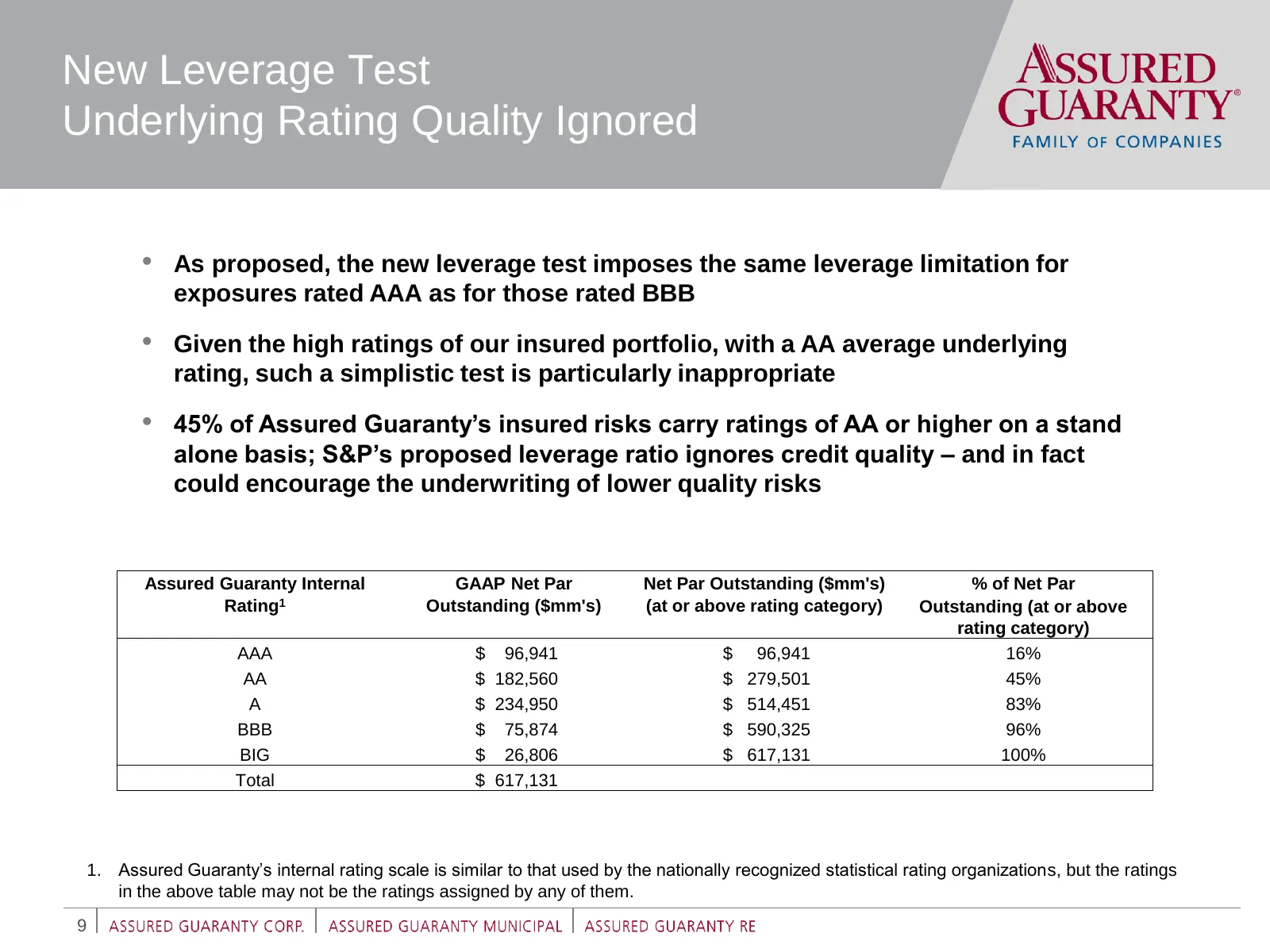
Slide 9: New Leverage Test: Underlying Rating Quality Ignored
New Leverage Test Underlying Rating Quality Ignored • As proposed, the new leverage test imposes the same leverage limitation for exposures rated AAA as for those rated BBB • Given the high ratings of our insured portfolio, with a AA average underlying rating, such a simplistic test is particularly
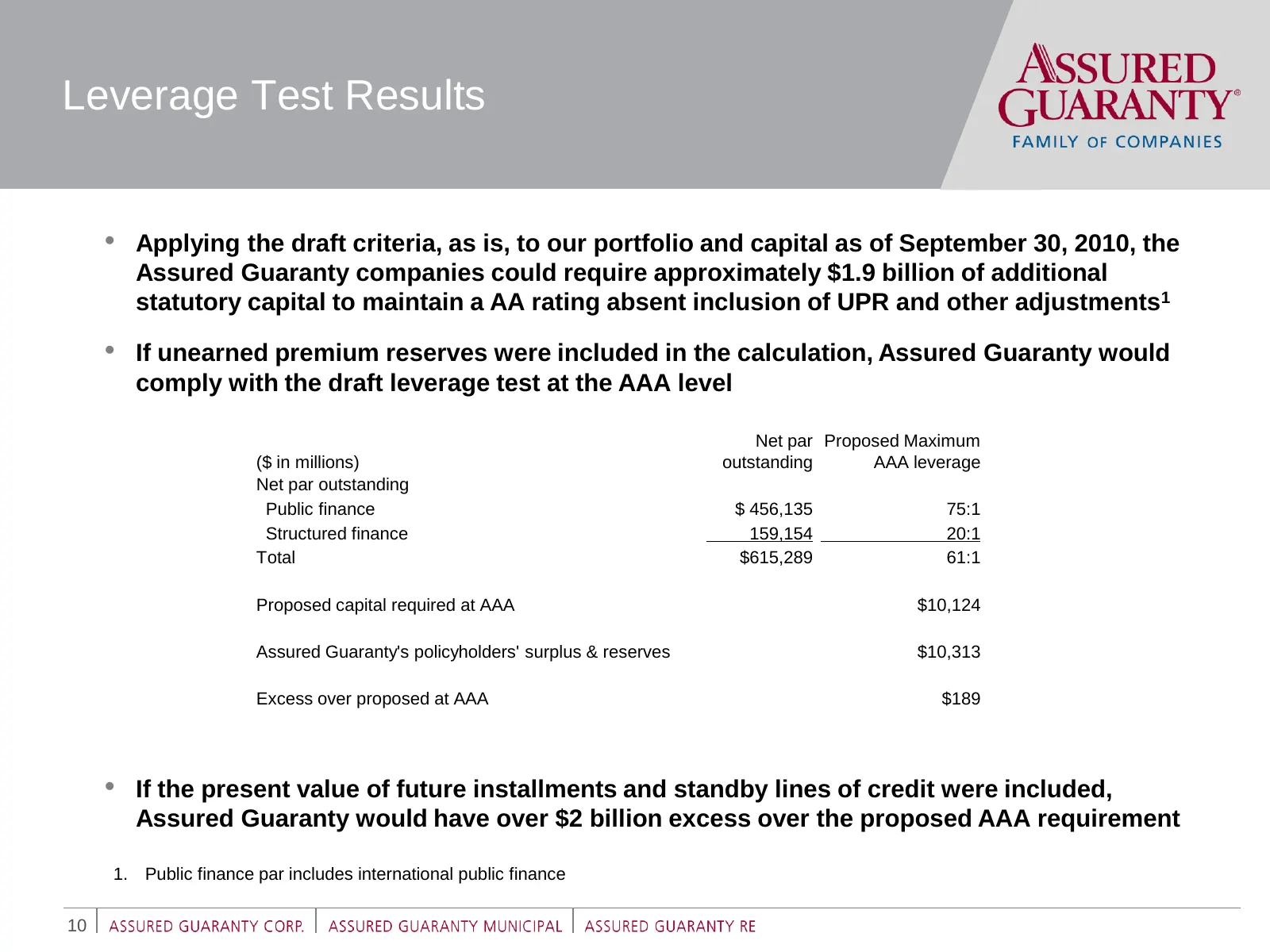
Slide 10: Leverage Test Results
Leverage Test Results • Applying the draft criteria, as is, to our portfolio and capital as of September 30, 2010, the Assured Guaranty companies could require approximately $1.9 billion of additional statutory capital to maintain a AA rating absent inclusion of UPR and other adjustments1 • If unear
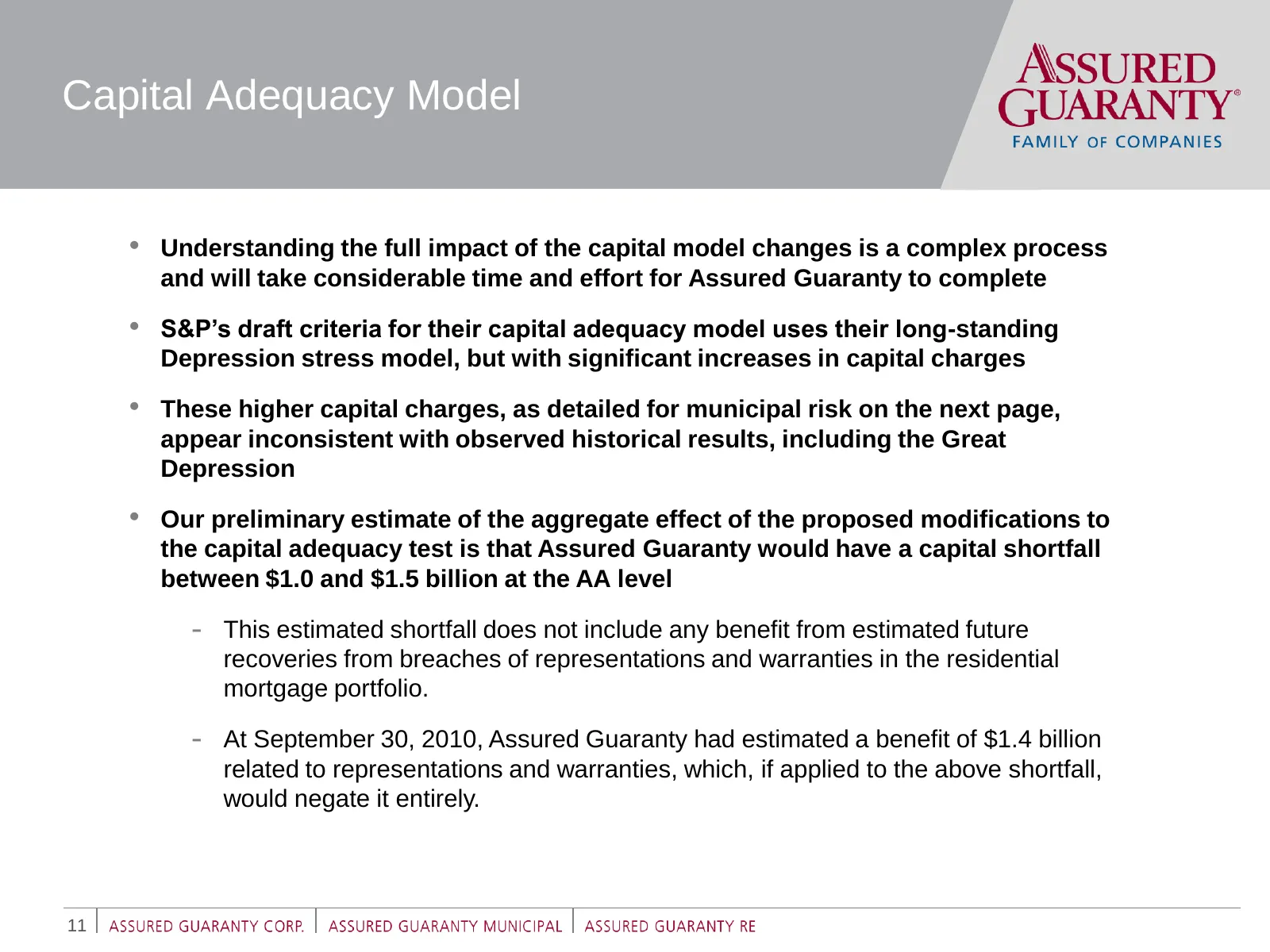
Slide 11: Capital Adequacy Model
Capital Adequacy Model • Understanding the full impact of the capital model changes is a complex process and will take considerable time and effort for Assured Guaranty to complete • S&P’s draft criteria for their capital adequacy model uses their long-standing Depression stress model, but with sign
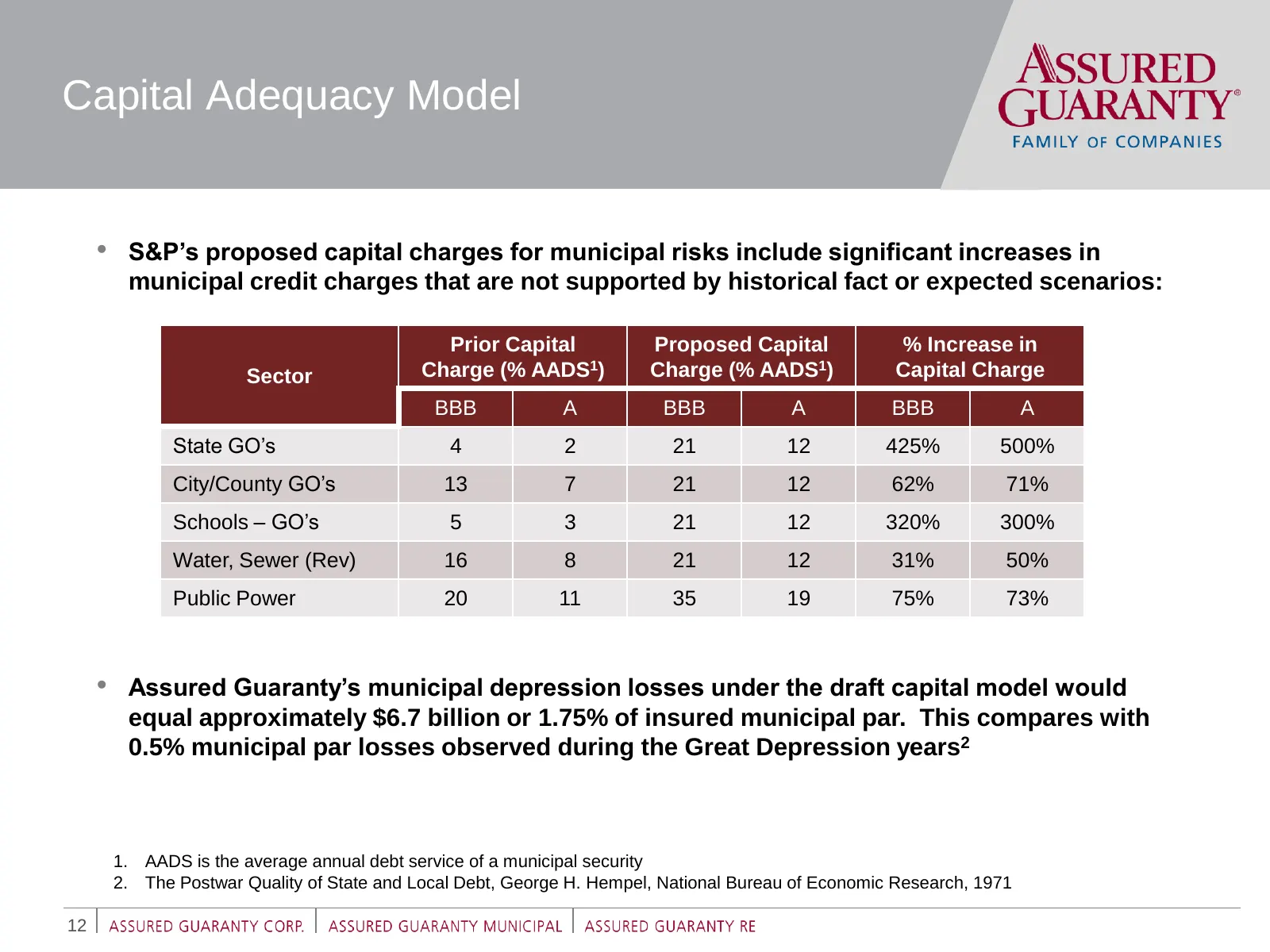
Slide 12: Capital Adequacy Model: Municipal Capital Charges
Capital Adequacy Model • S&P’s proposed capital charges for municipal risks include significant increases in municipal credit charges that are not supported by historical fact or expected scenarios: Prior Capital Proposed Capital % Increase in Sector Charge (% AADS1) Charge (% AADS1) Capital Charge
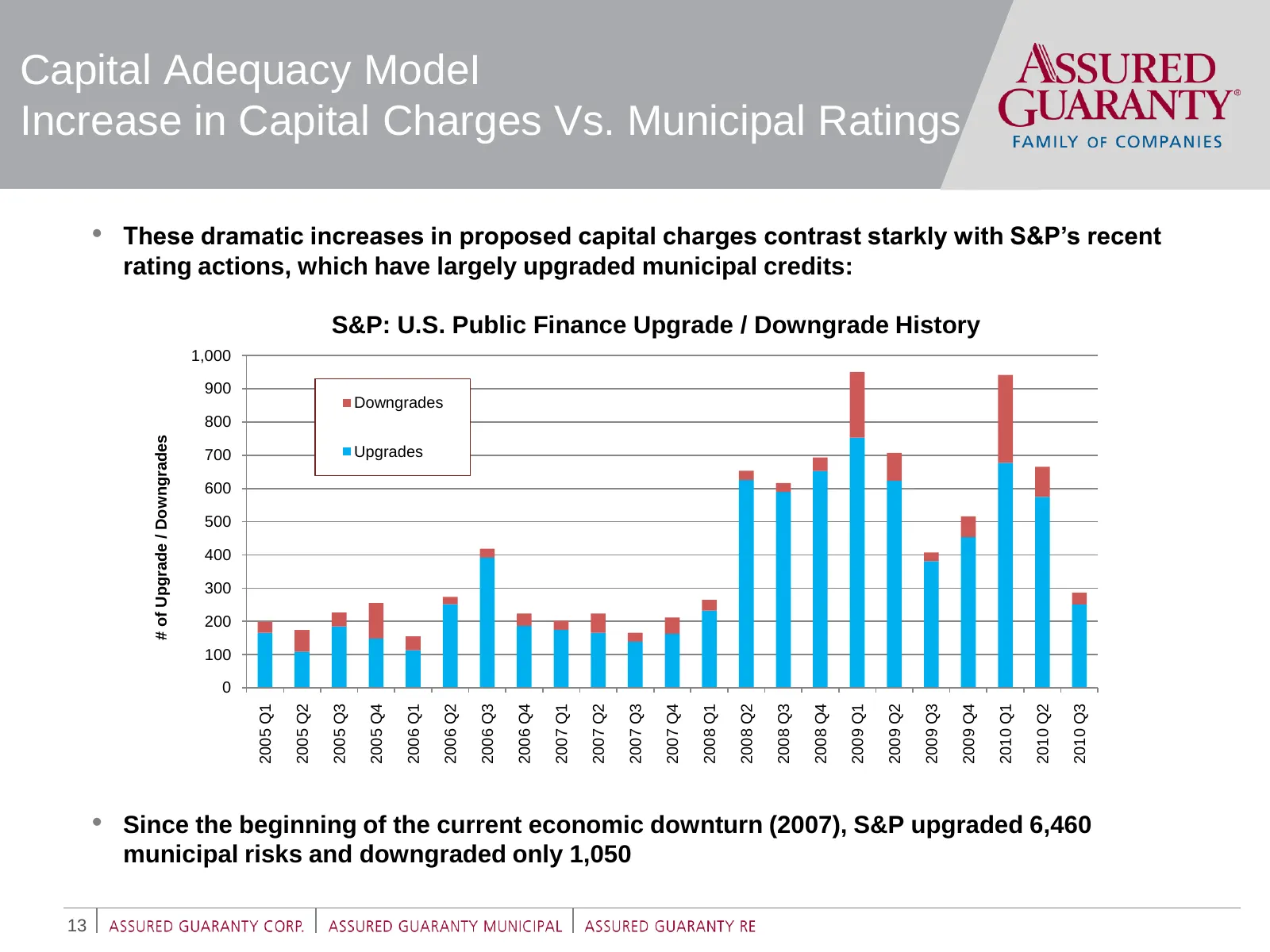
Slide 13: Capital Adequacy Model: Increase in Capital Charges vs. Municipal Ratings
Capital Adequacy ModeI Increase in Capital Charges Vs. Municipal Ratings • These dramatic increases in proposed capital charges contrast starkly with S&P’s recent rating actions, which have largely upgraded municipal credits: S&P: U.S. Public Finance Upgrade / Downgrade History 1,000 900 Downgrades
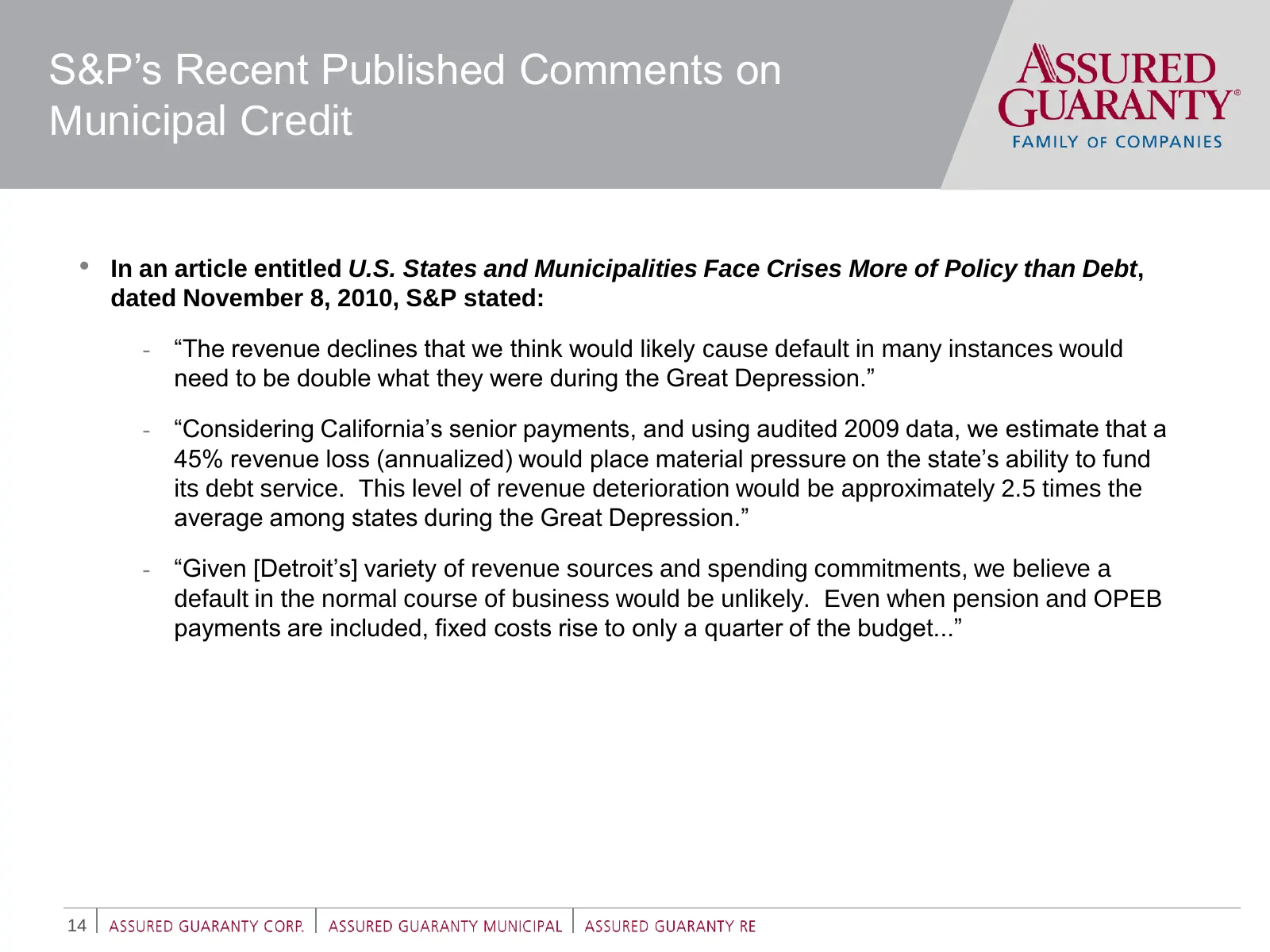
Slide 14: S&P's Recent Published Comments on Municipal Credit
S&P‟s Recent Published Comments on Municipal Credit • In an article entitled U.S. States and Municipalities Face Crises More of Policy than Debt, dated November 8, 2010, S&P stated: - “The revenue declines that we think would likely cause default in many instances would need to be double what they w
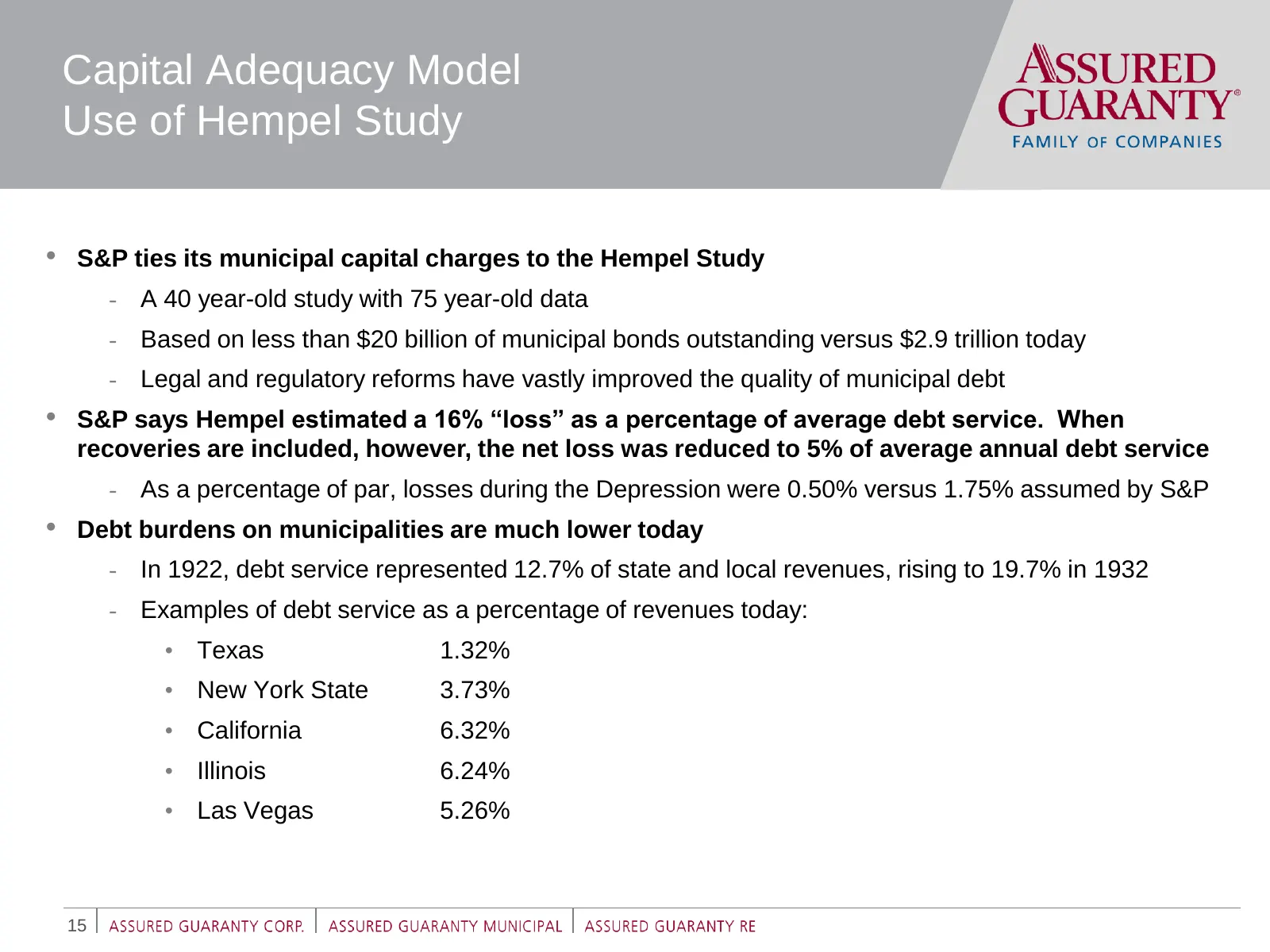
Slide 15: Capital Adequacy Model: Use of Hempel Study
Capital Adequacy Model Use of Hempel Study • S&P ties its municipal capital charges to the Hempel Study - A 40 year-old study with 75 year-old data - Based on less than $20 billion of municipal bonds outstanding versus $2.9 trillion today - Legal and regulatory reforms have vastly improved the quali
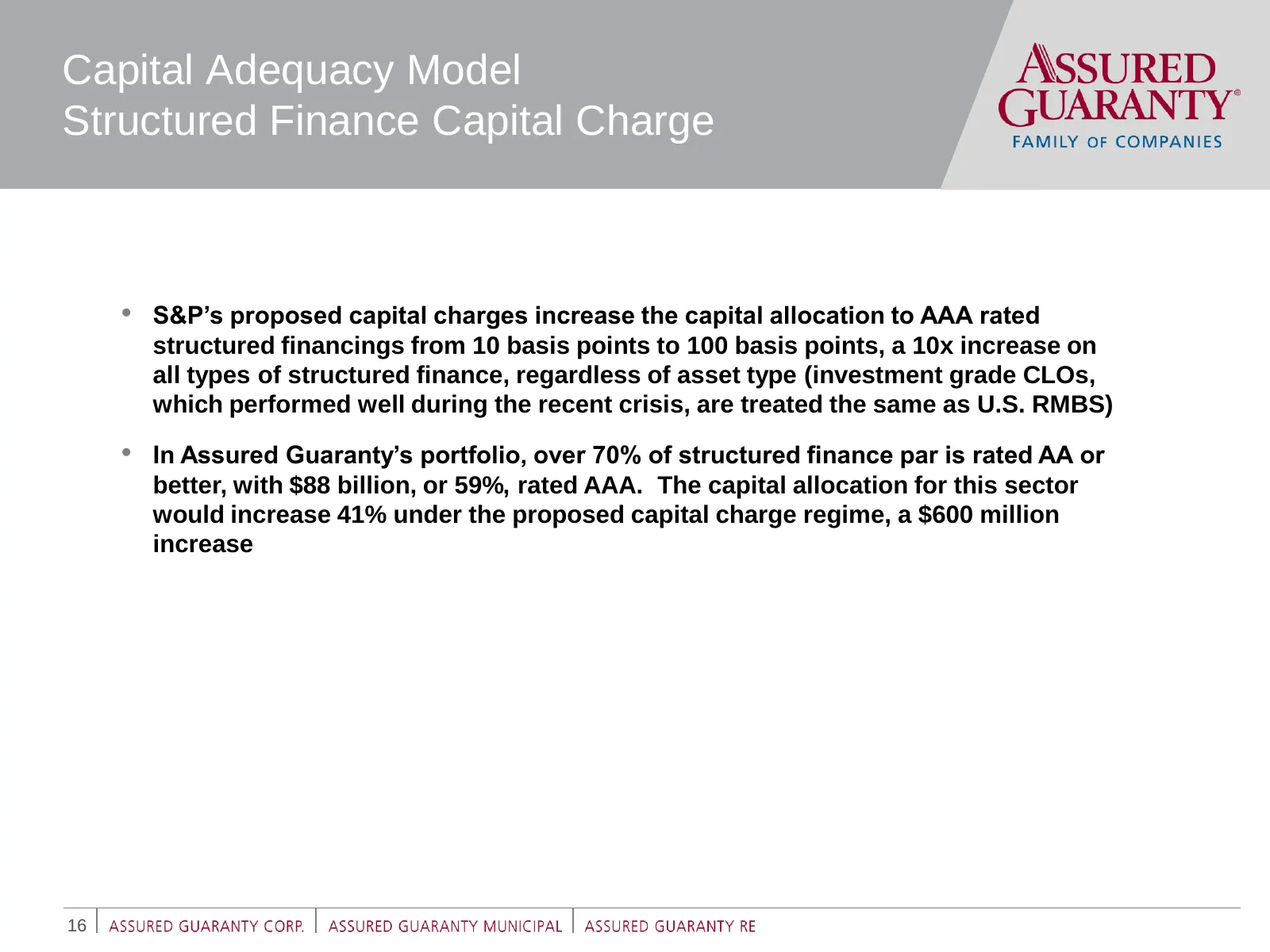
Slide 16: Capital Adequacy Model: Structured Finance Capital Charge
Capital Adequacy Model Structured Finance Capital Charge • S&P’s proposed capital charges increase the capital allocation to AAA rated structured financings from 10 basis points to 100 basis points, a 10x increase on all types of structured finance, regardless of asset type (investment grade CLOs, w
Slide 17: Municipal Single Risk Limits
Municipal Single Risk Limits • S&P proposes to lower monolines’ single risk limits and reduce the number of categories from 6 to 4 • Assured Guaranty’s internal limits reflect the credit quality (internal rating) and potential loss severity of each risk • The amount of capital insurers should hold a
Slide 18: Assured Guaranty's Response to S&P's Proposed Criteria Changes
Assured Guaranty‟s Response to S&P‟s Proposed Criteria Changes • Our principal concerns regarding the S&P’s proposed bond insurance criteria changes, which we encourage investors to comment on, are: - If a leverage test is to be used, it must be a more detailed model that takes into account total cl
Slide 19: Conclusions
Conclusions • S&P’s draft criteria include several important changes which could significantly affect the municipal bond market • The addition of an aggregate leverage test, while not unreasonable, should reflect both differences in credit quality among portfolios and the total claims paying resourc
Slide 20: Assured Guaranty Ltd.'s Comments on Standard & Poor's Proposed Bond Insurance Criteria
Assured Guaranty Ltd.’s Comments on Standard & Poor’s Proposed Bond Insurance Criteria February 1, 2011 20
Source: Internet Archive copy of assuredguaranty.com
More decks from Assured Guaranty Ltd.
 Debt Investor Presentation (September 2026)55 slides · Sep 30, 2026
 Q3 2026 Earnings Presentation71 slides · Sep 30, 2026
 Q2 2026 Earnings Presentation71 slides · Aug 7, 2026
 Debt Investor Presentation (June 2026)55 slides · Jun 30, 2026
 Shareholder Meeting (April 2026)15 slides · Apr 13, 2026
 Q1 2026 Earnings Presentation68 slides · Mar 31, 2026