16 April 2024
Kavango Resources
("Kavango" or "the Company")
ZIM: Tailings Resource Upgrade Nara Gold Project
Kavango Resources plc (LSE: KAV), the Southern Africa focussed metals explorer, is pleased to announce that it has received an updated Resource Estimate (the "Resource Estimate") for the largest tailings dump at the Nara Gold Project ("Nara") in Zimbabwe.
HIGHLIGHTS
- The updated Resource Estimate for the first time provides a Measured category of mineral resource.
- Resource Estimate concludes that the two Nara tailings dumps tested together contain:
- Upgrade of 77,664 tonnes ("t") to Measured Category, at an average of 0.54 grams per tonne ("g/t") gold, for a total of 1,346 ounces of gold contained.
- Indicated Mineral Resource of 221,934t at an average of 0.65 g/t gold, for a total of 4,637 ounces gold contained.
- An Inferred resource of 12,178t at 0.66g/t gold, for a total of 257 ounces gold contained.
- Previously identified upside potential at the tailings dump remains in addition, highlighting the opportunity to increase tonnage at as-yet-untested depths.
- Testwork to assess the optimal processing route is now underway at a local facility.
Ben Turney, Chief Executive of Kavango Resources, commented:
"This upgrade to the Nara Tailings Mineral Resource Estimate follows the acquisition of additional data. This has increased our confidence in the resource at the Nara tailings dumps. As a result, we have now declared a Measured Resource, together with an increase in combined tonnage.
Given that the tailings have already been mined, the upgrade in resource strengthens the attractiveness of the Nara project. Following our recent discovery of a near-surface, high-grade zone at Hillside, we are quickly assembling a cluster of near-term revenue generators for Kavango Mining to operate profitably alongside our main exploration activities.
Kavango is now completing test work to identify the optimal method for processing the tailings and bringing them into production. This includes metallurgical testing that will inform final plant design. We look forward to providing a further update later this quarter."
Background
A Maiden Resource dated 5 March 2024 was previously released by Kavango for the Nara tailings (announced >>> 6 March 2024). One of the recommendations from the consultant who produced the resource was to obtain additional density data, as the then limited data meant that a standard density value had to be utilised. This also limited resource categorisation, part of which would otherwise have been of a Measured category.
This data has now been collected, allowing for both an upgrade in category of part of the resource, and an increase in overall tonnage contained.
Mineral Resource Statement
Table 1. Nara Tailings Mineral Resource statement, effective date 12 April 2024
Domain | Category | Tonnes (Kt) | SG | Au (g/t) | Au (oz) |
NARA East & West | Measured | 77.7 | 1.80 | 0.54 | 1,347 |
Indicated | 221.9 | 1.80 | 0.65 | 4,637 | |
Sub tot Meas + Ind | 299.6 | 1.80 | 0.62 | 5,984 | |
Inferred | 12.2 | 1.80 | 0.66 | 258 |
NOTES:
1. The Mineral Resource is reported at a cut off grade of 0 (zero) g/t Au.
2. Tonnage is based on a global density average of 1800kg/m3 estimated from density sampling carried out over the impoundment surfaces to a depth of 4m.
3. Mineral Resource estimates are not precise calculations being dependent on the interpretation of limited information on the location, shape and continuity of the occurrence and on the available sampling results. Therefore, reporting of tonnage and grade figures reflects this relative uncertainty and figures are rounded to appropriate significant figures. As a result, some error may be incurred when reporting global figures based on rounded values.
4. The Mineral Resource Statement presented above has been classified in accordance with the requirements of the 2012 edition of the Australasian Code for Reporting of Exploration Results, Mineral Resources and Ore Reserves (JORC 2012 Edition). The Competent Person who assumes responsibility for reporting of the Mineral Resource is Dr John Arthur who is a Competent Person as defined by the JORC Code 2012 Edition, having more than 5 years experience that is relevant to the style of mineralisation and type of deposit described herein, and to the activity for which he accepts responsibility. The effective date of the Mineral Resource statement is 12 April 2024.
5. The Mineral Resource statement is prepared following the guidelines set out in London Stock Exchange AIM notice, Guidance for Mining and Oil & Gas Companies (AIM16, Appendix 3).
6. Resources are not constrained other than by the geological boundary limits of the Mineralised unit and search radii limits approximated from variographic analysis. At this stage no consideration has been made as to what tonnes and grade would be reasonably expected to be extracted profitably. Notwithstanding, the Competent Person considers the distance constraints in both the dip and strike directions to be a reasonable approximation and expectation of potential mining extents.
7. Mineral Resources which are not Ore Reserves do not have demonstrated economic viability. The estimate of Mineral Resource reported may be materially affected by environmental, permitting, legal, title, taxation, sociopolitical, marketing, or other relevant issues.
8. The Inferred Mineral Resource in this estimate has a lower level of confidence than that applied to the Indicated Mineral Resource and must not be converted to a Ore Reserve. It is reasonably considered that the majority of the Inferred Mineral Resource could be upgraded to an Indicated Mineral Resource with continued exploration.
9. Currently, no Ore Reserves have been established for the Nara Project
Next Steps
Kavango has commenced metallurgical test work to assess further the potential recovery of gold, reagent consumption, and operating parameters for a possible future facility to process Nara's gold tailings.
The Company will follow this up with a study aimed at commercialising Nara's gold tailings opportunity to achieve early cashflow.
Kavango intends to investigate potential upside in the Mineral Resource Estimate identified by Dr. Arthur's work.
Multiple holes stopped short due to intersecting items such as past concrete infrastructure, meaning there is potential for the tonnage to increase.
Likewise, some grade enrichment with depth was also seen in multiple holes, potentially because of gravity concentration. Given that not all holes reached target depth this may offer additional contained gold beyond the original target depths scoped out for the auger drilling.
THIS ANNOUNCEMENT CONTAINS INSIDE INFORMATION FOR THE PURPOSES OF ARTICLE 7 OF REGULATION 2014/596/EU WHICH IS PART OF DOMESTIC UK LAW PURSUANT TO THE MARKET ABUSE (AMENDMENT) (EU EXIT) REGULATIONS (SI 2019/310) ("UK MAR"). UPON THE PUBLICATION OF THIS ANNOUNCEMENT, THIS INSIDE INFORMATION (AS DEFINED IN UK MAR) IS NOW CONSIDERED TO BE IN THE PUBLIC DOMAIN.
Further information in respect of the Company and its business interests is provided on the Company's website at www.kavangoresources.com and on Twitter at #KAV.
For further information please contact:
Kavango Resources plc
Ben Turney
+46 7697 406 06
First Equity (Broker)
+44 207 374 2212
Jason Robertson
Kavango Competent Person Statement
The technical information contained in this announcement pertaining to the Nara Tailings Resource Estimate has been read and approved by Dr John Arthur. Dr Arthur is Chartered Geologist (FGS) with some 28 years' experience in the minerals industry. He has a PhD from Cardiff university. Dr Arthur has sufficient experience that is relevant to the exploration programmes and geology of the main styles of mineralisation and deposit types under consideration to act as a Qualified Person as defined in the 2012 Edition of the 'Australasian Code for Reporting of Exploration Results, Mineral Resources and Ore Reserves'.
APPENDIX 1
JORC Code, 2012 Edition - Table 1 NARA TAILINGS effective date 5 March 2024
Section 1 Sampling Techniques and Data
(Criteria in this section apply to all succeeding sections.)
Sampling techniques | · Nature and quality of sampling (eg cut channels, random chips, or specific specialised industry standard measurement tools appropriate to the minerals under investigation, such as down hole gamma sondes, or handheld XRF instruments, etc). These examples should not be taken as limiting the broad meaning of sampling. · Include reference to measures taken to ensure sample representivity and the appropriate calibration of any measurement tools or systems used. · Aspects of the determination of mineralisation that are Material to the Public Report. · In cases where 'industry standard' work has been done this would be relatively simple (eg 'reverse circulation drilling was used to obtain 1 m samples from which 3 kg was pulverised to produce a 30 g charge for fire assay'). In other cases more explanation may be required, such as where there is coarse gold that has inherent sampling problems. Unusual commodities or mineralisation types (eg submarine nodules) may warrant disclosure of detailed information. | · Samples were extracted as auger samples at 1.5 m intervals at an average mass of 1.51 kg. · These were placed in plastic bags, ticketed, and sealed. · Samples were split using a riffle splitter. A duplicate, standard (CRM) and blank were inserted every 20th sample. Samples were re-ticketed to ensure numerical continuity and were batched in coated clean poly-weave sacks. |
Drilling techniques | · Drill type (eg core, reverse circulation, open-hole hammer, rotary air blast, auger, Bangka, sonic, etc) and details (eg core diameter, triple or standard tube, depth of diamond tails, face-sampling bit or other type, whether core is oriented and if so, by what method, etc). | · Each hole was drilled using an engine-driven hydraulic auger with a 50 mm rotating spiral enclosed within a core barrel. · Samples were extracted as auger samples at 1.5 m intervals. |
Drill sample recovery | · Method of recording and assessing core and chip sample recoveries and results assessed. · Measures taken to maximise sample recovery and ensure representative nature of the samples. · Whether a relationship exists between sample recovery and grade and whether sample bias may have occurred due to preferential loss/gain of fine/coarse material. | · All samples were weighed. · No relationship was noted between sample size and grade. · Some holes stopped short of final depth due to hitting concrete infrastructure. This may result in under-reporting of grade as deeper (potentially enriched) portions could sometimes not be sampled · Drilling was carried out "dry" and recovery is therefore high with no perceptible preferential loss of either fine or coarse material |
Logging | · Whether core and chip samples have been geologically and geotechnically logged to a level of detail to support appropriate Mineral Resource estimation, mining studies and metallurgical studies. · Whether logging is qualitative or quantitative in nature. Core (or costean, channel, etc) photography. · The total length and percentage of the relevant intersections logged. | · Logging was limited to colour and textural descriptions given the nature of the tailings. This is considered sufficient for the style of deposit. · All intervals were logged, using the same sample intervals as the assay samples. |
Sub-sampling techniques and sample preparation | · If core, whether cut or sawn and whether quarter, half or all core taken. · If non-core, whether riffled, tube sampled, rotary split, etc and whether sampled wet or dry. · For all sample types, the nature, quality and appropriateness of the sample preparation technique. · Quality control procedures adopted for all sub-sampling stages to maximise representivity of samples. · Measures taken to ensure that the sampling is representative of the in situ material collected, including for instance results for field duplicate/second-half sampling. · Whether sample sizes are appropriate to the grain size of the material being sampled. | · Samples were split using an appropriately sized riffle splitter, aiming at a >500g sample weight for analysis. · The riffle splitter was cleaned with compressed air between samples. · The 500g sample size is considered representative for the particle size. · A duplicate, standard (CRM) and blank were inserted every 20th sample. · Field duplicates were derived from the primary sample using the balance of the sample. |
Quality of assay data and laboratory tests | · The nature, quality and appropriateness of the assaying and laboratory procedures used and whether the technique is considered partial or total. · For geophysical tools, spectrometers, handheld XRF instruments, etc, the parameters used in determining the analysis including instrument make and model, reading times, calibrations factors applied and their derivation, etc. · Nature of quality control procedures adopted (eg standards, blanks, duplicates, external laboratory checks) and whether acceptable levels of accuracy (ie lack of bias) and precision have been established. | · A company audit was made of the assay laboratory before it was engaged. · The bottle roll technique uses a cyanide leach and is a partial analysis method. · 10% of samples were analysed by Fire Assay as a further check. This in all but one sample reported a higher grade (as was expected). The target of this work was however to estimate leachable rather than total gold, and for which bottle roll is considered most appropriate. · Round robin and accreditation results for the laboratory were reviewed and considered acceptable. · The company's QAQC samples, including standards, are considered to confirm acceptable bias and precision, with no contamination issues identified. |
Verification of sampling and assaying | · The verification of significant intersections by either independent or alternative company personnel. · The use of twinned holes. · Documentation of primary data, data entry procedures, data verification, data storage (physical and electronic) protocols. · Discuss any adjustment to assay data. | · The Company's internal CP reviewed sampling and visited site to confirm that protocols had been followed. · No twinned holes were used. · Logged data was securely recorded and backed up. · Assay data was received as assay certificates and cross checked against sample submission data to ensure a correct match. |
Location of data points | · Accuracy and quality of surveys used to locate drill holes (collar and down-hole surveys), trenches, mine workings and other locations used in Mineral Resource estimation. · Specification of the grid system used. · Quality and adequacy of topographic control. | · All holes were set out by a professional survey company using Differential GPS. · Map datum is standard for the region of UTM35S Arc 1950. · Location of actual holes was observed to vary by up to 40cm from laid out position. Overall accuracy therefore is to be considered as +-40cm in X and Y, and approximately +-10cm in Z axis. |
Data spacing and distribution | · Data spacing for reporting of Exploration Results. · Whether the data spacing and distribution is sufficient to establish the degree of geological and grade continuity appropriate for the Mineral Resource and Ore Reserve estimation procedure(s) and classifications applied. · Whether sample compositing has been applied. | · The auger drill sites were designed according to a grid with 20 m line spacing and 20 m sample spacing. · This is considered appropriate for the Mineral Resource and Ore Reserve estimation procedure and classifications. · Compositing was not required. |
Orientation of data in relation to geological structure | · Whether the orientation of sampling achieves unbiased sampling of possible structures and the extent to which this is known, considering the deposit type. · If the relationship between the drilling orientation and the orientation of key mineralised structures is considered to have introduced a sampling bias, this should be assessed and reported if material. | · The greatest variation is likely to be vertically, through stratification as feed material sources varied over time. · The vertical orientation of the holes allows for close to 90° intersection angle with the stratification within the dumps · The relatively short sample length (1.5m) allows for relatively accurate definition of variation in source feed, colour, grain size. · No bias is considered to have resulted. |
Sample security | · The measures taken to ensure sample security. | · Samples were stored in a locked company compound at site and in a locked container in Bulawayo. They were shipped onwards to the analytical facility by a reliable courier. |
Audits or reviews | · The results of any audits or reviews of sampling techniques and data. | · The auger sampling process was recorded on video and is considered acceptable by both the internal and external CP. · Riffle splitting of sub-samples was reviewed by the Company's internal CP and is considered acceptable. · The Resource Consultant reviewed all data, and spot checked 10% of values versus logs. |
Section 2 Reporting of Exploration Results
(Criteria listed in the preceding section also apply to this section.)
Mineral tenement and land tenure status | · Type, reference name/number, location and ownership including agreements or material issues with third parties such as joint ventures, partnerships, overriding royalties, native title interests, historical sites, wilderness or national park and environmental settings. · The security of the tenure held at the time of reporting along with any known impediments to obtaining a licence to operate in the area. | · The mineral Claims are held by a third party with whom Kavango holds a valid Option agreement Call Option Agreement dated 23 June 2023. · The 45 Claims under the agreement cover 415 hectares, and the Call Option Agreement is valid for two years to 23 June 2025, during which Kavango has exclusive access to the Claims. · Under the Call Option Agreement Kavango will need to pay the licence holder a fee before expiry, following which Kavango will own 100%. · There is established mining activity in the area. An environmental permit is held by the Claims holder. |
Exploration done by other parties | · Acknowledgment and appraisal of exploration by other parties. | · The Nara project covers four historic mines with total recorded production of more than 90,000oz in the first half of the 20th Century. These mines also produced credits of tungsten and silver. There is a 30-year plus history of small-scale mining & custom milling on the property. · No drilling or modern exploration has been carried out to assess the property. |
Geology | · Deposit type, geological setting and style of mineralisation. | · The resource is a tailings deposit. The Nara prospect is located within the Filabusi Greenstone Belt, sitting astride the Redwing Shear Zone, which hosts gold mineralisation. Seven formations have been identified at Filabusi and these are grouped into Lower and Upper greenstones of the Bulawayan Group as in the adjoining Mberengwa belt. There is apparent unconformity between the Lower and Upper greenstones. · Historical reports and longitudinal sections show mining of at least two parallel orebodies and a third oblique splay. The southern or footwall reef consists of massive boudinage quartz veins, and the northern hangingwall reef consists of quartz stringers, both hosted within mafic schist. Both types of reefs are set in highly sheared and laminated chlorite- and carbonated biotite-feldspar-schists, with the proportion of biotite increasing towards the quartz. There is congruence between one of the reefs and the splay, with the first type truncating the second along strike east of the old main shaft. · The area around the Nara project contains 139 historic gold mines with a combined production of greater than 1.7Moz gold. These mines have been predominantly narrow, high-grade oxide production. · There are currently no active large mines. The area is instead serviced by stamp mills, receiving ore from tribute miners. |
Drill hole Information | · A summary of all information material to the understanding of the exploration results including a tabulation of the following information for all Material drill holes: o easting and northing of the drill hole collar o elevation or RL (Reduced Level - elevation above sea level in metres) of the drill hole collar o dip and azimuth of the hole o down hole length and interception depth o hole length. · If the exclusion of this information is justified on the basis that the information is not Material and this exclusion does not detract from the understanding of the report, the Competent Person should clearly explain why this is the case. | · These data are provided as an appendix in the Mineral Resource Report to the Company. |
Data aggregation methods | · In reporting Exploration Results, weighting averaging techniques, maximum and/or minimum grade truncations (eg cutting of high grades) and cut-off grades are usually Material and should be stated. · Where aggregate intercepts incorporate short lengths of high grade results and longer lengths of low grade results, the procedure used for such aggregation should be stated and some typical examples of such aggregations should be shown in detail. · The assumptions used for any reporting of metal equivalent values should be clearly stated. | · No weighted averages have been used. · No higher cut has been used, as not considered appropriate. · Samples are generally of a consistent length. · Only gold values are included. |
Relationship between mineralisation widths and intercept lengths | · These relationships are particularly important in the reporting of Exploration Results. · If the geometry of the mineralisation with respect to the drill hole angle is known, its nature should be reported. · If it is not known and only the down hole lengths are reported, there should be a clear statement to this effect (eg 'down hole length, true width not known'). | · The auger holes are considered perpendicular to stratification from when tailings were laid down. · Down hole lengths will therefore approximate to true widths. |
Diagrams | · Appropriate maps and sections (with scales) and tabulations of intercepts should be included for any significant discovery being reported These should include, but not be limited to a plan view of drill hole collar locations and appropriate sectional views. | · These are contained in separate resource report. |
Balanced reporting | · Where comprehensive reporting of all Exploration Results is not practicable, representative reporting of both low and high grades and/or widths should be practiced to avoid misleading reporting of Exploration Results. | · All grades and widths have been reported. |
Other substantive exploration data | · Other exploration data, if meaningful and material, should be reported including (but not limited to): geological observations; geophysical survey results; geochemical survey results; bulk samples - size and method of treatment; metallurgical test results; bulk density, groundwater, geotechnical and rock characteristics; potential deleterious or contaminating substances. | · Density data was collected from 4 trenches across the eastern dump with 5 samples collected in each trench representing depths between surface (0m) and 4m depth. After accounting for obvious outliers the final data indicated an average density of 1.8t/m3 was appropriate as a measure of in-situ dry density. · No metallurgical work has yet been carried out, however the bottle roll testwork provides a strong indication of the leachability of the tailings. · No deleterious materials were observed in the dumps or samples. |
Further work | · The nature and scale of planned further work (eg tests for lateral extensions or depth extensions or large-scale step-out drilling). · Diagrams clearly highlighting the areas of possible extensions, including the main geological interpretations and future drilling areas, provided this information is not commercially sensitive. | · There may be scope to extend the resource at depth. · Additional nearby dumps may become available in the future. |
Section 3 Estimation and Reporting of Mineral Resources
(Criteria listed in section 1, and where relevant in section 2, also apply to this section.)
Database integrity | · Measures taken to ensure that data has not been corrupted by, for example, transcription or keying errors, between its initial collection and its use for Mineral Resource estimation purposes. · Data validation procedures used. | · Data is stored in a Dropbox archive, which only two people have write access to. · All data have been run through Micromine and Surpac's validation tool, and any anomalies investigated and corrected. · A manual check of 10% of all data was carried out by the Resource Consultant. |
Site visits | · Comment on any site visits undertaken by the Competent Person and the outcome of those visits. · If no site visits have been undertaken indicate why this is the case. | · Due to the project location and straightforward nature of the tailings deposit the Resource Consultant did not visit. The Company's internal CP did however visit and has validated the hole locations and sampling protocols as well as visiting the analytical laboratory. |
Geological interpretation | · Confidence in (or conversely, the uncertainty of ) the geological interpretation of the mineral deposit. · Nature of the data used and of any assumptions made. · The effect, if any, of alternative interpretations on Mineral Resource estimation. · The use of geology in guiding and controlling Mineral Resource estimation. · The factors affecting continuity both of grade and geology. | · The mineralized domains which constitute the deposit consist of horizontally layered tailings deposit material deposited in 2 adjacent facilities which form above ground level elevated "dumps" free draining · Data used for the resource estimation consisted of auger drill data assay results as well as logging data describing colour and grain size. · The correlation between grade with colour and grain size is low and it was not considered appropriate to try and sub-divide the dumps into separate domains based on either colour or grain size. · Continuity of grade appears high, likely due to the relatively uniform nature of the source material. Variations within the deposits for colour and grain size do not materially impact the variability of grade |
Dimensions | · The extent and variability of the Mineral Resource expressed as length (along strike or otherwise), plan width, and depth below surface to the upper and lower limits of the Mineral Resource. | · The Mineral Resource domains consist of 2 adjacent historical tailings dumps. The east dump contains the bulk of the Mineral Resource and is roughly circular in plan view with dimensions of approximately 220x220m and a height of between 10-12m. the west dump dimensions are approximately 145m x 130m and a height of only 4m |
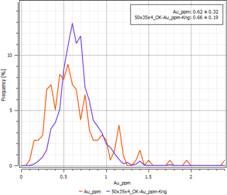
Estimation and modelling techniques | · The nature and appropriateness of the estimation technique(s) applied and key assumptions, including treatment of extreme grade values, domaining, interpolation parameters and maximum distance of extrapolation from data points. If a computer assisted estimation method was chosen include a description of computer software and parameters used. · The availability of check estimates, previous estimates and/or mine production records and whether the Mineral Resource estimate takes appropriate account of such data. · The assumptions made regarding recovery of by-products. · Estimation of deleterious elements or other non-grade variables of economic significance (eg sulphur for acid mine drainage characterisation). · In the case of block model interpolation, the block size in relation to the average sample spacing and the search employed. · Any assumptions behind modelling of selective mining units. · Any assumptions about correlation between variables. · Description of how the geological interpretation was used to control the resource estimates. · Discussion of basis for using or not using grade cutting or capping. · The process of validation, the checking process used, the comparison of model data to drill hole data, and use of reconciliation data if available. | 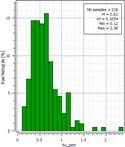 ![( ご x 主 4 - ◆ - ( ご x 主 。 [ N - ◆ - ( ご x 主 」 。 N - ◆ - ( ご x 主 ト N - ◆ - に x 主 45 - ◆ - [ 山 ] u 5 ( OS 当 ト 0 ・ 0 = ue リ 2 ↓ 山 凵 ご X 山 ご こ - : 2 ! 」 2 V(Åu_ppm) ト 毳 0 ~](https://6ix.com/media/news/69eb87381b7b256783cdd19d/2ea55e1f8ae006d8dd3d0ffd2928eeede82933240272d218e18bd5c11b5a9e92) · Estimation consisted of exploratory data analysis (EDA) of the auger sample data separately for the two domains (East and West). Following data validation the sample assay data was selected as the interpolation variable. The reason for this was that the sample length of 1.5m is the most common sample length and very samples fell below this interval correlation cross plots of sample length against gold grade showed no material bias between length and grade and it was decided that the sample length is an effective composite for use in the grade estimate. · The grade histogram exhibits the classic high grade tail seen in most gold deposits, however, given the nature of the tailings product the high grades are relatively well controlled with the highest grade only 2.5g/t. It was considered that there was no requirement for high grade cutting given the smoothing process inherent in the kriging algorithm and the fact that the high grades tend to occur in discrete groupings rather than a random scattering throughout the deposit. · Estimation and EDA were conducted using the Isatis Neo® software. Semi-variogram analysis was conducted on the raw data composites and the resulting experimental variograms were modelled with ranges of 52m and 37m in the east and north directions respectively and a relatively low nugget variance leading to a high estimated kriging efficiency and high Kriging Slope of Regression (KsoR) results. · Search parameters closely followed the geostatistical ranges and are summarized below: · Ellipsoid parameters: o Ellipsoid rotation Dip = 0° Dip Azimuth = N90° Pitch = 90° o Ellipsoid size (radius) 50 m,35 m,4 m o Use anisotropic distances Yes o Number of angular sectors 4 o Maximum number per sector 20 o Split ellipsoid vertically No o Minimum number of samples 4 · Parent block size was set at 10x10x4m (XYZ) and sub blocking was performed in order to better fit the resulting reporting to the modelled domain boundaries. The sub-blocks were defined at 2.5x2.5x0.5m. hole spacing is 20x20m with an average sample length of 1.4m thus the block size is considered appropriate to locate sufficient samples within a block to provide a reliable estimate of grade. · Grade interpolation was performed into the parent blocks and all sub-blocks retained the grade of their parent block for reporting purposes · Validation was carried out using visual examination of hole and block sections along with swath plots for the two domains independently. The following plot shows the superimposed histograms for the East domain samples (red) and kriged blocks (blue) highlighting the smoothing caused by the kriging algorithm. · · There are no previous estimates. · No by-product production is assumed. · No deleterious elements have been identified, however future metallurgical work should include this. · |
Moisture | · Whether the tonnages are estimated on a dry basis or with natural moisture, and the method of determination of the moisture content. | · Densities have been measured using in-situ tailings densities, moisture has not been calculated but is considered typical for this largely hot and dry area. |
Cut-off parameters | · The basis of the adopted cut-off grade(s) or quality parameters applied. | · No cut-off has been applied. The majority of material contains some grade, and owing to the nature of the deposit style, all material will be required to be mined and processed. |
Mining factors or assumptions | · Assumptions made regarding possible mining methods, minimum mining dimensions and internal (or, if applicable, external) mining dilution. It is always necessary as part of the process of determining reasonable prospects for eventual economic extraction to consider potential mining methods, but the assumptions made regarding mining methods and parameters when estimating Mineral Resources may not always be rigorous. Where this is the case, this should be reported with an explanation of the basis of the mining assumptions made. | · It is assumed that small mobile plant will be used. · As selective mining will not be used no mining losses or dilution are anticipated. · The material is considered to be "free dig" throughout the full depth extent of the dumps and the gold grade is relatively consistent throughout the domains modelled · The format of the dumps makes such mining straightforward. |
Metallurgical factors or assumptions | · The basis for assumptions or predictions regarding metallurgical amenability. It is always necessary as part of the process of determining reasonable prospects for eventual economic extraction to consider potential metallurgical methods, but the assumptions regarding metallurgical treatment processes and parameters made when reporting Mineral Resources may not always be rigorous. Where this is the case, this should be reported with an explanation of the basis of the metallurgical assumptions made. | · The bottle roll data may provide a reasonable proxy for recoverable gold using a cyanide leach. · Adjacent properties are processing tailings and generating significant revenue. This appears to demonstrate the viability of a future operation. · Metallurgical testwork will follow as a next step to verify recoveries, residence times, and estimate reagent consumptions. |
Environmen-tal factors or assumptions | · Assumptions made regarding possible waste and process residue disposal options. It is always necessary as part of the process of determining reasonable prospects for eventual economic extraction to consider the potential environmental impacts of the mining and processing operation. While at this stage the determination of potential environmental impacts, particularly for a greenfields project, may not always be well advanced, the status of early consideration of these potential environmental impacts should be reported. Where these aspects have not been considered this should be reported with an explanation of the environmental assumptions made. | · The project is in a brownfield area of tailings. With careful planning it is expected that given there will be minimal change in volume of the material, that it can be redeposited in its source area. · Consideration will be given as to whether the material can be improved in terms of chemical and physical stability, and whether for example revegetation can be facilitated. |
Bulk density | · Whether assumed or determined. If assumed, the basis for the assumptions. If determined, the method used, whether wet or dry, the frequency of the measurements, the nature, size and representativeness of the samples. · The bulk density for bulk material must have been measured by methods that adequately account for void spaces (vugs, porosity, etc), moisture and differences between rock and alteration zones within the deposit. · Discuss assumptions for bulk density estimates used in the evaluation process of the different materials. | · Density data was collected from 4 trenches across the eastern dump with 5 samples collected in each trench representing depths between surface (0m) and 4m depth. After accounting for obvious outliers the final data indicated an average density of 1.8t/m3 was appropriate as a measure of in-situ dry density. · There is distinct variation in the results obtained from the upper layers of each trench with the highest density in the upper surface (possibly due to compaction by machinery) with relatively wide variations (outliers) in the upper 1-2m below which the density values become considerably more uniform. The final density estimate used was a global figure of 1.80t/m3 which matches closely with data obtained from benchmarking of sand material density from a number of sources in the engineering literature and from experience of similar styles of deposition. · The continued determination of reliable and accurate density is recommended for the project going forward. · The data are considered representative for what is a relatively homogenous tailings deposit. |
Classification | · The basis for the classification of the Mineral Resources into varying confidence categories. · Whether appropriate account has been taken of all relevant factors (ie relative confidence in tonnage/grade estimations, reliability of input data, confidence in continuity of geology and metal values, quality, quantity and distribution of the data). · Whether the result appropriately reflects the Competent Person's view of the deposit. | · The majority of the defined Mineral Resource (96%) is considered by the competent person to be in the Indicated category. A portion of the deposit is considered suitable for classification as Measured Mineral Resource given the updated density sampling and assessment. · The resulting Mineral Resource statement appropriately and accurately reflects the Competent Persons view of the grade values and distribution within the defined domains. |
Audits or reviews | · The results of any audits or reviews of Mineral Resource estimates. | · No third party review has yet been carried out. |
Discussion of relative accuracy/ confidence | · Where appropriate a statement of the relative accuracy and confidence level in the Mineral Resource estimate using an approach or procedure deemed appropriate by the Competent Person. For example, the application of statistical or geostatistical procedures to quantify the relative accuracy of the resource within stated confidence limits, or, if such an approach is not deemed appropriate, a qualitative discussion of the factors that could affect the relative accuracy and confidence of the estimate. · The statement should specify whether it relates to global or local estimates, and, if local, state the relevant tonnages, which should be relevant to technical and economic evaluation. Documentation should include assumptions made and the procedures used. · These statements of relative accuracy and confidence of the estimate should be compared with production data, where available. | · Classification was based on a combination of visual and statistical parameters along with the results of the kriging quality parameters, principally the slope of regression (KSoR). The relatively close spaced drilling and the defined block size lend a high degree of confidence to the final estimates based on the quality of the semi-variogram results. · No production data is available as of the effective date of this report (12 April 2024) and therefore a reconciliation is not possible between the block model and actual production information. |