
17 February 2025
East Star Resources Plc
("East Star" or the "Company")
VMS Copper Drilling Results
Results expected to add tonnes to existing resources and lower strip ratio of open pit development
East Star Resources Plc (LSE:EST), which is exploring for copper and gold in Kazakhstan, is pleased to provide initial drill results from Q4 2024 drilling at the Verkhuba Copper Deposit ("Verkhuba") in the East Region of Kazakhstan. Assays from all 238 core samples taken from three drill holes have been received with several new mineralised zones intersected.
Highlights:
· All holes intersected ore grade mineralisation
· Mineralisation is recorded outside the current modelled ore bodies but within the open pit shell, potentially leading to a Mineral Resource increase
· Intercepts include:
Hole_ID | Intercept |
VU_24_DD_007A | 0.7m @ 2.94% Cu and 0.17% Zn from 60.1m |
4.0m @ 0.69% Cu from 210.1m including 0.5m @ 2.59% Cu from 211.8m | |
VU_24_DD_008A | 0.6m @ 1.99% Cu from 54.2m |
5.1m @ 1.43% Cu from 170.2m | |
0.5m @ 1.63% Cu from 221.5m | |
VU_24_DD_027A | 1.4m @ 2.88% Zn and 0.28% Cu from 172.8m |
Alex Walker, East Star CEO, commented:
"We are very pleased with these results, having drilled outside the current resource envelope and intersected numerous ore grade intervals. In the current open pit model, provided by AMC Consulting, these new intersections that were previously classified as waste will now be converted to ore. This supports our view that the ore lenses comprising the current resource model extend further and so additional drilling in these areas will potentially grow the resource and improve the economics.
It is important to note that the three drill holes completed were not targeting the thickest, shallowest or highest-grade portions of the resource and so we look forward to getting the drill rig turning again in Q2 2025."
Further Information
The new intervals were intercepted within the previously modelled open pit shell but outside of East Star's 2024 Verkhuba Mineral Resource Estimate (See Figure 1). The mineralised intervals appear to correlate with the same stratigraphic unit as existing modelled ore bodies, allowing these to join up along strike and therefore these drill results should add tonnes to the existing resources and lower the strip ratio of an open pit development. Holes VU_24_DD_007A and VU_24_DD_008A infilled gaps in the southern part of the deposit to approximately 100m drill spacing. Highlighted intercepts were reported using cut off grades of 0.3% for copper and 0.8% for zinc and limit of 2m maximum consecutive internal waste.
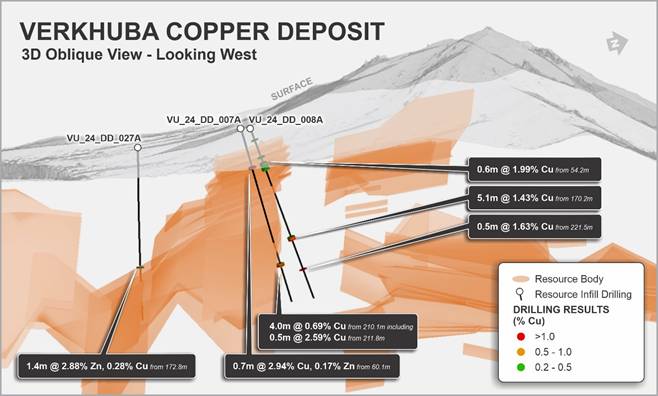
Figure 1: 2024 drilling demonstrating ore in gaps in the current resource envelope
East Star Resources Plc
Alex Walker, Chief Executive Officer
Tel: +44 (0)20 7390 0234 (via Vigo Consulting)
SI Capital (Corporate Broker)
Nick Emerson
Tel: +44 (0)1483 413 500
Vigo Consulting (Investor Relations)
Ben Simons / Peter Jacob
Tel: +44 (0)20 7390 0234
About East Star Resources Plc
East Star Resources is focused on the discovery and development of copper and gold in Kazakhstan. East Star's management are based permanently on the ground, supported by local expertise. The Company is pursuing three exploration strategies:
· A Volcanogenic Massive Sulphide (VMS) discovery with a maiden JORC MRE of 20.3Mt @ 1.16% copper, 1.54% zinc and 0.27% lead, in an infrastructure-rich region, amenable to a low capex development
· Copper porphyry and epithermal gold exploration, with multiple opportunities for Tier 1 deposits, supported by an initial $500k grant from BHP Xplor in 2024
· Sediment-hosted copper exploration with Getech where the initial targeting strategy is at no cost to East Star
Visit our website:
Follow us on social media:
LinkedIn: https://www.linkedin.com/company/east-star-resources/
X (formerly Twitter): https://twitter.com/EastStar_PLC
Subscribe to our email alert service to be notified whenever East Star releases news:
www.eaststarplc.com/newsalerts
The person who arranged for the release of this announcement was Alex Walker, CEO of the Company.
Competent Person Statement
Scientific or technical information in this disclosure related to exploration was reviewed by Dr Tremain Woods, a full-time employee of Discovery Ventures Kazakhstan Ltd, a 100% owned subsidiary of East Star Resources PLC. Dr Woods is a member in good standing with the Geological Society of South Africa. He has sufficient experience that is relevant to the commodity, style of mineralization or type of deposit under consideration and activity which he is undertaking to qualify as a Competent Person under the JORC code (2012 Edition).
Section 1 Sampling Techniques and Data
Criteria | JORC Code explanation | Commentary | ||||||||||||||||||||||||||||||||
Sampling techniques | · Nature and quality of sampling (e.g. cut channels, random chips, or specific specialised industry standard measurement tools appropriate to the minerals under investigation, such as down hole gamma sondes, or handheld XRF instruments, etc). These examples should not be taken as limiting the broad meaning of sampling. · Include reference to measures taken to ensure sample representivity and the appropriate calibration of any measurement tools or systems used. · Aspects of the determination of mineralisation that are Material to the Public Report. · In cases where 'industry standard' work has been done this would be relatively simple (e.g. 'reverse circulation drilling was used to obtain 1 m samples from which 3 kg was pulverised to produce a 30 g charge for fire assay'). In other cases, more explanation may be required, such as where there is coarse gold that has inherent sampling problems. Unusual commodities or mineralisation types (e.g. submarine nodules) may warrant disclosure of detailed information. | · Samples were taken from half drill core through sulphide or oxide mineralised intervals. · Sampling was conducted through mineralized intervals, with samples taken 2 meters into the hanging wall and footwall for intervals larger than 3 meters. For smaller intervals (<2 meters), only the mineralized portion is sampled. · Sample quality is ensured by a structured scheme, including blanks, certified reference materials (CRM), and duplicates. · Banks are inserted at the beginning and end of large, mineralized intervals, but not for smaller isolated intervals. · CRMs are inserted at every 50th and 100th sample to monitor consistency. · Coarse duplicates are taken every 40th and 80th sample, focused on mineralized portions, and 5% of mineralized pulps are sent for external lab analysis. · A total of 191.4 meters of core were sampled, with 216 core samples collected, including 12 blanks, 5 CRMs, and 5 duplicate samples. · Core samples were prepared by ALS Kazgeochemistry LLP, using standard methods like crushing, sieving (<70% passing 2mm), and milling (>85% passing 75μm). · Samples are analysed using the ME-ICP41 method for routine analysis, and for over-limit ore samples, the ME-OG62 method is used. | ||||||||||||||||||||||||||||||||
Drilling techniques | · Drill type (e.g. core, reverse circulation, open-hole hammer, rotary air blast, auger, Bangka, sonic, etc) and details (e.g. core diameter, triple or standard tube, depth of diamond tails, face-sampling bit or other type, whether core is oriented and if so, by what method, etc). | · Drilling was conducted using stand HQ sized diamond drilling technique. · Positive Group Kazakhstan undertook drilling. · Drill core was orientated using a REFLEX Act III orientation tool. All holes that weren't drilled vertically were orientated once solid core was intersected. · After drilling was completed, all holes were survey at 50 m intervals using the REFLEX EZ TRAC survey tool | ||||||||||||||||||||||||||||||||
Drill sample recovery | · Method of recording and assessing core and chip sample recoveries and results assessed. · Measures taken to maximise sample recovery and ensure representative nature of the samples. · Whether a relationship exists between sample recovery and grade and whether sample bias may have occurred due to preferential loss/gain of fine/coarse material. | · Core recovery was measured by East Star geologists, an average of 96 % recovery was recorded for the three completed drill holes. · Through the mineralized intervals, core recovery was 97% and greater. · There is no relationship between Cu, Pb or Zn grades and recovery. · There does not appear to have been any bias due to sample material loss/grain | ||||||||||||||||||||||||||||||||
Logging | · Whether core and chip samples have been geologically and geotechnically logged to a level of detail to support appropriate Mineral Resource estimation, mining studies and metallurgical studies. · Whether logging is qualitative or quantitative in nature. Core (or costean, channel, etc) photography. · The total length and percentage of the relevant intersections logged. | · East Star geologists undertook core logging. · Quantitative data for mineralization, lithology, structure, alteration, oxidation, and weathering was logged. · All recovered core was logged and photographed before and after sampling | ||||||||||||||||||||||||||||||||
Sub-sampling techniques and sample preparation | · If core, whether cut or sawn and whether quarter, half or all core taken. · If non-core, whether riffled, tube sampled, rotary split, etc and whether sampled wet or dry. · For all sample types, the nature, quality, and appropriateness of the sample preparation technique. · Quality control procedures adopted for all sub-sampling stages to maximise representivity of samples. · Measures taken to ensure that the sampling is representative of the in-situ material collected, including for instance results for field duplicate/second-half sampling. · Whether sample sizes are appropriate to the grain size of the material being sampled. | · Half core samples were collected for processing, the remaining half core is securely stored at East Star's core storage facilities in Verkhuba Village · Samples were crushed into chips; the chips were passed through a riffle splitter several times to obtain 500 g samples for milling. Crushed sample duplicates were analysed to confirm homogeneity of crushed samples. · Blank granite material was also inserted into the sample stream to ensure no contamination occurs during crushing or milling. · ALS laboratories weigh samples before and after sieving, to ensure that the thresholds for size fractions are met for each sample. | ||||||||||||||||||||||||||||||||
Quality of assay data and laboratory tests | · The nature, quality and appropriateness of the assaying and laboratory procedures used and whether the technique is considered partial or total. · For geophysical tools, spectrometers, handheld XRF instruments, etc, the parameters used in determining the analysis including instrument make and model, reading times, calibrations factors applied and their derivation, etc. · Nature of quality control procedures adopted (e.g. standards, blanks, duplicates, external laboratory checks) and whether acceptable levels of accuracy (i.e. lack of bias) and precision have been established. | · Aqua regia is a partial digest method well suited to base metal analyses, the method at ALS is internationally recognized and provides precise and accurate analyses. · Standard assay quality controls are used by the laboratory and East Star inserted QA/QC samples to evaluate and confirm the assay results. All QA/QC samples reported within limits. | ||||||||||||||||||||||||||||||||
Verification of sampling and assaying | · The verification of significant intersections by either independent or alternative company personnel. · The use of twinned holes. · Documentation of primary data, data entry procedures, data verification, data storage (physical and electronic) protocols. · Discuss any adjustment to assay data. | · Significant intersections were confirmed visually by East Star's exploration manager, no independent verification has been completed to date. · Logged data was inspected by East Star's exploration manager, any changes to the logged data were made before data was sent to Rock Solid based in Perth, Australia to be added to the maintained SQL database | ||||||||||||||||||||||||||||||||
Location of data points | · Accuracy and quality of surveys used to locate drill holes (collar and down-hole surveys), trenches, mine workings and other locations used in Mineral Resource estimation. · Specification of the grid system used. · Quality and adequacy of topographic control. | · Drill holes were surveyed using Garmin GPSMAP 62S handheld GPS device. DGPS surveys are planned once all drilling is completed. · Grid system WGS83, UTM44N · Some errors were noted in the elevation readings (from 5 - 14 m errors), these were adjusted to the elevation values of the LIDAR topography survey at the coordinates of the drill hole. · A drone LIDAR survey was conducted in 2023. The survey conducted by Aurora Geophysics used a drone mounted LIDAR sensor (DJI Zenmuse L1 Lidar on a DJI Matrice 300 RTK Combo D-RTK 2 drone) with a base station (Trimble R12 and Trimble TDL 450 radio modem). Flight lines were 90 m apart, and the resolution produced was 3.44 cm/pixel. The processed digital terrane model was checked against control points. | ||||||||||||||||||||||||||||||||
Data spacing and distribution | · Data spacing for reporting of Exploration Results. · Whether the data spacing and distribution is sufficient to establish the degree of geological and grade continuity appropriate for the Mineral Resource and Ore Reserve estimation procedure(s) and classifications applied. · Whether sample compositing has been applied. | · Historical drilling was drilled along NW-SE trending lines, the lines were spaced between 200-300m apart and drill holes were spaced between 100 and 250 m apart. · Current drilling aims to infill the spacing to ~120m. · The current drill holes have reduced the spacing within the Ultimate Open Pit generated by AMC in April 2024 to ~100m. · Geological distribution is sufficient for inferred resources throughout the ultimate pit shell (from April 2024). Some parts have sufficient spacing to be classified as indicated resources. · Significant intercepts are reported for results from 2024 drilling using the following parameters:
· | ||||||||||||||||||||||||||||||||
Orientation of data in relation to geological structure | · Whether the orientation of sampling achieves unbiased sampling of possible structures and the extent to which this is known, considering the deposit type. · If the relationship between the drilling orientation and the orientation of key mineralized structures is considered to have introduced a sampling bias, this should be assessed and reported if material. | · Sampling is taken for all intervals with sulphide mineralization. · Sampling adhered to lithological boundaries and additionally the hanging wall and footwall was sampled. · The ore body generally dips 30 to 40 to the SW. In some parts of the deposit the ore body dips steeper 80. These steeper areas of mineralization are interpreted to be the result of post mineralization deformation. · The ore body is cut by steep NE faults, these normal faults are interpreted to throw the lower ore body 20-40 m | ||||||||||||||||||||||||||||||||
Sample security | · The measures taken to ensure sample security. | · After samples are cut and bagged, they are sealed with zip ties. Samples were taken by East Star's senior geologist to ALS Oskemen. · The samples remained sealed until handed over to the laboratory. · Samples in the laboratory follow ALS standard procedures to ensure sample security. | ||||||||||||||||||||||||||||||||
Audits or reviews | · The results of any audits or reviews of sampling techniques and data. | · No audits were undertaken for this phase of sampling. · The sample methodology was checked and confirmed by the Competent Person for the AMC MRE (April 2024) |
Section 2 Reporting of Exploration Results
Criteria | JORC Code explanation | Commentary | |||||||||||||||||||||||||||||||||||||||||||||||||||||||||||||||||
Mineral tenement and land tenure status | · Type, reference name/number, location and ownership including agreements or material issues with third parties such as joint ventures, partnerships, overriding royalties, native title interests, historical sites, wilderness or national park and environmental settings. · The security of the tenure held at the time of reporting along with any known impediments to obtaining a licence to operate in the area. | · The Verkhuba polymetallic deposit is located in the eastern part of exploration license 1795-EL (the "License"). The license was issued to Discovery Ventures Kazakhstan Limited (the "DVK") on 27 July 2022 for initial period of 6 years with a possibility of further five years extension subject to reduction of the license area by 40%. · East Star resources have servitude for exploration from the local Akim (administrative head), the license can be explored under these agreements. · There are no known legal or security impediments to obtaining a mining license | |||||||||||||||||||||||||||||||||||||||||||||||||||||||||||||||||
Exploration done by other parties | · Acknowledgment and appraisal of exploration by other parties. | · Table of previously completed exploration
| |||||||||||||||||||||||||||||||||||||||||||||||||||||||||||||||||
Geology | · Deposit type, geological setting, and style of mineralisation. | · Verkhuba is Volcanogenic Massive Sulphide (VMS) deposit. Historical reports indicate that the type is felsic bimodal (or Kuroko-type). · The mineralization is lenticular massive and disseminated sulphides hosted in volcaniclastic units sub horizontal units. · Mineralisation occurs as a copper rich unit at shallower depths (<150 m) and a zinc-copper unit deeper (~200m) · The area has seen post depositional deformation in the form of folding and faulting | |||||||||||||||||||||||||||||||||||||||||||||||||||||||||||||||||
Drill hole Information | · A summary of all information material to the understanding of the exploration results including a tabulation of the following information for all Material drill holes: o easting and northing of the drill hole collar o elevation or RL (Reduced Level - elevation above sea level in metres) of the drill hole collar o dip and azimuth of the hole o down hole length and interception depth o hole length. · If the exclusion of this information is justified on the basis that the information is not Material and this exclusion does not detract from the understanding of the report, the Competent Person should clearly explain why this is the case. | · Drill hole information:
· Significant intercepts:
· No material information has been excluded from this report | |||||||||||||||||||||||||||||||||||||||||||||||||||||||||||||||||
Data aggregation methods | · In reporting Exploration Results, weighting averaging techniques, maximum and/or minimum grade truncations (e.g. cutting of high grades) and cut-off grades are usually Material and should be stated. · Where aggregate intercepts incorporate short lengths of high-grade results and longer lengths of low-grade results, the procedure used for such aggregation should be stated and some typical examples of such aggregations should be shown in detail. · The assumptions used for any reporting of metal equivalent values should be clearly stated. | · Significant intercepts are reported for results from 2024 drilling using the following parameters:
· No metal equivalents are reported. · Results for 32 elements received, but only Cu, Pb Zn is reported. | |||||||||||||||||||||||||||||||||||||||||||||||||||||||||||||||||
Relationship between mineralisation widths and intercept lengths | · These relationships are particularly important in the reporting of Exploration Results. · If the geometry of the mineralisation with respect to the drill hole angle is known, its nature should be reported. · If it is not known and only the down hole lengths are reported, there should be a clear statement to this effect (e.g. 'down hole length, true width not known'). | · The ore bodies are generally concordant to lithology (perpendicular to core axis). At some depths mineralization occurs as steeply dipping veins and veinlets with limited extent (low angles to core axis). · Drill holes were planned at 65 - 70° towards the north to intercept mineralisation at perpendicular angles. Mineralisation is typically sub-horizontal in core indicating that the true thickness is ~90% of the thickness of intervals in core. Therefore, one can assume that intervals thickness are as drilled. | |||||||||||||||||||||||||||||||||||||||||||||||||||||||||||||||||
Diagrams | · Appropriate maps and sections (with scales) and tabulations of intercepts should be included for any significant discovery being reported These should include but not be limited to a plan view of drill hole collar locations and appropriate sectional views. | · Relevant diagrams have been included in the body text | |||||||||||||||||||||||||||||||||||||||||||||||||||||||||||||||||
Balanced reporting | · Where comprehensive reporting of all Exploration Results is not practical, representative reporting of both low and high grades and/or widths should be practiced to avoid misleading reporting of Exploration Results. | · Grades below the cut off parameters have not been reported with these results. However, the mineralization has been noted within East Star's models and will inform future estimates | |||||||||||||||||||||||||||||||||||||||||||||||||||||||||||||||||
Other substantive exploration data | · Other exploration data, if meaningful and material, should be reported including (but not limited to): geological observations; geophysical survey results; geochemical survey results; bulk samples - size and method of treatment; metallurgical test results; bulk density, groundwater, geotechnical and rock characteristics; potential deleterious or contaminating substances. | · Not applicable | |||||||||||||||||||||||||||||||||||||||||||||||||||||||||||||||||
Further work | · The nature and scale of planned further work (e.g. tests for lateral extensions or depth extensions or large-scale step-out drilling). · Diagrams clearly highlighting the areas of possible extensions, including the main geological interpretations and future drilling areas, provided this information is not commercially sensitive. | · The three completed drill holes totalling 789 m of a planned 1,500 m of initial drilling. Should the drilling continue to provide satisfactory results a second phase of 3,000 m of infill drilling is planned. · Map of planned and completed drillholes is included in the body text. 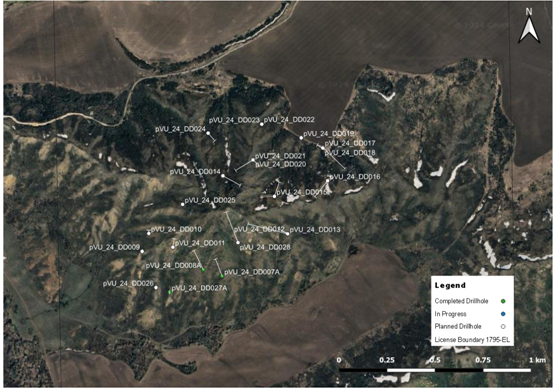 | |||||||||||||||||||||||||||||||||||||||||||||||||||||||||||||||||
Appendix 1: Assays Results
Hole_ID | Depth_From | Depth_To | Cu_pct | Pb_pct | Zn_pct | Notes |
VU_24_DD_007A | 0 | 10.2 | not assayed | |||
VU_24_DD_007A | 10.2 | 16 | no significant intercept | |||
VU_24_DD_007A | 16 | 17 | 0.175 | 0.0004 | 0.011 | HCORE |
VU_24_DD_007A | 17 | 20.6 | no significant intercept | |||
VU_24_DD_007A | 20.6 | 21.6 | 0.137 | 0.0006 | 0.0585 | HCORE |
VU_24_DD_007A | 21.6 | 28.1 | no significant intercept | |||
VU_24_DD_007A | 28.1 | 38 | not assayed | |||
VU_24_DD_007A | 38 | 42 | no significant intercept | |||
VU_24_DD_007A | 42 | 43 | 0.166 | 0.0009 | 0.037 | HCORE |
VU_24_DD_007A | 43 | 48.5 | no significant intercept | |||
VU_24_DD_007A | 48.5 | 58.1 | not assayed | |||
VU_24_DD_007A | 58.1 | 60.1 | no significant intercept | |||
VU_24_DD_007A | 60.1 | 60.8 | 2.94 | 0.0647 | 0.173 | HCORE |
VU_24_DD_007A | 60.8 | 61.5 | 0.265 | 0.0908 | 0.253 | HCORE |
VU_24_DD_007A | 61.5 | 74.2 | no significant intercept | |||
VU_24_DD_007A | 74.2 | 74.9 | 0.1975 | 0.0004 | 0.0483 | HCORE |
VU_24_DD_007A | 74.9 | 80.5 | no significant intercept | |||
VU_24_DD_007A | 80.5 | 81.3 | 0.129 | 0.0004 | 0.0297 | HCORE |
VU_24_DD_007A | 81.3 | 84.2 | no significant intercept | |||
VU_24_DD_007A | 84.2 | 186.5 | not assayed | |||
VU_24_DD_007A | 186.5 | 189 | no significant intercept | |||
VU_24_DD_007A | 189 | 203.2 | not assayed | |||
VU_24_DD_007A | 203.2 | 210.1 | no significant intercept | |||
VU_24_DD_007A | 210.1 | 211 | 0.908 | 0.0006 | 0.0238 | HCORE |
VU_24_DD_007A | 211 | 211.8 | no significant intercept | |||
VU_24_DD_007A | 211.8 | 212.3 | 2.59 | 0.001 | 0.0385 | HCORE |
VU_24_DD_007A | 212.3 | 213.1 | no significant intercept | |||
VU_24_DD_007A | 213.1 | 214.1 | 0.621 | 0.0004 | 0.0229 | HCORE |
VU_24_DD_007A | 214.1 | 218.4 | no significant intercept | |||
VU_24_DD_007A | 218.4 | 270 | not assayed | |||
VU_24_DD_008A | 0 | 14.4 | not assayed | |||
VU_24_DD_008A | 14.4 | 15.9 | no significant intercept | |||
VU_24_DD_008A | 15.9 | 16.9 | not assayed | |||
VU_24_DD_008A | 16.9 | 17.4 | no significant intercept | |||
VU_24_DD_008A | 17.4 | 18 | 0.286 | 0.0003 | 0.0078 | HCORE |
VU_24_DD_008A | 18 | 18.5 | no significant intercept | |||
VU_24_DD_008A | 18.5 | 38.9 | not assayed | |||
VU_24_DD_008A | 38.9 | 40.4 | no significant intercept | |||
VU_24_DD_008A | 40.4 | 43.8 | no data | |||
VU_24_DD_008A | 43.8 | 44.3 | no significant intercept | |||
VU_24_DD_008A | 44.3 | 44.9 | 0.317 | 0.0003 | 0.0146 | HCORE |
VU_24_DD_008A | 44.9 | 45.4 | 0.106 | 0.0003 | 0.0225 | HCORE |
VU_24_DD_008A | 45.4 | 51.5 | not assayed | |||
VU_24_DD_008A | 51.5 | 53.5 | no significant intercept | |||
VU_24_DD_008A | 53.5 | 54.2 | 0.304 | 0.0003 | 0.0249 | HCORE |
VU_24_DD_008A | 54.2 | 54.8 | 1.985 | 0.0011 | 0.0247 | HCORE |
VU_24_DD_008A | 54.8 | 55.7 | 0.259 | 0.0003 | 0.0102 | HCORE |
VU_24_DD_008A | 55.7 | 57.2 | no significant intercept | |||
VU_24_DD_008A | 57.2 | 58 | 0.275 | 0.0002 | 0.0093 | HCORE |
VU_24_DD_008A | 58 | 59 | no significant intercept | |||
VU_24_DD_008A | 59 | 60.5 | 0.1215 | 0.0002 | 0.0108 | HCORE |
VU_24_DD_008A | 60.5 | 61.5 | 0.41 | 0.0003 | 0.0115 | HCORE |
VU_24_DD_008A | 61.5 | 62 | 0.1365 | 0.0002 | 0.0089 | HCORE |
VU_24_DD_008A | 62 | 62.5 | 0.1175 | 0.0002 | 0.0089 | HCORE |
VU_24_DD_008A | 62.5 | 63.5 | 0.264 | 0.0002 | 0.008 | HCORE |
VU_24_DD_008A | 63.5 | 64.4 | 0.225 | -0.0002 | 0.0083 | HCORE |
VU_24_DD_008A | 64.4 | 67.4 | no significant intercept | |||
VU_24_DD_008A | 67.4 | 69.7 | not assayed | |||
VU_24_DD_008A | 69.7 | 71.1 | no significant intercept | |||
VU_24_DD_008A | 71.1 | 72 | 0.125 | 0.0003 | 0.0095 | HCORE |
VU_24_DD_008A | 72 | 72.5 | no significant intercept | |||
VU_24_DD_008A | 72.5 | 78.3 | not assayed | |||
VU_24_DD_008A | 78.3 | 87 | no significant intercept | |||
VU_24_DD_008A | 87 | 129.8 | not assayed | |||
VU_24_DD_008A | 129.8 | 130.3 | no significant intercept | |||
VU_24_DD_008A | 130.3 | 131.7 | no significant intercept | |||
VU_24_DD_008A | 131.7 | 141.7 | not assayed | |||
VU_24_DD_008A | 141.7 | 145.6 | no significant intercept | |||
VU_24_DD_008A | 145.6 | 146.2 | 0.1975 | 0.0005 | 0.0113 | HCORE |
VU_24_DD_008A | 146.2 | 152 | no significant intercept | |||
VU_24_DD_008A | 152 | 166.1 | not assayed | |||
VU_24_DD_008A | 166.1 | 170.2 | no significant intercept | |||
VU_24_DD_008A | 170.2 | 170.8 | 0.306 | 0.0133 | 0.026 | HCORE |
VU_24_DD_008A | 170.8 | 172 | 1.02 | 0.0074 | 0.0484 | HCORE |
VU_24_DD_008A | 172 | 173.1 | 0.965 | 0.0081 | 0.0374 | HCORE |
VU_24_DD_008A | 173.1 | 174.2 | 2.42 | 0.0062 | 0.0621 | HCORE |
VU_24_DD_008A | 174.2 | 175.3 | 1.97 | 0.0051 | 0.0834 | HCORE |
VU_24_DD_008A | 175.3 | 177.3 | no significant intercept | |||
VU_24_DD_008A | 177.3 | 203.5 | not assayed | |||
VU_24_DD_008A | 203.5 | 205.5 | no significant intercept | |||
VU_24_DD_008A | 205.5 | 214.3 | no data | |||
VU_24_DD_008A | 214.3 | 215.6 | no significant intercept | |||
VU_24_DD_008A | 215.6 | 216.1 | 0.119 | 0.0004 | 0.0167 | HCORE |
VU_24_DD_008A | 216.1 | 221 | not assayed | |||
VU_24_DD_008A | 221 | 221.5 | no significant intercept | |||
VU_24_DD_008A | 221.5 | 222 | 1.63 | 0.0027 | 0.0206 | HCORE |
VU_24_DD_008A | 222 | 222.5 | no significant intercept | |||
VU_24_DD_008A | 222.5 | 268 | not assayed | |||
VU_24_DD_027A | 0 | 47.9 | not assayed | |||
VU_24_DD_027A | 47.9 | 49.5 | no significant intercept | |||
VU_24_DD_027A | 49.5 | 73.2 | not assayed | |||
VU_24_DD_027A | 73.2 | 98 | no significant intercept | |||
VU_24_DD_027A | 98 | 105 | not assayed | |||
VU_24_DD_027A | 105 | 111.9 | no significant intercept | |||
VU_24_DD_027A | 111.9 | 164.5 | not assayed | |||
VU_24_DD_027A | 164.5 | 166.2 | no significant intercept | |||
VU_24_DD_027A | 166.2 | 172.3 | not assayed | |||
VU_24_DD_027A | 172.3 | 172.8 | no significant intercept | |||
VU_24_DD_027A | 172.8 | 173.5 | 0.273 | 0.0112 | 3.59 | HCORE |
VU_24_DD_027A | 173.5 | 174.2 | 0.278 | 0.0042 | 2.16 | HCORE |
VU_24_DD_027A | 174.2 | 174.8 | no significant intercept | |||
VU_24_DD_027A | 174.8 | 185.3 | not assayed | |||
VU_24_DD_027A | 185.3 | 188 | no significant intercept | |||
VU_24_DD_027A | 188 | 194.5 | not assayed | |||
VU_24_DD_027A | 194.5 | 196.9 | no significant intercept | |||
VU_24_DD_027A | 196.9 | 221.8 | not assayed | |||
VU_24_DD_027A | 221.8 | 228 | no significant intercept | |||
VU_24_DD_027A | 228 | 251 | not assayed |