

THIS ANNOUNCEMENT CONTAINS INSIDE INFORMATION FOR THE PURPOSES OF ARTICLE 7 OF REGULATION 2014/596/EU WHICH IS PART OF DOMESTIC UK LAW PURSUANT TO THE MARKET ABUSE (AMENDMENT) (EU EXIT) REGULATIONS (SI 2019/310) ("UK MAR"). UPON THE PUBLICATION OF THIS ANNOUNCEMENT, THIS INSIDE INFORMATION (AS DEFINED IN UK MAR) IS NOW CONSIDERED TO BE IN THE PUBLIC DOMAIN.
NOT FOR RELEASE, PUBLICATION OR DISTRIBUTION, IN WHOLE OR IN PART, DIRECTLY OR INDIRECTLY IN OR INTO THE UNITED STATES, AUSTRALIA, CANADA, JAPAN, THE REPUBLIC OF SOUTH AFRICA OR ANY OTHER JURISDICTION WHERE TO DO SO WOULD CONSTITUTE A VIOLATION OF THE RELEVANT LAWS OF SUCH JURISDICTION.
This RNS replaces RNS 9505B released on 5 November 2026 at 07:18 a.m. entitled "Strong Rare Earth Recoveries." The previous RNS contained Internal Completion Notes. The Company confirms that, at the time of publication, all results had been verified, solid assays reconciled and reported recoveries confirmed. All information contained in the original announcement (reissued below) is otherwise unchanged.
5 November 2026
Cobra Resources plc
("Cobra" or the "Company")
Strong Rare Earth Recoveries
Strong recoveries of valuable rare earths support strategy to maximise value and build an efficient, scalable operation
88.4% TREY, 81.2% samarium and 75.6% yttrium liquor extraction in ISR recoverable formation
Cobra (LSE: COBR) is advancing the Wudinna Rare Earth and the Manna Hill Copper projects, both in South Australia.
Wudinna is an advanced exploration/early development project that includes the Boland and Head rare earth discoveries and associated Mineral Resource Estimates ("MRE").
Manna Hill is an advanced exploration project that includes the Blue Rose, Shadow Rose and Neptune Rose copper discoveries.
A further 42 drill return samples from the Boland and Head discovery areas were forwarded to the Australian Nuclear Science and Technology Organisation ("ANSTO") for 24 hour ambient temperature leach. A pH of 3 was targeted using a 0.5 Molar ammonium sulphate lixiviant solution.
Encouraging recoveries of valuable rare earth elements and yttrium were returned supporting the company's strategy of prioritising recoverable value, optimising product quality and assessing a staged development pathway.
Highlights
• At the Boland Mineral Resource area, earlier Cobra testwork has shown that the Pidinga formation is amenable to In Situ Recovery ("ISR") of rare earth metals. Results from this testwork yielded recoveries up to:
· 88 % of total rare earth plus yttrium ("TREY")
· 87 % of neodymium plus praseodymium ("Nd+Pr")
· 73 % of dysprosium plus terbium ("Dy+Tb")
· 81 % of samarium ("Sm")
· 76 % of yttrium ("Y")
• At the Head Mineral Resource area, recoveries on Pidinga formation samples achieved up to:
· 66 % of TREY
· 62 % of Nd+Pr
· 58 % of Dy+Tb
· 64 % of Sm
· 57 % of Y
• All 3 samples of Narlaby formation mineralisation at Head returned strongly encouraging metal recoveries up to:
· 88 % of TREY
· 88 % of Nd+Pr
· 93 % of Dy+Tb
· 88 % of Sm
· 84 % of Y
• The younger Narlaby formation at Head is both permeable and mineralised but for the moment it has not been shown to be ISR amenable for MRE purposes.
• The Company will now study the Narlaby formation in greater detail with the objective of establishing its whole or partial inclusion in the ISR portion of the Head MRE.
• The project's development focus remains on recoverable value and operating efficiency - being key value drivers for rare earth operations. Diagnostic results will be assessed alongside permeability, intact-core testing and field performance aimed at delivering confidence in scoping study estimates and informing resource expansion works.
Rupert Verco, Managing Director of Cobra, commented
"These results provide us with greater clarity in identifying the materials that can contribute most to Wudinna's development. One Pidinga sample delivered 88.4% TREY extraction, including 81.2% samarium and 75.6% yttrium, alongside strong magnet rare earth extraction.
Our strategy is to maximise recoverable value and build an efficient, scalable operation. This programme aids in identifying both the opportunities and the variability that must be reflected in the scoping study. The next step is to establish how these laboratory results translate into an integrated mine plan and field performance.
The exceptional recovery results within the Narlaby formation present as a compelling opportunity to bring this existing material classified as open pit MRE mineralisation into the ISR recoverable resources - the team is evaluating the next work streams to enable this conversion."
Follow this link to watch a short video of CEO & MD Rupert Verco discussing this announcement: https://investors.cobraplc.com/link/y0VQXr
Results in context
These diagnostic test results provide a consistent laboratory basis that adds to the already robust metallurgy dataset that enables the evaluation of economics including reagent inputs and adjustment to ISR parameters.
Table 1 Diagnostic liquor extractions by lithology
Lithology | n | Nd+Pr % | Dy+Tb % | Y % | Sm % | TREY % |
Pidinga | 25 | 48.3 | 50.9 | 50.3 | 48.1 | 48.1 |
Garford | 9 | 47.1 | 48.0 | 39.3 | 47.0 | 45.9 |
Narlaby | 3 | 71.6 | 72.9 | 63.3 | 73.9 | 69.8 |
All samples | 42 | 48.2 | 50.2 | 46.8 | 48.4 | 47.1 |
Table 1 shows arithmetic mean (minimum-maximum), rounded to one decimal place. Nd+Pr and Dy+Tb are combined elemental extraction percentages, not ratios. TREY comprises La-Lu, plus Y. Results are elemental and are not reported as oxide grades. No extraction cut-off has been applied to the 42 reported records.
Supporting Wudinna's development strategy
The programme supports the companies bottom-quartile cost objective by identifying where recoverable value and operating efficiency should be tested. Including Y and Sm alongside magnet rare earths broadens the elemental recovery assessment, although saleable recovery, specifications and commercial contributions require downstream testing and customer assessment. Verified technical and product data will support partnering and offtake discussions, financing and permitting studies, and assessment of a staged development pathway. These remain strategic objectives from which the company aims to commercialise the Wudinna REE project by objective validation.
Next steps
• A large scale ISR column has been prepared to replicate the proposed small scale production study for crude precipitation, transport and re-dissolution.
• Define metallurgical domains and assess the relationship between extraction, mineralogy and aquifer permeability.
• Trade-off sensitivity evaluation, evaluating optimal economics through recovery/ reagent trade-off analysis
Figure 1: Distribution of recovery results - Boland Prospect
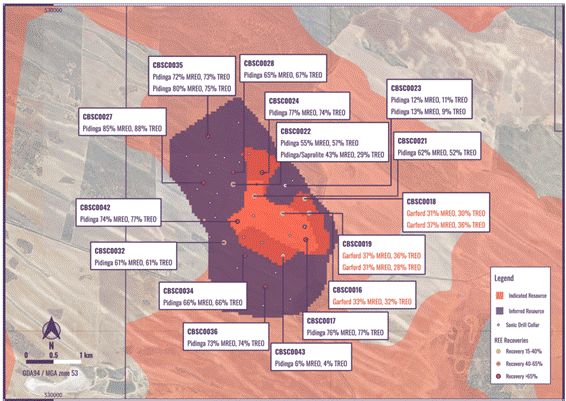
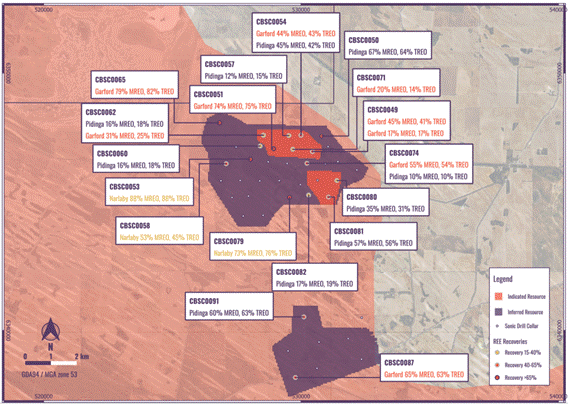
Figure 2: Distribution of recovery results - Head Prospect
About the Wudinna Rare Earth Project
Cobra has discovered what it believes to be a unique, scalable instance where ionic rare earth elements - containing economically attractive grades of valuable heavy and magnet rare earths - occur within a permeable horizon confined between horizons of impermeable clay.
Bench scale ISR testing has confirmed that this mineralisation is amenable to ISR recovery techniques. ISR techniques are currently in use (and have been used successfully for decades) in geologically similar environments, to recover uranium in South Australia which maintains a well-established ISR regulatory system.
Cobra is evaluating the technical and economic potential for ISR at Boland. Laboratory results support further assessment, but commercial recoveries, costs and environmental performance remain subject to integrated testing, studies and field validation.
Further information relating to Wudinna and these results are presented in the appendices.
Enquiries:
Cobra Resources plc Rupert Verco (Australia) Dan Maling (UK) | via Vigo Consulting +44 (0)20 7390 0234 |
Hannam & Partners (Joint Broker) Leif Powis Andrew Chubb | +44 (0) 20 7907 8500 |
SI Capital Limited (Joint Broker) Nick Emerson Sam Lomanto | +44 (0)1483 413 500 |
Vigo Consulting (Financial Public Relations) Ben Simons George Pope | +44 (0)20 7390 0234 cobra@vigoconsulting.com |
The person who arranged for the release of this announcement was Rupert Verco, Managing Director of the Company.
Information in this announcement relates to exploration results that have been reported in the following announcements:
· Exploration update: "Resource drilling completion", dated 5 May 2026
· Metallurgical update: "Boland Delivers Industry-Leading Heavy Rare Earth Product" dated 2 March 2026
· Metallurgical update: "Test work upgrades Boland liquor through 100% cerium removal resulting in a large increase in product value", dated 9th December 2025
· Exploration update: "Successful first pass suppression of cerium to maximise valuable dysprosium and terbium", dated 20 November 2025
· Exploration update: "Exceptional Results - Infield Permeability Study", dated 17 November 2025
· Exploration update: "Metallurgical Optimisation Upside", dated 20 October 2025
· Exploration update: "Exceptional Metallurgical Results from ISR Column", dated 14 October 2025
· Exploration update: "Met Study Supports Even Lower-Cost Recoveries", dated 11th September 2025
· Exploration update: "Low-Cost Recoveries from Optimised Testing", dated 11th August 2025
· Exploration update: "Rare Earth ISR System beyond Boland", dated 4th August 2025
· Exploration update: "Favourable Boland Metallurgical Results", dated 21st July 2025
· Exploration update: "Boland Project Update", dated 26th June 2025
· Wudinna Project Update: "Boland Aircore Drill Results", dated 25th February 2025
· Wudinna Project Update: "Further Positive Metallurgy Results from Boland Project", dated 16 December 2024
· Wudinna Project Update: "2nd Bench Scale ISR Study & £1.7M Placing", dated 26 November 2024
· Wudinna Project Update: "ISR Bench Scale Study Completion", dated 4 November 2024
· Wudinna Project Update: "ISR bench scale study delivers exceptional results", dated 1 October 2024
· Wudinna Project Update: "ISR bench scale update - Exceptionally high recoveries with low impurities and low acid consumption; on path to disrupt global supply
of heavy rare earths", dated 28 August 2024
· Wudinna Project Update: "ISR bench scale update -Further metallurgical success at world leading ISR rare earth project", dated 11 July 2024
· Wudinna Project Update: "ISR bench scale update - Exceptional head grades revealed", dated 18 June 2024
· Wudinna Project Update: "Re-Assay Results Confirm High Grades Over Exceptional Scale at Boland", dated 26 April 2024
Competent Person's Statement
The information in this report that relates to metallurgical results is based on information compiled by Cobra Resources and reviewed by Mr James Davidson who is Principal at Rendement and a Fellow of the Australasian Institute of Mining and Metallurgy (FAusIMM). Mr Davidson has sufficient experience that is relevant to the metallurgical testing which was undertaken to qualify as a Competent Person as defined in the 2012 edition of the "Australasian Code for Reporting of Exploration Results, Mineral Resources and Ore Reserves". Mr Davidson consents to the inclusion in this report of the matters based on this information in the form and context in which it appears.
Information in this announcement has been assessed by Mr Rupert Verco, a Fellow of the Australasian Institute of Mining and Metallurgy. Mr Verco is an employee of Cobra and has more than 18 years' industry experience which is relevant to the style of mineralisation, deposit type, and activity which he is undertaking to qualify as a Competent Person as defined in the 2012 Edition of the Australasian Code for Reporting Exploration Results, Mineral Resources and Ore Reserves of JORC. This includes 13 years of Mining, Resource Estimation and Exploration.
About Cobra
Cobra Resources is developing two South Australian critical minerals opportunities: the Wudinna ionic rare earth project and the Manna Hill copper project.
At Wudinna, Cobra has established a maiden JORC-compliant Mineral Resource Estimate of 150 Mt grading 470 ppm total rare earth oxides (TREO), with significant potential for further resource growth. The resource will underpin a Scoping Study as Cobra advances its staged development strategy, incorporating low-disturbance controlled-aquifer in situ recovery (ISR), targeting bottom-quartile production costs and the potential to establish the Western World's first rare earths ISR operation.
Cobra is also advancing the Manna Hill copper project in the Nackara Arc, where drilling has confirmed copper-gold mineralisation across multiple prospects, including shallow skarn-hosted discoveries and encouraging indications of a potentially larger porphyry copper-gold system.
Cobra also holds a significant shareholding in Barton Gold (ASX: BDG), following the 2025 sale of its non-core gold assets for A$15 million in cash and shares.
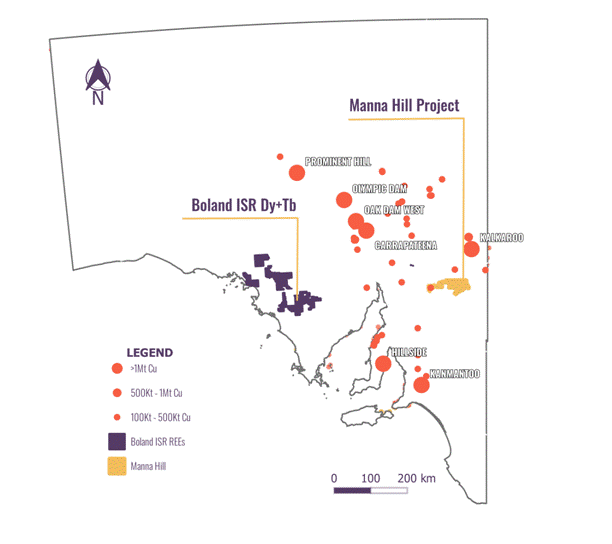
Regional map showing Cobra's tenements in South Australia
Follow us on social media:
LinkedIn: https://www.linkedin.com/company/cobraresourcesplc
X: https://twitter.com/Cobra_Resources
Engage with us by asking questions, watching video summaries and seeing what other shareholders have to say. Navigate to our Interactive Investor hub here: https://investors.cobraplc.com/
Subscribe to our news alert service: https://investors.cobraplc.com/auth/signup
Appendix 1: Background information - the Boland Project and ISR
· The Boland Project was discovered by Cobra in 2023. Mineralisation is ionically bound to clays and organics within palaeochannel sands within the Narlaby Palaeochannel
· Mineralisation occurs within a permeable sand within an aquifer that is saltier than sea water and is confined by impermeable clays
· The proposed ISR process would use engineered injection and extraction well arrays to circulate lixiviant through suitable permeable mineralisation. Hydraulic control and environmental performance require field validation.
· Once REEs are mobile in solution in groundwater, it is also possible, from an engineering standpoint, to recover the solution to surface via extraction drillholes, without any need for excavation or ground disturbance
· The proposed ISR route could reduce requirements for excavation and conventional solids handling. Capital intensity and operating costs remain to be assessed through engineering studies.
· Ionic mineralisation is highly desirable owing to its high weighting of valuable HREOs and the cost-effective method in which REEs can be desorbed
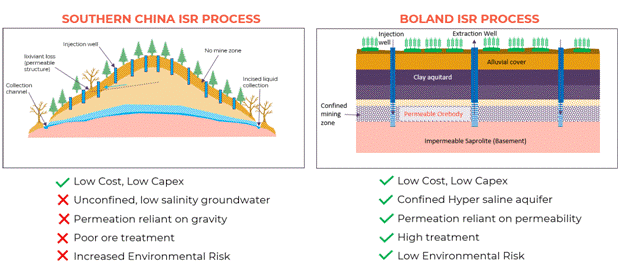
· The proposed confined-aquifer approach at Boland differs from gravity-driven in situ leaching of weathered ionic clay deposits. Site-specific hydraulic control and restoration performance must be demonstrated.
· Confined-aquifer ISR has precedents in uranium production. Its application to rare earths at Boland requires site-specific technical and environmental validation.
· Cobra aims to assess the economic and environmental performance of rare earth recovery through a controlled confined-aquifer ISR process.
Figure A1: Comparison between the Chinese and the proposed Boland process for ISR mining of REEs
Appendix 2: Diagnostic sample results
Table 1 Boland & Head TREY and 24-hour elemental liquor extraction. Intervals are downhole; true widths are not established here. Test and sample number prefixes are shown in the column headers.
Tbp = Pidinga formation, Tig = Garford formation, Tin = Narlaby Formation
CO-DIA | LAN Sample | Hole ID | Unit | From-to | Head TREY | Nd+Pr | Dy+Tb | Y | Sm | TREY |
01 | 6001 | CBSC0082 | Tbp | 25.00-25.50 | 278.6 | 14.9 | 36.5 | 49.3 | 23.5 | 19.4 |
02 | 6002 | CBSC0081 | Tbp | 26.10-29.90 | 1144.8 | 55.7 | 66.9 | 73.6 | 55.6 | 55.9 |
03 | 6003 | CBSC0050 | Tbp | 44.07-47.55 | 608.2 | 65.7 | 73.3 | 71.7 | 66.2 | 64.2 |
04 | 6004 | CBSC0060 | Tbp | 32.32-34.50 | 408.2 | 14.1 | 30.1 | 38.6 | 16.3 | 17.8 |
05 | 6005 | CBSC0062 | Tbp | 41.75-44.00 | 316.5 | 14.4 | 29.5 | 40.1 | 18.5 | 18.3 |
06 | 6006 | CBSC0057 | Tbp | 40.15-41.00 | 303.4 | 11.1 | 25.0 | 41.3 | 17.6 | 15.4 |
07 | 6007 | CBSC0080 | Tbp | 35.20-37.40 | 438.1 | 33.8 | 48.2 | 44.1 | 38.5 | 30.7 |
08 | 6008 | CBSC0022 | Tbp | 37.70-38.60 | 427.2 | 55.6 | 53.4 | 52.6 | 50.2 | 56.9 |
09 | 6009 | CBSC0032 | Tbp | 44.75-46.20 | 445.5 | 61.8 | 56.5 | 52.2 | 55.2 | 60.7 |
10 | 6010 | CBSC0018 | Tig | 14.00-17.00 | 6007.6 | 31.4 | 26.2 | 24.3 | 25.6 | 30.2 |
11 | 6011 | CBSC0018 | Tig | 17.00-21.10 | 470.9 | 35.8 | 45.6 | 34.9 | 37.0 | 36.0 |
12 | 6012 | CBSC0028 | Tbp | 41.21-42.60 | 335.5 | 65.4 | 63.5 | 63.1 | 61.5 | 67.0 |
13 | 6013 | CBSC0079 | Tin | 8.70-10.50 | 654.7 | 70.2 | 92.6 | 84.1 | 71.9 | 76.2 |
14 | 6014 | CBSC0024 | Tbp | 31.00-31.82 | 248.5 | 78.4 | 66.4 | 59.3 | 69.1 | 73.7 |
15 | 6015 | CBSC0027 | Tbp | 40.50-43.70 | 755.2 | 86.9 | 73.0 | 75.6 | 81.2 | 88.4 |
16 | 6016 | CBSC0036 | Tbp | 34.90-35.50 | 486.0 | 74.1 | 62.1 | 61.0 | 62.4 | 74.0 |
17 | 6017 | CBSC0042 | Tbp | 47.00-48.00 | 713.4 | 75.0 | 65.0 | 67.4 | 65.1 | 77.1 |
18 | 6018 | CBSC0016 | Tig | 15.77-21.00 | 546.3 | 31.6 | 41.6 | 38.2 | 34.2 | 32.0 |
19 | 6019 | CBSC0053 | Tin | 15.65-17.00 | 671.4 | 87.5 | 87.8 | 79.3 | 87.5 | 88.3 |
20 | 6020 | CBSC0087 | Tig | 18.80-19.95 | 1279.4 | 65.6 | 55.7 | 43.1 | 62.3 | 62.6 |
22 | 6022 | CBSC0019 | Tig | 17.00-21.20 | 534.6 | 28.8 | 50.8 | 37.0 | 34.8 | 27.7 |
Appendix 3: Diagnostic sample results continued
Table 2: Boland & Head TREY and 24-hour elemental liquor extraction. Intervals are downhole.
Tbp = Pidinga formation, Tig = Garford formation, Tin = Narlaby Formation
CO-DIA | LAN Sample | Hole ID | Unit | From-to | Head TREY | Nd+Pr | Dy+Tb | Y | Sm | TREY |
23 | 6023 | CBSC0017 | Tbp | 26.35-28.00 | 1447.0 | 76.4 | 67.1 | 64.8 | 69.5 | 76.6 |
24 | 6024 | CBSC0035 | Tbp | 41.95-44.15 | 689.1 | 74.2 | 57.4 | 53.2 | 70.3 | 72.6 |
25 | 6025 | CBSC0035 | Tbp | 32.60-33.65 | 249.7 | 80.0 | 80.6 | 66.7 | 81.1 | 74.7 |
26 | 6026 | CBSC0091 | Tbp | 22.55-23.60 | 373.1 | 60.0 | 57.1 | 52.7 | 54.7 | 63.4 |
27 | 6027 | CBSC0062 | Tig | 30.38-32.55 | 682.4 | 32.5 | 29.2 | 18.2 | 36.7 | 24.8 |
28 | 6028 | CBSC0065 | Tig | 17.23-17.58 | 865.1 | 79.3 | 74.6 | 68.7 | 74.3 | 81.7 |
29 | 6029 | CBSC0054 | Tig | 37.15-38.38 | 4628.7 | 44.1 | 46.3 | 36.9 | 43.4 | 43.3 |
30 | 6030 | CBSC0058 | Tin | 8.00-9.77 | 247.0 | 57.1 | 38.4 | 26.4 | 62.2 | 45.1 |
31 | 6031 | CBSC0022 | Tbp - Pbw | 50.00-52.00 | 84.3 | 43.9 | 37.6 | 30.7 | 41.8 | 28.7 |
32 | 6032 | CBSC0049 | Tigu | 33.30-36.00 | 380.0 | 45.4 | 41.2 | 34.5 | 44.0 | 41.3 |
33 | 6033 | CBSC0049 | Tigl | 42.70-43.70 | 1102.3 | 14.7 | 39.7 | 45.3 | 23.8 | 16.7 |
34 | 6034 | CBSC0074 | Tigu | 26.60-27.35 | 723.7 | 56.1 | 44.5 | 33.4 | 57.3 | 54.5 |
35 | 6035 | CBSC0051 | Tig | 34.00-34.95 | 595.4 | 75.0 | 61.9 | 52.7 | 75.1 | 75.2 |
36 | 6036 | CBSC0074 | Tbp | 34.05-34.65 | 485.9 | 8.5 | 25.0 | 33.4 | 10.5 | 10.0 |
37 | 6037 | CBSC0071 | Tigu | 27.80-33.75 | 309.8 | 18.8 | 24.7 | 22.1 | 20.2 | 13.7 |
38 | 6038 | CBSC0023 | Tbp | 22.10-23.00 | 328.7 | 11.3 | 19.9 | 12.7 | 14.4 | 11.0 |
39 | 6039 | CBSC0023 | Tbp | 32.00-32.60 | 759.9 | 11.8 | 32.3 | 17.6 | 35.6 | 9.3 |
40 | 6040 | CBSC0043 | Tbp | 45.40-47.10 | 547.1 | 5.8 | 12.2 | 11.2 | 8.4 | 4.2 |
41 | 6041 | CBSC0021 | Tbp | 29.00-32.75 | 256.4 | 61.5 | 64.5 | 47.0 | 66.0 | 52.4 |
42 | 6042 | CBSC0034 | Tbp | 43.90-44.45 | 466.1 | 66.6 | 57.5 | 56.6 | 64.3 | 66.0 |
43 | 6043 | CBSC0054 | Tbp | 46.20-47.27 | 510.8 | 44.5 | 48.7 | 51.9 | 47.0 | 42.0 |
Appendix 4:
Table 3 Collar details.
Hole ID | Easting | Northing | RL | ||
CBSC0017 | 534593.1 | 6365294.6 | 100.9 | ||
CBSC0035 | 532811.0 | 6367178.2 | 106.0 | ||
CBSC0035 | 532811.0 | 6367178.2 | 106.0 | ||
CBSC0091 | 530108.7 | 6340528.6 | 62.4 | ||
CBSC0062 | 528538.4 | 6347587.9 | 84.2 | ||
CBSC0065 | 526834.9 | 6348071.6 | 72.4 | ||
CBSC0054 | 529998.4 | 6347584.8 | 89.6 | ||
CBSC0058 | 527092.4 | 6346478.3 | 63.4 | ||
CBSC0022 | 533273.8 | 6366299.5 | 101.7 | ||
CBSC0049 | 530441.3 | 6346952.8 | 84.9 | ||
CBSC0049 | 530441.3 | 6346952.8 | 84.9 | ||
CBSC0074 | 530228.2 | 6346494.1 | 77.9 | ||
CBSC0051 | 528933.1 | 6347065.1 | 81.3 | ||
CBSC0074 | 530228.2 | 6346494.1 | 77.9 | ||
CBSC0071 | 529681.5 | 6347041.1 | 82.0 | ||
CBSC0023 | 534222.7 | 6366279.0 | 103.1 | ||
CBSC0023 | 534222.7 | 6366279.0 | 103.1 | ||
CBSC0043 | 534180.6 | 6365000.1 | 106.2 | ||
CBSC0021 | 533659.0 | 6366086.2 | 100.0 | ||
CBSC0034 | 533486.9 | 6365000.9 | 111.4 | ||
CBSC0054 | 529998.4 | 6347584.8 | 89.6 |
Appendix : JORC Code 2012
Table 4
Criteria | JORC Code explanation | Commentary |
Sampling techniques | · Nature and quality of sampling (eg cut channels, random chips, or specific specialised industry standard measurement tools appropriate to the minerals under investigation, such as down hole gamma sondes, or handheld XRF instruments, etc). These examples should not be taken as limiting the broad meaning of sampling. · Include reference to measures taken to ensure sample representivity and the appropriate calibration of any measurement tools or systems used. · Aspects of the determination of mineralisation that are Material to the Public Report. · In cases where 'industry standard' work has been done this would be relatively simple (eg 'reverse circulation drilling was used to obtain 1 m samples from which 3 kg was pulverised to produce a 30 g charge for fire assay'). In other cases more explanation may be required, such as where there is coarse gold that has inherent sampling problems. Unusual commodities or mineralisation types (eg submarine nodules) may warrant disclosure of detailed information. | The workbook links 42 numerical tests to sample IDs, drillholes and downhole intervals. It does not establish sample selection or representativity across the resource. Complete Table 3 with collection methods, composite components, masses and selection criteria. |
Drilling techniques | · Drill type (eg core, reverse circulation, open-hole hammer, rotary air blast, auger, Bangka, sonic, etc) and details (eg core diameter, triple or standard tube, depth of diamond tails, face-sampling bit or other type, whether core is oriented and if so, by what method, etc). | The framework describes aircore and sonic drilling, but a verified method-by-hole register for the current tests is not supplied. Complete Table 3, including core diameter, relevant drilling dates and recovery procedures. |
Drill sample recovery | · Method of recording and assessing core and chip sample recoveries and results assessed. · Measures taken to maximise sample recovery and ensure representative nature of the samples. · Whether a relationship exists between sample recovery and grade and whether sample bias may have occurred due to preferential loss/gain of fine/coarse material. | Current sample recoveries and the assessment of preferential loss of fines are not supplied. Establish whether drilling, groundwater or handling biased the tested material and disclose the outcome. |
Logging | · Whether core and chip samples have been geologically and geotechnically logged to a level of detail to support appropriate Mineral Resource estimation, mining studies and metallurgical studies. · Whether logging is qualitative or quantitative in nature. Core (or costean, channel, etc) photography. · The total length and percentage of the relevant intersections logged. | Confirm geological and geotechnical logging coverage, qualitative or quantitative methods, core photography and the basis for Tbp, Tig, Tin, Tigu, Tigl and Tbp-Pbw assignments. |
Sub-sampling techniques and sample preparation | · If core, whether cut or sawn and whether quarter, half or all core taken. · If non-core, whether riffled, tube sampled, rotary split, etc and whether sampled wet or dry. · For all sample types, the nature, quality and appropriateness of the sample preparation technique. · Quality control procedures adopted for all sub-sampling stages to maximise representivity of samples. · Measures taken to ensure that the sampling is representative of the in situ material collected, including for instance results for field duplicate/second-half sampling. · Whether sample sizes are appropriate to the grain size of the material being sampled. | Operational records describe pulverised feeds of approximately 80 g per test. Confirm drying, crushing, pulverising size, splitting, homogenisation, moisture basis and duplicate preparation. Pulverisation limits extrapolation to intact aquifer material. |
Quality of assay data and laboratory tests | · The nature, quality and appropriateness of the assaying and laboratory procedures used and whether the technique is considered partial or total. · For geophysical tools, spectrometers, handheld XRF instruments, etc, the parameters used in determining the analysis including instrument make and model, reading times, calibrations factors applied and their derivation, etc. · Nature of quality control procedures adopted (eg standards, blanks, duplicates, external laboratory checks) and whether acceptable levels of accuracy (ie lack of bias) and precision have been established. | Diagnostic conditions are stated in the main text. The framework describes ALS fusion ICP-MS head analyses and ANSTO liquor analyses, but current certificates and method mapping must be confirmed. Supply detection limits, standards, blanks, duplicates, repeats and accuracy/precision assessments. |
Verification of sampling and assaying | · The verification of significant intersections by either independent or alternative company personnel. · The use of twinned holes. · Documentation of primary data, data entry procedures, data verification, data storage (physical and electronic) protocols. · Discuss any adjustment to assay data. | Reported values are existing workbook liquor extraction outputs, not independently validated recoveries. Accountability formula errors and residue-mass treatment require correction. Provide independent checks, original certificates and a signed reconciliation; see internal completion notes. |
Location of data points | · Accuracy and quality of surveys used to locate drill holes (collar and down-hole surveys), trenches, mine workings and other locations used in Mineral Resource estimation. · Specification of the grid system used. · Quality and adequacy of topographic control. | Hole identifiers and intervals appear in Table 2. Coordinates, RL, datum, survey methods and accuracy for these holes are to be completed in Table 3; do not rely on historical survey statements without verification. |
Data spacing and distribution | · Data spacing for reporting of Exploration Results. · Whether the data spacing and distribution is sufficient to establish the degree of geological and grade continuity appropriate for the Mineral Resource and Ore Reserve estimation procedure(s) and classifications applied. · Whether sample compositing has been applied. | The programme includes 42 numerical samples across multiple coded units and two prospect codes. Confirm spatial coverage and sample-selection rationale. No claim of resource-wide metallurgical representativity is made. |
Orientation of data in relation to geological structure | · Whether the orientation of sampling achieves unbiased sampling of possible structures and the extent to which this is known, considering the deposit type. · If the relationship between the drilling orientation and the orientation of key mineralised structures is considered to have introduced a sampling bias, this should be assessed and reported if material. | Intervals are downhole and are not asserted to be true widths. Confirm hole orientation, geological relationships and any orientation-related sampling bias. |
Sample security | · The measures taken to ensure sample security. | Confirm chain of custody, sample storage, dispatch, transport and receipt for these test batches. The historical framework describes refrigerated handling; applicability to the current programme is unverified. |
Audits or reviews | · The results of any audits or reviews of sampling techniques and data. | The supplied material does not establish an independent review of this programme. Complete laboratory reconciliation and Competent Person review, and disclose any audit findings or absence of an audit. |
Appendix 3 continued: Table 1 Section 2 reporting of exploration results
Criteria | JORC Code explanation | Commentary |
Mineral tenement and land tenure status | · Type, reference name/number, location and ownership including agreements or material issues with third parties such as joint ventures, partnerships, overriding royalties, native title interests, historical sites, wilderness or national park and environmental settings. · The security of the tenure held at the time of reporting along with any known impediments to obtaining a licence to operate in the area. | Complete the current tenure and material interests record in Table 3, including ownership, royalties, native title, access and impediments. Historical licence and ownership statements require confirmation before release. |
Exploration done by other parties | · Acknowledgment and appraisal of exploration by other parties. | The framework refers to historical palaeochannel uranium exploration and earlier Wudinna exploration. Confirm which work is material to these samples and provide relevant references. |
Geology | · Deposit type, geological setting and style of mineralisation. | Project interpretation associates REE mineralisation with palaeochannel sediments and underlying weathered material. The workbook codes Tbp, Tig and Tin are described as Pidinga, Garford and Narlaby. Confirm unit definitions, mineral hosts and the distinction between leachability and hydraulic suitability. |
Drillhole Information | · A summary of all information material to the understanding of the exploration results including a tabulation of the following information for all Material drill holes: o easting and northing of the drill hole collar o elevation or RL (Reduced Level - elevation above sea level in metres) of the drill hole collar o dip and azimuth of the hole o down hole length and interception depth o hole length. · If the exclusion of this information is justified on the basis that the information is not Material and this exclusion does not detract from the understanding of the report, the Competent Person should clearly explain why this is the case. | Table 2 provides hole IDs and tested intervals. Complete Table 3 for collar coordinates, elevations, dip, azimuth, total depth and sample provenance. Include current location figures or a precise cross-reference to previously disclosed data. |
Data aggregation methods | · In reporting Exploration Results, weighting averaging techniques, maximum and/or minimum grade truncations (eg cutting of high grades) and cut-off grades are usually Material and should be stated. · Where aggregate intercepts incorporate short lengths of high grade results and longer lengths of low grade results, the procedure used for such aggregation should be stated and some typical examples of such aggregations should be shown in detail. · The assumptions used for any reporting of metal equivalent values should be clearly stated. | Individual liquor extractions are elemental liquor-to-head calculations. Combined Nd+Pr and Dy+Tb use their respective summed elemental contents. Y and Sm are reported individually. Summary means are unweighted by interval length or resource tonnes; no extraction cut-off or metal equivalent is used. Elemental ppm is not oxide ppm. CO-DIA-21 is incomplete. |
Relationship between mineralisation widths and intercept lengths | · These relationships are particularly important in the reporting of Exploration Results. · If the geometry of the mineralisation with respect to the drill hole angle is known, its nature should be reported. · If it is not known and only the down hole lengths are reported, there should be a clear statement to this effect (eg 'down hole length, true width not known'). | Lengths refer to sampled downhole intervals, not mineralised true widths or newly defined exploration intercepts. No true-width claim is made. |
Diagrams | · Appropriate maps and sections (with scales) and tabulations of intercepts should be included for any significant discovery being reported These should include, but not be limited to a plan view of drill hole collar locations and appropriate sectional views. | Insert a scaled sample-location plan and, where needed, sections showing sampled units and the distribution of high and low extraction results. Locations and spatial representativity are not demonstrated by the workbook alone. |
Balanced reporting | · Where comprehensive reporting of all Exploration Results is not practicable, representative reporting of both low and high grades and/or widths should be practiced to avoid misleading reporting of Exploration Results. | Table 2 includes all 42 available numerical results, including low extractions. Summary statistics give counts, averages and full ranges for Nd+Pr, Dy+Tb, Y, Sm and TREY. CO-DIA-21 is incomplete and excluded with explanation. |
Other substantive exploration data | · Other exploration data, if meaningful and material, should be reported including (but not limited to): geological observations; geophysical survey results; geochemical survey results; bulk samples - size and method of treatment; metallurgical test results; bulk density, groundwater, geotechnical and rock characteristics; potential deleterious or contaminating substances. | This announcement reports diagnostic leach results only. Relevant hydrological and mineralogical evidence should be referenced to verified prior disclosures. No field recovery, final product specification or economic conclusion is inferred from these tests. |
Further work | · The nature and scale of planned further work (eg tests for lateral extensions or depth extensions or large-scale step-out drilling). · Diagrams clearly highlighting the areas of possible extensions, including the main geological interpretations and future drilling areas, provided this information is not commercially sensitive. | Reconcile laboratory calculations and QA/QC, assess representative metallurgical domains, undertake intact-core and integrated flowsheet testing including Y and Sm, and plan field validation. Confirm scope and timing before release. |
This information is provided by RNS, the news service of the London Stock Exchange. RNS is approved by the Financial Conduct Authority to act as a Primary Information Provider in the United Kingdom. Terms and conditions relating to the use and distribution of this information may apply. For further information, please contact rns@lseg.com or visit www.rns.com.
RNS may use your IP address to confirm compliance with the terms and conditions, to analyse how you engage with the information contained in this communication, and to share such analysis on an anonymised basis with others as part of our commercial services. For further information about how RNS and the London Stock Exchange use the personal data you provide us, please see our Privacy Policy.