
Vancouver, British Columbia--(Newsfile Corp. - July 9, 2026) - Roxmore Resources Inc. (TSX: RM) (OTCQX: GARLF) ("Roxmore" or the "Company") is pleased to report gold and silver assay results from the ongoing drill campaign at its flagship Converse Gold Project ("Converse" or the "Project").
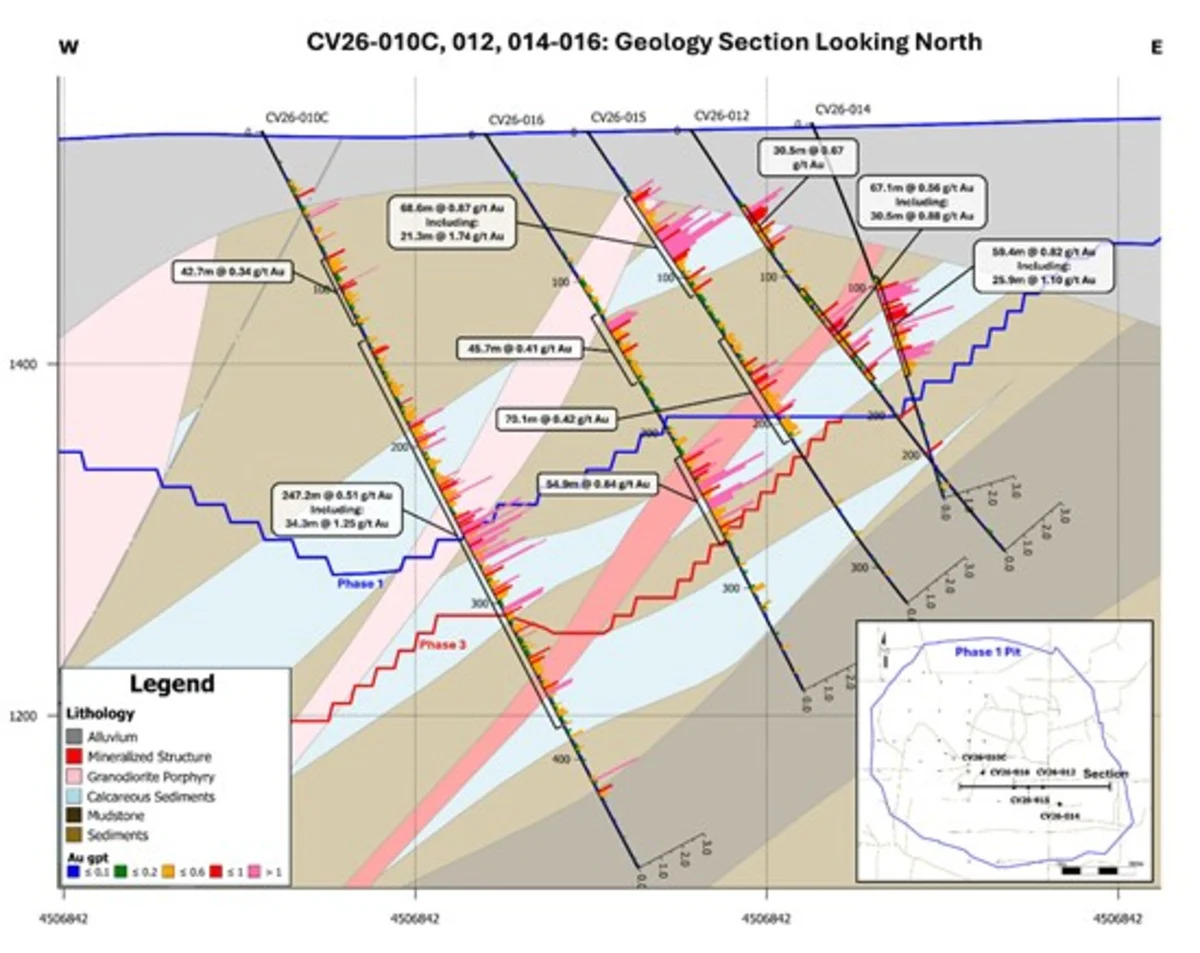
Highlights include hole CV26-010C, which returned a significant intercept of 247.2m grading 0.51 g/t Au and 3.79 g/t Ag from 131.7m including 34.3m grading 1.25 g/t Au from 246.3m. The hole was drilled through sparsely drilled area currently classified as inferred mineralization with the potential to upgrade confidence to indicated. Importantly, the hole intersected higher grades than the modelled inferred blocks it drilled through.
Key Highlights
CV26-010C
-
42.7m grading 0.34 g/t Au and 2.15 g/t Ag from 79.2m
-
247.2m grading 0.51 g/t Au and 3.79 g/t Ag from 131.7m
-
Incl. 34.3m grading 1.25 g/t Au from 246.3m
-
-
CV26-012
-
30.5m grading 0.67 g/t Au and 1.77 g/t Ag from 51.8m
-
67.1m grading 0.56g/t Au and 1.54 g/t Ag from 109.7m
-
Incl. 30.5m grading 0.88 g/t Au from 128.0m
-
-
CV26-014
-
59.4m grading 0.82 g/t Au and 2.99 g/t Ag from 94.5m
-
Incl. 25.9m grading 1.10 g/t Au from 102.1m
-
-
CV26-015
-
68.6m grading 0.87 g/t Au and 3.48 g/t Ag from 42.7m
-
Incl. 21.3m grading 1.74 g/t Au
-
-
70.1m grading 0.42 g/t Au and 4.55 g/t Ag from 140.2m
-
CV26-016
-
45.7m grading 0.41 g/t Au and 1.57 g/t Ag from 120.4m
-
54.9m grading 0.84 g/t Au and 3.04 g/t Ag from 214.9m
-
Initial drilling results strongly support Roxmore's updated geological model and demonstrate potential to improve the Converse deposit.
Roxmore commenced a Phase 1, 30,000 -metre infill and extension winter drilling campaign that continues with one RC rig and one diamond core rig currently operating.
A second diamond drill rig is scheduled to arrive in mid-July, with a second RC drill expected in September. Drilling is planned to continue throughout 2026 and 2027.
Resource Classification, True Widths of Intercepts and Grade Improvements Targeted with Current Drilling
The primary objective of the current drilling campaign is to upgrade portions of the existing Mineral Resource Estimate ("MRE") from the inferred category to indicated and/or measured. The recently released MRE[1] employed a more rigorous classification methodology of measured, indicated and inferred material with drill spacing having an enhanced influence over what had previously been employed for previous estimates. Roxmore is utilizing angle holes to intersect steeply-dipping, mineralized faults and stratigraphy, so true thickness of reported intercepts is generally 75% to 100% of drilled thickness. Historic drilling was mostly vertical and not considered optimal.