
LONDON--(BUSINESS WIRE)--Shipments of OLED displays featuring Active Privacy View (APV) are forecast to reach 91.7 million units by 2033, accounting for approximately 6.6% of total OLED display shipments, according to new research from Omdia.
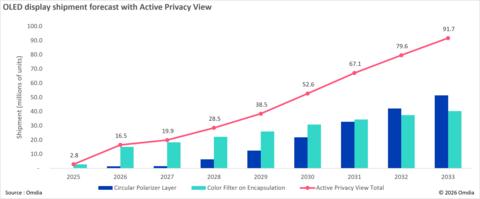
OLED display shipments featuring APV technology are expected to reach 16.5 million units in 2026, driven by its initial adoption in conventional smartphones and laptops.
Samsung Electronics incorporated Samsung Display’s APV technology into its Galaxy S26 Ultra, which launched in the first quarter of 2026, while Huawei adopted BOE’s APV technology in its Mate XT2 and Matebook Pro S, both launched in the third quarter. Xiaomi also adopted APV technology from TCL China Star for its 18 Pro/Pro Max models, released in November.
"As concerns over personal data protection grow, privacy-enhancing displays are emerging as a new point of competitive differentiation for flagship smart devices," said Jerry Kang, a Practice Leader, Displays, at Omdia. "With the technology still in its early stages, several approaches are competing in the market. Key factors influencing wider adoption will include performance capabilities, such as the ability to selectively activate privacy features in specific areas of display while maintaining resolution, and the choice between circular polarizer layer (CPL) and color filter on encapsulation (COE) technologies."
The COE and CPL approaches to APV technology offer different advantages and trade-offs in terms of display performance and manufacturing costs.
In the COE approach, two types of subpixels each featuring a Black Matrix (BM) of a different height are implemented on top of the COE layer. The CPL approach places these subpixels on top of the encapsulation or touch layer. In both approaches, activating the subpixels with the taller BM enable the privacy function by narrowing the viewing angle, while activation of the subpixels with the shorter BM is optional.
However, the COE approach requires five additional exposure steps to pattern the RGB color filters and the two different BM heights, increasing manufacturing costs due to additional equipment investment. While the CPL approach eliminates the need for color-filter patterning, the use of a polarizer reduces light extraction by approximately 50% presenting a performance disadvantage.
"Rising memory prices have already significantly increased bill of materials costs for finished devices, placing greater pressure on display manufacturers to reduce prices," added Kang. "Rather than a rapid increase in market penetration, Omdia expects APV-enabled OLED displays to see more gradual adoption, initially concentrated in premium flagship devices, as the technology evolves to deliver improved performance at lower manufacturing costs."
Omdia forecasts that shipments of OLED displays using COE-based APV technology will significantly exceed those using CPL-based APV technology in the short term. Omdia expects the CPL-based approach to increase the share of APV-enabled OLED display shipments over time because it costs less to produce and involves a simpler manufacturing process.
This press release is based on Omdia’s ‘OLED & Flexible Display Intelligence Service’. This report covers OLED trends: application demand, industry issues, panel suppliers’ strategies, manufacturing technologies, supply/demand, and cost analysis.
ABOUT OMDIA
Omdia, part of TechTarget, Inc. d/b/a Informa TechTarget (Nasdaq: TTGT), is a technology research and advisory group. Our deep knowledge of tech markets grounded in real conversations with industry leaders and hundreds of thousands of data points, makes our market intelligence our clients’ strategic advantage. From R&D to ROI, we identify the greatest opportunities and move the industry forward.