

Study of 1,000 global senior technology and data leaders uncovers what's blocking enterprises from making the leap from personal AI to organizational AI
SAN DIEGO, July 7, 2026 /PRNewswire/ -- Teradata (NYSE: TDC) today released findings from a commissioned Wakefield Research study of 1,000 senior technology and data leaders across six global markets. The report, "Arrested Automation: Why Agentic AI Stalls at the Enterprise Level," finds that while enthusiasm to deploy agentic AI is near-universal, foundational data systems were not built for agents and need rethinking to deliver the ROI organizations expect.
Many of the hurdles outlined in the report (and summarized below) are easier to understand by recognizing the need to move from personal AI — tools like chatbots and writing assistants that help individuals work faster — to organizational AI, which works on behalf of the whole company using shared knowledge, appropriate access levels, and well-designed governance. The returns enterprises are chasing don't happen until AI operates at the organizational level.
The report introduces the Agentic AI Maturity Index to track where organizations stand on that journey and charts a path forward through what it calls Autonomous Knowledge — enterprise data with enough context, lineage, and governance for AI agents to act on it reliably at scale.
The Agentic AI Maturity Index: Where Enterprises Actually Stand
This four-stage framework maps where organizations stand: Experimenting, Developing, Building, and Operationalizing, which is where AI is executing multi-step workflows with measurable business impact. Currently, only 7% of the global enterprises have reached the final stage where tangible outcomes occur. The majority (68%) remain in Experimenting or Developing, where context fragmentation — when data exists but carries no usable meaning for agents — is a major limiting factor.
Notably, 69% of C-suite executives say their organization is already operating with agentic AI, while only 57% of VPs say the same.
Report Breadth: Industry and Country Comparisons
The report breaks down findings across industries including healthcare, financial services, IT, manufacturing, and retail, and across six markets: the United States, United Kingdom, France, Germany, Japan, and Saudi Arabia. The agentic AI challenge is a global phenomenon, but not a uniform one. The research points to several barriers.
The ROI Gap
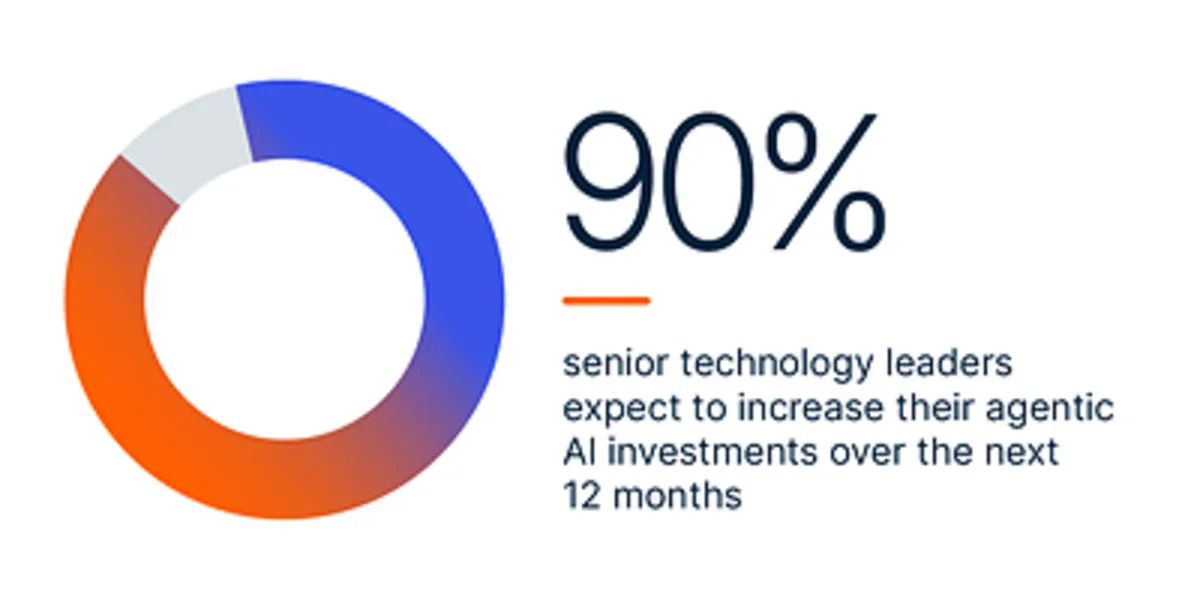
Nine in ten (90%)senior technology leaders expect to increase their agentic AI investments over the next 12 months; yet nearly two-thirds (63%)report they have seen no more than a small or emerging positive return on those investments to date. The gap between investment and returns is not a lack of ambition, but a data foundation that was built for human users, not autonomous AI agents.