
Prior to publication, the information contained within this announcement was deemed by the Company to constitute inside information as stipulated under the UK Market Abuse Regulation. With the publication of this announcement, this information is now considered to be in the public domain.
2 November 2026
Switch Metals plc
(“Switch Metals” or the "Company")
Issia drilling update
Lithium discovery at Kabore confirmed — intersecting 14m at 1.02% Li2O including 7m at 1.75% Li2O
Switch Metals (AIM: SWT), the critical metals company focused on tantalum and lithium in Côte d'Ivoire, is pleased to announce initial assay results from its maiden reverse circulation (“RC”) drilling programme at its Zraty and Kabore prospects. Both prospects lie within the Badinikro permit on the Company's Issia Project, in the Birimian terranes of south-western Côte d'Ivoire.
These are the first holes drilled by the Company in the Issia pegmatite district. Initial results confirm lithium mineralisation at depth beneath the Kabore surface discovery, alongside tantalum and niobium mineralisation at both Kabore and Zraty. Mineralisation has been identified in multiple pegmatite bodies, supporting the potential for a broader critical metals system at Issia.
Assays have been received for the first seven of the 34 holes drilled. Results for the remaining 27 holes, 26 for Kabore and one for Zraty, are still to come.
Highlights
Programme
- Assays received for the first 7 RC holes of 34 holes (3,438m): 4 of 30 at Kabore and three of four at Zraty
- Tantalum-niobium mineralisation identified at both Kabore and Zraty, complementing the Company’s existing near-surface tantalum and niobium (coltan) exploration activities at Issia
Kabore: lithium
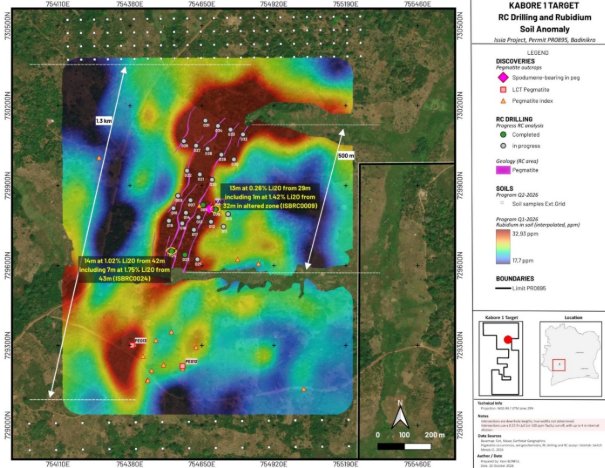
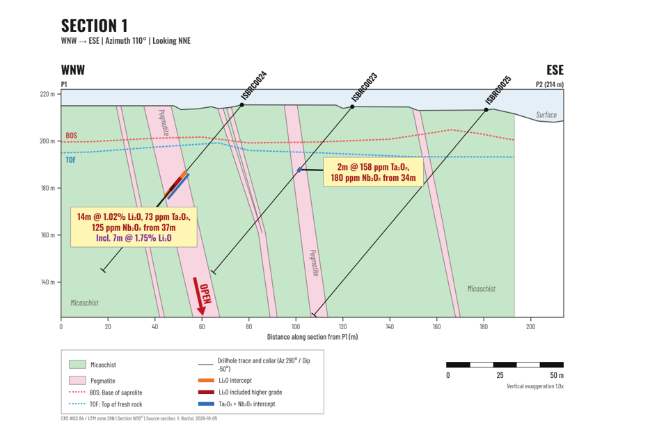
- 14m at 1.02% Li₂O from 42m, including 7m at 1.75% Li₂O from 43m (ISBRC0024), with a best single metre of 2.63% Li₂O
- 13m at 0.26% Li₂O from 29m, including 1m at 1.42% Li₂O from 32m (ISBRC0009), approximately 200m north-east of ISBRC0024, confirming lithium mineralisation on a second drill section
- Lithium mineralisation confirmed at depth beneath the spodumene discovery, where surface grades reach 2.8% Li₂O
- Significant lithium exploration upside: scout drilling has tested only 500m of more than a 1.3km prospective strike, on fences 50m to 100m apart
Kabore: coltan
- 6m at 130 ppm Ta₂O₅ and 152 ppm Nb₂O₅ from 29m (ISBRC0009), and 2m at 158 ppm Ta₂O₅ and 180 ppm Nb₂O₅ from 34m (ISBRC0023), with coltan (tantalum and niobium) present in all four holes assayed
- The association of tantalum and niobium with lithium is consistent with geochemically fertile Lithium-Caesium-Tantalum (LCT) pegmatite systems
Zraty: tantalum
- 6m at 85 ppm Ta₂O₅ and 134 ppm Nb₂O₅ from 58m (ISBRC0003), the first holes to be drilled at Zraty, with pegmatite intersected in all three holes assayed and tantalum-niobium mineralisation in two of the three holes
- Drill grades are well below surface samples (up to 1,230 ppm Ta₂O₅); further work is needed to test for higher-grade shoots
Looking ahead
- 27 holes still to report: 26 at Kabore and 1 at Zraty. Further updates will be provided as results become available
- Follow-up drilling: full interpretation of the Kabore dataset under way to design the next holes along strike and at depth
- Growing the footprint: geochemical and mapping programme launched to extend Kabore beyond the current 1.3km prospective strike, with soil sampling and scout auger drilling continuing across Issia to generate further targets
Karl Akueson, CEO of Switch Metals commented:
“Although these results have taken a little longer to come through than anticipated, they have been worth the wait. The Issia pegmatite district had never been drill-tested and our first holes at Kabore confirm lithium at depth beneath the spodumene we discovered at surface. We believe Kabore is now a drill-confirmed lithium discovery.
“Maiden drilling at Kabore has confirmed mineralisation beneath the surface discovery and supports the interpretation of Issia as a pegmatite system containing both lithium and coltan (tantalum and niobium).
“The initial drilling results support the potential for lithium mineralisation beneath the lithium-rich spodumene discovery at Kabore, where reported surface grades reach 2.8% Li2O. Drilling returned a best single metre of 2.63% Li2O and a downhole interval of 14m at 1.02% Li2O, including 7m averaging 1.75% Li2O. Further drilling and the outstanding assays will help us assess continuity along strike and at depth.
“In addition, the mineralisation is enriched by intervals of tantalum and niobium helping to explain the widespread surface occurrences observed across the drilling area. At Zraty, our first holes have intersected the pegmatite with tantalum and niobium mineralisation, and further work will test for higher-grade shoots.
“Only four of the thirty Kabore holes have been assayed so far. The pegmatite system is open at depth and along strike and work is ongoing to further extend this target. The remaining results will shape the next phase of drilling.
“Lithium activity is also building in the region. Operators backed by Chinese lithium majors are active around our Tiassalé project, where we have identified seven lithium targets, and with Kabore now drill-confirmed, we have lithium opportunities at both Issia and Tiassalé.
“We have a busy period ahead: the remaining 27 drill holes to report, laboratory assay results from our shallow tantalum programme, and further work to advance our Tantalum Mineral Resource Estimate. We look forward to updating shareholders as these work programmes progress.”
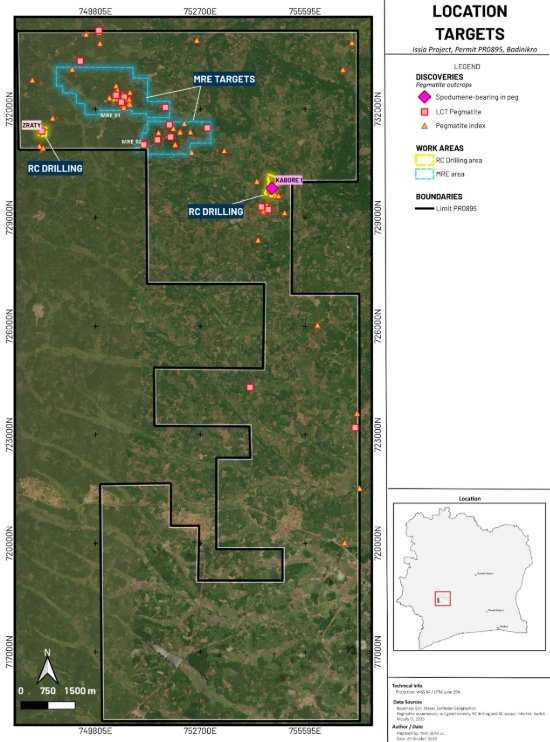
Drilling Programme
Kabore
The completed maiden RC drilling programme comprised 34 holes totalling 3,438m at the Kabore and Zraty prospects within the Issia Project, investigating pegmatite-hosted lithium, tantalum and niobium mineralisation. The programme was initially planned at approximately 2,500m, with the final allocation between prospects subject to drilling results and geological observations (see announcement dated 17 June 2026).
At Kabore, 30 RC holes totalling 3,186m were completed across seven drill fences spaced approximately 50m to 100m apart, testing approximately 500m of strike out of 1.3km.
Drilling at Kabore targeted the down-dip extension of the spodumene-bearing pegmatite discovered at surface in early 2026 with lithium grades of up to 2.8% Li₂O in the discovery trench, and the 1.3 km rubidium soil anomaly that surrounds it (see announcements dated 2 February 2026 and 4 June 2026).
Drilling results show that Kabore is underlain by interbedded mica schist and sandstone. The sequence is moderately to strongly deformed. It is intruded by numerous NE-striking pegmatite dykes. Some dykes are continuous and linear. Others are anastomosing and follow lithological contacts. Alteration comprises sericite, chlorite, silica and hematite, with quartz veining and garnet.
- ISBRC0024 returned 14m at 1.02% Li2O from 42m, including 7m at 1.75% Li2O from 43m. The best single metre assayed 2.63% Li2O. A tantalum and niobium enriched zone of 5m at 97 ppm Ta2O5 and 145 ppm Nb2O5 from 37m lies immediately above the lithium interval.
- ISBRC0009, which lies 200m north-east of ISBRC0024, returned 13m at 0.26% Li2O from 29m including 1m at 1.42% Li2O from 32m. The upper part of the interval is enriched in tantalum and niobium with 6m at 130 ppm Ta2O5 and 152 ppm Nb2O5 from 29m.
- ISBRC0023 and ISBRC0006 intersected pegmatite with no significant lithium. They returned 2m at 158 ppm Ta2O5 and 180 ppm Nb2O5 from 34m and 2m at 143 ppm Ta2O5 and 187 ppm Nb2O5 from 68m, respectively.
These intercepts confirm that lithium, tantalum and niobium mineralisation continues below the surface discovery. The system remains open at depth and to the south-west. Most Kabore results are still pending.
Assay results include the following significant intersections:
Table 1: Significant intersections:
|
Hole ID |
Prospect |
From (m) |
To (m) |
Interval (m) |
Li₂O (%) |
Ta₂O₅ (ppm) |
Nb₂O₅ (ppm) |
|
ISBRC0024 |
Kabore |
42 |
56 |
14 |
1.02 |
42 |
78 |
|
incl. |
43 |
50 |
7 |
1.75 |
58 |
110 | |
|
ISBRC0024 (3) |
Kabore |
37 |
42 |
5 |
0.11 |
97 |
145 |
|
ISBRC0009 |
Kabore |
1 |
2 |
1 |
0.02 |
153 |
169 |
|
ISBRC0009 |
Kabore |
29 |
42 |
13 |
0.26 |
66 |
78 |
|
incl. |
32 |
33 |
1 |
1.42 |
106 |
132 | |
|
Incl. |
29 |
35 |
6 |
0.29 |
130 |
152 | |
|
ISBRC0023 |
Kabore |
34 |
36 |
2 |
0.05 |
158 |
180 |
|
ISBRC0006 |
Kabore |
68 |
70 |
2 |
0.04 |
143 |
187 |
|
ISBRC0003 (3) |
Zraty |
58 |
64 |
6 |
85 |
134 | |
|
incl. |
61 |
62 |
1 |
112 |
172 | ||
|
ISBRC0001 (3) |
Zraty |
40 |
42 |
2 |
64 |
87 | |
|
ISBRC0002 |
Zraty |
NSI |
Notes: (1) All intervals are reported as downhole lengths. Kabore holes were drilled at about -50° to -60° towards 290° or 110°, approximately perpendicular to the strike of the NNE-trending pegmatites as mapped at surface. Interpretation on drill sections indicates steeply dipping pegmatites. Estimated true widths are approximately 50% to 70% of downhole lengths. (2) Significant intersections are reported using a lower cut-off of 0.25% Li₂O and/or 100 ppm Ta₂O₅, with a maximum of 4 m of consecutive internal dilution, with flexibility allowing a fair representation of mineralised intervals. Intervals meeting either criterion are reported. No top cut has been applied. Grades are length-weighted averages. No metal equivalents are reported. (3) ISBRC0001, ISBRC0003, ISBRC0024 have been reported below cut-off grade to disclose low-grade mineralisation in Ta₂O₅ and Nb₂O₅. (4) Samples analysed by Intertek, Perth area, Western Australia by sodium peroxide fusion with ICP finish. Lithium assays are reported as Li₂O using a conversion factor of 2.153 (Li × 2.153). Tantalum assays are reported as Ta₂O₅ using a conversion factor of 1.2211 (Ta × 1.2211). Niobium is reported as Nb₂O₅ (Nb × 1.431); values below detection limit are taken as zero. (5) Certified reference materials, blanks and duplicates were inserted at a rate of one additional QC sample for every 9 RC samples. NSI = No Significant Intersection.
Zraty
At Zraty, 4 RC holes totalling 252m were completed to investigate tantalum and niobium-bearing pegmatites previously identified through surface exploration.
Initial assay results have identified tantalum and niobium mineralisation at Zraty.
Four RC holes tested the Zraty tantalum pegmatite on two sections. They are the first holes drilled on this prospect. Assays have been received for three holes. All three intersected a steeply dipping pegmatite in mica schist. The alteration assemblage matches Kabore.
- ISBRC0003: 6m at 85 ppm Ta2O5 and 134 ppm Nb2O5 from 58m including 1m at 112 ppm Ta2O5 and 172 ppm Nb2O5 from 61m.
- ISBRC0001: 2m at 64 ppm Ta2O5 and 87 ppm Nb2O5 from 40m.
- ISBRC0002: no significant intercept.
Whilst drill grades are well below the surface samples (up to 1,230 ppm Ta2O5), the results confirm that the pegmatite continues down dip to the south. Tantalum in pegmatites is often concentrated in discrete shoots. Further work is needed to test for higher-grade zones.
Exploration Potential and Next Steps
The initial scout programme was designed to establish the geometry and mineralisation of the pegmatite system.
The results will be incorporated into the Company’s geological interpretation to refine potential follow-up drilling targets along strike and at depth. Assays for 27 holes remain outstanding and, subject to laboratory turnaround times, are expected by the end of 2026.
Soil sampling, scout auger drilling and geological mapping are ongoing at Issia to investigate north and south strike extensions and identify further drilling targets.
Qualified Person Statement
The information in this announcement that relates to Exploration Results is based on, and fairly represents, information compiled by Mr Rémi Bosc, a European Geologist (EurGeol No. 737) of the European Federation of Geologists, a Recognised Professional Organisation under the JORC Code. Mr Bosc is Principal Geologist of Arethuse Geology SARL, consultant to Switch Metals plc. Mr Bosc has more than 30 years of experience in mineral exploration and resource estimation.
Mr Bosc has sufficient experience relevant to the style of mineralisation and type of deposit under consideration, and to the activity being undertaken, to qualify as a Competent Person as defined in the 2012 Edition of the “Australasian Code for Reporting of Exploration Results, Mineral Resources and Ore Reserves” (JORC Code). He also meets the requirements of a Qualified Person under the AIM Note for Mining and Oil & Gas Companies. Mr Bosc has reviewed and verified the data in this announcement, including the QAQC results. Mr Bosc consents to the inclusion in this announcement of the matters based on his information in the form and context in which it appears.
**ENDS**
For further information, please contact:
|
Switch Metals plc Karl Akueson, CEO Andy Yeo, CFO |
Via IFC Advisory |
|
Allenby Capital Limited (Nominated Adviser & Broker) Corporate Finance: James Reeve / Nick Harriss Sales: Kelly Gardiner / Lauren Wright/ Matt Butlin |
+44 (0) 203 328 5656 |
|
IFC Advisory Limited (Financial PR and IR) Tim Metcalfe / Florence Staton |
+44 (0) 203 934 6632 |
About Switch Metals
Switch Metals plc, admitted to trading on AIM in April 2025, is a mining company focused on critical technology and battery minerals in Côte d’Ivoire, one of the most attractive mining jurisdictions in Africa. The Company is the largest land holder covering tantalum, lithium and other critical metals prospects in the country (and potentially in West Africa) today.
Its core assets include Issia (Ta + Nb + Li), Bouaké (Ta + Nb + REE) and Tiassalé (Li) projects. Issia is the current focus for the Company as it exhibits potential for early cash flow through ethical tantalum production from shallow coltan placer deposits with significant scale-up potential (from both placers and hard rock pegmatites).
APPENDIX A - JORC CODE, 2012 EDITION (TABLE 1)
Section 1: Sampling Techniques and Data
(Criteria in this section apply to all succeeding sections.)
|
Criteria |
JORC Code explanation |
Commentary |
|
Sampling techniques |
Nature and quality of sampling (eg cut channels, random chips, or specific specialised industry standard measurement tools). Measures taken to ensure sample representivity. Aspects of the determination of mineralisation that are Material to the Public Report. |
Sampling was undertaken on reverse circulation (RC) drill chips. Samples were collected at 1 m intervals from the cyclone and split at the rig using a riffle splitter to produce a sub-sample with a target mass of 2-4 kg for analysis. The coarse reject was retained on site for reference. The whole drill-holes were sampled. |
|
Drilling techniques |
Drill type (eg core, reverse circulation, open-hole hammer, rotary air blast, auger, Bangka, sonic, etc) and details (eg core diameter, triple or standard tube, depth of diamond tails, face-sampling bit or other type, whether core is oriented and if so, by what method, etc). |
Drilling was completed by Geodrill using a RC rig with a face-sampling hammer bit. RC drilling does not produce oriented samples, and no structural orientation data were collected from the drill holes. |
|
Drill sample recovery |
Method of recording and assessing core and chip sample recoveries and results assessed. Measures taken to maximise sample recovery and ensure representative nature of the samples. Whether a relationship exists between sample recovery and grade. |
Sample recovery was assessed for each metre by weighing the bulk sample. Average recovery within pegmatite intervals was >80%. Samples were predominantly dry; wet samples were recorded. No relationship between recovery and grade has been observed. Visual checks of sample volumes were used to identify irregular returns. Cyclone condition and cleanliness were checked regularly, and the sample return system was purged by air flush to minimise sample loss and carry-over. |
|
Logging |
Whether core and chip samples have been geologically and geotechnically logged to a level of detail to support appropriate Mineral Resource estimation. Whether logging is qualitative or quantitative. The total length and percentage of the relevant intersections logged. |
All RC chips were geologically logged at 1 m intervals for lithology, mineralogy, weathering and alteration. Representative chips were retained in labelled chip trays, which were photographed and archived at the Company’s Camp. Geological logs were checked by the supervising senior geologist. |
|
Sub-sampling techniques and sample preparation |
If non-core, whether riffled, tube sampled, rotary split, etc and whether sampled wet or dry. Nature, quality and appropriateness of the sample preparation technique. Quality control procedures for all sub-sampling stages. Field duplicates. Whether sample sizes are appropriate to the grain size. |
Dry samples were progressively riffle-split, with splitting stages selected according to the bulk sample mass to obtain a target analytical sample mass of 2–4 kg. Splitters and associated equipment were cleaned between samples. The procedure required wet material to be dried before riffle splitting; manual quartering was permitted where material remained too damp for riffle splitting. Field duplicates were prepared as separate splits of the same bulk sample, targeting three duplicates per 100 submitted samples. At Intertek Yamoussoukro, Côte d’Ivoire, samples were dried, crushed to 2 mm, riffle split and pulverised to minus 75 µm. Sample sizes are considered appropriate for first-pass exploration. Spodumene in the Kabore pegmatites is coarse-grained (centimetric) and tantalum minerals are prone to a nugget effect, so some sample-to-sample variability is expected. |
|
Quality of assay data and laboratory tests |
The nature, quality and appropriateness of the assaying and laboratory procedures used and whether the technique is considered partial or total. Nature of quality control procedures adopted (eg standards, blanks, duplicates, external laboratory checks) and whether acceptable levels of accuracy and precision have been established. |
Samples were analysed at Intertek, Perth area, Western Australia by sodium peroxide fusion with ICP-OES / ICP-MS finish for Li, Ta, Nb, Cs, Rb, Sn and a multi-element suite. Sodium peroxide fusion is considered a total digestion technique appropriate for lithium and for refractory tantalum-bearing minerals (columbite-tantalite). Certified reference materials and blanks, both OREAS commercial materials, were each inserted at a rate of 1 in 15 samples. The overall QAQC insertion rate was 10%. CRM results fell within ±3 standard deviations of certified values, and blanks returned Li2O values below the detection limit. Field duplicates showed very good precision. |
|
Verification of sampling and assaying |
The verification of significant intersections by either independent or alternative company personnel. The use of twinned holes. Documentation of primary data, data entry procedures, data verification, data storage protocols. Discuss any adjustment to assay data. |
Field observations and sampling records were recorded on standard field sheets and entered into dedicated Excel files. Data were checked by the supervising senior geologists, discrepancies were referred back to the originating personnel for correction, and validated records were transferred to the database manager to be stored in a database, that has been verified by an independent geologist. Significant intersections were verified by the Competent Person, who recalculated them from the laboratory assay files. No twinned holes have been drilled. No adjustments have been made to assay data other than the oxide conversions stated (Li × 2.153; Ta × 1.2211; Nb × 1.431). |
|
Location of data points |
Accuracy and quality of surveys used to locate drill holes (collar and down-hole surveys). Specification of the grid system used. Quality and adequacy of topographic control. |
Collars were surveyed using hand-held GPS. The grid system is WGS84 / UTM Zone 29N. Downhole surveys were taken every 50 or 60 m and one measurement at 12m to acknowledge for surface deviation. |
|
Data spacing and distribution |
Data spacing for reporting of Exploration Results. Whether the data spacing and distribution is sufficient to establish geological and grade continuity appropriate for a Mineral Resource. Whether sample compositing has been applied. |
Drilling is first-pass exploration on sections spaced 50 m to 100 m apart at Kabore and on two sections at Zraty. Data spacing is not sufficient to establish geological and grade continuity for Mineral Resource estimation. No sample compositing has been applied. |
|
Orientation of data in relation to geological structure |
Whether the orientation of sampling achieves unbiased sampling of possible structures. If the relationship between drilling orientation and key mineralised structures has introduced a sampling bias, this should be assessed and reported if material. |
Holes were planned to intersect the mapped pegmatite trends at a high angle, and oriented approximately perpendicular to the strike of the pegmatites as mapped at surface and in trenches (Kabore: about -50° to -60° towards 290° or 110°; Zraty: -60° towards 170° or 350°). Drill sections indicate steeply dipping pegmatites. Estimated true widths are approximately 50% to 70% of downhole lengths. No sampling bias is considered to have been introduced. |
|
Sample security |
The measures taken to ensure sample security. |
Samples were individually labelled and transferred to the Company’s camp by Company personnel. Sample sequences were checked against submission lists. Completed transport bags were secured with cable ties before dispatch. Samples were delivered to Intertek Yamoussoukro by road transport, accompanied by sample submission documentation. Reference samples were retained in a dedicated storage facility at the Company’s camp. RC Chips were duly photographed and stored in properly labelled chip trays. |
|
Audits or reviews |
The results of any audits or reviews of sampling techniques and data. |
Sampling procedures and data were reviewed by the Competent Person as part of its technical support to the programme. No separate independent audit of sampling and analytical procedures has been undertaken. |
Section 2: Reporting of Exploration Results
(Criteria listed in the preceding section also apply to this section.)
|
Criteria |
JORC Code explanation |
Commentary |
|
Mineral tenement and land tenure status |
Type, reference name/number, location and ownership including agreements or material issues with third parties such as joint ventures, partnerships, overriding royalties, historical sites, wilderness or national park and environmental settings. The security of the tenure held at the time of reporting. |
The prospects are located within the Badinikro exploration permit PR0895, covering 111.89 km². The permit is held by Switch Metals Cote d’Ivoire, in which Switch Metals holds a 100% interest. The permit was granted on 1 March 2023. Renewal is due in February 2027. No known impediments exist. |
|
Exploration done by other parties |
Acknowledgment and appraisal of exploration by other parties. |
Issia is a greenfield project developed by Switch Metals since 2023 |
|
Geology |
Deposit type, geological setting and style of mineralisation. |
Mineralisation is hosted in LCT-type pegmatite dykes intruding Birimian metasediments along the NW–SE Issia pegmatite corridor. Lithium occurs as spodumene, identified by XRD at surface (announcement dated 2 February 2026). Tantalum is hosted by columbite-tantalite. Near-surface pegmatites are weathered and oxidised, which may result in some lithium depletion in the upper zone. |
|
Drill hole Information |
A summary of all information material to the understanding of the exploration results including a tabulation of collar coordinates, elevation, dip and azimuth, down hole length and interception depth, hole length. |
Collar information (hole ID, easting, northing, RL, azimuth, dip, final depth) has been throughfully recorded and is presented on the Map given in Figure 2 with coordinates and orientation.. Significant intersections are given in Table 1 when results are available. All holes drilled and assayed to date are listed, including holes with no significant intersections (NSI). |
|
Data aggregation methods |
Weighting averaging techniques, maximum and/or minimum grade truncations and cut-off grades. Where aggregate intercepts incorporate short lengths of high-grade results and longer lengths of low-grade results, the procedure used should be stated and typical examples shown in detail. Metal equivalent assumptions. |
Significant intersections are reported using a lower cut-off of 0.25% Li2O and/or 100 ppm Ta2O5, with a maximum of 4 m of consecutive internal dilution. Intervals meeting either criterion are reported. Cut-off grades have been applied with flexibility to acknowledge for mineralisation. Higher-grade “including” intervals are reported. No top cut has been applied. Grades are length-weighted averages. Lithium assays are reported as Li2O using a conversion factor of 2.153 (Li × 2.153). Tantalum assays are reported as Ta2O5 using a conversion factor of 1.2211 (Ta × 1.2211). No metal equivalents are reported. |
|
Relationship between mineralisation widths and intercept lengths |
If the geometry of the mineralisation with respect to the drill hole angle is known, its nature should be reported. If it is not known and only the down hole lengths are reported, there should be a clear statement to this effect (eg "down hole length, true width not known"). |
All intervals are reported as downhole lengths. Holes were drilled at about -50° to -60° towards pegmatite dikes identified in surface, approximately perpendicular to the strike of the pegmatites as mapped at surface. Interpretation on drill sections indicates steeply dipping pegmatites. Estimated true widths are approximately 50% to 70% of downhole lengths. |
|
Diagrams |
Appropriate maps and sections (with scales) and tabulations of intercepts should be included for any significant discovery being reported. |
A plan view (Figure 2) and a representative cross-section (Figure 3) are included in the body of this announcement, together with the significant drill intersections presented in Tables 1. |
|
Balanced reporting |
Where comprehensive reporting of all Exploration Results is not practicable, representative reporting of both low and high grades and/or widths should be practiced. |
All results are reported, including holes with no significant intersections (ISBRC0001, ISBRC0002) and low-grade tantalum intervals. Assays are pending for 27 holes and will be reported when received. |
|
Other substantive exploration data |
Other exploration data, if meaningful and material, should be reported including geological observations, geophysical and geochemical survey results, metallurgical test results, bulk density. |
Surface trenching, grab sampling and soil geochemistry at Kabore and Zraty were first reported on 2 February, 10 February and 4 June 2026. Specific gravity, mineralogical (XRD) test work on drill samples and metallurgical test work have not yet been undertaken. |
|
Further work |
The nature and scale of planned further work (eg tests for lateral extensions or depth extensions or large-scale step-out drilling). Diagrams highlighting the areas of possible extensions. |
Further drilling is planned to test strike and depth extensions. Assays for 27 holes are pending and are expected to be available by the end of 2026. |
RNS may use your IP address to confirm compliance with the terms and conditions, to analyse how you engage with the information contained in this communication, and to share such analysis on an anonymised basis with others as part of our commercial services. For further information about how RNS and the London Stock Exchange use the personal data you provide us, please see our Privacy Policy.