
The German colocation market is set for growth, driven by rising AI and hybrid cloud demands, despite power constraints in Frankfurt, encouraging expansion to Berlin and Hamburg. GDPR and data protection laws bolster domestic demand. Industrial digitalization fuels enterprise deployments, enhancing market opportunities.
German Data Center Colocation Market
Dublin, April 30, 2026 (GLOBE NEWSWIRE) -- The "Germany Data Center Colocation Market Size and Forecast by Revenue, Capacity, and 70+ Performance Metrics Across Service Type, Facility Architecture, Customer Segment, AI and Non AI Workloads, End Use Sector, Capacity Pipeline and Financial Metrics Databook Q2 2026 Update" has been added to ResearchAndMarkets.com's offering.
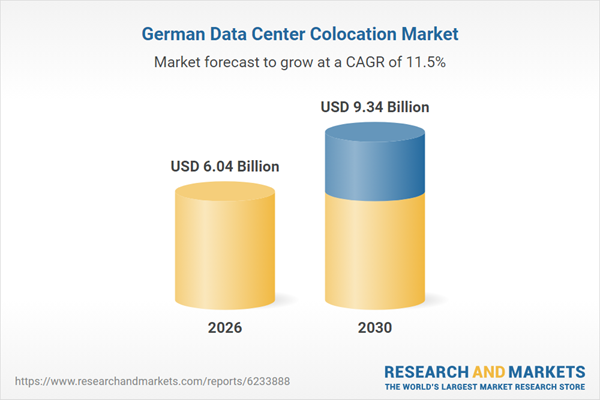
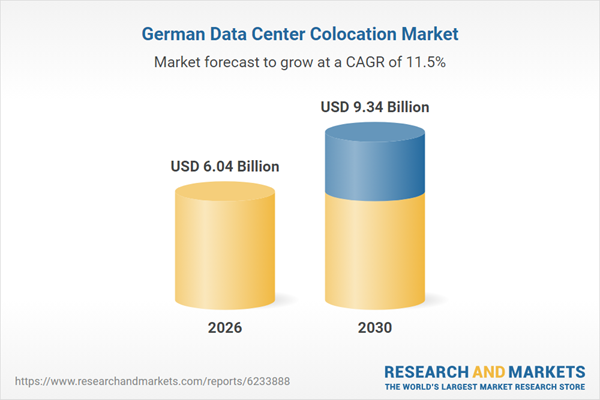
The Germany data center colocation market is poised for substantial growth, expected to increase by 16.0% annually, reaching US$6.04 billion by 2026. During 2021-2025, the market enjoyed a robust CAGR of 14.9%, and this momentum is set to continue with a projected 11.5% growth from 2026-2030. By 2030, the market is anticipated to expand from US$5.21 billion in 2025 to US$9.34 billion, driven by increasing demands for AI and GPU workloads, growing hyperscaler capacity, and an ongoing shift towards hybrid multi-cloud strategies.
Key Trends and Growth Drivers
Frankfurt Growth Constrained by Power Access Challenges
Frankfurt remains a key colocation market in Europe and a significant internet exchange point due to DE-CIX. However, power availability challenges in the Frankfurt Rhine-Main region are limiting new developments, despite ongoing demand from hyperscale and enterprise sectors. Major players like Equinix, Digital Realty, and NTT are navigating phased capacity expansions to align with utility availability.
Germany's Energiewende initiative has led to an evolving power landscape characterized by renewable intermittency and extended grid upgrade timelines. In Frankfurt, utility providers are more vigorous in regulating industrial load connections, impacting market expansion. Consequently, Berlin and Hamburg are set to grow as alternative colocation hubs.
German Data Protection Framework Drives Sovereign Colo Demand
Germany's rigorous adherence to GDPR, coupled with the Bundesdatenschutzgesetz (BDSG), accents the preference for domestic colocation solutions. In 2025, the government and critical infrastructure operators are advancing investments in locally certified colo environments under BSI standards.
The country's cultural ethos regarding data privacy and stringent compliance checks by German data protection authorities amplify the demand for local infrastructure with proven compliance credentials. Such compliance-driven demand preserves a premium market segment for certified colocation providers.
Industrial Digitalization Expands the Enterprise Colo Base
Key industries in Germany, including automotive, chemical, and engineering sectors, are enhancing digital infrastructure to advance Industry 4.0 transitions. By 2025, these entities will broaden colocation deployments to reinforce operational technology data management and deploy private 5G networks and AI-driven manufacturing analytics.
The European Data Act is fueling additional IT investments, helping manufacturers to establish digital twins and unified factory platforms that demand reliable and low-latency domestic colocation. Edge and regional colocation facilities near industrial zones like Stuttgart, Munich, and the Ruhr area will experience heightened demand.
Competitive Landscape
Current State of the Market
Germany leads as continental Europe's largest colocation market, with Frankfurt holding considerable capacity. However, secondary markets, including Munich, Berlin, Dusseldorf, and Hamburg, have matured significantly. In Frankfurt, prime interconnected space vacancy remains under 5%.
Key Players and New Entrants
Notable operators such as Equinix control several Frankfurt facilities housing DE-CIX infrastructure. Digital Realty boasts substantial capacities in Frankfurt and Munich, while NTT Global Data Centers manage essential Frankfurt operations. Regional operators like Maincubes and Telehouse (KDDI) also have significant presence.
Recent Launches, Mergers, and Acquisitions
In 2025, expansions by Digital Realty and Equinix in Frankfurt have been noteworthy. Although power limitations present a liability, there are incremental capacity additions by NTT at its Frankfurt sites, prompting shifts towards other German regions showing promise for new developments.
Infrastructure & Regulatory Environment
Power Grid Access and Energy Mix
Germany's grid is orchestrated by four main transmission operators, although the transition to renewable energy results in grid instability and regional price disparities. Frankfurt and Rhein-Main area utilities face high industrial load competition, posing lengthy processes for new large connections. With over 55% renewable electricity by 2024, data center operators increasingly turn to on-site batteries to mitigate grid expenses.
Government Policy and Data Localization
Germany enforces GDPR through BDSG, maintaining one of the most active data protection agencies in the EU. The BSI's certifications for digital security, vital for public sector procurement, signify growing requirements. Active in GAIA-X, Germany upholds strict data handling rules, mandating domestic hosting for sensitive data without broad data localization laws.
Barriers to Expansion
Power availability and utility approval hindrances in Frankfurt constitute primary obstacles. Increases in land costs, particularly in Frankfurt and Munich, plus regulatory complexities pertain to environmental permits posing potential delays. A shortage of skilled operational personnel provides another growth bottleneck.
Germany's colocation market harmonizes strong demand with supply limitations. Frankfurt's internet hub status ensures continued demand but power access issues divert investment towards alternative German sites. Germany's data protection rigor, strengthened by GDPR enforcement, sustains intrinsic domestic demand and configures a premium segment for certified colocation providers. Industrial digitalization diversifies enterprise demand beyond finance and technology sectors. Providers securing power access, BSI certifications, and strategic land holdings align aptly to capture ongoing growth in this market.
Key Attributes:
Report Attribute | Details |
No. of Pages | 125 |
Forecast Period | 2026 - 2030 |
Estimated Market Value (USD) in 2026 | $6.04 Billion |
Forecasted Market Value (USD) by 2030 | $9.34 Billion |
Compound Annual Growth Rate | 11.5% |
Regions Covered | Germany |
For more information about this report visit https://www.researchandmarkets.com/r/7yknn2
About ResearchAndMarkets.com
ResearchAndMarkets.com is the world's leading source for international market research reports and market data. We provide you with the latest data on international and regional markets, key industries, the top companies, new products and the latest trends.
Attachment
CONTACT: CONTACT: ResearchAndMarkets.com Laura Wood,Senior Press Manager press@researchandmarkets.com For E.S.T Office Hours Call 1-917-300-0470 For U.S./ CAN Toll Free Call 1-800-526-8630 For GMT Office Hours Call +353-1-416-8900