
16 November 2026
WESTMOUNT ENERGY LIMITED
("Westmount" or the "Company")
Final Results & Notice of AGM
The Company is pleased to announce its Final Results for the year ended 30 June 2026, and hereby gives notice that the Annual General Meeting of Westmount Energy Limited will be held at Floor 4, Liberation House, Castle Street, St Helier, Jersey JE1 4HH, Channel Islands on 11 December 2026 at 11.00.Copies of the Company's results, Notice of AGM and Proxy Form are available on the Company's website, www.westmountenergy.com from today.
CHAIRMAN'S REVIEW
2026 Highlights
- Eco (Atlantic) Oil & Gas Ltd (“EOG”) announces cashless acquisition of JHI – with completion of transaction pending at time of going to press
- At time of announcement – JHI acquisition valued at USD$62.6M (approximately GBP£46.7M) with JHI security holders to own circa 21.8% of the enlarged entity
- Completion of JHI acquisition and follow-on transaction will result in Westmount holding, in aggregate, circa 9.5M common shares in EOG – gaining enhanced liquidity and exposure to a diversified portfolio of exploration and appraisal assets across the South Atlantic Margin
- EOG announces a Strategic Partnership with Navitas Petroleum (“Navitas”) providing options to Navitas to farm-in across EOG’s portfolio
- EOG announces a series of farm-in transactions across the portfolio – at various stages of completion and government engagement – Block 1 CBK (South Africa, Navitas); PEL’s 97, 99 and 100 (Namibia, BP); PL001 (Falkland Islands, Navitas); Orinduik Block (Guyana, Navitas)
- Canje Block, Guyana – licence lapsed on the 4th March 2026 and is subject to ongoing ‘extension’ discussions with the Government of Guyana
- Kaieteur Block, Guyana - Farm-down process continues in parallel with ongoing discussions pertaining to the second renewal term with the Government of Guyana
- The company had cash of £0.110M and listed marketable securities of £0.772M at year end 30th June 2026; no debt
Energy remains the key driver of global economic growth and continues to feature at the centre of geopolitics amid the ongoing realignment of the international order. In 2026, Middle Eastern conflict has triggered one of the largest global energy supply shocks in history. Brent Crude oil prices reached $117/bbl during October with circa 20% of global oil and LNG supplies impacted by the conflict due to the restricted shipping movements through the Straits of Hormuz. Reduced oil flow from the Gulf region has been offset by re-routing flows through alternative existing pipelines to Fujairah and Yanbu, increased ex Gulf production, significant drawings from commercial inventories and Strategic Petroleum Reserves and demand reduction of circa 4 mb/d1. However, the knock-on effects caused by Straits of Hormuz supply chain disruptions – including soaring tanker transport costs, elevated refinery crack-spreads and low product inventories – have all pushed diesel and gasoline pricing, in particular, to very high levels, with broad economic consequences for global economic activity, inflation and cost of living. Likewise, although the recent growth in US LNG capacity has, to date, compensated for the loss of 20% of global LNG supply from Qatar and Abu Dhabi, the oncoming peak demand winter period looks more challenging, for Europe in particular - accentuated by limited storage capacity – with present gas spot prices (TTF) above $30/MMbtu. In addition, disruptions in hydrocarbon supply chains are pushing customers towards electrification – with a dramatic increase in EV sales observed across a range of geographies and acceleration in electricity demand also being driven by the proliferation of data centres to support expansion of the AI sector.
Current IEA forecasts indicate average global oil demand will have dropped by circa 2.6 mb/d to 101.4 mb/d in 2026 recovering to 103.4 mb/d in 2027, whereas average oil supply is forecast to have declined by 5.8 mb/d to 100.7 mb/d in 2026, recovering to 106.5 mb/d in 20272. Analysis of historical trends confirms the immense scale and inertia of the global energy system, with long term growth in absolute terms of individual components notwithstanding changes in relative share of these components of the global energy mix - in response to technological changes or near-term, localised, responses to major economic or geopolitical events. For example, from the mid-1980s through 2025 global oil demand has continued to rise, on average, by circa 1 million barrels per day per year3 in spite of short-term blips caused by the global financial crisis in 2008 and the Covid pandemic in 2020 and the introduction of energy transition policies during the most recent decade. At this point, the timing of a return to the longer-term trend in the energy market remains highly uncertain and is likely to be controlled primarily by political events, including the outcome of US mid-term and Israeli parliamentary elections, pertaining to the Middle East - which may determine a pathway towards peace initiatives or further regional escalation of the conflict. In the meantime, many governments have been forced to focus on maintaining access to secure and affordable energy supplies, in some cases at the expense of net-zero aspirations, while attempting to address the cost-of-living burden.
The general consensus is that oil and natural gas resources will be needed for many decades to come with some forecasts indicating that oil and natural gas will still make up more than half of the world’s energy supply in 2050. Oil demand is anticipated to rise more slowly, increasing by 5% to circa 105 million barrels per day in 2050 with natural gas demand forecast to increase by circa 18% to 520 bcf/d during this period3. Oil and gas production is a depletion business and a decade of underspending with respect to exploration and appraisal investment has brought a renewed focus on the challenge of replacement barrels. It is estimated that the world's 30 largest exploration and production companies face production declines averaging nearly 40% between 2025 and 2040 resulting in a potential 300-billion-barrel oil supply shortfall for the sector by 20504. Furthermore, the current Middle Eastern upheaval has highlighted the value of geographic diversity and emphasised the importance of sourcing replacement barrels in alternative jurisdictions to bolster strategic energy security. These forecast production declines are prompting renewed interest in frontier and emerging basin deepwater exploration. Some industry players are anticipating an investment ‘super-cycle’ over the next five years with a focus on deepwater oil and gas ventures that can deliver material volumes5.
The key development in Westmount’s portfolio over the past 12 months has been the cashless acquisition of JHI Associates Inc. (“JHI”) by Eco Atlantic Oil & Gas Ltd. (“EOG”) announced on the 11th March 20266 - with completion of the transaction still pending at the time of going to press. Completion of this acquisition combined with the completion of a contingent follow-on transaction, between Westmount and a JHI management shareholder, will result in Westmount holding, in aggregate, circa 9.5M common shares in EOG. Upon completion this development should prove transformational for Westmount shareholders as it will significantly enhance the liquidity of the company’s investment in JHI, in addition to providing shareholders increased exposure to a diversified portfolio of carried interests in exploration and appraisal assets across the South Atlantic Margin. In the context of the recent plethora of new entrants, major acreage acquisitions and industry activities along this margin, Westmount’s revised investee portfolio would remain well positioned in frontier and emerging Atlantic Margin hydrocarbon provinces (North Falkland, Guyana-Suriname, Orange and Walvis Basins) which should attract a disproportionate share of global exploration capital in the coming years.
The financial statements presented herein reflect the company’s investment portfolio at year end, 30th June 2026 – prior to the completion of the EOG-JHI transaction (Table 1). Completion of the EOG acquisition of JHI, and the follow-on transaction, will streamline and reduce Westmount’s portfolio to two material investments (Table 2) – a liquid shareholding in EOG with a diversified, multi-asset, portfolio (Falkland Islands, Guyana, Namibia and South Africa) and an illiquid shareholding in Cataleya Energy Corp (“CEC”) with a single asset, offshore Guyana. Realisation of this scenario should also help to create alternative options for funding the company going forwards and improve Westmount’s attractiveness as an RTO vehicle for new ventures.
Summary – key transactions during this period
On the 11th March 2026 EOG announced the cashless acquisition of JHI to be executed via a court-approved plan of arrangement6. Under the binding ‘Arrangement Agreement’, signed on the 10th March 2026, EOG agreed to acquire the entire issued and to be issued shares of JHI, not already held by EOG, based upon an exchange ratio of 0.7054 common EOG share for each JHI share. Upon completion of the acquisition, EOG will issue up to 96,307,811 new Common Shares to JHI Security holders such that up to approximately 21.8% of EOG's then issued share capital will be held by the shareholders of JHI. Approximately 45% of the Common Shares to be issued to JHI Security holders will be subject to lock-up arrangements to be released in tranches over an 18-month period following completion. At the time of announcement – the JHI acquisition was valued at USD$62.6M (approximately GBP£46.7M) based upon the mid-market closing price of EOG’s Common Shares, on the AIM market of the London Stock Exchange of £0.485 on 10th March 2026.
Completion of the acquisition is subject to several closing conditions, which have been progressing. On the 12th May 2026, at JHI's annual and special meeting of shareholders, 100% of the votes cast were in favour of the plan of Arrangement with EOG. Following approval by JHI shareholders, on the 18th May, 2026, EOG confirmed that JHI had successfully obtained, on the 15th May, 2026, the final order approval from the Ontario Superior Court of Justice (Commercial List), approving the court-approved plan of arrangement as proposed7. On the 21st September, 2026 the Falkland Islands Government (“FIG”) announced that it had approved the acquisition of a 65% stake in licence area PL001 by Navitas Petroleum Atlantic Limited8. The FIG also announced that, with the full support of the UK Government, it will be extending all existing offshore hydrocarbon production licences (including PL001). These licences, which are all currently in the exploration period, will be extended for an initial period of five years, with an optional two further years at the discretion of FIG, and subject to satisfactory progress by the licensees against their work programmes. The FIG announcement also stated that the FIG Department of Mineral Resources is now working with licensees to produce enhanced work programmes for the extension period, including commitments to the drilling of additional appraisal wells.
Separately, on the 13th October 2026, Argentina submitted a request to the International Tribunal for the Law of the Sea (“ITLOS”) for the prescription of provisional measures against the United Kingdom under article 290, paragraph 5, of the United Nations Convention on the Law of the Sea (“UNCLOS”) in a “dispute concerning the exploitation of hydrocarbon resources in the South-West Atlantic Ocean”. A public hearing of ITLOS was held on the 10th and 11th November 20269. The Tribunal is now deliberating on the case, with the date for reading of the Order tentatively set to 28th November 2026.
Currently, Westmount holds a total of 5,685,167 common shares and 50,000 warrants in JHI together with 1,500,000 common shares in Eco (Table 1). In addition, Westmount has entered into a Memorandum of Agreement with a JHI Management shareholder, conditional upon closing of the EOG-JHI transaction, to purchase for a nominal amount an additional 4,000,000 common shares in EOG (equivalent to 5,670,542 JHI shares) immediately upon closing of the EOG acquisition of JHI. These additional 4,000,000 common shares in EOG are bound by the lock-up provisions contained in the lock-up agreement entered into by JHI management shareholders and EOG. Subject to completion of that purchase and the closing of the EOG acquisition of JHI, Westmount will hold a total of 9,527,432 common shares in EOG, which includes the conversion of current shares and warrants using the exchange ratio and formula outlined in the JHI Circular, the newly purchased 4,000,000 shares, plus Westmount’s existing holding in EOG of 1,500,000 common shares (Table 2).

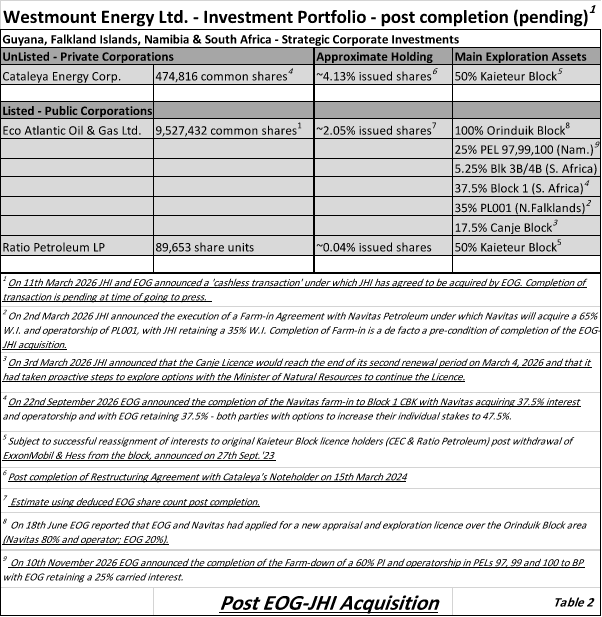
Summary Update – EOG Material Assets
A more complete summary of EOG’s material assets is available from EOG’s Audited Results for the Year Ended 31st March 2026, published on 23rd July 202610. The following is a summary of relevant updates which have been reported subsequent to the publication of these audited results or during the last 12-month period.
South Africa (Block 1 CBK – Orange Basin)
On 22nd September 2026 EOG announced the completion of the farm-down of 37.5% Working Interest (“WI”) in Block 1 CBK and transfer of operatorship of the block to Navitas Petroleum LP11. As consideration for the farm-down, EOG received US$4.0 million cash and will be carried by Navitas for the Block 1 work programme up to a carry cap of US$7.5 million net to EOG. The amounts carried by Navitas will be repaid via EOG's share of proceeds from future production on the block. Post transaction, EOG’s WI in Block 1 is 37.5%. However, as a result of pre-existing option agreements, both EOG and Navitas have the option, by mutual consent, to increase their respective WIs in the block to 47.5%, at any point throughout the term of the initial exploration period expiring in February 2028.
Namibia (PELs 97,99, & 100 – Walvis Basin)
On 10th November 2026 EOG announced that it had received the formal Ministerial deeds signature for the approval of the transfer and assignment of a 60% Participating interest (“PI”), in all three of its Petroleum Exploration Licenses (“PEL”) offshore Namibia to BP Namibia Energy Ltd, a wholly owned subsidiary of BP, as well as the renewal deeds to enter into the next exploration period for each PEL12. This receipt of the transfer and assignment and renewal deeds was the final closing step resulting in the completion of the previously announced farm-down by EOG of a 60% PI and operatorship in each of PEL 97, 99 and 100 to BP with EOG retaining a 25% PI in each of the three PELs. Following the completion of the transaction, as consideration, EOG will receive a cash payment of US$2.7M on 16th November 2026; BP will carry 100% of EOG’s 25% Retained PI as well as EOG's proportionate share of the NAMCOR (10%) and the Local Partners (5%) participating interests across PEL97, PEL99 and PEL100 during the first renewal period for which the work programme approved by the government, includes seismic reprocessing on PEL97 and the acquisition of at least 3,000km2 of new 3D Seismic data on PEL99 and PEL100.
Furthermore, if BP and partners elect to enter the Second Renewal Period of the license term in 2028 and commit to drilling an exploration well (on any one or all of the PELs), EOG will have the option to exercise a Put Option to transfer an additional 10% PI, in the relevant PEL or PELs, to BP in exchange for a full carry on EOG's remaining 15% PI subject to a cap of US$21 million net to EOG for each well on each of the licenses (PEL97, PEL99, and PEL100); the maximum aggregate Carry consideration payable by BP in respect of each Put Option (should all Put Options namely on PEL97, PEL99, and PEL100 be exercised) is US$63 million with a cap of US$21 million per Put Option.
Falkland Islands (PL001 – North Falklands Basin)
On 2nd March 2026 Navitas and JHI announced the execution of a farm-in agreement under which Navitas will acquire a 65% Working Interest (“W.I.”) and operatorship of PL001, with JHI retaining a 35% WI. As consideration, in addition to payment of its share of JHI’s past costs in connection with the Licence, Navitas will fund, on a loan-carry basis, JHI’s 35% W.I. share of the costs associated with potential future activities, including an exploration well and potential appraisal well, up to an aggregate cap of USD$14M. Subsequent to EOG’s proposed acquisition of JHI (announced on 11 March 2026), EOG reported, on the 18th June 2026, that it was awaiting final receipt of a five-year licence extension and approval of Navitas' operatorship of the PL001 licence from the Falkland Islands Government ("FIG")13.
On the 21st September, 2026 the FIG announced that it had approved the acquisition of a 65% stake in licence area PL001 by Navitas and that it will be extending all existing offshore hydrocarbon production licences (including PL001) – two of the listed items that were included as conditions precedent in the Arrangement Agreement governing the completion of the acquisition of JHI by EOG.
Guyana (Orinduik Block – Guyana-Suriname Basin
As reported on the 18th June 2026, EOG (20%) and Navitas (80%) have applied for a new appraisal and exploration license over the Orinduik Block area, including the Jethro and Joe existing oil discoveries. The parties are continuing to engage in constructive discussions with the Ministry of Natural Resources ("MNR"), Government of Guyana, regarding a new license for the Orinduik Block area13.
According to the Navitas Framework and Option agreement announced on 4th December 2025, upon exercise by Navitas of the option to farm-in to Orinduik, EOG will receive US$2.5M cash and EOG’s remaining 20% working interest will be carried in respect of the work performed in the new Orinduik Block, capped at US$11 million net to EOG (excluding mobilisation costs, if any).
Guyana (Canje Block – Guyana-Suriname Basin)
While the Canje Block reached the end of its 2nd renewal period on the 4th March 2026, JHI reported to its shareholders on the 3rd March 2026, that it had taken proactive steps with the Ministry of Natural Resources to explore options to continue the licence. On the 18th May 2026 EOG reported that JHI and EOG remain engaged with the Government of Guyana with respect to a potential extension or reissuance of the Canje block13.
Summary Update – CEC Material Asset
CEC is a private, Canadian-registered, company established in 2015 whose main asset is 50% participating interest in the Kaieteur Block, which it holds in partnership with Ratio Petroleum (50% and operator).
Guyana (Kaieteur Block – Guyana-Suriname Basin)
On 27th September 2023 it was announced by Ratio Petroleum Energy Limited Partnership ("Ratio Petroleum"), that both ExxonMobil and Hess had elected to withdraw from the Kaieteur Block and return their participating interests to the original Kaieteur Licence holders, Ratio Guyana Limited (“RGL”) and Cataleya Energy Limited (“CEL”) - with RGL and CEL each retaining a 50% participating interest, and RGL operating the block. Approval for the assignment of the participating interests has not occurred to date.
After the granting of a one year ‘Covid extension’ by the Guyanese Ministry of Natural Resources (“MNR”) the First Renewal Period expired on February 1, 2025 and the Second and last Renewal Period will expire on February 1, 2028. Discussions continue with the MNR in respect of relinquishments and a potential extension of the Kaieteur Block License to allow more time to attract an Operator that is capable of conducting drilling operations in the ultra-deep waters of Kaieteur Block. In this regard, farm-down efforts are continuing.
Summary/Outlook
Forecast industry oil production declines combined with strategic energy security concerns have come to the fore over the last 12 months against a backdrop of heightened geopolitical tensions and realignment of the international order. These issues are prompting renewed interest in frontier and emerging basin deepwater exploration in diverse, ex Middle East, geographies with potential for the delivery of material oil and gas volumes.
The most significant development in Westmount’s portfolio over the past 12 months has been the cashless acquisition of JHI Associates Inc. (“JHI”) by Eco Atlantic Oil & Gas Ltd. (“EOG”) announced on the 11th March 2026 - with completion of the transaction still pending at the time of going to press. Completion of this acquisition combined with the completion of a contingent follow-on transaction, between Westmount and a JHI management shareholder, will result in Westmount holding, in aggregate, circa 9.5M common shares in EOG. Upon completion this development should prove transformational for Westmount shareholders as it will significantly enhance the liquidity of the company’s investment in JHI, in addition to providing shareholders increased exposure to a diversified portfolio of carried interests in exploration and appraisal assets across the South Atlantic Margin. In the context of the recent plethora of new entrants, major acreage acquisitions and industry activities along this margin Westmount’s streamlined investee portfolio should remain well positioned (in North Falkland, Guyana-Suriname, Orange and Walvis Basins) to attract a disproportionate share of global exploration capital in the coming years.
Westmount also continues to proactively monitor its investment in CEC – where the challenge remains to identify a roadmap that will deliver drilling on the Kaieteur Block, via the introduction of a new deepwater operator and, with goodwill, the negotiation of an extension of the Kaieteur licence via Force Majeure or other mechanism.
In the near-term Westmount may trade as a proxy for the EOG share price, which should be a positive, given the potential for exposure to high impact, carried, drilling across the EOG portfolio in 2027-2028. While we wait for some of these scenarios to play out, Westmount’s continues to minimise costs and juggle its liquid resources while seeking value creation for shareholders. Westmount also continues to actively explore project and consolidation opportunities that can deliver improved shareholder value.
GERARD WALSH
Chairman
13 November 2026
Notes
1. Total Energies – 2026 Strategy and Outlook – Transcript 28th September 2026
2. IEA – Oil Market Report 2026 – 14th October 2026
3. ExxonMobil – Global Outlook 2026 – Executive Summary – 17th September 2026
4. Wood MacKenzie - Major oil companies increase high-impact exploration investment to address 300-billion-barrel supply gap and energy security priorities by 2050 – 23rd April 2026
5. Upstream – ‘Super-cycle windfall heading for deepwater oil and gas – 23rd September 2026
6.https://polaris.brighterir.com/public/eco_atlantic_oil_gas_plc/news/regulatory_news/story/xo94emx
7.https://polaris.brighterir.com/public/eco_atlantic_oil_gas_plc/news/regulatory_news/story/w14vm1w
8. https://www.gov.fk/press/fig-announces-extension-of-offshore-hydrocarbons-production-licences/
9. https://www.itlos.org/fileadmin/itlos/documents/press_releases_english/PR_402_EN.pdf
10.https://polaris.brighterir.com/public/eco_atlantic_oil_gas_plc/news/regulatory_news/story/x2403nw
11.https://polaris.brighterir.com/public/eco_atlantic_oil_gas_plc/news/regulatory_news/story/rn71qnx
12.https://polaris.brighterir.com/public/eco_atlantic_oil_gas_plc/news/regulatory_news/story/xlzl33w
13.https://polaris.brighterir.com/public/eco_atlantic_oil_gas_plc/news/regulatory_news/story/rym0vyr
For further information, please contact:
Westmount Energy Limited www.westmountenergy.com
David King, Director Tel: +44 (0) 1534 823000
Cavendish Capital Markets Limited (Nomad and Broker) Tel: +44 (0) 20 7397 8900
Neil McDonald / Pete Lynch
DIRECTORS’ REPORTFOR THE YEAR ENDED 30 JUNE 2026
The Directors present their annual report and the audited financial statements of Westmount Energy Limited (the “Company”) for the year ended 30 June 2026. | |||||||||||||||||||||||||||||||||
PRINCIPAL ACTIVITIES | |||||||||||||||||||||||||||||||||
The principal activity of the Company is, and continues to be, an energy investment company. Development of the Company’s activities and its prospects are reviewed in the Chairman’s Review on pages 3 to 10. | |||||||||||||||||||||||||||||||||
The Company was incorporated in Jersey on 1 October 1992 under the Companies (Jersey) Law 1991, as amended, and is a public company with registered number 53623. | |||||||||||||||||||||||||||||||||
DIRECTORS AND DIRECTORS’ INTERESTS | |||||||||||||||||||||||||||||||||
The Directors who served during the year and subsequently to the date of this report were as follows:
| |||||||||||||||||||||||||||||||||
RESULTS AND DIVIDENDS | |||||||||||||||||||||||||||||||||
The results for the year are set out on page 22 in the Statement of Comprehensive Income. The Directors do not recommend the payment of a dividend in respect of these financial statements (2025: £Nil). | |||||||||||||||||||||||||||||||||
DIRECTORS’ BIOGRAPHICAL INFORMATION Gerard Walsh, Chairman, age 63, a Swiss resident, is a member of the Chartered Institute of Management Accountants and has been involved in financing oil and gas companies for over 25 years. Mr Walsh maintains his knowledge and skills via direct contact with senior industry investors and other operators, and via monitoring of significant market activities within the global energy sector. David R King, age 68, a Jersey resident, is a Fellow of the Institute of Chartered Accountants in England and Wales and has over 35 years’ experience in capital markets and cross border structuring gained from senior positions in a number of offshore jurisdictions, notably the Cayman Islands, Hong Kong, Luxembourg and Jersey. He is an experienced professional Non-Executive Director and is regulated personally by the Jersey Financial Services Commission. He maintains his knowledge and skills via fulfilment of regular continuing professional development obligations and by close monitoring of significant market activities within the sector. Mr King acts as an independent director and oversees the efficient operation of Company Secretarial, Registrar and Administrative operations of the Company. Thomas P O'Gorman, age 74, a Northern Ireland resident, is a long-term investor in the resource sector and is the former Chairman of Cove Energy Plc (formerly Lapp Platts Plc) who has been involved in financing oil and gas companies for over 40 years. Mr O’Gorman maintains his knowledge and skills via direct contact with senior industry investors and other operators, and via monitoring of significant market activities within the global energy sector. Dermot Corcoran, age 67, a Republic of Ireland resident, is a petroleum geologist and geophysicist, with more than 30 years’ experience working with both major and minor hydrocarbon exploration companies globally. Mr Corcoran has wide experience in technical and commercial aspects of petroleum exploration and production, gained from employment and investment experience in Europe, North Africa, West Africa, Kurdistan, Syria, Pakistan and the USA. Mr Corcoran maintains his knowledge and skills via direct contact with senior industry investors and other operators, attendance and engagement at industry conferences and seminars and via monitoring of significant market activities within the global energy sector. | |||||||||||||||||||||||||||||||||
SECRETARY | |||||||||||||||||||||||||||||||||
The Secretary of the Company is Corient Corporate Services (Jersey) Limited. | |||||||||||||||||||||||||||||||||
AUDITOR | |||||||||||||||||||||||||||||||||
The auditor, Moore Stephens Audit and Assurance (Jersey) Limited, has indicated its willingness to continue in office, and a resolution that it is re-appointed will be proposed at the next annual general meeting. | |||||||||||||||||||||||||||||||||
STATEMENT OF DIRECTORS’ RESPONSIBILITIES WITH REGARD TO THE FINANCIAL STATEMENTS | |||||||||||||||||||||||||||||||||
The Directors are responsible for preparing the Directors’ Report and the financial statements in accordance with applicable law and regulations. | |||||||||||||||||||||||||||||||||
Jersey Company Law requires the Directors to prepare financial statements for each financial year. Under that law the Directors have elected to prepare the financial statements in accordance with International Financial Reporting Standards as adopted by the European Union (‘IFRS Accounting Standards’) and applicable law. Under Company law the Directors must prepare financial statements that give a true and fair view of the state of affairs of the Company and of the profit or loss of the Company for that period. In preparing these financial statements, the Directors are required to: | |||||||||||||||||||||||||||||||||
| |||||||||||||||||||||||||||||||||
| |||||||||||||||||||||||||||||||||
| |||||||||||||||||||||||||||||||||
| |||||||||||||||||||||||||||||||||
The Directors are responsible for keeping proper accounting records that are sufficient to show and explain the Company’s transactions and disclose with reasonable accuracy at any time the financial position of the Company and enable them to ensure that the financial statements comply with the Companies (Jersey) Law 1991. They are also responsible for safeguarding the assets of the Company and hence for taking reasonable steps for the prevention and detection of fraud and other irregularities. | |||||||||||||||||||||||||||||||||
As far as the Directors are aware, there is no relevant audit information of which the Company’s auditor is unaware and each Director has taken all the steps that he ought to have undertaken as a director in order to make himself aware of any relevant audit information and to establish that the Company’s auditor is aware of that information. The Directors are responsible for the maintenance and integrity of the corporate and financial information included on the Company’s website. The Company’s website is maintained in compliance with AIM Rule 26. | |||||||||||||||||||||||||||||||||
Legislation in Jersey governing the preparation and dissemination of financial statements may differ from legislation in other jurisdictions. | |||||||||||||||||||||||||||||||||
The Directors confirm that they have complied with all of the above requirements in preparing these financial statements. On behalf of the Board | |||||||||||||||||||||||||||||||||
D R KING | |||||||||||||||||||||||||||||||||
Director 13 November 2026 | |||||||||||||||||||||||||||||||||
CORPORATE GOVERNANCE
The Board have adopted the Quoted Companies Alliance Corporate Governance Code (“the QCA Code”) following the London Stock Exchange’s requirement for AIM listed companies to adopt and comply with a recognised corporate governance code.
Strategy and Business Model
The strategy of the Company is to invest in and provide follow on capital to small and medium sized companies which have significant growth possibilities operating in the oil and gas sector. Members of the Board have specialist knowledge and experience in the upstream sector of the oil and gas industry (gained from extensive investing activity over a number of decades) allowing them to identify projects and growth companies with potentially higher returns, commensurate with acceptable levels of risk. The Company undertakes extensive due diligence on potential investment opportunities and monitors performance of its investments via close contact with the companies concerned and analysis of their public announcements and presentations. In common with other investment companies in this sector, access as a minority shareholder to projects and valuable investments is challenging but the Board is confident of its ability to continue to source attractive investment opportunities given close relationships with a number of companies and their management teams, and recognition of the Board’s experience and strong network.
Shareholder Relations
The Company engages closely with its principal shareholders, a number of whom are Directors of the Company, primarily via face-to-face meetings and publishes announcements of significant activity consistent with market requirements. Shareholders receive annual and half-year financial statements and are invited to the Company’s Annual General Meeting. Contact details for the Company are maintained on the website and on Regulatory News Service announcements. The Board seeks to build strong relationships with its institutional shareholders which are managed by the Chairman and supported by other members of the Board.
Gerard Walsh, Chairman, and Dermot Corcoran, Director, are primarily responsible for shareholder liaison, and can be contacted via the Contact Page on the Company’s website.
Stakeholder and Social Responsibilities
The Board has identified its key stakeholders as being its shareholders and investee companies, given it has no employees and a small range of contracted service providers. It maintains contact with shareholders, of whom a significant proportion are Directors, via Regulatory News Service and periodic feedback from these parties. Contact with investee companies is operated via the Chairman and individual Board directors responsible for the relevant investment recommendation, and is geared to key operational, project and transactional cycles identified for the company concerned.
Risk Management
The Company actively monitors and manages risk in its activities, principally through oversight and operation of its investment portfolio. The Company identifies key risks in all of its investments during the selection and due diligence cycle, and subsequent recommendations for investment by the Company consider for each proposal a range of risks and mitigating factors. Identification of these risks is achieved by direct engagement with the companies in which the Company seeks to invest, close analysis of their market opportunities and threats, combined with detailed knowledge of the market sector where they operate and their competitors.
Board Composition, Evaluation and Decision Making
The Board comprises three shareholder Directors (including the Chairman Gerard Walsh) and one Non-Executive Director (David King) resident in Jersey, who is considered to be independent.
The Company deviates from the requirements of the QCA Code in that it has only one independent non-executive director. The Directors consider that the structure of the Board is appropriate and proportionate for the business at this stage of the Company’s growth, and that the Independent Director, in conjunction with the Company’s Nominated Adviser, provides appropriate challenge to the executive directors on all corporate governance matters. The Board intends to keep all aspects of its corporate governance – independence and the balance of executive and non-executive roles in particular – under review going forward.
Each of the four directors has considerable experience in their respective fields and act collectively in all decision making of the Company. The Board is satisfied that it has a suitable balance between independence on the one hand and knowledge of the Company's activities, to allow it to properly discharge its responsibilities and duties. Directors are expected to use their judgement and experience to challenge and assess the appropriateness of operations and decision making at all times.
The Board has formally met twice this financial year and the Directors each dedicate between 12 and 150 days’ time to the Company per annum, including informal contact with other Board members and advisors, and attendance at the Annual General Meeting.
The Board regularly takes advice from its Nominated Advisor, Cavendish Capital Markets Limited, and other external advisors (principally its external lawyers) in relation to periodic investment opportunities and fund raising.
The Board completes an annual self-evaluation of its performance based on externally determined guidelines appropriate to the composition of the Board and the Company's operation, including Board Sub Committees. The scope of the self-evaluation exercise will be re-assessed each year to ensure appropriate depth and coverage of the Board’s activities consistent with corporate best practice. The Board has adopted a board effectiveness questionnaire, which assesses the composition, processes, behaviours and activities of the board through a range of criteria, including board size and independence, mix of skills and experience, and general corporate governance considerations in line with the QCA code.
Given the stage of the business’ maturity, the responsibilities of a nomination committee are delegated to the Board, and there are no formal succession planning processes in place. The Board intends to keep this under review as the business develops.
Corporate Culture
The Company supports the growing awareness of social, environmental and ethical matters when considering business practices. These statements provide an outline of the policies in place that guide the Company and its employees when dealing with social, environmental and ethical matters in the workplace.
Code of Conduct
The Company maintains and requires the highest ethical standards in carrying out its business activities in regard to dealing with gifts, hospitality, corruption, fraud, the use of inside information and whistleblowing.
The Company maintains a zero-tolerance policy towards bribery and corruption.
Equal Opportunity and Diversity
The Company promotes and supports the rights and opportunities of all people to seek, obtain and hold employment without discrimination.
It is our policy to make every effort to provide a working environment free from bullying, harassment, intimidation and discrimination on the basis of disability, nationality, race, sex, sexual orientation, religion or belief.
Joint Venture Partners, Contractors and Suppliers
The Company is committed to being honest and fair in all its dealings with partners, contractors and suppliers.
Procedures are in place to ensure that any form of bribery or improper behaviour is prevented from being conducted on the Company’s behalf by joint venture partners, contractors and suppliers. The Company also closely guards information entrusted to it by joint venture partners, contractors and suppliers, and seeks to ensure that it is never used improperly.
Operating Responsibility and Continuous Improvement
The Company adopts an environmental policy which sets standards that meet or exceed industry guidelines and host government regulations. This is reviewed on a regular basis. Wherever we operate we will develop, implement and maintain management systems for sustainable development that will strive for continual improvement.
The Company is committed to maintaining and regularly reviewing its Health and Safety and Environmental Policies.
Periodic feedback from stakeholders, as described in relation to Stakeholder and Social Responsibilities (above), allows the Board to monitor the culture of the Company, as well as its ethical values and behaviours.
Governance Structures
The Board operates to manage and direct the affairs of the Company via close contact between Board members and through both regular scheduled and ad-hoc Board meetings. The Board aims to meet regularly with a timetable set by the external Company Secretary with formal agendas and papers delivered in advance supporting key matters for consideration or approval. Additionally, contact is maintained between the directors via email and telephone given the geographic separation of the Board.
Mr Walsh as Chairman is responsible for setting the strategy of the Company and maintaining performance of the Board in line with the broad objectives set in that strategy. He is responsible for liaison with key stakeholders, including shareholders and prospective investee companies, and also with advisers and regulatory authorities.
Mr King, as a Jersey resident, maintains close contact with the Company Secretary and other contracted service providers from Jersey. The Board does not operate separate sub-committees (Audit, Remuneration or Nomination) given its small size and close contact for key decisions. The Company does not plan to establish new sub-committees for the foreseeable future.
The Board retains full authority for the Company such that all decisions on behalf of the Company are reserved for the Board.
Communication with Stakeholders
The Company communicates with shareholders through the Annual Report and Audited Financial Statements, annual and half year results announcements, the Annual General Meeting, and periodic meetings with significant institutional shareholders and analysts.
Corporate information (including all Company publications and announcements) is available to all shareholders, prospective investors and the public and is maintained on the Company's website, www.westmountenergy.com.
In the last 12 months there were no votes of shareholders where a significant proportion voted against a resolution.
INDEPENDENT AUDITOR’S REPORT
TO THE SHAREHOLDERS OF WESTMOUNT ENERGY LIMITED
Opinion
We have audited the financial statements of Westmount Energy Limited (the ‘Company’) as at and for the year ended 30 June 2026 which comprise the Statement of Comprehensive Income, the Statement of Financial Position, Statement of Changes in Equity, the Statement of Cash Flows, and the notes to the financial statements, including a summary of significant accounting policies. The financial reporting framework that has been applied in their preparation is International Financial Reporting Standards (‘IFRS’ Accounting Standards) as adopted by the European Union and the requirements of the Companies (Jersey) Law 1991.
In our opinion, the financial statements:
· give a true and fair view of the state of the Company’s affairs as at 30 June 2026 and of its gain for the year then ended;
· have been properly prepared in accordance with IFRSs as adopted by the European Union; and
· have been prepared in accordance with the requirements of the Companies (Jersey) Law 1991.
Basis for opinion
We conducted our audit in accordance with International Standards on Auditing (ISAs) and applicable law. Our responsibilities under those standards are further described in the Auditor’s Responsibilities for the Audit of the Financial Statements section of our report. We are independent of the Company in accordance with the International Ethics Standards Board for Accountants’ Code of Ethics for Professional Accountants (IESBA Code) together with the ethical requirements that are relevant to our audit of the financial statements in Jersey, and we have fulfilled our ethical responsibilities in accordance with these requirements and the IESBA Code. We believe that the audit evidence we have obtained is sufficient and appropriate to provide a basis for our audit opinion.
Emphasis of matter
We draw your attention to note 6 and note 11 of the financial statements, which include unlisted investments held by the Company and carried at £3,442,325 (2025: £3,535,961) based on Directors’ valuations. These are Level III investments and have been calibrated to the price of a recent transaction, where considered representative of fair value. The Directors have considered current market conditions, market expectations of future performance of the entity’s industry sector, in particular known interest in the area of current exploration, available market proxies and entity-specific information. Our audit opinion is not modified in respect of this matter.
Key audit matters
Key audit matters are those matters that, in our professional judgment, were of most significance in our audit of the financial statements of the current period and include the most significant assessed risks of material misstatement (whether or not due to fraud) we identified, including those which had the greatest effect on the overall audit strategy; the allocation of resources in the audit; and directing the efforts of the engagement team. These matters were addressed in the context of our audit of the financial statements as a whole, and in forming our opinion thereon, and we do not provide a separate opinion on these matters. We have determined the matters described below to be the key audit matters to be communicated in our report:
Key Audit Matter | How the matter was addressed in the audit |
Risk of incorrect valuation of unquoted investment The valuation of the Company’s investments is a key driver of the Company’s investment return and investments represent a material proportion of the Company’s financial assets. The relevant accounting policies and investment composition are discussed in note 2, note 6 and note 11 to the financial statements. As of 30 June 2026, the investments comprise listed and unlisted equity instruments valued at £0.77 million and £3.44 million, respectively. The primary risk is associated with the unlisted equity instruments, whose valuation involves a higher degree of judgement by the directors. These instruments have been valued based on the price of recent investments, classifying them as Level III investments. The valuation of these Level III investments has been calibrated to the price of a recent transaction, where considered representative of fair value. The Directors have considered current market conditions, market expectations of future performance of the entity’s industry sector, in particular known interest in the area of current exploration, available market proxies and entity-specific information. This valuation methodology is in accordance with the International Private Equity and Venture Capital Guidelines (IPEVC Guidelines). | Our main audit procedures to address the identified risk in respect of the unlisted investment were:
Key Observations We have not identified any material issues from the completion of the above procedures. We conclude that the valuation of unquoted investment in accordance with the requirements of Financial Reporting Standards (‘IFRS Accounting Standards) as adopted by the European Union |
Risk of management override of controls Management is in unique position to perpetrate fraud because of management's ability to manipulate accounting records and prepare fraudulent financial statements by overriding controls that otherwise appear to be operating effectively. Although the level of risk of management override of controls will vary from entity to entity, the risk is nevertheless present in all entities. Due to the unpredictable way in which such override could occur, it is a risk of material misstatements due to fraud and thus a significant risk. | Our main audit procedures in respect of Management Override of Controls were as follows:
Key Observations We did not note any material issues arising from the procedures performed in this area. |
Conclusions relating to going concern
In auditing the financial statements, we have concluded that the Director’s use of the going concern basis of accounting in the preparation of the financial statements is appropriate.
Our evaluation of the directors’ assessment of the Company’s ability to continue to adopt the going concern basis of accounting included understanding the nature of the Company, its business model, system of internal control and related risks, reviewing the performance of the underlying investments, critically assessing the key assumptions made by management including its appropriateness in the context of the financial reporting framework, and evaluating the directors’ plans for future actions in relation to their assessment.
Based on the work we have performed, we have not identified any material uncertainties relating to events or conditions that, individually or collectively, may cast significant doubt on the Company’s ability to continue as a going concern for a period of at least twelve months from when the financial statements are authorised for issue.
Our responsibilities and the responsibilities of the directors with respect to going concern are described in the relevant sections of this report.
Other information
The Directors are responsible for the other information. The other information comprises the information included in the annual report, other than the financial statements and our auditor’s report thereon. Our opinion on the financial statements does not cover the other information and, except to the extent otherwise explicitly stated in our report, we do not express any form of assurance conclusion thereon.
In connection with our audit of the financial statements, our responsibility is to read the other information and, in doing so, consider whether the other information is materially inconsistent with the financial statements, or our knowledge obtained in the audit or otherwise appears to be materially misstated. If we identify such material inconsistencies or apparent material misstatements, we are required to determine whether there is a material misstatement in the financial statements or a material misstatement of the other information. If, based on the work we have performed, we conclude that there is a material misstatement of this other information, we are required to report that fact.
We have nothing to report in this regard.
Matters on which we are required to report by exception
In the light of the knowledge and understanding of the Company and its environment obtained in the course of the audit, we have not identified material misstatements in the chairman’s review or the directors’ report.
We have nothing to report in respect of the following matters where the Companies (Jersey) Law 1991 requires us to report to you if, in our opinion:
· adequate accounting records have not been kept, or
· returns adequate for our audit have not been received from branches not visited by us; or
· the financial statements are not in agreement with the accounting records and returns; or
· we have not received all the information and explanations we require for our audit.
Responsibilities of Directors
As explained more fully in the statement of directors’ responsibilities with regard to the financial statements set out on page 12, the directors are responsible for the preparation of the financial statements and for being satisfied that they give a true and fair view, and for such internal control as the directors determine is necessary to enable the preparation of financial statements that are free from material misstatement, whether due to fraud or error.
In preparing the financial statements, the directors are responsible for assessing the Company’s ability to continue as a going concern, disclosing, as applicable, matters related to going concern and using the going concern basis of accounting unless the directors either intend to liquidate the company or to cease operations, or have no realistic alternative but to do so.
Auditor’s responsibilities for the audit of the financial statements
Our objectives are to obtain reasonable assurance about whether the financial statements as a whole are free from material misstatement, whether due to fraud or error, and to issue an auditor’s report that includes our opinion. Reasonable assurance is a high level of assurance but is not a guarantee that an audit conducted in accordance with ISAs will always detect a material misstatement when it exists. Misstatements can arise from fraud or error and are considered material if, individually or in the aggregate, they could reasonably be expected to influence the economic decisions of users taken on the basis of these financial statements.
As part of an audit in accordance with ISAs, we exercise professional judgment and maintain professional scepticism throughout the audit. We also:
- Identify and assess the risks of material misstatement of the financial statements, whether due to fraud or error, design and perform audit procedures responsive to those risks, and obtain audit evidence that is sufficient and appropriate to provide a basis of our opinion. The risk of not detecting a material misstatement resulting from fraud is higher that for one resulting from error, as fraud may involve collusion, forgery, intentional omissions, misrepresentations, or the override of internal control.
- Obtain an understanding of internal control relevant to the audit in order to design audit procedures that are appropriate in the circumstances, but not for the purpose of expressing an opinion on the effectiveness of the Company’s internal control.
- Evaluate the appropriateness of accounting policies used and the reasonableness of accounting estimates and related disclosures made by management.
- Conclude on the appropriateness of management’s use of the going concern basis of accounting and, based on the audit evidence obtained, whether a material uncertainty exists related to events or conditions that may cast significant doubt on the Company’s ability to continue as a going concern. If we conclude that material uncertainty exists, we are required to draw attention in our auditor’s report to the related disclosures in the financial statements or, if such disclosures are inadequate, to modify our opinion. Our conclusions are based on the audit evidence obtained up to the date of our auditor’s report. However, future events or conditions may cause the Company to cease to continue as a going concern.
- Evaluate the overall presentation, structure and content of the financial statements, including the disclosures, and whether the financial statements represent the underlying transactions and events in a manner that achieves fair presentation.
- Plan and perform the audit to obtain sufficient appropriate audit evidence regarding the financial information of the entities or business units within the Company as a basis for forming an opinion on the financial statements. We are responsible for the direction, supervision and review of the audit work performed for the purposes of the audit. We remain solely responsible for our audit opinion.
We communicate with those charged with governance regarding, among other matters, the planned scope and timing of the audit and significant audit findings, including any significant deficiencies in internal control that we identify during our audit.
We also provide those charged with governance with a statement that we have complied with relevant ethical requirements regarding independence, and to communicate with them all relationships and other matters that may reasonably be thought to bear our independence, and where applicable, actions taken to eliminate threats or safeguards applied.
From the matters communicated with those charged with governance, we determine those matters that were of most significance in the audit of the financial statements of the current period and are therefore the key audit matters. We describe these matters in our auditor’s report unless law or regulation precludes public disclosure about the matter or when, in extremely rare circumstances, we determine that a matter should not be communicated in our report because the adverse consequences of doing so would reasonably be expected to outweigh the public interest benefits of such communication.
Use of our report
This report is made solely to the Company’s shareholders as a body, in accordance with Article 113A of the Companies (Jersey) Law 1991. Our audit work has been undertaken so that we might state to the Company’s shareholders those matters we are required to state to them in an auditor’s report and for no other purpose. To the fullest extent permitted by law, we do not accept or assume responsibility to anyone other than the Company and the Company’s shareholders as a body, for our audit work, for this report, or for the opinions we have formed.
Adam Gavin
For and on behalf of Moore Stephens Audit and Assurance (Jersey) Limited
1 Waverley Place
Union Street
St Helier Jersey
Channel Islands JE4 8SG
Date: 13 November 2026
STATEMENT OF COMPREHENSIVE INCOME
FOR THE YEAR ENDED 30 JUNE 2026
Year ended 30 June 2026 | Year ended 30 June 2025 | ||||
Notes | £ | £ | |||
Net fair value gains/(losses) on financial assets held at fair value through profit or loss | 6 | 512,125 | (295,478) | ||
Investment income | - | 1,893 | |||
Finance income Administrative expenses | 4 | 2,593 (251,389) | 1,607 (254,317) | ||
Foreign exchange gains/(losses) | 213 | (5,499) | |||
Operating gain/(loss) | 263,542 | (551,794) | |||
Gain/(loss) before tax | 263,542 | (551,794) | |||
Tax | 3 | - | - | ||
Gain/(loss) after tax | 263,542 | (551,794) | |||
Other comprehensive income | - | - | |||
Total comprehensive income/(loss) for the year | 263,542 | (551,794) | |||
Basic earnings/(loss) per share (pence) continuing and total operations | 5 | 0.18 | (0.38) | ||
Diluted earnings/(loss) per share (pence) continuing and total operations | 5 | 0.18 | (0.38) | ||
The Company has no items of other comprehensive income. |
STATEMENT OF FINANCIAL POSITION
AS AT 30 JUNE 2026
As at | As at | |||||||||||
30 June 2026 | 30 June 2025 | |||||||||||
Notes | £ | £ | ||||||||||
ASSETS | ||||||||||||
Non-current assets | ||||||||||||
Financial assets held at fair value through profit or loss | 6 | 3,442,325 | 3,535,961 | |||||||||
3,442,325 | 3,535,961 | |||||||||||
| Current assets | ||||||||||||
Financial assets held at fair value through profit or loss | 6 | 772,080 | 153,342 | |||||||||
Other receivables and prepayments | 7 | 17,735 | 38,137 | |||||||||
Cash and cash equivalents | 8 | 110,274 | 281,883 | |||||||||
900,089 | 473,362 | |||||||||||
Total assets | 4,342,414 | 4,009,323 | ||||||||||
LIABILITIES AND EQUITY | ||||||||||||
Current liabilities | ||||||||||||
Trade and other payables | 9 | 128,460 | 58,911 | |||||||||
128,460 | 58,911 | |||||||||||
Total Liabilities | 128,460 | 58,911 | ||||||||||
| EQUITY | ||||||||||||
Stated capital | 10 | 16,652,482 | 16,652,482 | |||||||||
Retained deficit | (12,438,528) | (12,702,070) | ||||||||||
| Total equity | 4,213,954 | 3,950,412 | ||||||||||
Total liabilities and equity | 4,342,414 | 4,009,323 | ||||||||||
These financial statements were approved and authorised for issue by the Board of Directors on 13 November 2026 and were signed on its behalf by: | ||||||||||||
D R King | ||||||||||||
Director 13 November 2026 | ||||||||||||
STATEMENT OF CHANGES IN EQUITY
FOR THE YEAR ENDED 30 JUNE 2026
Stated | Share-based | Retained | Total | |||
capital | payment reserve | deficit | equity | |||
£ | £ | £ | £ | |||
As at 1 July 2024 | 16,652,482 | 469,670 | (12,619,946) | 4,502,206 | ||
Comprehensive income | ||||||
Transfer of share-based payment reserve | - | (469,670) | 469,670 | - | ||
Total comprehensive loss for the year ended 30 June 2025 | - | - | (551,794) | (551,794) | ||
As at 30 June 2025 | 16,652,482 | - | (12,702,070) | 3,950,412 | ||
Comprehensive income | ||||||
Total comprehensive income for the year ended 30 June 2026 | - | - | 263,542 | 263,542 | ||
As at 30 June 2026 | 16,652,482 | - | (12,438,528) | 4,213,954 |
STATEMENT OF CASH FLOWS
FOR THE YEAR ENDED 30 JUNE 2026
Year ended 30 June 2026 | Year ended 30 June 2025 | ||||
Notes | £ | £ | |||
Cash flows from operating activities | |||||
Income/(loss) for the year | 263,542 | (551,794) | |||
Adjustments for: | |||||
Net fair value (gains)/losses on financial assets at fair value through profit or loss | 6 | (525,102) | 295,478 | ||
Movement in other receivables and prepayments | 20,402 | 18,264 | |||
Movement in trade and other payables | 69,549 | 8,127 | |||
Net cash used in operating activities | (171,609) | (229,925) | |||
Cash flows from investing activities | |||||
Proceeds from return of capital on investment | - | 289,504 | |||
Net cash generated from in investing activities | - | 289,504 | |||
Net (decrease)/increase in cash and cash equivalents | (171,609) | 59,579 | |||
Cash and cash equivalents at beginning of year | 281,883 | 222,304 | |||
Cash and cash equivalents at end of year | 8 | 110,274 | 281,883 |
NOTES TO THE FINANCIAL STATEMENTS
FOR THE YEAR ENDED 30 JUNE 2026
1. GENERAL INFORMATION AND STATEMENTS OF COMPLIANCE WITH INTERNATIONAL FINANCIAL REPORTING STANDARDS AS ADOPTED BY THE EUROPEAN UNION | ||||||||||||||||||
Westmount Energy Limited (the “Company”) operates solely as an energy investment company. The investment strategy of the Company is to invest in and provide follow on capital to small and medium sized companies that have significant growth possibilities. | ||||||||||||||||||
The Company was incorporated in Jersey on 1 October 1992 under the Companies (Jersey) Law 1991, as amended, and is a public company with registered number 53623. The Company is listed on the London Stock Exchange Alternative Investment Market (“AIM”) under the ticker symbol “WTE”. | ||||||||||||||||||
Basis of Preparation The financial statements are prepared on a going concern basis in accordance with International Financial Reporting Standards as adopted by the European Union (“IFRS Accounting Standards”) and applicable legal and regulatory requirements of the Companies (Jersey) Law 1991. The financial statements have been prepared under the historical cost convention except for the valuation of financial assets held at fair value through profit or loss. Going Concern The Directors have assessed the Company’s ability to continue as a going concern for a period of at least eighteen months from the reporting date. Despite historical losses, the Company reported a profit of £263,542 for the year ended 30 June 2026 (2025: loss of £551,794), including net fair value gains on investments of £512,125. At the reporting date, the Company had net assets of £4,213,954, cash of £110,274 and quoted investments of £772,080, with no external borrowings. Cash and quoted investments totalled £882,354, compared with trade and other payables of £128,460 and annual administrative expenses of £251,389. In reaching their assessment, the Directors have considered the Company’s ongoing expenditure requirements and its holdings of liquid quoted investments, which can be disposed of to generate funds as required, subject to prevailing market conditions. Although cash alone was insufficient to cover year-end payables, the Directors believe that the Company’s available resources, including proceeds from timely investment disposals, are sufficient to meet its obligations throughout the assessment period. Accordingly, the financial statements have been prepared on a going concern basis. | ||||||||||||||||||
2. ACCOUNTING POLICIES | ||||||||||||||||||
The material accounting policies that have been applied in the preparation of these financial statements are summarised below. These accounting policies have been used throughout all periods presented in the financial statements. | ||||||||||||||||||
New standards, amendments and interpretations to existing standards that are effective in the current year Amendments to IFRS 9 and IFRS 7 ‘Amendments to the Classification and Measurement of Financial Instruments’ (1 January 2026) The above amendments which have become effective from 1 January 2026 and have therefore been adopted do not have a material effect on the financial statements of the Company. New standards, amendments and interpretations to existing standards that are not yet effective and have not been adopted early by the Company IFRS 18 ‘Presentation and Disclosure in Financial Statements’ (1 January 2027) At the date of authorisation of these financial statements, certain new standards, amendments and interpretations to existing standards have been published but are not yet effective and have not been adopted early by the Company. The Company is currently assessing their impact, particularly of IFRS 18 which the Company expects may change the format and subtotals presented in the primary financial statements and may enhance note disclosures. Use of estimates and judgements The preparation of financial statements in conformity with IFRS Accounting Standards requires the use of accounting estimates and the exercise of judgement by management while applying the Company’s accounting policies. Financial assets at fair value through profit and loss that are not listed have been valued in accordance with IFRS Accounting Standards using the International Private Equity and Venture Capital (“IPEVC”) Guidelines and information received from the investment entity. The inputs to value these assets require significant estimates and judgements to be made by the Directors. The Directors have considered the sensitivity of the valuations as detailed in note 12. Functional and presentation currency The functional currency of the Company is United Kingdom Pounds Sterling (“Sterling”), the currency of the primary economic environment in which the Company operates. The presentation currency of the Company for accounting purposes is also Sterling. Foreign currency monetary assets and liabilities are translated into Sterling at the rate of exchange ruling on the last day of the Company’s financial year. Foreign currency non-monetary items that are measured at fair value in a foreign currency are translated into Sterling using the exchange rates at the date when the fair value was determined. Foreign currency transactions are translated at the exchange rate ruling on the date of the transaction. Gains and losses arising on the currency translation are recognised in the Statement of Comprehensive Income in the year in which they arise and are presented separately as foreign exchange gains or losses. Financial instruments Financial assets and financial liabilities are recognised when the Company becomes party to the contractual provisions of the instrument.
The Company classifies its financial assets in the following measurement categories: - those to be measured subsequently at fair value (either through other comprehensive income or through profit or loss); and - those to be measured at amortised cost. The classification depends on the entity’s business model for managing the financial assets and the contractual terms of the cash flows. The Company determines the classification of its financial assets and financial liabilities at initial recognition. Financial liabilities which are not financial liabilities held at fair value through profit or loss are classified as other financial liabilities and held at amortised cost.
Financial assets and financial liabilities are initially measured at fair value. Transaction costs that are directly attributable to the acquisition or issue of financial assets and financial liabilities (other than financial assets and financial liabilities at fair value through profit or loss) are added to or deducted from the fair value of the financial assets or financial liabilities, as appropriate, on initial recognition. Transaction costs directly attributable to the acquisition of financial assets or financial liabilities at fair value through profit or loss are recognised immediately in the Statement of Comprehensive Income. Subsequent to initial recognition, financial assets at fair value through profit or loss are re-measured at fair value. For listed investments, fair value is determined by reference to stock exchange quoted market bid prices at the close of business at the end of the reporting year, without deduction for transaction costs necessary to realise the asset. For non-listed investments fair value is determined by using recognised valuation methodologies, in accordance with the IPEVC Guidelines. Gains or losses arising from changes in the fair value of financial assets at fair value through profit or loss are presented in the Statement of Comprehensive Income in the period in which they arise. Subsequent measurement of the Company’s debt instruments depends on the model for managing the asset and the cash flow characteristics of the asset. Financial liabilities, which includes borrowings, are measured at amortised cost using the effective interest method. The effective interest rate is the rate that exactly discounts estimated future cash payments through the expected life of the financial liability or, where appropriate, a shorter period, to the net carrying amount on initial recognition. Financial liabilities at fair value through profit or loss are re-measured at fair value at each reporting date. Gains or losses arising from changes in fair value of financial liabilities at fair value through profit or loss are presented in the Statement of Comprehensive Income in the period in which they arise.
A financial asset or part of a financial asset is derecognised when the rights to receive cash flows from the asset have expired and substantially all risks and rewards of the asset have been transferred. The Company derecognises a financial liability when the obligation under the liability is discharged, cancelled or expires. | ||||||||||||||||||
Cash and cash equivalents Cash and cash equivalents include cash held in banks and cash with broker. The cash with broker is available on demand, is not subject to withdrawal restrictions and is held to meet short-term cash commitments rather than for investment purposes. Accordingly, it is considered to meet the definition of cash and cash equivalents. Equity, reserves and dividend payments Ordinary shares are classified as equity. Transaction costs associated with the issuing of shares are deducted from stated capital. Retained deficit include all current and prior period retained profits and losses. Shares are classified as equity when there is no obligation to transfer cash or other assets. Income and Expenditure The income and expenses of the Company are recognised on an accrual basis in the Statement of Comprehensive Income. | ||||||||||||||||||
3. TAXATION | ||||||||||||||||||
The Company is subject to income tax at a rate of 0%. The Company is registered as an International Services Entity under the Goods and Services Tax (Jersey) Law 2007 and a fee of £300 has been paid, which has been included in administrative expenses. | ||||||||||||||||||
4. ADMINISTRATIVE EXPENSES
2026 | 2025 | |||
£ | £ | |||
Administration and consultancy fees | 60,362 | 61,876 | ||
Advisory fees | 35,606 | 34,136 | ||
Audit fees | 21,112 | 23,606 | ||
Directors’ fees | 60,000 | 60,000 | ||
Legal and professional fees | 6,458 | 7,888 | ||
Printing and stationery | - | (6,086) | ||
Registered agent’s fees | 28,554 | 22,178 | ||
Insurance expense | 23,474 | 24,955 | ||
Other expenses | 15,823 | 25,764 | ||
251,389 | 254,317 |
5. EARNINGS PER SHARE
Basic earnings per share (pence) | 2026 0.18 | 2025 (0.38) |
Diluted earnings per share (pence) | 0.18 | (0.38) |
Current year income
Diluted earnings per share is equal to basic earnings per share because the Company had no dilutive potential ordinary shares in issue during the year.
The table below presents information on the profit/(loss) attributable to the shareholders and the weighted average number of shares used in the calculating the basic and diluted earnings per share.
2026 | 2025 | |||
Basic earnings per share | £ | £ | ||
Income/(loss) attributable to the shareholders of the Company | 263,542 | (551,794) | ||
Diluted earnings per share | ||||
Income/(loss) attributable to the shareholders of the Company: | ||||
Used in calculating basic earnings per share | 263,542 | (551,794) | ||
Income/(loss) attributable to the shareholders of the Company used in calculating diluted earnings per share | 263,542 | (551,794) | ||
No. of shares | No. of shares | |
Weighted average number of ordinary shares used as the denominator in calculating basic earnings per share | 144,051,486 | 144,051,486 |
Weighted average number of ordinary shares and potential ordinary shares used as the denominator in calculating diluted earnings per share | 144,051,486 | 144,051,486 |
6. FINANCIAL ASSETS AT FAIR VALUE THROUGH PROFIT OR LOSS
2026 | 2025 | |||||||||||
£ | £ | |||||||||||
Current Equity investments | ||||||||||||
Eco Atlantic Oil & Gas Ltd (“Eco Atlantic”) | 762,000 | 147,450 | ||||||||||
Ratio Petroleum Energy Limited Partnership (“Ratio”) | 10,080 | 5,892 | ||||||||||
Total investments | 772,080 | 153,342 | ||||||||||
Non-current Equity investments | ||||||||||||
Cataleya Energy Corporation (“Cataleya”) | 1,397,369 | 1,353,440 | ||||||||||
JHI Associates Inc (“JHI”) | 2,044,956 | 2,182,521 | ||||||||||
Total investments | 3,442,325 | 3,535,961 | ||||||||||
In 2025, the Company reassessed its investment portfolio and reclassified certain investments from non-current to current assets. The reclassification reflects management’s change in intention to monetise these investments when the need arises, rather than holding them for the long-term. Net changes in fair value of financial assets designated at fair value through profit or loss | ||||||||||||
2026 | 2025 | |||||||||||
£ | £ | |||||||||||
Opening cumulative unrealised loss | (8,094,887) | (8,044,740) | ||||||||||
Net unrealised movement | 512,125 | (50,147) | ||||||||||
Cumulative unrealised loss on financial assets at fair value through profit or loss | (7,582,762) | (8,094,887) | ||||||||||
2026 | 2025 | |||||||||||
£ | £ | |||||||||||
Unrealised gain/(loss) | 512,125 | (50,147) | ||||||||||
Realised loss on return of capital of financial assets | - | (245,331) | ||||||||||
Net changes in fair value of financial assets at fair value through profit or loss | 512,125 | (295,478) | ||||||||||
In 2025, the Company sold all its holdings of 300,000 ordinary fully paid shares in AOC for a consideration of CAD 531,264.79.
On 30 June 2026, the fair value of the Company’s holding of 1,500,000 (2025: 1,500,000) ordinary fully paid shares in Eco Atlantic, representing 0.43% (2025: 0.48%) of the issued share capital of the company, was £762,000 (2025: £147,450) (£50.80p per share (2025: £9.83p per share)). No shares were purchased or disposed of in the current year nor the prior year.
On 30 June 2026, the fair value of the Company’s holding of 89,653 (2025: 89,653) ordinary fully paid shares in Ratio, representing 0.04% (2025: 0.04%) of the issued share capital of the Company, was £10,080 (2025: £5,892) (11.24p per share (2025: 6.57p per share)). No shares were purchased or disposed of during the current year nor the prior year.
On 30 June 2026, the Directors’ estimate of the fair value of the Company’s holding of 474,816 (2025: 474,816) shares in Cataleya was £1,397,369 (2025: £1,353,440) (£2.94 per share (2025: £2.85)). No shares were purchased or disposed of in the current year nor the prior year.
During the year, the Company received 33,897 JHI shares from Argos by way of a post liquidation pro rata distribution of assets to Argos shareholders. On 30 June 2026, the Directors’ estimate of the fair value of the Company’s holding of 5,685,167 (2025: 5,651,270) shares in JHI was £2,044,956 (2025: £2,182,521) (£0.36 per share (2025: £0.39 per share)). No shares were disposed of in the current year nor the prior year.
Proposed acquisition of JHI by Eco Atlantic
In March 2026, Eco Atlantic entered into a binding agreement to acquire all shares of JHI, subject to certain conditions. On 15 May 2026, Eco Atlantic confirmed that, following JHI shareholder approval, JHI had obtained final order approval from the Ontario Superior Court of Justice (Commercial List) approving the takeover.
As at 30 June 2026, completion remained subject to the receipt of a five-year extension of the PL001 licence from the Falkland Islands Government and approval of Navitas Petroleum LP’s operatorship, via its subsidiary. Subject to completion, the Company is expected to hold 9,527,432 Eco Atlantic shares, representing an approximate minority interest of 2.05%.
7. OTHER RECEIVABLES AND PREPAYMENTS
2026 | 2025 | ||
£ | £ | ||
Prepayments | 17,735 | 25,161 | |
Other receivables | - | 12,976 | |
17,735 | 38,137 |
8. CASH AND CASH EQUIVALENTS
2026 | 2025 | ||
£ | £ | ||
Cash at bank | 108,932 | 84,790 | |
Cash at broker | 1,342 | 197,093 | |
110,274 | 281,883 |
9. TRADE AND OTHER PAYABLES
2026 | 2025 | ||
£ | £ | ||
Accrued expenses | 128,460 | 58,911 | |
128,460 | 58,911 |
10. STATED CAPITAL
Allotted, called up and fully paid: | Ordinary shares | Ordinary shares | |
No. | £ | ||
1 July 2024 | 144,051,486 | 16,652,482 | |
Additions | - | - | |
1 July 2025 Additions | 144,051,486 - | 16,652,482 - | |
At 30 June 2026 | 144,051,486 | 16,652,482 |
There were no share issues nor redemptions during the year ended 30 June 2026 (2025: £Nil).
11. FINANCIAL RISK The Company’s investment activities expose it to a variety of financial risks: market risk (including foreign exchange risk, price risk and interest rate risk), credit risk and liquidity risk. The Company’s overall risk management programme focuses on the unpredictability of financial markets and seeks to minimise potential adverse effects on the Company’s financial performance.
The Company’s functional and presentation currency is Sterling. The Company is exposed to currency risk through its investments in Cataleya, JHI and Ratio, and cash at bank. The Directors have not hedged this exposure. Currency exposure as at 30 June:
If the value of Sterling had strengthened by 5% against all of the currencies, with all other variables held constant at the reporting date, the equity attributable to equity holders and the profit for the year would have increased by £180,493 (2025: loss decreased by £177,093). The weakening of Sterling by 5% would have an equal but opposite effect. The calculations are based on the foreign currency denominated financial assets as at year end and are not representative of the period as a whole. ii) Price risk Price risk is the risk that the fair value of the future cash flows of a financial instrument will fluctuate due to changes in market prices. The Company is exposed to price risk on the investments held by the Company and classified by the Company on the Statement of Financial Position as at fair value through profit or loss. To manage its price risk, management closely monitor the activities of the underlying investments. The Company’s exposure to price risk is as follows:
With the exception of JHI and Cataleya, the Company’s investments are all publicly traded and listed on either the AIM, OTCQB, Tel Aviv Stock Exchange or Toronto Stock Exchange. A 30% increase in market price would increase the pre-tax profit for the year and increase the net assets attributable to ordinary shareholders by £231,624 (2025: decrease the pre-tax loss £46,003). A 30% reduction in market price would have decreased the pre-tax profit for the year and reduced the net assets attributable to shareholders by an equal but opposite amount. 30% represents management’s assessment of a reasonably possible change in the market prices. A 30% increase in the market price of JHI and Cataleya would increase the pre-tax profit for the year and the net assets attributable to ordinary shareholders by £1,032,697 (2025: £1,060,788). A 30% reduction in market price would have decreased the pre-tax profit for the year and reduced the net assets attributable to shareholders by an equal but opposite amount. 30% represents management’s assessment of a reasonably possible change in the market price of JHI and Cataleya based on the price of share purchases over the last two years. iii) Interest rate risk Interest rate risk is the risk that the fair value or future cash flows of a financial instrument will fluctuate because of changes in market interest rates. The Company is not exposed to material interest rate risk. | |||||||||||||||||||||||||||||||||||||||||||||||||||||||||
Credit risk is the risk that an issuer or counterparty will be unable or unwilling to meet commitments it has entered into with the Company. The Directors do not believe the Company is subject to any significant credit risk exposure regarding trade receivables. At the end of the reporting period, the Company’s financial assets exposed to credit risk amounted to the following:
The Company considers that all the above financial assets are not impaired or past due for each of the reporting dates under review and are of good credit quality. | |||||||||||||||||||||||||||||||||||||||||||||||||||||||||
Liquidity risk is the risk that the Company cannot meet its liabilities as they fall due. The Company’s primary source of liquidity consists of cash and cash equivalents and those financial assets which are publicly traded and held at fair value through profit or loss and which are deemed highly liquid. The following table details the contractual, undiscounted cash flows of the Company’s financial liabilities: As at 30 June 2026
As at 30 June 2025
| |||||||||||||||||||||||||||||||||||||||||||||||||||||||||
Capital Management The Company’s objective when managing capital is to safeguard the Company’s ability to continue as a going concern in order to provide optimum returns for shareholders and benefits for other stakeholders and to maintain an optimal capital structure to reduce cost of capital. In order to maintain or adjust the capital structure, the Company may issue new shares, return capital to shareholders or sell assets. The Company does not have any debt nor is the Company subject to any external capital requirements. | |||||||||||||||||||||||||||||||||||||||||||||||||||||||||
Fair Value Estimation The Company has classified its financial assets as fair value through profit or loss and fair value is determined via one of the following categories: Level I – An unadjusted quoted price in an active market provides the most reliable evidence of fair value and is used to measure fair value whenever available. As required by IFRS 13, the Company will not adjust the quoted price for these investments, (even in situations where it holds a large position and a sale could reasonably impact the quoted price). | |||||||||||||||||||||||||||||||||||||||||||||||||||||||||
Level II – Inputs are other than unadjusted quoted prices in active markets, which are either directly or indirectly observable as of the reporting date, and fair value is determined through the use of models or other valuation methodologies. | |||||||||||||||||||||||||||||||||||||||||||||||||||||||||
Level III – Inputs are unobservable for the investment and include situations where there is little, if any, market activity for the investment. The inputs into the determination of fair value require significant management judgment or estimation. | |||||||||||||||||||||||||||||||||||||||||||||||||||||||||
The following table shows the classification of the Company’s financial assets held at fair value through profit or loss:
| |||||||||||||||||||||||||||||||||||||||||||||||||||||||||
The Company has classified quoted investments as Level I and unquoted investments as Level III. The Level III investment valuation has been calibrated to the price of a recent transaction. The Directors have considered current market conditions, market expectations of future performance of the entity’s industry sector, in particular known interest in the area of current exploration, available market proxies and entity-specific information. Cataleya was valued based on the January 2023 return of capital transaction. There have been no further transactions in Cataleya equity since that date and no farm-in or other industry transactions with respect to the Kaieteur Licence. In retaining the valuation, the Directors considered Cataleya’s financial position, ongoing Kaieteur licence-extension negotiations and farm-in requirements. Increased regional deepwater activity provides a supportive backdrop; however, licence and funding uncertainties remain significant. JHI was valued using the proposed Eco acquisition exchange ratio of 0.7054 Eco shares per JHI share and Eco’s closing share price of £0.51 at 30 June 2026. The Directors considered market-price volatility, underlying licence developments and uncertainty over the acquisition’s completion and timing. The acquisition remained incomplete at the reporting date. Both investments remain classified within Level 3, with no transfers between fair value hierarchy levels during the year. A reconciliation of the movements in Level III investments is shown below:
| |||||||||||||||||||||||||||||||||||||||||||||||||||||||||
12. DIRECTORS’ REMUNERATION
At the year end the Company owed £65,000 (2025: £25,000) in outstanding Directors’ fees. During the year consultancy fees of £21,683 (2025: £20,042) were paid to D Corcoran. The shares held by the Directors are declared in the Directors’ report. The Company does not employ any staff except for its Board of Directors. The Company does not contribute to the pensions or any other long-term incentive schemes on behalf of its Directors. | |||||||||||||||||||||||||||||||||||||||||||||||||||||||||
13. RELATED PARTIES | |||||||||||||||||||||||||||||||||||||||||||||||||||||||||
In July 2025, Canaccord Genuity ceased to be a related party following its disposal of its significant ownership interest in the Company. During 2025, the Company paid £391 in Custody fees to Canaccord Genuity. The shares held by the Directors are declared in the Directors’ report. 14. CONTROLLING PARTY In the opinion of the Directors, the Company does not have a controlling party. 15. SUBSEQUENT EVENTS On 21 September 2026, the Falkland Islands Government announced that it will be extending all existing offshore hydrocarbons production licenses for an initial period of five years, with an optional further two years at its discretion, subject to satisfactory progress against licensees’ work programmes. It also approved Navitas Petroleum Atlantic Limited’s acquisition of a 65% interest in PL001. The Company is awaiting formal confirmation that the license extension and operatorship conditions have been satisfied. The Company is expected to hold 9,527,432 Eco Atlantic shares, representing an approximate minority interest of 2.05%. Subsequent to the year-end, the Secretary of the Company, Stonehage Fleming Corporate Services Limited, changed its name to Corient Corporate Services (Jersey) Limited with effect from 10 July 2026. This is a change of name only and does not affect the legal status of existing agreements or appointments. The Directors do not consider this to be an adjusting event and accordingly no adjustment has been made to these financial statements. 16. COMMITMENTS AND CONTINGENCIES There are no commitments or contingencies other than those mentioned in these financial statements. | |||||||||||||||||||||||||||||||||||||||||||||||||||||||||
This information is provided by RNS, the news service of the London Stock Exchange. RNS is approved by the Financial Conduct Authority to act as a Primary Information Provider in the United Kingdom. Terms and conditions relating to the use and distribution of this information may apply. For further information, please contact rns@lseg.com or visit www.rns.com.
RNS may use your IP address to confirm compliance with the terms and conditions, to analyse how you engage with the information contained in this communication, and to share such analysis on an anonymised basis with others as part of our commercial services. For further information about how RNS and the London Stock Exchange use the personal data you provide us, please see our Privacy Policy.