
Vancouver, British Columbia--(Newsfile Corp. - July 9, 2026) - Excalibur Metals Corp. (TSXV: EXCL) (OTCQB: EXCBF) ("Excalibur" or the "Company") is pleased to provide an exploration update on the developing Rangefront Target ("Rangefront") at the Company's Bellehelen Silver-Gold Project ("Bellehelen" or the "Project"), Nye County, Nevada.
Highlights from Rangefront
Soil sampling has identified a large, coherent multi-element anomaly (Sb-As-Hg) vectoring towards the Rangefront structural corridor, where epithermal alteration is obscured by gravel cover
CSAMT geophysics reveal an interpreted structure that corresponds with mapped faults along the Rangefront structural corridor, better defining the zone at depth
Rangefront is slated as a priority target for the Company's next drill campaign, along with follow-up drilling at Spyglass Ridge, anticipated in late 2026 or early 2027
In the coming months, the Company will remain focused on identifying, advancing, and prioritizing targets at Bellehelen to optimize the chances of discovery during subsequent drilling
The Rangefront Target is located along the Bellehelen structural corridor approximately eight kilometres northwest of the Spyglass Ridge Target. Rangefront was first identified through airborne AVIRIS hyperspectral data, which highlighted a multi-kilometer zone of increasing kaolinite alteration intensity interpreted as the upper "cap" of a precious metals epithermal system (see the Company's news releases dated March 19, 2026 and April 16, 2026). Follow-up reconnaissance rock chip sampling returned anomalous mercury, antimony, and arsenic across the alteration footprint, consistent with the high-level, gold-depleted portion of a preserved epithermal system.
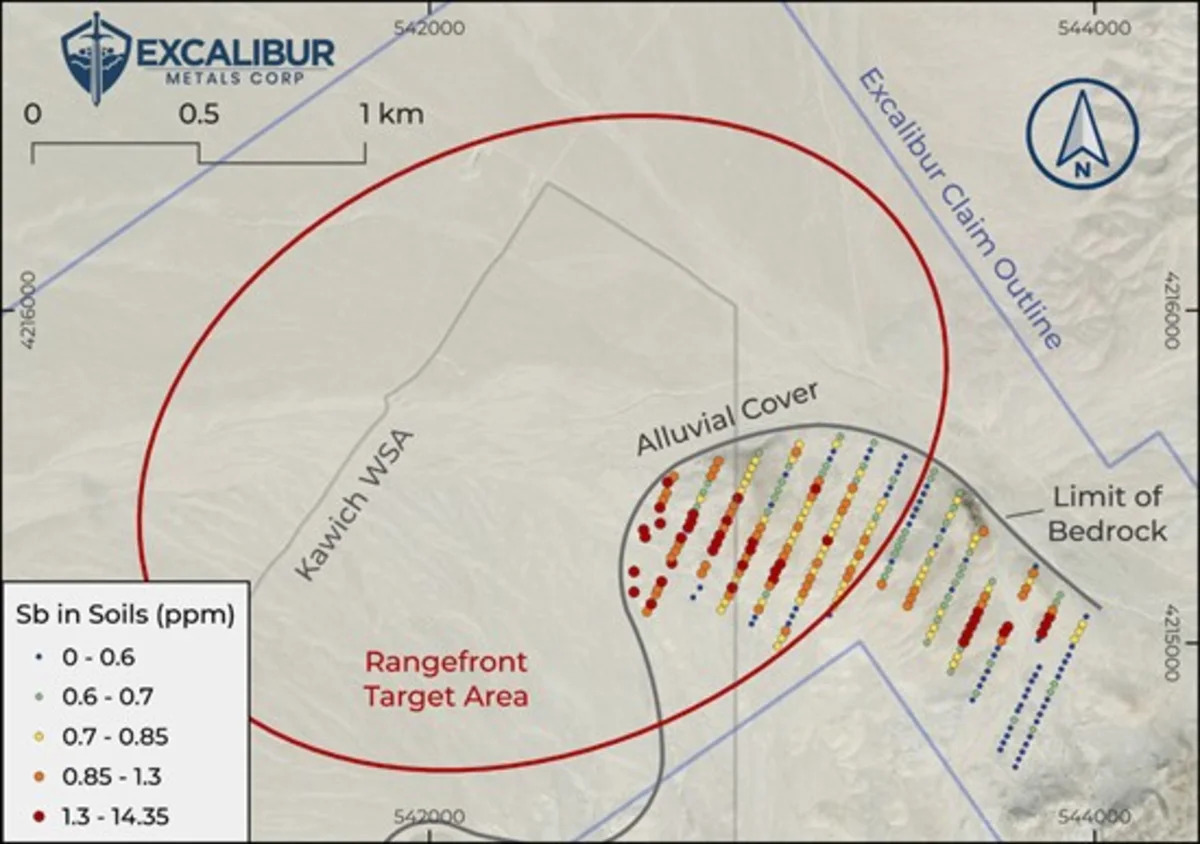
Following this initial work, the Company completed a systematic soil sampling grid across the Rangefront alteration anomaly (Figure 1) as well as a CSAMT survey. Results from both programs have now been received, with the soil samples defining a strong, coherent anomaly in antimony, arsenic, mercury, and gold concentrated immediately along the rangefront — the contact where pre-mineral bedrock outcrop is overlain to the west by post-mineral alluvial cover (Figure 1 and Figure 2). The CSAMT results reveal a marked discontinuity in resistivity values across a west-dipping plane near the location of the rangefront; Excalibur interprets this discontinuity to correspond to a west-dipping fault that constitutes a structural target for epithermal mineralization (Figure 2).