
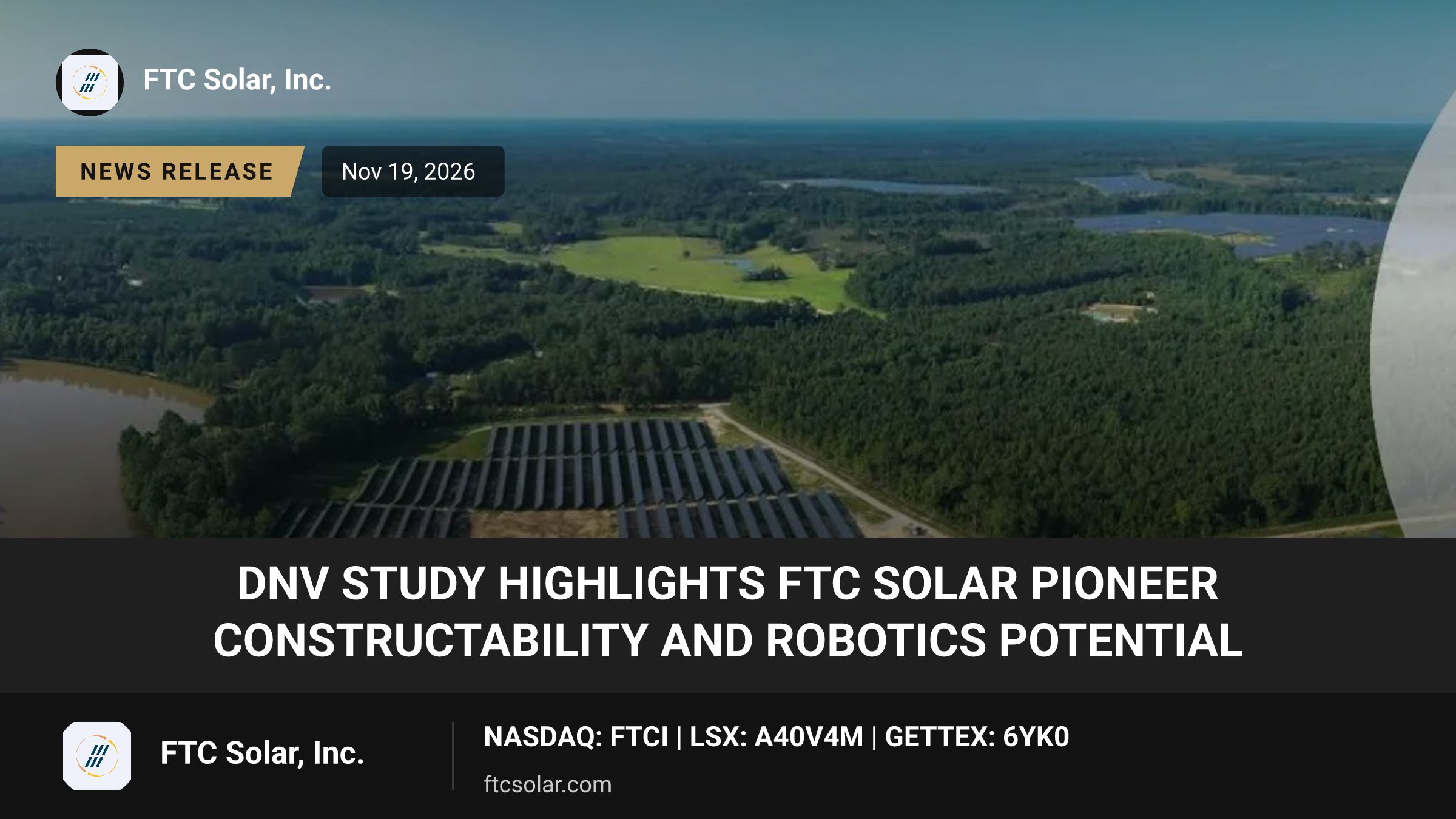
AUSTIN, Texas, Nov. 19, 2026 (GLOBE NEWSWIRE) -- FTC Solar, Inc. (Nasdaq: FTCI), a leading provider of solar tracker systems, software and engineering services, today announced a DNV technical assessment underscoring the highly constructable design of its Pioneer tracker. The review examines how Pioneer’s hardware, assembly sequence, and material management support field installation.
Following its review of leading tracker manufacturers, DNV concluded that Pioneer appears to have the fewest unique bolt sizes and one of the lowest quantities of bolted structural connections in the industry. The assessment highlights how fewer fastener types and simpler connections reduce hardware handling, tool changes, and assembly complexity.
FTC reports approximately 81 person-hours per MWdc for tracker mechanical assembly and module mounting, based on time trials conducted at the FTC training facility. As part of its assessment, DNV visited FTC Solar’s Austin training facility, reviewed installation documentation, videos and time trial data, and considers the time estimates reasonable based on the information reviewed and conditions shown. Results exclude commissioning, QA/QC and rework, daily setup, equipment moves, and effects of crew learning and turnover, weather, and terrain. DNV notes that the trials show promising potential, but field validation at large scale is still needed.
“Constructability is at the core of FTC Solar and how we design our trackers,” said Anthony Carroll, President and Chief Executive Officer of FTC Solar. “DNV’s assessment validates the design choices behind Pioneer: simplified connections, fewer structural bolt sizes, and an installation sequence built around the needs of field crews. For our customers, that means a tracker designed from the outset to be easier to build.”
Key findings
- Simpler connections and standardized hardware: Pioneer uses three primary structural bolt sizes - M12, M16, and M20 - with one standardized length per size. Open journals and self-aligning torque tube connections simplify positioning, while bolt-free Python Clip rail attachments, Slide-and-Glide module placement, and Cinch Clip fastening streamline rail and module installation.
- Efficient tracker assembly: The assessment reports approximately 81 person-hours per MWdc for measured tracker and module assembly activities, based on FTC-provided controlled time trials using a row of 90 modules rated at 710 W each.
- Installation organization built into the system: Color-coded components help crews identify installation locations, array-specific packaging groups materials by their intended destination, and optional preassembly reduces the work required in the field.
Building on these findings, DNV reviewed robotic approaches to module placement and fastening, two of the most labor-intensive components of tracker installation. Libra Robotics uses Pioneer’s Slide-and-Glide process for module placement, while RoboForce demonstrated robotic Cinch Clip insertion as a proof of concept. FTC Solar is collaborating with multiple robotics companies, using these unique elements of the Pioneer 1P tracker to demonstrate compatibility with different robotic platforms.
To learn more about FTC Solar and the Pioneer 1P tracker contact info@ftcsolar.com or visit FTC Solar’s website. www.ftcsolar.com
About DNV
We are the independent expert in assurance and risk management. Driven by our purpose, to safeguard life, property and the environment, we empower our customers and their stakeholders with facts and reliable insights so that critical decisions can be made with confidence. As a trusted voice for many of the world’s most successful organizations, we use our knowledge to advance safety and performance, set industry benchmarks, and inspire and invent solutions to tackle global transformations.
About FTC Solar
Founded in 2017 by a group of renewable energy industry veterans, FTC Solar is a global provider of solar tracker systems, technology, software and engineering services. Solar trackers significantly increase energy production at solar power installations by dynamically optimizing solar panel orientation to the sun. FTC Solar’s innovative tracker designs provide compelling performance and reliability, with an industry-leading installation cost-per-watt advantage. For more information, visit www.ftcsolar.com.
Forward-Looking Statements
This press release contains forward-looking statements. These statements are not historical facts but rather are based on our current expectations and projections regarding our business, operations and other factors relating thereto. Words such as “may,” “will,” “could,” “would,” “should,” “anticipate,” “predict,” “potential,” “continue,” “expects,” “intends,” “plans,” “projects,” “believes,” “estimates” and similar expressions are used to identify these forward-looking statements. These statements are only predictions and as such are not guarantees of future performance and involve risks, uncertainties and assumptions that are difficult to predict. You should not rely on our forward-looking statements as predictions of future events, as actual results may differ materially from those in the forward-looking statements because of several factors, including those described in more detail above and in our filings with the U.S. Securities and Exchange Commission, including the section entitled “Risk Factors” contained therein. FTC Solar undertakes no duty or obligation to update any forward-looking statements contained in this release as a result of new information, future events or changes in its expectations, except as required by law.