
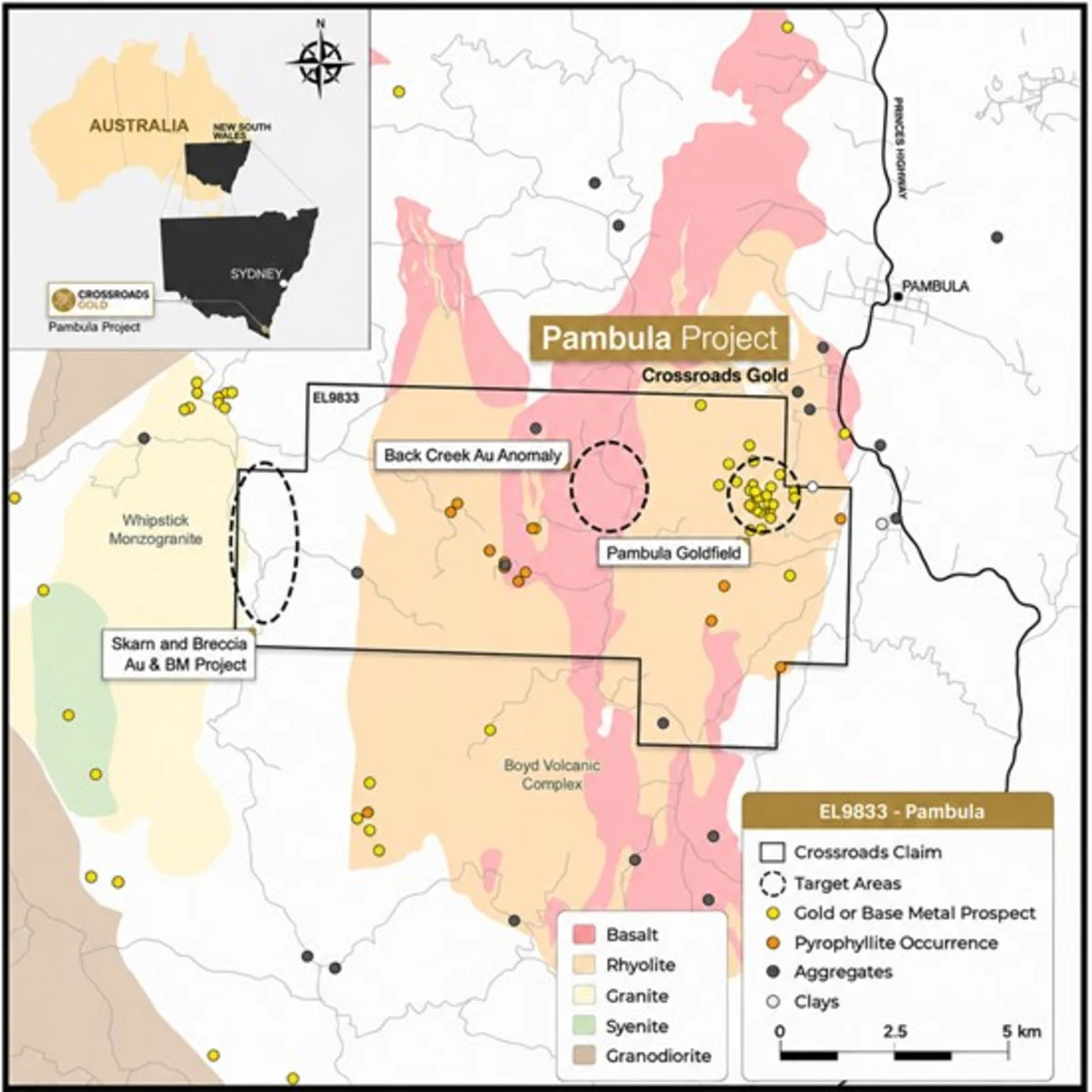
Vancouver, British Columbia--(Newsfile Corp. - June 25, 2026) - Crossroads Gold Corp. (TSXV: CRG) (OTCQB: CRGCF) (FSE: FI1) ("Crossroads" or the "Company") announces the completion of a comprehensive historical data compilation and geological reinterpretation for the Pambula Gold Project (the "Pambula Project") in New South Wales, Australia. The work integrates mining records, Geological Survey data, structural interpretations and historical production information into a modern exploration framework (Figure 1).
Mr. Rex Motton, CEO & Director of Crossroads, commented, "Pambula is emerging as a compelling district-scale gold system, with strong indications of structural continuity and sulphide-hosted mineralization that present an excellent opportunity for systematic exploration. Although historical mining achieved excellent recovered grades of an estimated 30 g/t Au, modern exploration has been minimal, with most work in the 1980s focused on shallow, open-pit concepts. As a result, significant potential remains for deeper drilling targeting sulphide-hosted mineralization. Historical evidence suggests the field's decline was driven more by metallurgical limitations and lack of capital — not because the geological system was depleted. Modern exploration methods and contemporary sulphide-processing technologies offer the potential to unlock substantial value across this underexplored district."
The review indicates that the Pambula Goldfield, which produced more than 40,000 oz of gold at recovered grades of an estimated 30 g/t Au, remains significantly underexplored. Only 32 historical drill holes (2,515m total) have tested the Pambula Goldfield, with the deepest hole reaching 271m (DDH-P7) and no drilling below 230m vertical depth (Figure 2).
Key findings:
Broad, continuous gold mineralization at depth, highlighted by hole DDH-P7 returning 16m at 2.36 g/t Au from 94m, including 5m at 6.62 g/t Au, with no follow-up drilling completed on the main Victory ore shoot (Figure 3).
Untested deep structural targets, including a feeder-zone target at 400m depth and an additional similar style Crossroads-defined target at approximately 250-300m depth.
Evidence of a large, structurally controlled hydrothermal system, including east-dipping lodes, brecciated corridors, sulphide-associated mineralization and north-plunging high-grade shoots.
Increasing sulphide and arsenopyrite mineralization with depth, consistent with deeper sulphide-hosted gold systems in southeastern Australia.
Uncharacterized silver and antimony potential, with historical references to electrum, silver sulphosalts and stibnite but no systematic modern analysis.