
Vancouver, British Columbia--(Newsfile Corp. - July 14, 2026) - Brasnova Energy Materials Inc. (TSXV: BEM) ("BEM" or the "Company") is pleased to announce analytical results from 23 rock chip samples collected from surface at the Capela Gold Project in Pintadas, Bahia, Brazil. The program follows the field activities announced on May 11, 2026, and was designed to verify historical gold occurrences and assess the continuity of mineralization within the Capela Target.
Twenty-two of the 23 samples returned encouraging gold results with values ranging from 0.241 g/t Au to 4.13 g/t Au, confirming a mineralized north-south-trending corridor approximately 120 meters long and up to 25 meters wide. Additional results include 1.734 g/t Au, 1.435 g/t Au and 1.170 g/t Au.
The mineralized trend defined by the current rock chip sampling remains open to the north and south along strike and laterally to the east and west, as the boundaries of the gold-bearing system have not yet been delineated.
HIGHLIGHTS
22 of 23 rock chip samples returned encouraging gold results above 0.241 g/t Au.
Peak assay of 4.13 g/t Au from sample BGP-ROCK-002.
Mineralization is defined along an approximately 120-metre-long, north-south-trending outcrop corridor.
Gold is hosted by sheared and hydrothermally altered granitic to granodioritic rocks.
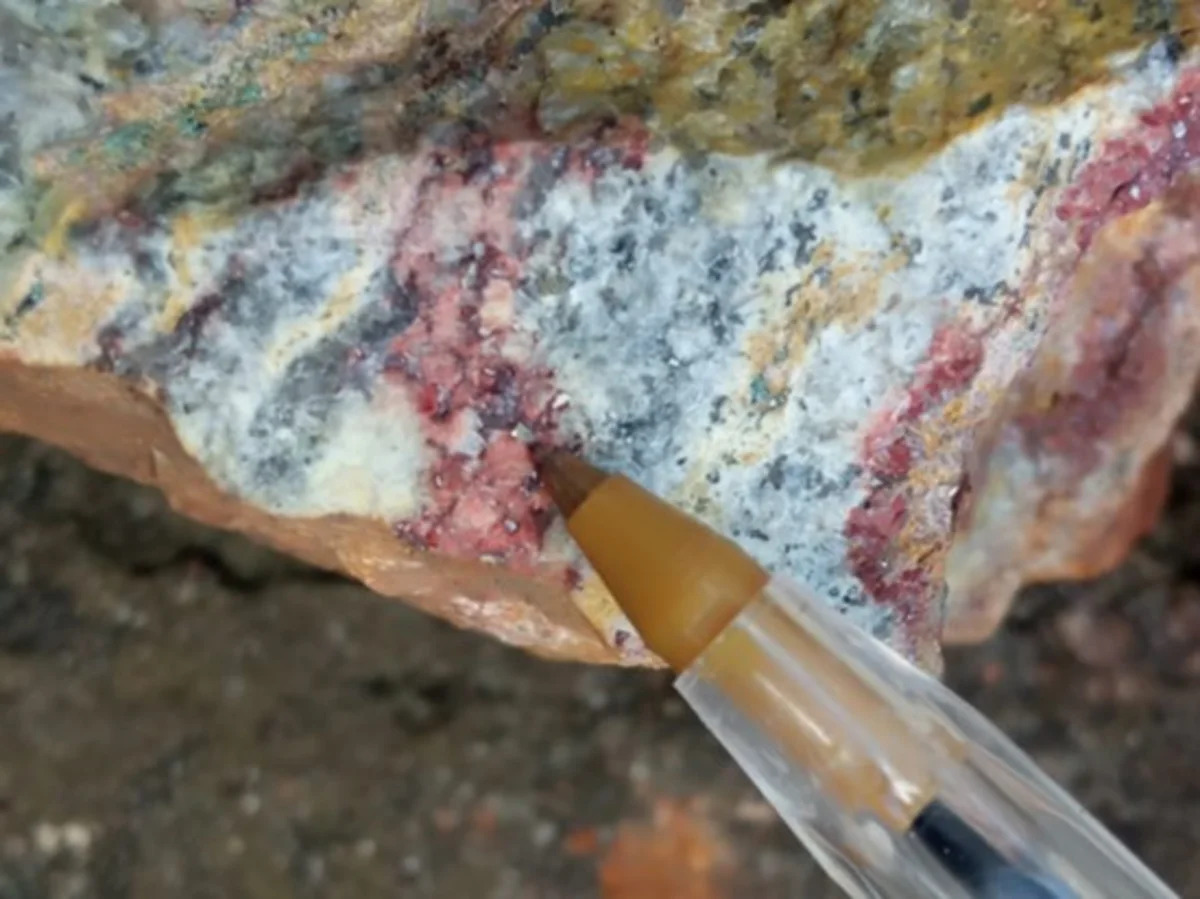
Observed alteration includes potassic alteration, silicification and sulphidation, with disseminated pyrite and subordinate chalcopyrite and pyrrhotite.
GEOLOGICAL CONTEXT AND MINERALIZATION
The Capela Project occurs within a structurally complex geological setting characterized by dextral and sinistral shear zones and regional fold structures (Figure 2). Geological mapping indicates that the target lies near the contact between granodioritic, granitic and metavolcanic-metasedimentary units, with mapped hydrothermal alteration developed within the broader intrusive and structural corridor (Figure 1).
Figure 1: Sulphide mineralization hosted within hydrothermally altered granitic rock, showing disseminated sulphides associated with silicified and reddish potassic-altered zones.
To view an enhanced version of this graphic, please visit:
https://images.newsfilecorp.com/files/5386/305075_66f2cf31c49b6a31_001full.jpg
Rock chip samples were collected from granitic to granodioritic outcrops affected by intense ductile-brittle shearing and pervasive hydrothermal alteration. Sulphide mineralization is dominated by disseminated pyrite, visually estimated at approximately 1-3% by volume, with subordinate chalcopyrite and pyrrhotite. The sulphides are closely associated with the altered and structurally prepared zones.