
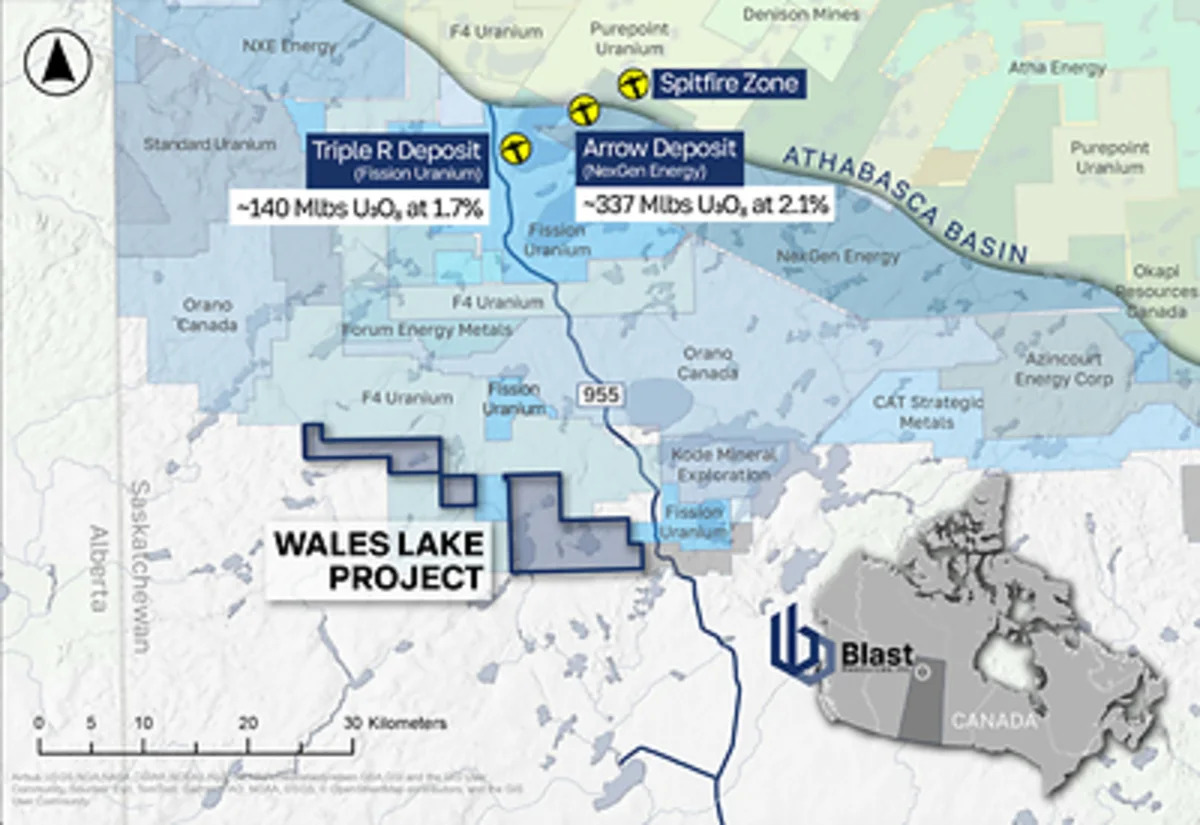
Blast claims are contiguous on the east to Fission Uranium Corp, "Typhoon Project"
Key Highlights:
Low magnetic susceptibility in regional surveys shows a NE-SW structural corridor that crosses the Blast claims for 9 km. The feature may be caused by alteration and destruction of magnetic minerals.
The significance of a structural corridor zone is that it may host concentrations of uranium mineralization in individual or multiple shears or faults to hundreds of metre depths.
VANCOUVER, BC, July 7, 2026 /CNW/ - Blast Resources Inc. ("Blast" or the "Company") (CSE: BLST) (FRA: O0E) is pleased to announce a structural corridor found on the Blast mineral claims. The Company has 3 claim groups on the southwest side of the Athabasca Basin in northern Saskatchewan.
Casey Forward, Chief Executive Officer & Director of the Company, commented, "We are very excited to announce the newly identified structural corridor found at our Wales Lake Uranium Project. The identification of this corridor provides us with a heightened understanding of our Project as we develop as a company and continuously seek sustainable growth for our investors. Moving forward, we are well equipped to continue driving advancement at the Project and look forward to sharing what we uncover next."
This structural corridor is a zone of approximately parallel faults or shears in basement rock. The trend extends both NNW (330°) and SSE (150°) of the Blast claims continuous within the Blast claims for a length of 9 km. Width of the zone as indicated by basement conductors (Fission 3) may be 3 km. Info on this target are as a result of the December 2024 airborne magnetic survey done by the Company and historic F3 Uranium field work (public domain).
In structural geology, a structural corridor refers to a long, relatively narrow area defined by specific geological structures, such as faults, shears or folds, which can influence the location of geological features and resources
The Athabasca Basin's structural corridors are critical for understanding the sites of uranium mineralization, particularly the relationship to unconformity-related deposits. These corridors, often major fault zones, act as pathways for uranium-bearing fluids and provide geometric traps for ore deposition.
The Company is focussed on conductors in basement rock that acted as traps for uranium mineralization. Unconformity-related deposits, uranium mineralization is often associated with the unconformity surface, where older basement rocks are overlain by younger sedimentary rocks. Conductors in the basement rocks can guide fluids from deeper sources to the unconformity, where they can deposit uranium.