
VANCOUVER, BC - August 25, 2026 (NEWMEDIAWIRE) - Andina Copper Corporation (TSX-V: ANDC | FSE: FIR | OTCQB: PMMCF) is pleased to report further significant near-surface drill result from its large-scale Cobrasco porphyry copper-molybdenum discovery in Choco, Colombia.
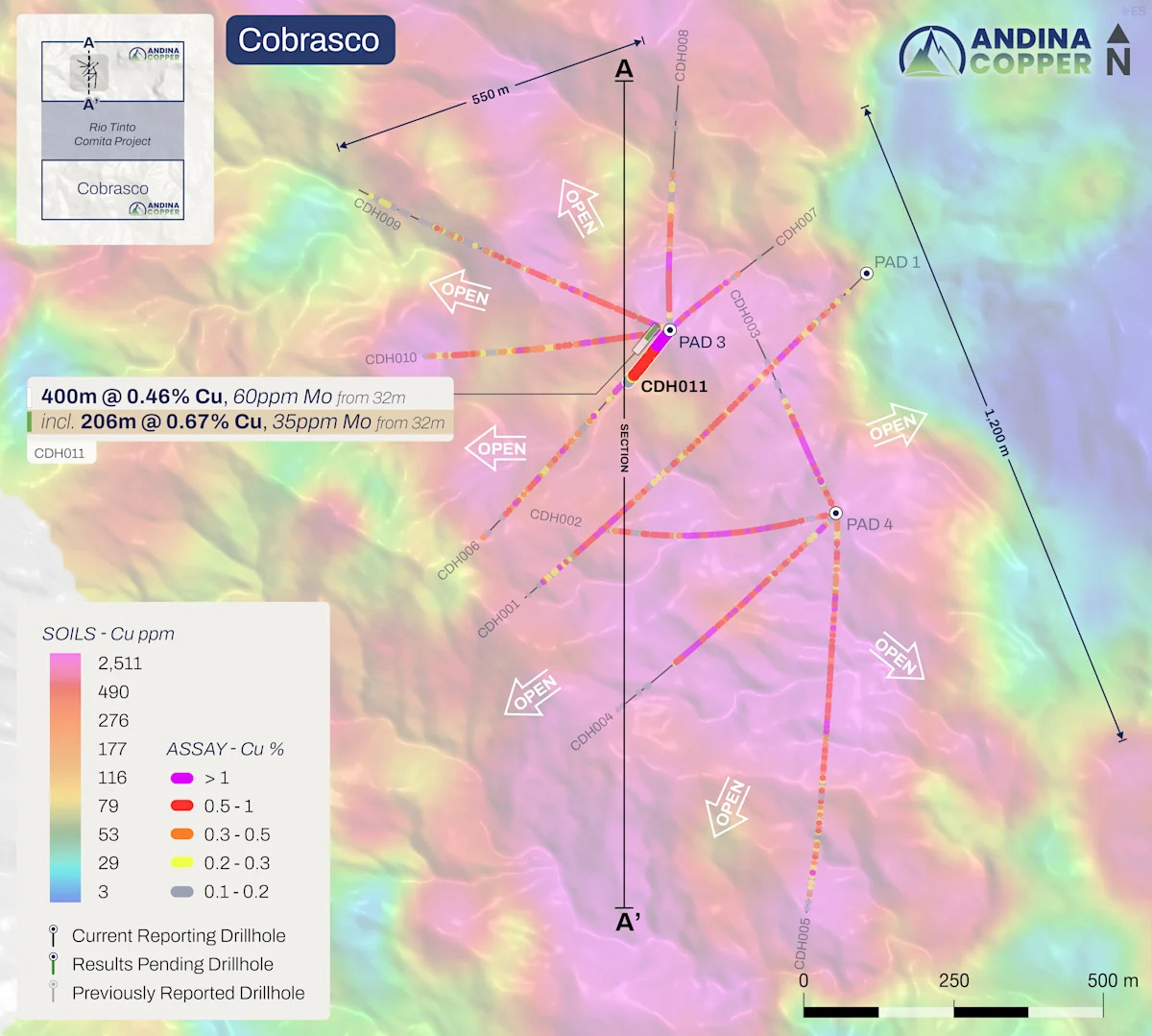
Hole CDH011, collared from the same drill pad as CDH006 - CDH010 (refer 11 August 2026 News Release) intersected continuous mineralization from 32m downhole, returning 206m @ 0.67% Cu within a broader interval of 400m @ 0.46% Cu. The higher-grade upper zone extends to 276m downhole, while moderate-grade Cu-Mo mineralization continues to approximately 592m downhole. Drilled steeply beneath Pad 3, CDH011 confirms the vertical continuity of mineralization within the central portion of the Cobrasco system.
Andina Copper is systematically advancing a wide-spaced scout drilling program using substantial step-outs to test the overall extent and limits of the Cobrasco mineralized system. Multiple holes have since been completed from a new platform located approximately 350m northwest of Pad 3, with drilling ongoing. A second drill rig is expected to be mobilized shortly to accelerate the systematic evaluation of the extent, geometry and geological controls of the mineralized system.
HIGHLIGHTS:
- CDH011 returned one of the highest-grade near-surface intervals drilled at Cobrasco to date:
400m @ 0.46% Cu, 60ppm Mo, 1.1g/t Ag from 32m
Including 206m @ 0.67% Cu, 35ppm Mo from 32m
Including 40m @ 0.87% Cu, 70ppm Mo from 32m
Including 54m @ 0.76% Cu, 59ppm Mo from 184m
- Drilled steeply beneath Pad 3, CDH011 confirms the vertical continuity of shallow Cu–Mo mineralization within the central portion of the Cobrasco system.
- Below the higher-grade upper zone, CDH011 intersected a further 290m @ 0.25% Cu and 93ppm Mo from 302m, with bornite observed locally between approximately 335m and 407m downhole.
- The initial 11 diamond drillholes reported to date have delineated a mineralized footprint of approximately 1,200m by 550-700m which remains open in multiple directions.
- Multiple holes have since been completed from a new platform located approximately 350m northwest of Pad 3, with drilling ongoing. Results pending.
Joseph van den Elsen, Andina Copper President and CEO, stated:
"All eleven drillholes reported at Cobrasco have intersected significant near-surface copper-moly mineralization, with CDH011 including one of the highest-grade near surface intervals to date of 206m @ 0.67% Cu. This steep test beneath our most productive drilling platform confirms the continuity of the system at depth.
With assays pending from multiple completed holes at a northwest platform and drilling ongoing, we look forward to a continuing steady flow of results as we systematically define the scale of the Cobrasco system. Mobilization of a second drill rig will further accelerate the systematic evaluation of the extent, geometry and geological controls of the mineralized system."
Figure 1: Cobrasco Project plan view showing copper-in-soil geochemistry, drillhole traces and downhole Cu assays. CDH011 intercepts are labelled; mineralization remains open in multiple directions.
Geology and Mineralization - Drillhole CDH011
Hole CDH011 was collared from the same drill pad as CDH006 to CDH010 and drilled steeply southwest to test the vertical continuity of mineralization beneath Pad 3. All holes completed from this pad have intersected consistent intervals of shallow, continuous, moderate- to high-grade Cu-Mo mineralization beginning immediately below the base of oxidation.
Hole CDH011 (azimuth 225 degrees; dip -80 degrees; final depth 695.45m) was the sixth hole drilled from Pad 3. CDH011 intersected an approximately 32m-thick oxidized, supergene-leached zone. From the base of oxidation to approximately 58m downhole, moderate supergene chalcocite enrichment occurs locally as partial replacement of hypogene chalcopyrite and pyrite. This supergene-enriched interval includes one individual 2m sample returning 2.21% Cu.
The higher-grade upper zone extends to approximately 276m downhole and is hosted by quartz-eye rhyolite porphyries and subordinate daci-andesitic porphyries and microdiorites. Copper mineralization occurs principally as chalcopyrite in disseminations, hairline veinlets and fracture fillings, associated with moderate to strong sericite alteration. Remnants of earlier potassic alteration, characterized by secondary biotite, are locally preserved.
Zones of high fracture intensity within the upper interval locally host high copper grades. A highly fractured zone between approximately 106m and 197m downhole contains individual 2m samples grading 2.52% Cu from 130m and 3.59% Cu with 477ppm Mo from 190m. Chalcopyrite occurs as veins, veinlets and fracture fillings within rocks affected by brittle deformation. Higher-grade subintervals within the upper mineralized zone include 40m @ 0.87% Cu and 70ppm Mo from 32m, including 22m @ 1.17% Cu from 34m, and 54m @ 0.76% Cu and 59ppm Mo from 184m.
Below approximately 300m, moderate-grade Cu–Mo mineralization continues within rhyolite porphyries and magmatic-hydrothermal breccias, returning 290m @ 0.25% Cu and 93ppm Mo from 302m. This interval is characterized by molybdenite-bearing B-type quartz veins and pervasive grey-green sericite alteration overprinting earlier potassic alteration. Bornite occurs locally between approximately 335m and 407m downhole as fine disseminations and thin veinlets, commonly replacing chalcopyrite. Later anhydrite–chalcopyrite, calcite and polymetallic sphalerite–galena–chalcopyrite veinlets overprint the earlier vein generations.
In broad terms, the rhyolite porphyries intrude intermediate-composition daci-andesitic porphyries and microdiorites, with emplacement of the rhyolite porphyries likely generating magmatic-hydrothermal breccias that subsequently became mineralized. Sericite alteration overprints earlier potassic alteration and is accompanied by the precipitation of chalcopyrite and bornite, with bornite commonly replacing chalcopyrite. The style and distribution of hydrothermal alteration and sulfide assemblages in CDH011 are broadly consistent with those observed in adjacent drillholes.
(A) Hydrothermally brecciated daci-andesitic–microdiorite porphyry affected by moderate to intense sericite alteration, with pyrite-chalcopyrite-anhydrite veinlets and pyrite and chalcopyrite fracture fillings.
(B) Quartz-eye rhyolite porphyry affected by sericite alteration, with brownish remnants of earlier potassic alteration. Fine bornite occurs as disseminations and veinlets, commonly replacing chalcopyrite.
(C) Polymictic magmatic-hydrothermal breccia containing microdiorite and quartz-eye rhyolite porphyry fragments within a sericite-chlorite-altered matrix and chalcopyrite-pyrite-rich hydrothermal cement.
(D) Quartz-eye rhyolite porphyry affected by moderate sericite alteration, containing bornite and chalcopyrite aggregates and chalcopyrite–anhydrite veinlets.
The Company's Corporate Presentation is available at: Andina Copper Corporate Presentation
Interested parties can subscribe to our mailing list and follow our social media channels in the links below:
Mailing List | Andina Copper LinkedIn | Andina Copper X
ON BEHALF OF THE BOARD
Joseph van den Elsen
President & Chief Executive Officer
joseph@andinacopper.com
Jordan Webster
VP – Technical Communications
jordan@andinacopper.com
QUALIFIED PERSON
Gustavo Zulliger, a consultant of Andina Copper Corp and a "qualified person" ("QP") within the definition of that term in National Instrument 43-101, Standards of Disclosure for Mineral Projects, has reviewed and approved the technical information contained in this news release. Gustavo Zulliger is a Certified Professional Geologist with the American Institute of Professional Geologists (CPG #11165).
QAQC
CDH011 was collared with a PQ size drill string and reduced to HQ/HQ3 at approximately 176m depth, continuing to a final depth of 695.45m. In all cases the drill core was extracted from the core barrel by the drill contractor under the supervision of Andina Copper personnel and placed in core boxes with appropriate depth markers (core blocks) and padding added for extra protection during transport. Full core boxes were then strapped closed before being transported by helicopter and pickup truck to the Cobrasco core cutting facility in Quibdo. The drill core was cleaned where required, marked-up and photographed, prior to undergoing geotechnical and geological logging. All core segments were cut by diamond saw by Andina Copper technicians, other than the soft upper oxidized, near surface intervals that could be cut and sampled using hand tools. All sampling was conducted in nominal 2m intervals with cut-lines marked by the supervising geologists to ensure representative sampling. Samples were placed in plastic bags with non-repeatable sample tags and bagged in woven polypropylene sacks ready for transport.
The core trays with the remaining half-core are stored at the Andina Copper facility in Quibdo for ongoing geotechnical (Terraspec spectral analysis, magnetic susceptibility readings, rock density measurements) and follow-up detailed geological logging. From Quibdo, core samples were sent to the ALS sample preparation facility in Medellin, an accredited laboratory which is independent of the Company. Prepared sample pulps were then forwarded to the ALS laboratory in Lima, Peru for gold (Au-AA23), multi-elements (ME-MS61), and "overlimits" analysis (ME-OG62 including copper Cu-OG62). Coarse and fine rejects are routinely returned by ALS Medellin for storage at the Andina Copper storage facility.
Table 1: Cobrasco Project - Significant Drill Intercepts
Note 1: CDH011 intervals were calculated using a nominal 0.2% Cu cutoff and a maximum internal dilution of 20m, consistent with the criteria previously applied to CDH004 and CDH010. As an exception, the broader 400m interval from 32m includes a 26m interval from 276m to 302m below the 0.2% Cu cutoff and is reported to reflect the broader envelope of near-continuous mineralization. The 290m interval from 302m partially overlaps the broader 400m interval between 302m and 432m. Intervals for CDH001 to CDH010 are reproduced as previously reported and retain the reporting criteria described in the corresponding news releases.
Note 2: Reported interval widths are downhole lengths and may not represent the true widths of mineralization.
Table 2: Cobrasco Project – Drill Collar Parameters (WGS84, UTM Zone 18N)
ABOUT ANDINA COPPER
Andina Copper Corporation is a unique South America-focused copper explorer listed on the TSX Venture Exchange (TSXV:ANDC), Frankfurt (FSE: FIR), and OTC (OTCQB: PMMCF) exchanges. The Company holds two significant discoveries along the world's premier copper producing Andean porphyry belt in Argentina and Colombia, and a compelling undrilled copper-gold target in the prolific copper production district of the Coastal Cordillera of Chile.
FORWARD-LOOKING STATEMENT
This news release contains certain statements that may be deemed "forward-looking statements". All statements in this release, other than statements of historical fact, that address events or developments that Andina Copper expects to occur, are forward-looking statements. Forward-looking statements are statements that are not historical facts and are generally, but not always, identified by the words "expects" and similar expressions, or that events or conditions "will" or "may" occur. These statements are subject to various risks. Although Andina Copper believes the expectations expressed in such forward-looking statements are based on reasonable assumptions, such statements are no guarantee of future performance, and actual results may differ materially from those in forward-looking statements.
Neither the TSXV nor the Canadian Investment Regulatory Organization accepts responsibility for the adequacy or accuracy of this release.