

Vancouver, British Columbia--(Newsfile Corp. - July 7, 2026) - Advanced Gold Exploration Inc. (CSE: AUEX) (FSE: ZF2) (OTCQB: AUHIF) ("Advanced Gold" or the "Company") is pleased to announce the assay results from its spring mapping and sampling reconnaissance program at the Company's 100% owned Silver Belle project in Nevada. High grade mineralization is present in at least three mineralized zones that were explored over several kilometers by small historic mines and prospects, with the most important being Phillipsburg, Silver Bell, and Mammoth/Champion.
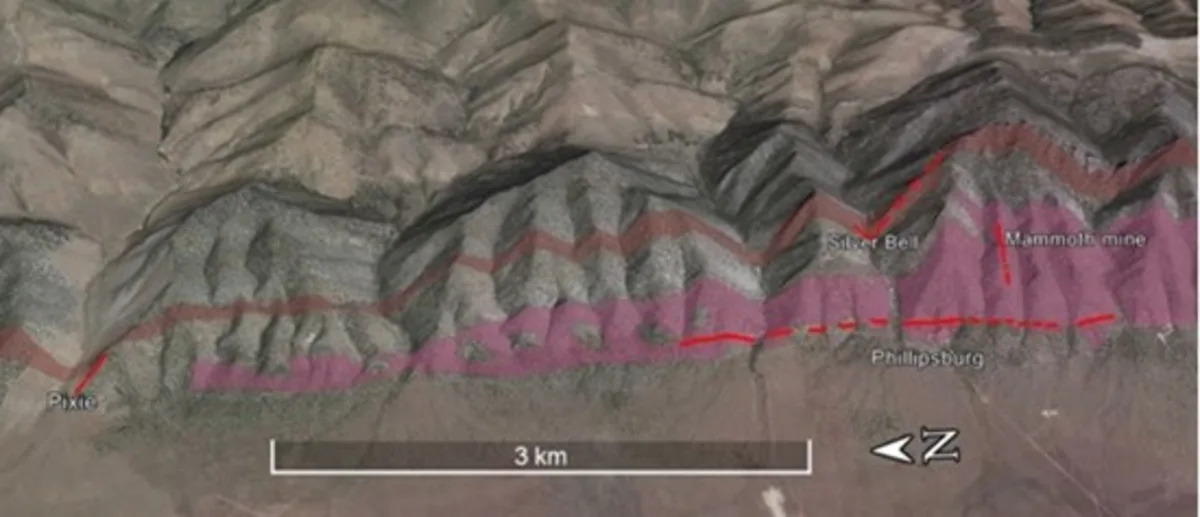
Fig. 1. Perspective view looking westward of a portion of the Silver Belle Project showing target areas and important strata in the Lower Paleozoic sequence. The light brown band across the upper portion of the figure is a sandstone unit that hosts mineralization at the Silver Bell mine, while the purple rocks are dolomite that hosts the Phillipsburg mineralization.
To view an enhanced version of this graphic, please visit:
https://images.newsfilecorp.com/files/8072/304139_advanced%20gol%201.jpg
Highlights
257 g/t Ag over 0.7 meters at the Pixie mine
192 g/t Ag, >10% Pb, 2.3% Zn and 0.1% Cu over 1 meter at the Phillipsburg mine
189 g/t Ag and 7.4% Zn at the Mammoth mine
The Phillipsburg manto consists of strongly oxidized gossanous replacement of a layer in carbonate rocks along the front of the Diamond Range and is recognized in several small historic mines developed along about 1.5 km of strike. Sampling returned up to 192 g/t Ag, >10% Pb, 2.3% Zn and 0.1% Cu over 1 meter (Table 1).
Fig. 2. Schematic cross section through the Phillipsburg and Silver Bell mines.
To view an enhanced version of this graphic, please visit:
https://images.newsfilecorp.com/files/8072/304139_advanced%20gold2.jpg
The Silver Bell mineralized zone consists of quartz veins with galena, sphalerite and stibnite with oxide copper minerals along bedding in a sandstone unit east of the Phillipsburg manto. A sample of the dump at the Silver Bell mine yielded as much as 131 g/t Ag, >10% Pb and > 0.1% Sb, and sampling of similar occurrences 5.5 km along strike to the north yielded 257 g/t Ag over 0.7 meters.
A third zone at the Mammoth mine consists of quartz veins in a transverse structure in carbonate rocks structurally between the Phillipsburg manto and the Silver Bell zone. Four samples from the Mammoth vein yielded 142 g/t Ag, 3.2% Pb, 1.9% Zn and 0.2% Cu over about 0.4 meters, with one of the samples reporting Pb >10%.
The Silver Belle project covers about 2,000 acres within the Diamond Mining District located 55 km north of the Eureka district that hosts large carbonate replacement deposits CRD as well as sedimentary rock hosted gold deposits. Mineralization at the Silver Belle Project is similar to that at Eureka. At Silver Belle, mineralization was mined from about 1869 to 1887 and two small smelters were operating. Although no records exist from this period, intermittent production from 1936-1955 is recorded at 851,898 oz Ag, 755,100 lbs Pb, 184,520 lbs Zn. Also a 1937 smelter shipment of 21 tons returned approximately 1,611 grams per tonne (g/t) silver (47 ounces per ton (oz/t)), 34 per cent lead, 9 per cent zinc, 1 per cent copper and 0.3 per cent antimony from underground workings.