John Mills
CEO at XAAR PLC
Replay available
Interim Results hosted by Xaar (LSE:XAR) on Investor Meet Company, held 2026-08-07.
Automated transcript · Written by software from the replay's audio. It can mishear names and figures; the replay is the record.
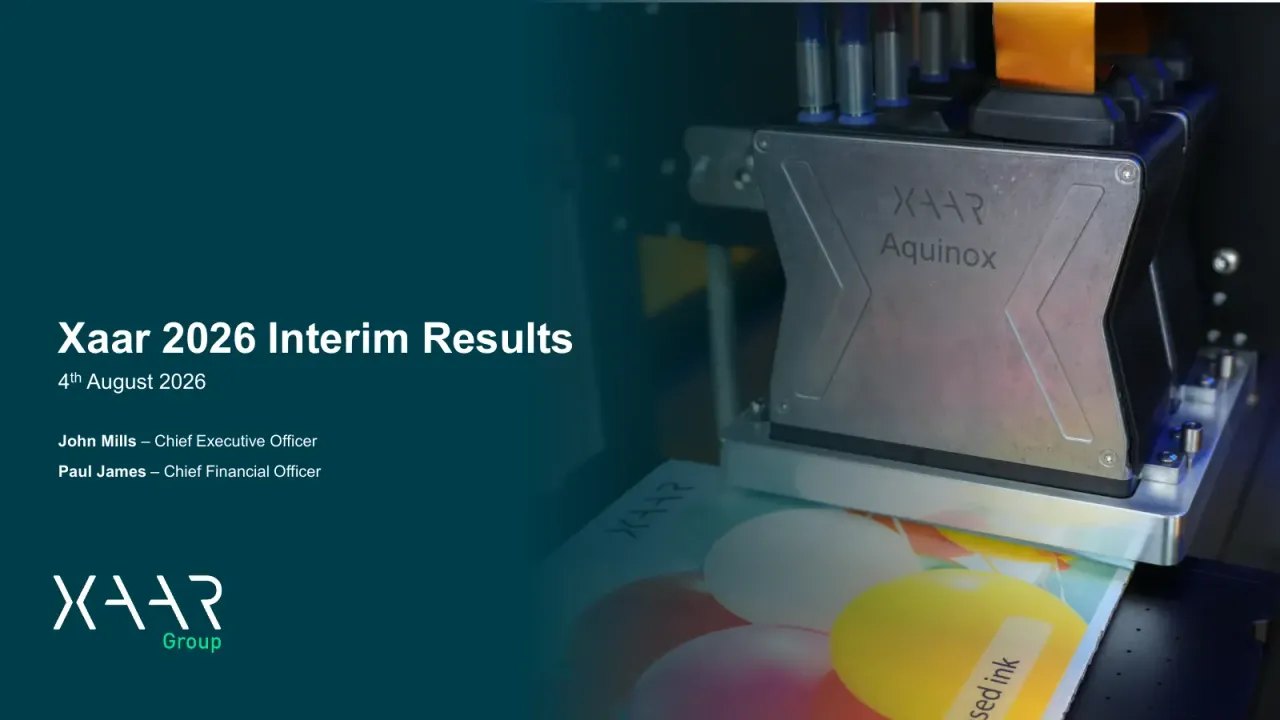
0:00 Good afternoon, and welcome to the XAR PLC investor presentation. Throughout this recorded presentation, investors will be in listen only mode. Questions are encouraged and could be submitted at any time by the Q and A tab situated on the right hand corner of your screen. Simply type in your questions and press send. The company may not be in a position to answer every question it receives during the meeting itself. However, the company can review all questions submitted today and publish responses where it's appropriate to do so. Before we begin, I'd like to submit the following poll. I'd now like to hand you over to John Mills, CEO. Good afternoon, sir. Hi. Good morning good afternoon, and welcome to everybody. I'm here. I'm John Mills, CEO of XAAR. I'm joined by Paul James, who's our CFO. Today, I'd like to take you through the 2,026 interim results presentation and then give you an overview of where we are.
0:55 So I think so far this year has been a a good year. We've seen some disruptions markets due to the the war in Iran. We have seen that when when there's disruption or uncertainty in the world, capital equipment purchases are affected, and we sell print heads into OEMs who build equipment. And what happens is that they they sell less machines and we sell less print heads. As a result of that, there are certain markets where we've actually seen some decline in in in the markets. However, we'd be pleased to report that print head revenue is actually up by 5.5%. And the reason for that is actually because there's quite a lot of new business that's come through. So whilst we've seen some headwinds because of the global economic challenges, the growth has been there by these new applications that we move through. And we'll talk more about that later on in the the presentation.
1:56 And combined with that, MagniJet and EPS were pleased overall to report 9.2% increase like for like year on year. Also, we've continued to control expenditure, and that's delivered a margin improvement of 2.2%. And one of the things that has been some frustration frustrating and disappointing in the first half is that six months ago when we were doing the full year results, we were pretty sure that FlashForge would be launching the desktop three d within days, if not weeks, of of that time. Since that that point, they've encountered a few technical issues that have delayed the launch.
2:43 And we've helped them resolve those technical issues. And and today, we have a a team on-site with them as they ramp up their pre manufacturing launch. And we're fairly confident that they will actually launch in the next couple of months. There is the the remaining challenges have, I think, have largely been resolved, and we're now supporting them in their production build. So we hopefully will see that launch happening before the end of end of this this year. And it's an interesting area because the opportunity with the desktop three d is significant, and we can talk about that later later on. So the business sensors are you know, we are a small company. We compete against very large companies like Epson, Rico, Fuji, and and these companies have huge geographical reach. They have huge reputations and significant manufacturing capabilities.
3:49 And so how do we win? Well, we we win as a small company by being able to print the fluids that no one else can print. And that, as many of you may have already heard from XAR that that's about printing materials which have a much higher viscosity or a higher pigment load in the market competitors. So for instance, an Epson head can print eight centipoise. One centipoise is water, and 20 centipoise would be cream, 50 centipoise is olive oil, and and so the thicker you get, the higher the number. And Epson tops out around about eight centipoise. And what that means is they're limited to very low viscosity fluids. So if you wanted to print an application where a low viscosity fluid is, it's fine. You'd absolutely don't choose XAAR.
4:40 However, for for us, what we focus on is the the high viscosity applications where if the fluid that you need to deposit is much higher viscosity, then really you need to be using XAR PLC. And that is the differentiation, and that differentiation capability comes from our fundamental architecture, which delivers a much broader operating window. And that architecture is protected by a significant number of patents, thirty years of manufacturing know how, and and increasingly application expertise as well. So how do you actually use the print heads in a given application? And and what that means is is that for the the print heads into the market, we we can print with much higher pigment loading. We have a much wider range of fluids that we can print, and we can operate at a much higher temperature.
5:40 As what that means is that customers can typically print the fluid that they want to print and ultimately means that they can print with reduced energy, reduced waste, and and and high precision. And the route to market is actually quite complex. So it's one of the things that I think if you look at XAR and have followed us for a number of years, you might sort of say, well, we've been talking about certain applications for many years, and that's absolutely true. We sell a print head into an OEM. They develop and build a machine. They then test it in the application. And in many cases, the application requires other regulatory approval. It might require other investment in processes to adopt in a broader manufacturing sense. And all of this means that the time frame to actually get the product into volume manufacturing in in the OEM's application can be very difficult to predict and and actually often sometimes can be many many years.
6:45 The the benefit is that once you're in and once you're actually the print head of choice, all of those things have made it difficult to get in, but makes it very sticky. And so it's it's for us, we believe that as we enter these markets, then it's believe that we can sustain the position within that market once we're once we're in there. And there's sort of three sources of revenue. There's the printers that we sell to OEMs to build machines that go into the application. And then as you build that installed base, over time, you would put there will be print head replacement, and the replacement cycle depends on the application. In in more extreme applications like semiconductor, we might see a replacement on an annual cycle.
7:32 In more of the the less demanding areas, you might see a replacement every six, seven years. So what if that's so if the replacement is every five years, then that means 20% of your installed bases is is actually effectively a USC revenue revenue going forward. So it's key to actually build that installed base and grow that replacement revenue. I don't increasingly, we're seeing is accessing the ink revenue. And if we've been involved in developing the solution, there's often opportunity to share in some some ink revenue in the application. So with that, I'll hand over to Paul to take you through the financial summary.
8:25 Thank you, John. Yes. So I'm actually pleased to present these results for the first half where we had year on year growth in all parts of our business with group revenues, John said, up 9.2%. And I'm particularly pleased about the recovery in our US business called EPS under new leadership, which has come with an ever expanding pipeline. Is print head, and that was up five and a half percent, and that's prior to the launch of FlashForge's desktop three d offering. So that is actually, in of itself, an impressive performance for the first half. The revenue performance translates to a profitable first half, really, for the first time in at least three years, and we're in line to achieve consensus on profit.
9:16 The balance balance sheet is balance sheet, sorry, is almost net neutral with a net debt position of nought 100,000 and an adjusted free cash outflow of 4,300,000. And that was primarily driven by the need to build build inventory to support the launch of FlashForge's desktop three d product. So that's the that's the overall shape of the numbers. Let's have a look now at the divisional performance. So as you can see, I'm pleased with the growth in print head, and with the expected launch of, FlashForward's desktop three d in the second half. Year year revenue performance for the second half is expected to be much stronger. The growth growth has been driven by new business, new applications, and uses for our unique technology.
10:04 Within all of this, we've seen the legacy ceramics market stabilize after many years decline, and that's been helped by the development of, new so so called called ceramic blaze technology. And as such, this, this decline that we've experienced for many for a long time now, for many years, no longer represents a headwind for us in our growth going forward. Now there's a wider important point here. The the XAR of today has broadened its appeal to many different sectors and continues to expand. And as such, there is now a de risked portfolio effect compared to the XAR of old. Operational gearing effects show an enhanced adjusted profit before tax profitability. That's improved by some 100 basis points year on year.
10:53 And MEGNAjet gross margin is up 120% 100 sorry, 120 basis points built on revenue increase of 27% year on year. And the MEGNAjet business underlies the importance of supporting systems or system components for our core offering, supporting our customer base. The growth comes from new customers as well as increased demand from the existing customer base. And then back to EPS. Much hard work has been done to rebuild a durable pipeline, address the cost base, and that's work that's been ongoing for some time now, and solve some long term intractable problems. So I expect EPS's recovery recovery path to continue into next year. So let's have a look at a bit of detail at the adjusted income statement.
11:41 So taking it as a whole, the group grew revenue by 9.2%, percent, a performance that would be the envy of many companies in the current global climate, and growing gross margin performance by 220 basis points. The development of operation expenditure is worthy of mention. Now it's up 5.7% year on year, but this increase is driven by building, and some would say rebuilding, capability in the front end, sales and marketing, and the sharp end, which is how I term research and development. That's to drive growth growth in the innovation pipeline, which is our lifeblood after all. So general and admin expenses have actually declined by 1.6% note, a contraction in the cost of back office roles.
12:30 Putting Putting that all together, we now see a business that grew profitability substantially in the first half to achieve an adjusted profit before tax of 200,000 compared to a loss of 700,000 last year and similar losses, I must say, for the first half of the years before that. Then just take a look at, cash flow and turning our attention to cash. The group's adjusted free cash flow was an outflow of 4,300,000. This was primarily driven by temporarily building inventory to support the launch of desktop three d by FlashForge. And once this launch has happened, we expect this to, sharply reverse. In addition, the group has upped capital expenditure in the first half compared to last year, again, driven by building out capability to support anticipated higher volume levels in the future, particularly with our new manufacturing facility in Dongguan, China, that is in in itself enhancing supply chain resilience.
13:29 Now I want to emphasize, and I've done this many times already since I joined XAAR, that the days of storing large amounts of cash in what is essentially a current account are over. We have entered into an expanded rolling credit facility, increasing it from 5 to £10,000,000 with an EBITDA covenant of three times, whereas previously, it was two times. And in addition, we have an uncommitted accordion facility of 5,000,000 an increased invoice discounting facility of 5,000,000. So at the moment, our liquidity is substantial. So that's it for me for now. I'll hand back to John. K. Thanks, Paul. So in terms of the the the strategy going forward, we you know, as I said earlier, we compete against very large Japanese companies, and our key strategy is to maintain a differential in capability to be able to print fluids that no one else can.
14:32 And that the the real competitive advantage is based around our technology. And therefore, one of the key things that we will do is continue to actually invest in in engineering and then and r and d to maintain this this advantage. The other key thing is that if you go back ten, fifteen years, XAR was pretty much a single product in a single market of ceramics. And when I joined six, seven years ago, there was very, very few applications for XAR and technology. What we've done over the last five, six years is really to focus on how we diversify and have a broader set of market applications.
15:17 And today, I'm pleased to say we have 21 separate markets where we are generating revenue across across the many many territories and many applications. And so the route to market through the through the OEMs, we OEMs build machines and sell them into a particular application. We have another category user developer inspirations. So these are companies that actually actually buy the printers or systems for their own use. And we see that increasingly as large very large companies start to adopt our technology in their process. And that's typically true in the semiconductor space.
16:03 And what we typically do is we enter into a new market is that we have halo partner, somebody where who will will give preferential pricing and significant support to get them to market, knowing that once they're in the market and gaining market share because of the advantage of our print heads, then their competitors will come to XAR and at that point, we will have much more flexibility on pricing and how we would charge for around supporting them. And and so if you look overall, the the four phases development, we would work a company would come along saying, really want to use inkjet in this application. We would work with them to develop an ink that can jet through through our print heads and and often has the widest range of premises that we can that we can deploy.
17:00 And then we move into a mean machine development phase. So they will actually develop a machine that will actually function and and and and and print whatever is the the item that they'll need printing. Once they've done that, they can then use that to go into customer accreditation, and that can vary significantly for the car battery application. The machines were built. It took about a year and a half to build the and develop the machines, then they started producing batteries. And those batteries went through a substantial amount of testing with the car manufacturers, putting them into cars, testing them, environmental tests. So that took about another year and a half to do those testing before the batteries were actually accepted into the the border circulation.
17:49 So from the point where we celebrate because the company has chosen our print head to the point where they launch a number of machines and we get repeat orders for the machine for the printers for those machines can be a number of years. And so over the last five, six years, we've built a pipeline of applications that are starting to come come through now. And we talked a lot about desktop three d and car batteries and spray paint in and wax. But there are others that are starting to come through and deliver revenue now. So conformal course in the PCBs. So this is putting a waterproof coating onto a PCB. So for instance, you might remember a number of years ago, if you dropped your iPhone into a into water, it would probably never work again. Now if you drop it into water, it survives. And and and a lot of that is down to putting a conformal coating onto the the PCB.
18:50 This is an increasing market, and the same coating that's used on the car battery can be used on the PCBs and is much quicker and more efficient than the incumbent method. And we're starting to see that now grow in particularly in China. We've also developed a new method of putting structure on top of ceramic tiles to make the tiles look more like a natural stone or granite. That tiles that have that natural look currently really expensive to manufacture. With the high viscosity and high pigment loading, we're able to print a a very heavily loaded fluid and put down significant amounts of crushed powders to recreate natural storm effects. And this is actually now two OEMs, one in China, one in Europe, developing machines.
19:47 And the samples that they've been producing have have been really well received by the the industry. Then in semiconductors, we're we're seeing a number of companies actually adopting our grid head largely for the replacement of spin coating. So spin coating is a very widely used then process in semiconductor manufacturing where to put a layer of fluid onto the subs to the silicon wafer, you would spin the wafer. You would then put the fluid in the middle of the wafer, and then the forces basically move the material out. And physics makes it gives you a very uniform fill. And the challenge here is is that when the fluid gets to the edge, a lot of it flies off the edge and it's wasted.
20:41 Excuse me. Some of these materials that we are working with now can be $50,000 per kilo. So wasting fluids that that expensive, and you can see that with inkjet where the wastage is effectively zero, there's a very attractive ROI in that in that sector. So the number of companies are testing it. The question will be, can we actually deliver the the performance, the accuracy, and the reliability needed for the semiconductor industry? And there are several machines now in in in large companies that are under test to determine determine that. And similar in in solar panels, we're actually now there's three test machines that have been developed that are in pilot lines looking at how we could replace some of the laser patterning steps with with inkjet in solar panel manufacturing.
21:40 So the thing that is consistent against those four applications is that the fluid that we're depositing, you can't compromise on the fluid. And the reason why they're using our head is because those fluids just will not print in any other printer. And that's why they've come in using our print head for the applications into these sectors. And those are four, as I said earlier, there are 21 sectors altogether where we have revenue either revenue already from machines launched or machines actually in development to to launch. And one of the key things is getting our customers to market as quick quickly as possible. And then so what we have done is we built a sort of ecosystem of of supporting products around the print heads.
22:41 So a customer now could buy a fully integrated print power or print engine. So instead of actually taking the individual print head and developing everything themselves, which which would take many years, customers are now opting to buy a print power or a print engine from us to make sure that they get to market within months rather than than than years. And so particularly in in The US and with the semiconductor companies, they're actually just buying a print engine that they put into their to their machines. So if you look at the the the this is sort of broad spectrum in China, pretty much buying print heads and and and ink systems, and they do all the inspiration themselves. Much more in in The US. They're buying print engines and fully fully turnkey solutions.
23:35 And and if you look at the the the numbers, the the percentages look quite big if you actually look in the the actual numbers. Some of these numbers are quite quite small. The the categories are split up really by the type of ink that that it's it's producing. So ceramics and and glass up 11%. Really pleasing because for the last ten years, that market has been in decline as XAR has reduced its installed base from from the of the time in 2012 to 2020, 2013 where it had a 100% market share and then unfortunately lost it all. And then we see going forward that the ceramic glaze application, we should see some growth within the ceramics market going forward.
24:23 According to marketing, that negative there is is really just timing around half year. There were some issues around payment with some of our key customers at the half year, so we didn't ship product to them. They've all caught up now. We expect that to be on track by the end of the the year. WiFi format graphics enables up by 8%. But the real the real activity is in the three d and advanced manufacturing, which is really where some of those applications we just talked about would sit. Packaging textiles, small numbers, but one of our key customers bought a significant number of print systems at the back end of twenty twenty five. Believing that they would install all of them.
25:10 They went into the start of this year. We're still quite a few in stock, and that they've burned through those in the first half. So that's hence, they didn't actually punish them more in the first half of the year, which is why it's down. Still expected to be down at the end of the year compared to 2025, and then we'll it will pick back up again as we go through into 2027. So overall, really pleased with the growth in the new markets. So summary, we're seeing really strong demand across all these applications, and the rates at which we are now being contacted for new applications is is growing significantly.
26:00 The desktop three d application with with with Flash Forge is is delayed, but we do expect that to launch in the coming months. And we have received initial orders for production at volumes, and we're helping them with their production ramp up with the team in in in China. And what this means is that I think, you know, XAR very much is as I said earlier, was a single product in a single application. Now revenue stream is much broader. And as we build the installed base, that just builds an ongoing replacement revenue, which will grow as the installed base grows.
26:46 So despite the economic headwinds, despite the the turbulence in the in in the markets, we with the new applications coming through, the man ourselves and the and the border look forward to the future with with some confidence. And with that, we will take any questions. That's great. Thank you very much for your presentation this afternoon. Ladies and gentlemen, please do continue to submit your questions just by using the Q and A tab situated on the right hand corner of your screen. Just while the company take a few moments to review those questions submitted today, I'd like to remind you that recording of this presentation along with a copy of the slides and the published q and a can be accessed via investor dashboard. Can I please ask you to read out the questions and give responses where appropriate to do so, and I'll pick up from you at the end?
27:38 Good. Okay. So we take we'll set the questions in in order. So you recently opened an office in in China. What was what's the reason for this? Are you excited about the growth in the region? So the the we've opened a facility in China that has multiple functions. It it's a sales office and training center, engineering center, plus demo center. And we've actually opened up a manufacturing facility. So the print head that is in the desktop three d, the front end is actually built in in in The UK where we were saying all of the IP and all of the technology.
28:23 And then the assembly of the print head with all of the PCBs and the tubes and the pipes and the cases is then done in in the manufacturing facility in China where we've got an automated line in. What that means is is that as the volume for that product increases, we have the capacity and the margin would be substantially better out of the facility in China. So the second question is, which growth opportunity you're most excited about and why? I think it's it's very much the desktop three d. The market size so desktop three d printers, there was 8,800,000 desktop three d printers sold last year, and there are four companies now developing high resolution, full color machines using our print heads.
29:18 And two of the significant ones, one obviously being FlashForge, have told us that they expect 10% of the market to to be switched to this product category, which is therefore about 808,000 heads. Now our revenue from each machine is about £500. So, you know, 800,000 machines times 500 is 400,000,000, which is a crazy number. So e even if that number turns out to be 1%, that's 40,000,000. And then so I think that the desktop three d category, which is our first real b to c type application, is potentially transformative for for the for the company.
30:07 And then so we we anticipate launch over the next couple of months. And the we will see is the reception of the product? Does the product work? Does do do the consumers love it, and do they buy it? And if the answer to those questions were yes, then then we'll do very well. Question is what do investors most misunderstand about our business? It's a tough question, actually. I think the thing that's really difficult to get to to really get your head around is tiny tiny little company like has this capability to print this fluid that no one else can, why on earth wouldn't a giant like Epson be able to just do the same thing?
31:10 And the reality is is that their technology and I use the analogy that they've effectively developed a formula one card. So all of the big companies, they've developed formula one card that's very good at printing low viscosity fluids and with high resolution and and high speed. Bit like Formula One car. What we've done is we've developed a Volvo state, which isn't as fast. It's not as good as going around the track. But if you want to actually take stuff down the recycling center, not take the kids to school, then you've absolutely got the right right car. And what you can't do is you can't start off with a Formula one car and evolve it into a form Volvo state. What you have to do is you have to start again, and you have to develop a new a new product category. And if you do that, then you're gonna trip over our IP.
32:09 So I think one of the that's I think that's the thing that is the hardest thing for investors to to understand is how different our IP and our product is compared to the big companies and how difficult it would be for them just to switch to do something like we do. And the next question is, do you expect further innovations come from internal r and d or external r and d collaborations? Very much the innovation in the print head is very much from us. So we have a very clear r and d pipeline of technology that removes our inputs significantly for further forward.
32:59 And so we we can see what the market requires and the developing products to meet those requirements. What's interesting is that our customers are finding new applications that we we couldn't even have thought of. And they're not not in the presentation, but there's there's three new applications that if, you know, if if everybody on this call, you know, we all went down the pub and had a few beers and tried to think of things that you could use Inkjet for, you just wouldn't come over these three application areas. So it's quite extraordinary the breadth of industries and the breadth of applications that we're now looking at. But it's pretty much anywhere where you have a a deposit in the fluid, and you want to reduce waste, and you want to reduce costs, so you want to actually do it more accurately.
33:52 And so I think that's kind of, you know, extremely interesting. Next question is, could you kindly expand on working capital dynamics as as you work with customers towards product launches? Is there any use of customer upfront payments to invoice discounts in to help alleviate any short term stress on XAR's working capital? I'm gonna let Paul deal with that. My turn's back on. So you alluded to the fact that we grew inventory by 3,000,000 since January and twenty nine, 30,000,000. And that was primarily driven by the need to support the FlashForge desktop three d launch. And we have about 27, 30,000 print heads in stock to support that.
34:41 We do anticipate that once the launch happens to reverse very sharply. So the first thing that happens is our Chinese customers are payment in advance. So, really, as soon as the order comes in, the cash will come in, and then we'll be shipping those print heads quickly. So that will reverse reverse quite quickly. Yeah, selling to the Chinese is actually from a cash flow point of view with PIA, payment advance, a very useful thing. So the other thing I just want to emphasize is that at the start of the year, anticipating that this this growth, we did did expand quite substantially our facilities. So our revolving credit facility was increased from 5 to £10,000,000 with a EBITDA gearing covenant increased from twice two times EBITDA to three.
35:31 We We have an uncommitted accordion facility of 5,000,000, and we have a expanded invoice discount facility from 3 to 5,000,000. So our total facilities are 20,000,000. So our liquidity is is is comfortable right now and sufficient to support this launch and others. And, yeah, it's it's it's it's a good position to be in. I'm I'm sort of looking forward to this year during this this year year and the launch, and I think it will be a transformative experience for us. Okay. And then final final question. Could you please provide a sense of the broader market opportunity within painting given collaborations such as XAAR PLC and XJET seem revolutionary.
36:18 And Absolutely. They are revolutionary. Again, this is like all of the applications. We have done the work with XAAR PLC and DERR, the robot company. They provide 50% of the 50% of the robots to to car paint and booths around the world. And so they've partnered with XAAR, and we worked with XAAR to develop an inkjet version of of car paints. And we now have a range of colors and and and and and we've done they've done trials with with pretty much every western car manufacturer to look at how they can deploy the technology, and and I've seen pictures of cars with graphics on it, which are which I think are really cool.
37:11 There are a couple of Front Runner projects, which we're gonna deploy this technology onto onto cars. And I think it's fair to say that we were already expecting that to be announced publicly, but I think that the challenge is is that the first targets were all European car manufacturers. And I think the reality is is that with the influx of Chinese cars, the European car industry is in a bit of turmoil at the moment. And and I don't think that investing in new technology as much as maybe some people might think that that's, you know, that's this is the time to do it, to try and keep ahead. I think they've got other things to to to think about. So we are we are waiting for a a public announcement of the first project, which we hope will be in the soon soon distant future.
38:09 But the scale of it, the the excitement from the car companies is is real. It's you know, the thing you can do with it, I think, are are are gonna change the look of certain car brands. And I think it will be big, but I think that the time frame that I will be looking more now in the three to five year time frame rather than any significant revenue over the next twelve to eighteen months. That's great. Thank you for answering all those questions you have from investors. And, of course, the company can review all questions submitted today, and we'll publish those responses on the investor me company platform. Just before redirecting investors to provide you with their feedback, which now is particularly important to the company, John, could I please just ask you for a few closing comments?
38:55 Yeah. No. First of all, I really appreciate you all taking the time to come listen to story today. And hopefully, we've been able to answer the the the questions. I think we're we're really excited about the future. I think that there's a huge amount of opportunity here. And and hopefully, you know, when you see FlashForge launch, you know, that hopefully will be the the start of the start of the change of of of growth trajectory for the company. So, again, thank you very much for your time, and I hope to see you again Thanks then. That's great. Thank you for updating investors today. Now please ask investors not to close the session, and it shall now be automatically redirected to provide your feedback in order that management team can better understand your views and expectations.
39:43 This will only take a few moments to complete, and I'm sure will be greatly valued by the company. On behalf of the management team, we'd like to thank you for attending today's presentation, and good afternoon to you all.
Follow Xaar PLC into a list and get an email when it puts out news.
CEO at XAAR PLC
CFO at XAAR PLC