Alex Pease
CEO at WATKIN JONES PLC
Replay available
Half Year Results hosted by Watkin Jones (LSE:WJG) on Investor Meet Company, held 2026-06-04.
On 6ix: 6ix.com/event/watkin-jones-plc-wjg-half-year-results
Automated transcript · Written by software from the replay's audio. It can mishear names and figures; the replay is the record.
0:01 Good afternoon, and welcome to the WATKIN JONES PLC Half Year Results Investor Presentation. Throughout this recorded presentation, investors will be in listen only mode. Questions are encouraged and they can be submitted at any time using the Q and A tab situated on the right hand corner of your screen. Just simply type in your questions and press send. Before we begin, I would like to submit the following poll. And I would now like to hand you over to CEO, Alex Peace. Good afternoon. Good afternoon, and thank you all for joining us this afternoon. Here to present our half year results for FY twenty six. So I'm Alex Pease, the chief executive, and I'm joined today by Simon Jones, our CFO. So in terms I'll just turn to the agenda. So in terms of the agenda for today, I'll give you an overview of the business and the performance in the half year, what we've seen, the key themes that we'd like to sort of draw out in terms of our performance over that that year, and, I guess, importantly, looking at the strategies that we're adopting and how we're addressing sort of current market conditions.
1:07 I'll also then move into a bit of review of the the wider investment markets that we operate and before handing over to Simon, who will take you through the sort of financial numbers and the outlook before we do a bit of a deeper dive into some of our key sort of operational divisions and some case studies, which I think help bring to life the business and and some of the scale complexity projects that we're delivering. We'll then have a a decent amount of time to do q and a, and so we'll try to answer as many of the questions as possible. So turning to sort of the overview for half year twenty six. Look. I I think it will surprise no one to hear that, you know, the market conditions have unfortunately remained incredibly challenging for the The UK economy generally, UK real estate, and and consequently, the markets that we operate in.
2:01 I will touch on when I talk about the investment market, actually some cause for optimism. You know, we did have some real positivity heading into Christmas this year, and, you know, I I think it's it's worthwhile coming back to that because I think it showed that there's genuine investor interest in our sector still, but it is more the the confines and the challenges that we are finding geopolitically, which is sort of driving, as as as everyone will know, inflation, guilt rates, interest rates, and and more negative sentiment, and also to The UK domestic politics, which is is is clearly creating a bit of stasis in the market as people try to understand, you know, which way the government will go and and and what we'll end up with. So it it it is a challenge backdrop. It'd be silly to say otherwise, but I think in light of that, you know, we do view our half year performance as, you know, what we'd classify as as as a very resilient performance where we we feel we've executed very strongly across a wide area of the business, and, you know, we are we are still a highly robust business in in sectors that we believe people want to be in. So how how does that manifest? You know, adjusted operating profit, just just in the black, naught point 4,000,000, very much in line with f y twenty five at the at the half year. We we retained this with strong cash position, and we've we have actually reduced our debts in in the period further. So our our net
3:32 cash at half year was 61,000,000, which is a good strong position. We we continue to work hard with our pipeline look looking to retain it, replenish it as as as we spend down on it. And when when we come to the outlook, you'll see sort of the the slightly changing complexion of the pipeline as as as we adapt to sort of market circumstances, and, you know, diversification will be a big theme of of of the conversation today, and and and that that will be well represented in in how that pipeline's looking. As I said, in terms of execution, yeah, the business has has maintained an absolute focus on making sure we've got good cost control, good cash control. We are really analyzing every area of the business continually to see if we can drive performance, and it it's it's demonstrated very ably within our delivery execution. You know, we've complete we we're due to complete three schemes in the year. We we have been outperforming our target margins through through our performance in the construction side, and you'll you'll see that our our profit margin, our trading profit margin has actually increased to 14.2% in in the half year, really as a result of a couple of deals that we did before Christmas, but also some very strong delivery execution. So, you know, that that is clearly positive to see.
4:53 We we talk we've talked about revenue diversification quite a lot over the last sort of eighteen months or so. And, yeah, I I do genuinely believe we diversified early. We we've recognized market challenges. We've recognized that they they might endure. And what we've been very keen to do as a a management team is is make sure that that there is more resilience in the business and and and there are more income streams to to target. So it is pleasing to see, you know, through our diversification activities, you know, as as we sort of forecast two years ago, we've been able to take them over 40% of our revenues from diversified activities, you know, which will result in over a 100,000,000 of revenue in in in f y twenty six. So pleased with the execution there.
5:41 Again, as we said, transactional progress, you know, liquidities in the market remain, you know, very difficult, but we have been able to secure two two development led transactions and two refreshed transactions in the half year, and we continue to look to progress pipeline and achieved 800 consent bed consents in the period as well. Fresh, Simon will talk about later, but, again, they've had a solid solid half year. They've retained their units under management and and are actively mobilizing a number of 1,700 bed spaces. So overall, we whilst it's not easy, we we we do believe that we've delivered a a a a good resilient performance in that in that half year period. I think turning to sort of, I I guess, the strategy that we're adopting, you know, I think it's important for people to remember, we we do believe that we've got a relatively unique platform here. We've got huge amounts of specialist expertise across various value chains, and it and it's that expertise and and those different strands which have enabled us to diversify the model to try and counter, you know, the the challenges of the last four years.
6:52 We've done so principally by, you know, adapting models. So we've got our development partnership model, which I'll I'll I'll recap and remind people on, and we've also got our refresh model. So development partnerships, in essence, we're combining our development expertise with our construction expertise, and we are looking to proactively deliver buildings for investors, which they might already own and have already got consent, or we are looking at acquiring existing consented sites alongside investors and levering in that sort of development construction expertise. Why why is this working, and and and why is this resonating with investors? I think really driven by two key things. One, we've got a lot of specialist expertise in how to design, optimize, value engineer, and deliver, I guess, more viable schemes. You know, viability is a huge challenge in the market, and we're able to unlock schemes where others can't through that skill set.
7:52 Connected with that is our supply chain. We've got a very strong supply chain, which we specialize in in the residential for rent sectors, and that helps leverage our position as well. So that's one side of it. The other side, I I think what the investment market has realized is that if they engage directly with contractors or pure contractors, that that it leaves risk gaps in in in in the development stack. There's certain risks that contractors won't take because they're deemed as development risks, and that may well leave investors exposed. I think the the ability to combine both development and construction means we can cover the entire risk curve for them, which which is attractive. So that's why it's been resonating. I think refresh, I'll I'll I'll come to in in more detail later. But, again, it's working because, you know, there is a clear demand for people's buildings to be to have fire remedial works done, other remedial works done. They need to get their buildings up to speed in terms of ESG performance.
8:55 And I think, actually, the ability to reposition an asset in the current market when viability for new build is is challenged, that that that's remarkably attractive. I think it also talks to capital. There's a lot of capital out there who are looking at value add strategies and opportunistic strategies, and they see that the ability to buy assets, add value through CapEx, stabilize, and then sell, that is an that's an attractive strategy. So that's why I think that we we've we've got traction there. And I think our key aim here is to be proactive. We we don't believe you should sit still, let the market sort of forces dictate and and wait for sunny climbs. I think we need to do more than that, and we want to put more volume through the business. We think with our platform, with our overhead structure, we've got the capability to put more volume for our business. And so we were making certain adjustments to how how we set up the business to make sure that we are really targeting, originating, executing as well as we can in in these sectors.
9:57 The the other side of it is we want to broaden the addressable market. You know? So we we're predominantly known for PBSA and build to rent. But over the last two years, we we have been slowly looking at widening the the number of markets that we can target and where we can leverage skill sets and supply chains with with which have good match offs with other sectors. So in the next slide, I'll I'll talk more about that, but the the key point here is we've diversified models. We're also looking to diversify into adjacent sectors, which are similar enough that we've got transferable skills. Therefore, we can broaden the addressable market. Therefore, we can try and put more volume through the business, and I think that is the right strategy when there's opaqueness in terms of exactly when markets will recover, when geopolitical environments will settle, and when The UK sort of, you know, political horizon will settle. So that's the key strategy.
10:52 Alongside that, just continuing to focus on execution and efficiency. You know, we've done it well for the last few years. We've gotta continue doing it well. Now now is the time to double down on that and and and make sure that every penny counts. So let's move on to the next slide. So this this slide, really, I'm I'm just trying to sort of identify what what do I mean by adjacent sectors and markets. And and some of these aren't entirely new news. We've got exposure to them, but I think it's just more emphasizing we're gonna put more focus onto these and target them with with, I guess, greater gusto than than perhaps we have done historically. So university partnerships, we think, an interesting area. Clearly, we specialize in PBSA. We have we have not specifically targeted university on campus accommodation before.
11:41 Why? Because the procurement process tends to be quite slow and and drawn out and can be quite expensive. I think we like the sector because we think universities are more and more looking to partner with the private sector. They we we know that university financials are are under pressure. It's been a tough market for them as well, they're and looking to partner with the private sector. We think our skill sets match off well, and we think we can lever both development partnerships and refresh in in in into this space. So we've set up a a new partnership led team to help open avenues there, and We've had initial success. It's it's not contractually closed, but it it's it's been publicly announced that we've been made preferred bidder alongside UPP to partner the University of Bristol in in delivering nearly 900 units in Bristol. So we we we think it makes good sense to to try and secure more more of those opportunities.
12:39 The next one, again, we we've always retained some house building capability within the business, and I think it's fair to say that single family homes and the affordable side remain the most robust residential for rent sector in the in The UK at the moment, the fastest growing, and that's underpinned by the volumes of sales that you're seeing coming through. It's being driven there because capital is deeming it less risky, less risky on a sales basis, on a on a let up basis, and on a construction basis. It's more granular. They can understand it more. And I think if the capital is is really focusing on it, it it should be something that we look at in more detail. Again, we're already on-site with two schemes, and we have one in exclusivity. And I think we are just really assessing what's the right strategy. What there's there's a number of different ways we could approach the market, and we're we're not trying to launch this with a great fanfare and and say we're gonna do huge numbers. We're just looking at what's the right entry points, and and we will be looking to increase increase volume in in this area.
13:41 Coliving, again, not not new news. We we have done a couple of coliving schemes historically. The reason why it's it's generating more interest at the moment, coliving is a is a subset of build to rent. It is smaller units, higher density, and as a result, it drives higher viability credentials versus perhaps other sectors like like build to rent. So it's attracting more attention attention from the investors. And I think from a customer base, the smaller units drive more affordability on the rental process, but also major on community living and creating large communal areas to bring people together. So I think that's resonating as well from a customer base. So, again, we're doing a few schemes. We've got a few in in in the planning pipeline, and I think we're just assessing, making sure that there's there's an investment market that that's that's really hungry for this product, and and then we could well look to do more.
14:37 I think I I spoke for the first time last the full year about hotels. And, again, I think this is a really interesting hedge market for us. We're currently on-site with two in London, and we're in legals or or heads of terms on on three other ones. I I guess the important thing to emphasize here is we're not entering in the hotel market and taking market risk. You know, we're we're not claiming that we we understand fully that investment market. We're doing this under sort of delivery partnership models whereby we are delivering the product for investors who already have the sites and and and want to fund them and operate them. It's good for us because there's almost a 100% transferability in terms of the skill sets within our business and also in terms of the supply chains that we utilize. So it's it's a hedge market. It utilizes all our skill sets and can generate some valuable revenues.
15:29 So I think the those are sorts of adjacencies, which I think hopefully demonstrates we're not moving too far out of our sort of area of comfort, but that they clearly add a wider market target. So I I I won't I'm not gonna spend too long on the market review, and I'm happy to answer further questions on it. I guess I reference it at the outset. What gives us confidence that the market will will come back at that some stage when when economics allow? Q one this year was probably the most optimistic the market has been and the business has been for a a good while. I think it was driven by some strong performance from us running into Christmas. Secured a couple of good sales. We secured a couple of gateway consents to allow us to get on-site.
16:18 We we were delivering well on on the construction side, and we'd also managed to get our results, you know, published and audited ahead of Christmas, which is the first time the business had ever done that. So there was a whole range of sort of internal reasons why we were feeling quite positive. And I think the most important bit was it was actually the conversations we were having with capital. I think back then, we were we were coming off the back of free interest rate cuts in '25. There was forecast at least another couple of cuts in '26, and inflation was trending down. And the capital that we really need to be active in the market, the core, the core plus capital, the lower cost of capital, there was hugely positive conversations about them getting ready to come back into the markets and and and wanting to start deploying again.
17:06 Unfortunately, we've clearly ran into a a pretty solid brick wall with with all of the geopolitical events that that everyone's well aware of, and and that has really sort of blunted that that sort of optimism and and that sentiment, and it is inevitably pushed pushed recovery right. But I I think the fact that it it really highlighted to us that capital is still there, capital still likes, you know, UK living and and the sectors that we operate, I I think that is reason reason for optimism in in the medium term. I think turning turning to PBSA, what what are the key characteristics to draw draw out? I I guess there's been quite a lot of noise about PBSA recently, particularly regarding Unite and and and their sort of share price operating at a big discount to NAV.
17:54 I I think it's in a distraction, and it's it's not necessarily a barometer for the the PBSA market generally. If you look at Unite from a real estate point of view, they're 96, 97% less. They've got two to 3% rental growth going through. That is not a bad performance at all in in in in a real estate forum and especially considering the sort of market backdrop. So I think student numbers, we are still getting increases in applications. So applications increased by 3%. There's clearly been a rise and and a flight to quality to higher tariff universities. You know, that is not a new trend. That's something we've been seeing for the last five years, and it's something that we've adapted our model to to really target, you know, those higher quality opportunities.
18:40 So we feel we can pivot in line with that. I I think what's interesting in terms of lettings so there has been a little bit of softness in lettings in the last two years, principally driven by less international students take taking up places. I think what what what's quite interesting is actually in terms of the let up curve, we are now very much more in normalized pre COVID like letting patterns where letting start slow at the start of the cycle and ramp up as you get towards the the academic start of year. What happened post COVID was that that curve actually inverted. There was so much pent up demand. So many people had delayed going to university that actually the curve the the letter was very, very strong to start with as people rushed to secure accommodation.
19:28 That drove sort of very strong rental growth, and and and and then it sort of plateaued and and and leveled out. So I think we're much more in norm with with the market conditions of old. I think occupancy people are reporting is holding up. It it it seems to be performing okay. And and the big thing that we're all looking at is, you know, when when will international numbers sort of pick up, and it's difficult to truly analyze what's going on in the international markets. Yes. There has been some domestic policy, which has perhaps detracted from its attractiveness to certain students. The reality is, though, if if you look at a lot of the think tanks, they they look at it and say, UK should be a net beneficiary here because Australia, Canada, US, you know, other sort of high highly regarded international education markets, they all have more restrictive policies in The UK in terms of international students. So there could be a potential for us to outperform.
20:27 I think, personally, what is going on, the economies of the of these the the, I guess, the large contributors to international students have all had a challenging time. That's possibly led for people to think we'll stay closer to home. We we won't necessarily go to the additional expenditure. I think the geopolitical impacts have also played into that. So I think we all need to see how how it plays out in the next couple of years in terms of those those those two numbers. But to our mind, UK higher education still is a global leader and and will continue to attract internationals. On the on the supply side, you know, again, I think something which people do need to be cognizant of starts on-site, consent's coming through. They're all getting towards historic lows. You know, the the challenges in the market are being felt by everyone, and that is resulting in in a real dearth of new stock, which is coming to market.
21:19 Alongside that, you've got older bed spaces. I think it's predicted 8,000 units will leave the market this year to to move into other use classes, etcetera. And the new renters right act is also continuing to accelerate the exit of smaller investors in in HMOs, all of which is supportive of a more medium term sort of supply demand imbalance, and we believe will help catalyze market recovery when when the economy allows. Build build to add, look, again, it's a fascinating sector. It's performing very well operationally. Good good levels of occupancy. Rental growth still coming through. It it's just been absolutely hit by viability.
22:06 It's it's perhaps more impacted by viability than than students and other sectors. Yeah. That's that's driven units under construction fell nearly 11% year on year. Starts on sites are really low. And and, again, we believe that will create pent up demand because there's not a huge amount of the product available in the market. An interesting transaction, the ebb and flow building in Reading, that that recently traded at about 200,000,000, and I think it kind of just highlights there is still good investor demand for trading assets, you know, which which are well built, well designed. Excuse me. Yeah. Apparently, the the the yield on the 200,000,000 was was a a very sensible yield and and just demonstrates, yeah, this product has a customer demand and an investor demand.
22:59 I think I've really touched on sort of the investor trends and sentiments. The the these slides really just highlight living is remains very high up on investor allocation lists and a a keenness to continue to invest in in these sectors. And, again, that that gives us sort of comfort as as markets continue. So I'm now gonna hand over to Simon. He's gonna briefly sort of take you through the financial results. Thanks very much, Alex, and good afternoon, everybody. So just in terms of a high level summary on the income statement, you can see that revenue has come back slightly from 2025. Two sort of reasons, really, Alex has alluded to the challenging market conditions we've seen over over recent years. So we have had fewer transactions, therefore, less construction activity in the period than the prior year.
23:53 The one key driver was the transaction we announced during the period, another joint venture in our Maslow JV, which is owned 95% by Maslow Kaplan and 5% by ourselves. That was in in Bristol, Malgo Road in Bristol. That was to say that the the the transaction was completed via the sale of the subsidiary, the holding company that owns the asset. Under accounting rules, we can't recognize any revenue, just the margin. You can see that in the JV land sale line there of 4,900,000 because we didn't recognize the revenue. That effectively reduced our revenue that we would have recognized on a consistent basis of '25 by about 15,000,000. It's about 50% of that. So that that sort of just explains the slight decline in in revenue. But I think the encouraging thing is despite lower throughput in terms of volume, our continued focus on delivery, efficiency and cost control have seen margins increase by three percentage points, as Alex alluded to.
24:53 That continued focus on cost, you can see there a slight decline of £200,000 in overheads. We're very focused on cost, not only in terms of our operational costs but our central costs as well. And those factors combined allowed us to report a resilient performance in line with 2025 at GBP 400,000. Moving on to cash flow. Robust cash position. We ended up, as Alex alluded to, 67,000,000. Gross cash, we paid down some debt in the year, so just under GBP 6,000,000 of debt. Net cash of GBP 61,000,000. In total, allowing for the additional facility we have under our revolving credit facility, that means we're still in a very strong liquidity position with total cash and available facilities of just over £110,000,000 In terms of our balance sheet, the net asset position largely, in in in line with full year, just under £125,000,000 or 45p per share. So a very strong balance sheet, significant amounts of cash on that balance sheet, as I've just alluded to. Just one thing really to highlight there.
26:07 We we continue to do our remediation on-site, four projects on-site to expect to complete this year. So the net provision of for the BSA came down £8,000,000 reflecting that progress on-site to £38,000,000 So we just move on now to look at our pipeline. Alex alluded to the strength of our pipeline. We maintained it despite obviously using some of that pipeline in the first half, so we maintained it at £2,000,000,000. Importantly, the focus that Alex alluded to in terms of that sort of pivot of the business into refresh and development partnerships meant that combined development partnerships and and refresh were up almost 20% in total and particularly encouraging that we had about £500,000,000 pipeline partnership.
26:57 So really strong base to augment our existing business over the next number of years. Moving on to the future. So of that pipeline of 2,000,000,000, about 300,000,000 is is contractually secured, and so will be delivered over the next three years. 90 odd million pounds of that will be delivered in the second half of of this year. We've as I mentioned, we've got a strong growth in our development partnership and pie and refresh pipeline. But in in terms of our traditional more traditional sort of forward fund joint venture business, we're under sorry. We've got five further schemes in terms of partnerships and and refresh, having completed one in half one this year.
27:43 Importantly, the integrated nature of our platform, we've retained that capability to to to do planning, to do development management, and that's allowed us to maintain and diversify that business into the new areas we've just talked about. But that obviously has some cost pressure, but we've worked hard to contain that, as I as I mentioned. And what we're trying to to really do is pivot our business development away from using that capacity in slightly different ways in a capital light way in terms of our refresh and development partnership revenue. And importantly, over 40% of our revenue has come from that probably about a year earlier than we're expecting. Just moving back to the existing sort of transactional business, we've got five schemes, as I just mentioned, in the market attracting interest.
28:30 And really depending on how the market conditions plays out, that's really gonna determine where we end up in terms the full year trading position. So just in terms of a summary, we end up with a strong balance sheet, significant amounts of cash, £67,000,000 gross, £61,000,000 net, having paid down about a £6,000,000 £6,000,000 of our debt, and importantly, a strong liquidity position with over £110,000,000 of cash and headroom under our facility. So I'll now hand back to Alex just to go through some of our operational updates. Thank you. So I'm I'm gonna be relatively swift through these slides because I'm conscious. I can see a lot of questions coming through, I I want to make sure that we we leave enough time for those. In in terms of sort of the land and planning market, I I I think the land market surprises people quite often because, clearly, all all the charts show that land prices are going down, and that should drive more opportunity for for the likes of us to take advantage.
29:29 That is true to an extent, but, unfortunately, what was happening is just because land prices are going down doesn't mean vendors are accepting the lower land prices. And there's a lot of people sat on land, which they don't need to sell. And and as a result, whilst pricing is going down, transaction volumes are also going down. So it's not quite the clear feed through. We do think there there'll be more opportunity coming through. We are continuing to look at new opportunities. We are not just looking at diversification. You know, the real strategy for the business when markets allow is to have a fully fledged development, you know, business as as we've always done, look at looking to make those high returns and and and and deliver pipeline. But we also want to supplement it and augment it with with the the more resilient, I guess, lower risk strategies of development partnership and and and refresh. And I think that will be a better balance for the business going forward.
30:25 But at this point, we've gotta be very disciplined in how we buy land. So we're being disciplined and agile. We're focusing on prime prime locations, and and we are looking to try and drive as much defensiveness and flexibility into land contracts, which will offices offer us downside protection in these. And there's a case study which sort of draws that out. I think it actually might be the next slide. Yeah. So so this is a good example of a lot of what I've been talking about. It's a slightly diversified sector in coliving. It's a prime location on Broadway, Wimbledon, so it's a few 100 yards down down down the road from the tube station, huge amount of amenity around it. It's a 318 unit colive scheme, which we are taking for your planning.
31:12 You know, we think it's a sensible appraisal. We think it's it's it's adjusted to the market conditions. And the contract that we've we exchanged on is a defensive contract in that it's conditional on planning, but it's also conditional on funding. So we we need to take it through and achieve planning. So we'll we'll put some capital expenditure into doing that. But if after after we've gone through that process and we've gone through a sales process, there's just no investment market and we can't find a buyer, We do not need to put that asset onto balance sheet. So that that's a good example of diversification and also land buying and a defensive sort of contract. So that that that's we did that in the half year. I think as as we alluded to, delivery and the construction side, we we think is one of our sort of key USPs in the market at the moment. It it gives us that sort of multifaceted capability, and it gives us that capability to diversify.
32:07 So it it's it's a hugely valuable resource for us, and our in house sort of ability to design and value engineer is critical to to combat the market as it is. I think lots of people ask us about the building gateways and the regulation, which has been a real sort of tough thing to deal with for anyone involved in residential buildings sort of over 18 meters. I would say that to our mind, the regulator is improving. The that's under new leadership. They are getting things done. They're they're being pragmatic. It still takes too long. But, equally, we recognize that we've got the skill sets within the business to actually sort of monetize it and and and make it a skill set that we can offer. And we have recently been selected on the project with the key differentiator being our capability of taking it through the gateways for for for the client. So I think we're trying to, as always, look for an opportunity out of a challenge.
33:05 I think in inevitably, and there's a couple of questions come through on on inflation. You know, the Iran conflict is is going to drive inflation through build costs. It's it's it's inevitable that there is there there will be some impact, and we have seen some inflation coming through in our numbers and through our through our subcontract packages. I guess the the way we look at inflation, we are trying to be as sort of proactive and and really sort of defensive as we can in in our approach and and and look to limit its impact as much as possible. What do I mean by that? Well, we we now do quarterly inflation board committees where we assess the inflation, what's happening, what what what what's the forward look, make sure that we feed that into all of our appraisals.
33:53 We now include not just normal construction contingencies, but inflation contingencies in all of our budgets. So at the minute, even though we have seen inflation come through, we are absorbing it within our inflation contingencies, so it hasn't impacted the bottom line. Clearly, contingencies don't last forever, and and then inflation if inflation is drawn out and and does accelerate, you know, we need to find other ways to be proactive to try and mitigate it. And I think the the three key things we're doing here is we're looking to procure our subcontract packages as early as possible and much, much earlier than historically we would have done. There's a large scale scheme at the moment which we're delivering, which won't be delivered until September 28, and yet we're already 85% procured on that project. So that means we secured 85% of the packages.
34:46 The they they are fixing the prices, so they are carrying the the price fix on that, and and and we offset the risk. So I I think that's that's one key strategy. The second is in in a number of circumstances, we have actually looked to forward buy materials that that we will use. So we we felt that steel would be a potential higher risk inflationary target. So in February, we forward bought enough steel to cover free free future schemes. It's proved to be a good decision. You know, inflation has come through on that, and we're derisked on on that element because we've we've vested it and we've stored it and and we can utilize it. Clearly, that does use some cash, but, obviously, it recycles as as we go through the build and and what we think that is a a sensible pragmatic approach.
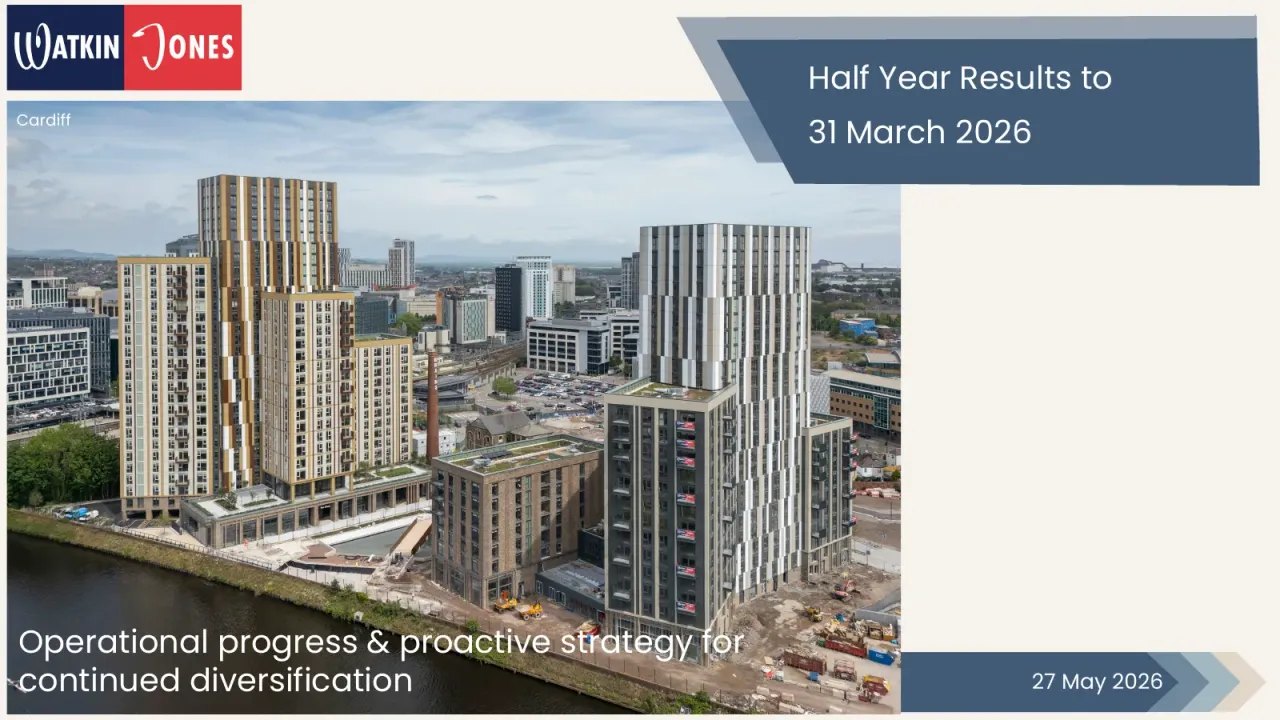
35:32 I guess I guess third, you know, opportunity for us is is in that value engineering and design optimization. You know, we are well skilled at finding alternative ways to build alternative materials if if required and and using that to try and combat inflation. So a solid performance and delivery. And as I said, they have they have outperformed their margin targets this year, which is which is a a real positive. The case study, I I won't dwell too long on, but this this is a large scale scheme. Nearly 718 built to rent units in Cardiff. This is a great sort of manifestation of our development partnership and our delivery expertise. We were invited into this deal by legal in general. He wanted us to come in, value engineer, optimize the scheme, and then take it off the the incumbent developer, and we we would be the developer contractor to deliver the scheme.
36:29 We've now PC'd the first block ahead of program, and we are significantly ahead of program on on the second block because as we've gone through the construction, we've been able to optimize the sequencing and our supply chain. And as a result, we will be able to deliver the building early, which will help our sort of our costs and our our our prelim costs. So a great quality project. It's fantastic to see in in a really iconic location in in Cardiff. Refresh. I I think I've already touched on in terms of sort of, you know, we are looking to progress this and progress the volumes. I've seen there's there's a question on on refresh in terms of how how we're looking to do that. Well, we've been targeting PBSA as an initial market. We are now starting to see opportunities in wider markets as well.
37:20 You know, we we we are progress we are quite close in conversations on a hotel refresh job. So I think that addressable market to us is is growing, and the tracked pipeline that that we have now sits at 250,000,000 of assets of of revenue potential. That that's nearly 10% up on on the full year. So that that that visibility we have is growing. We are then sort of looking to convert and execute. And I I think it's always important that you look at what you've done well, what you haven't done well. Decision making in any deal in in any sphere at the moment is slowed because of the market conditions, but we need to make sure that we are absolutely honed in how we're originating and how how we're executing it. So internally, we have repositioned certain resource to make sure that refresh is an absolute focus and and not a sort of secondary part of someone's targets just just to put the additional targets to so we can drive volumes. And, look, as as the slide says, in the last couple of weeks, we signed heads of terms or letters of intent or projects for revenues of over 27,000,000, and that's that's two refresh projects.
38:29 So we're starting to see some more volume come through, and and that is going to be a a continued push for us. I'm I'm not gonna take you through this case study because I'm I'm conscious of time, but this is a good example of you know, this this is a private equity partner buying buying a scheme, which in full knowledge that it needs comprehensive remediation, fire safety works, m and e enhancements, and cosmetic refurbishment. They bought it. They bought us in to be that development partner. We will do the works. Actually, whilst yeah. We'll we'll do it. We're keeping students in the building where where possible. So we'll go block by block so so they can maximize their income during that phase, and then they will look to stabilize that asset and and and sell it on.
39:18 I I've talked a lot about development partnerships, and so so I'm gonna skip over this slide. But, you know, as Simon said, that visible pipeline of 500,000,000 coming through is is a positive. And we've we've talked about the university deal at Temple Island. So, again, I'm skipping through. I'll hand over to Simon just to sort of quickly take you through Fresh, and then we'll we'll look to close and go to questions. Okay. Thanks. Thanks, Alex. So, yeah, turning to Fresh. Fresh is our operational platform. It it it manages buildings principally on behalf of institutional clients in the in the PBSA co living and and BTR space. And it does more than that as well as being a profitable business for us. It it also gives us a lot of insights into those markets as we're looking into into new schemes. But it had a really successful half year, nearly 22,000 units under management and some clear sort of growth for the the future. You can see there, Alex mentioned earlier, 124 beds mobilizing for September 2026, over 800 for September 2027.
40:19 So it it it's also important to us in the sense that we've got two refresh projects that came came through from the Fresh scheme. So really value showing the value of the integrated platform that we have that actually Fresh is delivering not only the the operational capability, but actually additional, refresh opportunities. We're also looking for the to the future in terms of a bespoke brand for for built built to rent. And in co living, we're mobilizing our second scheme and and and increasing the pipeline. So with that, I don't know, Alex, if you just wouldn't have any closing comments or just hand over to to q and a. No. Look. I I I think yeah. Look. If if we look at the summary, a resilient performance and execution, you know, I I think we are fighting very hard. There's huge efforts going into this business, and I and I think we are delivering results in excess of our peers and and and our and our ask for rivals.
41:19 It might not feel like at times, but, you know, there there is absolutely some resilience coming through this business. I think we've got a platform that we can lever and especially skill sets, and we are we are doing that, and we are looking to diversify and looking to be proactive in that strategy. I think that's actually a key thing for us. You can't let the market just do what it wants. We we we can't outrun the market, but we've got to find different ways to operate within it, and and and that's that's a firm belief of mine. We have capacity for growth and volume, and we've gotta try and use it. So I think that is the right strategy for the current current current market. We should always be prepared to review strategies. But as I said, what the way I envisage as, hopefully, markets come back and our BAU development business comes back, I will not turn my back on that sort of more granular, that more resilient income streams. I think that is a key thing for us. That would ultimately mean growing the business, but I think it'd be a more resilient business. And I and I I think that would be a positive. So that's that's where we want to get to.
42:19 So with with that, look very happy to move to questions. And there's there's a a lot here, so I will look to try and try and get through as as as many as we can. So there's one come through. Land values are coming under pressure. How much headroom do you have on your land bank? Are all sites held still expected to generate a profit when developed, and how much would the market have to deteriorate before you start to record impairments? Do want to cover that one and I'll I'll chip in? Sure. So I'll I'll I'll talk a little bit more about the second part of that question. So I think I think the important thing to bear in mind is that, generally, the land that we hold hold on balance sheet is land that we've we we've secured through a subject to planning type deal where we only buy it once we've got planning.
43:07 Generally, what you see with land values is once you've got planning, you get planning gain and and therefore the valuation increases. So that inherently gives us a little bit of headroom in terms of that deterioration in terms of land value because we hold it at cost on our balance sheet or valuation. And then you can see a couple of examples of that during the last year, in fact. The asset Alex has alluded to in in Glasgow that we sold to that Maslow JV in September last year, we generated just over £8,000,000 of of land profit. And that's because we bought that probably, if we're honest, not far off sort of peak in land values in 2021. We sold it in 2025, and yet we recorded a profit of £8,000,000. You can see the same. I talked about it in my my finance presentation, £5,000,000 profit on our bis Bristol transaction.
43:56 Again, that was land profit. So I think, naturally, we have on our land bank a degree of protection from the fact that those assets have largely got planning, and therefore, the the the valuation at which they're held should be lower than the valuation with planning. Now we do have some smaller legacy assets that we're working through, which aren't a material portion of the £92,000,000 that land and work on the balance sheet at half year. And that that obviously remains the risk of some kind of deterioration. But at this point, it's it's really hard to determine where yields and land values will be towards the year end. I don't know if you wanna talk about the land value, the sort of land market itself, Alex. No. I I think I think you covered that well, and and I I talked a bit about what was going on the land market. The the the there clearly is, you know, downward pressure, but equally, there's not many willing sellers at those levels.
44:48 So trying to pin a value is is quite tricky. Hopefully, that answered that question. We've had one share buyback at the moment, very low price of shares. Look. I I we get that. Yeah. Clearly, that that that that is an opportunity. I I think at this stage, the the view of the team is, look. The markets are uncertain. Cash is king. We want to preserve as much cash as we can. We're gonna carry on looking after the cash because we think we can deploy it into opportunity, and we want to make sure that we remain resilient. So I I get it, and I I and it will always be under review where whether a mechanic like that should be employed. But I think we've when you've got such opaqueness in terms of the market recovery, I I think it's it's it's more prudent to hold that cash and not to utilize it to to generate revenues and margins as opposed to sort of free free buybacks. So it'll remain under review, but, hopefully, people feel that is is a pragmatic approach that we're we're taking. Agree. In terms of pipeline, what sort of period is this meant to be over? Would you kindly run for it briefly with regards to revenue and profit recognition?
46:02 So I I think we've covered a lot of that. I I think in term in terms of the pipeline, that that typically will spread over a three, four year period. It it that's not an exact answer, but it's so some of the pipeline is stuff obviously or already secured contractually secured that we're going to deliver. Some of it is is due imminently to start on-site and might be delivered over a two to three year period, and some of it is yeah. We are still looking to acquire the contracts on it or or acquire planning on it. So that journey could spread out if if you assume a two to three year sort of build period and a, let's say, a eighteen month planning period. That's how it can stretch out. So the the pipeline does run run over a a a sort of broad period of time.
46:48 I think it's probably worth just touching I'll touch on the second one. And just to add to that, obviously, I I I just alluded to the fact that of that pipeline, 300,000,000 is secured on-site. 90,000,000 of it will be delivered this year. So it really depends. Some of it quite short term. Some of it, we're working through planning. It might have to go through gateway. So that's gonna be much more medium term. So there's there's a whole range depending on where it is, and you can see that segmented on the chart in in the deck. In terms of land and profit recognition, revenue and profit recognition, just really building on what I just said a couple of moments ago. So, typically, where we're doing a forward fund or joint venture type transaction, we will recognize any valuation of the land on on the sale of that land upfront. So once we sell the land into that joint venture or to to the third party, and then we recognize our build over the over the build period. So it's as we as we perform month by month as it's valued, we recognize it based on the margin implicit in that build contract based on the costs incurred. So it could be over a two, two and a half, three year period.
47:49 Okay. When will trading conditions enable dividends to return? Yes. I wish I wish I knew. No. Look. Clearly, we we want to get back to a progressive dividend policy. It's it's exactly what we want this business to redo, and and we want to return value to shareholders, and that that's a clear objective. I I think so echoing my my my point previously, at this stage, we've got to focus on making sure that the business is resilient, that the business is moving forward, and that there is room to grow and take opportunity of markets. The whole strategy here has been extend our runway, make sure we're there when the market turns, and then we should you know, we believe that we are incredibly well placed to take advantage. There's lots of competitors that have fallen by the wayside.
48:39 You know, there could be some real opportunities. That that is for us the the target at the moment. We want to get good visibility back in in incomes coming through and market conditions recovered, and that that will then be able to drive a return to dividends. And that is absolutely the intention as as market, you know, to to return to a progressive dividend policy once we have visibility in terms of market conditions and profitability. Yeah. Exactly. I've never understood why single family homes have not been in huge demand, queues around the corner for affordable rental buy rental buy units. Large companies like Legal and General failed in this area. Why is this? What's the stopper? So, I mean, I don't actually think Legal and General failed in this. I think Legal and General are actually doing quite a lot in it. What what did fail was they they they launched a factory to do fully modular built product, and that didn't work. And my my own 2 pennies worth, modular remains tricky in in The UK because planning is varied. You know, it's very difficult to provide the same uniform products.
49:46 You know, modular is all driven around uniformity, and we've got a lot of brownfield sites which don't work that well for modular because they're not uniform, and the planning environments mean that, actually, they want differential units. They want differentiated units, and and that that has been more challenging. But I think single family generally is is really picking up pace, and I think it's that recognition that, you know, people don't necessarily just want to rent a flat. They they might want to rent a house. There there's there's a huge tranche of people who want to be renters, and they're they're not forced to be renters. And I think perhaps the market has been slow recognizing it. I think perhaps the house builders have been much less interested in it historically because their sales rates have been good, and they they they haven't needed to bulk sell. And when you bulk sell, you do sell at a discount. So they haven't been sort of driven that way. But, you know, I I I completely agree that there's there's good demand there.
50:44 It's growing, and and and that's why I want us to focus on it. Moving to the next one. Benefits and opportunities and refresh appear many and varied that does seem to be slow progress given all the positives in the area and how you've spoken about it and your expertise given existing TAM and quite apart from adding further TAM, would you please explain where you think the company is falling short and where it is just the situation process? Yeah. Look. So, I mean, hopefully, I've touched on this already. You know? I I think we are doing a good job from a standing start. You know, we are growing revenues. I I would like to think that revenues will grow this year, and, you know, that visible pipeline is is critical in in terms of sort of being able to then then convert it. So I think, generally, markets are slow. Decision making is slow. That that is one factor. The second factor is quite often, these are assets which need remedial actions and not necessarily sort of remunerative actions.
51:47 So that makes decision making on behalf of the investors sometimes a bit slower because, you know, it is perhaps lower down their list of things they they they want to do, but but they they have to do them. I think the complexity of underwriting refresh opportunities is higher. You need to do more due diligence on a an existing building than you would on a site. It's it's very important you understand the layers of the onion, the fabric of the building to make sure that you you get it right and and you and you don't have, you know, surprises as as you go through. So there are a whole lot of structural reasons why the deals are are taking longer. But then, you know, as I said, I think it's always important to reflect on what you're not doing as well as you could be. And, you know, our reflection is we we perhaps haven't had as much focus resource really targeting the the origination, really sort of targeting the the key players in the market.
52:43 And and so we're just trying to every enhance everything. You know? I don't think we are fundamentally getting anything majorly wrong. I think it's more just doubling down on the intention, making sure our execution processes are well. We are we are putting a little bit more legal resource in to make sure that we don't logjam when we do have transactions that that we've got the legal resource to to process them through. So, look, I I I I'd like to think the pace will continue to grow. I think as we have a a wider pipeline to AMAT, he'll continue to grow, and and and and that's that's the challenge for the business that that we've laid down. Okay. So with the share price really constrained at the moment, what can you do to demonstrate to the markets you're ahead of what they are pricing in?
53:32 Look. I I I think we're just trying to communicate with the market. We're we're trying to be you know, both mine and Simon's belief is, you know, we just gotta be honest. We gotta call things out as we see them. We're we're we're trying to talk, you know, with honesty and candor about the challenges, but then we're also really trying to let people know we're we are being proactive. We we do have different strings to our bow. We've got some more resilient income streams coming through. We're looking to grow them. So, look, it's it's it's it's difficult because I think, you know, you you look across all of the sectors and a lot a lot of our investors are, you know, invested all all across the the The UK economy and wider, and and there's challenges everywhere. So for us, it's just continue the communication and, you know, continue to generate results. You know, if we can grow development partnerships over, if we can grow refresh further, I think people will start to take notice that that that consistency, you you know, is is key. So I don't know if you got anything I I just think I've no. I completely echo that.
54:31 I think the one thing to note is that we're not unique. So Alex alluded to Unite. You know, their discount to NAV is about the same as Alex Grange's is trading. It's it's a it's a it's a problem in the whole market across this this sector, and I think everybody in that space is trying to do to to communicate the the the the benefits of their particular business model. It's just not really resonating yet. So there's another one on buybacks, which hopefully I've covered, so I'm I'm not gonna go through that one. This one's quite long, and I'm tempted to read it because they're actually quite nice about management and what we're doing proactively. But I'm I'm just trying to sort of skip through and and and and find the the key essence of the question.
55:17 I think it's talking about using our cash for alternative uses to generate returns, which isn't really part of our core strategy. Yeah. Okay. Yeah. No. Yeah. I I can see that right now. But I I I do get it, but I I think what we wanna focus on is what we're what we're experts in, and we want to leverage, you know, the the overhead and the platform that we have into areas that we really understand and add value. That that that's that's gotta be the core. I don't wanna diversify us into areas that we don't know and and and take punts that we that we don't understand. So I think, you know, the the best execution for us at the moment is to continue doing what we're doing and try and find as many angles as possible to to generate new revenue streams. But, I mean, just to echo one point on that, I think it says this this company is well improved. I'm glad to see the message we're we're getting across in terms of the the folks at the cost. We're doing work with that sort of thing. I'm I'm glad that's evident. So that's a that's a positive. Thank you.
56:18 God. This is a technical question. Given the ongoing cost and provisions for legacy cladding and fire remediation, have you looked at utilizing retrospective pumped cavity barrier products to such as Yes. We have, and we've used it successfully. Yep. No. You you the the this this question is actually really important because, you know, we we are obviously being a good actor and and and looking to remediate the the assets where where where appropriate. But the technology is catching up as well, and and and that the Injecta Cloud systems now make some of the remedial works much, much more efficient, much quicker, and and much more cost effective, and and along with that to continue. And then we have one scheme that we've done where the original cost was ultimately did it for a fraction, ten, twenty percent of what the full remediation have taken the whole facade down. So, yeah, we're absolutely using it, and we're trying to be as innovative as we can whilst maintaining building safety.
57:17 Yeah. Okay. So that's that one. Yeah. You said during the presentation you want more volume. Are you open to using cash pile for JVs with REITs like Granger, PLC, or taking a strategic investment into these companies at large discounts to assets if you have any excess cash? So I think looking to do JVs with entities like Granger, absolutely. You know, we we have done JVs. I think we we are still guarded with our cash, but we we have left equity in JVs with HGP in in scheme in in in Stratford. That's the Lloyd's banking group backed business and and equally a small amount of equity with with Maslow. So if it unlocks deals and we are very happy to to put some equity in, don't think we are gonna be looking to invest in in in the REITs from from a sort of share perspective.
58:10 Again, it's echoing echoing the points. I think we want to really focus on on on cash in the business. Yeah. We're property experts, not capital markets experts. Yeah. K. I think you're doing a great job under challenging times. Sounds good. Really impressive where you're looking to diversify, to stabilize your revenue. Also very nice to see Simon and his family bought significant shares with with their own money. That shows he truly believes in the viability and prospects of the business. Absolutely agree with your views on cash. This is what allows you to breathe and not panic. Blah blah blah. My question is with regard to inclusion of the sale of the building when comparing this half year profit to last year, that seems like Apple and Pairs to me. Shouldn't they have been excluded for comparing underlying profit?
59:04 I think I'll leave you to cover that one. I think what what this question is alluding to is why have we included this the the profit on sale of the JV in in our profit this year versus last year? And I think I I talked through the the difference in accounting to a traditional forward fund versus joint venture, but but I don't the essence of our business is it's it can be quite lumpy. You know, typically, we will take we we can or have taken significant profits on land sales, and that's exactly what that joint venture is. So that is part of our underlying business, and that's why the the profits can be quite lumpy. So I I don't I don't think I agree with that premise to say just because we've had a profit on a land sale, that's our underlying business.
59:56 It should be excluded from underlying business because that that's part of the nature of the model. So I hope I've explained that correctly. So so I think it makes it makes it consistent. If you go back to full year 2025, you can see the profit on the sale of the Glasgow transaction, that was £8,000,000. And, that was an an underlying profit. It doesn't go through gross margin, but it does go through operating profit, and I think rightly through underlying profit. K. I think We've just missed one on safety. Yeah. I was just I was just gonna do this one, and then we can move on to that if you got time. Has there been recent conversations with new investors with the entrance of new significant investors in WJG like Fulcrum Global? Well, yeah, look. Absolutely. You know, we we continue we we've we've spoken met with Fulcrum and, you know, that they are that they they've built a position and, you know, that they they are interested in in WATKIN JONES and, you know, under and understand that they're actually sort of property developers in in in different markets in their own rights.
1:00:57 So, yeah, they they have obviously been the new acquirer shares, which is positive. And, you know, we continue to engage with nonholders and and holders alike and, you know, just look to sort of tell them what we're doing, what why why we, you know, are both passionate about the business, you know, what what the downsides are, what what the upsides are. You know, I I think we're just trying to be very honest and and that we want to continue to grow our investor base and then make sure we've got a strong strong shareholders who want to come with us on on on on a growth growth journey. That that's that's what we all aspire to. So I'll just answer this one on building safety. Yep. The question is, what downside risk remains on building safety provision? Do you expect any further contributions from partners?
1:01:44 So I I think if you go back to sort of twenty twenty five in our annual report, you'll notice that we we we reported on certain contingent liabilities. These were buildings where we weren't sure if there was a liability, if there was a problem. We weren't sure if it was our liability, if there were if if any work was needing doing, and and those still need to be investigated. So to the extent there's any risk associated with those, they could that that could turn out to be a further risk of building safety provision. That being said, we've got a degree of contingency. We've done well in terms of our procurement on-site of those projects. So it will really depend on the interplay between how the spend goes on on the on the other projects and whether or not there's any further liability. So can I sit here? I guess the number of the question is, you expect the safety provision to need to increase?
1:02:32 I don't think anyone can say at this point. I think we're managing it well. You can see the provisions coming down. It hasn't gone up in terms of any new properties during the the the first half. But can anyone in this sector say, for definite, the provision won't go up? No. It's uncertain. We just have to take it quarter by quarter, half year by half year, and we'll say more of that at the full year. Okay. So I think we've actually managed to get through all the questions. I think we're two minutes over. So I'll I'll just close by saying, look. Thank you very much for your time. Thank you for your support. It continues to be a a tough a tough journey through through the markets, but, yeah, we we really are, you know, giving it our all, and and and we think our strategies are right right for the market, and and we're gonna continue to try and execute them. So thank you very much for your time. Fantastic.
1:03:22 Alex Simon, thank you once again for updating investors today. Could you please ask investors not to close this session as you now be automatically redirected to provide your feedback, which will help the company better understand your views and expectations. On behalf of the management team, we would like to thank you for attending today's presentation, and good afternoon to you all.
Follow Watkin Jones PLC into a list and get an email when it puts out news.
CEO at WATKIN JONES PLC
CFO at WATKIN JONES PLC