Kathy Creswell
Director of Investor Relations
Replay available
Vornado Realty Trust (NYSE:VNO) Q4 2019 earnings call, held 2020-02-19. Watch the replay and read the transcript on 6ix.
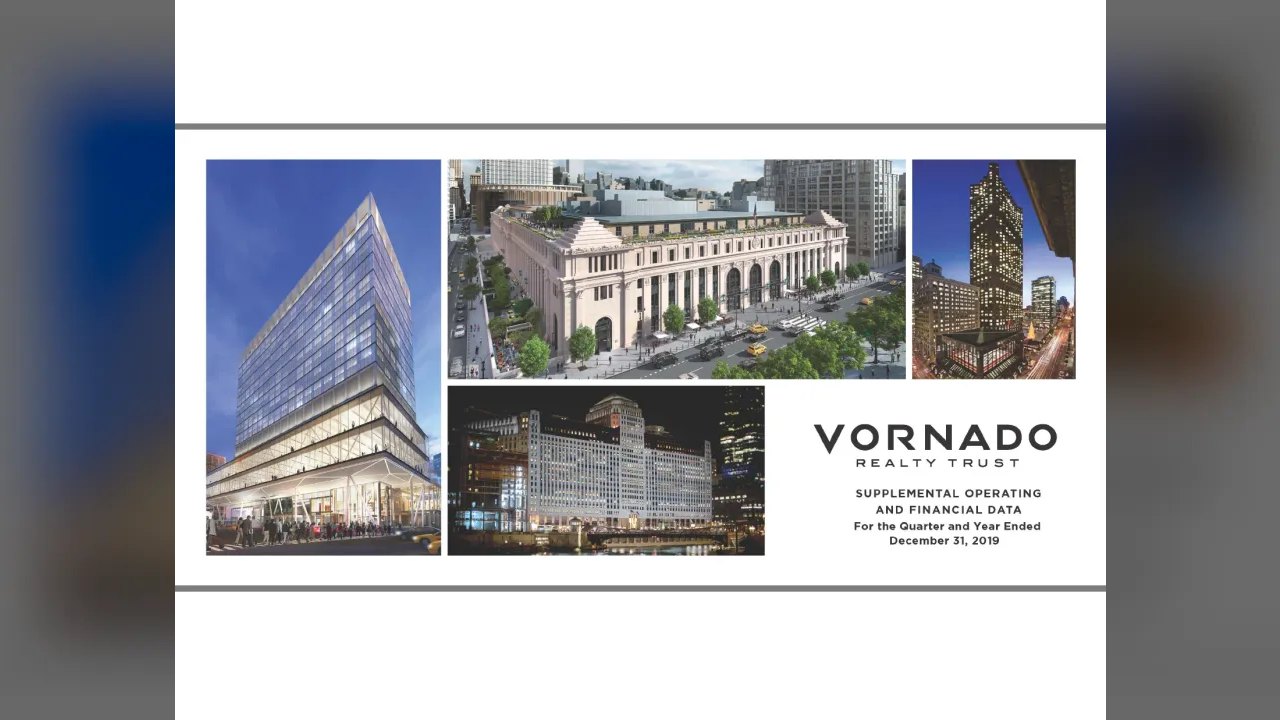
On 6ix: 6ix.com/event/vornado-realty-trust-vno-q4-2019-earnings-call
Automated transcript · Written by software from the replay's audio. It can mishear names and figures; the replay is the record.
0:00 Good morning and welcome to the Vornado Realty Trust fourth quarter 2019 earnings call. My name is Brandon and I'll be your operator for today. This call is being recorded for replay purposes. All lines are in a listen-only mode. Our speakers will address your questions at the end of the presentation during the question and answer session. At that time, please press star 1 on your touchtone phone. I will now turn the call over to Ms. Kathy Creswell, Director of Investor Relations. Please go ahead.
0:28 Thank you. welcome to tornado Realty Trust fourth quarter earnings call yesterday afternoon we issued our fourth quarter earnings release and filed our annual report on form 10k with the Securities and Exchange Commission these documents as well as our supplemental financial information package are available on our website www.vno.com under the investor relations section in these documents and during today's call we will discuss certain non-GAAP financial measures Reconciliations of these measures to the most directly comparable GAAP measures are included in our earnings relief form 10-K and financial supplement. Please be aware that statements made during this call may be deemed forward-looking statements and actual results may differ materially from these statements due to a variety of risks, uncertainties, and other factors.
1:18 Please refer to our filings with the Securities and Exchange Commission, including our form 10-K, for more information regarding these risks and uncertainties. The call may include time-sensitive information that may be accurate only as of today's date. The company does not undertake a duty to update any forward-looking statements. On the call today for management for our opening comments is Michael Franco, President. In addition, Steven Roth and our senior team are present and available for your questions. I will now turn the call over to Michael Franco.
1:50 Thank you, Kathy, and good morning, everyone. Overall, we look back at 2019 as an important and successful year, setting the stage for the next phase of the company's growth. In addition to keeping our buildings full at very healthy rents, we are at 96.5% occupancy. We recapitalized our 5th Avenue and Times Square retail assets on a very attractive basis in a $5.5 billion transaction. We paid $1.95 per share of special dividend last month for Layman. Most importantly, we advanced the redevelopment of the Penn District, positioning the company to capitalize on the enormous opportunity we have on the west side of Manhattan. More on this in a moment. Before giving some thoughts on the markets in our portfolio, and in particular the Penn District, let me review our fourth quarter and full year financial results.
2:41 Fourth quarter FFO as adjusted was 89 cents per share, flat to last year's fourth quarter. Full year 2019 FFO as adjusted was $3.49 per share compared to $3.73 per share for 2018. These results are 9 cents ahead of the guidance we've given in the third quarter. As we've previously indicated, our financial results for 2019 were lower than 2018. Explained as follows. Of the 24 cent reduction, 25 cents is due to over 3.2 billion of asset sales. 9 cents is due to a one-time non-cash stock-based compensation and four cents is due to lost income from retail and bankruptcies, all of which aggregate to a 38 cent reduction, which was partially offset by growth in our core business and interest savings. Overall, our core business continues to be strong.
3:37 For the year, across New York, Chicago and San Francisco, our office and retail leasing teams completed 215 leases comprising 1.7 million square feet at starting rents of $90.45 per square foot at positive mark-to-markets of 14% GAAP and 8.8% cash. Please see page 18 of the supplement for further detail. Cash basis same-store NOI company-wide was up 3.6%. Company-wide, our fourth quarter cash basis same-store NOI increased by 6.6%, broken down as follows. New York office was up 3.4%, street retail was down 2.2%, The MART was up 100%, benefiting from a one-time $12 million accrual of real estate tax expense last year due to the triennial reassessment of the property.
4:32 And 555 California Street was up 4.1%. Our non-comparable items in the fourth quarter included the $173.7 million after-tax net gain on unit closings at 220 Central Park South. To date, we have closed on 65 units for net proceeds of $1.82 billion, including 17 units for $565.9 million in the fourth quarter. We are now 91% sold in the face of a very soft luxury condo market, a testament to the building being the best ever built in New York City. And our sales continue strong. Since the beginning of 2019, we have executed contracts for $490 million. We expect to receive over $1 billion from closings in 2020, and as we've said previously, all the net proceeds will be redeveloped into the Penn District, redevelopments underway, turning this capital into highly accretive earnings and driving strong future growth.
5:32 Now turning to 2020, which will be an inflection point for us as we invest heavily in the Penn District to create enormous future value. Given the full year effect of our substantial asset sales, and our development activity as we continue to invest in the Penn District, we thought it appropriate to provide some greater visibility into our projection for 2020. We currently estimate the 2020 FFO as adjusted will be lower than 2019 by between $0.23 and $0.33 per share. Of this $0.28 reduction to the midpoint, $0.16 is due to the full year impact of asset sales. $0.09 is due to taking additional assets out of service for redevelopment, primarily in the Penn District, at Penn II, the retail at the LIR Concourse, and the Kmart space at Penn I. And $0.08 is due to lost income from the full-year effect of 2019 retailer bankruptcies, all of which aggregate to a $0.33 reduction, which is partially offset by growth in the core business.
6:37 Let me now turn to the New York market. The Manhattan office market continues to fire on all cylinders, fueled by strong job growth and unabated tenant demand for office space, particularly for landlords with new or redeveloped products. The city added 19,000 office-using jobs during the year, bringing office-using employment to an all-time high of 1,470,000 jobs. And the recently announced large future office commitments from major companies in the city point to continued strong jobs. Leasing volume citywide in 2019 totaled 43 million square feet, the highest activity in 20 years. Tammy tenants continued their strong demand, accounting for one-third of all activity during the year, with the tech sector alone leasing 7.5 million square feet.
7:28 This sector has become a dominant powerhouse in New York, as tech companies are attracted by the city's dynamic economy, deep and diverse talent base, and leading universities. While the big tech companies like Facebook, Google, and Amazon continue to expand their sizable presence, the city's growth is also being driven by long-established traditional industries hiring more and more technology workers to support their businesses. Importantly, in 2018, venture capital investment in New York companies surpassed $17 billion, increasing New York City's share of total VC investment in the U.S. to an all-time high of 20%. up from 11% in 2018. These investments paved the way for continued growth from the tech sector in the future.
8:15 The flight to quality trends and tenants for new construction and redeveloped space accelerated during 2019. According to JLL's annual trophy building report, more than 20%, or 8.8 million square feet, of the citywide leasing activity was signed to triple-digit starting rents, a record number. Interestingly, 60% of this triple-digit activity was with Tammy Tennis, mainly concentrated on the west side. According to a Cushman & Wakefield year-end report, asking rents for Class A product in the Penn District sub-market, which includes Hudson Yards and Manhattan West, reached a historic $109 per square foot, a very good sign for our 5.2 million square feet currently in redevelopment.
9:01 As a company, we are heavily focused on the transformational repositioning of our Penn District holdings as a new epicenter of New York. Our redevelopments are now in full construction mode. 2020 will mark an important step in the district's transformation as the majestic Moynihan Train Hall in Farley and our 850,000 square feet of office and retail space in Farley will be substantially completed at year end. As you walk around the district today, you see the incredible amount of activity underway. The redevelopments of Farley, Penn 1 and Penn 2, the grand new entrance to Penn Station on Plaza 33 where work has begun, and the scaffolding in the LIRR concourse where redevelopment will shortly commence. In total, there is over $5 billion currently being invested in the district and its infrastructure, between Guarnero's $2.2 billion and the government's $3 billion.
9:54 During the fourth quarter, we bought out Kmart's 141,000 square foot lease at Penn which had another 16 years to run for a $34 million payment of which $10 million is expected to be reimbursed. Steve and Eddie have been wrangling about this for years and years and we think we timed the buyout at exactly the right time and got it at a fair price. Despite the nominal short-term FFO loss from Kmart's rent, this was a big win for us and allows us to immediately integrate this space into our overall redevelopment plan for PEN1, the adjacent plaza, and the LIR concourse. and to populate this space with high-quality retailers much sooner. Overall, a big uptick for the neighborhood. During January, we executed a relocation transaction with Information Builders, which will move them from the tower of Pen 2 into two separate spaces at Pen 11 and Pen 1, totaling 78,000 square feet. This deal was the last piece of space we needed to get back to execute the redevelopment plan at Pen 2.
10:57 Moreover, the starting ramp with information builders at Penn One is in the mid-90s per square foot, reflecting the market's confidence in the district's transformation and in this extraordinary development as it begins to take shape. In addition, as I'm sure most of you saw, the governor made a major announcement in January, expressing the state's intention to further modernize and expand track capacity at Penn Station through the creation of the Empire Station complex, with an expanded terminal on the block south of Penn II, increasing train capacity by approximately 40%. This announcement represents another validation of Penn Station slash Empire Station as the key transportation hub in the region and a further commitment from the government to invest in the area. The government expects ridership at Penn Station to double in the next 10 to 15 years.
11:48 The state intends to fund this expansion through the creation of a new district which encompasses our Penn District holdings and by capturing future increases in tax revenues for new developments in this designated district. We look forward to working with the state, city, and other important stakeholders to help realize the governor's very important vision. With the explosion of tech demand in New York City, particularly on the west side, our Penn District assets are very well positioned to be at the center of this activity. It's in the hottest sub-market in the city. We're going to be delivering Farley, Pen 1 and Pen 2, totaling 5.2 million square feet near term, with an ability for tenants to grow with us over time on our massive campus located right on top of transportation.
12:36 We're confident, as our plans become reality, that office tenants will truly appreciate the unique and differentiated product we're delivering. In this regard, we remain on track with the two large leases we mentioned on last quarter's call, and there's good activity from a variety of important tenants behind us. On the retail side, the interest in Farley has been outstanding as retailers come to understand the significant foot traffic that will course through Farley in the district every day. We are in lease negotiations on over 50% of the Farley concourse and are in active negotiations with the majority of the space on the main level. More broadly, we are working on a variety of deals to curate the district with all sorts of offers. Food and beverage, coffee, fitness, co-working, conferencing, retail, and so forth. The service, our tenth base.
13:29 While earnings are, of course, negatively impacted in the short term, earnings will significantly increase as we turn the 60s per square foot office rents currently in place into mid-90s and higher as we deliver and lease the redeveloped space. Overall, our New York office portfolio is in great shape. 97% occupancy with a very manageable 525,000 square feet expiring during 2020 after taking the previously announced McGraw Hill space comprising 566,000 square feet at 10-2 out of service. Our office leasing activity is extremely strong with more than 1.6 million square feet of leases in final documentation and an additional 1.8 million square feet in the pipeline.
14:17 During 2019, we completed 102 office transactions for 987,000 square feet at starting rents of $82.17 per square foot, with positive market markets of 4.6 cash and a 5.5% gap. Approximately 20% of our total leasing activity in 2019 was at triple digits at average starting rents of $120 per square foot. In terms of the fourth quarter, we leased 173,000 square feet at an average starting rent of $101 per square foot. While we had negative 5.2 cash and 3.5% gap mark the markets for the quarter, it is worth noting this was based on only 54,000 square feet of second generation space and driven by the rent reduction of one short-term renewal at $350 per gap.
15:12 This is the single best development site on Park Avenue in Lakely Midtown, and we will be keeping renewals short-term here in order to line up this site for a possible new development. Leasing highlights during the fourth quarter included a headquarters lease at our new 512 West 22nd Street with NextGen Media for 41,000 square feet. At The Mart in Chicago during 2019, we completed 62 leases comprising 286,000 square feet at average starting rents of $49.43 per square foot. During the fourth quarter, we completed 50,000 square feet of showroom deals at starting rents of $51 per square foot. I can see stood at 94.6% a year end.
15:57 We have very good activity on our available office space here and our numerous discussions with those new and existing tenants throughout the building. In San Francisco, the market remains on fire and it is hard for tenants to find quality available space At our 1.8 million square foot 555 California Street campus, we remain full and are enjoying the benefits. During the fourth quarter, we finalized a lease renewal with one of our full-floor law firm tenants in the bottom third of the tower at a starting rent of $94 per square foot, a 72.5% positive cash mark to market. We are also in renewal negotiations with two of our major tenants in the tower of the building, with each transaction that ramps well into the triple-dig.
16:43 Turning now to our New York Street retail business. Overall, while rents are down, activity is up from a year ago, and there continues to be a flight to quality for retailers, a trend that benefits our portfolio. The best high street retail is not bad, but rents do need to be economic for retailers to commit. In a very difficult retail environment, we completed 39 retail leases with 238,000 square feet during with gap and cash positive mark to markets of 12.9% and 9.8% respectively. In the fourth quarter, we completed 16 leases comprising 94,000 square feet highlighted by very important 10-year leases with two LVMH brands, 595 Madison Avenue, better known as the Fuller Building.
17:32 Fendi and Berluti leased a total of 16,850 square feet a year. reflecting the building's bullseye location at the corner of 57th Street and Madison Avenue. A portion of this space was formerly occupied by Coach and a portion was vacant. Kudos to Haim for sourcing the LDMH deal. Our retail occupancy remains high at 94.5% as we continue to source tenants for this best-in-class portfolio. Rents this quarter rolled up on a cash-mark-to-market basis by 11.3% and were flat on a gap. In addition, we are pleased to report that last week we signed an 8,000 square foot lease with Sephora at 4 Union Square South, which fills most of the space vacated by Forever 21 last year. Between the recent Whole Foods expansion and new Sephora deal, we have now surpassed the total rent Forever 21 was paying on the entire space, and we still have an additional 9,700 square foot leasing opportunity.
18:32 Taken as a whole once fully released, we project an approximate 40% mark-to-market increase and a much better credit profile. As a testament to the uniqueness of our Union Square asset, we released the space 96 days after Forever 21's lease expired. We don't yet know what will happen with the other two Forever 21 leases we have, but if we get them back, these assets are in premier locations, and while it might take longer, we are confident we'll release them successfully, just as we did Union Square. Finally, a comment on sustainability. We have always prioritized reduction of our carbon footprint and mitigation of our contribution to climate change. And we are in lockstep with our investors, tenants, employees, and communities. We have reduced by 25% our same store energy consumption in the last 10 years and are committed to furthering our progress through continued energy retrofits, smart building technology, and meaningful engagement with our tenants.
19:31 We will also include renewable energy as an important step in our process towards carbon neutrality. We are well positioned to comply with recent climate laws, as evidenced by our being Energy Star Partner of the Year for the seventh time, a Navy leader in the Life Award recipient for the tenth year in a row, and a top performer among all global real estate sustainability benchmark respondents. In addition to the many awards for sustainability we win each year, I am specifically proud of our team for being cited as the industry model with our innovative approach to furnishing our audited ESG report to the Security Exchange Commission. We continue to maintain a fortress balance sheet with measured leverage and an abundance of liquidity today in Toronto. After the $400 million special dividend was paid last month, our liquidity is $3.8 billion, comprised of $1.2 billion in cash and restricted cash, and $2.175 billion undrawn or revolving credit facility. To conclude, we feel very good about our overall business.
20:34 We own great assets in great locations in great cities and know how to keep these properties full with best in class tents and market leading us. Moreover, we have outstanding and unique development skills that allow us to create significant value. We will continue to take full advantage of New York's strong economy and climate for businesses to grow and succeed while they find the best talent in the country. With that, I'll turn it over to the operator for Q&A. Thank you. We will now begin the question and answer session. If you have a question, please press star 1 on your telephone keypad. If you'd like to be removed from the queue, please press the pound sign or the hash key. If you're on a speakerphone, please pick up your handset first before dialing. Once again, if you have a question, please dial star one on your telephone keypad.
21:22 And from Citi, we have Manny Korchman. Please go ahead.
21:26 Hey, good morning. It's Michael Billerman here with Manny. Michael, I want to just go through some of the numbers you threw out in terms of the headwinds that are affecting 2020. And maybe if we can just take each of them. You talk about the space coming out of service being the nine cents, the 19 million that's in the supplemental on page 31. Can you give us some color in terms of when you expect income to start flowing back? Because the chart, at least in the supplemental, doesn't have the positive effect of releasing that space. And then on the retail side, that $16 or so million, that $0.08, what is the prospects of that income flowing in at some point in 2020?
22:15 versus later on, just as we think about the ramp as we get back.
22:24 Michael Willeman is Joe Mack. Now, I want to take the second part of that question. On the 16 cents from asset sales, half of that, almost half of that comes from the retail JV. The balance comes from sales of 330 Madison, 3040 M Street, Creek, UE, LXP. That stuff is not coming back. Other than being reinvested, the cash being reinvested in the Penn District, it's not a one-for-one. We sold this, we're putting this here, and we're going to get back NOR.
23:02 Michael, in terms of the retail bankruptcies, right, which is Topshop and Forever 21, obviously 608 is permanently gone. The asset in SoHo... you know the problem plan there is to convert that upper floor the upper floors to office and so that will undergo a redevelopment and so you know best case is that won't come online June won't come online in 2020 best case at some point next year but again nothing nothing certain there and then Forever 21 you know we have a deal in place today with them the numbers we cited reflect The reduced leases. We'll see what happens as they come out of bankruptcy now.
23:50 And to the extent that those leases are not accepted or to the extent that we proactively take that space back after the year, again, that income is not going to come on in 2020. Best case, that's going to come on sometime in 2021. The usual free rent period, etc., I think at the best case that would be towards the latter part of 2021. But again, there's nothing that is imminent on those. We're aware that both those leases either could come back or we'll proactively take those back and we're out of marketing space.
24:34 Michael, it's Joe Macdown again. That explanation of the possible Forever 21 lease is coming back is what gave rise to the range of $0.23 to the midpoint of $0.28. That $0.05 represents the exposure if those two leases come back.
24:55 Okay. And then if you think about, I mean, you were running basically $0.89 of adjusted FFO in the third and fourth quarter, right? So annualizing out to $3.56. for the year relative to the 349 for the full year. Arguably, the last two quarters should have the dilution from the asset sales, certainly on the retail side from the stock investments, already baked in to that number and arguably has some of the retail loss as well. So I'm trying to reconcile those two things where you had been reporting a quarterly number of 89 cents, 356 annualized, which should already take into account some of this 28 cents of added dilutions that we're talking about for 2020.
25:46 So, Michael, it's Joe Mack now again. I'm not prepared to address that question fully, but Some of the items are really one-timers. There was lease cancellation income in the fourth quarter. That was two cents. There was a straight-line write-off that we anticipated on 10 Plaza that got deferred to 2020. That was another two cents. So 89 cents is up two cents, and 2020 is going to be down two cents. Those two items are a six-cent swing. from annualizing the fourth quarter. And there has to be many, many more items like that that Manny and our team or you and our team can do offline.
26:33 Michael, the other thing is, you know, the out-of-service that we cite, right, that's all incremental, right? So that is Kmart. It's a number of little things, frankly, between PIN 1, PIN 2, that with further evolution or development plans, right, is incremental out-of-service. obviously there was a sale of the pre-share so there's a number of items that are not run rate from the fourth quarter.
26:59 Right, no and I think that was part of my first question and I'll get off after this that 19 million of reduction for the stuff coming out of service trying to understand when some of the income will flow back into the company I guess trying to understand that aspect of it right as you spend money and leave some space What type of disclosure are you going to provide? You've provided on slide 31 the stuff that comes out. I guess at what point are we going to get some stuff about it coming back in?
27:34 Well, I think also on page 31, Michael, it's Malayoko. If you look at the top part of that page, we do provide the incremental cash yields and the stabilization year we expect to begin to achieve those cash yields.
27:53 Right, but some of that will come in in 21, 22, 23, like it will be phased. And so it's just looking at, you know, that incrementally each year. So anyways, I'll yield the floor. Thank you. From Evercore ISI, we have Steve Sakwa. Please go ahead.
28:14 Thanks. Good morning. I guess Michael or Steve, I know you're not going to provide a lot of details around some of the big pending leases at Farley and Penn too, but can you just kind of help frame some of the discussions and the timing and I know you talked about a pretty big pipeline of LOIs and just kind of help us sort of think through some of the timing at Farley and 2 Penn on some of the leasing and then some of the commentary you made in the 10K about kind of the mark to markets that you're seeing on the office component. I realize it's not a lot of square footage, but it sounds like there's about a 20% mark to market. So can you just maybe flush out some of the bigger leasing?
28:58 Sure, I'll start and Glen can jump in as well. Look, in general, Steve, obviously there's been press speculation about a couple of major leases that are in the works. and we're not going to comment on specific names. I think in my intro remarks I said those remain on track and on the normal course our expectation would be that we would start finalizing some important leases probably in the next quarter. In terms of PEN2, we're just showcasing that product now. That's a major redevelopment. Obviously we referenced the one lease last quarter, again, which remains on track.
29:46 And, you know, these are major headquarters leases and going through the normal process right now. You know, I think, again, making very good progress. I think next quarter you'll start to see some real announcements. You know, Glen, you want to talk more broadly on the pipeline? The only thing I have to say, Steve, on the mark-to-market is that Again, one of the big thesis is, you know, we are taking, it's a function of two things, right? What are the end place rents in terms of what's expiring and where are we taking those to? And, you know, given what we're doing in the Penn District, you know, we've talked about taking the rents from the 60s into the 90s and 100 plus range. And, you know, that's starting to be reflected in what we're doing, you know, in those, in that number.
30:35 All right, Steve, go ahead.
30:38 We mentioned in the remarks that we have 1.6 million feet of leases. Those are in documentation, so leases are out, and that includes the deals you're referring to in Penn. We're certainly on track. We feel very good about where we are, and there's more activity to come. As it relates to the overall business, if you think about it, we're 97% full in the core portfolio. We keep filling up space with our existing tenants. Our buildings are in fantastic shape. The core portfolio, we've redeveloped those buildings over the last five, six, seven years. During that period of time, at least on average, two and a half million feet a year in those buildings, and the major tenants continue to expand.
31:28 So with the 8887s, the 90 parks, the 1290s, we're seeing great activity from within the buildings and from outside. So overall, we have a lot of leases out. We have a lot of other action. So we feel great about where we're sitting right
31:46 now. Okay. And I guess second question is just, look, I realize that, you know, the company is not really, you know, driven by short-term earnings and really is doing the right thing for the real estate. But clearly, you know, coming up with effectively guidance that's well below the street, you know, is... A little bit shocking to people, the magnitude. I'm just curious, as you sort of laid out some of the issues, and I realize you can't contemplate everything, are there any other potential wild cards that we should be thinking about that could potentially hurt earnings this year or even into next year? Or at this point, have most of the big things been flushed out and from here, earnings bottom in 20 and start to rebound in 21 and beyond?
32:34 Joe referenced the Forever 21 situation, Steve. So to the extent that the leases are not affirmed, then there could be a five-cent ding on a temporary basis. That's the most near-term insight. Other things, obviously there's always risk of tenant bankruptcies, etc., but the numbers we gave you is what is in our purview today and obviously there's some positives as well but we clearly think that 2020 is the bottom and we'll start to see strong growth thereafter and as we said a lot from a real estate standpoint, you said it yourselves, You know, the steps we're taking in terms of taking the assets out of service or additional assets out of service, you know, is the right thing for, you know, our redevelopment plans, right? And so that's going to create significant value, you know, getting the Kmart, making some modifications on some other things we're doing in the district which impacts the out of service.
33:43 You know, those are the right business decisions, right? It's going to create value, notwithstanding it has a short-term impact on our business.
33:52 Okay, thanks. From Bank of America, we have Jamie Feldman. Please go ahead.
34:00 Great, thank you. I guess, Michael, just to go back to your last comment, you said 2020 is the bottom and we'll start to see strong growth thereafter. Can you just talk through the drivers of the growth in 21, the strong growth in 21?
34:11 You know, Jamie, look, you're starting to pressure us into guidance there. I mean, the reality is, you know, we can take that offline.
34:27 Certainly, Farley coming into FFO.
34:32 But the reality, Jamie, is it's a, really, every part of the business, particularly the office business, has growth. You know, 555, New York Business, et cetera. You know, we're not going to mention point by point, but, you know, that is the deal. 770, you know, Facebook is fully rent paying at that point.
34:58 And Jamie, it's Joe. While 2019 had many depressions of earnings from asset sales, dot, dot, dot, we've gone through that. We don't anticipate that reoccurring, which of course lets the growth in the core business not be masked by other dispositions, et cetera, et cetera.
35:23 Okay, that's all. Yeah, I was just trying to figure out the largest moving pieces. Sounds like you listed them for 21. I guess thinking about the core, can you talk about a same-store growth rate that kind of looks through all the noise
35:37 for 20? I don't know if we're prepared to do that on this call, Jay. Okay.
35:48 Okay. All right, then I guess my last question. You know, you in the past have talked about a $200 million run rate for retail NOI. It sounds like that's come down on Forever 21, maybe the Kmart space. How does that, just for an apples to apples comparison, how does that look today and based on what you've outlined?
36:09 You know, I don't know that what we, and I remember you asked me last quarter, I don't know that that really has changed. I think last quarter, and you know we said it was going to be a low 200 and we said that that was before taking in and out the LIR concourse right that also was before the Kmart buyout so obviously with those two you know they take it below that number but those are you know proactive things we're doing as opposed to impact from the tenancy so Forever 21 as we talked about was You know, it could be on both leases go away temporarily. You know, it could be a $10 million ding. But I think it was generally in the number that we cited to you last quarter.
37:06 So, Jeremy, a little more color. Last year's reported number, 2019's reported number was $267.7 million. The retail sale will adversely affect that by 25.6 and 20 that wasn't a 19. Other sales will affect that negatively by almost $3 million. Out of service at Penn Station will affect that negatively by $6 million. Then there are other tenant items, Forever 21, Topshop, et cetera, et cetera. But our math still is in the low 200s.
37:44 Okay, and then just to confirm the quote-unquote guidance you gave is that assumes that Forever 21 leases are cut in half but not go to zero, and there's an additional five cents if they go to zero. Is that correct?
38:02 That's correct, Jamie.
38:04 Okay. All right.
38:06 Thank you. From BMO, we have John Kim. Please go ahead.
38:13 Thanks. Not to belabor the point, but a couple quarters ago you mentioned that 2019 would be the trough year for earnings, and now you're coming out with negative 9.5% for 20. But looking back two quarters ago, you already knew about the retail joint venture, the top shop store closings, the PEN2 redevelopment. So I'm trying to understand what was new over the last six months besides Forever 21 and the Kmart early termination.
38:47 Well, John, it's Joe Mack now. A number of moving parts affected that. We took signage out of service in the Penn District we didn't anticipate doing when we gave that first set of guidance. We moved leasing assumptions from 19 to 20. There are numerous, numerous things that affected that, but It's over. We're confident from what Michael told you that 20 will be the trophy year, that the growth in 21 will be substantial. And again, if you'd like to go into greater, greater detail, let's do that offline but not monopolize this call with that type of detail.
39:34 Sure, okay. And then you updated your NAV. Now your stock is trading at a 32% discount to it. Wouldn't a buyback, I know you've talked about it in the past, but wouldn't a buyback help offset some of this dilution and it would have been a lever or could be a lever for offset earnings dilution going forward?
40:00 John, look, we recognize we're at a meaningful discount, though the market is seems to ignore any of the input out, and maybe even analyst any of these. And, you know, look, it's something that we have evaluated, we continue to evaluate. You know, it's not the course of action that, you know, we're prepared to embark on today. You know, we are, just as we've done in the past, you know, we consistently look at ways to kind of narrow that gap and First of all, to grow NAB, which is what we're trying to do through our appendage redevelopments. But secondly, to close that gap. We've shown an ability to execute within the creative transactions, and we are continuing to look at that. Obviously, buyback is one way.
40:55 I don't know if it's as significant in terms of the things we've done in the past, but... and so on. Not something that we have felt is the appropriate use of capital yet.
41:10 I guess what would be the appropriate time to use it? I mean, you have free cash flow that is significant. You're trading at a big discount. You have some earnings dilution, which is near term. I mean, if this is not the right time, then when would it be?
41:24 You know, it's a matter of using that capital for that or other things. And we continue to have significant opportunities to invest in our business. You know, we've outlined the three initial redevelopments from the Penn District that are, you know, substantially accretive. You know, and there are opportunities behind that where, you know, our capital, you know, we want to have available to continue to execute on our redevelopment in the whole district, right? We're taxing the first five million square feet today, you know, but there's significant amounts to do beyond that. And right now, We want to have that capital available for that or for other purposes. One last from me.
42:09 We think that's more creative in terms of NAV creation than a buyback for that same amount of capital based on our analysis.
42:21 Your earnings decline is more than offset by condo sales at 220 Central Park South, which you don't include in your normalized FFO. But did you have a $200 million increase in your estimated proceeds? Because looking at the 10K, it still looks like you have a billion dollars in after-tax profits maintained.
42:40 John, it's Joe again. I saw some confusion from some people on that point. We published in this NAV $1.2 billion, but we didn't say that's the profit on the job. What we described it as is the incremental value Estimated future proceeds net. The net is net of costs to complete the job, which are winding down, and net of taxes to be paid. Our estimate of profit, which is what you're talking about, hasn't changed from the billion dollars. The billion two plus 200 million of taxes for a billion dollars. But this is the timing of cash coming into Bornado. If you look at the 10K, you'll see we've already gotten 1.8 billion from the project.
43:27 That $1.8 billion plus this $1.2 billion represents $3 billion, which is the after-tax cash coming from both the profits of a billion and recouping the original investment of $2 billion and the cost to do the job. So no, we have not increased the sales estimate by $200 billion. Okay, thank you. From Stiefel, we have John Guiney. Please go ahead.
43:57 Wow, a lot of moving pieces. Just curious, if you look at paying $34 million for the Kmart space, about 141,000 square feet, what do you put in 141,000 square feet of ginormous floor plates? And that's about 240 a foot. Does that imply that the retail there is worth 240 a foot? Yeah.
44:24 John, your $240 a foot I think is taking the aggregate amount, which is a value, right, as opposed to an annual rent. I think Kmart was paying us around $60 a foot, maybe a touch less. So I think that's the more relevant comparison. But we think in terms of that space, you know, is there demand, is there use for that? Absolutely. I mean, that is a full dilocation right in the heart of the district. and that now having Kmart back which was effectively shut off to the plaza on 33rd Street, we can integrate that and have it facing both 34th and 33rd Street. And based on our preliminary discussions with a couple of large format users that wouldn't necessarily take it all because we don't want one tenant to take it all given how we're gonna incorporate the redevelopment, there's absolutely gonna be strong demand for that space at a good numbers.
45:24 And then just a few quick questions. When do you think you're going to get the hit for the 10-1 ground lease and is 20 cents a share a good number? Second, does the train capacity that the governor is thinking, 40%, is that with or without a new tunnel, which I'm not sure what the status is of the tunnel? And then third, what do you... guys thinking about Manhattan Mall and Hotel Pennsylvania because we're always under the assumption that that is pretty soon thereafter.
46:01 Okay, let me see if I can take those in order, John. Pen1 Brown Lease, I think you asked about the impact there. That's something we've talked about on the last call or two. you know we're not prepared to you know give an estimate as to what that can be right that's that's almost three years away in terms of that reset and there's a lot of factors that go into that reset and whether it's negotiated or arbitrated, there's still a fair amount of time. Obviously, it's going to be up from today's number, but not something we want to prognosticate, particularly as we don't want to negotiate in public with our groundless sewer.
46:59 In terms of the track capacity, the 40%, that's not dependent on the new tunnel. That's effectively... adding a new terminal to the south and allowing additional trains to basically dead end coming from the New Jersey side but not dependent on Gateway per se.
47:26 And then Manhattan Mall and Hotel Pennsylvania.
47:32 Okay. You know, right now Manhattan Mall is, you know, the office building is full and we've got a great tenant who continues to love the building. So that's performed well. The retail, you know, we're effectively, you know, keeping on shorter term arrangements. But that asset, you know, is cash flowing, you know, quite significantly and, you know, that's the plan for the near future. We've talked about in the past that as we finish the redevelopments of Farley Pen 1 and Pen 2 and the district transformation becomes evident, Hotel Pen, we think, is going to be the best development site in the city.
48:26 Obviously, we'll see what market conditions are at the time. that's the next logical place to build a new building and at some point Manhattan Mall could be expansion for that but that's years and years away not anywhere anytime soon in terms of altering what that asset is.
48:46 Great, thank you.
48:49 Thank you. From Piper Sandler we have Alexander Goldfarb, please go ahead.
48:54 Oh hey, good morning there. Just a few quick questions here. Just on first, on the guidance, or we'll put guidance in quotes, that you guys talked about for the impact to 2020, that includes the benefit of stopping the, or presumably stopping the ground rent payment on the Topshop Fifth Avenue store?
49:18 Correct.
49:19 Okay, okay. and then as you guys have laid out the roadmap for the Penn Station.
49:26 Alex, just to clarify, net-net, right, there's diminution from that.
49:31 But Alex, that's not incomparable FFO. 608 Fifth Avenue is not incomparable FFO and when that lease is rejected some months from today, there'll be a $70 million income item, non-cash income item. but that's not in comparable FFOs. So that's not in what Michael referred to in his discussion.
49:56 Okay, Joe, that's helpful. And as far as the roadmap that you guys provided on the Penn Station and Penn II impact, is that consistent with what you guys had originally penciled or has that impact grown as you guys have gotten more involved and have seen what you could do there?
50:19 The numbers are a bit accelerated, Alex, as we've seen as we begin to execute on the plan. So it's a little more front-ended.
50:30 Okay.
50:31 And then finally, Alex, it's David. Good morning. I guess what I'd add to that is our objective is to turn this building into a mid-to-high 90s building on average. If not higher. So to the extent we can get tenants out of this building, our objective effectively is to do so. So that's something that Glenn and team have been working on to accelerate over the last number of months.
51:04 David, that's helpful. And then the final question is, you know, you guys clearly are not an earnings story. You're an NAV story. on the last call Michael you talked about Hotel Penn that it's not time yet you guys are sitting on 350 Park and I hear comments from the brokerage community I was just talking to a guy over the weekend who was saying that they can't find space under 120 a foot in Plaza District at what point do rents on Park Avenue make sense where you can redevelop on Park Avenue or is the construction cost delta just that far that for those of us thinking about value creation for you guys at 350, it's going to be years out because the math simply doesn't work now or in the foreseeable future.
51:51 When does the math work?
51:56 Alex, look, as I said in my opening comments, you know, we are beginning to take the steps in order to line that site up for a new development. Now we'll make that decision as we get closer to that time based on market conditions and so forth. But the feedback from the brokerage community is that that is the best site in town and would command the highest rents. And so I think we may have even referenced in the past, we have been approached by significant users for either all or a meaningful portion of a new building on the site. So that is, in terms of the economics, I think it's not a matter of it working today, it's a matter of can you actually begin to develop.
52:51 And so if you just think about the timing, we have leases that run through
52:56 you know, really beginning in 2024 to land into 23.
53:00 And so that's the earliest that we could, you know, begin to take the building down. And so, you know, new delivery wouldn't be until, you know, 27 or 28. And so, you know, it's a significant opportunity, but it's going to take some time in order to, you know, bring it to fruition, both in terms of, you know, lining up the tenancies and then executing on it. I think if we had the building today, could we command the rents to achieve the yield necessary to develop? The answer is we think quite possibly. To build a brand new building that's perfect in that location, we think today would command rents that would make that work.
53:45 And that would be the JV with Rudin?
53:49 The answer is it could go either way, Alex. We can build on our own. We don't need... and so on and so forth and so forth and so forth and so forth and so forth and so forth and so forth and so forth Black Rock's moving around out in 2023 as well. So they line up for that so we can put them together. But we'll evaluate based on tenant discussions. And obviously a tenant for the whole combined building would require a significant pre-lease, which there's interest in.
54:46 So the answer is too early to tell which direction it could go. But either is possible.
54:53 Thank you, Michael. From Morgan Stanley, we have Vikram Malhotra. Please go ahead.
55:01 Thanks for taking the questions. Just on expirations on the office and retail side, we obviously have the big move out in Penn here, but you've also kind of alluded to a 20% mark to market in your 10K. Can you kind of outline what's driving that view and any other major leases that are expiring in 2020 that should be aware about on the office side. And on the retail side, I think it's more flattish mark-to-market, but there's a big expiration in 4Q of 20. Can you remind us what that is?
55:38 On 2020, our expiration totaled approximately 525,000 feet. That's after we take McGraw-Hill out of service, which is a 560,000-fill lease, which expires the end of March. On the mark-to-market, we're coming up $70 rents. We think that goes 20% to a call it mid-80s number. Remember, quarter-to-quarter, these numbers fluctuate. There's no rule of thumb, obviously. But as we look at our leasing projections, the spaces that are coming up for expiration, plus all the activity that we've been talking about this morning, We feel the mid-80s number coming off the $70 rent is in the ballpark of what we're going to hit.
56:28 And again, that's not to speak necessarily to timing, right? In other words, the timing on those new leases may not necessarily occur in 2020, but that's our expectation in terms of where, on average, they will get marked to.
56:51 That includes the 500 that you highlighted but potentially other leases and you're just that sort of a broad statement saying in general coming off of $70 rents and we think overall we can get a 20% mark-to-mark including kind of new leases. Correct.
57:12 On retail, which as you said is more flattish, you know that's again no big leases probably half of that is in the Penn District which you know given everything we're doing there you know we feel good about that may you know some of that maybe take we may frankly intentionally take a little longer there to get the right mix of tenants but again that's a fairly no big leases fairly diversified set of expiries.
57:46 Okay, so not even in 4Q, it just seemed like there was a large chunk in 4Q 2020, but maybe just building off of that, and Fifth Avenue, over the last, call it 12 or 18 months, there have been a number of vacancies over there. I'm just sort of wondering, what does this mean for, in your view, what does this mean for sort of upper fifth rent per foot, you know, sustainability, and specifically the ability to lease up your vacancy there? Hi, this is Haim. On Fifth Avenue, we have one vacancy on Upper Fifth Avenue. We love our corner. We have a great property. It sits on the 50-yard line on the luxury side of Fifth Avenue.
58:34 And while it's too early to call a rebound in luxury leasing, we do have a lot of confidence in the quality of our asset and the positive momentum that we feel is going on today in luxury retail. among the strong brands with the strong balance sheets who have profitable business lines. So early to call a rebound, but still confident in the quality of what we have. We happen to dominate the best-in-class retail assets, and we have confidence in that.
59:04 And Haim, if I can just ask you, if I remember correctly, in your vacancy, rents there were well below market, but Just given the broader vacancies on Fifth Avenue, it seems like asking is still kind of above $2,500 or $2,800 a foot. But what is the true sustainable per foot rate if you were to just take sort of a longer term view? I'm not looking for your specific mark to market, but just that upper fifth area. What's a more sustainable level? I believe the sustainable rents are not where peak rents have hit on Fifth Avenue. The release is signed in the $4,000 to $5,000 a square foot range at peak. I do believe it's down significantly from there in terms of affordability, but there are brands with significant margins and huge balance sheets that can do a lot of business in the market. There are still well over half a dozen brands that have more than $100 million in sales on Fifth Avenue, and those are the customers that will look for sustainable rents in the range of what you're talking about.
1:00:16 Okay, and then just last clarification, the stabilization that you've outlined for Farley 22, I know you said that you're pretty confident of lease up, we'll hear more news, but just from a modeling perspective to kind of get to that 22 stabilization, like what sort of, when do you have to get the leases done or what sort of in the model that we have to get leasing done to achieve that stabilization before maybe it gets pushed out into 23?
1:00:50 I was going to say in the next three months or so.
1:00:56 Okay, so you would need to get a lease done in the next three months before you need to push it out.
1:01:01 Victor, as we talked about, the office lease is on track and the retail leasing, which I described in the opening remarks, We are in active negotiation on the leases on the bulk of the concourse and much of the main floor. So we feel good about the numbers that we have out there.
1:01:28 Okay, thanks. I'll follow up offline. Thank you. From Green Street Advisors, we have Dan Ismail. Please go ahead.
1:01:38 Great, thank you. Just given all the moving pieces, can you speak to how leverage will trend in 20 on a debt to EBITDA basis?
1:01:48 Daniel, we couldn't hear your question. If you'd repeat it, please.
1:01:53 Sure. Just given all the moving pieces, can you speak to how leverage will trend in 20 on a debt to EBITDA basis?
1:02:04 This is Joe. Dan, we don't anticipate leverage rising in 20, if that was your question. There's no reason. I mean, we're sitting on an awful lot of cash. There's no reason really to increase leverage.
1:02:19 And then maybe just for the New York office portfolio outside of Penn Plaza, can you frame how you guys are seeing net effective rent growth in 20? Are you guys expecting something more in line with inflation or something above that?
1:02:36 We're seeing rents, you know, still strong. You know, rents in Midtown are at all-time highs right now, hovering around $8 a foot. We feel a bit about the portfolio, the strength of the buildings with which we're leasing right now. So, you know, we feel like rents are still going up in most sub-markets, including in many of our buildings. But again, it's case-by-case, you know, as we lease out. And again, we don't have a lot of space to come, you know, in that core portfolio that I talked about earlier.
1:03:08 And if you're at the ballpark, where in place rent sits outside of your Penn District office portfolio in Manhattan, can you frame how far below market those rents would be?
1:03:24 Daniel, I don't want to give you a number on the phone here. That'd be a guess as opposed to a precision. but I'm comfortable saying there the in-place rents are below the market rents. But again, I don't want to quantify how much that would be. That would be a little off the cuff. I think going back to your first question, we're seeing, and I think we've talked in the opening remarks, is that you have redeveloped your building, you have new buildings. We are seeing real rental growth there. In the Penn District, we are seeing significant and so forth. So, you know, I think that's probably a little more, you know, three, four percent type growth.
1:04:24 You know, again, I would say all the way on the west side with Chelsea Meatpack, you know, you're continuing to see I think the trends have remained fairly consistent, although I think Midtown has been a little stronger in the last four to five months than it was in the middle part of last year. That's helpful. Thanks. Thank you. We'll now turn it back to Michael Franco for closing comments.
1:04:59 Thank you everybody for joining our call today. We look forward to seeing many of our investors at the City Conference in Florida next month. Our first quarter earnings call will be Tuesday, May 5th, and look forward to your participation again. Take care and thank you. Thank you. Ladies and gentlemen, this concludes today's conference. Thank you for joining. You may now disconnect.
Follow Vornado Realty Trust into a list and get an email when it puts out news.
Director of Investor Relations
President
Analyst, Stiefel
Analyst, Citi
Analyst, Piper Sandler
Chief Operating Officer
SVP, Finance
SVP, Real Estate
Analyst, Evercore ISI
Analyst, Morgan Stanley
Analyst, Green Street Advisors
Analyst, BMO
Analyst, Bank of America