Kathy Cresswell
Director of Investor Relations
Replay available
Vornado Realty Trust (NYSE:VNO) Q4 2018 earnings call, held 2019-02-12. Watch the replay and read the transcript on 6ix.
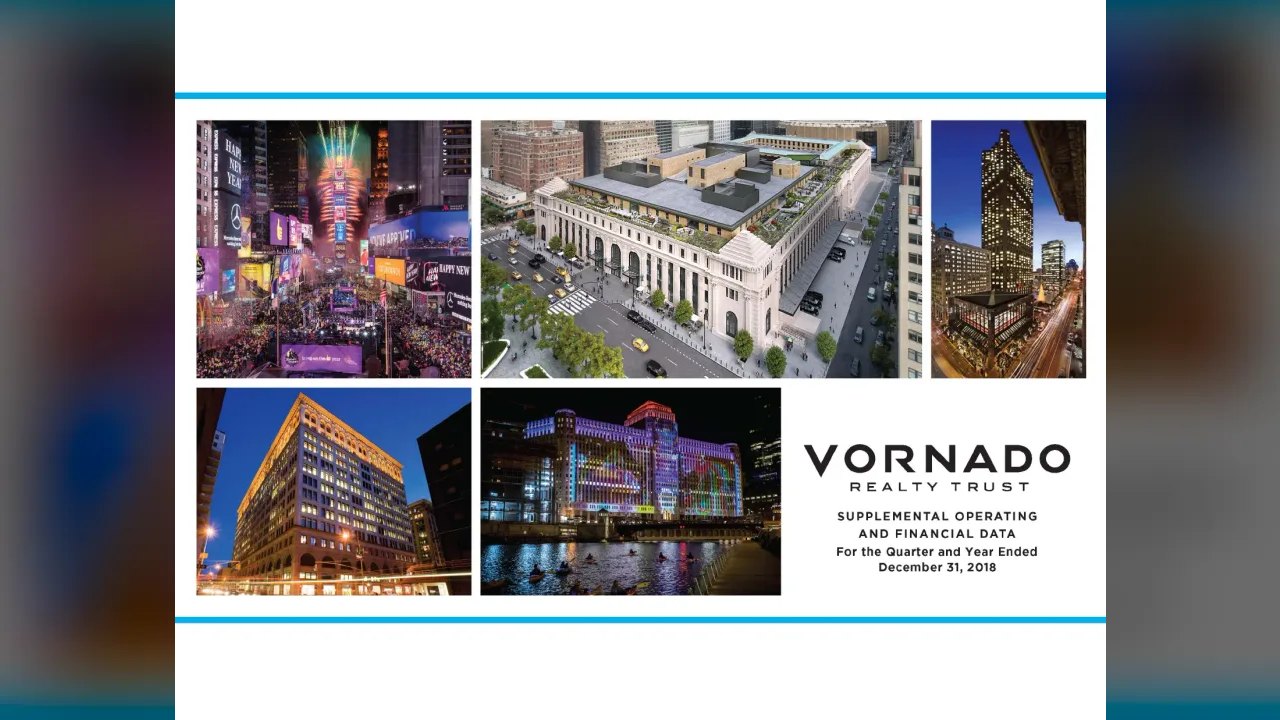
On 6ix: 6ix.com/event/vornado-realty-trust-vno-q4-2018-earnings-call
Automated transcript · Written by software from the replay's audio. It can mishear names and figures; the replay is the record.
0:00 Good morning and welcome to the Vornado Realty Trust fourth quarter 2018 earnings call. My name is Michelle and I will be your operator for today's conference. This call is being recorded for replay purposes. All lines are in a listen only mode and our speakers will address your questions at the end of the presentation during the question and answer session. At that time, please press star and then one on your touch phone. I will now turn the call over to Ms. Kathy Cresswell, Director of Investor Relations. Please go ahead, ma'am.
0:32 Thank you. Welcome to Gornado Realty Trust's fourth quarter earnings call. Yesterday afternoon, we issued our fourth quarter earnings release and filed our annual report on Form 10-K with the Securities and Exchange Commission. These documents, as well as our supplemental financial information package, are available on our website, www.dno.com, under the Investor Relations section. In these documents and during today's call, we will discuss certain non-GAAP financial measures. Reconciliations of these measures to the most directly comparable GAAP measures are included in our earnings release, Form 10-K, and financial supplement. Please be aware that statements made during this call may be deemed forward-looking statements and actual results may differ materially from these statements due to a variety of risks, uncertainties, and other factors. Please refer to our filings with the Securities and Exchange Commission, including our Form 10-K, for more information regarding these risks and uncertainties. The call may include time-sensitive information that may be accurate only as of today's date. The company does not undertake a duty to update any forward-looking statements.
1:42 On the call today from management for our opening comments are Steven Roth, Chairman of the Board and Chief Executive Officer, and David Greenbaum, President of the New York Division. Also in the room are Michael Franco, Executive Vice President and Chief Investment Officer, Joseph Macnow, Executive Vice President, Chief Financial Officer, and Chief Administrative Officer, Mark Hudspeth, Executive Vice President and Head of Capital Markets, Matt Iocco, Executive Vice President and Chief Accounting Officer, and Tom Sanelli, Executive Vice President and Chief Financial Officer, New York Division. I will now turn the call over to Steven Roth.
2:20 Thank you, Kathy. Good morning, everyone. 2018 was a good year. Here are some highlights. Our leasing activity for the year across the entire business, including New York, The Mart, 555 California Street, and retail, totaled over 2.6 million square feet and 230 leases, with industry-leading mark-to-markets of 25.6% gap and 18.4% cash. At year-end, office occupancy across the board was 97%. and retail occupancy was 97.3%. These numbers in the very high 90s are typical of our performance year in and year out over the past 20 years. Thanks to Glen and our best in the business leasing team.
3:08 We have begun closings at our 220 Central Park South super tall condominium project. In the fourth quarter, we closed 11 units aggregating $222 million with a 67.3 million after tax gain. and we have already closed in just the first five weeks of this year another 290 million. Closings will continue throughout 2019 as we climb up the building. And the last of the 27 large full floor apartments in the tower is now committed and under contract. I'm guessing that this is the most successful apartment project ever anywhere. We increased our ownership in the Moynihan Train Hall Farley project from 50% to 95%.
3:54 We are in full-blown construction here and in 2020 we will deliver the best creative space in Manhattan. We love this asset. It is the link between our Penn Plaza neighborhood and Hudson Yards. It is a double wide block with 150,000 square foot floor plates and high ceilings. It is a horizontal campus in an iconic landmark building much like the horizontal campuses favored by our Fang tenants in the West. It is a truly unique asset. In the Penn District, we are underway to transform Penn One and Penn Two to create a two building, 4.4 million square foot campus right on top of Penn Station. It will include a three block grand plaza along Seventh Avenue covered by a giant new bustle across the entire 400 feet frontage of Penn Two. This bustle will extend 70 feet out from the building and will be 50 feet above the street. It will serve a dual purpose.
4:52 It will be striking, creating a huge covered plaza in front of our 1.8 million square foot Penn II and the main entrance to Penn Station. It will bring the neighborhood into the modern age. And at the same time, we will create 140,000 square feet of very valuable new best-in-class creative space. The scale of our campus here will allow us to provide our tenants with the biggest and best unparalleled amenity package, even a giant step forward from what many of you have seen that we have done at the Mart. Considering our redevelopment plans and everything that's happening around us, we expect an incremental $30 uplift in rents here. This financial reward is the main event.
5:38 So, putting 220 Central Park South and the Penn District together. Big picture, our financial plan is to redeploy the proceeds of 220 Central Park South sales into the capex of Farley, Penn 1, and Penn 2. Give or take, we expect to finance all this capex internally, probably with no or very little new debt. Given that the only cost of the capital coming out of 220 Central Park South is the accounting item, capitalized interest, which in round numbers is about $25 million. This will be enormously accretive. As is our custom, we published management's estimate of NAV in the fourth quarter supplement. Please see page 22 of the supplement. Our SPOT NAV is $97 per share versus $96 per share a year ago. The math here reflects an increase in office NOI partially offset by an increase in the cap rate on street retail to 4.5% from 4.25%, which we believe more accurately reflects current market conditions.
6:44 Last month we increased our quarterly dividend to $0.66 per share at an annual rate of $2.64, a 4.8% increase, this after a 7.7% increase the year before. Based on yesterday's closing price, the dividend yield is 3.8%. It is very encouraging that Amazon chose New York for half of HQ2 and that Google, Disney, Facebook, and many others continue to expand and expand again and again, making New York their second home. By the way, the other half of HQ2 is going to Crystal City, Virginia, on land we contributed to our JBG Smith spinoff, validating investments we made years ago.
7:29 This is a really big deal. Kudos to Matt Kelly and the JBG Smith team. Here's an interesting tidbit that bodes really well for the future of New York. As David will tell you in a minute, a research piece just came out with the fact that New York has grown to be the leading tech city in this year's index, overtaking San Francisco. The point here is that New York has been steadily growing in creative class workforce, in creative employers, and in creative infrastructure. Now I'd like to cover the financial math. Financial results for the full year are as follows. Net income was $2.01 per share compared to $0.85 for 2017. Total FFO was $3.82 compared to $3.75 for 2017. FFO as adjusted was $3.76 compared to $3.73 for 2017, consistent with our comments at the beginning of the year that 2018 would be flat.
8:31 2018 cash basis FFO is adjusted was 373 compared to 348 for 2017 up a strong 7.2%. Company-wide cash basis NOI for 2018 was 1.338 billion compared to 1.315 billion for 2017. 2018 cash basis same-store NOI increased 3.9% as follows. New York office was up 7.5%. Retail was essentially flat down two-tenths of a percent. The total New York segment was up 4.3%. Retail produced $324.2 million of cash NOI in 2018, well ahead of the $304 million minimum we guided in the beginning of the year, which we increased to $315 minimum in the third quarter.
9:33 The market was down a funky 6.5% as a result of a fourth quarter $12.1 million additional real estate tax accrual. This is essentially a timing mismatch between the gap required expense accrual in 2018 and the actual payment, which we will make in 2019, which is when we will bill our tenants and collect approximately 80% in reimbursement income. Excluding this mismatch, Lamar's same store would have been positive 8.8%. At 555 California Street, the same store was up 18.1%. For the fourth quarter, results are as follows.
10:19 Net income was 53 cents compared to 14 cents in the prior year's fourth quarter. Total FFO was $1.10 compared to 80 cents for the prior year's fourth quarter. FFO as adjusted which includes non-recurring items was 90 cents compared to 98 cents in the prior year's fourth quarter. FFO as adjusted for this quarter was negatively impacted by the following items. $12.1 million or six cents from the already mentioned additional real estate tax accrual at the mark. 10.5 million or five cents from expected retail vacancies and lower income from a few short-term deals. and 6.2 million or 3 cents from expected vacancy at 90 Park Avenue and the Mart, space out of service at Pen 2 and 825 7th Avenue and lower office termination fees.
11:14 Of course, there were many positives which partially offset these items. This is all the normal ebb and flow of our business. We run the business for cash. Here are the cash numbers for the quarter. Cash basis FFO is adjusted with 91 cents and Robert Larson. This flattish number masks a very healthy business.
12:01 Here are the details. New York office was up a sound 5.8%. Retail was down an anticipated 4.1% based on scheduled lease expiries and reduced rents on short-term renewals. The total New York segment was up 1.9%. The Martin same-store number is so heavily skewed by the real estate tax mismatch that the number is not meaningful. Excluding this mismatch, The March same store would have been positive 2.7%. And 555 California Street was up a very healthy 15.8%. Our office business continues to perform very well. We continue to experience robust demand from all manner of industries in all of our submarkets.
12:47 As I have said before, our tenants are optimistic, aggressive, growing, and upbeat about New York. Retail continues to be soft, albeit we are finding sales volumes are leveling and there is increased retailer activity and tours. The two strongest retail submarkets in town are Times Square and Penn Station, where we are the largest owner with the best assets. And here I want to make a plug for the 120,000 square feet of retail we are developing in the Moynihan Train Hall at Penn Station. In addition to the teeming streets and the existing traffic and the nation's busiest train stations, All the pedestrian traffic to and from Hudson Yards and Manhattan West will funnel through us.
13:32 As you would expect, we have tremendous retailer interest in this unique space. David will give you more facts and details in a minute. Turning now to investment sales. After a slow start to 2018, the investment sales market strengthened over the course of the year, ending strongly. Investor appetite for New York City office continues to be healthy, though disciplined, with a good mix of domestic and foreign capital sources easily replacing declining activity from China. Demand for assets in the west and south of Manhattan and for smaller assets continue to be strongest, but investor interest is also active in midtown. Pricing has stayed fairly constant with cap rates in the mid-fours. The market has suffered from a shortage of available quality product on offer, and with a fair amount coming out in 2019 should get off to a strong start.
14:28 The debt markets continue to be constructive, very strong in the first three quarters of 2018, but signaling caution and volatility in the fourth quarter. All in borrowing rates remain low by historical standards. It's interesting to note that for us, secured non-recourse financing, which is our mainstay, is now cheaper than unsecured public market full recourse financing by 25 basis points for sure, and maybe even more. We have a highly liquid fortress balance sheet with $3.3 million in immediate liquidity, measured leverage, and well-staggered debt maturities. and this doesn't count a couple of billion dollars to come from 220 closings and non-core asset sales. Thank you, now to David.
15:16 Steve, thank you, good morning everyone. 2018 was a historic year in Manhattan. We leased a total of 42.2 million square feet, the most active year in two decades, including 61 leases of 100,000 square feet or greater with 20 of those deals greater than 250,000 square feet. This enormous rise in activity is due to the continued strong job growth in New York. Both private sector employment at 3.98 million jobs and office using employment at 1.4 million jobs are at all time highs. Manhattan's overall average asking rent ended the year at a record $76 per square foot with Class A Midtown rents north of $80 per square foot.
16:08 The overall availability rate remained steady and actually went down in Midtown, even in the face of the delivery of some 2 million square feet of new construction. Financial service tenants continued to be a strong player in the Midtown market, accounting for 41% of all leasing activity. Large tenants continued to be attracted to new and redeveloped product. which captured significantly almost two-thirds of the year's leasing activity. The landmark announcements made by JPMorgan Chase to develop a new corporate headquarters on Park Avenue, Google's commitment to a campus on Hudson Square, Disney's announcement to build a new headquarters also in Hudson Square, Deutsche Bank's commitment to Midtown, Pfizer's commitment to Hudson Yards, and finally Amazon's selection of Long Island City for a half of its second headquarters location, all reflect upon the great strength of this city.
17:08 Just last week, Savills, the international brokerage house, issued its annual global tech cities report. Savills concluded that New York ranked first as the world's foremost center for tech, due to its deep talent pool, providing the business environment, lifestyle, and quality of urban infrastructure to position New York as the attractive location for both startups and multinationals alike. Our portfolio of redeveloped assets has experienced the benefit of this enhanced demand from tenants, and Farley, Pen1, and Pen2 are up next. Reflective of the strong overall marketplace in New York, as well as River North in Chicago and San Francisco, Vornado's portfolio across all three cities delivered very strong results. For the year 2018, our leasing teams completed 230 leases, a total of 2.5 million square feet of activity at exceptionally strong mark-to-markets across the board of 25.6% gap and 18.4% cash.
18:22 Focusing on our New York office portfolio, For the year, our team completed 113 office leases totaling over 1.8 million square feet and an average starting rent of $79 per square foot with strong, strong mark to markets of 33.7% gap and 22.7% cash. We remain full with year-end occupancy at 97.2% and a very modest 625,000 square feet expiring during 2019 with approximately half of the expiring space coming from the to be redeveloped PEN1 and PEN2 campus. Tenants in New York are growing.
19:11 38% of our activity in 2018 was with tenants new to and expanding in New York City. Real Real Growth in the City. Looking at the last three years, our leasing performance in the portfolio totaled almost 6 million square feet and an average starting rent of $76.50 per square foot, underscoring the very high quality of our offerings and the strong profile of the tenants in our buildings. During 2018, our trophy assets also continued to shine highlighted by 11 triple digit transactions totaling 445,000 square feet comprising fully a quarter of our total annual activity at an average starting rent of $109 per square foot.
20:03 Our New York office 2018 same store results show robust growth of 7.5% cash and 4% gas. Now turning to the fourth quarter, were executed on 479,000 square feet across 27 transactions at an average starting rent of $73 per square foot and positive mark to markets of 6.9% gap and 1.2% cash. Same store growth during the quarter was a strong 5.8% cash while gap was essentially flat. Notable fourth quarter leases included and a new headquarters for Sotheby's International at 650 Madison Avenue on the entire 38,000 square foot second floor, where this luxury residential brokerage house will take advantage of this building's premier location, great branding opportunities and abundant outdoor space.
21:06 This space previously was retail space, which we now have converted to office, taking advantage of the highest and best use for this space similar to what we did with Kmart's third floor at 770 Broadway. In the fourth quarter, we also relocated CICC, one of China's leading investment banking firms from our 350 Park Avenue into 20,000 square feet at 280 Park Avenue where they will double inside. And the Interpublic Group expanded again at 100 West 33rd Street by 44,000 square feet bringing IPG's total footprint there to 662,000 square feet. As we kick off 2019, we're seeing very active demand in the market with leases in negotiation totaling 460,000 square feet across all submarkets and another 600,000 square feet of deals in the pipeline.
22:07 At 1290 Avenue of the Americas and 90 Park Avenue, two of our completely redeveloped buildings We have seen multiple tenants bidding on the blocks of space available at our sweet spot in the market in the $80 to $90 per square foot range. Now turning to our office development and redevelopment pipeline where we remain very active. We've recently completed and brought to market the new build 170,000 square foot office building at 512 West 22nd Street directly on the High Line where we are in active dialogue with multiple tenants. Notably, these discussions are mainly with boutique financial services tenants looking for a new home in Chelsea. As we have said in the past, the geographic boundaries for tenants in Manhattan to continue to expand as demand for this type of product in this district is at an all-time high.
23:03 Rents in Midtown South for this product have now surpassed Midtown's asking rents. Construction progress at Farley continues. where you can now really get a sense of the grandeur of the new train hall. The train hall's mid-block skylight, one of two signature skylights, is now complete. The skylight soars 50 feet above the mid-block hall that will include our retail, restaurants, and one of our three office lobbies. The work on our office core and shell program has commenced with initial delivery anticipated by mid-2020. We're seeing great office and retail interest in the project from all industry types as we are presenting the vision of this horizontal campus to brokers and tenants on almost a daily basis.
23:55 PennOne is the tone setter for the new Penn District neighborhood where we will create a hospitality-rich communal workplace for our district-wide tenants from the lobby to the second and even to the third floor. Physical work has commenced both our facade restoration and elevator modernization programs have begun. We've completed the necessary arrangements to relocate office and retail tenants at the base of the building, which will allow us to begin the real construction work on this transformational project once the Ascendants move this coming summer. At PEN2, we are finalizing our plans and permits with construction to commence during the first quarter of 2020.
24:40 Here, we have completed the necessary tenant relocations to make way for this fill building capital program, delivering 1.8 million square feet of unique modernized office space, along with all new retail offerings, outdoor plazas, and multiple amenities, which will also serve our tenants district-wide. Collectively, the projects we are undertaking at Farley, Pen 1, and Pen 2 are the catalyst to our recreation of the Penn District neighborhood in the epicenter of the new New York. I encourage you to take a look at our Penn District plans, which are now posted on our website at www.vno.com homepage.
25:30 Now turning to our flagship New York retail portfolio. For the year, we leased a total of 255,000 square feet. same-store results were flat year-over-year, negative 2.2% gap and negative 0.2% cash. Retail portfolio occupancy stands at a strong 97.3%. During the fourth quarter, we completed nine retail leases comprising 26,000 square feet with positive mark-to-markets of 3% gap and 1.1% cash. Notable deals included a lease with HSBC Bank at our new 606 Broadway in Soho, Wells Fargo's lease of the entire retail box at 968 3rd Avenue, and the announcement of Ballast Point Brewery's first New York location at 330 West 34th Street. Ballast Point will bring their West Coast craft brewery and restaurant concept to the Penn District, where they will have an indoor restaurant experience on 34th Street and an outdoor garden for its patrons on 33rd Street directly across the street from what will be the main entrance to our future Farley Building office occupants.
26:48 We also completed a lease for a new flagship location with Krispy Kreme at the Crowne Plaza Hotel at the corner of 48th Street and Broadway, which will include a 4,500 square foot retail component as well as a large exterior digital signage presence. At the Mart in Chicago, 2018 results reflect continued strong leasing performance at this 3.7 million square foot campus. We completed 243,000 square feet of leases for the year, comprised mainly of a variety of showroom tenants and very strong starting rents of $53.50 per square foot. During the fourth quarter, we completed 46,000 square feet of showroom deals at an average starting rent of $61 per square foot with positive mark to markets of 8.7% gap and 3.2% cash. We currently have an office lease out for 36,000 square feet with a well-known technology company and have multiple other prospects for the remaining space vacated last year by Publicis on floors four and five.
28:01 In San Francisco, We completed a stellar year at our 555 California Street campus, taking full advantage of this marketplace where the demand for space continues to surge amidst limited availability. Our SAMHSA results for the year were a very strong 14.9% gap and 18.1% cash. In 2018, we leased 249,000 square feet at an average starting rent of $89 per square foot, resulting in very healthy mark to markets of 34.3% gap and 13.4% cash. We are now at 100% occupancy.
28:48 At 315 Montgomery, we do have a renewal lease in negotiation for 56,000 square feet, which we expect to close during the next few weeks. and our 345 Montgomery redevelopment work is in full force with concrete work substantially complete and steel work having begun. We remain on time with respect to our delivery of the building to Regis Spaces by the end of the third quarter of this year. We are very pleased with our overall 2018 company-wide results and continue to see strength in all three of our markets. These leases are a credit to the quality of our portfolio and the dedication and teamwork of all of our enormously talented professionals.
29:34 Back to Steve.
29:38 Ready for Q&A. Thank you. We will now begin the question and answer session. If you have a question, please press star then 1 on your touchtone phone. If you wish to be removed from the queue, you may press the pound sign or the hash key. and if you're using your speakerphone, you may need to pick up on your handset first before pressing the numbers. Once again, to ask a question, please press star one on your phone at this time. The first question in the queue comes from Steve Sacqua from Evercore. Your line is open.
30:11 Thanks. Good morning. Steve, you and David both kind of mentioned the Amazon situation. I know there's been a number of different press reports out there about maybe the city having some issues coming to terms with Amazon on the Long Island City project. And I'm just wondering what that sort of signals as it relates to kind of new business coming here and kind of any thoughts you have around that deal maybe getting consummated.
30:39 That's a hot potato. First of all... folks like Google and Facebook and on and on and on have no trouble expanding, growing, relocating, locating in New York through the conventional way of dealing with basically as of right real property. Amazon chose to take a different tack and that's fine. I would say it's my personal opinion that if my personal opinion that the deal that the governor of New York and the mayor of New York made with Amazon was a terrific deal for the city and a terrific deal for us. I mean, you know, a huge, huge company with an enormous number of important, high-paying jobs, etc.
31:38 If the political climate in New York blows this deal, it would be the stupidest damn thing I've ever seen. And that's what I think. Now, we know, you know, we have, you know, as I said before, obviously, we're heavily involved and I'm the chairman of the company, the Crystal City Company, which is welcoming. So I think maybe some of the folks in New York should take a much more welcoming approach. and many other savvy points of view on this deal.
32:40 Steve, good morning. Listen, we think the Farley Building as a horizontal campus in New York is totally unique in terms of the space that we will be delivering. We have told you in the past that we think rents at this building are triple digit numbers. And by the way, as you think about rents in the city generally, When I mentioned earlier some 44 or 42 million square feet of activity for the year, some 4.2 million square feet across the city last year was leased at over $100 rents.
33:28 So these triple-digit rents as it relates to redeveloped and new construction clearly have become the norm We think, again, our building is differentiated in a significant way from substantially all of the new what I'll call vertical product. We remain in discussion with a number of tenants for the space. As I said, the space will be delivered for tenants to begin build out sometime by the middle of next year. Very excited about the fact we now own 95% of this asset.
34:14 Our financial plan here, Steve, is we're basically going to build this deal with cash, cash coming out of 220, so that our cost of capital here is the lowest that it's possible to be. we have enthusiastic, very enthusiastic reactions from the brokers community and the tenant community and as I said and David both said, we love this one.
34:51 Okay, and then I guess my last question just around the uplift you talked about it, I guess two pen and maybe the uplift at one pen, I think you quoted a $30 per square foot Just kind of help us think through how you're sort of framing that out or thinking about the uplift and sort of the rent differential that you would expect there to be between some of the new product at Manhattan West and Hudson Yards and maybe ultimately your finished project at 1 and 2 Penn.
35:18 Well, I mean, I think it's pretty simple. The in-place rents are high 50s, low 60s on average with the current leasing being a little bit higher than that, but the average in the buildings are those numbers. We think the finished product will be worth, in the marketplace, let's say, pick a number, $90 a foot. So that's a $30 uplift. Now, out of that uplift has become a marginal increase in expenses. The cleaning doesn't get to be any higher, or the taxes may go up a little bit. So basically, that's a fairly pure number. and, you know, we're pretty excited about it. We, you know, we determine what we believe the future market, we've got to remember this is trended now for a couple of years.
36:10 We determine what we believe the future market will be, you know, based upon what we see all around us, what new building, new builds are going for, what other space is going for and the fact that we have the best location on top of Penn Station. and we have experience in transforming these buildings both at the Mart and in New York on many different occasions and we have history in what the transformation yields in terms of tenant demand and pricing. So that's our best judgment and we're pretty certain we're right.
36:48 Okay, that's it for me. Thanks, guys.
36:50 Thanks, Steve. Thank you. The next question in the queue comes from Manny Korchman with Citi. Your line is open, sir. Please proceed.
36:58 Hey, good morning, everyone. Maybe if we can just stick to Farley for one more second. In the past, you've discussed a potential life science component there and build out to support that. It now sounds like you're squarely focused on a more traditional, if you will, tech tenant. Am I reading that correctly?
37:18 You know, maybe we're an equal opportunity landlord. I mean, you know, when an important tenant at the proper pricing comes in, you know, a strong tenant, we're very happy to welcome everybody with open arms. So we have some interest from science tenants. We have more interest from creative class tenants. We even have interest from some fairly significant financial firms. So once again, this is not a special purpose building. It's a building designed to service the entire market.
37:58 Thanks for that. And then in terms of street retail, transaction activity has been a little bit lighter. What gives you confidence that cap rates haven't moved up more than the 25 basis points that you've applied to the cap rates in your NAV analysis? and maybe with that, can you talk about the potential new legislation related to a vacancy tax?
38:21 You know, the cap rate we put in this year's NAV is our best estimate of what the marketplace is. So it's a very thin marketplace, but these great, scarce, unique assets... We believe we've hit it right on the button. The second question was what about legislation, Manny?
38:51 On the retail vacancy tax that's getting proposed, I guess, for the umpteenth time?
38:58 Well, yeah, I think the key thing there is the umpteenth time. You know, everybody's concerned about the fact that there are lots of vacancies on the streets of New York. It's not good for anybody. It's especially not good for the landlords, okay? So I don't understand why the politicians, and we talk to these folks all the time. I don't understand why the politicians don't recognize the fact that landlords want to fill this space up more than they want the space filled up. and so obviously the landlords that are professional will go to the clearing price for the space. So I think it's extremely, what's the word?
39:45 It's a bad piece, it's a bad idea both in concept and in execution. And I don't make predictions but I'm fairly confident that it will pass by. By the way, just as I'm fairly confident, just as I'm going back to what Steve said, just as I'm fairly confident that the Amazon deal will get completed.
40:09 Thank you. Thank you. The next question in the queue comes from Jamie Feldman with Bank of America. Merrill Lynch, your line is open. Please proceed.
40:19 Great. Thank you and good morning. You know, it sounds like you'll have a... A lot of move-ins and move-outs in the portfolio for the rest of the year, and even as you're kind of getting ready for the two-pen redevelopment and emptying out that building, are you able to give us more color on what same-store NOI could look like, what earnings could look like, just a bit of a guide as you get the portfolio ready for those big changes?
40:46 You're talking about guidance, and as you know, we don't give guidance. We do guide for What we think are extraordinary things, for example, when the patent office moved out of, what was it, the BRAC, when we had all of that dislocation in Washington, you know, better part of 10 years ago, we did guide for that because we thought it was something that was, you know, very difficult to predict that everybody was focused on. Last year, we did guide to what the minimum that retail cash NOI would be. And I'm happy to say we missed it by $20 million to the positive side.
41:32 So having said that, we'll think about your question because it's a valid question.
41:37 I will tell you one thing.
41:40 I, for one, as an operator, don't understand how folks think about this. When we empty out a slug of space that's paying us $55 a foot to transform a building and two years later or 18 months later we let that space for $90 a foot. We think that that's a huge asset and that's a very important part of our business and our colleagues as well. So whereas what I'm really saying is that I wish you folks would look upon the fact that we are are going to kick out $50 tenants and move in $90 tenants as a huge uptick in shareholder value. We hear what you're saying about guiding and everything.
42:27 We'll think about it, but that's not the normal way we run our business.
42:34 Okay, that's a fair point. I think it's more just about setting expectations. I don't think anyone disagrees that it's the right thing to do to kick out tenants and redevelop the buildings. It's more just So the market has a sense of what to expect as we're heading into quarterly earnings each quarter. And then moving on, I know Manny touched on cap rates. Can you just talk generally about your thoughts on the 19 transaction market? You said you thought office would probably pick up in terms of volumes. Maybe what's on the market and what do you think cap rates will look like?
43:08 Michael Franco is here, who's our chief investment officer, and I'm going to let him answer that question.
43:14 So, Jamie, good morning. I think after a pause coming into the year, there's a number of things that are hitting the market. Some new product like the condo interest at 30 Hudson Yards. You've got some other, you know, called midtown buildings, maybe lesser quality coming out on Lex. But I think the sweet spot is going to continue to be that under $300 million to $400 million market. and some of the other assets in the garment district. So, you know, it looks like near term there's probably five to six billion dollars of office product that is recently hit or will hit in the next 30 days. I think it's probably higher quality than what we saw for the bulk of last year. And we'll see how it plays out.
44:15 But I think the investor interest, at least from what we're seeing, hearing, is active. And, you know, I think you're starting to see investors perceive value in Midtown as well, just sort of on a price per square foot standpoint where, you know, most of the assets are treading for $1,000 a foot or less, which is, you know, as we're seeing now with some of the new builds that are going at $2,000 a foot or north, you know, that's a pretty attractive basis. So The market feels like it's picking up in terms of quality, and I think we'll see investor interest reflect that.
44:48 You know, I would put my two cents in. I agree with what Michael said. I think the first thing is that buildings have been pricing now at $1,000 a foot in that neighborhood a pinch more or a pinch less for years now. The investing marketplace has gotten used to that number and considers it to be fair value as I do. So there is no sticker shock and people are getting used to the pricing of what first class Manhattan office buildings trade for. So I think that there is a very deep market of investors who want to invest in New York. I think it's basically the strongest market in the world.
45:36 You know, we know what's going on in London. We know what's going on in Europe. I mean, you know, Tokyo's doing great. That's a whole different kettle of fish. So what I'm saying is, is we think New York gets way more than its fair share. We think pricing, investors are used to the pricing, and we're anticipating a strong investment sales market next year.
45:56 Okay, thank you. And then finally, Steve, you had mentioned as, you know, a source of capital non-core asset sales. Are you thinking more operating buildings or maybe you've seen a decent move in some of the REIT stocks, some of the equities you guys are holding?
46:13 All of that is on the for sale list. I'm not going to predict timing and I'm not going to predict which specific assets, but I mean we were pretty transparent in what we intend to do to realize over a billion dollars of sales. and those, you know, it's pretty obvious what we're doing in terms of timing those sales with our CapEx needs, etc. So, you know, that'll all roll out over time.
46:44 Okay. Thank you.
46:46 Thank you, sir. Thank you. The next question to queue comes from Adam Gabowski with Morgan Stanley. Your line is open. Please proceed.
46:56 Hey guys, thanks for taking the question. Just on street retail, given what we saw happen with rents in 2018, do you guys have any thoughts on where you could see street retail rents bottom and start to inflect positively, and also whether or not Vernado is considering taking advantage of any distress you're seeing in the market?
47:15 We love distress, Adam. We can't wait for some distress. We have the capital base, the appetite, and most importantly, the expertise that to be interested in growing in this asset class at fair prices, or maybe even a little bit below fair prices. So there's that. We're not seeing a lot of that. We're beginning to see the first inkling of assets going back to lenders now. And so that's the beginning of that cycle. With respect to rents, The biggest problem on rents are that there are fewer tenants trolling the marketplace looking for space.
48:05 So we don't yet know what the bottom price is. If you follow this market as most other markets, it'll take a while, maybe a year, maybe two years, for some of these vacancies to be cleaned up by bottom fishers, and then the market will level and start to grow again. So we have the enviable position of not really having... I mean, we have a vacancy here, we have a vacancy there. But in terms of the mass of our portfolio, it's under lease for long term with good tenants. And so, you know, we're fine.
48:43 All right. That's very helpful. Thank you. And then just one more on street retail. I know the Massimo Duty and Westbury expirations got pushed out a little bit. Can you just talk about the latest... The latest update on those leases and then what the impact will be to street retail NOI in 2019.
49:02 Once again, that's a guidance question. I don't think the Massimo Duty lease was pushed out. So I don't think that the neighboring MAC lease goes into the 20s, 24, I think. We have people cruising the Massimo Duty space. We have nothing to report yet.
49:26 All right, thanks. Appreciate it. Thank you. The next question in the queue comes from Alexander Goldfarb with Sandler O'Neill. Your line is open. Please proceed.
49:36 Good morning. Steve, I appreciate your comments on guidance. So I guess let me try to ask it this way. If we look over this year and next – well, Steve, you've got to try, right? Every New Yorker's got to try. If you look over earnings this year and next – obviously you know the mart had had you know you guys created value so taxes went up you'll recoup part of that but still that's a net headwind uh pen two is going to come offline I think next year so that's some NOI that will come off in the near term obviously you guys will boost rents and grow it eventually uh but you then have the cube at 555 that will get filled and produce NOI so just with all the different pieces that are coming and going including some of the street retail vacancy that I mean street retail that you've talked about before Directionally, do you see over this year to next that net NOI will be growing, stay flat, or reduce just with all the different moving parts?
50:34 I think to Jamie's question, earnings have been flat the past few years, so just trying to get a sense for how directionally people are thinking about it, because I think we all agree you're creating value at the NAV and property level, but just from an FFO, that part stays flat.
50:52 Oh boy, you know, I don't want you to hold me to this, but I would just say directionally, if you think flat, that would be a good thought, okay? So there's, I mean, the business is, some people refer to it as noise. I refer to it as the normal ebb and flow of our business. Tenants move in, tenants move out, rents go up, rents go down, whatever, okay? So if you take it all together, the office business in three different jurisdictions, arguably the best building in San Francisco, arguably the best financial asset in Chicago and our New York business and our retail business, overall I think it will all meld together as flat.
51:42 But that's not a guide. Don't hold me to it, okay?
51:46 Okay. And then the second question is just bigger picture, you know, This morning or yesterday, Silverstein said he may go spec downtown. Obviously, Brookfield has talked about going spec on the far west side. Do you view this as marketing bluster, like trying to drum up business, or are you concerned that we could suddenly have another supply wave where we're just sort of working through the previous few years of supply delivery, which has pressured rents in New York?
52:14 Hey, these are major, major people. They don't bluster, okay? They may bullshit a little bit, but they don't bluster. So you've got to remember that both of these firms are firms that deal with with promoted third party capital. OK, so what they're you know, my guess is, is I haven't talked to either of them about this, is that if they can get an investor who has the appetite, they'll build the building. Why not? So I think that's totally possible, and whatever. There is a large appetite of investor capital for buildings, even for development, in brilliantly located spots, like Park Avenue, for example. So I have no idea what Larry and Rick are going to do, and they're both...
53:16 you know seasoned guys Rick Scott you know fund money that that he has discretion over so he can build it if he wants to Larry will you know will raise third-party capital if he can and we'll see what happens but you're not concerned about another supply you know sort of glut pressuring rent though it doesn't sound like you know a building here a building there a building the next place these buildings they all take you know five seven years to create they're like pulling teeth. They will not have a dramatic influence on the 400 million square foot New York City office business. The last time that this happened was in the early 80s where there was a zoning change and then the entrepreneurial developers, there was a rush to beat the zoning change and 20 or 30 million square feet was created in one slug. That is not happening now and will not happen now.
54:21 Thank you, Steve.
54:23 By the way, as an aside, we love to build new buildings. I mean, we're pretty good at it. We built the Bloomberg building. We built 220 Center. We know how to do it. It's part of our skill set. but our main business is in the core of properties that we own now and if somebody's going to build a new building and get $120 a foot rents for it, that creates the absolutely wonderful price umbrella that we function under in the 80, 85, 90, $9,500 range. So that's all fine.
55:02 Thank you.
55:04 Thanks, Alex. Thank you. The next question, the queue comes from John Kim with BMO Capital Macro. Your line is open. Please proceed.
55:12 Thank you. Thanks. Just wanted to follow up on Alex's last question. Given Manhattan West directly competes with Penn Plaza, does that potentially change the timeline of the redevelopment of Penn II?
55:26 Absolutely not. Absolutely not. Penn II... We're going as fast as we can on PEN2. We're going to deliver the product as quickly as we can. We think it's a unique product, and we think that's all fine. The more people that are in our neighborhood in first-class property with first-class tenants, the better it is for the entire neighborhood, us included. So we don't look upon them as a competitor. We look upon them as a as a colleague and as a good neighbor.
56:10 Okay. With your NAV at $97, can I just ask what your updated views are on a share buyback, given you now traded a 28% discount? And I don't know if you saw this morning, but Simon just announced a $2 billion buyback program during your call.
56:27 No, I didn't see that. Our views on the buyback are the same as we have communicated over the last year or so.
56:38 Which is you look at it, but it's lower on the priority list?
56:41 You know, the answer is that our views would change if somebody were to do a buyback that was successful. So that hasn't happened yet, and so we'll watch and learn, keep our money in our jeans. and we'll see. So the answer is, as of right now, our thinking about buybacks is pretty much the same as it's been over the last year or so.
57:09 Okay. And then a final question, this might be for Joe, but at 220 Central Park South, you had on your balance sheet county units ready for sale at 99 million and that's lower than what you've already closed in January. So I'm wondering if this is a good indicator of of what you plan to close on over the next quarter going forward.
57:31 I think in Steve's remarks, he commented that through the first five weeks in January, it was another $290 million. We anticipate substantial additional closings in the remainder of 2019 and quarter by quarter there will be more reclassified for accounting rigors into that category that you questioned. But yes. We expect substantially more closings. Remember, all of the full-floor apartments have been sold for the remainder of 2019.
58:05 Check me on this, Joe. My understanding of the accounting convention is that when an apartment gets a TCO, a temporary certificate of occupancy, It gets reclassified on the balance sheet as apartments available for sale.
58:20 That's correct.
58:21 So that the number that you're looking at has got nothing to do with sales, nothing to do with future financial activity. It has entirely to do with how many apartments in what order we have gotten COs on.
58:36 This is a number as of the end of the year, not a number into 2019. It will grow in 2019.
58:42 Our plan is that we get TCOs on the apartment serially as we go through, right before we sell them. I hope that helps.
58:53 Yeah, it does. Is there a good run rate that we should be modeling in? Is it $200 to $300 million per quarter? No.
59:03 No, we haven't given the information by quarter. And to take that noise out of earnings, we've shown it is non-comparable. Because again, it is one time, albeit over $3 billion in total. But no, we have not given that by quarter. And I don't think we intend to.
59:25 It's going to roll out. It's going to roll out over the next year. I mean, pretty simply. whether it's another $100 or $200 million, more one quarter or less one quarter, it doesn't matter. It's going to all roll out and be sold over the next year.
59:41 Great. Thank you.
59:42 Thank you. The next question comes from Nick Ulico with Scotiabank. Your line is open. Please proceed.
59:51 Okay. Thanks. A couple questions. First on how we should think about You talked about that $25 million of capitalized interest from 220 Central Park South. I think the plan is to pay down debt from the sales of the condos, which would lower your interest expense, but then you're also losing that capitalized interest benefit over time. So can you just give us a feel for how we should think about that impact to your interest expense over the next year?
1:00:21 Well, hi, it's Joe. Good morning. We've said publicly that we're going to pay down the construction first mortgage, which was originally in the amount of $950 million. At year end was a little over $700 million. Today is a little over $400 million. And that the balance of the proceeds are going to be used, as Steve said earlier, to fund the needs of Pen 1, Pen 2, Folly, the entire pipeline of what we have in development. We've shown you in the NAV $1 billion. Somebody wrote in one of the reports that's an increase from the prior quarter.
1:01:07 It's really the same number, and that comes from the $3.2 billion of sales proceeds. $200 million of taxes is $3 billion. The cost of the job was $2 billion. That's $1 billion. So I think that's where we are.
1:01:27 Okay, yeah, I'm just trying to think about, you know, capitalized interest, which is at its, you know, highest level for your company, you know, last year as, you know, kind of a benefit for interest expense and how does that change going forward as, you know, 220 Central Park goes away versus you spending on your, you know, new redevelopments?
1:01:49 Simply put, our financial plan is this. The first sales that come out of 220 go to pay down a secured loan of $950 million, which is now in the fours, and will quickly go to zero. So that eliminates the interest expense for that loan. And by the way, that loan is the lowest cost of capital in the industry. Then all of the capital that comes out after that, which is going to be the better part of a couple of billion dollars, okay, will go into CapEx or other programs are the purposes. So when you think about it, I mean, you know, we're going to be building these buildings with no interest costs and therefore the profit in those buildings will be higher.
1:02:39 The accretion to our P&L will be very substantial.
1:02:46 Okay, thanks. And then just going back to the retail segment, I know you had the benefit this year from Levi's, Sephora, Forever 21, lease commencements. As the offset's out, you do have some of the move-out, Massimo Dutti, and then the expirations this year. I think there was also some temporary occupancy renewal item at Westbury. Do you mind just giving us a feel for the expirations and the move-outs, the temporary occupancy? I mean, how much of an offset that is to the benefits you are getting from lease commencements and lease escalations in the portfolio?
1:03:33 I mean, that's a detailed guidance question, again. Basically, in the beginning of last year, we said that our retail cash NOI would not go below $304 million. Okay? That number was adjusted to $309 million because we bought back some of the retail. It was the other way around, $309 million. We bought back some of the Kmart space in favor of Facebook, so that number went from 309 to 304. In mid-year last year, we said that that minimum number, this is a minimum guidance that we gave last year for retail, would be no less than $315 million cash NOI.
1:04:21 We came in the year at $324 million. So we're happy about that. It's too sensitive a number for me to give you something off the top of my head. But once again, we're guesstimating that the retail business cash will be flattish this year.
1:04:46 Okay, thanks. Appreciate it.
1:04:48 Yes, sir. The next question comes from Jamie Feldman with Bank of America, Merrill Lynch. Your line is open. Please proceed. Jamie, welcome back.
1:05:02 Thank you. Good to be back. I just had a quick follow-up. I don't want to prolong your call. On the 10-K on page 31, you have a footnote talking about where you think you can get rents leased or renewals done in 2019. It looks like on office, you're looking at about an 11% leasing spread. It looks like on Street Retail, you're looking at positive, depending on where it is in that range, but generally positive. I just want to get your thoughts on, you know, are you seeing rent growth? Is this kind of a flat, a look at market rents being flat? I just want to get your thoughts on where market rents are going and if there's any way to tie this into kind of leasing spreads for the year, that would be helpful.
1:05:42 First of all, Mike, congratulations for ferreting that information out. I think that's genius. Joe, what are you guys saying?
1:05:51 I was just going over with David that what Jamie is referring to is the office expiries in 2019 have an average embedded rent of $65.58, and Jamie took the midpoint of our guidance for what that will re-let at, and that was $73, so he did the math and said it's 11% mark-to-market.
1:06:14 Jamie, I think the important point there is the number that's published... effectively is only relevant with respect to the 600 and something thousand square feet that's actually expiring next year. So it's not reflective of mark to markets across the portfolio. It's not reflective of where we think rents are across the portfolio. We're specifically looking at the space that's coming up over the course of the next year. And in fact, some of that space that's coming up comes in at 2 Penn Plaza, which in fact is going to go out of service.
1:06:54 Okay.
1:06:56 And then just... Jamie, your observation that next year's numbers will benefit from expiries at a low number in the mid-60s as opposed to $10 or $20 higher than that is a valid observation. So we do expect... to have a low double-digit mark-to-market in 2019.
1:07:19 Okay, thank you. And then just general sense of rent growth in the market.
1:07:23 Go ahead, Jamie.
1:07:29 Oh, sorry. Just general sense of rent growth. I mean, would you say rents are rising or would you say they're still generally flat?
1:07:37 You know, I'll come back to what I said a little bit earlier, Jamie, and that is while if you look at a single spot number and say Manhattan rents generally over the last year went up three four five percent whatever the number is again I think the key is we've emphasized this on any number of our calls is looking at the sub districts in the city where we've seen the highest rent growth so I mentioned Midtown South which obviously includes our West Chelsea assets asking rents in Midtown South have increased dramatically over the last couple of years. The same thing is true, obviously, in Hudson Yards and in Manhattan West, where rents started out several years back in the mid-70s, and those numbers today are in the triple digits.
1:08:31 The most telling thing, as I said earlier, is what we're seeing today is triple-digit rents are no longer a sticker shock to tenants as it relates to new product and redeveloped product. So generally I'd say we are seeing a bifurcation in the marketplace between buildings that are older buildings, not redeveloped, where rents are flat and maybe even trending down a bit, to the redeveloped product and new buildings where we are seeing rent increasing. And then the other thing I would add to all this is from a concession point of view, we see concessions that basically have leveled off at this point in time.
1:09:17 All encouraging from a net effective rent point of view.
1:09:23 All right, thank you, and I have to be honest here. I have a client who's even smarter than I am that pointed that out to me. Just full disclosure, but thank you for your help.
1:09:31 That's all very interesting. I'm happy to give you the credit. Thanks.
1:09:34 All right, thank you. The next question in the queue comes from Daniel Ismail with Green Street Advisor. Your line is open.
1:09:44 Thanks. Good morning, guys. Just a quick one for me. On the NAV page, it looks like you raised the cap rate for residential by about 50 bps. Can you provide any more color on that? And is that speaking to just weakness in the resi market in New York?
1:10:03 You know, we're not that smart to know whether it's exactly this or that or the other. We just thought three and a half was a very aggressive number. It's a small number in our portfolio. It doesn't affect the NAV substantially. and we thought the better part of conservatism and the better part of valor was to take it up a notch. I'm sure that the residential gang would fight me and say the number's really three and a half or three or two and a half or whatever it is, but we're comfortable with four. And from our point of view, it doesn't make any difference whether it's three and a half or four in terms of the shareholder value of our company.
1:10:44 Fair enough, thank you.
1:10:47 We have limited market knowledge to support that. We have some, but we're not going to die on our sword over that number. The next question in the queue comes from Manny Korchman with Citi. Your line is open. Please proceed.
1:11:09 Hey, it's Michael Billerman here with Manny. Good morning, Steve. Last July, late July.
1:11:17 Hiya, Michael. I was wondering where you were hanging.
1:11:20 I'm hanging. You made a comment last July when talking about the NAV discount that you fluctuate between being frustrated and being pissed. And you said we can quote you on it, so I'm quoting you on it. The NAV went up over the course of the year. You've been executing and getting additional office NOIs as Lisa started. and a number of other value creating activities. And so I'm just wondering at what point should the market expect any sort of future ways of narrowing this gap? And I know you've talked about the share buyback being not something that you'd want to entertain because others haven't been successful at it in your mind.
1:12:08 But when should we expect something else that may occur, if anything?
1:12:16 You know, once again, as I said before, we think we've done more in terms of restructuring our business, focusing our business, spinning off this, spinning off that, selling non-core assets, etc. than anybody in the entire industry. and once again, we still think the stock is significantly undervalued and we continue to work hard on it. We can't really tell you and we're not going to speculate and we're not even going to hint anymore as to what we might do. When we decide to do something, that's when we will announce it.
1:12:59 Do you feel like the timing, the time to do something is getting shorter given what's going on in the marketplace that you'd want to make a decision about what route to go to narrow this gap that arguably you've been frustrated with? It's not something that's new and I totally agree with you of all the value creating things that the company has done over the last number of years to highlight that value and increase that value. I just don't know whether you feel like time is getting short to want to take advantage in a marketplace that may be changing.
1:13:36 What do you mean by take advantage and what do you mean by maybe changing?
1:13:40 Well, I don't know. I think there's a lot of uncertainty out in the global marketplace and you don't want to be in a situation where you can't get to that NAV in the event that we have a softer economic environment or there's some other external event that occurs.
1:13:57 I think that would be the opposite of what you just said. If you're hinting that we may have a recession and the stock market may go down, that would be the time that we would want to avoid buying stock at this price if you think it's going to go lower. I don't know. Well, I don't think so.
1:14:14 I'm not saying... I think stock buyback, I concede that your view on that, that may not be the route to go. I'm thinking more broadly strategic in terms of lookifying additional assets, maybe doing additional spin or split-offs, doing some other maybe type of sales transactions to narrow the gap between what you believe is $97 and a stock that's in the 70s.
1:14:45 My answer to that is yes. We appreciate your advice. Believe me, that's something that we focus on every minute of every day. And I've been cautioned by some of my friends out there not to speculate, not even to hint at what we might do. Just shut up and do it, and that's what we're going to do.
1:15:08 Okay. Well, I look forward to seeing what comes out. I appreciate it. Thank you.
1:15:14 Thanks, Michael. Okay. And the last question in the queue comes from Steve Sackwell with Evercore. Your line is open. Please proceed.
1:15:24 Thanks. Just a follow-up. But, David, you had kind of touched on this. Just in terms of, like, you know, the TI leasing commissions, you know, they're running a little over 12% in New York. I'm just curious how you sort of see that number trending over the next year or so. I mean, if rents are up, you see – CapEx and TI leasing commissions kind of being flat so that number can go down, or do you see that 12% holding steady?
1:15:50 Leasing commissions realistically are a function of a percentage of the rent. So leasing commissions realistically are going to track directly as a release to rent. So unless I'm missing something, I want my leasing commissions to be generally as high as they can be because it's going to reflect significant rent growth. So I think the only variable relates to TI allowance, and as I said, I think those numbers have plateaued.
1:16:19 Okay, thanks. We have no further questions in the queue at this time, so I will now turn the call back over to Mr. Steven Roth for any closing remarks.
1:16:31 Thanks, everybody. I just want to emphasize one thing, which is in my remarks, I said that our financial plan is to take the very significant billions coming out of 220 Central Park South, which has a zero cost of capital, and putting it into our developments, which will be enormously accretive. We're very excited about our future prospects. and all of our conversation about 220 has focused only on one pen, two pen and Farley and not all the other assets. So anyway, we're very enthusiastic. We look forward to talking with you again next quarter. Thank you, ladies and gentlemen. This concludes today's teleconference.
1:17:20 Thank you for participating. You may now disconnect.
Follow Vornado Realty Trust into a list and get an email when it puts out news.
Director of Investor Relations
Chairman of the Board & Chief Executive Officer
President, New York Division
Analyst, Evercore
Executive Vice President & Chief Investment Officer
Analyst, Bank of America Merrill Lynch
Analyst, Citi
Executive Vice President, Chief Financial Officer & Chief Administrative Officer
Analyst, Citi
Analyst, Morgan Stanley
Analyst, Scotiabank
Analyst, Green Street Advisors
Analyst, Sandler O'Neill