Kathy Cresswell
Director of Investor Relations
Replay available
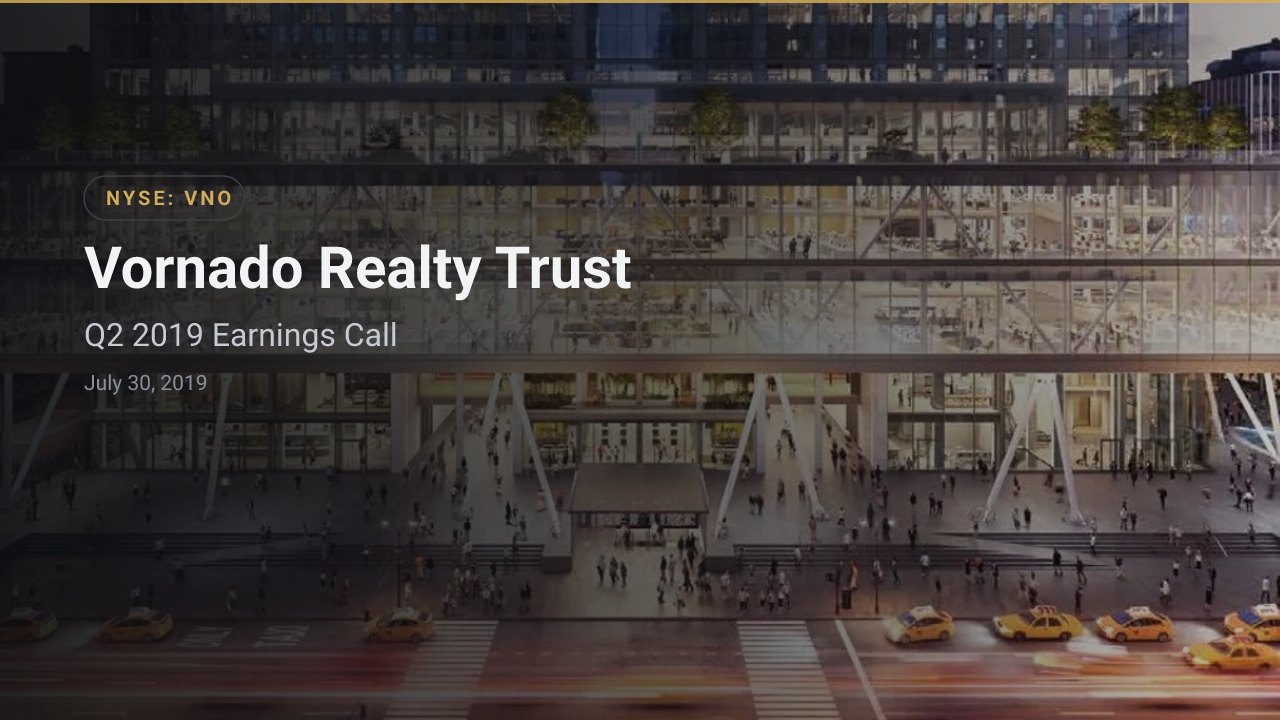
Vornado Realty Trust (NYSE:VNO) Q2 2019 earnings call, held 2019-07-30. Watch the replay and read the transcript on 6ix.
On 6ix: 6ix.com/event/vornado-realty-trust-vno-q2-2019-earnings-call
Automated transcript · Written by software from the replay's audio. It can mishear names and figures; the replay is the record.
0:00 Good morning and welcome to the Vornado Realty Trust's second quarter 2019 earnings call. My name is Michelle and I will be your operator for today's conference. This call is being recorded for playback purposes. All lines are in listen-only mode and our speakers will address your questions at the end of the presentation during the question and answer session. At that time, please press star then one on your touchtone phone. I will now turn the call over to Ms. Kathy Cresswell, Director of Investor Relations. Please go ahead, Kathy.
0:34 Thank you. Welcome to Vornado Realty Trust's second quarter earnings call. Yesterday afternoon, we issued our second quarter earnings release and filed our quarterly report on Form 10-Q with the Securities and Exchange Commission. These documents, as well as our supplemental financial information package, are available on our website, www.vno.com, under the investor relations section. In these documents and during today's call, we will discuss certain non-GAAP financial measures. Reconciliations of these measures to the most directly comparable GAAP measures are included in our earnings release, Form 10-Q, and financial supplement. Please be aware that statements made during this call may be deemed forward-looking statements and actual results may differ materially from these statements due to a variety of risks, uncertainties, and other factors. Please refer to our filings with the Securities and Exchange Commission, including our form 10-K, for more information regarding these risks and uncertainties. The call may include time-sensitive information that may be accurate only as of today's date. The company does not undertake a duty to update any forward-looking statements.
1:44 On the call today from management for our opening comments is Michael Franco, President. In addition, Steven Roth and our senior team are present and available for questions. I will now turn the call over to Michael Franco.
1:58 Thank you, Kathy, and good morning, everyone. Let me start with a few comments on our second quarter financial results before giving some thoughts on the markets and our portfolio and the important new disclosure we provided on our Penn District redevelopments and our earnings release and supplement. While FFO has adjusted on a gap basis for the second quarter, it was 91 cents per share, seven cents lower than last year's second quarter. Cash basis FFO was up 2.1%, reflecting the underlying strength of our core business with strong same-store results, which I will review shortly. Let me explain the gap numbers as they contain a little noise. First, this year so far, we have sold assets which aggregated almost $3 billion, notably the 45.4% stake in our upper Fifth Avenue and Times Square assets and our stock interest in Lexington Realty Trust and Urban Edge Properties.
2:51 Even though these sales were applauded by all and they were done at NAV and should have been accretive to our share price, earnings go down as a result. As an aside, we were surprised and disappointed by the stock market's ho-hum reaction. FFO decreased by $10 million or $0.05 per share in the second quarter due to these sales, partially offset by $5 million or $0.02 per share of interest savings from the retirement of the 5% $400 million unsecured notes. So that accounts for a $0.03 per share net decrease. Next, FFO was reduced by almost $0.02 per share from the non-cash impact of one-time equity awards issued to the new leadership group, net of the savings from the accelerated vesting of restricted stock awards in the first quarter.
3:39 We also had a couple of retail tenant issues impact our second quarter results. At the end of June, Topshop closed all its U.S. stores including our two locations at 608 Fifth Avenue and 478 Broadway following the Top Shop U.S. retail operating entity being placed in U.K. administration in the commencement by the U.K. administrators of a Chapter 15 case in New York. While we were paid rent to the end of June, we wrote off the straight line rent balances associated with this tenant. The increase in the straight line write-offs in this year's second quarter over last year's second quarter amounted to $9.9 million or 5 cents per share. which is included in both same-store NOI and comparable FFO results, primarily attributable to Topshop at Broadway.
4:25 We treat it as non-comparable the write-off at 608 Fifth Avenue of the straight-line rent and the write-of-use asset at this location. Under the new lease accounting standard, on January 1st of this year, we recorded as an asset the present value of the rents we pay under this 14-year non-recourse building and ground lease. We have the right to cancel this non-recourse ground lease. In terms of the bottom line impact of Topshop, upon such a cancellation of the ground lease at 608 Fifth Avenue, we will no longer have the asset, and in such event, FFO will be permanently reduced by $10 million per year, which will nick our NAV by roughly $1 per share. At 478 Broadway, FFO will be temporarily reduced by $8 million per year from the vacancy. This is great space which we will release in the ordinary course.
5:16 We may convert some of the upper floors to office given the attractiveness of this bullseye location in SoHo to creative types. So to summarize, the aggregate of all these items that affected second quarter comparable results was a $0.10 per share decrease. This was partially offset by $0.03 of growth from the core business which I will cover in a minute. In our July 12th press release, we cover the details of the non-comparable items in the quarter, which includes a $2.559 billion net gain on the retail joint venture, the previously discussed non-cash charge on 608 Fifth Avenue, which was $77.2 million, and an $88.9 million after-tax net gain on unit closings at 220 Central Park South.
6:03 Speaking of 220 Central Park South, sales continue apace. To date, we have closed on 38 units for net proceeds of $1.03 billion, and earlier this month paid off the remainder of the $950 million loan. The property is now debt-free. Closings will continue throughout 2019 and 2020, and importantly from here, we will retain all future net proceeds, which will be redeployed primarily into the Penn District redevelopments, turning this capital into highly accretive earnings. On July 11th, just after the close of the second quarter, we sold our 25% interest in 330 Madison Avenue to our partner at a $900 million valuation, netting us approximately $100 million after our share of the mortgage.
6:54 This asset was the subject of a buy-sell, and of the pricing offered, we concluded it was a better sale than a buy. Over our 20-year hold period, we made eight times our investment. And by the way, we have quite a few like this. The taxable gain related to this sale coming on top of the big retail deal will increase the special dividend requirement at year end, which as of now looks like it will be approximately $1.75 per share. To give you some visibility into comparable FFO for the second half of the year, the aforementioned asset sales after the unsecured note repayment will reduce FFO by approximately $21 million or $0.10 per share. and the lost rent from Topshop will reduce FFO by approximately $13 million or six cents per share. We expect 2019 will represent a trough year for comparable FFO per share.
7:51 As we continually say, cash NOI is the most important metric in our business. That's how real estate is traditionally valued. Companywide, our second quarter cash basis, same store NOI increased by a healthy 4.3%, broken down as follows. New York office was up 3.3%, street retail was up 4.2%, the Mart was up 15.5%, and 555 California Street was up 12.9%. Let me now turn to the New York market. New York's deep pool of talent and the fact that they want to live and work here coupled with record venture capital investment has led to enormous technology sector employment growth of 80% since 2009.
8:37 This has played an important role in attracting large tech tenants to the city and continues to feed their insatiable appetite to grow their footprints in Manhattan. These tenants not only want to be in New York, they need to be in New York. Just think of the names in the last 90 days who have either committed or are actively looking for space. It's a who's who. In fact, almost all the well managed companies in every other industry are copying this template in their efforts to attract the best talent. As a result, The New York City economy continues to enjoy sustained job growth, driving strong tenant demand for office space. Private sector jobs increased 54,000 in the first six months as compared to 76,000 for all of 2018, with six-month office sector jobs increasing 12,000 as compared to 20,000 again for all of 2018.
9:30 Overall, our office portfolio is in great shape and continues to perform well. occupancy stands at 96.7% with only 132,000 square feet of remaining expirations in 2019. Our midtown portfolio, which has been completely modernized and redeveloped for the long term, remains very resilient and highly sought after by tenants. In the second quarter, our leasing team completed 221,000 square feet of office leases and 29 separate transactions in New York at a very healthy average starting rent of $83.54 per square foot. Our mark-to-market rents were positive 3.3% cash and 5.9% gap.
10:17 While the first half leasing activity of 617,000 square feet is on the lighter side for us historically, realistically, our portfolio is substantially full. But there is more to the story. We have a robust leasing pipeline with more than 2 million square feet of deals in various stages of negotiation. We are experiencing strong leasing activity across all submarkets from tenants in all industry sectors. We have our first leases out at the recently delivered 512 West 22nd Street, including one with a leading media company, all at triple-digit rents. Now, turning to the next major driver of growth and value creation in our business, the Penn District. First and most importantly, yesterday we published on page 8 of our earnings release and page 30 of our supplement the projected costs and returns for the Farley Building, Pen 1, and Pen 2 redevelopments.
11:14 In total, these three projects comprise 5.2 million square feet consisting of an 845,000 square foot new build at Farley and 4.3 million square feet of renovated and new space at Pen 1 and Pen 2. The redevelopments will be transformative for these buildings and for the district overall. Please see our latest renderings and videos of these projects on our website. We are projecting to spend $2.2 billion to redevelop these assets along with other district-wide improvements, of which we have spent $514 million to date. We project these redevelopments will generate $183 million of incremental cash NOI upon stabilization, a very strong 8.3% initial stabilized yield on cost. This is before ground lease rent reset on PEN1 in 2023, which will be comfortably absorbed by that asset's increased NOI.
12:14 Overall, we expect to replace $60 plus per square foot office rents at PEN1 and PEN2 with $90 plus per square foot rents and expect to achieve triple digit rents at Farley. These redevelopments will begin to contribute to earnings in 2022 and accelerate over time as the projects are finished and leased up. As we have mentioned previously, the capital for these projects will be funded from the net proceeds of 220 Central Park South without the need for any new debt, which will be very accretive to earnings. We expect that this will put our earnings growth at the head of the pack. Notably, the projected returns in these projects do not include the knock-on effects on all of our other existing assets in the Penn District and the multiple additional development opportunities we control. All will clearly benefit enormously.
13:03 As the Penn District transformation takes hold, we believe that the Hotel Pennsylvania will be one of the best development sites in the city. Once redeveloped, we are confident the Penn District, which is located directly on top of all major transportation serving the city and region, will become the heart of the New West Side where companies will plant their flag in order to attract and retain talent by creating new workplace environments in our buildings. Looking towards 2020, our lease expirations stand at 1.1 million square feet with 560,000 of this amount coming at Penn II, primarily McGraw-Hill, which will be taken out of service as this redevelopment kicks into high gear. It is here at Penn I and Penn II where we are creating a unique campus and will be providing today's workforce with the office of tomorrow.
13:52 The scale of our 4.3 million square foot campus at these buildings enables us to provide our tenants with an unrivaled amenity package. These buildings will operate and feel much like a full service hotel with fitness and wellness centers, abundant conferencing facilities, large town hall spaces, food and beverage facilities, as well as many communal spaces to work alongside colleagues. Anticipating our redevelopment program during the second quarter, We signed a 38,000 square foot lease at Penn One with a Fortune 200 company at a starting rent of $93 per square foot, a sign of things to come. This is a first generation lease. If this lease would have been included in our mark to markets, the mark to market for New York office would have been approximately 20% on a cash basis. In addition, both at Farley and Penn Two, we are deep in negotiations with multiple large users for anchor spaces, all in the triple digits.
14:53 All of this validates the unique nature of what we're delivering here and our underwritten pricing for space in the new Penn District. In addition to the capital we are spending on the Penn District, the government is also investing an estimated $3 billion on various infrastructure improvements, including the Moynihan Train Hall, the West End Concourse, 34th Street subway station improvements, and the new 33rd Street train station entrance. In addition, we have entered into a memorandum of understanding with New York State to redevelop the Long Island Railroad concourse under Pen 1. This redevelopment will tie together 7th and 8th avenues underground, dramatically widen the corridor and raise the ceiling height, allow natural light into the concourse, and substantially improve the user experience.
15:43 Overall, we couldn't be more excited about what we're doing here. At the Mart in Chicago, Occupancy was 94.8% at quarter end. We have strong leasing activity with term sheets in negotiation for much of the 125,000 square feet of vacant space on floors four and five, in addition to discussions with two large tenants regarding early renewals fueled by their expansion needs. During the quarter, we completed 30,000 square feet of showroom leases and an average starting rent of $63.83 per square foot, Our mark-to-market rents were positive 6% cash and 14.9% gap. At our 555 California Street complex in San Francisco, we are 100% leased.
16:30 During the quarter, we completed a 30,000 square foot renewal with one of our blue chip financial services tenants at an initial starting rent of $86 per square foot. Our mark-to-market rents were positive 12.8% cash and 32.2% gap. As an aside, we believe rents at 555 California are under market by, say, 25%, which will result in continued strong growth over the next few years as leases roll. Finally, turning now to our New York Street retail business. Overall, the retail market continues to be challenging, with leasing velocities slow and assets prone to negative surprises, a la Topshop. I will also point out Forever 21 has hired restructuring advisors and is working with the mall owners to provide rent relief to help stabilize the company.
17:21 They are a continuing tenant of ours at 1540 Broadway and 435 7th Avenue. Their lease at 4 Union Square expires this November and we chose not to renew them. We have re-released a portion to Whole Foods for an expansion of its store and are actively negotiating to release the balance of their space at higher rents. 435 7th Avenue is a new five-year lease where they recently opened. At 1540 Broadway, we will likely participate with the mall owners for rent relief in some small measure. Retail occupancy was 94.7% a quarter and down from 97.1% last quarter, all due to Top Shop and the Four Seasons Restaurant. In the second quarter, we leased a total of 70,000 square feet of retail space, achieving mark-to-markets of 18.7% cash and 44.4% gap.
18:14 The highlight was the significant 20-year, 61,000-square-foot renewal and expansion with Whole Foods at 4 Union Square South, the premier asset in that submarket. They are enlarging and remodeling this high-volume store. To conclude, we continue to maintain a fortress balance sheet with reasonable leverage and an abundance of liquidity today and growing over the next few years. Our current liquidity is $3.77 billion. comprised of $1.1 billion in cash, restricted cash and securities, and $2.6 billion undrawn on our revolving credit facilities. With that, I'll turn it over to the operator for Q&A. Thank you, sir. We will now begin the question and answer session.
18:59 If you have a question, please press star then one on your touchtone phone. If you wish to be removed from the queue, please press the pound sign or the hash key. If you're using a speakerphone, you may need to pick up on your handset first before pressing the numbers. Once again, if you have a question, please press star then one on your touchtone phone. Each caller will be allowed to ask a question and a follow-up question before we move to the next caller. The first caller in the queue is from Manny Corchman, Wood City. Please proceed with your question.
19:38 Hey, good morning, everyone. Michael, I think you mentioned that 2019 would be a trough year for FFO. Just given the bigger move-outs like McGraw-Hill and some of the retail vacancies that are going to come into the year, can you walk us through why 2020 wouldn't dip versus 2019? Joe? Manny, it's Joe. Our forecast shows a substantial recoupment of this year's diminution next year. So when you did that pencil to paper and took Michael's one-timers that affect the rest of this year, comparable FFO in the 140s somewhere, I'm sorry, 340s somewhere around there, Our projections are next year, notwithstanding that a bigger piece of 2PEN will be out of service, is greater than that. Don't forget we have two of the other West Side assets coming back into service. We have growth in the core business.
20:48 We have steps. We have many pluses offsetting those minuses.
20:57 Thanks, Joe. On Farley, it looks like the costs sort of on a pro forma basis ticked up versus where you had them the last time you talked about costs. Can you just tell us what's going into that project that's maybe taking a little bit more money to get done?
21:14 So, Benny, we probably could have done a little better given the roadmap here, but I think the short answer is that the costs we publish now include the initial land contribution of $230,000. plus the amount we paid related, which was $41.5 million. So when you take the previous costs, which when you grossed up was $800 million plus the 230 plus related, et cetera, you essentially get back to the number we publish now. There's some minor scope changes, but net-net, you're pretty close with all those additions.
21:55 Thanks, Michael. Thank you. The next question is from Steve Sackler with Evercore ISI. Please proceed with your question.
22:05 Thanks. I guess I wanted to first touch on kind of the ground lease at one pen. I know you probably can't get into a lot of detail, but could you just, whatever you can sort of tell us about maybe what you're paying today and maybe how we think about the fair market value reset. And then are there any other ground leases in the next, say, 10 or 15 years that have any kind of Renewals or resets that we should be aware of?
22:31 The current rent at one pen is two and a half million dollars. The reset is in 23. The term of that lease goes all the way out to 2098, so it is truly a long-term control over the land. It's a fairly standard fair market value reset, and we don't really have very much else to say about where we'll end up. One thing is that if you look at one pen as an asset, the income is in round numbers the better part of $100 million today.
23:18 we project that that income is going to go up by another 40, 50 million odd dollars as a result of the redevelopment and neighborhood improvements. So somewhere around the reset date, the income will be on that building somewhere around 140,150 million dollars, maybe a pinch less, maybe a pinch more, so that that asset can easily and comfortably withstand an increase in the land value. We have three other ground leases that I can recall. We have one at 330 West 34th Street, which has a reset coming up in 2020. It's a small asset, so whatever the rent reset might be is going to be immaterial.
24:13 We have another one at 8887th Avenue, which comes out up for reset at the end of the decade, late in the 2020s. And we have a third ground lease at 909 3rd Avenue, which has an expiry of when, David? 2063. 2063, and it is flat from now. There are no resets, whatever. And the rent is an extraordinarily low and favorable number to us. One comment about the ground lease reset process. There are plenty of these kicking around. And the recent resets over the last year or two have been, in my mind, pretty stupid. I mean, you just take the Barneys reset and take a look at that.
25:05 That has basically, the numbers have no reality and basically will bankrupt Mr. Barney's. So we believe that there will be more reality in the reset process going forward. The issue that really caused the issue, the problem, is that retail rents went crazy and therefore land for retail became extremely inflated, hyperinflated, a bubble. and similarly the condo market went crazy and that was a bubble. We expect those two bubbles are coming out of the market.
25:51 So the answer is that we believe that the resets will be more realistic. Whatever they happen to be, we can handle economically easily. And I think that's a pretty fulsome explanation, Steve.
26:07 Okay, thank you. And then I guess the second question, just to kind of circle back on kind of McGraw Hill and some of the move outs, as we think about 2 Penn going into kind of redevelopment, you're showing about 1.3 million square feet in service of the kind of 1.6. Outside of the McGraw Hill space coming offline, is there really any other space in that building that needs to come offline for you to effectuate this redevelopment?
26:39 Joe, you have an answer for that one? So, Steve, you were accurate. Without getting too specific. You did disclose almost 300,000 square feet out of service today. We project that will go up to about a half a million feet at the end of this year. It will go up in 2020 as more of the building is taken out of service. Approximately two-thirds of the building will be taken out of service at peak. and then of course they'll have to come back in as the hostel is built, as the top two floors are rented, et cetera, et cetera.
27:14 So, but look, Steve, I know you can't do this because I know modeling is the essence of what you do, but I would ask you to look at the real estate business that we're in from a different point of view, okay? We will be taking this building and we will be transforming a building from $60 rents to $90 and $100 rents. We will be taking a building which is long of tooth and bringing it into the modern age and making it be one of the most competitive buildings in terms of a work environment for our tenants. We believe that this will be an extremely profitable activity I'm not even getting into how it will help to transform the entire neighborhood.
28:09 It's an enormous undertaking. The building has 400-odd feet of frontage on 7th Avenue from 31st Street to 33rd Street, all of which will look totally different when we complete it. You've seen the pictures. I'm sure you've seen the pictures. So this will be, in the interim, while we do our work, it will have a slight dilution. but the objective is to convert $60 space to $90 space which will be extremely accretive to earnings and NAV when we complete this in just a few years. So I know that you have to be extremely interested in model what happens month by month and quarter by quarter. Our perspective is on the end game as to what the product will look like when we're done and how it will increase our earnings and our NAV.
29:01 Furthermore, the market is, has been, the market tenants and brokers community have been extensively exposed to the product and they love it. And the example of which is, is that we are going to lease now with the first very large anchor tenant at a triple digit number. So the building will be a success. It is a success. And just, you know, while you have to model, take a look at the long view. Okay. Thank you. Okay, the next question in the queue comes from Jamie Feldman with Bank of America Merrill Lynch. Please proceed with your question.
29:41 Great, thank you and good morning. I was just hoping to dig a little deeper into your yield assumptions. Can you just talk about kind of what gives you comfort on those rents and what the leasing pipeline looks like in detail for these projects?
29:57 We have Michael, who did a great job, Michael, thank you. I thank you for multiple reasons, okay? First, you did a great job, and second of all, I didn't do it. So, Michael said in his remarks that we have executed a lease with a Fortune 200 company, so a large, important company, at PEN2, at $93 a month. I'm sorry, at PEN1, pardon me. at Penn One for $93 a foot. Now, obviously, that's a significant gap from the perceived market value of the building today. The reason for that is that this tenant and the community believe in what we're doing and is willing to pay the fair price.
30:46 We believe the market price for the building as we lease it up now and as we complete our redevelopment is well into the 90s. Think about where it is. We are in the west side of New York which is the hottest area of New York and we're directly on top of the transportation network. We have that as a for a skeptic, we have that as a validation. In 10 Two, we have as validation that we are going to lease with an anchor tenant at a triple digit number. With respect to Farley, we are in the market. I think one of the analysts wrote in a report that I read overnight that his, while we haven't announced any leasing at Farley, his broker checks indicate that there is intense activity on the building. That is correct.
31:47 The activity is at triple digits, and I think that's all we have to say about these important negotiations going on at Farley. So we have our view, we have the market's view, we have lead tenants executing leases at our underwritten numbers. By the way, there's nothing that says that we won't exceed our underwriting.
32:11 Okay, thank you. Can you talk about operating expenses in those buildings and whether they'll change post-renovation?
32:19 Somebody's going to have to do that other than me.
32:20 I mean, I think, Jamie, our general view is that, you know, not meaningfully, right? We're obviously expanding and dramatically enhancing the plazas, et cetera. So at PEN1, there's probably a little bit additional increase from an OPEC standpoint. Obviously, taxes go up proportionally with rents, but from an OPEC standpoint, I think the answer is not meaningfully other than maybe a little bit on PEN1.
32:49 Let me handle the question slightly differently. The increase in base rent that we are underwriting, almost all of it will drop to the bottom. What will not drop is a marginal increase in taxes. and the maintenance expense of the building will remain basically the same. The building is the building. The cleaning is the cleaning. The common areas are the common areas. So we believe that almost all of, call it 90% or whatever, of the increase in face rent will go to, will drop to FFO. By the way, that's an important comment. I say drop the FFO because there will be no interest against any of this incremental increase in income because we're funding it with cash coming in from 220 and other places off our balance sheet with no new debt, which we think is an extraordinary thing.
33:50 Okay, thank you. Do I get another or that counted as my second?
33:54 What's that?
33:55 Do I get another question or that counted as my second?
33:58 Yes, sir.
34:01 So can you just talk about, I mean, with Topshop bankruptcy, just some thoughts on credit risk in the retail portfolio going forward?
34:13 Wow. Well, the first thing is that, you know, somebody asked the question about who's on our watch list. and the answer is everybody is on our watch list. So that's the way we run the business. The second thing is by and large, almost all of the retailers that we do business with are large and important credit worthy companies. The issue is not their credit worthiness, although Topshop was obviously an issue. And Forever 21, by the way, is a little shaky. But the issue really is is that what happens when the leases expire? So the answer is that we have a few weak tenants, of course, as everybody does. But by and large, the credit of the portfolio is pretty cool.
35:08 OK. All right. Thank you. Thank you. The next question in the queue comes from John Kim with BMO. Please proceed.
35:17 Thank you. On the incremental cash yield of 8.3% at Penn, Can you clarify how you calculate that number? Is it new rent over incremental cost or is it the incremental rent over the incremental
35:32 cost? It's basically the, you know, Farley is a new build, right? So that's NOI over the budget. And then for the balance, it's the incremental NOI over the cost to be spent.
35:52 Okay, so the numerator would be the $30 difference in rents between $60 and $90. That's right. Okay. That's right.
36:00 Essentially what Steve said, right? It's the incremental rents multiplied by the square footage. Obviously, we're adding some square footage at Pen 2 with the addition of the bustle and then converting some of the top two floors from mechanical to office. but accepting that, you know, it's the incremental rent with a slight leakage for taxes and OPEX.
36:26 Okay, great. Thank you. And can you also describe what is in the $100 million of district-wide improvements? Are those investments in your assets or is that infrastructure costs, basically?
36:38 Principally common area in between the buildings, the putting plazas and plinths in the common areas and not inside the building. So it's principally exterior work. It includes safety ballads, it includes some other miscellaneous improvements connecting the buildings.
37:04 Has that increased more than you expected or was that within budget?
37:09 This is the first time that we have published anything about this. and we thought it was appropriate to list it in the budgeting that we released but we can't allocate it and we didn't allocate it to any specific building. We didn't allocate a return on it either so we just put it in together as part of the neighborhood. And of course, John, we gave you the yield on the total cost inclusive of that.
37:41 Very helpful. Thank you. Yes, sir. Thank you. The next question in the queue comes from Vikram Malhotra with Morgan Stanley. Your line is open. Please proceed.
37:51 Thanks for taking the question. So just around street retail, you had cash and OIF about $66 million this quarter, and if I just for the full quarterly impact of the JV, it's probably closer to $60, maybe low $60. Given sort of all the move-outs you mentioned and the potential moving pieces including Forever 21. How should we think about a run rate heading into 2020? I know you've given some that you had given disclosure earlier, but just now post the JV in the numbers. How should we think about the run rate even if there's a range you can provide that'll be helpful going into 20?
38:32 Vikram, give me the question again, please.
38:35 Your street retail cash NOI was $66 million this quarter, but if I adjust for the full quarter, because the JV occurred in April, mid-April, so if I adjust for that, I think your cash NOI should be closer to the low $60 million range. But if we look forward, you talked about Topshop, Forever 21 potentially.
38:56 Okay, I got it. I got to thank you. Let me give you some numbers which I think is a very direct answer to your question. Last year, we gave guidance on the retail income. We started out with a $304 million number. We then raised it to $309 million as a result of some space at 770 Broadway coming out of the Kmart store and another retail lease that was converted from the retail segment to the office segment. So we then got up to $309 million. Mid-year, is it the other way around? Yes, it's the other way around.
39:43 Oh, gosh. 309 went to 304. So we started out with 309. We reduced it to 304 because we took space out of the retail segment into the office segment. We then raised it to 315 on performance during the year, and we ended up the year at $324 million on performance. So that's the starting point, okay? The retail JV, which we believe was a monumental deal, a superb execution, and very important, okay, will reduce the running rate NOI of the retail segment by $84 million, okay? and that basically is simplistically taking the income that was included in that venture and saying we lose 45% of it. Now, that's not an economically good number because that is offset by the proceeds, the cash that we got and the huge preferred dividend that we're getting, et cetera. But that is just, if you just look at the retail segment, that's a number. The Top Shop, so that's an $84 million deduct.
40:57 The Top Shop, the two stores in Top Shop that left, will nick the income stream by an annual running rate of $17 million. So if you take those $324, which was the actual, less $84 million, which is the loss of 45% of the JV retail, less $17 million for the two top shops, you get to a $223 million number. I'm not comfortable with that number, but I am comfortable with something in the low $200s. So that's where we think that that will go. Now understand, this is only the retail segment. It doesn't account for several ins and outs on the financial side of our balance sheet, et cetera, so that the economic number is actually much higher.
41:49 But anyway, that's where we see it. Okay, two things. When you look at Steve's chairman's letter as it was amended, he talked about $109 million. His $84 million is the retail piece of that.
42:08 Yep, the retail. Got it. And then the $223 million, that may be adjusted. I mean, I'm assuming there's no... There's no assumption there of a potential lease-up of the Massimo space or any other of the Madison Avenue assets. This 223 just is the math that you gave. There's no other assumption behind those two.
42:28 When I went to 223, I said I'm not comfortable with that number yet, but I'm comfortable in the low 200s. That's just in my mind for move-ins, move-outs, and other things that may happen which will affect it, but not in a significant amount.
42:45 Got it. Okay. And then just a bigger picture question.
42:48 Okay.
42:53 Just a bigger picture question. You sort of mentioned, or I think maybe Michael mentioned you were disappointed with sort of the ho-hum sort of reaction to the retail JV, which was indeed very good execution. I'm just sort of thinking bigger picture. Are you thinking about similar structures on the office side or Tactically, strategically, anything else just to kind of start to close this NAV gap? I know you have a lot operationally going on, but just more strategically, anything else you can sort of offer in terms of thoughts around closing the NAV gap?
43:30 You know, obviously we were extremely disappointed with the reaction to the retail deal, which we thought was a spectacular deal and a spectacular execution. in a challenging market. And obviously, we continue to work away at all many different alternatives to create value. Nothing that we are prepared to discuss today or hint at or get into.
44:06 Okay. And no changes on the buyback from your perspective on a buyback?
44:12 Since you mentioned it, let's spend a second on buyback. I wrote extensively about it in my shareholder's letter 18 months ago, and there's a paragraph in there on page 23 of that letter that if you have a mind, go back and reread it. But basically what it says is that buybacks are a are very useful if they are funded out of a recurring stream of earnings so that you can continuously do it. And there's lots of Fortune 500 companies that are in continuous buyback mode, but they are doing it out of retained earnings, recurring retained earnings. We don't have that. So we have to do it out of basically off our balance sheet by selling assets or whatever.
45:05 So, and I think I said in my letter that if we did a billion-dollar buyback, it would increase our NAV by maybe, for the remaining shareholders, by maybe a dollar and a half or some such number, and that our management and our board would rather have the billion dollars than the dollar and a half NAV increase when we're already selling at some huge number below NAV. But now there's a better way to look at it, okay? So what I've said, if we took cash off our balance sheet or we sold an asset or whatever it is and we bought back our shares, my math is that for every billion dollars that we would do it, we would increase the NAV to the remaining shareholders by a dollar and a half. But we're not doing that. We may do it, but we're not doing that.
45:51 What we are doing is we're going to spend a billion dollars at an 8.3% return on our own assets, and that doesn't take the knock-on effect of the value we will create on the buildings that surround the buildings that we are redeveloping at Penn Plaza. Now, if you take that math, if you can invest a billion dollars at 8%, that generates $80 million of income at a 4.5% cap rate. That's a billion seven of value creation. That billion seven divided by 200 odd million shares is rounded $9 a share. So would you rather invest a billion dollars in buying back your stock, where, by the way, the billion dollars goes away, you lose the liquidity, and you increase your NAV by a dollar and a half, or would you rather invest it in the buildings where you will be creating $9 a share for the remaining shareholders of NAV?
46:47 I don't think that's a difficult question. Now, what's more, when we get done with this, we will have barley with no debt whatsoever. We will have one pen with no debt whatsoever. and Tupin with debt of about $500 million, which is debt that is on there now and we're not going to increase. So with those three buildings alone, there are multiple billions of dollars of additional liquidity available to the company for whatever corporate purpose we have. So we think that we're on the right track here.
47:22 Fair enough. Fair enough.
47:25 Hang on. I'm not done yet.
47:26 Oh, sorry.
47:28 we're not inflexible and we think we try to learn one of our pals is doing a buyback very committed to it it hasn't worked yet but if as and when it does work we will learn from that but as of right now we would rather invest a couple of billion dollars in our own assets and create 150 odd billion dollars of new earnings rather than buy back our stock that's where we are
47:57 Thank you very much. Thank you. The next question in the queue comes from John Guiney with Stiefel. Please proceed.
48:06 Well, thank you for all the information on Penn Station, Penn District Campus. I'm convinced it's going to be a spectacular product. Steve, why would anybody want to be in Hudson Yards or Manhattan West if they can be at Penn Station?
48:21 Welcome to the team, John. Hey, John, that's not a serious question. But the answer to that is, first of all, look, my pal Stevie Ross did a great job at Jamp and Du Bois. They did a great job at Hudson Yards. I mean, you know, all of our friends that are developing in our neighborhood, you know, we're all friends. It all plays off each other. It all makes the entire district of the west side of Manhattan better, okay? So I'm not sure that we would be able to, no, I am sure. I am sure that we would not be able to create the value that we are going to create in our Penn Plaza assets had not Hudson Yards preceded us. So that's step one. By the way, John, since I got you, you wrote something on June 12th, and normally I'm not nuts about what you write, okay?
49:15 But this one I'm going to read out loud because I love you, okay? you said on June 12th expect phase one of Penn Plaza to be extremely well done sparing no expense to create a transformative environment and landmark on the west side we expect the finished product to be completely different than the current landscape the cost and return on cost the cost and return on cost are as of now unknown but now you know them by the way so anyway thank you for that we appreciate your support thank you can I ask one more question No. I want to stop while I'm at it.
49:50 Go ahead. Okay, so Farley, $1,220 a square foot. If you take out the land and the payment to relate it, about $900 a foot. Manhattan, what I understand, X the land, new builds, about $1,200 to $1,300 a foot. But your budget for Penn too is only $416 a foot. And it seems to me Barry Wischapach
50:45 Hang on, hang on, I'm looking for something here in a big stack of paper. So here's our budget, okay? So the $750 million, now remember that doesn't include carry because we're basically funding it with cash, okay? So our budget in round numbers is that we're going to be creating 90,000 square feet, call it 100,000 square feet of new space in the bustle and at the top of the building where we're converting mechanical space into a highly leasable, a triple digit red space.
51:38 and that in round round numbers is a couple of hundred million dollars, okay? We are going to skin the building. We're not taking it down to the frame. We're gonna take portions of the frame off and re-image it. We're gonna skin the building and put a new beautiful glass front on it. And that in round numbers is $200 million in our budget. That budget also includes the heating and convectors at the perimeter of the building. So there's $200 million to create new space, which is income-producing and return space, and there's a good return on that. $200 million to do the basic curtain wall project. And then the balance of the $350 million is for lobbies, elevators, new bathrooms, new corridors, etc., and the new amenity space. So we, you know, you've been yelling at me for quarter after quarter after quarter for not having, you know, costs in the, not having made our cost projections and our budgets public. And the reason for that is that it's a big project.
52:56 We've been working on them. We're trying to get them accurate. And this is our best guess as to what the numbers are, okay? By the way, a significant portion of this job is already in construction drawings and already bought. And when you drive by it, you'll see that the first mock-up of what this enormous bustle, which projects 45 feet off the plaza and 75 feet off the ground, which includes the better part of a couple of hundred thousand square feet of new space, is already mocked up so you can get a feel for it. This is our budget. We're happy with our budget.
53:35 Great. All right. Thank you, and good luck.
53:38 Great job. Thanks, John. One last thing. To be totally clear, the budget includes TIs and leasing commissions for the new bustle-created space. It does not include TI and leasing commissions in the normal course for re-renting all of the other space in the buildings. which we think is an appropriate way to do the cost accounting.
54:04 Okay, thank you.
54:05 Thanks. I love what you wrote on June 12th, John. Thanks. And the next question comes from Nick Ulico with Scotiabank. Please proceed with your question.
54:18 Thanks. I just want to go back to Farley. We have heard that there's good interest in the building's high floors. Even if you look at your website right now, the fifth floor is not showing as being available. Earlier this month, the fourth floor wasn't shown as being available, though it is now. Is it fair to say that these two floors are spoken for?
54:40 We have nothing more to say about Farley other than what we've already said. We have activity. It does us no good to speculate on what these important negotiations are that are ongoing now. It does us no good to speculate on that in this venue.
54:59 Okay. And then going back to 110, I think you gave the annual rent on the ground lease being $2.5 million. Can you give us the formula about how that works? Is it A percentage of the value of the land on a fair market value reset? I mean, for some other companies we've seen or buildings, it could be four to five percent of land value. What's the formula calculation here?
55:26 I think we've disclosed what we're prepared to disclose at the present time. The current rent is two and a half million dollars. It's a normal fair market value reset. It happens in 2023.
55:39 Yeah, I guess, I mean, the reason I ask is if you do assume it's, you know, 4.5% of land value, then it looks like the land value is about, you know, it's less than $50 a foot, which seems pretty low and would require, you know, you could be facing a, as you even mentioned in your supplemental, a material reset on the ground lease. So I think it would be pretty helpful for us to understand how that could work so we can think about the ultimate yield on the project.
56:07 Well, the answer is it will be material, but we're not prepared to speculate. This is a reset which is subject to arbitration four years from now. It's impossible to predict what the land values will be four years from now. I have already said in my comments 10, 15 minutes ago, we strongly believe that the land value is coming in and coming our way, and I really don't want to say anything more about it. I will say one last thing. In the last comments I made about that, I said that the income of this building is going to go up to the sunny side of $150 million a year. Whatever the land resets to, it'll be a material number, but it will not be significant in the scheme of the huge income coming in from this great building.
57:07 The next question in the queue comes from Alexander Goldfarb with Sandler O'Neill. Your line is open. Please proceed.
57:14 Good morning over there. So two questions. First, Steve, sort of a two-part on Penn. You talked about the $100 million of, I'll just say, sort of catch-all development. So sort of curious, one, I don't know who the landowner is. I don't know if it's the MTA. I'm assuming that that $100 million captures whatever public mandated improvements, whether it's subway or train or whatever. I'm assuming that that $100 million includes that in that budget. And then two, maybe I missed it earlier, but I don't think that you guys have quantified the NOI that's going to come offline when you start work on PEN 1 and PEN 2, just as we think about our 2020 earnings.
58:00 The first is that... The $100 million of neighborhood improvements really is improvements. It does include improving the street bed that we have closed in between the two buildings. But the rest of it basically is capital that we're spending on behalf of our building. There's another project that's in the works which will enhance our situation in the underground in Penn Station. which is not yet ready for disclosure and that'll probably come out next quarter or the quarter after. It's not a big deal but it's incrementally better and better and better. With respect to what comes offline, what comes online, et cetera, the timing of it quarter by quarter, we do not give guidance and we have not basically said other than some brief remarks that Joe made about what is gonna happen in terms of the details of that.
59:02 I did make what I consider to be, you know, an important comment half an hour ago that says, you know, I know that you have to model, I know it's important, but the big picture here is that over a short period of development time, we're going to transform a neighborhood. We are going to take all the surrounding land that we have, an asset that we own, and we are going to take a $60 building and take it into the 90s. That's the big picture, okay? We have not given guidance about quarter-by-quarter results, okay, about quarter-by-quarter in-service, out-of-service, et cetera.
59:44 Okay. And then the second question is on the top shop on Fifth Avenue. You guys wrote off the value of your improvements for that ground lease position just based on sort of the market value being equivalent to what the ground rent is, which I believe you guys said is $5.5 million. So just sort of curious, just given that that rent seems really low, especially given what your neighbors signed with Puma across the street, just sort of curious more about how you made the determination that the ground rent effectively represents market value. I don't know, maybe it's counting all the fit out that you'd have to do, or maybe it's the length of time left on that ground lease that drives it more than what the actual street retail rents would be there.
1:00:28 You know, Alex, it's all the above. First of all, we have not said that we are abandoning the ground lease. It's an option that we have in the future. That's that one. The accounting is that there is a liability and an asset for this right to use. Is that the terminology? Right of use. Right of use. And so we wrote off the asset right of use. We retained the liability. if as and when we cancel the non-recourse lease, that liability will be taken into income and extinguished. So that's the accounting. In terms of the business side of it, the way we do the math, if you take the ground rent payments and the expenses of operating the building, and you take the expected income that comes from the small office portion, and what we might get from the market vis-a-vis a retail The building is a push to slightly underwater.
1:01:30 If you then take the fact that there's a 14-year ground lease and you would have to amortize the tenant improvements, it becomes underwater more. And if you take the fact that the ground lease goes up by its terms by another $2 or $3 million a year shortly, then the building... On the whole, when you get done with the math, There's either negative economics or no economics, and the likelihood is that this is not something that we want to spend our energy and time on.
1:02:03 Okay. No, with the 14 years left, you answered the question. Thank you, Steve.
1:02:09 Thanks, Alex. See you. The next question in the queue comes from Daniel Ismail with Green Street Advisors. Your line is open. Please proceed.
1:02:18 Thanks and good morning. Just two quick ones on Penn Plaza. I appreciate all the new disclosure, but can you give an update and a refresher on the air rights that you own in Penn Plaza and the usability and perhaps the ability to monetize those air rights in the future?
1:02:38 You know, there's plenty of air rights. We own lots of them. there's air rights that are on top of Madison Square Garden that we own a share of there's air rights on top of the landmark Farley building that we have are we contracted to move those that we have access to we don't have legal access but we have access to so there's plenty of air rights and then now where do you put them and so we have multiple sites that are in the future. The most interesting one of which is obviously the Hotel Pennsylvania, which has a current ULURP approval for a 2.8 million square feet, which would be a tear down and a rebuild, et cetera.
1:03:39 and then we have multiple other sites in the neighborhood. So there is not a shortage of air rights. We own plenty of them and there are plenty of them available to be purchased and moved from different government sources and private owners.
1:03:55 Can you remind us how many air rights you directly own currently?
1:04:00 I don't think so. I don't have that in my head so we would have to get that to you. but I don't think it's a material calculation.
1:04:12 Just one on the redevelopment of Penn Plaza. With the new green New York building standards, did that cause any material uplift in total costs and will the new redevelopments be in compliance with the new standards?
1:04:30 There's not a material increase in cost today, and yes, the new developments will be in compliance with those standards.
1:04:38 Well, the answer is there is not a compliance. There is a goal of the admission standard, and if you do not meet the goal, there are penalties. So actually, if there's not a binary comply or don't comply, What there is is that the assets will be measured for their emissions, and based upon that result, there will be a penalty tax, if you will. The interesting thing about it, and we said this, I think, on the last call, and that is that we believe that we are already in substantial compliance with the 2024 requirements The ones that come at the end of the decade are more strenuous.
1:05:34 But if we maintain our current position, the tax would be de minimis for noncompliance. Now, there's two things that are going on with respect to the regulation. By the way, this is in New York, but it's going to go universal across the whole country and probably the world as well. The first is that 80 or 85% of the energy usage in our buildings is under the control of our tenants, not under the control of the landlord. So therefore, and we've been talking to the government authorities about this, the law needs to be modified so that it gives incentives to the tenants to comply. And that will happen over time.
1:06:26 The second is even more important. To the extent that alternative sources of energy are going to go into the creation of electricity and transmission of it from where it's created down into New York City and other major cities, that will cause the carbon footprint to decrease substantially. So there's all of that kind of stuff that's going on.
1:06:57 That's helpful. Thanks. The next question in the queue comes from Manny Korchman with Citi. Your line is open. Please proceed.
1:07:08 Manny Korchman with Manny. Michael or Joe, just to think about sources and uses from a just timing perspective, you think about you got a billion dollars today, another billion dollars coming in from 2020. 100 million that closed post quarter from 330 Madison and then the eventual 1.8 billion redemption of the preferred a couple of years out. You've outlined the billion seven which is quite helpful to have the costs and the returns that incremental billion seven that needs to go out the door plus another 360 million for the dividend towards the end of the year. How should we think about the timing of that $2 billion going out and then the drawdown of cash and the influx of cash just as we think about the ins and outs going on?
1:08:06 Michael, it's Joe. That's a pretty complicated question to do by phone, but I at least want to clarify one thing. You said $1 billion coming in from $2.20 billion. That's $2 billion, not $1 billion.
1:08:23 Well, of net of the debt that you're going to repay. A billion dollars of net cash. No, that whole $950 million is zero today. And from that point forward, we get $2 billion. A billion of profit, a billion of our costs that we put into the project recouped through the sales process. The right number for you to think of is $2 billion. Now, our NAV shows it properly today. but the incremental cash coming to the company is $2 billion against the $1.7 billion that you accurately portrayed needs in the three projects in the Penn Plaza, Penn District area that we outlined. Of course, the capital needs if we were to do the Hotel Penn would be much, much larger or any of the other add-ons that we haven't talked about that the question on the air rights dealt with.
1:09:15 I don't know if you were, I mean, we can come back to you with a little more specificity on timing of the outflows. Obviously, Farley is well underway. You know, PEN2 will be, you know, generally, let's call it 20 through 22 and PEN1, you know, over a couple year period beginning next year. But I think the most, what I think you're trying to get, and I think the most important point is the cash will be in the door before that money has to be spent, right? So 220, I think we sit on today, Joe Craig, if I'm wrong, $1.1 billion of liquidity as of quarter end, right? That number will go well north of $2 billion by year end, Michael. And so when you look at the... Post the special dividend. Post the special dividend. That's exactly right. So net of the special dividend, that'll still be well north of $2 billion, right?
1:10:02 So that gives you a sense of the amount of money that's going to flow out of 2020, the balance of this year. and so as we look at the ins and outs, all the money will be in the door in advance of needing to spend the billion seven that's laid out in the supplement. That's without needing to touch the retail preferred ever, et cetera. The money will be in the door.
1:10:27 Right, which gives you even more liquidity as you start thinking about the billion eight preferred but then also the refinancings that occur in 2020 and I don't know if you want to talk about 1110 and 8887, whether as you think about upsizing those mortgages or are you thinking about using cash to repay and just reduce leverage further, how should we start thinking about the incremental cash that potentially could come from that or use of cash?
1:11:00 The answer is this. First of all, with respect to 220, the sellout, published sellout, is maybe three and a quarter billion dollars. We've sold a billion dollars so far. That means there's two odd billion dollars coming out of that with no debt requirements. That all comes into our treasury. That's step one. Step two is our internal budget shows that we are able to spend as it comes due over the next number of years, the $1.7 billion incremental that's going into PEN1, PEN2, and Farley. And at the same time, our cash balances will be funded off our balance sheet with no new debt, and our cash balances will grow.
1:11:46 With respect to our balance sheet, we have been... showing proformas to y'all that shows that our debt ratios are actually, if you proforma for what's happening with certainty, our debt ratios are low and going lower, and we're very comfortable with that. We have enormous liquidity on our balance sheet, and we have an enormous queue of unfinanced assets and even under-financed assets that we can increase our liquidity for. So, for example, I mean, the right strategy, we are principally a secured lender, okay? We do that for lots of reasons that I have written about, which have to do with non-recourse debt and safety and whatever.
1:12:39 And we have, in fact, we're actually engaged in an internal conversation about this now. Rather than encumber a new asset, which is currently unencumbered, and we have $10 or $15 billion of those, we would rather increase the debt on an underlevered asset, which is encumbered. So all of that is what we consider. But right now we're in a spectacular financial condition, and we're very happy with where we stand. And we are delighted to be able to deliver PEN1, PEN2, and Farley. all brought balance sheets with no debt.
1:13:20 Yep. Last question. Michael, in your prepared remarks, I think you made the comment, it's better to be a seller than a buyer. Is there anything else that's left in the disposition program today? Any other cleanup and anything else that you're contemplating from that perspective?
1:13:42 The answer is yes, Michael. We've got there's still a few cleanup items from the original billion dollars Steve referenced, I don't know, 18 months ago or whatnot. You know, a small one of which we just put under contract. It's, you know, $70 million. We've got, you know, two, three others in the works as well. So we're finishing that original billion dollars of non-core assets. Team's hard at work on those.
1:14:12 You know, it's interesting. First of all, the community has been suggesting that we sell our non-New York City assets out there in what I call the suburbs of New York, mainly the Martin Chicago and 555 California Street in San Francisco for years now. The fact of the matter is that those two are two of our best assets with the highest growth trajectory. and would we have sold 555 California three, four years ago when there was a big drumbeat to do it, we would have undervalued the asset by five, $700 million at least. I think Michael said in his remarks that that asset is under-rented by, pick a number, 25%.
1:15:04 And so whatever. So those two assets are not on the for sale list today. The other thing is that I think one of the analysts wrote, when you sell assets, you dilute your earnings. And so if you take our retail sale, we sold it at NAV. We sold it at a number which we thought, and the market, I think, thought was a very strong execution. But nonetheless, you are selling the income to the buyer, and you are losing that income, so it diluted the income. So there is a tension between selling assets when they delete your income and your analysts want to take your stock down for that.
1:15:51 So it's a complicated thing.
1:15:54 I appreciate the color.
1:15:59 One last little tag on to that, Michael, and that is that it's good to have cash, but cash doesn't appreciate, okay? Assets appreciate. So if you have well-chosen assets... that have a great future they can appreciate. So that's just sort of a little bit about that. But you can be sure we look at every asset and every piece of debt in the company at least once a month.
1:16:27 Yep, and it was helpful to get your thoughts regarding using cash on the buyback versus investing it in new as well as redeveloped assets and harvesting that value. It definitely sounds as though there's additional cash coming in and we'll continue to look for ways that the balance sheet and that cash can be used to drive value for existing and new shareholders.
1:16:54 Yeah, and we too. Look, investing the money and creating $9 of value versus $1.5 billion is a no-brainer, right? The point that you're making is that that's not our only cash. We've got more assets. We've got more financial flexibility. We couldn't be more aware of that. Thank you for pointing it out.
1:17:15 All right, guys. Have a great rest of the summer.
1:17:20 Thank you, too. And gentlemen, there are no further questions at this time.
1:17:30 Great. Thank you, everybody, for listening, participating on our call today. We look forward to your participation in our third quarter. earnings call, which will be on Tuesday, October 29th. Enjoy the rest of the summer as well. Thank you. Ladies and gentlemen, this concludes today's teleconference. Thank you for your participation. You may now disconnect.
Follow Vornado Realty Trust into a list and get an email when it puts out news.
Director of Investor Relations
President
Chairman and CEO
Analyst, Wood City
Analyst, Evercore ISI
Analyst, Bank of America Merrill Lynch
Analyst, BMO Capital Markets
Analyst, Morgan Stanley
Analyst, Stifel
Analyst, Scotiabank
Analyst, Sandler O'Neill
Analyst, Green Street Advisors