Eduardo de Salles Bartolomeu
Chief Executive Officer
Replay available
Vale (B3:VALE3) Q3 2021 earnings call, held 2021-10-29. Watch the replay and read the transcript on 6ix.
Automated transcript · Written by software from the replay's audio. It can mishear names and figures; the replay is the record.
0:00 Good morning, ladies and gentlemen. Welcome to Vale's conference call to discuss the third quarter of 2021 results. At this time, all participants are in a listen-only mode. Later, we'll conduct a question and answer session and instructions will be given at the time. If it should require assistance during the call, please press the star followed by zero. As a reminder, this conference is being recorded. and the recording will be available on the company's website at vale.com at InvestorsLink. This conference call is accompanied by slide presentations, also available at InvestorsLink at the company's website and is transmitted via internet as well. The broadcasting via internet, both the audio and the slide change, has a few seconds delay in relation to the audio transmitted via phone.
0:54 Before proceeding, let me mention the forward-looking statements are being made under the safe harbor of the Security Litigation Reform Act of 1996. Actual performance could differ materially from that anticipated in any forward-looking comments as a result of macroeconomic conditions, market risks, and other factors. With us today are Mr. Eduardo de Salles Bartolomeu, Chief Executive Officer, Mr. Luciano Ciani Pires, Executive Vice President Finance and Investor Relations, Mr. Marcelo Spinelli, Executive Vice President Iron Ore, Mr. Mark Travers, Executive Vice President Base Metal, and Mr.
1:39 Alexandre D'Ambrosio, Executive Vice President Legal and Tax. First, Mr. Eduardo Bartolomeu will proceed to the presentation on Vale's third quarter 2021 performance. And after that, he'll be available for questions and answers. It's now my pleasure to turn the call over to Mr. Eduardo Bartolomeu. Sir, you may now begin.
2:01 Thank you. Good morning, everyone. I hope you are all fine. Regarding COVID, the vaccination of our employees is progressing very well, in line with actions of the public health care system. We have already 90% of our own workforce with at least one vaccine shot in Brazil. We are gradually resuming activities in our offices. Today, for example, we are almost all together at the company's headquarter for this conversation, for the first time since the beginning of the pandemic. With our guard up, we are getting back to a normal routine, keeping our focus on safety and people.
2:46 We continue to work with the authorities to implement the R$37.7 billion agreement For the Integral Reparation in Brumadinho, signed in February this year. By the end of the third quarter, we had disbursed almost R$ 4 billion for our payable obligations and actions for environmental recovery. This expenditure should reach R$ 13 billion by the end of 2021. The individual damage compensation also continues, with over 11,400 people covered by civil or labor indemnification agreements entered into EVALI. We remain committed to repairing Brumadinho in an agile, fair, and quick way.
3:38 We are also advancing on our ESG agenda. In our new package society, We renounced our mining rights in indigenous lands in Brazil. On the social front, we donated more than 600,000 food baskets to the families in a situation of food insecurity in Brazil, an action in partnership with civil society entities and volunteers. By the end of the year, we must reach 1 million food baskets for over 200,000 families. One of our purposes on the social front is to contribute to the strengthening of autonomous and resilient communities through education, health, and income generation programs. To do this, we are defining our new social ambition and redesigning our goals, as we did on our journey towards a low-carbon mine.
4:37 Our social agenda is increasing in its strength, and we expect to announce further details On the climate agenda, we are pleased to announce some important advances this quarter. In scope 3 emissions reduction, we achieved some milestones. In July, the Porto do Barão received the first arqueira with a rotor sail system. And in August, our Ponta da Madeira terminal received the first vessel with air lubrication technology. Thank you very much. which can curb CO2 emissions of our steel making clients by more than 10%.
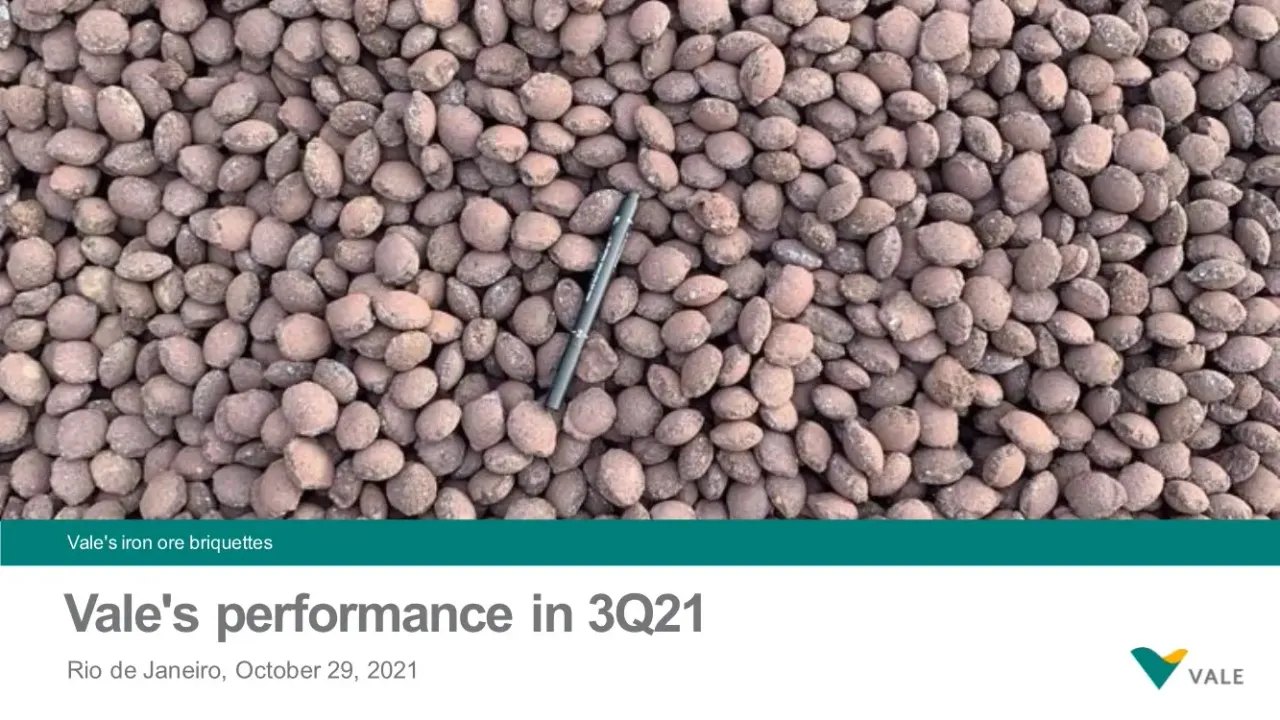
5:45 The briquette is the result of years of research and development by Vale. We already have three plants under construction, an investment of $185 million. We are assessing the feasibility of building another five plants for a potential production capacity of 50 million tons per year. With that, we are Well positioned to lead the way in reducing Scope 3 emissions with innovative technologies and a portfolio of high-quality products essential for the low-carbon economy transition. Now focusing on our performance this quarter, we produced close to 90 million tons of iron ore, 18% higher than the previous quarter. In these nine months, we increased our production by 8%, On the resumption, we had an important progress in the Vargem Grande complex, with the operational start-up of the Maravides III dam and the commissioning of the long-distance conveyor belt. With this release, we unlocked another 6 million tons of annual capacity.
7:04 We continue to move forward with a safe operational resumption In a year still marked by COVID-19 restrictions. Spinelli will give you more details about our performance in Iron Horse soon. Well, in ICO, our performance was impacted by two important events. First, the labor disruption in Sudbury. In August, we reached a five-year collective bargaining agreement and restarted operations in September. In Onsapuma, who had a longer maintenance due to COVID safety measures with production resumption by the end of September as well. We will continue to work towards great operational reliability, particularly in the base metals business. Our entire management team is committed to this.
7:58 And we continue with our discipline and capital allocation. Our cash generation, in addition to supporting the reparation Business Safety, and the resumption of operations allow us to return value to our shareholders as our recent track record of dividend payments makes clear. We ended the quarter with a strong cash generation of $7.8 billion, $1.2 billion higher than the second quarter. Sticking to our value over volume strategy, We will continue to create and share value with our shareholders. With consistency in dividend payout and with our buyback program almost 100% complete, our board of directors has just approved a new buyback program, this time for up to 200 million shares, equivalent to 4.1% of outstanding shares.
8:59 Our buyback program shows our confidence Invalides Potential to Create Value. To conclude, I want to reinforce that we are making progress with our de-risking, reshaping, and re-rating to build a better valley. To recap, in the de-risking, we are implementing the agreement for the integral reparation of Brumadinho with total payments of R$ 13 billion expected by the end of 2021. We are executing Our dam de-characterization program. We expect to eliminate one more structure by the end of this year, totaling seven completed structures.
9:44 We continue to resume our production with the release of the long-distance conveyor belt and the start-up of Maravira tree dams in Vargem Grande. And our next big deliver is Brukutu and Itabira. The works of the Torto Dam are advancing, and the filtration plants have a physical progress higher than 80%, as you can see in these pictures. Finally, we are committed to increase the reliability of our operations. Transforming the base metals business is one of our top priorities for 2022. In reshaping, we are moving towards divesting the coal operation with good prospects until the end of the year.
10:29 In fact, in coal, We expect an important cash generation in the fourth quarter due to excellent market conditions. We also expect to complete the divestment of manganese assets, and as a result, we will move forward with the divestment of other non-core access. In the re-rating, we continue to implement our management model, the VPS. We continue to work hard on values culture transformation. and we are moving forward with our agenda and commitments to transform ourselves into a more sustainable mining company and engaged in matters relevant to society. I would like to conclude by thanking Luciano for his excellent work in charge of Vale's finance and investor relations area since 2012 and I'm sure that he'll make a significant contribution for the future of the company as our new Executive Vice President of Strategy and Business Transformation.
11:32 I also would like to welcome Gustavo Pimenta, our new Executive Vice President of Finance and Investor Relations. Gustavo brings his global experience and a renewed vision to our business. Now I hand it over to Spinelli, who will give more details about the performance in Iron Ore. Thank you very much.
11:55 Thank you, Eduardo. Good morning, good evening. I want to start my presentation giving you an update about the resumption plan. We had a chance to go in details in our last investor tour. If you need more information, you can find it on our website. But Vargem Grande, as Eduardo said, is almost there, step by step. Maravilhas III is now running. And the long-distance conveyor belt just added 6 million tons of capacity. So, We reached 341 million tons of capacity as we planned. Now moving to production overview. In Q3, we produced almost 90 million tons due to the seasonality coming from the rainy season to the dry season, improving the northern system. Vargem Grande, as I mentioned, is in ramp-up. Itabira is running really well, much more efficient.
12:54 and we have the full operation in Fabrica. But I want to drag your attention to the northern system. As we presented also in the last investor tour, we expect a smooth ramp up to reach 240 million tons of production there. S11D is a brand new project, you know very well, trackless system, low OPEX, but we are still in a learning curve We've been improving our body knowledge. We found more jaspalite than we expected. Jaspalite is a very compact waste material, and as the system there is less flexible than the conventional system, we need to crush this material in the mine site.
13:44 So to address this, small rocks, we are We're going to install the able crushers. We have one already installed. Now we have the other three. We're going to do this in the next quarters. And to solve bigger rocks, we need to install a bigger crusher that will be ready in three years. But until there, we're going to stockpile these rocks in the mine side. But we have good news from the Northam system. Several actions and assets are coming online such as the Plus 10, the expansion S11D, the Plus 20, Gelado, Northern Range, we have N3, N2, N1 and East Range.
14:29 All of them together will support the ramp up of 240 million tons. Well, you may ask us about the gap between production and sales. Last year, we had the same problem. And remember that we have a production seasonality comparing the Q2 and Q3. And we need to add the supply chain extension, the blending process time. Remember that we have some volume adjustments. Don't forget, in an example, if you produce pellets, we reduce 10% of the mass. But all this together, we could expect a gap of 8 to 9 million tons. But we had an additional 4 million tons.
15:19 We decided to delay the sales of the standalone high silica and blend with Carajás to form the BRBF later. So that's the beauty of the supply chain flexibility we have in Vale. We can daily take decisions to maximize our margins. You also may ask about why margin of volume at this level of price. So don't forget, we also have in this analysis the discount of the product, totally related to the demand, and the freight. And in this case, this time of the year, we have the spot freight as a marginal product. We need to consider the spot freight. And we are Participants of this market, this pot market, if you put more pressure or less pressure, we can increase or decrease the impact for the whole portfolio value. So all this together, we decide to delay these sales. We didn't decide yet, due to the market condition, to replenish this high silica standalone product. So we're not producing this yet.
16:33 So that's the reason our production guidance is 315 to 335. We didn't change that, but we are in the lower than the middle of the range of the guidance. What we can expect for the production in 2022. So you always ask us about the guidance for next year. We are going to announce only in the Valley Day in the end of November. But what we can consider in our rationale to define this range for next year. Firstly, the presumption plan. The following increase of capacity will come more in the end of next year, like Torto, Gelado, we'll add more volumes. But as Eduardo said, we need to understand that the guidance is related to volumes, but we are increasing Thank you very much.
18:01 One example is due to this market conditions today, we can reduce the production of the high silica standalone that is still available. Every time we increase the quality, the process to increase the quality, we're going to leave this kind of product, but we have 12 to 15 million tons that we can reduce in our capacity and produce less last year. That's an example. And third, we also consider buffers for some production setback if you have any variation, any anomaly in our production, we consider in our planning.
18:46 So all of this together will be part of the definition of the production guidance for 2022. I'll stay here for further questions. I pass now to Luciano Ciani.
18:59 Okay, I'll start my Commentary on the results by the elephant in the room, which is the wild variation of EBITDA estimates from what we actually posted. And this chart you see here, usually we bring this on our releases, but now we're bringing more detail. It shows the value realized prices compared to the average of the quarter. And there are two large red bars here Thank you very much for joining us. For the sales open in the third quarter of 117, so it's a $90 swing in the space of three months. That creates those types of effects.
20:10 The first effect, the minus 8.2 miss in realized prices, relates exactly to the open sales. We bring the numbers here, 18 million tons, which were open and provisioned at $207 per ton. They were actually realized at 176. So that difference of $30 was revenue and EBITDA that was recorded in the second quarter that shouldn't have been recorded. So the way to deal with that is you need to reduce revenues in the third quarter and give back those revenues and EBITDA when you account for this. The second big effect you read on the column provisional prices in the current quarter, A total effect of almost a billion U.S. absolute numbers is exactly the 22 million tons that we have outstanding, so sales which were not yet settled, provisioned at $117 compared to the average of the quarter of $163.
21:18 So this is actually, we can call it an opportunity cost, right? If we had sold those tons at the average price for the quarter, we would have realized a billion additional revenue. But that's not the case. And some of you might have done the calculation with the entire volume sold by Vale at the average price for the quarter. And as I just explained, part of this is provision at much lower prices. So that's the reason behind the important decline in EBITDA compared to when you look at the average prices for the quarter. Moving into cash flows, you saw that the cash conversion was actually more than 100%, which means we generated more cash than EBITDA, which is also odd. And the reason for this is because of the cash collections of the open sales from the second quarter.
22:17 and you might have noticed a variation of working capital above $3 billion U.S. So about $2 billion of it is explained by the changing in accounts receivable. So we collected a lot of sales from previous periods at very high prices and the open sales for this period are recorded at much lower prices. And there's another $1 billion actually, which is... Thank you very much. To notice as well that this quarter will be heavy in terms of Brumadinho cash outflows.
23:15 Eduardo already mentioned that. Nine billion reais approximately. And also first quarter of 22 will also have a heavy bill to be paid in terms of cash taxes collection. So if you notice the cash taxes, there's a lag between cash taxes and the economic profit that we are generating. There's an annual settlement every first quarter of the year. They should be paid then. Moving to the commentary on costs. You see costs going sideways. There's a slight increase from 17.8 to 18.1. You are observing in the industry a lot of inflationary pressures.
24:00 Specifically in Brazil, the price index reached two digits in the past 12 months in the quarter. Many of the contracts that were expiring and being renewed were subject to renewal pressures from those indexes. So that's flowing through higher costs in the quarter. Another effect is that the cost of goods sold in this quarter is also tied to the production costs of the second quarter, which were production was of a smaller volume, less cost dilution. Thank you very much. There's a headwind, which is the collective bargaining in Brazil.
25:12 Whatever number we settle will be high because of high inflation. That has one-off effects in terms of provisions, especially for profit sharing. But also we have tailwinds. The exchange rate is more depreciated in Brazil than we initially expected when we made that provision. Those effects may offset each other. Another important cost component is freight. You saw the increase from 17.7 to 20.6. That obviously was because of the increase in bunker prices and the dramatic increase in spot freight rates. But as you can see, our sensitivity to those variables is nowhere near the market rate. So it shows how assertive is our strategy of having those very large or carriers contracted for the long run.
26:04 For the fourth quarter, you should expect a small increase, another dollar per ton, basically because the average spot rate should be higher in the fourth quarter than in the third. However, as Pinelli mentioned, we are taking some high silica material from the market from now on, so therefore we will be less exposed to spot than we initially envisioned. And so that compensates this slightly. My last comment is on coal. First performance and then a comment on the impairment. In terms of performance, September, we generated $43 million of EBITDA. In addition to that, we had a negative impact of $27 million because of a thermal coal hedge. You can see that number in the footnotes to the financial statement.
26:52 So therefore, if it wasn't for the hedge, we would have generated $70 million of EBITDA in just one single month. And also, if you look in the release, Cole is very much influenced by lag prices. We have on average thermal and metallurgical coal about $35 prices lower in September than we should have had because of those lag prices. So we could have had another $30 million of EBITDA in the month if we had the proper prices, which will come now in October. So I'm saying all of this just to highlight that the business is running at $100 million per month run rates at So the question might be, so why impair the assets? The issue here is that no potential buyer will buy the coal assets based on today's prices, nor it will buy the coal assets based on the business plan that we have not yet delivered.
27:51 This asset under normalized conditions requires 12, 13 million tons of production in order to break even. and we haven't achieved that. So we expect most of the proceeds and the economic value from a potential sale to come from a contingent, let's say, a contingent economic value based on volumes and on prices. So probably the upfront Thank you very much. Thank you. Ladies and gentlemen, we will now begin the question and answer session.
29:17 If you have a question, please press the star key followed by the one key on your touchtone phone now. If at any time you would like to remove yourself from the questioning queue, press star 2. Please restrict your questions to 2 at a time. Our first question comes from Carlos de Alba from Morgan Stanley. Mr. Carlos, your audio is available.
29:45 Good morning. Thank you very much. Luciano, it has been great working with you as CFO. All the best in your new position. The question I have first is if you could comment maybe on an update of how you see the Brumadinho payment schedule in the coming quarters. That would be quite useful as it hits both the income statement as well as the cash flow. And second, maybe just, Spinelli, if you could Clarify or maybe explain a little bit more, maybe I missed it, but if you could explain the dynamics between iron ore production and shipments that you see for the fourth quarter and perhaps for the first and second quarter in light of the ramp-up in production, but also the reduction in steel production in China that is taking place right now. Thank you very much.
30:43 Carlos, thanks very much for your kind comments. The cash flows for Brumadinho, I believe in one of our prior presentations, which is on our website, there is an estimate that we haven't been updating because it's still current. I don't have the numbers top of my mind, but the numbers will still be Very high in 2022, similar to this year, which I believe are going to be close to $2.5 billion. So there will be a lot because although there's a heavy concentration of payments for the obligations to pay this year, next year we will have less obligations to pay, but there will be an acceleration of the obligations to perform.
31:32 The projects will start to come from design to execution. So We will have those sorts of payments. And then we have for 23, then we start a decline, also another heavy year, but a significant release of outflows just from 24 onwards.
31:54 Carlos, thank you for a question. Dynamics between production and sales for the next part of Q4, We believe it will be like the last year, the same level of production and sales. We don't see any gap. And even in the first quarter, the supply demand, considering what's going on in China, we understand that we have a slowdown in China due to the disruption in energy rationing and also property demand. The industry is healthy. We have good margins. We have a good price for steel, but they are tracking to go after the target of energy consumption.
32:48 In the beginning of the next year, definitely there is another event that is the Olympics that can Thank you very much for joining us. In China, we have dynamics, but in the other part of the world, the ex-China, we have a very heated market going really well today in terms of production and demand. And our check should be related to the seaborne coming from other parts of the world. Like in Brazil, we expect to sell more in Brazil last year than this year. That's the trend we see in India.
33:51 That's the trend we see in CIS and even supply coming from Australia in a lower level than this year. So that's the balance we can see in China that will be important for you. We have a number of reduction, 40 million tons of iron ore next year in the supply of the seabor market. So that's the point. But our gap will be Our next question comes from Jonathan Brandes from HSBC.
34:36 Mr. Jonathan, your auto is available.
34:40 Hi, good morning, good afternoon. Luciana, I'd just like to echo the comments. It's been great working with you and best of luck in your new role. Spinelli, I'm hoping you can maybe elaborate a little bit more on Chinese demand next year. So obviously it's going through a bit of a tough time now given the Olympics and the energy issues. But what are you seeing next year? What gives you the confidence to say that Chinese steel production will pick up in 2022 rather than sort of trend along at current levels? I guess that's my first question. And then my second question, it's kind of a generic one. I mean, obviously, you've had a lot of disruptions in your operations, whether it's iron ore or base metals. And I guess I'm not necessarily talking about the labor issues in Canada, but more with the disruptions in Brazil from the licensing issues that forces you to go to to the courts and things like that.
35:45 Obviously, you react to each situation, but it certainly takes a lot of management time and effort. I know that there's this ambition to be a more stable and sustainable mining company. I'm hoping you can maybe touch upon what you can do to proactively minimize these disruptions and prevent them from happening going forward.
36:10 Thank you.
36:14 Thank you, Jonathan. Spinelli here. Well, let me clarify what I just mentioned to Carlos. We see definitely a slowdown in China, a smooth slowdown. I think more now this year that they already achieved the goals for the fourth five-year plan. COVID is okay. GDP is okay. Energy conception is not okay yet. Now better than the last quarter. So they need to reduce that. That's the point that I was mentioning. What I see for next year, for this year, we see the goal of CSP probably less or equal or less than last year, 1 billion 65 or less. We can consider a gap here, a range here of 10 to 15 million tons less or the peak can consider the same of last year.
37:14 And for next year, we'll be above 1 billion, but less than this year, probably. What I'm saying is that we can have a seasonality with a rebound after all this pressure coming in the short term that can bring more volatility to this moment, but can be more in place, the demand in place after the first quarter or in the end of the first quarter. What I was saying that despite China is slowing down, we have ex-China growing. The CSP that we see for next year, they're coming from 900 million tons of CSP.
38:00 They can go to 940,950. And the other point is the balance of supply demand. When we see the seaborne that can supply China, We see some other forces coming when you have the domestic market of many of these producers like Brazil or India or other places. They are consuming the iron ore in their domestic market. So that's our view. Supply demand that we more balanced after the first quarter. but definitely there will be a reduction in China but a growth in ex-China.
38:51 Thank you, Spinetti. Jonathan, thanks for your question. I think it's very appropriate because it's in the core, it's Eduardo speaking, okay, it's in the core of what we're doing here since I arrived and I think your question is extremely relevant to us. I would put the situation in two sides, one exogenous and one endogenous, if the word is right in English, something that is Thank you very much. I don't think it's a relevant issue here. I'm much more concerned about the endogenous issues that are related to our operational stability, as you pointed out.
39:46 When we go, for instance, for the fire in Salobo mine and the problems that we have with the mine movement during the year, goes to the core of what we call, and I mentioned that in my speech, about our management model that were implemented or was implemented with Thank you very much. Acquainted with that, we understand what I'm trying to say.
40:38 And obviously, the maturity level, when you look at the technical dimension or the leadership or the method at Vale as a whole is still very low. When you go to this excellence aisles that we have inside Vale, you see there is high. So I'm pretty comfortable that the work that we're doing together with a cultural transformation and safety is the same as production. We say here that in Vale there is no production before For safety, because there's no production really without safety. So being stable, being able to control your process, have the people engaged in the right manner to do what is expected from him, from that process will result in adequate results and stability and will last disruptions as we do have in the railway, for instance, as I have mentioned.
41:30 We are pretty comfortable, even in base metals business, I've just been in Long Harbour, We are hitting the record in production for Long Harbor, and we're going to see what they've been doing there. Right people, right process, safety, and production. So it's not rocket science, but takes people, takes engagement. So that's what I believe, and my team is fully committed with that. We understand that we have a gap between our competitors that is, by the way, Translated in our opportunities on our C1s, even in Iron Ore, with less. I think Iron Ore has had a good year in stability, I believe. All our plans that we were supposed to resume were resumed, how we have planned.
42:20 But anyhow, as I mentioned in my speech initially, pace matters the big focus, but we are very confident that we are doing the right thing, and we'll get there for sure. Thanks for your questions. Ladies and gentlemen, let me remind you that if you have a question, please press the Start key followed by the One key on your touch-tone phone now. If at any time you would like to remove yourself from the questioning queue, press Start 2. Please restrict your questions to two at a time. Our next question comes from Andreas Buchenhauser from UBS. Mr. Andreas, your audio is available.
43:09 Thank you very much. Thank you for taking my question. Also echoing my appreciation to you, Luciano. Thank you very much for all your time and availability over the years, and especially your patience with us going through the numbers. So thank you very much for that. Seems very fitting that I kind of direct my first question to you. This is something we've been talking about. You know, over the last six, eight quarters, I think it's just kind of the longer term cost or unit cost outlook for Vale. You know, management has been saying that you still intend to get back to kind of the early 30s levels overall, where you used to be, you know, pre-Brumadinho. Does that change now? Because you've always talked about maybe you're going to be producing less iron ore than you have capacity for.
43:57 And if you don't produce as much iron ore, does that mean that your cost dilution effectively ends up being smaller and then your unit costs end up being high? Is that how to think about it or does it still drop because you're taking high cost production offline? Is that the way to think about it? That's the first question. Thank you.
44:17 Andres, very much appreciate your kind words. Same for Jonathan. Thank you very much.
44:23 It has been a pleasure all these years as well.
44:30 There's a number of effects playing, right, in our current cost position. So first effect is a pro-cyclical increase in costs, right, which you're seeing across the entire industry. So we see this, for example, in higher oil costs, higher freight costs, higher royalties. In the case of Vale, higher purchase price for third-party ores, which although the volume is small, Thank you very much for joining us. And that has a number of effects. The first one is obviously diluting costs.
45:33 You have operations, for example, which take Brucutu, for example, which could be operating at 30 million tons. You have everything there to do it, all the fixed costs, and you're still producing just 12. And now with the high silica products in the past quarter, 15. So cost dilution is an important driver. Thank you very much. Thank you very much.
46:51 Thank you very much. We intend to run the best mines at their full capacity. What eventually we may do is, if you adjust production, if we remove it from the less competitive mines, so therefore we don't expect this to be, let's say, a drag in the overall cost performance.
47:39 So we are targeting $35 per ton, and we want to be there as soon as we reach normality in our operations.
47:47 Okay. Our next question comes from John Tumazos from John Tumazos Independent Research. Mr. John, your audio is available.
48:08 Thank you. Once again, all love and congratulations to Luciano. It's been a tremendous joy to talk to you over the years. My question concerns end market diversification for iron ore. I'm a little shocked At the 0.8 million ton per day five-month fall in Chinese steel output, or 292 million tons crude steel annualized, or almost 15% of world output, I think that's the biggest non-recessionary decline in steel output in any country in the history of the world. There's a lot of explanations, reasons. It's not my business.
48:55 But it raises the question as to the desirability of China as a customer and the benefit of moving more iron ore to Europe or the Mideast or DRI feeds or HBI feeds, pellets and other products that have their own markets aside from China. Excuse me for my question if it's a little difficult.
49:27 Thank you, John Spinelli here. You're right. There is a trend that now there's no return that the quality trend to this new world of zero carbon. So that's the trend. We have a delay if you compare China with the other parts of the world, as you mentioned, Europe and Middle East. And the key point here is we need to have high-quality ores to compete. And we are, you know, the most important player in the world to supply this trend. So how can you do that? We are returning with the filtration, the full capacity of Itabira and also Brukutu at the end of the year. We have Torto Dam in Brukutu that we can Finally have back our pellet feed production.
50:28 So we are bringing back the capacity of pellets coming from 30 million tons to 60 million tons. Direct reduction is a key point here. We are already developing the briquette as a part of our strategy to replace where in this transition next 10 years, We still have blast furnace, so we need to improve the efficiency in the blast furnace, substitute the sinter with the briquettes, with high-quality flexibility to develop this kind of product that will be really helpful for Europe and also Middle East. In China, we see the trend of quality. Despite the market can reduce, as you mentioned, there is a big market there, still big market there.
51:22 We're talking about 1 billion of production of steel. But if you consider the increase of quality, Vale is in a really good shape to compete. We see the trend in China. We are really close to them to also develop the briquette there. Carajás Fines in the north of Brazil is a key product today. You can see The gap today, the premiums in Carajás finds even BRBF. So for this whole transition you see in China, even in the rest of the world, quality is the key point here. And we are really prepared and developing not only MOUs to understand what they need, but we are already investing in new products to compete.
52:22 Our next question comes from Alex Hacking from Citi. Alex, your audio is available.
52:33 Okay, yeah, thank you. Let me add my thanks to Luciano. You've been a great leader of Vale for some very difficult times, and I think all the shareholders and analysts appreciate it. With regards to freight costs, obviously, It's been pretty volatile recently. Do you think there's anything structural there where you would be concerned that freight could be higher going forward, or you think this is just a period of volatility and then we'll settle down to more normalized freight rates again?
53:08 Thank you, Alex. Penelio here. You know what happened in the market dynamics in freight early this year, We saw the supply chain disruption in other kind of markets like container and Panamaxes touching the cape sizes business. But what happened after that, it was a combination of other factors that we see a kind of one-off effect. We don't see it as a structural problem that we can see in the future. First one is related to The efficiency in China to discharge the vessels waiting lines two to three times more than the average.
53:55 It was related to the Australia and China tensions and all the problems to discharge the coal and also the iron ore vessels in all the ports. And the other point is related to the energy crisis. So we had a huge mess in this market. With thermal coal going to Europe, going to China, also met coal without the production in China, now they're catching up the production there and stabilizing the demand. So we see now a movement that can organize better this market with the impact of the coal. And the last one that I can mention, Alex, is the seaborne market for iron ore for next year.
54:46 We see less product coming from every place, from Brazil, from Australia, from India, going to China, because we see these markets improving the consumption of iron ore in their domestic market, so they will relieve
55:07 Alex and John, let me express here my appreciation for your comments. I hope to be together in the future as well, maybe welcoming both of you in our operations here in Brazil. Our next question comes from Andreas Buchenhauser from UBS.
55:40 Thank you. I just had a follow-up on the inventory strategy. So obviously in Q3 you built some inventory. Can you just talk us through quickly what the thinking is there? I understand it's obviously a high silica product and you weren't happy with the price, but just kind of thinking on where we are in the price cycle. I mean, iron ore is still above $100 a ton, historically a very high level, you know, Thank you Andreas. Sorry about the second question that we missed in the first round.
56:36 Again, the high silica product is not a common product that we already have in our operations. When we increase the filtration and all the products, we will reduce the exposure of high silica products. But that's a marginal product. We just sold independently this product because the market was really good. But what kind of impact we have Not only the level of the price, but the discount, we need to count on that. And the other point was the freight. As a marginal cost, we are considering that we need the spot freight to move from Brazil to China.
57:22 And the level of the spot freight was pressuring the margins there. So, wait to sell as a BRBF. In a negative margin with standalone high silica was a better solution for that. But that's the reason we decided not to produce more high silica standalone without Carajás to blend SBRBF. But again, that's a very dynamic decision. And this quarter we are already assessing every day this. If you have a chance to go to the market, we have the flexibility to sell From BRBF to sell as an individual product every day we can do this.
58:07 But that was the problem last month when we had the reduction and the level of the spot freight was really high. That was the decision in the last quarter. But we can change this every day and we are already assessing the possibilities to make this happen this quarter. This concludes today's question and answer session. Mr. Eduardo Bartolomeu, at this time you may proceed with your closing statement.
58:48 Okay, thank you. First of all, I would like to reinforce the congratulations to Luciano and just remind everyone he's still with us and will make a huge contribution in our future. And again, thanks a lot, Luciano. Welcome, Gustavo. You know what I'm going to come back to you. It's the It's the same every quarter, but we had something. Last quarter or last six months, I was asked about super cycle. Now we're talking China bust. As a mining company, we have to be ready for any cycle. So the question is being answered is by the derisking, by the reshaping, and by the rewriting. The derisking brings us to the level of the game. We need to repair Brumadinho, we need to Thank you very much.
1:00:07 What was asked before is around being stable, being reliable, being a safe operator. That's when interruptions are coming, and you're going to reward us as a C1 in the first quartile, or iron ore, or nickel, or copper, or any commodities that we'll be in. So, again, I would like to thank you a lot for your attention, for your interest in our call, and I hope to see you either in a valid day or in the next call. Thanks a lot. Keep safe. That does conclude Vale's conference call for today. Thank you very much for your participation. You may now disconnect.
Follow Vale S.A. into a list and get an email when it puts out news.
Chief Executive Officer
Executive Vice President Iron Ore
Morgan Stanley Analyst
Executive Vice President Finance and Investor Relations
Executive Vice President Finance and Investor Relations
UBS Analyst
Citi Analyst
HSBC Analyst